

ISO 23665:2026
(Main)Uncrewed aircraft systems — Training for personnel involved in UAS operations
General Information
- Abstract
This document specifies the procedures for training personnel who will be involved in the operation of uncrewed aircraft systems (UAS). This document defines: knowledge, skill, attitude and qualification criteria required for UAS remote pilots (RP), remote pilot in command (rPIC) and UAS training organizations (UTO) that provide training to UAS remote pilots and other personnel involved in UAS operations; training curriculum and contents for specific learning courses; qualification and criteria for verification of achieved competence by the training organizations; general procedures for providing training of UAS personnel. NOTE 1 An UTO can include additional topics or learning objectives, such as when required by legally binding rules in the applicable jurisdiction. NOTE 2 A UAS operator can also act as the UTO, providing that possible conflict of interest between training and operations is properly managed.
- Status
- Published
- Publication Date
- 17-Aug-2026
- Technical Committee
- ISO/TC 20/SC 16 - Unmanned aircraft systems
- Drafting Committee
- ISO/TC 20/SC 16/WG 3 - Operations and procedures
- Current Stage
- 6060 - International Standard published
- Start Date
- 18-Aug-2026
- Due Date
- 27-Nov-2026
- Completion Date
- 18-Aug-2026

Overview
ISO 23665:2026 - Uncrewed aircraft systems (UAS) - Training for personnel involved in UAS operations specifies internationally recognized requirements for training personnel engaged in UAS operations. Developed by ISO’s Aircraft and Space Vehicles technical committee, this standard defines the knowledge, skill, attitude, and qualification criteria required for UAS remote pilots (RP), remote pilot in command (rPIC), visual observers (VO), fleet managers (FM), and UAS training organizations (UTO). It provides a comprehensive framework for the development and verification of training programs, offering guidelines for curricula, assessment, and certification. ISO 23665:2026 supports harmonization across jurisdictions, enabling movement of skilled personnel, safer operation of unmanned aircraft systems, and international recognition of qualifications.
Key Topics
Training Organization Requirements
Defines the roles and responsibilities of UAS Training Organizations (UTO), including staff qualification, record-keeping, safety protocols, and requirements for training delivery.Personnel Training and Qualification
- Specifies criteria for UAS remote pilots (RP), remote pilots in command (rPIC), visual observers, and fleet managers.
- Outlines standard curricula for theoretical and practical training.
- Describes minimum competence levels for knowledge, skill, and attitude.
Training Curriculum and Content
- Covers legal requirements, airspace classifications, and responsibilities in UAS operations.
- Includes both classroom-based theory and practical flight training.
- Addresses risk management, emergency procedures, and use of simulators.
Assessment and Certification
- Procedures for evaluating trainee competence before certification.
- Record-keeping and information necessary for issuing diplomas or certifications.
- Ongoing evaluation of training effectiveness and staff qualifications.
Applications
UAS Operator and Training Provider Use
UAS operators and training organizations use ISO 23665:2026 to establish consistent, effective, and compliant training programs for staff involved in drone operations, from remote pilots to fleets managers.Regulatory Alignment
Assists organizations in meeting or exceeding national aviation authority requirements and promotes alignment with the International Civil Aviation Organization's (ICAO) risk-based categories: open (VLOS), specific (EVLOS, BVLOS), and certified operations.International Recognition of Qualifications
Enables cross-border recognition of UAS qualifications, supporting mobility of skilled drone operators and crew within the global industry.Comprehensive Personnel Training
The standard covers all key operational roles, including final qualification and evaluation protocols for remote pilots, remote pilots in command, visual observers, and flight operation officers, ensuring personnel are fully competent for their assigned duties.Risk and Safety Management
Emphasizes structured risk assessment, management procedures, and safety in both theoretical classrooms and practical field environments, reducing the likelihood of incidents.
Related Standards
ISO 21384-3:2023
Unmanned aircraft systems - Operational proceduresISO 21384-4
Uncrewed aircraft systems - VocabularyISO 21895
Categorization and classification of civil unmanned aircraft systemsISO 23629-12
UAS traffic management (UTM) - Requirements for UTM service providersISO 5015-2
Unmanned aircraft systems - Operation of vertiports for VTOL unmanned aircraftISO 29993
Learning services outside formal education - Service requirements
These related standards provide additional guidance on operational practices, terminology, system categorization, and educational service requirements relevant to UAS training.
Keywords:
ISO 23665, UAS training, uncrewed aircraft systems, drone operations, remote pilot qualification, UAS training provider, RP, rPIC, visual observer, drone safety, international standards, UAS certification, drone pilot curriculum, UAS personnel training, risk-based UAS categories, remote pilot training.
Relations
- Revises
ISO 23665:2023 - Unmanned aircraft systems — Training for personnel involved in UAS operations - Effective Date
- 16-Dec-2023
Get Certified
Connect with accredited certification bodies for this standard

BSI Group
BSI (British Standards Institution) is the business standards company that helps organizations make excellence a habit.

Bureau Veritas
Bureau Veritas is a world leader in laboratory testing, inspection and certification services.

DNV
DNV is an independent assurance and risk management provider.
Sponsored listings
Frequently Asked Questions
ISO 23665:2026 is a standard published by the International Organization for Standardization (ISO). Its full title is "Uncrewed aircraft systems — Training for personnel involved in UAS operations". This standard covers: This document specifies the procedures for training personnel who will be involved in the operation of uncrewed aircraft systems (UAS). This document defines: knowledge, skill, attitude and qualification criteria required for UAS remote pilots (RP), remote pilot in command (rPIC) and UAS training organizations (UTO) that provide training to UAS remote pilots and other personnel involved in UAS operations; training curriculum and contents for specific learning courses; qualification and criteria for verification of achieved competence by the training organizations; general procedures for providing training of UAS personnel. NOTE 1 An UTO can include additional topics or learning objectives, such as when required by legally binding rules in the applicable jurisdiction. NOTE 2 A UAS operator can also act as the UTO, providing that possible conflict of interest between training and operations is properly managed.
This document specifies the procedures for training personnel who will be involved in the operation of uncrewed aircraft systems (UAS). This document defines: knowledge, skill, attitude and qualification criteria required for UAS remote pilots (RP), remote pilot in command (rPIC) and UAS training organizations (UTO) that provide training to UAS remote pilots and other personnel involved in UAS operations; training curriculum and contents for specific learning courses; qualification and criteria for verification of achieved competence by the training organizations; general procedures for providing training of UAS personnel. NOTE 1 An UTO can include additional topics or learning objectives, such as when required by legally binding rules in the applicable jurisdiction. NOTE 2 A UAS operator can also act as the UTO, providing that possible conflict of interest between training and operations is properly managed.
ISO 23665:2026 is classified under the following ICS (International Classification for Standards) categories: 03.100.30 - Management of human resources; 49.020 - Aircraft and space vehicles in general. The ICS classification helps identify the subject area and facilitates finding related standards.
ISO 23665:2026 has the following relationships with other standards: It is inter standard links to ISO 23665:2023. Understanding these relationships helps ensure you are using the most current and applicable version of the standard.
ISO 23665:2026 is available in PDF format for immediate download after purchase. The document can be added to your cart and obtained through the secure checkout process. Digital delivery ensures instant access to the complete standard document.
Standards Content (Sample)
International
Standard
ISO 23665
Third edition
Uncrewed aircraft systems —
2026-08
Training for personnel involved in
UAS operations
Aéronefs sans pilote — Formation du personnel impliqué dans
l'exploitation d'UAS
Reference number
© ISO 2026
All rights reserved. Unless otherwise specified, or required in the context of its implementation, no part of this publication may
be reproduced or utilized otherwise in any form or by any means, electronic or mechanical, including photocopying, or posting on
the internet or an intranet, without prior written permission. Permission can be requested from either ISO at the address below
or ISO’s member body in the country of the requester.
ISO copyright office
CP 401 • Ch. de Blandonnet 8
CH-1214 Vernier, Geneva
Phone: +41 22 749 01 11
Email: copyright@iso.org
Website: www.iso.org
Published in Switzerland
ii
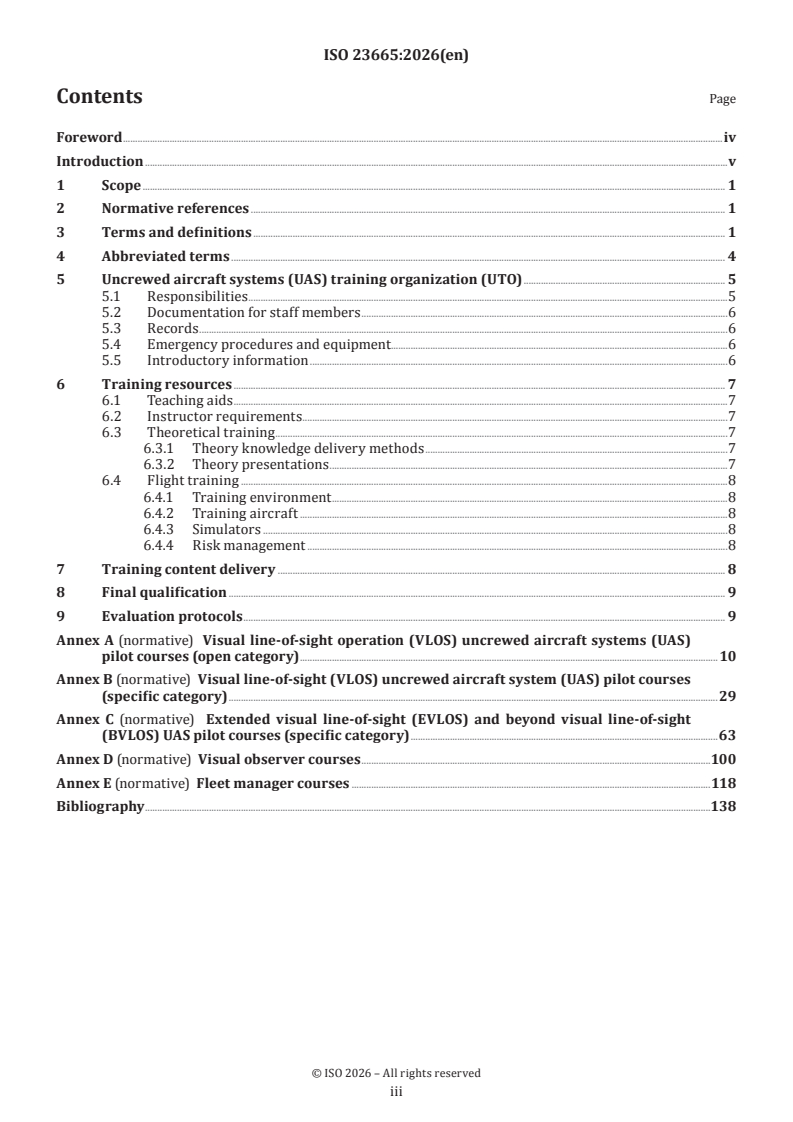
Contents Page
Foreword .iv
Introduction .v
1 Scope . 1
2 Normative references . 1
3 Terms and definitions . 1
4 Abbreviated terms . 4
5 Uncrewed aircraft systems (UAS) training organization (UTO) . 5
5.1 Responsibilities .5
5.2 Documentation for staff members .6
5.3 Records .6
5.4 Emergency procedures and equipment.6
5.5 Introductory information .6
6 Training resources . 7
6.1 Teaching aids .7
6.2 Instructor requirements . .7
6.3 Theoretical training .7
6.3.1 Theory knowledge delivery methods .7
6.3.2 Theory presentations .7
6.4 Flight training .8
6.4.1 Training environment .8
6.4.2 Training aircraft .8
6.4.3 Simulators .8
6.4.4 Risk management .8
7 Training content delivery . 8
8 Final qualification . 9
9 Evaluation protocols . 9
Annex A (normative) Visual line-of-sight operation (VLOS) uncrewed aircraft systems (UAS)
pilot courses (open category) .10
Annex B (normative) Visual line-of-sight (VLOS) uncrewed aircraft system (UAS) pilot courses
(specific category) .29
Annex C (normative) Extended visual line-of-sight (EVLOS) and beyond visual line-of-sight
(BVLOS) UAS pilot courses (specific category) .63
Annex D (normative) Visual observer courses .100
Annex E (normative) Fleet manager courses .118
Bibliography .138
iii
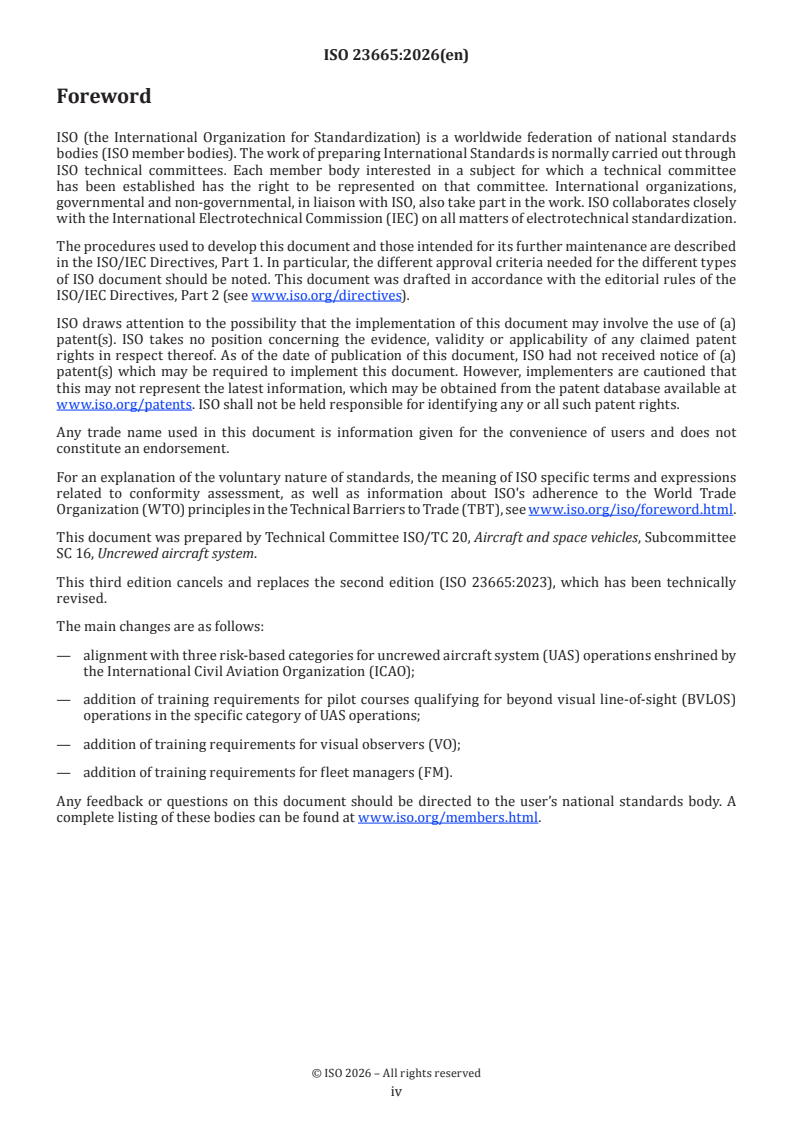
Foreword
ISO (the International Organization for Standardization) is a worldwide federation of national standards
bodies (ISO member bodies). The work of preparing International Standards is normally carried out through
ISO technical committees. Each member body interested in a subject for which a technical committee
has been established has the right to be represented on that committee. International organizations,
governmental and non-governmental, in liaison with ISO, also take part in the work. ISO collaborates closely
with the International Electrotechnical Commission (IEC) on all matters of electrotechnical standardization.
The procedures used to develop this document and those intended for its further maintenance are described
in the ISO/IEC Directives, Part 1. In particular, the different approval criteria needed for the different types
of ISO document should be noted. This document was drafted in accordance with the editorial rules of the
ISO/IEC Directives, Part 2 (see www.iso.org/directives).
ISO draws attention to the possibility that the implementation of this document may involve the use of (a)
patent(s). ISO takes no position concerning the evidence, validity or applicability of any claimed patent
rights in respect thereof. As of the date of publication of this document, ISO had not received notice of (a)
patent(s) which may be required to implement this document. However, implementers are cautioned that
this may not represent the latest information, which may be obtained from the patent database available at
www.iso.org/patents. ISO shall not be held responsible for identifying any or all such patent rights.
Any trade name used in this document is information given for the convenience of users and does not
constitute an endorsement.
For an explanation of the voluntary nature of standards, the meaning of ISO specific terms and expressions
related to conformity assessment, as well as information about ISO's adherence to the World Trade
Organization (WTO) principles in the Technical Barriers to Trade (TBT), see www.iso.org/iso/foreword.html.
This document was prepared by Technical Committee ISO/TC 20, Aircraft and space vehicles, Subcommittee
SC 16, Uncrewed aircraft system.
This third edition cancels and replaces the second edition (ISO 23665:2023), which has been technically
revised.
The main changes are as follows:
— alignment with three risk-based categories for uncrewed aircraft system (UAS) operations enshrined by
the International Civil Aviation Organization (ICAO);
— addition of training requirements for pilot courses qualifying for beyond visual line-of-sight (BVLOS)
operations in the specific category of UAS operations;
— addition of training requirements for visual observers (VO);
— addition of training requirements for fleet managers (FM).
Any feedback or questions on this document should be directed to the user’s national standards body. A
complete listing of these bodies can be found at www.iso.org/members.html.
iv
Introduction
Uncrewed aircraft (UA) have rapidly increased in number, applications and types within recent decades. UA
are commonly utilized for filming, agricultural spraying, inspection, security activities and are expected to
be also employed for transportation.
Because of the myriad of possible applications, several regulatory aviation authorities, starting with the
[8]
International Civil Aviation Organization (ICAO), use a holistic taxonomy of UAS operations based on
safety risk perceived by the society.
These three risk-based categories of UAS operations are:
— low-risk open category, limited to visual line-of-sight operation (VLOS) operations;
— medium-risk specific category which permits also extended visual line-of-sight (EVLOS) and beyond
visual line-of-sight (BVLOS) and entering controlled airspace;
— high-risk certified category which permits also long-range international flights under instrument flight
rules (IFR) in controlled airspace.
In all categories, the UAS operator is responsible to train, qualify and maintain the competence of all
personnel involved in the operations, including but not limited to remote pilots. In several jurisdictions,
the aviation authorities promulgate rules on the competence of remote pilots (i.e. regulated profession, see
Reference [11]). For other jobs (e.g. visual observers), no rules exist in several jurisdictions on any mandatory
training. However, the UAS operator is still responsible for ensuring the competence of such personnel.
This document can help operators and training organizations to develop, purchase and deliver courses not
only for the regulated professions, but even for other jobs related UAS operations. The resulting attestations
can be useful for the career development and mobility of related personnel.
The required knowledge, attitude and skill levels for personnel who are involved in UAS operations must be
clearly defined. When unskilled persons operate a UA, the risk of an accident or serious incident increases.
Discrepancies in qualification criteria among countries or organizations also prevent the international
exchange of workers.
This document helps to ensure that personnel who are involved in UAS operations receive appropriate
education and obtain essential knowledge and skill. Training organizations and individuals qualified
according to this document are internationally recognized. It enhances the international operation of UAS,
enable personal exchange, and encourage international trade.
This document defines the procedures for the operation of a training organization, which is the entity that
delivers training to UAS remote pilots.
This document provides requirements for the following specific courses:
— UAS remote pilot in the open category in Annex A;
— VLOS UAS remote pilot in the specific category in Annex B;
— EVLOS and BVLOS UAS remote pilot in Annex C;
— visual observers (VO) in Annex D;
— flight operations officer and fleet manager (FM) in Annex E.
v
International Standard ISO 23665:2026(en)
Uncrewed aircraft systems — Training for personnel involved
in UAS operations
1 Scope
This document specifies the procedures for training personnel who will be involved in the operation of
uncrewed aircraft systems (UAS).
This document defines:
a) knowledge, skill, attitude and qualification criteria required for UAS remote pilots (RP), remote pilot in
command (rPIC) and UAS training organizations (UTO) that provide training to UAS remote pilots and
other personnel involved in UAS operations;
b) training curriculum and contents for specific learning courses;
c) qualification and criteria for verification of achieved competence by the training organizations;
d) general procedures for providing training of UAS personnel.
NOTE 1 An UTO can include additional topics or learning objectives, such as when required by legally binding rules
in the applicable jurisdiction.
NOTE 2 A UAS operator can also act as the UTO, providing that possible conflict of interest between training and
operations is properly managed.
2 Normative references
The following documents are referred to in the text in such a way that some or all of their content constitutes
requirements of this document. For dated references, only the edition cited applies. For undated references,
the latest edition of the referenced document (including any amendments) applies.
ISO 5015-2, Unmanned aircraft systems — Part 2: Operation of vertiports for vertical take-off and landing
(VTOL) unmanned aircraft (UA)
ISO 21384-3:2023, Unmanned aircraft systems — Part 3: Operational procedures
ISO 21384-4, Uncrewed aircraft systems — Part 4: Vocabulary
ISO 21895, Categorization and classification of civil unmanned aircraft systems
ISO 23629-12, UAS traffic management (UTM) — Part 12: Requirements for UTM service providers
3 Terms and definitions
For the purposes of this document, the terms and definitions given in ISO 21384-4 and the following apply.
ISO and IEC maintain terminology databases for use in standardization at the following addresses:
— ISO Online browsing platform: available at https:// www .iso .org/ obp
— IEC Electropedia: available at https:// www .electropedia .org/
3.1
airspace observer
AO
remote crew member who assists the remote pilot (3.7) by performing unaided visual scanning of the
airspace in which the uncrewed aircraft is operating for any potential hazard in the air
Note 1 to entry: The definition is adapted from Reference [9].
Note 2 to entry: Airspace observer is one of the possible qualifications of the generic term visual observer (3.11).
Note 3 to entry: One or more airspace observers are typically employed in extended visual line of sight (EVLOS)
operations.
3.2
controlled ground area
ground area where the UAS is operated and within which the UAS operator can ensure that uninvolved
persons (3.9) are not present
Note 1 to entry: The definition is adapted from Reference [9].
3.3
fleet manager
FM
person designated by the operator to execute specific functions associated with the operational control
system of the UAS operator
Note 1 to entry: The definition is adapted from Reference [13].
Note 2 to entry: The tasks of the fleet manager are specified in ISO 21384-3, including planning, control and supervision
of flight operations.
Note 3 to entry: FM qualification requires an initial flight operations officer (FOO) (3.4) qualification followed by an
advanced role-specific training.
Note 4 to entry: If a remote pilot (3.7) in command is required for the operation, the fleet manager supports, either
briefing or assisting the remote pilot in command, or both, in the safe conduct of the flight.
Note 5 to entry: In case of autonomous operations, as defined in Reference [10], for which the RP is not required, the
fleet manager remains responsible to obtain the necessary authorization, to monitor the outcome of the mission and,
should it be necessary, to activate the emergency response plan.
Note 6 to entry: The term flight dispatcher (FD) is traditionally used in crewed aviation. In some jurisdictions, the
same term is also used in remotely piloted aircraft system (RPAS)/UAS operations.
3.4
flight operations officer
FOO
generic function or role associated with the operational control system of the UAS operator, supporting the
preparation and execution of a flight
Note 1 to entry: The definition is adapted from Reference [13].
Note 2 to entry: FOO qualification does not require advanced role-specific training, an initial qualification is sufficient.
3.5
ground observer
remote crew member who assists the remote pilot (3.7) by contributing to maintaining the controlled area
on the ground void of uninvolved persons (3.9) or monitoring the position and behaviour of such uninvolved
persons, to minimize risks for them and to minimize the possibility that they would jeopardise safety of
flight
Note 1 to entry: The definition is adapted from Reference [12].
Note 2 to entry: Ground observer is one of the possible qualifications of the generic term visual observer (3.11).
Note 3 to entry: The presence of the ground observer has no effect on the range of the operation.
3.6
national aviation authority
civil aviation authority
competent aviation authority
government statutory authority in each country that regulates and oversees safety of civil aviation
3.7
remote pilot
RP
person charged by the operator with duties essential to the operation of an uncrewed aircraft and who
manipulates the flight controls, as appropriate, during flight time
Note 1 to entry: The definition is adapted from Reference [5].
3.8
uncrewed aircraft observer
remote crew member, positioned alongside the remote pilot (3.7), who, by unaided visual observation of
the uncrewed aircraft, assists the remote pilot in keeping the uncrewed aircraft in VLOS (3.10) and safely
conducting the flight
Note 1 to entry: The definition is adapted from Reference [9].
Note 2 to entry: Uncrewed aircraft observer is one of the possible qualifications of the generic term visual observer
(3.11).
Note 3 to entry: UA observers do not enable extending the range of operations beyond VLOS.
3.9
uninvolved person
person who is not participating in the UAS operation or who is not aware of the instructions and safety
precautions given by the UAS operator
Note 1 to entry: The definition is adapted from Reference [9].
3.10
visual line-of-sight operation
VLOS
operation in which the remote pilot (3.7) or uncrewed aircraft observer (3.8) maintains direct unaided visual
contact with the uncrewed aircraft system
Note 1 to entry: The definition is adapted from Reference [4].
3.11
visual observer
remote crew member who, by visual observation of the remotely piloted aircraft, assists the remote pilot
(3.7) in the safe conduct of the flight
Note 1 to entry: The definition is adapted from Reference [6].
Note 2 to entry: Visual observer is a generic term referring either to airspace observer (3.1), ground observer (3.5) or
uncrewed aircraft observer (3.8).
4 Abbreviated terms
AICs aeronautical information circulars
AIP aeronautical information publication
AGL above ground level
ARC air risk class
ATC air traffic control
ATS air traffic service
ATZ aerodrome traffic zone
Baro-VNAV barometric-vertical navigation
BVLOS beyond visual line-of-sight
CAE control area extensions
CRM crew resource management
CTR control zone
CZ control zones
DAA detect and avoid
ERP emergency response plan
EVLOS extended visual line-of-sight
FD flight dispatcher
FIR flight information region
GNSS global navigation satellite system
GPS global positioning system
ICAO International Civil Aviation Organization
IFR instrument flight rules
MAC mid-air collision
NOTAM notice to airmen
OM operations manual
PIC pilot in command
RPA remotely piloted aircraft
rPIC remote pilot in command
RPS remote pilot station
SD card secure digital card
TCA terminal control areas
TEM threat and error management
UAS uncrewed aircraft systems
UO uncrewed aircraft observer
UTO UAS training organization
UTM UAS traffic management
VFR visual flight rules
VLOS visual line-of-sight
VO visual observer
WIS weather information system
5 Uncrewed aircraft systems (UAS) training organization (UTO)
5.1 Responsibilities
a) The UTO shall offer one or more of the following courses:
1) courses covering one or more of the learning objectives related to theoretical knowledge listed in
the annexes to this document;
2) courses covering one or more of the learning objectives related to practical skill listed in the annexes
to this document;
3) courses covering learning objectives linked to a specific UAS model or use of specific equipment;
4) the UTO may group the learning objectives in 1), 2) or 3) in one or more clearly identified modules
or offered courses.
b) The training organization shall identify as a minimum the person(s) responsible for the following areas:
1) training;
2) assessment or examination;
3) occupational health and safety, including when the UTO uses flight training devices (FTD);
4) safety officer when the UTO provides practical skill training in the real environment with the UA in
flight in the airspace.
NOTE 1 ISO 21384-3 describes which function cannot be combined into a single person.
c) The UTO may contract elements of training to a third-party external provider, through procedures
ensuring that the standard of training intended to be provided by the third party meets the requirements
of this document.
NOTE 2 In case of c), the UTO retains responsibility for the whole course or module (e.g. instructor for a group
of theoretical LOs), including for the elements contracted to a third party.
NOTE 3 In some jurisdictions, a possible third party can be a qualified entity (QE) providing only assessment
or examination, with independence from training delivery.
5.2 Documentation for staff members
The training organization shall maintain, at least, the following documentation for all staff members
delivering training services:
a) name, address and date of birth;
b) training or qualification, experience;
c) duties assigned to the individual staff member.
The training organization shall have documentary evidence that all staff members hold relevant and current
qualifications for their duties. Proof of qualifications shall be updated at least every two years and made
available to the clients upon request.
5.3 Records
The training organization shall retain, at least, the following records of trainee training and certification in
paper or electronic format for a minimum of 7 years:
a) trainee name;
b) trainee address;
c) trainee email address;
d) trainee telephone number;
e) trainee date of birth;
f) course(s) taken;
g) pass or fail and date;
h) instructor details.
The training organization should follow the general protocols for data management outlined in ISO 15489-1
as far as possible.
5.4 Emergency procedures and equipment
For all locations where UAS are to be operated, the training organization shall ensure the availability of the
following:
a) a first aid kit suitable for the planned activities;
b) a communication system suitable for alerting emergency services;
c) firefighting equipment;
d) identification of an evacuation location for personnel;
e) a means for contacting the appropriate air traffic control (ATC), e.g. telephone, radio.
5.5 Introductory information
The training organization shall provide the following information to trainees:
a) conditions regarding the responsibilities of each party related to commencement, delivery and
termination of the service;
b) consequences for the training organization and the trainee should either party choose to cancel the
service;
c) prerequisites and any qualification requirements to obtain the service (e.g. prerequisite certifications);
d) equipment requirements;
e) costs;
f) insurance requirements;
g) any legislation and legal requirements relevant to the specific kind of service;
h) limitations of eventual qualification;
i) scope of the training course;
j) course procedures;
k) means and methods for assessment and criteria for successful completion;
l) the fact that records of their personal data will be kept for 7 years, and that these records may be passed
on to a central training authority or national aviation authority;
m) specification of duration, modules, matters and contents delivered in the course;
n) specification of language or languages of the course delivery.
6 Training resources
6.1 Teaching aids
The training organization shall provide the necessary resources for training such as instructors, trainee
reference materials, facility equipment.
6.2 Instructor requirements
The instructor shall be capable of conducting training on the specific requirements detailed in Annex A, B,
C, D or E.
6.3 Theoretical training
6.3.1 Theory knowledge delivery methods
Required theory knowledge can be introduced using instructor-delivered sessions, via internet, virtual
reality, applications or any similar mechanisms if the trainee can subsequently prove mastery of the
required information.
6.3.2 Theory presentations
In the case that theory teaching is conducted by training organization instructor-delivered sessions, it shall
be conducted in an environment such as a dedicated classroom that is free from significant distractions to
learning. This shall provide trainees with sufficient working facilities and training aids (e.g. writing surfaces,
reference materials, computers, visual or audio materials) to ensure that trainees are able to understand the
information being presented.
6.4 Flight training
6.4.1 Training environment
Where the training organization provides flight training with real UA, it shall secure an appropriate flight
training airspace. The training environment shall be suitably designated and equipped for trainees. The
airspace shall be designated as a reserved airspace for training, if possible.
The training organization shall ensure the training environment is appropriate and safe, including taking
reasonable steps to consider such factors as:
a) potential conflict with other aircraft;
b) risk to third parties, including to members of the public;
c) ensuring the area is cleared of any unnecessary hazards to trainees, instructors and other personnel
involved in the training operations.
Electromagnetic interference including from other communications and sources in the environment (e.g.
other emitter, power lines) should be prevented as far as can be reasonably achieved.
NOTE Applicable radio interference assessment methods are described in Reference [2] and Reference [3].
6.4.2 Training aircraft
The training organization shall provide appropriate uncrewed aircraft of an appropriate kind, number and
quality for the training courses being offered to trainees to ensure all trainees have sufficient experience
and airtime with the necessary aircraft types. Dual control systems for training aircraft can be beneficial in
some circumstances and may be used when appropriate.
6.4.3 Simulators
The training organization should use training simulators wherever possible and appropriate, particularly
when demonstrating serious emergency actions.
6.4.4 Risk management
The training organization shall ensure that a risk assessment is conducted before each flight training
activity and shall adopt procedures to ensure that all risks are controlled as far as is reasonably possible.
All relevant factors shall be considered as part of this assessment including the capability of trainees, the
weather conditions, likely air traffic movement and the available equipment.
7 Training content delivery
The training organization shall provide training covering the theoretical knowledge and practical skills as
defined in Annex A, B, C, D or E. If trainees are taking multiple curricula such as those specified in Annex A and
Annex B, the items already covered in Annex A may be omitted during the training as specified in Annex B.
The quality and effectiveness of the training content shall be evaluated and maintained periodically.
Before a qualification is issued to a trainee, the training organization shall assess the trainee's knowledge
and practical competence to ensure all the required competencies defined in this document have been met.
The training organization should meet the general requirements for learning services described in
ISO 29993:2017, Clause 12 and ISO 29993:2017, Clause 13 as far as possible.
8 Final qualification
The training organization shall issue diplomas, or other means of recognition, to certify when trainees have
met the requisite knowledge and practical skills as defined in Annex A, B, C, D or E. The diplomas shall
include the following data:
a) trainee name;
b) serial number of the diploma, given by the training organization issuing the diploma;
c) course name and version information;
d) UAS classification or category covered by course;
e) issue date;
f) expiration date (where applicable);
g) training organization name;
h) qualifying instructor’s name;
i) any special endorsements, e.g. including night operations.
9 Evaluation protocols
Trainees shall be evaluated in their theoretical and practical skills to demonstrate their competency
according to this document before being issued with any qualification.
Prior to final evaluation, trainees shall either complete the training described in the applicable annex or
Annexes A to E or, in the case of experienced but unqualified UAS pilots, demonstrate equivalent existing
abilities.
Annex A
(normative)
Visual line-of-sight operation (VLOS) uncrewed aircraft systems (UAS)
pilot courses (open category)
A.1 Overview
This annex specifies requirements for UAS remote pilot training programs and the verification of the
competencies achieved by the trainee by the UTO. The training organization shall ensure the trainee is able
to demonstrate sufficient knowledge or competence for all the items listed in this annex.
Once the UTO is satisfied that a trainee has achieved a sufficient level of competence, the UTO issues a VLOS
UAS pilot certification attesting the competence to act as remote pilot-in-command, subject to the applicable
jurisdiction.
This qualification is typically applicable to the open category of UAS operations, but in some cases it can be
sufficient for VLOS operations even in the specific category.
Although in some jurisdictions, demonstrations of practical skill in the open category is not required, this
document specifies two stages of pilot training:
— theory knowledge (see A.4);
— practical skills (see A.5).
A.2 Competencies
A trainee who successfully completes the training course that satisfies the requirements of this document
shall be able to conduct the flights indicated below with an uncrewed aircraft that is operated within their
visual line of sight. If the training course is for a specific configuration (5.1) or type of UA, this shall be
specified.
A.3 Fitness to act as remote pilot
To operate the UAS in a safe manner, the trainee shall be able to recognize any health issues that can impede
the control of the aircraft.
In particular, the trainee shall be able to:
a) clearly see, with the naked eye or with corrected vision, the aircraft at all times and be able to judge its
orientation at any distance at which it is likely to be operated;
b) identify any other air users or obstructions that can pose a collision risk for the UA;
c) communicate with other crew members, operators and stakeholders.
A.4 Theory knowledge
A.4.1 Air law/responsibilities
A.4.1.1 Terminology
The trainee shall be able to explain the relevant air law and regulatory terminology.
A.4.1.2 Legislation
A.4.1.2.1 Relevant articles and definitions
The trainee shall be able to summarize:
a) the legal framework that governs airspace in the regulatory environment or jurisdiction of operation;
b) the legal articles or regulations relevant to UA flight in that jurisdiction.
A.4.1.2.2 Use of airspace
A.4.1.2.2.1 General
The trainee shall be able to:
a) explain the limitations and conditions to enter airspace in the open category in the relevant jurisdiction;
b) identify the rules and regulatory processes for UAS operations in the open risk-based category;
c) identify the rules and regulatory processes for UAS operations in the specific risk-based category;
d) identify the rules and regulatory processes for UAS operations in the certified risk-based category.
NOTE ISO 21384-3 describes three risk-based categories, based on ICAO provision.
A.4.1.2.2.2 Avoidance of collisions ("see and avoid")
The trainee shall be able to explain:
a) the PIC’s responsibility for "see and avoid" and how this relates to avoidance of collisions with crewed/
uncrewed aircraft;
b) the procedures that the UA should follow in a conflict situation according to the information provided
by the manufacturer or required by regulations or by the procedures of the UAS operator.
A.4.2 Uncrewed aircraft system (UAS) rules and regulatory guidance applicable in the
jurisdiction of operation
The trainee shall be able to summarize:
a) the legally binding rules and related guidance material;
b) taxonomy of categories and sub-categories of UAS operation;
c) mass grades eligible for operations in the sub-categories of the open category;
d) restrictions, limitations and conditions applicable in different operating environments, including, if
applicable in the relevant jurisdiction, UAS geozones.
A.4.3 Incident and accident reporting
A.4.3.1 General
The trainee shall be able to explain:
a) the definition of "accident" in regards to uncrewed aviation;
b) the definition of "incident" in regards to uncrewed aviation;
c) the responsibility of the PIC in regards to mandatory reporting of UAS incidents and accidents;
d) the relevant agencies to whom to address different types of reports;
e) the mechanisms for reporting;
f) the procedures for voluntary reporting of UAS incidents and accidents.
A.4.3.2 Aircraft proximity reporting
The trainee shall be able to explain the definition of an aircraft proximity situation (airprox).
A.4.3.3 Investigation handling/assistance
The trainee shall be able to explain the legal obligations to assist any accident or incident investigation
including presentation of logs, records and documentation.
A.4.4 Uncrewed aircraft system (UAS) airspace operating principles
A.4.4.1 Flight information region (FIR)
The trainee shall be able to list:
a) FIR, CTR, ATZ;
b) airspace sovereignty;
c) national or host nation source of airspace information.
A.4.4.2 Airspace classifications
A.4.4.2.1 General
The trainee shall be able to explain:
a) TMA, CTR and ATZ and limits;
b) difference between controlled and noncontrolled airspace;
c) classes of airspace;
d) airspace restrictions and UAS geozones;
e) 3D nature of airspace;
f) IFR and VFR rules;
g) ATS units.
A.4.4.2.2 Differing considerations
The trainee shall be able to explain likely traffic considerations for the UAS pilot to be concerned about.
A.4.4.2.3 Controlled airspace
The trainee shall be able to demonstrate an understanding of:
a) how airspace responsible body is assigned;
b) when authorization from air traffic control is either required or appropriate, or both for specific airspace
types.
c) aerodrome traffic zone (ATZ):
1) factors to be considered when operating in liaison with airspace owners;
2) typical or likely traffic flow or operations close to airfields;
3) how to recognize ATZs on airspace charts.
d) CTR:
1) how to act in high-traffic areas;
2) likely traffic flow in high-traffic areas;
3) how to recognize CTR zones on airspace charts.
A.4.5 Unclassified airspace volumes
The trainee shall be able to explain:
a) the definitions, avoidance criteria and risks associated with danger areas and where to find information
on them;
b) the definition of prohibited areas, their meaning for UAS pilots and where to find information on them;
c) the definition of restricted areas, their meaning for UAS pilots and where to find information on them,
including for possible UAS geozones established by the state.
A.4.6 Obtaining information/approvals
The trainee shall be able to summarize when it is appropriate to contact other parties and the information
needed, for example (but not limited to):
a) air traffic service (ATS);
b) national aviation authority;
c) police;
d) landowner;
e) neighbouring property owners;
f) bystanders.
A.4.7 Uncrewed aircraft system (UAS) operations
The trainee shall be able to explain the meaning of each of these terms and their operating limitations:
a) VLOS;
b) EVLOS;
c) BVLOS.
A.4.8 Aviation professionalism and aviation safety
A.4.8.1 Good aviation professionalism principles
A.4.8.1.1 General
Aviation professionalism comprises a sound acquaintance with the principles of flight, the ability to operate
an aircraft with competence and precision both on the ground and in the air, and the exercise of sound
judgment that results in optimal operational safety and efficiency.
The trainee shall be able to explain:
a) how aviation professionalism is a range of skills, knowledge and attitudes and is not limited to the motor
skills of flying an aircraft;
b) how aviation professionalism principles can contribute to aviation safety and risk management in the
uncrewed aircraft environment;
c) how to put into practice good aviation professionalism principles in real operational situations.
A.4.8.1.2 Aircraft safe to operate
The trainee shall be able to explain:
a) the requirement to conduct appropriate maintenance checks on the aircraft;
b) the appropriate action when an aircraft requires repairs or maintenance;
c) interpretation of the records on maintenance and repairs;
d) the need to stop the operation if the aircraft is not safe to operate at any point in the operation (go/no go
decision);
e) the need to conduct pre-flight checks to ensure the aircraft is safe to operate and airworthy before each.
A.4.8.1.3 Planning
The trainee shall be able to demonstrate the basic principles of the following:
a) planning and preparation of the flight to remain in conformance with the limitations and conditions to
operate in the open category;
b) building situational awareness using thorough planning and applicable checklist prior to the UAS flight;
c) determining the workload of a particular operation prior to the flight and allocating correct resources;
and
d) conducting effective briefing of normal and emergency actions immediately prior to the flight to help
perform the UAS flight successfully.
A.4.8.1.4 Hazard identification
The trainee shall be able to:
a) explain the hazards and risks at the planning stage, on which the pre-flight checklist is based;
b) use and generate risk assessments at an appropriate level of detail;
c) continually assess emerging hazards during the flight and take appropriate actions throughout the
flight as the operating environment changes.
A.4.8.2 Flight safety
A.4.8.2.1 Avoiding collisions
The trainee shall be able to explain maintaining situational awareness of the operating environment so that
collisions with people, vehicles, vessels, structures and any obstacles are avoided.
A.4.8.2.2 Perception
The trainee shall be able to explain the following items:
a) distance:
1) using onboard sensors or other means to assess distance;
2) making effective use of remote flight crew members, e.g. visual observer;
b) height:
1) using onboard sensors to assess height;
2) making effective use of remote flight crew members;
c) speed:
1) correctly using onboard sensors to assess speed;
2) making effective use of remote flight crew members to determine speed and rates of closure.
A.4.8.2.3 Go/no go decisions
The trainee shall be able to explain that:
a) the remote pilot-in-command has responsibility to determine for when it is safe to operate;
b) the remote pilot-in-command’s assessment of whether to operate or not cannot be overruled;
c) the remote pilot-in-command holds ultimate responsibility for the flight, from pre-flight checks to post
flight records.
A.4.8.3 Remote pilot logbooks
The trainee shall be able to demonstrate understanding of effective logging of pilot records using traditional
or electronic methods.
A.4.8.4 Overflight of people, crowds and gatherings
The trainee shall be able to:
a) explain the requirements for minimum distance from involved people in the subcategories of the open
category;
b) explain restrictions for overflying assemblies of people;
c) explain how to obtain information regarding expected people movement, crowds, gatherings or
sensitive structure and events.
A.4.9 Human factors
A.4.9.1 Medical fitness
A.4.9.1.1 General
The training organization shall ensure the trainee is able to demonstrate an understanding of:
a) appropriate med
...