

ISO 22314:2023
(Main)Plastics — Glass-fibre-reinforced products — Determination of fibre length
General Information
- Abstract
This document specifies a method of determining the length of the fibres present in a fibre-reinforced product. The method is applicable to moulding materials and to moulded parts. The test conditions specified limit the application of this method to thermoplastics reinforced with short glass fibres (less than 1 mm long), i.e. fibres whose length is less than or equal to 7,5 mm prior to incorporation in the moulding material and moulding.
- Status
- Published
- Publication Date
- 05-Dec-2023
- Technical Committee
- ISO/TC 61/SC 13 - Composites and reinforcement fibres
- Drafting Committee
- ISO/TC 61/SC 13 - Composites and reinforcement fibres
- Current Stage
- 6060 - International Standard published
- Start Date
- 06-Dec-2023
- Due Date
- 26-Sep-2024
- Completion Date
- 06-Dec-2023
Overview
ISO 22314:2023 provides a standardized method for determining the length of glass fibres in fibre-reinforced products. The method is designed for thermoplastics reinforced with short glass fibres (fibres < 1 mm after moulding; initial fibre length ≤ 7.5 mm). It covers separation of fibres by calcination, dispersion, image-based measurement and reporting of results for moulding materials and moulded parts.
This second edition revises apparatus and procedural requirements and clarifies calcination time and measurement counts compared with the prior edition.
Key Topics
- Scope and limitation: Applicable to thermoplastics reinforced with short glass fibres; not developed for thermosets, long fibres or carbon fibres without further development.
- Principle: Separate fibres from the polymer by calcination, disperse individual fibres, and measure lengths from a magnified image.
- Apparatus highlights:
- Muffle furnace capable of 625 °C ± 20 °C under a ventilated hood
- Crystallizing dish (80–110 mm) and degreased glass microscope slides
- Ultrasonic device for dispersion (basic lab ultrasonic baths are suitable)
- Microscope/stereoscope with video camera and image acquisition for at least ×50 magnification
- Reference micrometer for calibration and a drying oven at 130 °C ± 5 °C
- Procedure essentials:
- Calcination at 625 °C for about 1 h 30 min (extend if needed)
- Ultrasonic dispersion in demineralized water with surfactant
- Evaporation on a slide and imaging at 50–100× to display ~100 fibres per image
- Manual measurement: 100 ± 20 fibres per image from three images (total 300 ± 60 fibres)
- Semi‑automatic methods allowed but should measure ≥ 360 fibres; note bias toward smaller fibres
- Results and statistics:
- Mean length, standard deviation, histogram of ranges
- Weighted mean length and coefficient of distribution width (D)
Applications
- Quality control of glass-fibre reinforced thermoplastics in production and incoming materials inspection.
- Process optimization where fibre length influences mechanical properties and part performance.
- Material characterization and specification verification for moulding compounds and finished parts.
Practical benefits include reproducible measurement practice, a defined sample preparation route, and statistical reporting to support material acceptance decisions.
Related Standards
- ISO 1172 (calcination methods for textile-glass and mineral-filler content) - referenced for calcination practice
- ISO 472 (plastics vocabulary) - terminology
Notes for Test Reports
Report items specified by ISO 22314:2023 include reference to the standard, sample identification, sample quantity, crystallizing dish diameter and water amount, magnification used, measured results with min/max, measurement date, and any procedural deviations.
Relations
- Effective Date
- 15-Oct-2022
Get Certified
Connect with accredited certification bodies for this standard

DIN CERTCO
DIN Group product certification.

Smithers Quality Assessments
US management systems and product certification.
Sponsored listings
Frequently Asked Questions
ISO 22314:2023 is a standard published by the International Organization for Standardization (ISO). Its full title is "Plastics — Glass-fibre-reinforced products — Determination of fibre length". This standard covers: This document specifies a method of determining the length of the fibres present in a fibre-reinforced product. The method is applicable to moulding materials and to moulded parts. The test conditions specified limit the application of this method to thermoplastics reinforced with short glass fibres (less than 1 mm long), i.e. fibres whose length is less than or equal to 7,5 mm prior to incorporation in the moulding material and moulding.
This document specifies a method of determining the length of the fibres present in a fibre-reinforced product. The method is applicable to moulding materials and to moulded parts. The test conditions specified limit the application of this method to thermoplastics reinforced with short glass fibres (less than 1 mm long), i.e. fibres whose length is less than or equal to 7,5 mm prior to incorporation in the moulding material and moulding.
ISO 22314:2023 is classified under the following ICS (International Classification for Standards) categories: 83.120 - Reinforced plastics. The ICS classification helps identify the subject area and facilitates finding related standards.
ISO 22314:2023 has the following relationships with other standards: It is inter standard links to ISO 22314:2006. Understanding these relationships helps ensure you are using the most current and applicable version of the standard.
ISO 22314:2023 is available in PDF format for immediate download after purchase. The document can be added to your cart and obtained through the secure checkout process. Digital delivery ensures instant access to the complete standard document.
Standards Content (Sample)
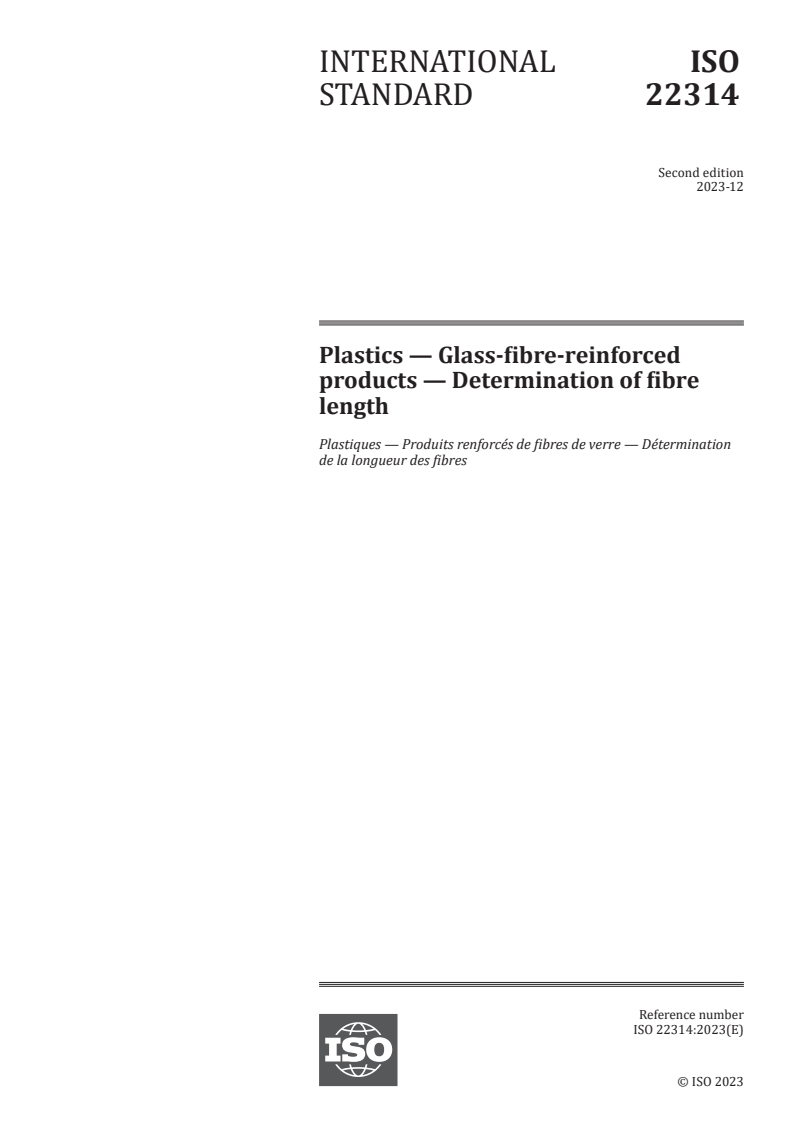
INTERNATIONAL ISO
STANDARD 22314
Second edition
2023-12
Plastics — Glass-fibre-reinforced
products — Determination of fibre
length
Plastiques — Produits renforcés de fibres de verre — Détermination
de la longueur des fibres
Reference number
COPYRIGHT PROTECTED DOCUMENT
© ISO 2023
All rights reserved. Unless otherwise specified, or required in the context of its implementation, no part of this publication may
be reproduced or utilized otherwise in any form or by any means, electronic or mechanical, including photocopying, or posting on
the internet or an intranet, without prior written permission. Permission can be requested from either ISO at the address below
or ISO’s member body in the country of the requester.
ISO copyright office
CP 401 • Ch. de Blandonnet 8
CH-1214 Vernier, Geneva
Phone: +41 22 749 01 11
Email: copyright@iso.org
Website: www.iso.org
Published in Switzerland
ii
Contents Page
Foreword .iv
Introduction .v
1 Scope . 1
2 Normative references . 1
3 Terms and definitions . 1
4 Principle . 1
5 Apparatus . 1
6 Procedure .2
6.1 Preparation of the test specimen . 2
6.2 Calibration . 3
6.3 Examination and measurements . 3
6.4 Calculation and expression of results . 3
7 Test report . 4
iii
Foreword
ISO (the International Organization for Standardization) is a worldwide federation of national standards
bodies (ISO member bodies). The work of preparing International Standards is normally carried out
through ISO technical committees. Each member body interested in a subject for which a technical
committee has been established has the right to be represented on that committee. International
organizations, governmental and non-governmental, in liaison with ISO, also take part in the work.
ISO collaborates closely with the International Electrotechnical Commission (IEC) on all matters of
electrotechnical standardization.
The procedures used to develop this document and those intended for its further maintenance are
described in the ISO/IEC Directives, Part 1. In particular, the different approval criteria needed for the
different types of ISO document should be noted. This document was drafted in accordance with the
editorial rules of the ISO/IEC Directives, Part 2 (see www.iso.org/directives).
ISO draws attention to the possibility that the implementation of this document may involve the use
of (a) patent(s). ISO takes no position concerning the evidence, validity or applicability of any claimed
patent rights in respect thereof. As of the date of publication of this document, ISO had not received
notice of (a) patent(s) which may be required to implement this document. However, implementers are
cautioned that this may not represent the latest information, which may be obtained from the patent
database available at www.iso.org/patents. ISO shall not be held responsible for identifying any or all
such patent rights.
Any trade name used in this document is information given for the convenience of users and does not
constitute an endorsement.
For an explanation of the voluntary nature of standards, the meaning of ISO specific terms and
expressions related to conformity assessment, as well as information about ISO's adherence to
the World Trade Organization (WTO) principles in the Technical Barriers to Trade (TBT), see
www.iso.org/iso/foreword.html.
This document was prepared by Technical Committee ISO/TC 61, Plastics, Subcommittee SC 13,
Composites and reinforcement fibres.
This second edition cancels and replaces the first edition (ISO 22314:2006), which has been technically
revised.
The main changes are as follows:
— the requirements of muffle furnace and ultrasonic device have been modified;
— the description of the calcination time has been added;
— the description of the number of fibre measurements has been added;
— the meaning of L / L has been added.
p n
Any feedback or questions on this document should be directed to the user’s national standards body. A
complete listing of these bodies can be found at www.iso.org/members.html.
iv
Introduction
There is global interest in the determination of the length of glass fibres in all types of composite, to
predict their characteristics (essentially mechanical ones). For these determinations, three steps are
necessary:
— separation of the fibres from the composite;
— dispersion of the fibres to obtain individual fibres;
— measurement of their length.
After considering all the existing methods for separating the fibres from the resin, it was decided to
develop the proposed method only for short glass fibres from thermoplastic resins, extracted by
calcination.
The principles of the method are probably suitable for other composites, but it would need more
development to obtain a method suitable for other conditions (thermoset resins, long fibres in
thermoplastic or thermoset resins, carbon fibres).
v
INTERNATIONAL STANDARD ISO 22314:2023(E)
Plastics — Glass-fibre-reinforced products —
Determination of fibre length
1 Scope
This document specifies a method of determining the length of the fibres present in a fibre-reinforced
product. The method is applicable to moulding materials and to moulded parts. The test conditions
specified limit the application of this method to thermoplastics reinforced with short glass fibres (less
than 1 mm long), i.e. fibres whose length is less than or equal to 7,5 mm prior to incorporation in the
moulding material and moulding.
2 Normative references
The following documents are referred to in the text in such
...