


ISO 15267:1998
(Main)Animal and vegetable fats and oils — Flashpoint limit test using Pensky-Martens closed cup flash tester
Animal and vegetable fats and oils — Flashpoint limit test using Pensky-Martens closed cup flash tester
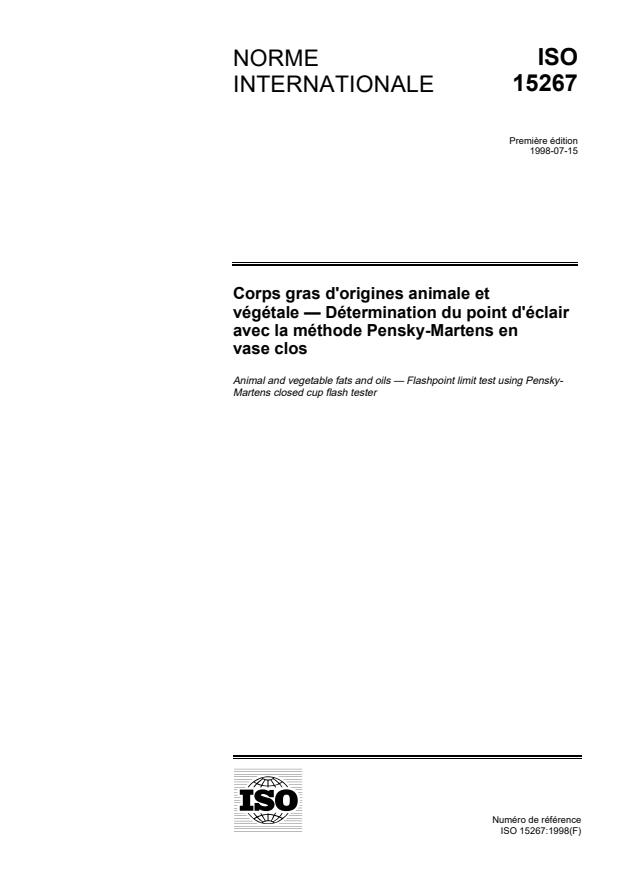
Corps gras d'origines animale et végétale — Détermination du point d'éclair avec la méthode Pensky-Martens en vase clos
General Information
- Status
- Published
- Publication Date
- 08-Jul-1998
- Technical Committee
- ISO/TC 34/SC 11 - Animal and vegetable fats and oils
- Drafting Committee
- ISO/TC 34/SC 11 - Animal and vegetable fats and oils
- Current Stage
- 9093 - International Standard confirmed
- Start Date
- 24-Apr-2025
- Completion Date
- 12-Feb-2026
Overview
ISO 15267:1998 specifies a qualitative flashpoint limit test for animal, vegetable and marine fats and oils using the Pensky‑Martens closed‑cup flash tester. The method determines whether a sample at a given temperature will produce a flash when exposed briefly to a test flame. It is intended to support safety assessment, product classification and transport regulatory decisions.
Key Topics
- Scope: Applicable to animal, vegetable and marine fats and oils; small amounts of volatile solvents may be present.
- Principle: The sample is heated at a slow, controlled rate with stirring; when the test temperature is reached a small flame is introduced into the closed cup. A sample is deemed to have "flashed" if a large flame propagates across the surface (blue halo ignored).
- Apparatus: Pensky‑Martens closed cup tester per ISO 2719, thermometer (range 10–200 °C or IP 101 C), swing‑type centrifuge and 120 ml centrifuge tubes with stoppers.
- Preparation: Follow ISO 661 for test sample preparation. If solid at room temperature, melt slowly not higher than 5 °C above the melting point. Treat roughly 90 g sample with 5 g anhydrous sodium sulfate, shake, stand and centrifuge to obtain clear oil for testing.
- Procedure highlights:
- Fill cup to the marked line and suspend thermometer so bulb is 43–46 mm below the cup rim.
- Adjust test flame to ~4 mm diameter.
- Heat at 5–6 °C per minute with stirring at 1–2 revolutions per second.
- At the specified temperature (commonly 121 °C) stop stirring and lower the test flame within 0.5 s; observe for a distinct flash.
- Perform tests in duplicate; use fresh portions for determinations at different temperatures.
- Reporting: Report either "flash" or "no flash" at the specified temperature and state the method and apparatus used. If duplicates disagree, disregard the "no flash" result.
Applications
- Safety testing: Rapid assessment of whether a fat or oil will flash under specified conditions for workplace or process safety.
- Classification: Supports classification decisions for storage, handling and transport of fats and oils when flash behavior at a defined temperature is required.
- Quality control: Useful as a go/no‑go test in production and incoming material inspection where presence of volatile contaminants is a concern.
Related Standards
- ISO 2719 - Pensky‑Martens closed cup method for petroleum products and lubricants (apparatus details).
- ISO 661 - Preparation of test sample for animal and vegetable fats and oils.
- ISO 5555 - Recommended sampling for animal and vegetable fats and oils.
Notes: Annex A of ISO 15267 is informative and summarizes an interlaboratory trial organized by FOSFA and NOFOTA in 1995. For precise implementation, refer to the full ISO text and referenced standards to ensure compliance with current editions.
ISO 15267:1998 - Animal and vegetable fats and oils -- Flashpoint limit test using Pensky-Martens closed cup flash tester
ISO 15267:1998 - Corps gras d'origines animale et végétale -- Détermination du point d'éclair avec la méthode Pensky-Martens en vase clos
Get Certified
Connect with accredited certification bodies for this standard

BSI Group
BSI (British Standards Institution) is the business standards company that helps organizations make excellence a habit.

Bureau Veritas
Bureau Veritas is a world leader in laboratory testing, inspection and certification services.

DNV
DNV is an independent assurance and risk management provider.
Sponsored listings
Frequently Asked Questions
ISO 15267:1998 is a standard published by the International Organization for Standardization (ISO). Its full title is "Animal and vegetable fats and oils — Flashpoint limit test using Pensky-Martens closed cup flash tester". This standard covers: Animal and vegetable fats and oils — Flashpoint limit test using Pensky-Martens closed cup flash tester
Animal and vegetable fats and oils — Flashpoint limit test using Pensky-Martens closed cup flash tester
ISO 15267:1998 is classified under the following ICS (International Classification for Standards) categories: 67.200.10 - Animal and vegetable fats and oils. The ICS classification helps identify the subject area and facilitates finding related standards.
ISO 15267:1998 is available in PDF format for immediate download after purchase. The document can be added to your cart and obtained through the secure checkout process. Digital delivery ensures instant access to the complete standard document.
Standards Content (Sample)
INTERNATIONAL ISO
STANDARD 15267
First edition
1998-07-15
Animal and vegetable fats and oils —
Flashpoint limit test using Pensky-Martens
closed cup flash tester
Corps gras d'origines animale et végétale — Détermination du point d'éclair
avec la méthode Pensky-Martens en vase clos
A
Reference number
Foreword
ISO (the International Organization for Standardization) is a worldwide
federation of national standards bodies (ISO member bodies). The work of
preparing International Standards is normally carried out through ISO
technical committees. Each member body interested in a subject for which
a technical committee has been established has the right to be represented
on that committee. International organizations, governmental and non-
governmental, in liaison with ISO, also take part in the work. ISO
collaborates closely with the International Electrotechnical Commission
(IEC) on all matters of electrotechnical standardization.
Draft International Standards adopted by the technical committees are
circulated to the member bodies for voting. Publication as an International
Standard requires approval by at least 75 % of the member bodies casting
a vote.
International Standard ISO 15267 was prepared by Technical Committee
ISO/TC 34, Agricultural food products, Subcommittee SC 11, Animal and
vegetable fats and oils.
Annex A of this International Standard is for information only.
© ISO 1998
All rights reserved. Unless otherwise specified, no part of this publication may be reproduced
or utilized in any form or by any means, electronic or mechanical, including photocopying and
microfilm, without permission in writing from the publisher.
International Organization for Standardization
Case postale 56 • CH-1211 Genève 20 • Switzerland
Internet iso@iso.ch
Printed in Switzerland
ii
©
INTERNATIONAL STANDARD ISO ISO 15267:1998(E)
Animal and vegetable fats and oils — Flashpoint limit test using
Pensky-Martens closed cup flash tester
1 Scope
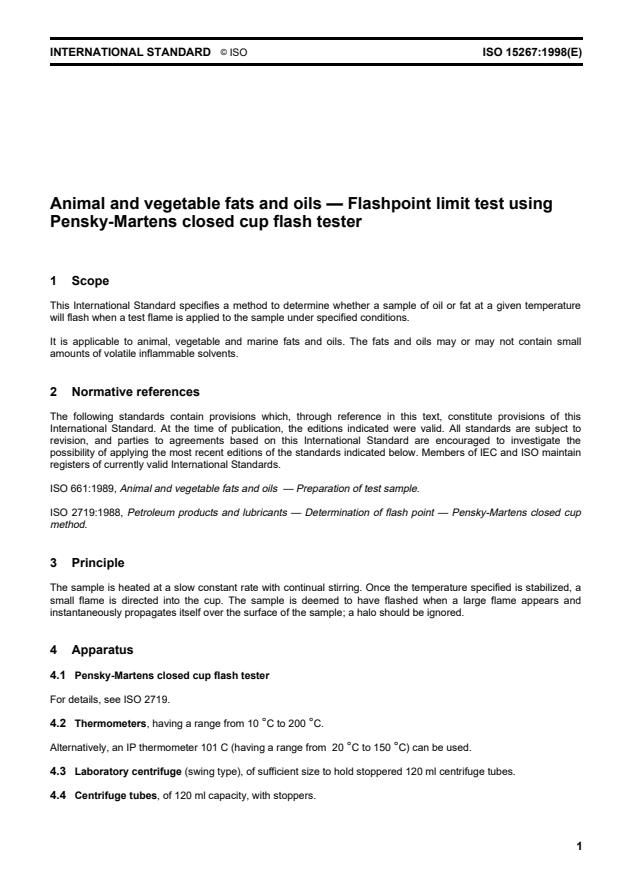
This International Standard specifies a method to determine whether a sample of oil or fat at a given temperature
will flash when a test flame is applied to the sample under specified conditions.
It is applicable to animal, vegetable and marine fats and oils. The fats and oils may or may not contain small
amounts of volatile inflammable solvents.
2 Normative references
The following standards contain provisions which, through reference in this text, constitute provisions of this
International Standard. At the time of publication, the editions indicated were valid. All standards are subject to
revision, and parties to agreements based on this International Standard are encouraged to investigate the
possibility of applying the most recent editions of the standards indicated below. Members of IEC and ISO maintain
registers of currently valid International Standards.
ISO 661:1989, Animal and vegetable fats and oils — Preparation of test sample.
ISO 2719:1988, Petroleum products and lubricants — Determination of flash point — Pensky-Martens closed cup
method.
3 Principle
The sample is heated at a slow constant rate with continual stirring. Once the temperature specified is stabilized, a
small flame is directed into the cup. The sample is deemed to have flashed when a large flame appears and
instantaneously propagates itself over the surface of the sample; a halo should be ignored.
4 Apparatus
4.1 Pensky-Martens closed cup flash tester
For details, see ISO 2719.
4.2 Thermometers, having a range from 10 °C to 200 °C.
Alternatively, an IP thermometer 101 C (having a range from 20 °C to 150 °C) can be used.
4.3 Laboratory centrifuge (swing type), of sufficient size to hold stoppered 120 ml centrifuge tubes.
4.4 Centrifuge tubes, of 120 ml capacity, with stoppers.
©
ISO
5 Reagents
Use only reagents of recognized analytical grade, and distilled or demineralized water or water of equivalent purity.
5.1 Sodium sulfate, anhydrous.
6 Sampling
Sampling is not part of the method specified in this International Standard. A recommended sampling method is
1)
given in ISO 5555 . (See also 8.1.)
It is important that the laboratory receive a sample which is truly representative and has not been damaged or
changed during transportation, sampling and storage.
Samples shall be stored in bottles made of materials which do not allow diffusion of volatile compounds from the
sample through the walls of the bottle.
NOTE PET or glass bottles are preferred. Some plastics (e.g. polyethylene or polypropylene) are not suitable for this
purpose.
7 Preparation of test sample
Prepare the test sample in accordance with ISO 661.
8 Procedure
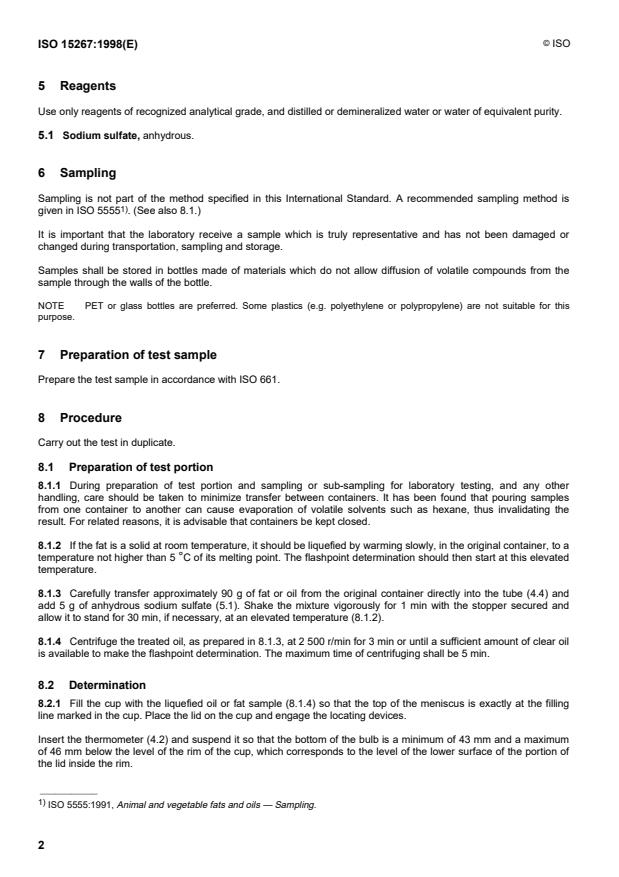
Carry out the test in duplicate.
8.1 Preparation of test portion
8.1.1 During preparation of test portion and sampling or sub-sampling for laboratory testing, and any other
handling, care should be taken to minimize transfer between containers. It has b
...
NORME ISO
INTERNATIONALE 15267
Première édition
1998-07-15
Corps gras d'origines animale et
végétale — Détermination du point d'éclair
avec la méthode Pensky-Martens en
vase clos
Animal and vegetable fats and oils — Flashpoint limit test using Pensky-
Martens closed cup flash tester
A
Numéro de référence
Avant-propos
L'ISO (Organisation internationale de normalisation) est une fédération
mondiale d'organismes nationaux de normalisation (comités membres de
l'ISO). L'élaboration des Normes internationales est en général confiée aux
comités techniques de l'ISO. Chaque comité membre intéressé par une
étude a le droit de faire partie du comité technique créé à cet effet. Les
organisations internationales, gouvernementales et non gouvernementales,
en liaison avec l'ISO participent également aux travaux. L'ISO collabore
étroitement avec la Commission électrotechnique internationale (CEI) en
ce qui concerne la normalisation électrotechnique.
Les projets de Normes internationales adoptés par les comités techniques
sont soumis aux comités membres pour vote. Leur publication comme
Normes internationales requiert l'approbation de 75 % au moins des
comités membres votants.
La Norme internationale ISO 15267 a été élaborée par le comité technique
ISO/TC 34, Produits agricoles alimentaires, sous-comité SC 11, Corps
gras d’origines animale et végétale.
L’annexe A de la présente Norme internationale est donnée uniquement à
titre d’information.
© ISO 1998
Droits de reproduction réservés. Sauf prescription différente, aucune partie de cette publi-
cation ne peut être reproduite ni utilisée sous quelque forme que ce soit et par aucun pro-
cédé, électronique ou mécanique, y compris la photocopie et les microfilms, sans l'accord
écrit de l'éditeur.
Organisation internationale de normalisation
Case postale 56 • CH-1211 Genève 20 • Suisse
Internet iso@iso.ch
Imprimé en Suisse
ii
©
NORME INTERNATIONALE ISO ISO 15267:1998(F)
Corps gras d'origines animale et végétale — Détermination du
point d'éclair avec la méthode Pensky-Martens en vase clos
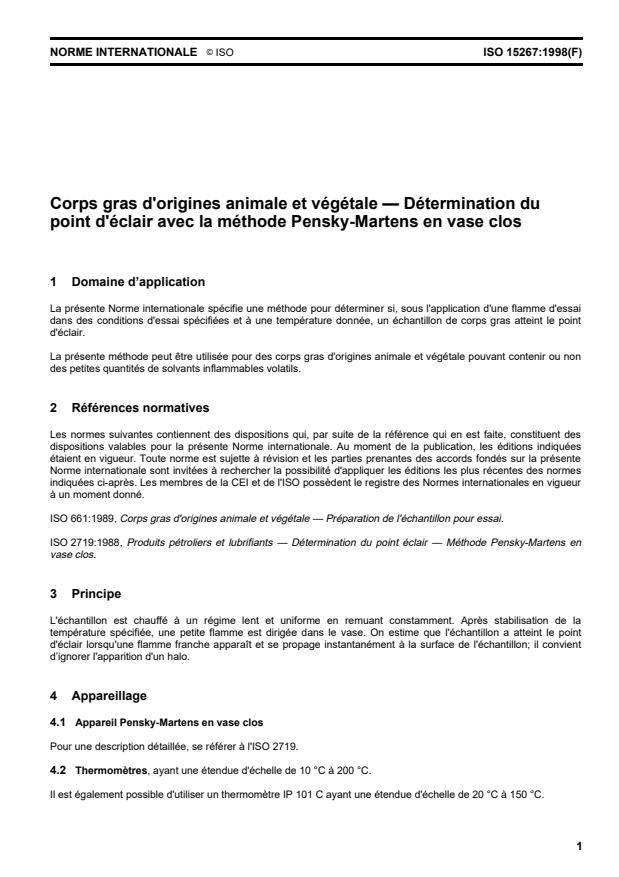
1 Domaine d’application
La présente Norme internationale spécifie une méthode pour déterminer si, sous l'application d'une flamme d'essai
dans des conditions d'essai spécifiées et à une température donnée, un échantillon de corps gras atteint le point
d'éclair.
La présente méthode peut être utilisée pour des corps gras d'origines animale et végétale pouvant contenir ou non
des petites quantités de solvants inflammables volatils.
2 Références normatives
Les normes suivantes contiennent des dispositions qui, par suite de la référence qui en est faite, constituent des
dispositions valables pour la présente Norme internationale. Au moment de la publication, les éditions indiquées
étaient en vigueur. Toute norme est sujette à révision et les parties prenantes des accords fondés sur la présente
Norme internationale sont invitées à rechercher la possibilité d'appliquer les éditions les plus récentes des normes
indiquées ci-après. Les membres de la CEI et de l'ISO possèdent le registre des Normes internationales en vigueur
à un moment donné.
ISO 661:1989, Corps gras d'origines animale et végétale — Préparation de l'échantillon pour essai.
ISO 2719:1988, Produits pétroliers et lubrifiants — Détermination du point éclair — Méthode Pensky-Martens en
vase clos.
3 Principe
L'échantillon est chauffé à un régime lent et uniforme en remuant constamment. Après stabilisation de la
température spécifiée, une petite flamme est dirigée dans le vase. On estime que l'échantillon a atteint le point
d'éclair lorsqu'une flamme franche apparaît et se propage instantanément à la surface de l'échantillon; il convient
d’ignorer l'apparition d'un halo.
4 Appareillage
4.1 Appareil Pensky-Martens en vase clos
Pour une description détaillée, se référer à l'ISO 2719.
4.2 Thermomètres, ayant une étendue d'échelle de 10 °C à 200 °C.
Il est également possible d'utiliser un thermomètre IP 101 C ayant une étendue d'échelle de 20 °C à 150 °C.
©
ISO
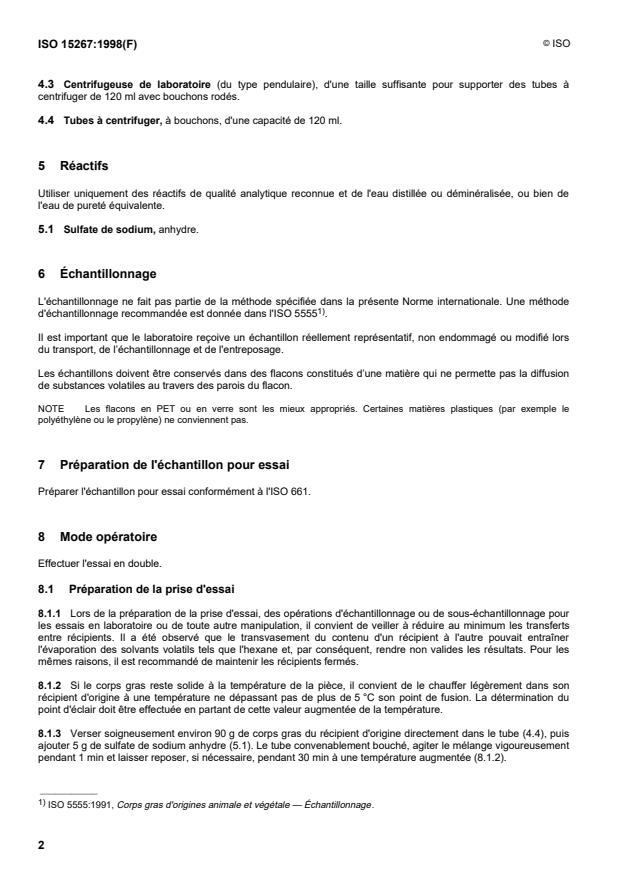
4.3 Centrifugeuse de laboratoire (du type pendulaire), d'une taille suffisante pour supporter des tubes à
centrifuger de 120 ml avec bouchons rodés.
4.4 Tubes à centrifuger, à bouchons, d'une capacité de 120 ml.
5 Réactifs
Utiliser uniquement des réactifs de qualité analytique reconnue et de l'eau distillée ou déminéralisée, ou bien de
l'eau de pureté équivalente.
5.1 Sulfate de sodium, anhydre.
6 Échantillonnage
L'échantillonnage ne fait pas partie de la méthode spécifiée dans la présente Norme internationale. Une méthode
1)
d'échantillonnage recommandée est donnée dans l'ISO 5555 .
Il est important que le laboratoire reçoive un échantillon réellement représentatif, non endommagé ou modifié lors
du transport, de l’échantillonnage et de l'entreposage.
Les échantillons doivent être conservés dans des flacons constitués d’une matière qui ne permette pas la diffusion
de substances volatiles au travers des parois du flacon.
NOTE Les flacons en PET ou en verre sont les mieux appropriés. Certaines matières plastiques (par exemple le
polyéthylène ou le propylène) ne conviennent pas.
7 Préparation de l'échantillon pour essai
Préparer l'échantillon pour essai conformément à l'ISO 661.
8 Mode opératoire
Effectuer l'essai en double.
8.1 Préparation de la prise d'essai
8.1.1 Lors de la préparation de la prise d'essai, des opérations d'échantillonnage ou de sous-échantillonnage pour
les essais en laboratoire ou de toute autre manipulation, il convient de veiller à réduire au minimum les transferts
entre récipient
...
Questions, Comments and Discussion
Ask us and Technical Secretary will try to provide an answer. You can facilitate discussion about the standard in here.
Loading comments...