

ISO 8126:2019
(Main)Micrographics — Duplicating film, silver, diazo and vesicular — Specifications and measurement for visual density
General Information
- Abstract
This document specifies visual diffuse transmission densities for second generation silver-gelatin and diazo microforms and projection densities for second generation vesicular microforms. It also specifies methods of measurement. It does not apply to duplicates of microforms of technical drawings and other drawing office documents.
- Status
- Published
- Publication Date
- 09-Jan-2019
- Technical Committee
- ISO/TC 171 - Document management applications
- Drafting Committee
- ISO/TC 171 - Document management applications
- Current Stage
- 9093 - International Standard confirmed
- Start Date
- 04-Jun-2024
- Completion Date
- 29-Aug-2026
Buy Documents


ISO 8126:2019 - Micrographics -- Duplicating film, silver, diazo and vesicular -- Specifications and measurement for visual density
ISO 8126:2019 - Micrographics — Duplicating film, silver, diazo and vesicular — Specifications and measurement for visual density/10/2019
Overview
ISO 8126:2019 is an international standard developed by ISO that specifies requirements and measurement methods for the visual density of duplicating films used in micrographics. This standard addresses silver-gelatin, diazo, and vesicular films, focusing specifically on second-generation microforms. ISO 8126:2019 ensures consistency, legibility, and practical usability of microfilmed documents by prescribing visual diffuse transmission densities for silver-gelatin and diazo films and projection densities for vesicular films. It also provides clear guidance for density measurement procedures. The standard is widely used in document management, archival practices, and information preservation workflows to maintain high-quality microform reproductions.
Key Topics
- Visual Density Specifications: Defines acceptable ranges for visual diffuse transmission density on silver-gelatin and diazo microforms, as well as projection densities for vesicular microforms.
- Measurement Methods: Outlines the use of densitometers and the required sampling apertures for measuring density as per ISO 5-2 and ISO 5-3 standards.
- Quality Assurance: Specifies measurement areas and procedures to assess uniformity and legibility of image densities to support reliable information retrieval from duplicated microforms.
- Applicability: This standard is intended for second-generation duplicates from source documents and computer output microforms (COM), explicitly excluding technical drawings and other specialized office documents.
- Terminology: Establishes a consistent vocabulary by referencing related ISO micrographics and density measurement standards.
Applications
ISO 8126:2019 plays a critical role in industries and organizations where long-term document retention and reliable reproduction of records are essential. Typical applications include:
- Archives and Libraries: Ensures that historical documents and records, when duplicated, maintain a consistent level of image legibility and contrast suitable for future reference.
- Government Records Management: Supports standardized microfilming practices for legal, compliance, and records preservation purposes.
- Document Reproduction Services: Provides criteria for quality control in the production of distribution copies and intermediary microform reels.
- Information Preservation Programs: Promotes uniform procedures for density evaluation, aiding in the integrity and accessibility of digital conversions of microforms.
- Micrographics Vendors and Manufacturers: Used to define product quality and service specifications for duplicating film, equipment, and measurement instruments in line with international standards.
Following the requirements of ISO 8126:2019 ensures that duplicated microforms-whether generated for backup, distribution, or intermediate processing-remain accessible, easy to read, and suitable for projection or other forms of viewing.
Related Standards
For comprehensive compliance and broader understanding, ISO 8126:2019 should be implemented alongside the following related ISO standards:
- ISO 5-1, ISO 5-2, ISO 5-3: Standards for density measurements, covering geometric and spectral conditions essential for accurate densitometry.
- ISO 6196 Series: Vocabularies related to micrographics, including general terms, film processing, materials, packaging, and image quality.
- ISO 6200: Provides specifications and methods for measuring density in first-generation silver-gelatin microforms.
- Other Micrographics and Document Management Standards: To ensure end-to-end quality and compatibility across imaging and documentation processes.
By adhering to ISO 8126:2019, organizations can achieve and maintain the desired clarity and uniformity in microform duplicates, ensuring reliable access and preservation of vital information for the long term.
Relations
- Effective Date
- 23-Apr-2020
Buy Documents
ISO 8126:2019 - Micrographics -- Duplicating film, silver, diazo and vesicular -- Specifications and measurement for visual density
ISO 8126:2019 - Micrographics — Duplicating film, silver, diazo and vesicular — Specifications and measurement for visual density/10/2019
Frequently Asked Questions
ISO 8126:2019 is a standard published by the International Organization for Standardization (ISO). Its full title is "Micrographics — Duplicating film, silver, diazo and vesicular — Specifications and measurement for visual density". This standard covers: This document specifies visual diffuse transmission densities for second generation silver-gelatin and diazo microforms and projection densities for second generation vesicular microforms. It also specifies methods of measurement. It does not apply to duplicates of microforms of technical drawings and other drawing office documents.
This document specifies visual diffuse transmission densities for second generation silver-gelatin and diazo microforms and projection densities for second generation vesicular microforms. It also specifies methods of measurement. It does not apply to duplicates of microforms of technical drawings and other drawing office documents.
ISO 8126:2019 is classified under the following ICS (International Classification for Standards) categories: 37.080 - Document imaging applications. The ICS classification helps identify the subject area and facilitates finding related standards.
ISO 8126:2019 has the following relationships with other standards: It is inter standard links to ISO 8126:2000. Understanding these relationships helps ensure you are using the most current and applicable version of the standard.
ISO 8126:2019 is available in PDF format for immediate download after purchase. The document can be added to your cart and obtained through the secure checkout process. Digital delivery ensures instant access to the complete standard document.
Standards Content (Sample)
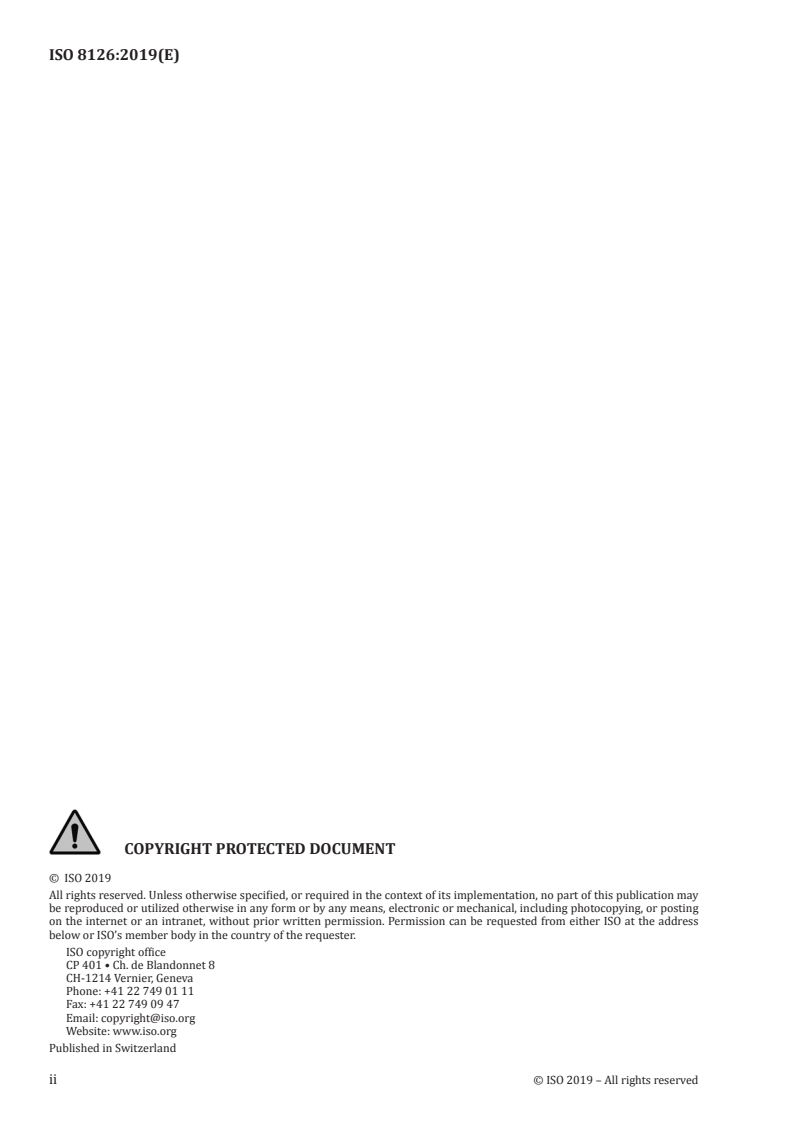
INTERNATIONAL ISO
STANDARD 8126
Third edition
2019-01
Micrographics — Duplicating
film, silver, diazo and vesicular —
Specifications and measurement for
visual density
Micrographie — Films de duplication argentiques, diazoïques et
vésiculaires — Spécifications et mesurage pour la densité visuelle
Reference number
©
ISO 2019
© ISO 2019
All rights reserved. Unless otherwise specified, or required in the context of its implementation, no part of this publication may
be reproduced or utilized otherwise in any form or by any means, electronic or mechanical, including photocopying, or posting
on the internet or an intranet, without prior written permission. Permission can be requested from either ISO at the address
below or ISO’s member body in the country of the requester.
ISO copyright office
CP 401 • Ch. de Blandonnet 8
CH-1214 Vernier, Geneva
Phone: +41 22 749 01 11
Fax: +41 22 749 09 47
Email: copyright@iso.org
Website: www.iso.org
Published in Switzerland
ii © ISO 2019 – All rights reserved
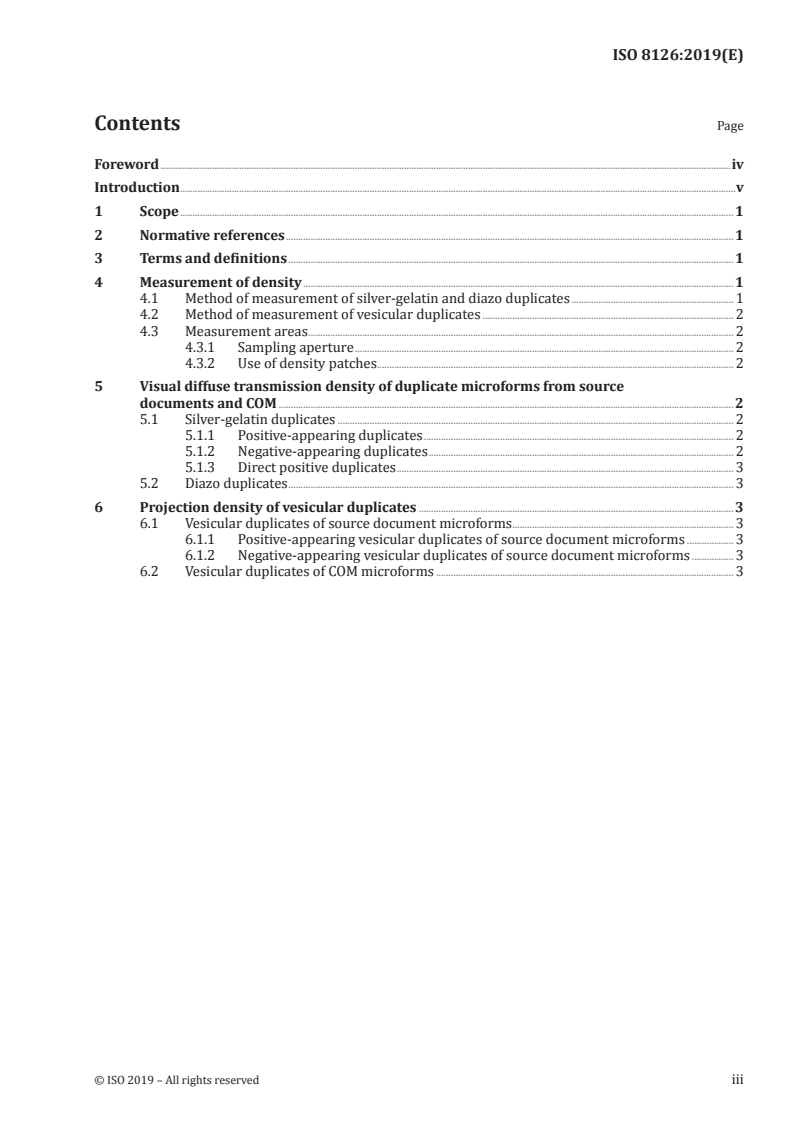
Contents Page
Foreword .iv
Introduction .v
1 Scope . 1
2 Normative references . 1
3 Terms and definitions . 1
4 Measurement of density . 1
4.1 Method of measurement of silver-gelatin and diazo duplicates . 1
4.2 Method of measurement of vesicular duplicates . 2
4.3 Measurement areas . 2
4.3.1 Sampling aperture . 2
4.3.2 Use of density patches . . 2
5 Visual diffuse transmission density of duplicate microforms from source
documents and COM . 2
5.1 Silver-gelatin duplicates . 2
5.1.1 Positive-appearing duplicates . 2
5.1.2 Negative-appearing duplicates . 2
5.1.3 Direct positive duplicates . 3
5.2 Diazo duplicates . 3
6 Projection density of vesicular duplicates . 3
6.1 Vesicular duplicates of source document microforms . 3
6.1.1 Positive-appearing vesicular duplicates of source document microforms . 3
6.1.2 Negative-appearing vesicular duplicates of source document microforms . 3
6.2 Vesicular duplicates of COM microforms . 3
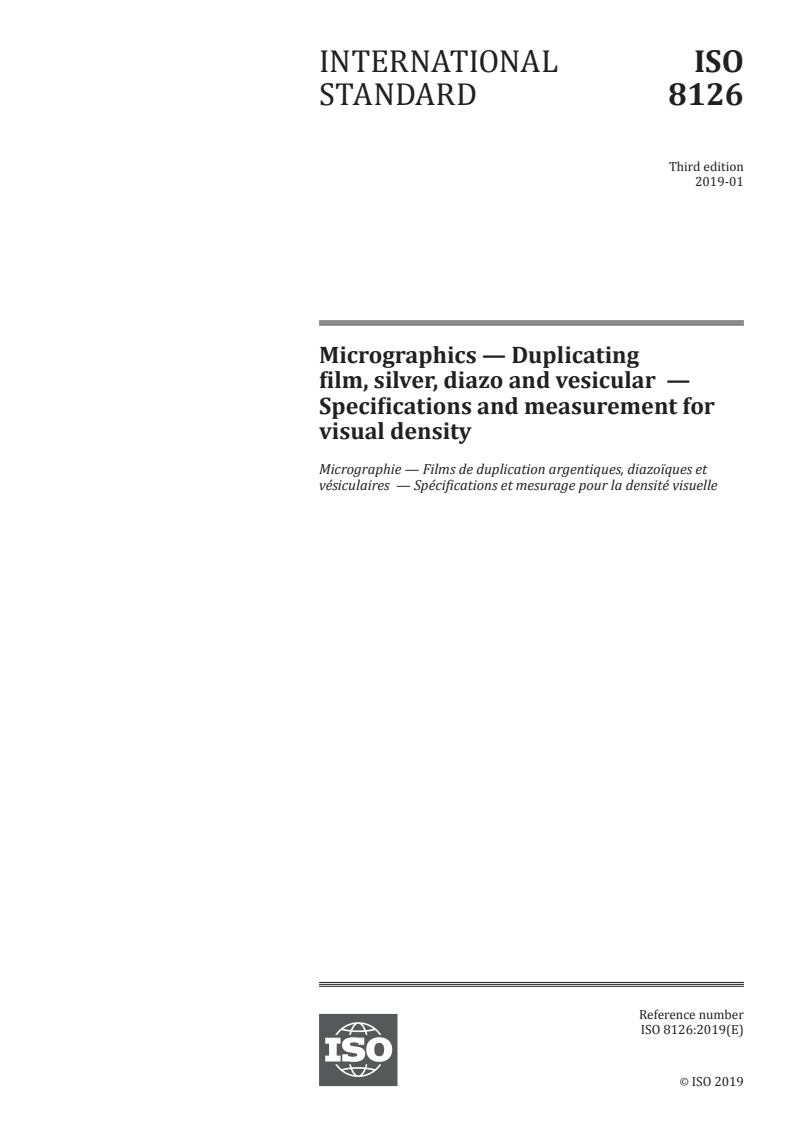
Foreword
ISO (the International Organization for Standardization) is a worldwide federation of national standards
bodies (ISO member bodies). The work of preparing International Standards is normally carried out
through ISO technical committees. Each member body interested in a subject for which a technical
committee has been established has the right to be represented on that committee. International
organizations, governmental and non-governmental, in liaison with ISO, also take part in the work.
ISO collaborates closely with the International Electrotechnical Commission (IEC) on all matters of
electrotechnical standardization.
The procedures used to develop this document and those intended for its further maintenance are
described in the ISO/IEC Directives, Part 1. In particular, the different approval criteria needed for the
different types of ISO documents should be noted. This document was drafted in accordance with the
editorial rules of the ISO/IEC Directives, Part 2 (see www .iso .org/directives).
Attention is drawn to the possibility that some of the elements of this document may be the subject of
patent rights. ISO shall not be held responsible for identifying any or all such patent rights. Details of
any patent rights identified during the development of the document will be in the Introduction and/or
on the ISO list of patent declarations received (see www .iso .org/patents).
Any trade name used in this document is information given for the convenience of users and does not
constitute an endorsement.
For an explanation of the voluntary nature of standards, the meaning of ISO specific terms and
expressions related to conformity assessment, as well as information about ISO’s adherence to the
World Trade Organization (WTO) principles in the Technical Barriers to Trade (TBT) see www .iso
.org/iso/foreword .html.
This document was prepared by Technical Committee ISO/TC 171, Document management applications.
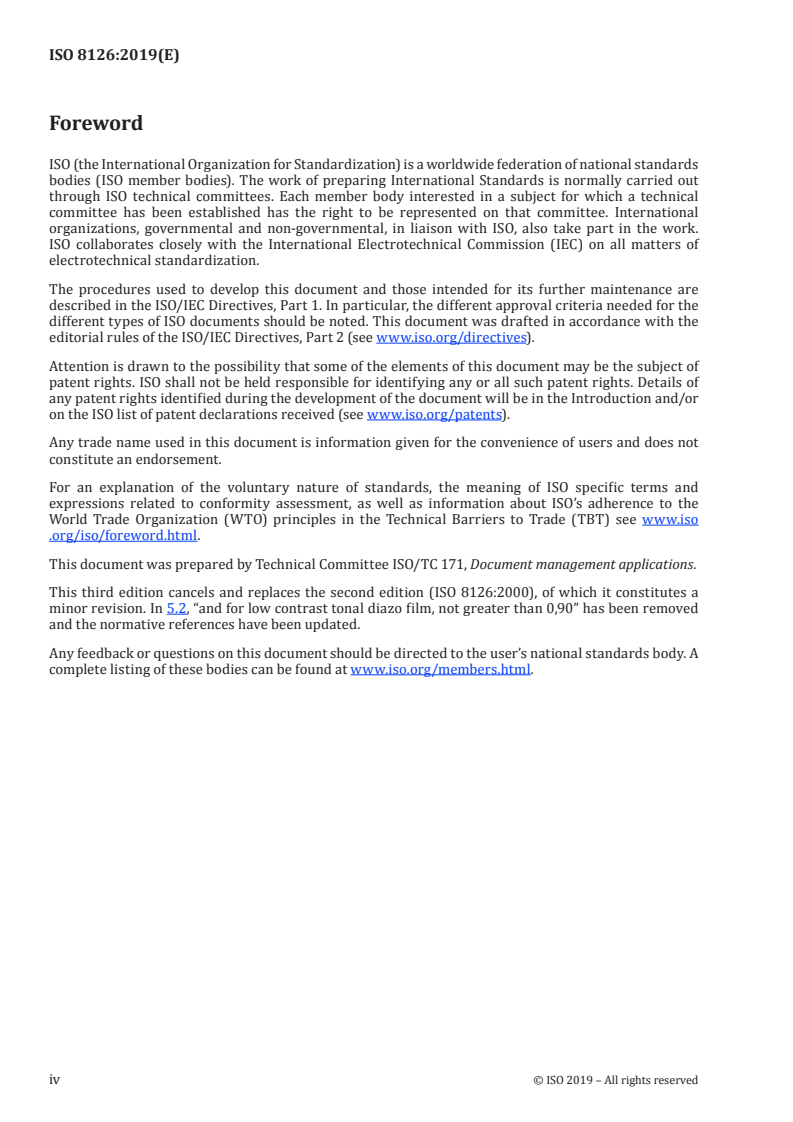
This third edition cancels and replaces the second edition (ISO 8126:2000), of which it constitutes a
minor revision. In 5.2, “and for low contrast tonal diazo film, not greater than 0,90” has been removed
and the normative references have been updated.
Any feedback or questions on this document should be directed to the user’s national standards body. A
complete listing of these bodies can be found at www .iso .org/members .html.
iv © ISO 2019 – All rights reserved
...
INTERNATIONAL ISO
STANDARD 8126
Third edition
2019-01
Micrographics — Duplicating
film, silver, diazo and vesicular —
Specifications and measurement for
visual density
Micrographie — Films de duplication argentiques, diazoïques et
vésiculaires — Spécifications et mesurage pour la densité visuelle
Reference number
©
ISO 2019
© ISO 2019
All rights reserved. Unless otherwise specified, or required in the context of its implementation, no part of this publication may
be reproduced or utilized otherwise in any form or by any means, electronic or mechanical, including photocopying, or posting
on the internet or an intranet, without prior written permission. Permission can be requested from either ISO at the address
below or ISO’s member body in the country of the requester.
ISO copyright office
CP 401 • Ch. de Blandonnet 8
CH-1214 Vernier, Geneva
Phone: +41 22 749 01 11
Fax: +41 22 749 09 47
Email: copyright@iso.org
Website: www.iso.org
Published in Switzerland
ii © ISO 2019 – All rights reserved
Contents Page
Foreword .iv
Introduction .v
1 Scope . 1
2 Normative references . 1
3 Terms and definitions . 1
4 Measurement of density . 1
4.1 Method of measurement of silver-gelatin and diazo duplicates . 1
4.2 Method of measurement of vesicular duplicates . 2
4.3 Measurement areas . 2
4.3.1 Sampling aperture . 2
4.3.2 Use of density patches . . 2
5 Visual diffuse transmission density of duplicate microforms from source
documents and COM . 2
5.1 Silver-gelatin duplicates . 2
5.1.1 Positive-appearing duplicates . 2
5.1.2 Negative-appearing duplicates . 2
5.1.3 Direct positive duplicates . 3
5.2 Diazo duplicates . 3
6 Projection density of vesicular duplicates . 3
6.1 Vesicular duplicates of source document microforms . 3
6.1.1 Positive-appearing vesicular duplicates of source document microforms . 3
6.1.2 Negative-appearing vesicular duplicates of source document microforms . 3
6.2 Vesicular duplicates of COM microforms . 3
Foreword
ISO (the International Organization for Standardization) is a worldwide federation of national standards
bodies (ISO member bodies). The work of preparing International Standards is normally carried out
through ISO technical committees. Each member body interested in a subject for which a technical
committee has been established has the right to be represented on that committee. International
organizations, governmental and non-governmental, in liaison with ISO, also take part in the work.
ISO collaborates closely with the International Electrotechnical Commission (IEC) on all matters of
electrotechnical standardization.
The procedures used to develop this document and those intended for its further maintenance are
described in the ISO/IEC Directives, Part 1. In particular, the different approval criteria needed for the
different types of ISO documents should be noted. This document was drafted in accordance with the
editorial rules of the ISO/IEC Directives, Part 2 (see www .iso .org/directives).
Attention is drawn to the possibility that some of the elements of this document may be the subject of
patent rights. ISO shall not be held responsible for identifying any or all such patent rights. Details of
any patent rights identified during the development of the document will be in the Introduction and/or
on the ISO list of patent declarations received (see www .iso .org/patents).
Any trade name used in this document is information given for the convenience of users and does not
constitute an endorsement.
For an explanation of the voluntary nature of standards, the meaning of ISO specific terms and
expressions related to conformity assessment, as well as information about ISO’s adherence to the
World Trade Organization (WTO) principles in the Technical Barriers to Trade (TBT) see www .iso
.org/iso/foreword .html.
This document was prepared by Technical Committee ISO/TC 171, Document management applications.
This third edition cancels and replaces the second edition (ISO 8126:2000), of which it constitutes a
minor revision. In 5.2, “and for low contrast tonal diazo film, not greater than 0,90” has been removed
and the normative references have been updated.
Any feedback or questions on this document should be directed to the user’s national standards body. A
complete listing of these bodies can be found at www .iso .org/members .html.
iv © ISO 2019 – All rights reserved
...