

ISO/IEC TS 17021-12:2020
(Main)Conformity assessment — Requirements for bodies providing audit and certification of management systems — Part 12: Competence requirements for auditing and certification of collaborative business relationship management systems
General Information
- Abstract
This document specifies additional competence requirements for personnel involved in the audit and certification process of collaborative business relationship management systems (CBRMS) and complements the existing requirements of ISO/IEC 17021-1.
- Status
- Published
- Publication Date
- 16-Apr-2020
- Technical Committee
- ISO/CASCO - Committee on conformity assessment
- Drafting Committee
- ISO/CASCO - Committee on conformity assessment
- Current Stage
- 9093 - International Standard confirmed
- Start Date
- 03-Sep-2026
- Completion Date
- 12-Sep-2026
Buy Documents
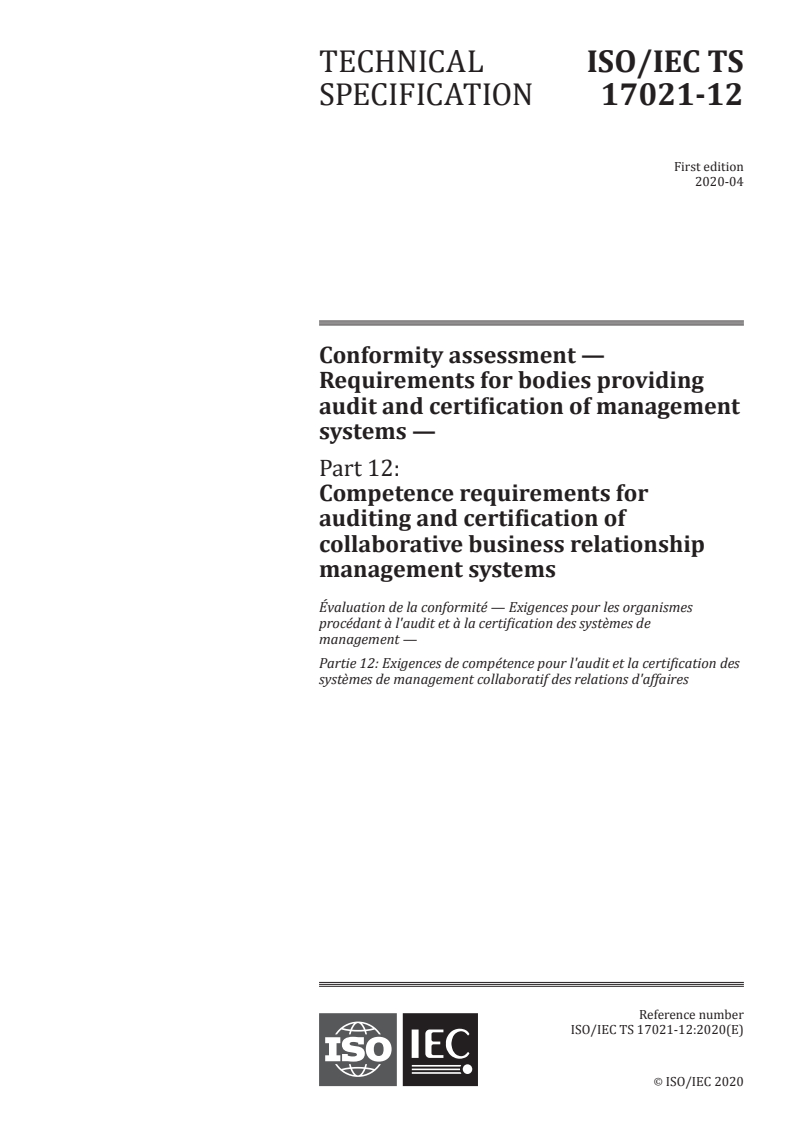
ISO/IEC TS 17021-12:2020 - Conformity assessment — Requirements for bodies providing audit and certification of management systems — Part 12: Competence requirements for auditing and certification of collaborative business relationship management systems Released:4/17/2020
ISO/IEC TS 17021-12:2020 - Conformity assessment — Requirements for bodies providing audit and certification of management systems — Part 12: Competence requirements for auditing and certification of collaborative business relationship management systems/17/2020
Overview
ISO/IEC TS 17021-12:2020 specifies additional competence requirements for personnel involved in auditing and certifying Collaborative Business Relationship Management Systems (CBRMS). It complements the generic requirements of ISO/IEC 17021-1 and is applicable where certification is based on ISO 44001. The technical specification clarifies expected knowledge and behaviours for audit teams, report reviewers and certification decision-makers to ensure consistent, rigorous certification outcomes.
Key Topics
The document sets out domain-specific competence elements that certification bodies shall take into account when defining role-based requirements (referenced to ISO/IEC 17021-1). Core topics include:
- Collaborative business relationship management premise, terminology and principles - understanding the drivers, complexity and interdependencies of collaborative relationships as described in ISO/TR 44000 and ISO 44001.
- Visions and values - recognising how organizational vision and values affect collaboration effectiveness.
- Collaborative leadership and behaviour - knowledge of leadership principles and skills that enable collaborative performance.
- Trust and commitment - appreciation of the role of trust and commitment across relationship lifecycles.
- Information and knowledge sharing - the effects of information and knowledge management on collaboration.
- Risk management - competence to assess risks within the lifecycle of collaborative relationships.
- Exit strategy and contractual arrangements - awareness of termination planning and contract elements that impact collaboration.
The specification requires the audit team as a whole to possess the necessary collective competence; individual auditors need not all hold identical skills, but the team must be able to meet audit objectives.
Applications
This specification is intended for use by:
- Certification bodies to define and document competence criteria for audit teams, report reviewers and decision-makers for CBRMS certification.
- Auditors and lead auditors preparing to perform CBRMS audits to identify knowledge gaps and training needs.
- Accreditation assessors evaluating whether a certification body has appropriately implemented competence requirements for CBRMS.
Practical benefits include:
- More consistent and credible CBRMS certifications aligned with ISO 44001.
- Improved audit rigour through clearly defined competence expectations.
- Better alignment of audit team composition with the complexity and maturity of collaborative arrangements.
Related Standards
- ISO/IEC 17021-1:2015 - Generic requirements for bodies providing audit and certification of management systems; TS 17021-12 complements these requirements.
- ISO 44001:2017 - Requirements and framework for collaborative business relationship management systems (CBRMS).
- ISO/TR 44000 - Principles for successful collaborative business relationship management.
Note: Annex A of the technical specification provides an informative overview of the specific knowledge areas relevant to auditing and certification of CBRMS. Certification bodies should refer to the referenced clauses when developing role-based competence profiles.
Buy Documents
ISO/IEC TS 17021-12:2020 - Conformity assessment — Requirements for bodies providing audit and certification of management systems — Part 12: Competence requirements for auditing and certification of collaborative business relationship management systems Released:4/17/2020
ISO/IEC TS 17021-12:2020 - Conformity assessment — Requirements for bodies providing audit and certification of management systems — Part 12: Competence requirements for auditing and certification of collaborative business relationship management systems/17/2020
Get Certified
Connect with accredited certification bodies for this standard

BSI Group
BSI (British Standards Institution) is the business standards company that helps organizations make excellence a habit.

Bureau Veritas
Bureau Veritas is a world leader in laboratory testing, inspection and certification services.

DNV
DNV is an independent assurance and risk management provider.
Sponsored listings
Frequently Asked Questions
ISO/IEC TS 17021-12:2020 is a technical specification published by the International Organization for Standardization (ISO). Its full title is "Conformity assessment — Requirements for bodies providing audit and certification of management systems — Part 12: Competence requirements for auditing and certification of collaborative business relationship management systems". This standard covers: This document specifies additional competence requirements for personnel involved in the audit and certification process of collaborative business relationship management systems (CBRMS) and complements the existing requirements of ISO/IEC 17021-1.
This document specifies additional competence requirements for personnel involved in the audit and certification process of collaborative business relationship management systems (CBRMS) and complements the existing requirements of ISO/IEC 17021-1.
ISO/IEC TS 17021-12:2020 is classified under the following ICS (International Classification for Standards) categories: 03.120.20 - Product and company certification. Conformity assessment. The ICS classification helps identify the subject area and facilitates finding related standards.
ISO/IEC TS 17021-12:2020 is available in PDF format for immediate download after purchase. The document can be added to your cart and obtained through the secure checkout process. Digital delivery ensures instant access to the complete standard document.
Standards Content (Sample)
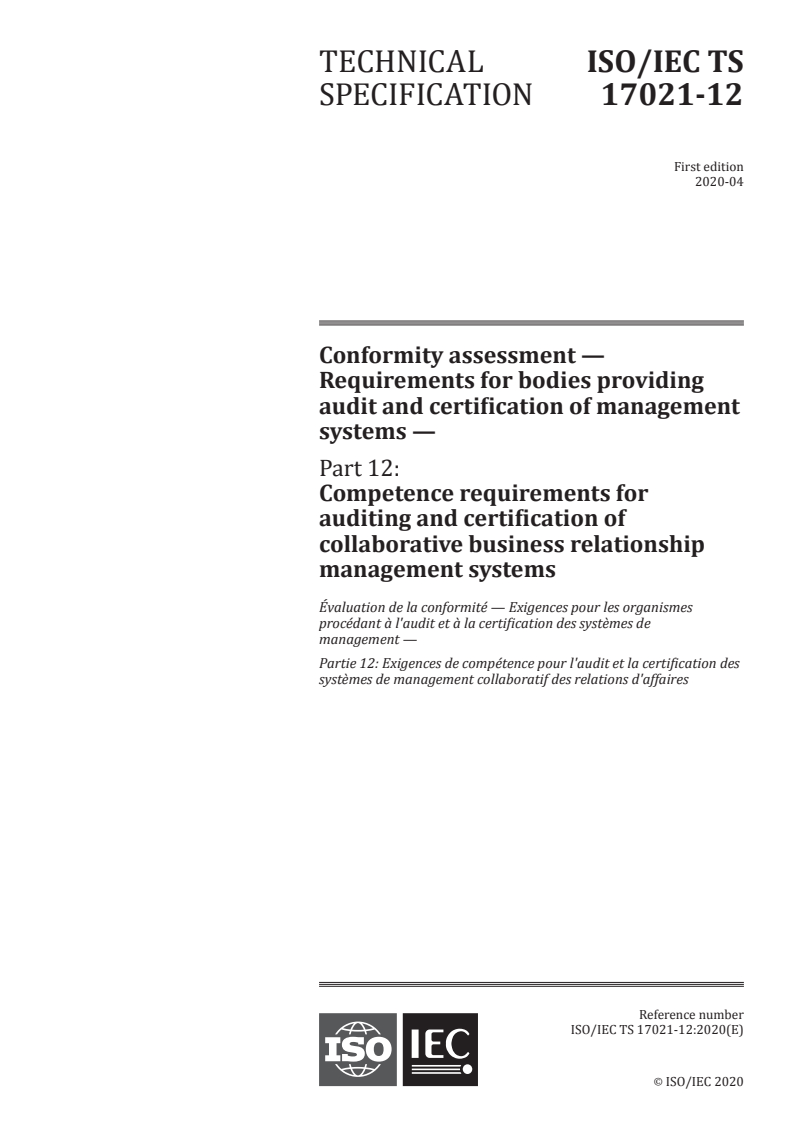
TECHNICAL ISO/IEC TS
SPECIFICATION 17021-12
First edition
2020-04
Conformity assessment —
Requirements for bodies providing
audit and certification of management
systems —
Part 12:
Competence requirements for
auditing and certification of
collaborative business relationship
management systems
Évaluation de la conformité — Exigences pour les organismes
procédant à l'audit et à la certification des systèmes de
management —
Partie 12: Exigences de compétence pour l'audit et la certification des
systèmes de management collaboratif des relations d'affaires
Reference number
©
ISO/IEC 2020
© ISO/IEC 2020
All rights reserved. Unless otherwise specified, or required in the context of its implementation, no part of this publication may
be reproduced or utilized otherwise in any form or by any means, electronic or mechanical, including photocopying, or posting
on the internet or an intranet, without prior written permission. Permission can be requested from either ISO at the address
below or ISO’s member body in the country of the requester.
ISO copyright office
CP 401 • Ch. de Blandonnet 8
CH-1214 Vernier, Geneva
Phone: +41 22 749 01 11
Fax: +41 22 749 09 47
Email: copyright@iso.org
Website: www.iso.org
Published in Switzerland
ii © ISO/IEC 2020 – All rights reserved
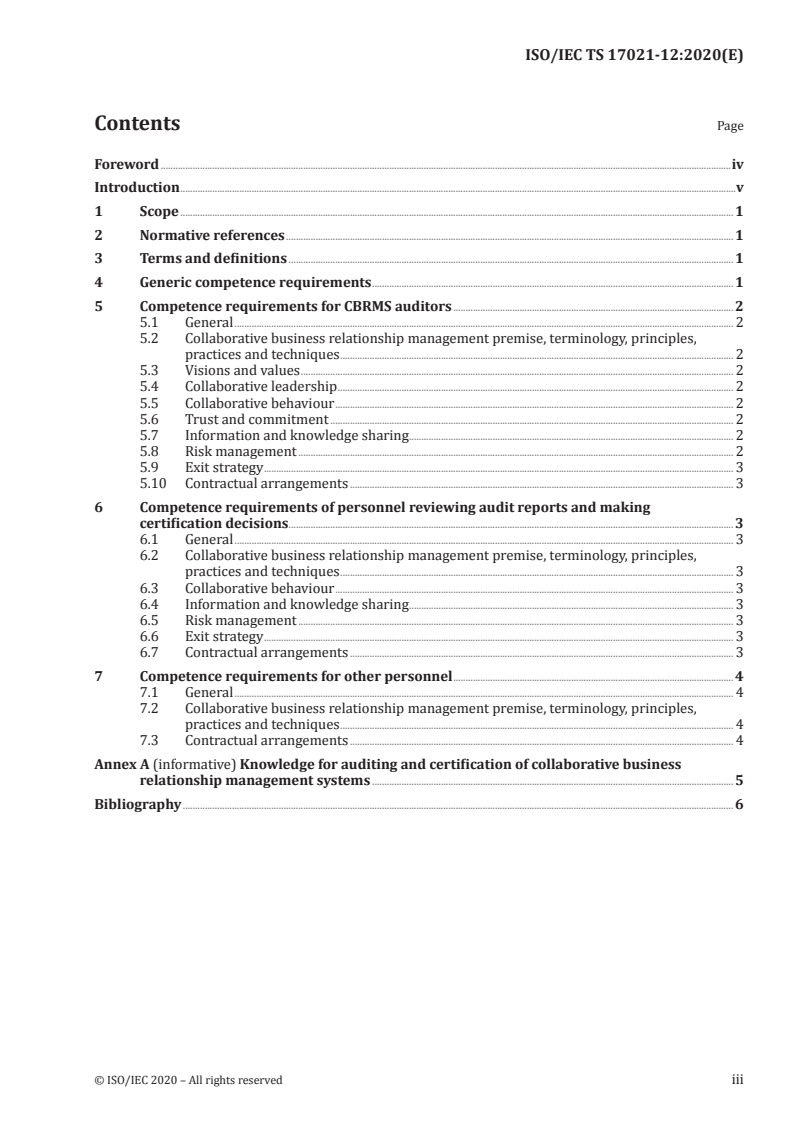
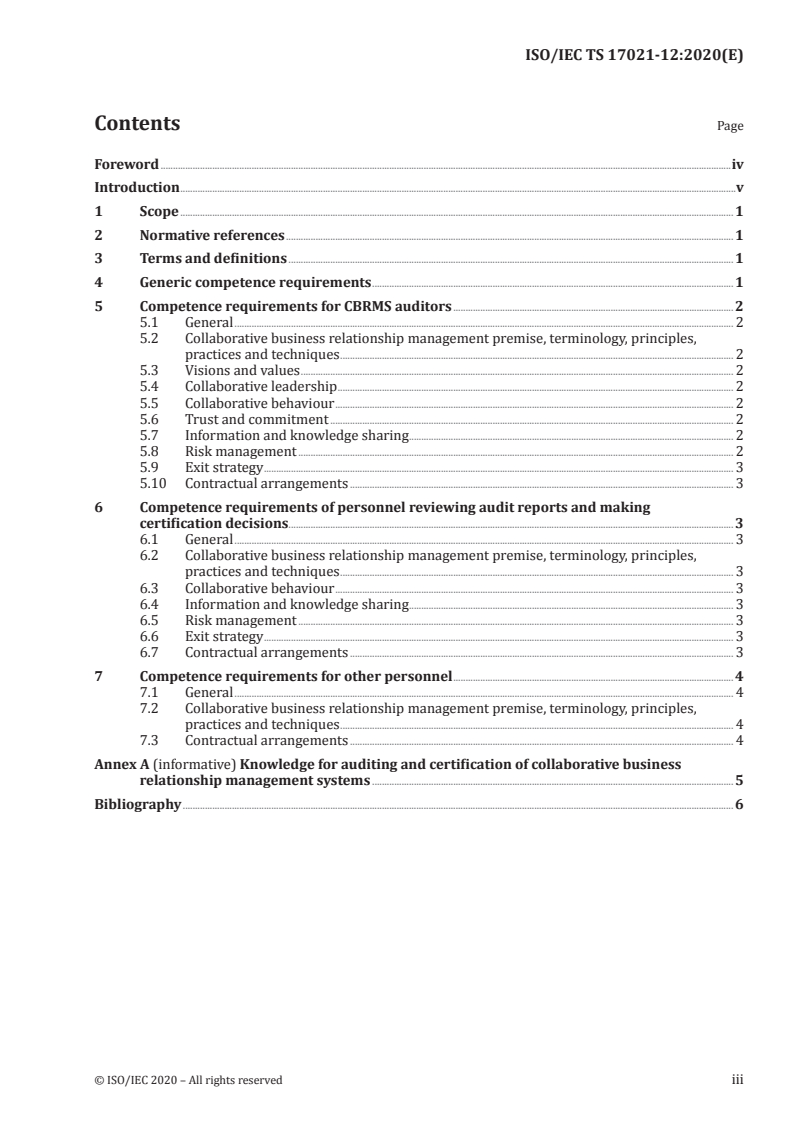
Contents Page
Foreword .iv
Introduction .v
1 Scope . 1
2 Normative references . 1
3 Terms and definitions . 1
4 Generic competence requirements . 1
5 Competence requirements for CBRMS auditors . 2
5.1 General . 2
5.2 Collaborative business relationship management premise, terminology, principles,
practices and techniques . 2
5.3 Visions and values . 2
5.4 Collaborative leadership . 2
5.5 Collaborative behaviour . 2
5.6 Trust and commitment . 2
5.7 Information and knowledge sharing . 2
5.8 Risk management . 2
5.9 Exit strategy . 3
5.10 Contractual arrangements . 3
6 Competence requirements of personnel reviewing audit reports and making
certification decisions. 3
6.1 General . 3
6.2 Collaborative business relationship management premise, terminology, principles,
practices and techniques . 3
6.3 Collaborative behaviour . 3
6.4 Information and knowledge sharing . 3
6.5 Risk management . 3
6.6 Exit strategy . 3
6.7 Contractual arrangements . 3
7 Competence requirements for other personnel . 4
7.1 General . 4
7.2 Collaborative business relationship management premise, terminology, principles,
practices and techniques . 4
7.3 Contractual arrangements . 4
Annex A (informative) Knowledge for auditing and certification of collaborative business
relationship management systems . 5
Bibliography . 6
© ISO/IEC 2020 – All rights reserved iii
Foreword
ISO (the International Organization for Standardization) is a worldwide federation of national standards
bodies (ISO member bodies). The work of preparing International Standards is normally carried out
through ISO technical committees. Each member body interested in a subject for which a technical
committee has been established has the right to be represented on that committee. International
organizations, governmental and non-governmental, in liaison with ISO, also take part in the work.
ISO collaborates closely with the International Electrotechnical Commission (IEC) on all matters of
electrotechnical standardization.
The procedures used to develop this document and those intended for its further maintenance are
described in the ISO/IEC Directives, Part 1. In particular, the different approval criteria needed for the
different types of ISO documents should be noted. This document was drafted in accordance with the
editorial rules of the ISO/IEC Directives, Part 2 (see www .iso .org/ directives).
Attention is drawn to the possibility that some of the elements of this document may be the subject of
patent rights. ISO shall not be held responsible for identifying any or all such patent rights. Details of
any patent rights identified during the development of the document will be in the Introduction and/or
on the ISO list of patent declarations received (see www .iso .org/ patents).
Any trade name used in this document is information given for the convenience of users and does not
constitute an endorsement.
For an explanation of the voluntary nature of standards, the meaning of ISO specific terms and
expressions related to conformity assessment, as well as information about ISO's adherence to the
World Trade Organization (WTO) principles in the Technical Barriers to Trade (TBT), see www .iso .org/
iso/ foreword .html.
This document was prepared by the ISO Committee on Conformity Assessment (CASCO).
A list of all parts in the ISO/IEC 17021 series can be found on the ISO website.
Any feedback or questions on this document should be directed to the user’s national standards body. A
complete listing of these bodies can be found at www .iso .org/ members .html.
iv © ISO/IEC 2020 – All rights reserved
Introduction
ISO 44001 sets out a coherent framework for collaborative business relationship management.
Personnel certifying the management system for collaborative business relationship (CBRMS) need to
have generic competencies described in ISO/IEC 17021-1, as well as the specific management system
competencies described in this document.
This document complements the requirements in ISO/IEC 17021-1 and the guiding principles in
ISO/IEC 17021-1:2015, Clause 4. It clarifies the requirements for the competence of personnel involved
in the certification process set out in ISO/IEC 17021-1:2015, Annex A.
Certification bodies have a responsibility to interested parties, including their clients and the customers
of the organizations whose management systems are certified, to ensure that only those auditors who
demonstrate the relevant competence may conduct collaborative business relationship management
system (CBRMS) audits.
Certification bodies identify the specific audit team competence necessary for the sco
...
TECHNICAL ISO/IEC TS
SPECIFICATION 17021-12
First edition
2020-04
Conformity assessment —
Requirements for bodies providing
audit and certification of management
systems —
Part 12:
Competence requirements for
auditing and certification of
collaborative business relationship
management systems
Évaluation de la conformité — Exigences pour les organismes
procédant à l'audit et à la certification des systèmes de
management —
Partie 12: Exigences de compétence pour l'audit et la certification des
systèmes de management collaboratif des relations d'affaires
Reference number
©
ISO/IEC 2020
© ISO/IEC 2020
All rights reserved. Unless otherwise specified, or required in the context of its implementation, no part of this publication may
be reproduced or utilized otherwise in any form or by any means, electronic or mechanical, including photocopying, or posting
on the internet or an intranet, without prior written permission. Permission can be requested from either ISO at the address
below or ISO’s member body in the country of the requester.
ISO copyright office
CP 401 • Ch. de Blandonnet 8
CH-1214 Vernier, Geneva
Phone: +41 22 749 01 11
Fax: +41 22 749 09 47
Email: copyright@iso.org
Website: www.iso.org
Published in Switzerland
ii © ISO/IEC 2020 – All rights reserved
Contents Page
Foreword .iv
Introduction .v
1 Scope . 1
2 Normative references . 1
3 Terms and definitions . 1
4 Generic competence requirements . 1
5 Competence requirements for CBRMS auditors . 2
5.1 General . 2
5.2 Collaborative business relationship management premise, terminology, principles,
practices and techniques . 2
5.3 Visions and values . 2
5.4 Collaborative leadership . 2
5.5 Collaborative behaviour . 2
5.6 Trust and commitment . 2
5.7 Information and knowledge sharing . 2
5.8 Risk management . 2
5.9 Exit strategy . 3
5.10 Contractual arrangements . 3
6 Competence requirements of personnel reviewing audit reports and making
certification decisions. 3
6.1 General . 3
6.2 Collaborative business relationship management premise, terminology, principles,
practices and techniques . 3
6.3 Collaborative behaviour . 3
6.4 Information and knowledge sharing . 3
6.5 Risk management . 3
6.6 Exit strategy . 3
6.7 Contractual arrangements . 3
7 Competence requirements for other personnel . 4
7.1 General . 4
7.2 Collaborative business relationship management premise, terminology, principles,
practices and techniques . 4
7.3 Contractual arrangements . 4
Annex A (informative) Knowledge for auditing and certification of collaborative business
relationship management systems . 5
Bibliography . 6
© ISO/IEC 2020 – All rights reserved iii
Foreword
ISO (the International Organization for Standardization) is a worldwide federation of national standards
bodies (ISO member bodies). The work of preparing International Standards is normally carried out
through ISO technical committees. Each member body interested in a subject for which a technical
committee has been established has the right to be represented on that committee. International
organizations, governmental and non-governmental, in liaison with ISO, also take part in the work.
ISO collaborates closely with the International Electrotechnical Commission (IEC) on all matters of
electrotechnical standardization.
The procedures used to develop this document and those intended for its further maintenance are
described in the ISO/IEC Directives, Part 1. In particular, the different approval criteria needed for the
different types of ISO documents should be noted. This document was drafted in accordance with the
editorial rules of the ISO/IEC Directives, Part 2 (see www .iso .org/ directives).
Attention is drawn to the possibility that some of the elements of this document may be the subject of
patent rights. ISO shall not be held responsible for identifying any or all such patent rights. Details of
any patent rights identified during the development of the document will be in the Introduction and/or
on the ISO list of patent declarations received (see www .iso .org/ patents).
Any trade name used in this document is information given for the convenience of users and does not
constitute an endorsement.
For an explanation of the voluntary nature of standards, the meaning of ISO specific terms and
expressions related to conformity assessment, as well as information about ISO's adherence to the
World Trade Organization (WTO) principles in the Technical Barriers to Trade (TBT), see www .iso .org/
iso/ foreword .html.
This document was prepared by the ISO Committee on Conformity Assessment (CASCO).
A list of all parts in the ISO/IEC 17021 series can be found on the ISO website.
Any feedback or questions on this document should be directed to the user’s national standards body. A
complete listing of these bodies can be found at www .iso .org/ members .html.
iv © ISO/IEC 2020 – All rights reserved
Introduction
ISO 44001 sets out a coherent framework for collaborative business relationship management.
Personnel certifying the management system for collaborative business relationship (CBRMS) need to
have generic competencies described in ISO/IEC 17021-1, as well as the specific management system
competencies described in this document.
This document complements the requirements in ISO/IEC 17021-1 and the guiding principles in
ISO/IEC 17021-1:2015, Clause 4. It clarifies the requirements for the competence of personnel involved
in the certification process set out in ISO/IEC 17021-1:2015, Annex A.
Certification bodies have a responsibility to interested parties, including their clients and the customers
of the organizations whose management systems are certified, to ensure that only those auditors who
demonstrate the relevant competence may conduct collaborative business relationship management
system (CBRMS) audits.
Certification bodies identify the specific audit team competence necessary for the sco
...