


ISO/R 1195:1970
(Main)Withdrawal of ISO/R 1195-1970
Withdrawal of ISO/R 1195-1970
Annulation de l'ISO/R 1195-1970
General Information
- Status
- Withdrawn
- Publication Date
- 31-May-1970
- Withdrawal Date
- 31-May-1970
- Technical Committee
- ISO/TC 61 - Plastics
- Drafting Committee
- ISO/TC 61 - Plastics
- Current Stage
- 9599 - Withdrawal of International Standard
- Start Date
- 01-Dec-1980
- Completion Date
- 12-Feb-2026
Get Certified
Connect with accredited certification bodies for this standard

Smithers Quality Assessments
US management systems and product certification.

DIN CERTCO
DIN Group product certification.
Sponsored listings
Frequently Asked Questions
ISO/R 1195:1970 is a standard published by the International Organization for Standardization (ISO). Its full title is "Withdrawal of ISO/R 1195-1970". This standard covers: Withdrawal of ISO/R 1195-1970
Withdrawal of ISO/R 1195-1970
ISO/R 1195:1970 is classified under the following ICS (International Classification for Standards) categories: 83.080.01 - Plastics in general. The ICS classification helps identify the subject area and facilitates finding related standards.
ISO/R 1195:1970 is available in PDF format for immediate download after purchase. The document can be added to your cart and obtained through the secure checkout process. Digital delivery ensures instant access to the complete standard document.
Standards Content (Sample)
Ref. No. : ISO/R 1195-1970(E)
UDC 678.5/.8 - 416 : 620.165.29
INTERN ATi O N A L ORGAN iZAT I O N FOR STAND A RD IZATl O N
IS0 RECOMMENDATION
PLASTl CS
DETERMINATION OF THE WATER VAPOUR TRANSMISSION RATE
OF PLASTICS FILMS AND THIN SHEETS
DISH METHOD
1st EDITION
June 1970
COPYRIGHT RESERVED
The copyright of IS0 Recommendations and IS0 Standards
belongs to IS0 Member Bodies. Reproduction of these
documents, in any country, may be authorized therefore only
by the national standards organization of that country, being
a member of ISO.
For each individual country the only valid standard is the national standard of that country.
Printed in Switzerland
Also issued in French and Russian. Copies to be obtained through the national standards organizations.
-2-
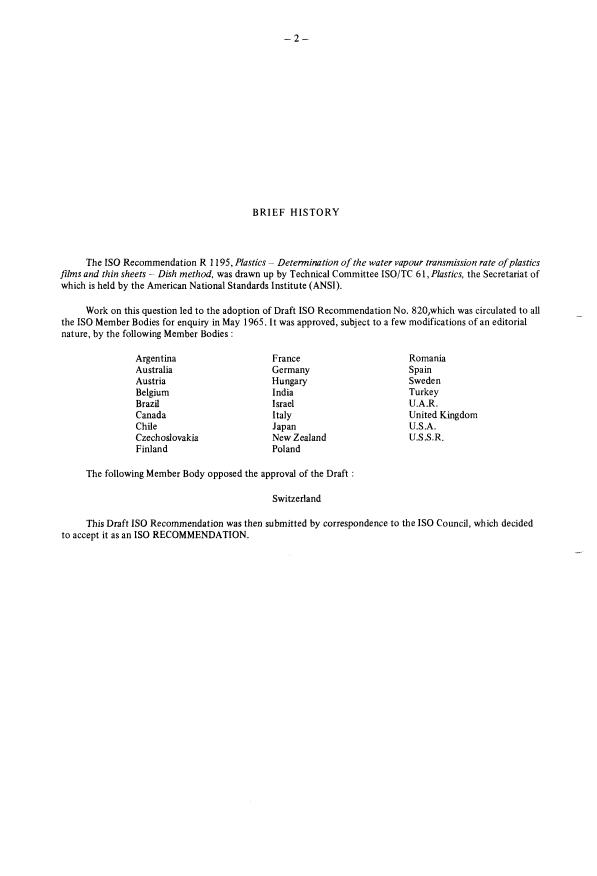
BRIEF HISTORY
The IS0 Recommendation R 1 195, Plastics - Determination of the water vapour pansmission rate of plastics
films and thin sheets - Dish method, was drawn up by Technical Committee ISOlTC 6 1, Plastics, the Secretariat of
which is held by the American National Standards Institute (ANSI).
Work on this question led to the adoption of Draft IS0 Recommendation No. 820,which was circulated to all
the IS0 Member Bodies for enquiry in May 1965. It was approved, subject to a few modifications of an editorial
nature, by the foilowing Member Bodies :
Argentina France Romania
Australia Germany Spain
Austria Hungary Sweden
Turkey
Belgium India
Brazil Israel U.A.R.
Canada Italy United Kingdom
Chile Japan U.S.A.
New Zealand U.S.S.R.
Czechoslovakia
Finland Poland
The following Member Body opposed the approval of the Draft :
Switzerland
This Draft IS0 Recommendation was then submitted by correspondence to the IS0 Council, which decided
to accept it as an IS0 RECOMMENDATION.
ISO/R 1 195 -1 970 (E)
-3-
IS0 Recommendation R 1195 June 1970
P LAST I CS
DETERMINATION OF THE WATER VAPOUR TRANSMISSION RATE*
OF PLASTICS FILMS AND THIN SHEETS
DISH METHOD
1. SCOPE
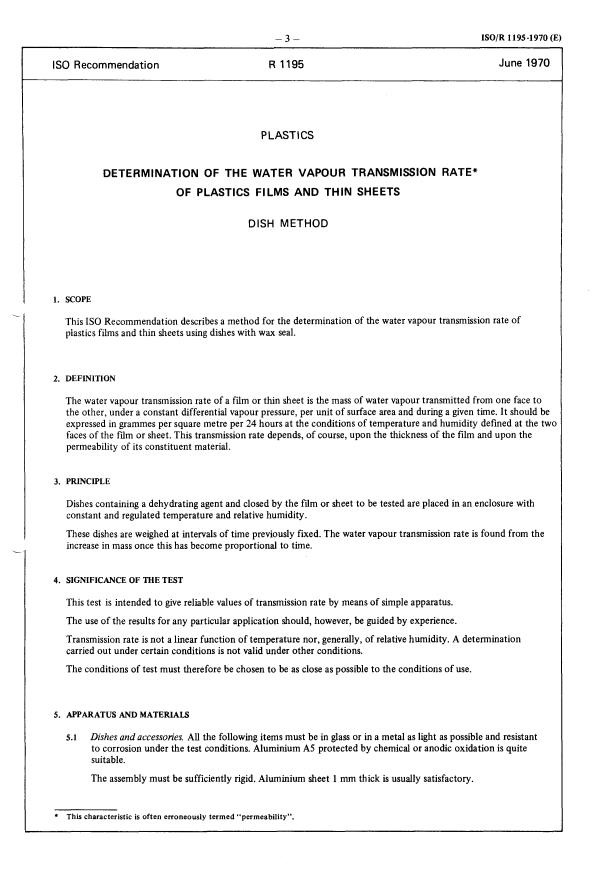
This IS0 Recommendation describes a method for the determination of the water vapour transmission rate of
plastics films and thin sheets using dishes with wax seal.
2. DEFINITION
The water vapour transmission rate of a film or thin sheet is the mass of water vapour transmitted from one face to
the other, under a constant differential vapour pressure, per unit of surface area and during a given time. It should be
expressed in grammes per square metre per 24 hours at the conditions of temperature and humidity defined at the two
faces of the film or sheet. This transmission rate depends, of course, upon the thickness of the film and upon the
permeability of its constituent material.
3. PRINCIPLE
Dishes containing a dehydrating agent and closed by the film or sheet to be tested are placed in an enclosure with
constant and regulated temperature and relative humidity.
These dishes are weighed at intervals of time previously fixed. The water vapour transmission rate is found from the
increase in mass once this has become proportional to time.
4. SIGNIFICANCE OF THE TEST
This test is intended to give reliable values of transmission rate by means of simple apparatus.
The use of the results for any particular application should, however, be guided by experience.
Transmission rate is not a linear function of temperature nor, generally, of relative humidity. A determination
carried out under certain conditions is not valid under other conditions.
The conditions of test must therefore be chosen to be as close as possible to the conditions of use.
5. APPARATUS AND MATERIALS
Dishes and accessories. All the following items must be in glass or in a metal as light as possible and resistant
5.1
to corrosion under the test conditions. Aluminium AS protected by chemical or anodic oxidation is quite
suitable.
The assembly must be sufficiently rigid. Aluminium sheet 1 mm thick is usually satisfactory.
*
This characteristic is often erroneously termed “permeability”.
I
ISO/R 1195-1970 (E)
-4-
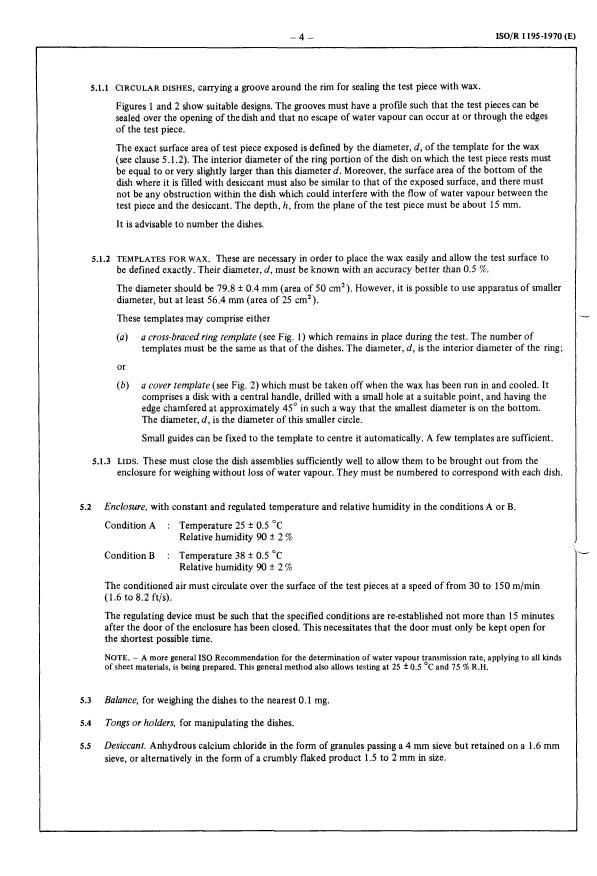
5.1.1 CIRCULAR DISHES, carrying a groove around the rim for sealing the test piece with wax.
Figures 1 and 2 show suitable designs. The grooves must have a profile such that the test pieces can be
sealed over the opening of the dish and that no escape of water vapour can occur at or through the edges
of the test piece.
The exact surface area of test piece exposed is defined by the diameter, d, of the template for the wax
(see clause 5.1.2). The interior diameter of the ring portion of the dish on which the test piece rests must
be equal to or very slightly larger than this diameter d. Moreover, the surface area of the bottom of the
dish where it is filled with desiccant must also be similar to that of the exposed surface, and there must
not be any obstruction within the dish which could interfere with the flow of water vapour between the
test piece and the desiccant. The depth, h, from the plane of the test piece must be about 15 mm.
It is advisable to number the dishes.
5.1.2 TEMPLATES FOR WAX. These are necessary in order to place the wax easily and allow the test surface to
be defined exactly. Their diameter, d, must be known with an accuracy better than 0.5 %.
The diameter should be 79.8 f 0.4 mm (area of 50 cm'). However, it is possible to use apparatus of smaller
diameter, but at least 56.4 mm (area of 25 cm').
These templates may comprise either
a cross-bracedring template (see Fig. 1) which remains in place during the test. The number of
(a)
templates must be the same as that of the dishes. The diameter, d, is the interior diameter of the ring;
or
a cover template (see Fig. 2) which must be taken off when the wax has been run in and cooled. It
(b)
comprises a disk with a central handle, drilled with a small hole at a suitable point, and having the
edge chamfered at approximately 45" in such a way that the smallest diameter is on the bottom.
The diameter, d, is the diameter of this smaller circle.
Small guides can be fixed to the template to centre it automatically. A few templates are sufficient.
5.1.3 LIDS. These must close the dish assemblies sufficiently well to allow them to be brought out from the
enclosure for weighing without loss of water vapour. They must be numbered to correspond with each dish.
Enclosure, with constant and regulated temperature and relative humidity in the conditions A or B.
5.2
Condition A : Temperature 25 t. 0.5 "C
Relative humidity 90 I 2 %
Condition B : Temperature 38 f 0.5 "C
Relative humidity 90 * 2 %
The conditioned air must circulate over the surface of the test pieces at a speed of from 30 to 150 m/min
(1.6 to 8.2 ft/s).
The regulating device must be such that the specified conditions are re-established not more than 15 minutes
after the door of the enclosure has been closed. This necessitates that the door must only be kept open for
the shortest possible time.
NOTE. - A more general IS0 Recommendation for the determination of water vapour transmission rate, applying to all kinds
of sheet materials, is being prepared. This general method also allows testing at 25 f 0.5 OC and 75 % R.H.
5.3 Balance, for weighing the dishes to the nearest 0.1 mg.
5.4 Tongs or holders, for manipulating the dishes.
5.5 Desiccant. Anhydrous calcium chloride in the form of granules passing a 4 mm sieve but retained on a 1.6 mm
sieve, or alternatively in the form of a crumbly flaked product 1.5 to 2 mm in size.
-5- ISO/R 1195-1970 (E)
ring
Wax
I
Dish
Test piece
FIG. 1 - Cross-braced ring template and dish
Template cover
&
Wax
Test piece Dish
FIG. 2 - Cover template and dish
ISO/R 1195-1970 (E)
-6-
5.6 Sealing material. A wax mixture which adheres strongly both to the dish and the test piece, and is not brittle
at ordinary temperature, not hygroscopic and not susceptible to oxidation. A surface of 50 cni' of freshly
nielted wax when expcsed for 24 hours in condition B (
...
m
Rif. No : ISO/R 1195-1970 (F)
CDU 678.5/.8 - 416 620.165.29
IS0
ORGAN IS AT I ON I N T ER N AT I O N A LE DE NORM A LI SAT1 ON
RECOMMANDATION IS0
MATIÈREJ PLASTIQUES
DÉTERMINATION DU TAUX DE TRANSMISSION DE LA VAPEUR D‘EAU
FAR Lw FEUILLES ET PLAQUES MINCES r_aidRES PLASTIQUES
MÉTHODE DE LA CAPSULE
EDITION
Juin 1970
REPRODUCTION INTERDITE
Le droit de reproduction des Recommandations IS0 et des Normes
IS0 est la propriétd des Comités Membres de 1’ISO. En consé-
quence, dans chaque pays, la reproduction de ces documents ne
peut être autorisée que par l’organisation nationale de normali-
sation de ce pays, membre de 1’ISO.
Seules les normes nationales sont valables dans leurs pays respectifs.
Imprimé en Suisse
Ce document est également édité en anglais et en russe. I1 peut être obtenu auprès des organisations
nationales de normalisation.
-2-
HISTORIQUE
La Recommandation ISO/R 1195,Matières plastiques - Détermination du taux de transmission de la vapeur
d’eau par les feuilles et plaques minces en matières plastiques - Méthode de la capsule, a été élaborée par le Comité
Technique ISO/TC 6 1, Matières plastiques, dont le Secrétariat est assuré par l’American National Standards
Institute (ANSI).
Les travaux relatifs à cette question aboutirent à l’adoption du Projet de Recommandation IS0 No 820 qui
fut soumis, en mai 1965, à l’enquête de tous les Comités Membres de I’ISO. I1 fut approuvé, sous réserve de quelques
modifications d’ordre rédactionnel, par les Comités Membres suivants :
Allemagne Finlande R.A.17.
Argentine France Roumanie
Royaume-Uni
Australie Hongrie
Inde Suède
Autriche
Israël Tchécoslovaquie
Belgique
Italie Turquie
Brésil
Canada Japon U.R.S.S.
Chili Nouvelle-Zélande [J.S.A.
Espagne Pologne
Le Comité Membre suivant se déclara opposé à l’approbation du Projet :
Suisse
Cc Projet de Recommandation IS0 fut alors soumis par correspondance au Conseil de VISO, qui décida de
l’accepter comme RECOMMANDATION ISO.
-3- ISO/R 1195-1970 (F
Recommandation IS0 R 1195 Juin 1970
MATI ÈRES PLASTIQUES
D~TERMINATION DU TAUX DE TRANSMISSION DE LA VAPEUR D‘EAU*
PAR LES FEUILLES ET PLAQUES MINCES EN MATIÈRES PLASTIQUES
MÉTHODE DE LA CAPSULE
1. OBJET
La présente Recommandation IS0 décrit une méthode pour la détermination du taux de transmission de la
vapeur d’eau par les feuilles et plaques minces en matières plastiques par la méthode de la capsule avec scellement
à la cire.
2. DÉFINITION
Le taux de transmission de la vapeur d’eau d’une feuille ou plaque mince est la masse de vapeur d’eau transmise
d‘une face à l’autre, sous une tension de vapeur différentielle constante, par unité de surface et pendant un temps
donné. I1 doit être exprimé en grammes par mètre carré et par 24 heures, les conditions de température et d’hygro-
métrie étant définies sur les deux faces de la feuille ou plaque. Ce taux de transmission dépend, bien entendu, de
l’épaisseur de la feuille mince et de la perméabilité de la matière dont elle est constituée.
3. PRINCIPE
Des capsules, contenant un déshydratant et obturées par la feuiile ou plaque à essayer, sont placées dans une enceinte
réglée à température et humidité relative constantes.
Ces capsules sont pesées à intervalles de temps préalablement fixés. L’augmentation de masse permet, dès qu’elle est
proportionnelle au temps, de déterminer le taux de transmission de la vapeur d’eau.
4. SIGNIFICATION DE L‘ESSAI
Le but de cet essai est d’obtenir, au moyen d‘un appareillage simple, des valeurs sûres du taux de transmission de la
vapeur d’eau.
L‘utilisation de ces valeurs pour un emploi donné doit cependant être déterminée par expérience.
Le taux de transmission n’est pas une fonction linéaire de la température ni, généralement, de l’humidité relative.
Une détermination faite dans certaines conditions ne peut donner d’indication valable dans d’autres conditions.
Les conditions d‘essai doivent donc être choisies le plus près possible des conditions d’emploi.
5. APPAREILLAGE ET PRODUITS
5.1
Capsules er accessoires. Toutes les pièces suivantes doivent être en verre ou en un métal aussi léger que possible
et résistant à la corrosion dans les conditions de l’essai. L’aluminium A5 protégé par oxydation chimique ou
anodique convient parfaitement.
L‘ensemble doit être suffisamment rigide. Une tôle d’aluminium de 1 mm d’épaisseur convient en général.
*
Cette caractéristique est souvent dénommée, de façon erronée, uperméabilitth.
-4- ISO/R 1195-1970 (F)
5.1.1 CAPSULES CIRCULAIRES, comportant une gorge sur le pourtour, pour le scellement de l’éprouvette avec
de la cire.
Les Figures 1 et 2 représentent deux modèles convenables. Les gorges des capsules doivent avoir un profil
tel que les éprouvettes puissent être scellées sur l’ouverture de la capsule et qu’aucune fuite de vapeur d’eau
ne puisse se produire aux ou à travers les bords de l’éprouvette.
L‘aire exacte de la surface exposée des éprouvettes est définie par le diamètre d du gabarit à cire (voir
paragraphe 5.1.2). Le diamètre intérieur de la partie annulaire de la capsule sur lequel repose l’éprouvette
doit être égal ou très légèrement supérieur à ce diamètre d. De plus, la surface du fond de la capsule remplie
de desséchant doit être voisine de celle de la surface exposée et il ne doit y avoir dans la capsule aucune
obstruction susceptible de restreindre le flux de vapeur d’eau entre l’éprouvette et le desséchant. La profon-
deur h depuis le plan de l’éprouvette doit être d’environ 15 mm.
I1 est conseillé de numéroter les capsules.
5.1.2 GABARITS À CIRE. Ils ont pour but de faciliter la mise en place de la cire et de délimiter exactement la
surface en essai. Leur diamètre, d, doit être connu avec une précision supérieure à 0,5 %.
Ce diamètre doit être de 79,8 f 0,4 mm (surface de 50 cm2). Cependant, il est possible d’utiliser des appareils
de diamètre plus faible, mais d‘au moins 56,4 mm (surface de 25 cm2).
Ils peuvent être constitués par
un anneau-gabarit entretoisé (Fig. 1), qui reste en place pendant l’essai. Le nombre d’anneaux doit
a)
être égal à celui des capsules. Le diamètre d est le diamètre intérieur de l’anneauj
ou
un couvercle-gabarit (Fig. 2), qui doit être enlevé lorsque la cire est coulée et refroidie. I1 est constitué
b)
par un disque muni d’une poignée centrale, percé en un point convenable d’un petit trou et dont le
bord est chanfreiné à 45” environ, de telle façon que le cercle le plus petit soit en dessous. Le diamètre
d est le diamètre de ce petit cercle.
Des petits guides peuvent être fucés au gabarit pour le centrer automatiquement. Quelques appareils suffisent.
5.1.3 COUVERCLES. Ils doivent permettre d’obturer suffisamment les capsules pour pouvoir les sortir de l’enceinte
sans qu’il y ait échange de vapeur d’eau avec l’extérieur. Ils doivent être numérotés et correspondre chacun
à une capsule.
5.2 Enceinte, à température et humidité relative constantes et réglables dans les conditions A ou B.
Conditions A : Température 25 f 0,5 “C
Humidité relative 90 1: 2 70
Conditions B : Température 38 f 0,5 OC
Humidité relative 90 f 2 %
La circulation de l’air conditionné doit être assurée à une vitesse comprise entre 30 et 150 m/min (1,6 6 8,2 ft/s)
à la surface des éprouvettes.
Le dispositif de régulation doit être tel que les conditions spécifiées soient rétablies très peu de temps (15 minute!
au plus) après que la porte de l’enceinte ait été refermée. Cette condition n’est atteinte en général que si la porte
ne reste ouverte que le minimum de temps.
NOTE. - Une Recommandation IS0 plus générale concernant le taux de transmission de la vapeur d’eau, s’appliquant à tous
les types de matériaux en feuilles, est en préparation. Cette méthode générale permet également d’effectuer les essais à 25 f 0,5 O(
et 15 % H.R.
Balance, permettant la pesée des capsules à O, 1 mg près.
5.3
5.4 Pinces ou fourches spéciales pour la manutention des capsules.
5.5 Agent dessiccateur. Chlorure de calcium anhydre sous forme de granules passant au tamis de 4 mm d’ouverture
de mailles, mais non à celui de 1,6 mm d’ouverture, ou sous forme de produit écaillé et friable de 13 à 2 mm.
-5-
ISO/R 1195-1970 (F
k
I
i
l
!
I
.+-
I
l
i
I
l
~ Cire
Capsuie
Eprouvette /y 1
FIG. 1 - Anneau-gabarit entretoisé et capsule
Couvercle-gabarit
Cire
FIG. 2 - Couvercle-gabant et cuvette
-6-
ISO/R 1195-1970 (F)
5.6 Matière pour scellement. Mélange de cire adhérant énergiquement tant à la capsule qu’à l’éprouvette, non
cassant à la température ordinaire, non hygroscopique et non oxydable. LJne surface de 50 cm2 de cire
fraîchement fondue exposée pendant 24 heures dans les conditions B, (voir paragraphe 5.2), ne doit pas
accuser une variation de masse supérieure à 1 mg (voir paragraphe 9.1).
5.7 Dispositif de distribution de cire, tel qu’une pipette à
...
Questions, Comments and Discussion
Ask us and Technical Secretary will try to provide an answer. You can facilitate discussion about the standard in here.
Loading comments...