


ISO 19177-1
(Main)Geographic information — Geospatial application programming interface (API) for tiles — Part 1: Core
Geographic information — Geospatial application programming interface (API) for tiles — Part 1: Core
Information géographique — Interface de programmation d'application (API) géospatiale pour les tuiles — Partie 1: Profil-minimal
General Information
- Status
- Not Published
- Technical Committee
- ISO/TC 211 - Geographic information/Geomatics
- Drafting Committee
- ISO/TC 211/WG 4 - Geospatial services
- Current Stage
- 6000 - International Standard under publication
- Start Date
- 18-Dec-2025
- Completion Date
- 12-Feb-2026
Relations
- Effective Date
- 12-Feb-2026
- Effective Date
- 22-Jun-2024
Overview
ISO 19177-1, titled Geographic Information - Geospatial Application Programming Interface (API) for Tiles - Part 1: Core, is a pivotal international standard developed by ISO/TC 211 and co-produced with the Open Geospatial Consortium (OGC). Published in 2025, this standard specifies the core functionalities of web APIs designed for accessing tiled geospatial data. It establishes fundamental building blocks to facilitate the retrieval, discovery, and metadata handling of geospatial tiles through RESTful web services.
This standard is an ISO adaptation of the OGC API for Tiles Part 1: Core, retaining identical normative content with editorial improvements in line with ISO/IEC Directives. ISO 19177-1 promotes interoperability for geospatial applications by enabling consistent and scalable access to tiled datasets such as vector features, imagery, and coverages, leveraging HTTP-based OpenAPI specifications.
Key Topics
- Core API Behavior for Tile Access: Defines standardized patterns for discovering, requesting, and retrieving tiles from geospatial data collections.
- Tile Metadata and Tilesets: Specifies how APIs must expose metadata including tile matrix sets, spatial extents, and scale partitions for effective client usage.
- Conformance Classes: Introduces modular conformance classes for resources, query parameters, tile encodings, and metadata formats to allow flexible API implementations.
- Tile Matrix Sets and Partitioning: Adopts the OGC Two-Dimensional Tile Matrix Set standard to manage multi-scale, spatially indexed tiles in various coordinate reference systems (CRS).
- RESTful Design and OpenAPI Support: Aligns with OpenAPI Specification 3.0 to facilitate consistent documentation and easy integration across diverse platforms like web, mobile, and desktop.
- Encodings for Tiles: Includes support for common tile encodings such as PNG, JPEG, TIFF, NetCDF, GeoJSON, and Mapbox Vector Tiles.
- Integration with OGC API Standards: Designed for interoperability and extendibility with other OGC/ISO standards including OGC API - Common and ISO 19168-1 for enhanced geospatial data handling.
Applications
ISO 19177-1 plays a critical role in modern geospatial technology landscapes by enabling efficient and standardized access to tiled spatial data. Key practical applications include:
- Web Mapping Services: Offers a modern alternative to OGC Web Map Tile Service (WMTS) by providing a flexible REST API to serve tiled map layers, imagery, or vector data.
- Geospatial Data Portals: Powers spatial data infrastructures and geoportals that require scalable access to high-resolution tiles for client-side rendering or analysis.
- Mobile and Desktop GIS: Enables GIS software and mobile apps to dynamically consume tiled datasets with multi-scale support for offline or low-bandwidth environments.
- Environmental and Earth Observation Systems: Supports tiled delivery of satellite imagery, environmental models, and sensor data covering large geographic extents.
- Smart City and IoT Applications: Facilitates real-time geospatial data delivery using tile-based APIs that can be integrated with location-aware services and Internet of Things platforms.
- Custom Geospatial Solutions: Allows developers to implement tailored geospatial web APIs by mixing core tiles API with other OGC API conformance classes to extend functionality.
Related Standards
ISO 19177-1 complements and integrates within a broader ecosystem of international standards for geospatial data and APIs:
- OGC API - Tiles (Core): The original OGC specification upon which ISO 19177-1 is based.
- OGC Two-Dimensional Tile Matrix Set (TMS): Defines logical models and encodings for tile matrix sets vital for indexing tiles.
- OGC API - Common: Provides base standards for common API patterns such as collections, features, and conformance declarations.
- ISO 19168-1: Covers geographic information - spatial referencing by coordinates - with direct interoperability.
- OpenAPI Specification 3.0: Industry standard for describing RESTful APIs, extensively used to define and document the Tiles API endpoints.
- OGC Web Map Tile Service (WMTS): A predecessor standard for serving map tiles, superseded in flexibility by the Tiles API.
- ISO/IEC Directives, Part 2: Editorial and procedural guidelines ensuring consistency in ISO document drafting.
By adhering to ISO 19177-1, organizations and developers gain access to a robust, standardized API framework that streamlines the exchange and use of tiled geospatial data resources globally, fostering interoperability, enhanced data discoverability, and flexible API design in geospatial applications.
ISO/FDIS 19177-1 - Geographic information — Geospatial application programming interface (API) for tiles — Part 1: Core Released:10/8/2025
REDLINE ISO/FDIS 19177-1 - Geographic information — Geospatial application programming interface (API) for tiles — Part 1: Core Released:10/8/2025
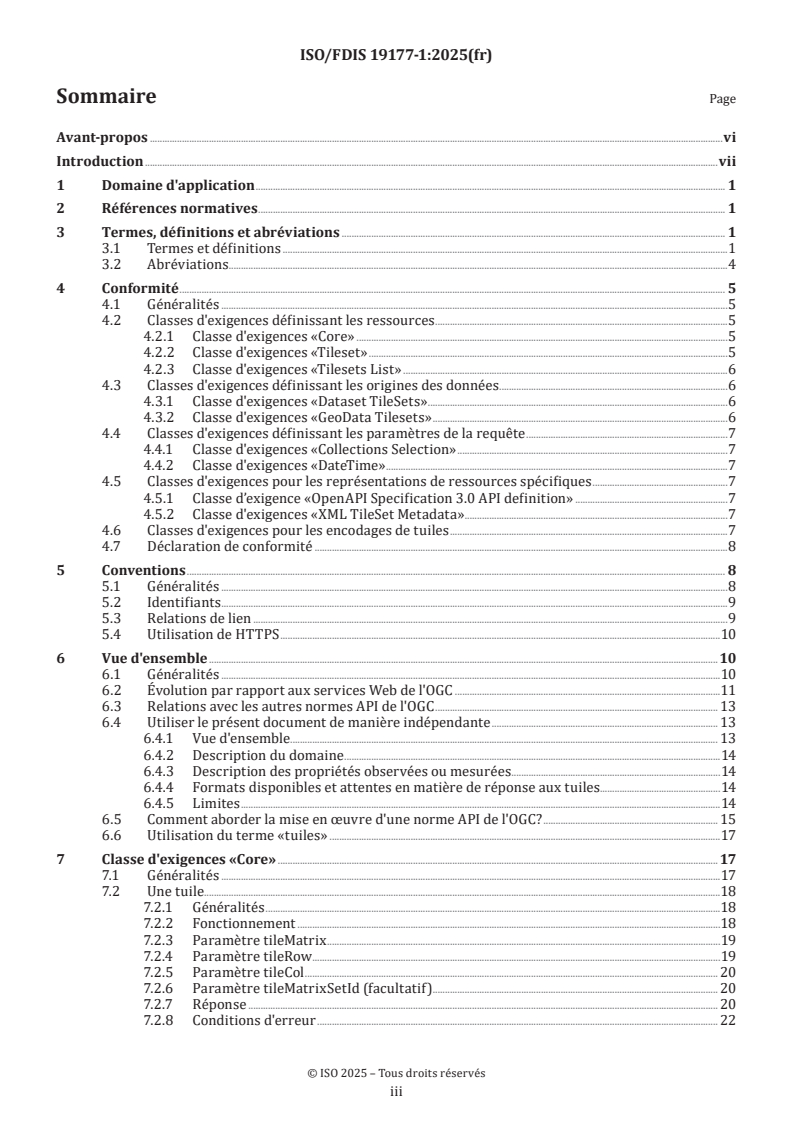
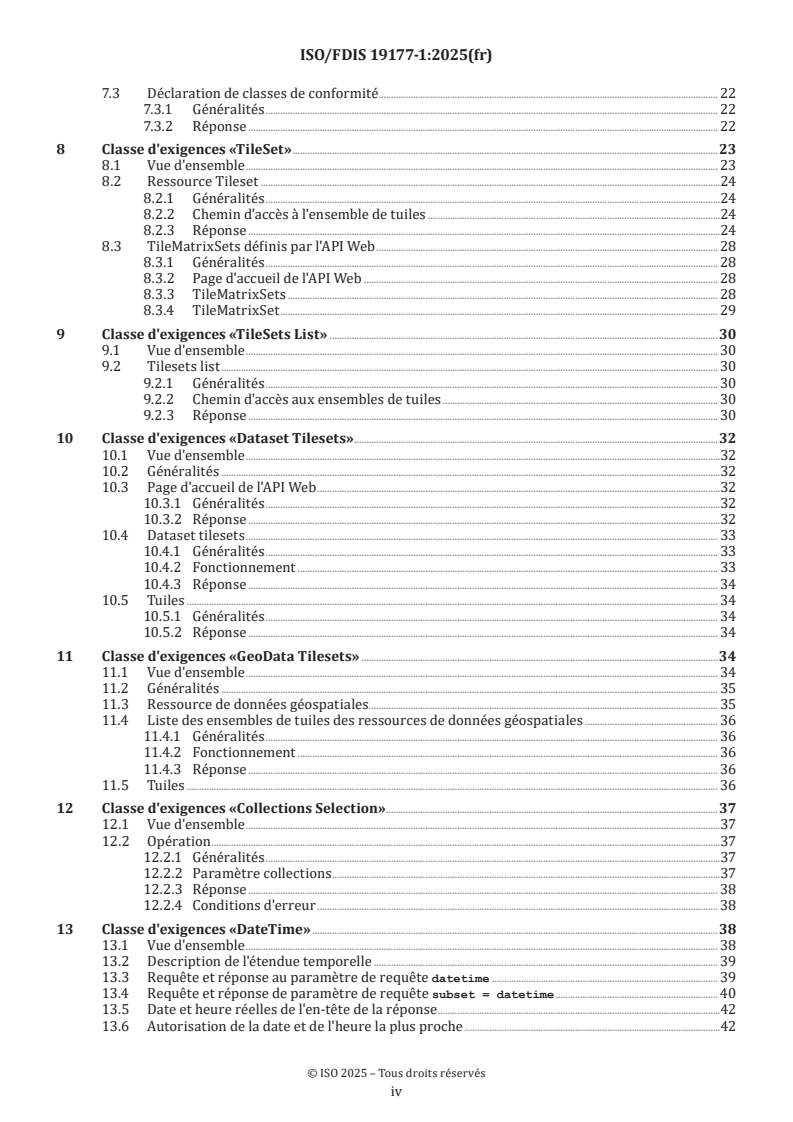
ISO/FDIS 19177-1 - Information géographique — Interface de programmation d'application (API) géospatiale pour les tuiles — Partie 1: Profil-minimal Released:15. 11. 2025
Get Certified
Connect with accredited certification bodies for this standard

BSI Group
BSI (British Standards Institution) is the business standards company that helps organizations make excellence a habit.

NYCE
Mexican standards and certification body.
Sponsored listings
Frequently Asked Questions
ISO 19177-1 is a draft published by the International Organization for Standardization (ISO). Its full title is "Geographic information — Geospatial application programming interface (API) for tiles — Part 1: Core". This standard covers: Geographic information — Geospatial application programming interface (API) for tiles — Part 1: Core
Geographic information — Geospatial application programming interface (API) for tiles — Part 1: Core
ISO 19177-1 is classified under the following ICS (International Classification for Standards) categories: 35.240.70 - IT applications in science. The ICS classification helps identify the subject area and facilitates finding related standards.
ISO 19177-1 has the following relationships with other standards: It is inter standard links to FprEN ISO 19177-1, ISO 21384-3:2023. Understanding these relationships helps ensure you are using the most current and applicable version of the standard.
ISO 19177-1 is available in PDF format for immediate download after purchase. The document can be added to your cart and obtained through the secure checkout process. Digital delivery ensures instant access to the complete standard document.
Standards Content (Sample)
FINAL DRAFT
International
Standard
ISO/FDIS 19177-1
ISO/TC 211
Geographic information —
Secretariat: SIS
Geospatial application
Voting begins on:
programming interface (API) for
2025-10-22
tiles —
Voting terminates on:
2025-12-17
Part 1:
Core
RECIPIENTS OF THIS DRAFT ARE INVITED TO SUBMIT,
WITH THEIR COMMENTS, NOTIFICATION OF ANY
RELEVANT PATENT RIGHTS OF WHICH THEY ARE AWARE
AND TO PROVIDE SUPPOR TING DOCUMENTATION.
IN ADDITION TO THEIR EVALUATION AS
BEING ACCEPTABLE FOR INDUSTRIAL, TECHNO-
ISO/CEN PARALLEL PROCESSING LOGICAL, COMMERCIAL AND USER PURPOSES, DRAFT
INTERNATIONAL STANDARDS MAY ON OCCASION HAVE
TO BE CONSIDERED IN THE LIGHT OF THEIR POTENTIAL
TO BECOME STAN DARDS TO WHICH REFERENCE MAY BE
MADE IN NATIONAL REGULATIONS.
Reference number
ISO/FDIS 19177-1:2025(en) © ISO 2025
FINAL DRAFT
ISO/FDIS 19177-1:2025(en)
International
Standard
ISO/FDIS 19177-1
ISO/TC 211
Geographic information —
Secretariat: SIS
Geospatial application programming
Voting begins on:
interface (API) for tiles —
Part 1:
Voting terminates on:
Core
RECIPIENTS OF THIS DRAFT ARE INVITED TO SUBMIT,
WITH THEIR COMMENTS, NOTIFICATION OF ANY
RELEVANT PATENT RIGHTS OF WHICH THEY ARE AWARE
AND TO PROVIDE SUPPOR TING DOCUMENTATION.
© ISO 2025
IN ADDITION TO THEIR EVALUATION AS
All rights reserved. Unless otherwise specified, or required in the context of its implementation, no part of this publication may
BEING ACCEPTABLE FOR INDUSTRIAL, TECHNO-
ISO/CEN PARALLEL PROCESSING
LOGICAL, COMMERCIAL AND USER PURPOSES, DRAFT
be reproduced or utilized otherwise in any form or by any means, electronic or mechanical, including photocopying, or posting on
INTERNATIONAL STANDARDS MAY ON OCCASION HAVE
the internet or an intranet, without prior written permission. Permission can be requested from either ISO at the address below
TO BE CONSIDERED IN THE LIGHT OF THEIR POTENTIAL
or ISO’s member body in the country of the requester.
TO BECOME STAN DARDS TO WHICH REFERENCE MAY BE
MADE IN NATIONAL REGULATIONS.
ISO copyright office
CP 401 • Ch. de Blandonnet 8
CH-1214 Vernier, Geneva
Phone: +41 22 749 01 11
Email: copyright@iso.org
Website: www.iso.org
Published in Switzerland Reference number
ISO/FDIS 19177-1:2025(en) © ISO 2025
ii
ISO/FDIS 19177-1:2025(en)
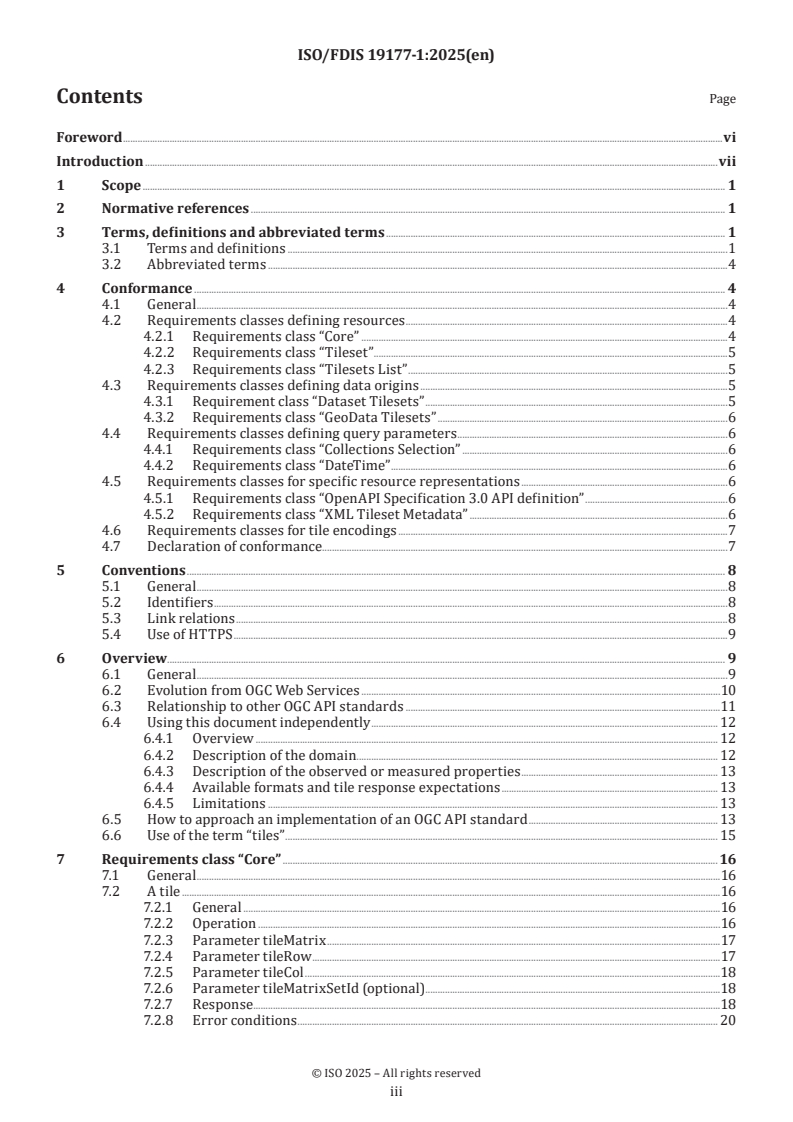
Contents Page
Foreword .vi
Introduction .vii
1 Scope . 1
2 Normative references . 1
3 Terms, definitions and abbreviated terms . 1
3.1 Terms and definitions .1
3.2 Abbreviated terms .4
4 Conformance . 4
4.1 General .4
4.2 Requirements classes defining resources .4
4.2.1 Requirements class “Core” .4
4.2.2 Requirements class “Tileset”.5
4.2.3 Requirements class “Tilesets List” .5
4.3 Requirements classes defining data origins .5
4.3.1 Requirement class “Dataset Tilesets” .5
4.3.2 Requirements class “GeoData Tilesets” .6
4.4 Requirements classes defining query parameters .6
4.4.1 Requirements class “Collections Selection” .6
4.4.2 Requirements class “DateTime” .6
4.5 Requirements classes for specific resource representations .6
4.5.1 Requirements class “OpenAPI Specification 3.0 API definition” .6
4.5.2 Requirements class “XML Tileset Metadata” .6
4.6 Requirements classes for tile encodings .7
4.7 Declaration of conformance.7
5 Conventions . 8
5.1 General .8
5.2 Identifiers .8
5.3 Link relations .8
5.4 Use of HTTPS .9
6 Overview . 9
6.1 General .9
6.2 Evolution from OGC Web Services .10
6.3 Relationship to other OGC API standards .11
6.4 Using this document independently . 12
6.4.1 Overview . 12
6.4.2 Description of the domain. 12
6.4.3 Description of the observed or measured properties . 13
6.4.4 Available formats and tile response expectations . 13
6.4.5 Limitations . 13
6.5 How to approach an implementation of an OGC API standard . 13
6.6 Use of the term “tiles” . 15
7 Requirements class “Core” . 16
7.1 General .16
7.2 A tile .16
7.2.1 General .16
7.2.2 Operation .16
7.2.3 Parameter tileMatrix .17
7.2.4 Parameter tileRow .17
7.2.5 Parameter tileCol .18
7.2.6 Parameter tileMatrixSetId (optional).18
7.2.7 Response . .18
7.2.8 Error conditions . 20
iii
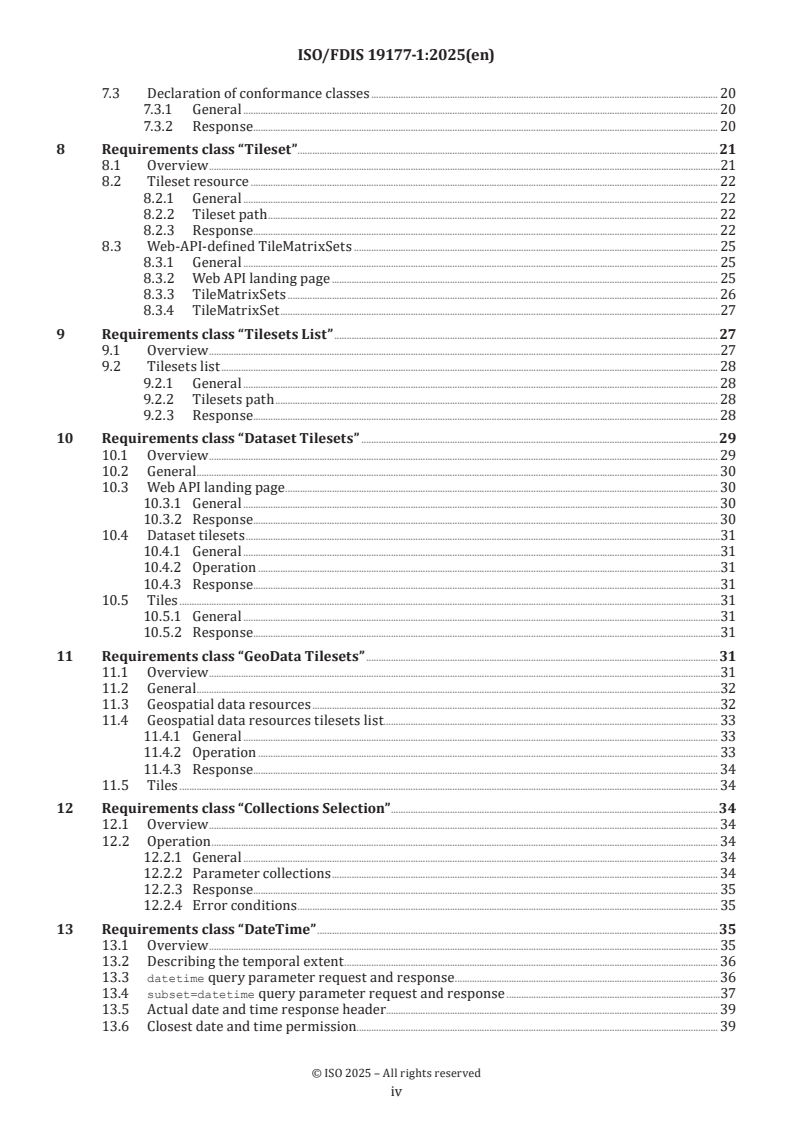
ISO/FDIS 19177-1:2025(en)
7.3 Declaration of conformance classes . 20
7.3.1 General . 20
7.3.2 Response . . 20
8 Requirements class “Tileset” .21
8.1 Overview .21
8.2 Tileset resource . 22
8.2.1 General . 22
8.2.2 Tileset path . 22
8.2.3 Response . . 22
8.3 Web-API-defined TileMatrixSets . 25
8.3.1 General . 25
8.3.2 Web API landing page . 25
8.3.3 TileMatrixSets . 26
8.3.4 TileMatrixSet .27
9 Requirements class “Tilesets List” .27
9.1 Overview .27
9.2 Tilesets list . 28
9.2.1 General . 28
9.2.2 Tilesets path . 28
9.2.3 Response . . 28
10 Requirements class “Dataset Tilesets” .29
10.1 Overview . 29
10.2 General . 30
10.3 Web API landing page . 30
10.3.1 General . 30
10.3.2 Response . . 30
10.4 Dataset tilesets .31
10.4.1 General .31
10.4.2 Operation .31
10.4.3 Response . .31
10.5 Tiles .31
10.5.1 General .31
10.5.2 Response . .31
11 Requirements class “GeoData Tilesets” .31
11.1 Overview .31
11.2 General .32
11.3 Geospatial data resources .32
11.4 Geospatial data resources tilesets list. 33
11.4.1 General . 33
11.4.2 Operation . 33
11.4.3 Response . . 34
11.5 Tiles . 34
12 Requirements class “Collections Selection” .34
12.1 Overview . 34
12.2 Operation . 34
12.2.1 General . 34
12.2.2 Parameter collections . 34
12.2.3 Response . . 35
12.2.4 Error conditions . 35
13 Requirements class “DateTime” .35
13.1 Overview . 35
13.2 Describing the temporal extent . 36
13.3 datetime query parameter request and response . 36
13.4 subset=datetime query parameter request and response .37
13.5 Actual date and time response header . . 39
13.6 Closest date and time permission. 39
iv
ISO/FDIS 19177-1:2025(en)
14 Requirements class “OpenAPI Specification 3.0” .39
14.1 Overview . 39
14.2 Web API OpenAPI description . 39
14.2.1 General . 39
14.2.2 Response . . 40
15 Requirements class “XML Tileset Metadata” .42
15.1 Overview .42
15.2 Tileset and Tilesets List XML representation .43
15.2.1 General .43
15.2.2 Operation .43
15.2.3 Response . .43
16 Requirements classes for tile encodings . .44
16.1 General . 44
16.2 Overview . 44
16.3 Requirements class “PNG” . 44
16.4 Requirements class “JPEG” .45
16.5 Requirements class “TIFF” . 46
16.6 Requirements class “NetCDF” . 46
16.7 Requirements class “GeoJSON” .47
16.8 Requirements class “Mapbox Vector Tiles”. 48
Annex A (normative) Abstract test suite .49
Bibliography .62
v
ISO/FDIS 19177-1:2025(en)
Foreword
ISO (the International Organization for Standardization) is a worldwide federation of national standards
bodies (ISO member bodies). The work of preparing International Standards is normally carried out through
ISO technical committees. Each member body interested in a subject for which a technical committee
has been established has the right to be represented on that committee. International organizations,
governmental and non-governmental, in liaison with ISO, also take part in the work. ISO collaborates closely
with the International Electrotechnical Commission (IEC) on all matters of electrotechnical standardization.
The procedures used to develop this document and those intended for its further maintenance are described
in the ISO/IEC Directives, Part 1. In particular, the different approval criteria needed for the different types
of ISO document should be noted. This document was drafted in accordance with the editorial rules of the
ISO/IEC Directives, Part 2 (see www.iso.org/directives).
ISO draws attention to the possibility that the implementation of this document may involve the use of (a)
patent(s). ISO takes no position concerning the evidence, validity or applicability of any claimed patent
rights in respect thereof. As of the date of publication of this document, ISO had not received notice of (a)
patent(s) which may be required to implement this document. However, implementers are cautioned that
this may not represent the latest information, which may be obtained from the patent database available at
www.iso.org/patents. ISO shall not be held responsible for identifying any or all such patent rights.
Any trade name used in this document is information given for the convenience of users and does not
constitute an endorsement.
For an explanation of the voluntary nature of standards, the meaning of ISO specific terms and expressions
related to conformity assessment, as well as information about ISO’s adherence to the World Trade
Organization (WTO) principles in the Technical Barriers to Trade (TBT), see www.iso.org/iso/foreword.html.
This document was prepared by Technical Committee ISO/TC 211, Geographic information/Geomatics, in
collaboration with the European Committee for Standardization (CEN) Technical Committee CEN/TC 287,
Geographic Information, in accordance with the Agreement on technical cooperation between ISO and CEN
(Vienna Agreement), and in collaboration with the Open Geospatial Consortium (OGC).
A list of all parts in the ISO 19177 series can be found on the ISO website.
Any feedback or questions on this document should be directed to the user’s national standards body. A
complete listing of these bodies can be found at www.iso.org/members.html.
vi
ISO/FDIS 19177-1:2025(en)
Introduction
This document is an ISO adaptation of OGC API – Tiles – Part 1: Core (OGC 20-057). The normative content
is identical to that in the OGC standard, but some minor editorial changes have been made to bring this
document in line with the ISO/IEC Directives, Part 2.
This document defines building blocks for implementing web application programming interfaces (APIs)
that support the retrieval of tiled geospatial information. A web API is an application programming interface
for either a web server or a web browser. This document is sometimes referred to as the “Tiles API”.
The OGC suite of web API standards is an extensible framework for building HTTP-based services that can be
accessed in different applications on different platforms such as the web, desktop, mobile, etc. This document
specifies how different forms/types of geospatial resources are supported, such as tiles of vector features
(“vector tiles”), coverages and maps (or imagery). Although this document can be used independently,
the building blocks (e.g. subsets of the API definition that provide for specific functions) can be combined
with other OGC API standards (or the ISO equivalents, such as ISO 19168-1) for additional capabilities or
increased interoperability for specific types of data. This document references OGC Two Dimensional Tile
Matrix Set and Tile Set Metadata, Version 2.0 (OGC 17-083r4). That standard defines logical models and
encodings for specifying tile matrix sets and describing tile sets. A tile matrix set is a tiling scheme that
enables an application to partition and index space based on a set of regular grids defined for multiple scales
in a coordinate reference system (CRS). ®
This document is an alternative to OpenGIS Web Map Tile Service Implementation Standard (OGC 07-057r7).
Instead of a fixed web interface, this document focuses on simple reusable Representational State Transfer
(REST) API building blocks which can be described using the OpenAPI specification. Whereas WTMS ®
OpenGIS Web Map Tile Service Implementation Standard (OGC 07-057r7) focuses on map tiles, this document
is designed to support any form of tiled data.
vii
FINAL DRAFT International Standard ISO/FDIS 19177-1:2025(en)
Geographic information — Geospatial application
programming interface (API) for tiles —
Part 1:
Core
1 Scope
This document specifies the behaviour of web application programming interfaces (APIs) that provide
access to tiles of one or more geospatial data resources (collections) that the web API offers.
This document describes how to:
— discover which resources offered by the web API can be retrieved as tiles;
— get metadata about the available tile sets (including according to which tile matrix set each tile set is
partitioned and the limits of that tile set within a common potentially global tile matrix set);
— request a tile.
The core conformance class is defined in a way that can be easily included in a web API, even if that API does
not conform to the OGC API – Common Standard. A web API can combine some requirements classes of this
document with those of other OGC API standards (including OGC API – Common) to extend the scope of the
web API by adding functionality.
2 Normative references
The following documents are referred to in the text in such a way that some or all of their content constitutes
requirements of this document. For dated references, only the edition cited applies. For undated references,
the latest edition of the referenced document (including any amendments) applies.
Masó, J., Jacovella-St-Louis, J. (eds.) OGC Two Dimensional Tile Matrix Set and Tile Set Metadata. Version 2.0.
OGC 17-083r4. Open Geospatial Consortium, 2022. Available at: https:// docs .ogc .org/ is/ 17 -083r4/ 17 -083r4 .html
Heazel, C. (ed.) OGC API – Common – Part 1: Core. Version 1.0.0. OGC 19-072. Open Geospatial Consortium,
2023. Available at: https:// docs .ogc .org/ is/ 19 -072/ 19 -072 .pdf
3 Terms, definitions and abbreviated terms
3.1 Terms and definitions
For the purposes of this document, the following terms and definitions apply.
ISO and IEC maintain terminology databases for use in standardization at the following addresses:
— ISO Online browsing platform: available at https:// www .iso .org/ obp
— IEC Electropedia: available at https:// www .electropedia .org/
ISO/FDIS 19177-1:2025(en)
3.1.1
coverage tile
tile (3.1.7) that contains information, often in a gridded form, where the values represent observations or
measurements as a count, or quantity using some unit of measure
Note 1 to entry: Coverage tiles are generated in combination with the proposed OGC API – Coverages, and can also be
generated by combining a subset (trim) and resampling operation. Usually, visualizing a coverage tile on a rendering
device implies mapping those values to colours.
Note 2 to entry: Coverages are described in ISO 19123-1.
3.1.2
dataset
collection of data
Note 1 to entry: Published or curated by a single agent, and available for access or download in one or more
serializations or formats.
Note 2 to entry: A web API (3.1.14) implementing OGC API – Common – Part 1: Core (OGC 19-072) often gives access to
a single dataset which may be comprised of one or more geospatial data resources (3.1.3).
[SOURCE: ISO 19168-1:2025, 3.1.1, modified — Note 2 to entry replaced.]
3.1.3
geospatial data resource
web-accessible resource that consists of a set of geospatial data
Note 1 to entry: In this document, geospatial data are sometimes referred to using the abbreviated form "geodata".
Note 2 to entry: In web APIs (3.1.14) implementing OGC API – Common – Part 2: Geospatial Data (OGC 20-024),
geospatial data resources are referred to as collections and are defined in the collections conformance class.
3.1.4
geospatial resource aspect
web-accessible resource that represents a component of geospatial information (e.g. metadata, schemas) or
geospatial data accessed using a particular mechanism and data model (e.g. feature items, tiles (3.1.7), maps,
coverages) of a more generic geospatial data resource (3.1.3) (e.g. a collection)
Note 1 to entry: A geospatial resource aspect is not to be confused with a web accessible resource representation.
While resource representations share the same path and are selected by format negotiation, geospatial aspects use
different paths. Commonly a geospatial aspect is a subpath of a geospatial data resource.
3.1.5
landing page
page whose primary purpose is to contain a description of something else
Note 1 to entry: Landing pages often provide summaries or additional information about the thing that they describe
(e.g. W3C, URLs in Data Primer).
Note 2 to entry: In the context of the OGC API standards, a landing page serves as the root node of the API Resource
tree and provides the information needed to navigate all the resources exposed through the API. The landing page
provides access to the root of a dataset (3.1.2).
3.1.6
map tile
tile (3.1.7) that contains information in a raster form where the values of cells are colours which can be
readily displayed on rendering devices
3.1.7
tile
geometric shape with known properties that can be (but are not necessarily) the result of a tiling
(tessellation) process
Note 1 to entry: A tile consists of a single connected “piece” without “holes” or “lines” (topological disc).
ISO/FDIS 19177-1:2025(en)
Note 2 to entry: In the context of a 2D tile matrix (3.1.8), a tile is one of the rectangular regions of space, which can be
uniquely identified by row and column integer indices, making up the tile matrix.
Note 3 to entry: In the context of a geospatial data tile set (3.1.10), a tile contains data for such a partition of space as
part of an overall set of tiles for that tiled geospatial data.
Note 4 to entry: Tiles are useful to efficiently request, transfer, cache, display, store and process geospatial data for
a specific resolution and area of interest, providing deterministic performance and scalability for arbitrarily large
datasets (3.1.2).
Note 5 to entry: Tiles can contain a variety of data types, such as grid-based pictorial representations (map tiles
(3.1.6)), coverage subsets (coverage tiles (3.1.1)) or feature-based representations (vector tiles (3.1.13)).
[SOURCE: GC Core Tiling Conceptual and Logical Models for 2D Euclidean Space (OGC 19-014r3)]
3.1.8
tile matrix
tiling grid in a given 2D coordinate reference system, associated to a specific scale and partitioning space
into regular conterminous tiles (3.1.7), each of which being assigned a unique identifier
Note 1 to entry: Each tile of a tile matrix is uniquely identifiable by integer indices for the row and the column. The
number of rows is referred to as the matrix height, while the maximum number of columns is referred to as the matrix
width (the number of columns can vary for different rows in variable width tile matrices).
[SOURCE: OGC Two Dimensional Tile Matrix Set and Tile Set Metadata, Version 2.0 (OGC 17-083r4)]
3.1.9
tile matrix set
tiling scheme (3.1.11) consisting of a set of tile matrices defined at different scales covering approximately
the same area and having a common coordinate reference system
[SOURCE: OGC Two Dimensional Tile Matrix Set and Tile Set Metadata, Version 2.0 (OGC 17-083r4)]
3.1.10
tile set
set of tiles (3.1.7) resulting from tiling data according to a particular tiling scheme (3.1.11)
[SOURCE: GC Core Tiling Conceptual and Logical Models for 2D Euclidean Space (OGC 19-014r3), modified — to
clarify that in the context of this document, a tile set refers specifically to a set of tiles containing data and
following a common tiling scheme.]
3.1.11
tiling scheme
scheme that defines how space is partitioned into individual tiles (3.1.7), potentially featuring multiple levels
of detail (each tiling at a different granularity to reflect a different resolution or scale)
Note 1 to entry: A tiling scheme defines the spatial reference system and the geometric properties of each tile defined
by the scheme. Those properties include which space each tile occupies (the tile’s spatial extent), as well as a tile
coordinate origin if a particular corner of origin convention is established.
Note 2 to entry: A tiling scheme can be defined on top of a coordinate reference system (CRS) as well as other spatial
reference systems such as a discrete global grid system (DGGS) and other organizations including irregular ones. In
this document, only tiling schemes based on CRSs are supported.
[SOURCE: OGC Two Dimensional Tile Matrix Set and Tile Set Metadata, Version 2.0 (OGC 17-083r4)]
3.1.12
tile set metadata
additional metadata beyond the common properties defining the tile set (3.1.10)
Note 1 to entry: Metadata describing common properties defining a tile set, layers and styles used to produce the tile
set, the limits of the tile matrix (3.1.8) with actual data and common metadata such as abstract, owner, author, etc.
[SOURCE: OGC Two Dimensional Tile Matrix Set and Tile Set Metadata, Version 2.0 (OGC 17-083r4)]
ISO/FDIS 19177-1:2025(en)
3.1.13
vector tile
tiled vector feature data
tile (3.1.7) that contains vector data that have been generalized (simplified) at the tile scale resolution and
clipped by the tile boundaries
[SOURCE: OGC Two Dimensional Tile Matrix Set and Tile Set Metadata, Version 2.0 (OGC 17-083r4)]
3.1.14
web API
web application programming interface
API using an architectural style that is founded on the technologies of the web
[SOURCE: OGC API – Features – Part 1: Core (OGC 17-069r4)]
3.2 Abbreviated terms
ABNF Augmented Backus Naur Form
API application programming interface
CRS coordinate reference system
DGGS discrete global grid system
HTTP Hypertext Transfer Protocol
HTTPS Hypertext Transfer Protocol Secure
JSON JavaScript Object Notation
MVT Mapbox Vector Tiles
NetCDF Network Common Data Form
REST Representational State Transfer
URI Uniform Resource Identifier
WMS Web Map Service
WMTS Web Map Tile Service
XML Extensible Markup Language
4 Conformance
4.1 General
This document defines multiple requirements classes and their associated conformance classes.
The standardization targets of all conformance classes are “web APIs”.
The Tiles API requirements classes are summarized in 4.2 to 4.6 and in more detail in Clauses 7 to 16.
4.2 Requirements classes defining resources
4.2.1 Requirements class “Core”
Requirements class “Core” (http:// www .opengis .net/ spec/ ogcapi -tiles -1/ 1 .0/ req/ core).
ISO/FDIS 19177-1:2025(en)
The Core requirements class specifies requirements that all
...
ISO/DISFDIS 19177-1:2024(en)
ISO/TC 211/WG 4
Date: 2024-05-23
Secretariat: SIS
Date: 2025-10-07
Geographic Information information — Geospatial application
programming interface (API) for Tiles — tiles —
Part 1:
Core
FDIS stage
ISO/FDIS 19177-1:2025(en)
All rights reserved. Unless otherwise specified, or required in the context of its implementation, no part of this publication
may be reproduced or utilized otherwise in any form or by any means, electronic or mechanical, including photocopying,
or posting on the internet or an intranet, without prior written permission. Permission can be requested from either ISO
at the address below or ISO’s member body in the country of the requester.
ISO copyright office
CP 401 • Ch. de Blandonnet 8
CH-1214 Vernier, Geneva
Phone: + 41 22 749 01 11
E-mail: copyright@iso.org
Website: www.iso.org
Field Code Changed
Published in Switzerland
ii
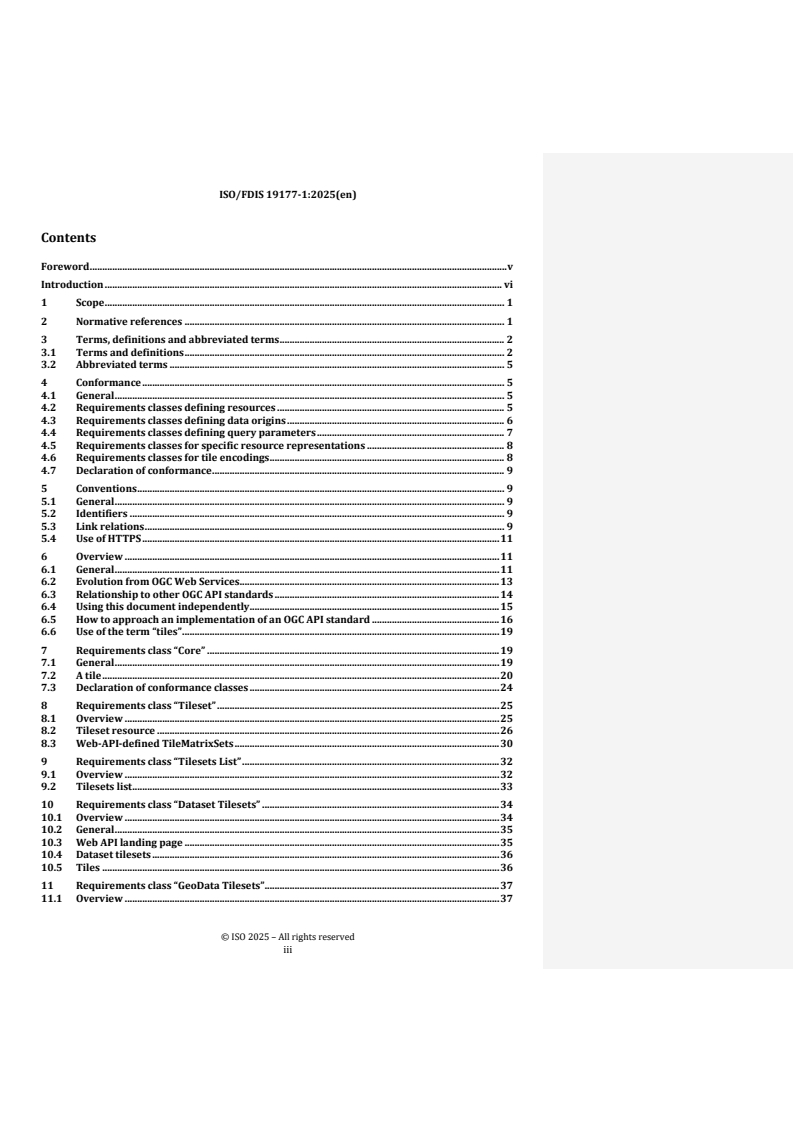
ISO/FDIS 19177-1:2025(en)
Contents
Foreword . v
Introduction . vi
1 Scope . 1
2 Normative references . 1
3 Terms, definitions and abbreviated terms . 2
3.1 Terms and definitions . 2
3.2 Abbreviated terms . 5
4 Conformance . 5
4.1 General . 5
4.2 Requirements classes defining resources . 5
4.3 Requirements classes defining data origins . 6
4.4 Requirements classes defining query parameters . 7
4.5 Requirements classes for specific resource representations . 8
4.6 Requirements classes for tile encodings . 8
4.7 Declaration of conformance . 9
5 Conventions . 9
5.1 General . 9
5.2 Identifiers . 9
5.3 Link relations . 9
5.4 Use of HTTPS . 11
6 Overview . 11
6.1 General . 11
6.2 Evolution from OGC Web Services . 13
6.3 Relationship to other OGC API standards . 14
6.4 Using this document independently . 15
6.5 How to approach an implementation of an OGC API standard . 16
6.6 Use of the term “tiles” . 19
7 Requirements class “Core” . 19
7.1 General . 19
7.2 A tile . 20
7.3 Declaration of conformance classes . 24
8 Requirements class “Tileset” . 25
8.1 Overview . 25
8.2 Tileset resource . 26
8.3 Web-API-defined TileMatrixSets . 30
9 Requirements class “Tilesets List” . 32
9.1 Overview . 32
9.2 Tilesets list . 33
10 Requirements class “Dataset Tilesets” . 34
10.1 Overview . 34
10.2 General . 35
10.3 Web API landing page . 35
10.4 Dataset tilesets . 36
10.5 Tiles . 36
11 Requirements class “GeoData Tilesets”. 37
11.1 Overview . 37
iii
ISO/FDIS 19177-1:2025(en)
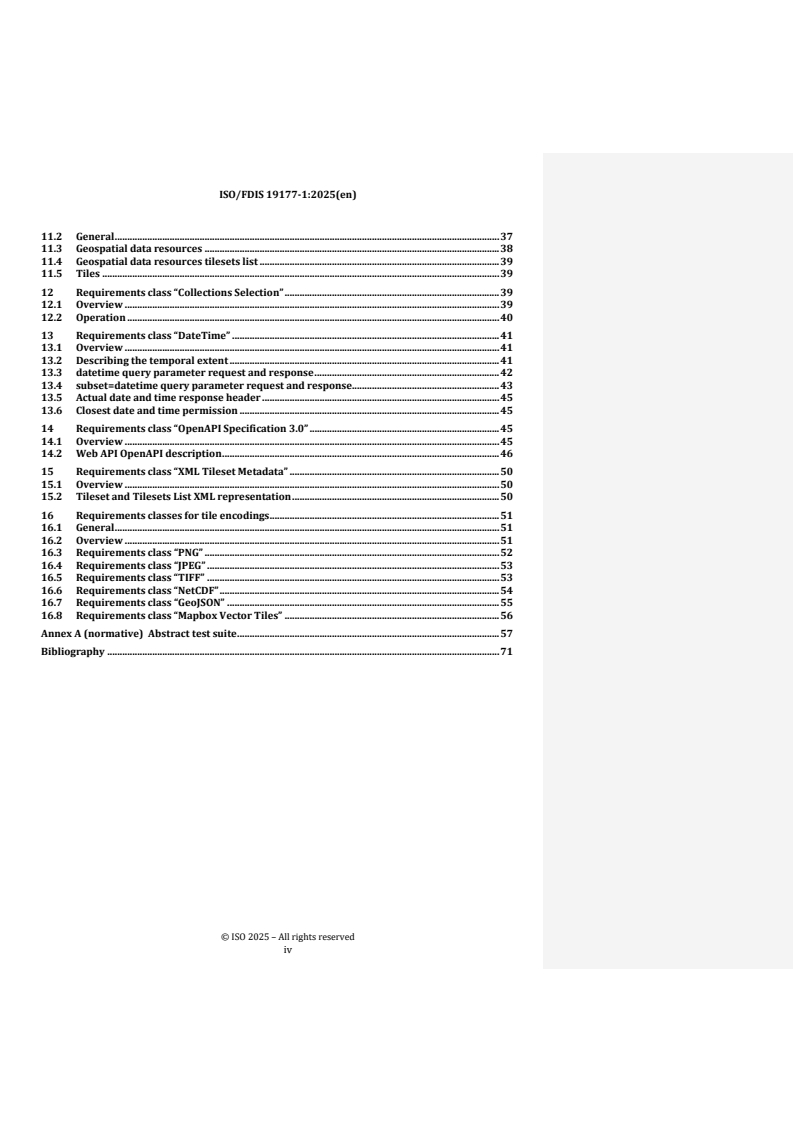
11.2 General . 37
11.3 Geospatial data resources . 38
11.4 Geospatial data resources tilesets list . 39
11.5 Tiles . 39
12 Requirements class “Collections Selection” . 39
12.1 Overview . 39
12.2 Operation . 40
13 Requirements class “DateTime” . 41
13.1 Overview . 41
13.2 Describing the temporal extent . 41
13.3 datetime query parameter request and response . 42
13.4 subset=datetime query parameter request and response . 43
13.5 Actual date and time response header . 45
13.6 Closest date and time permission . 45
14 Requirements class “OpenAPI Specification 3.0” . 45
14.1 Overview . 45
14.2 Web API OpenAPI description . 46
15 Requirements class “XML Tileset Metadata” . 50
15.1 Overview . 50
15.2 Tileset and Tilesets List XML representation . 50
16 Requirements classes for tile encodings . 51
16.1 General . 51
16.2 Overview . 51
16.3 Requirements class “PNG” . 52
16.4 Requirements class “JPEG” . 53
16.5 Requirements class “TIFF” . 53
16.6 Requirements class “NetCDF” . 54
16.7 Requirements class “GeoJSON” . 55
16.8 Requirements class “Mapbox Vector Tiles” . 56
Annex A (normative) Abstract test suite . 57
Bibliography . 71
iv
ISO/FDIS 19177-1:2025(en)
Foreword
ISO (the International Organization for Standardization) is a worldwide federation of national standards
bodies (ISO member bodies). The work of preparing International Standards is normally carried out through
ISO technical committees. Each member body interested in a subject for which a technical committee has been
established has the right to be represented on that committee. International organizations, governmental and
non-governmental, in liaison with ISO, also take part in the work. ISO collaborates closely with the
International Electrotechnical Commission (IEC) on all matters of electrotechnical standardization.
The procedures used to develop this document and those intended for its further maintenance are described
in the ISO/IEC Directives, Part 1. In particular, the different approval criteria needed for the different types of
ISO documentsdocument should be noted. This document was drafted in accordance with the editorial rules
of the ISO/IEC Directives, Part 2 (see www.iso.org/directives).
ISO draws attention to the possibility that the implementation of this document may involve the use of (a)
patent(s). ISO takes no position concerning the evidence, validity or applicability of any claimed patent rights
in respect thereof. As of the date of publication of this document, ISO had not received notice of (a) patent(s)
which may be required to implement this document. However, implementers are cautioned that this may not
represent the latest information, which may be obtained from the patent database available at
www.iso.org/patents. ISO shall not be held responsible for identifying any or all such patent rights.
Any trade name used in this document is information given for the convenience of users and does not
constitute an endorsement.
For an explanation of the voluntary nature of standards, the meaning of ISO specific terms and expressions
related to conformity assessment, as well as information about ISO’s adherence to the World Trade
Organization (WTO) principles in the Technical Barriers to Trade (TBT), see www.iso.org/iso/foreword.html.
This document was prepared by Technical Committee ISO/TC 211, Geographic information/Geomatics, in
collaboration with the European Committee for Standardization (CEN) Technical Committee CEN/TC 287,
Geographic Information, in accordance with the Agreement on technical cooperation between ISO and CEN
(Vienna Agreement), and in collaboration with the Open Geospatial Consortium Inc. (OGC).
A list of all parts in the ISO 19177 series can be found on the ISO website.
Any feedback or questions on this document should be directed to the user’s national standards body. A
complete listing of these bodies can be found at www.iso.org/members.html.
v
ISO/FDIS 19177-1:2025(en)
Introduction
The Geospatial Application Programming Interface (API) for Tiles – Part 1: Core StandardThis document is an
ISO adaptation of the OGC API — – Tiles Standard. – Part 1: Core (OGC 20-057). The normative content is
identical to that in the OGC Standardstandard, but some minor editorial changes have been made to bring this
document in line with the ISO/IEC Directives, Part 2.
This document defines building blocks for implementing Web web application programming interfaces (APIs)
that support the retrieval of tiled geospatial information. A Webweb API is an application programming
interface for either a web server or a web browser [. This document is sometimes referred to as the “Tiles
API.”.
The OGC suite of Webweb API standards is an extensible framework for building HTTP-based services that
can be accessed in different applications on different platforms such as the Webweb, desktop, mobile, etc. This
document specifies how different forms/types of geospatial resources are supported, such as tiles of vector
features (“vector tiles”), coverages, and maps (or imagery). Although this document can be used
independently, the building blocks (e.g.,. subsets of the API definition that provide for specific functions) can
be combined with other OGC API standards (or the ISO equivalents, such as ISO 19168-1) for additional
capabilities or increased interoperability for specific types of data. This document references the OGC Two -
Dimensional Tile Matrix Set (TMS) and Tile Set Metadata Standard [, Version 2.0 (OGC 17-083r4].). That
standard defines logical models and encodings for specifying tile matrix sets and describing tile sets. A tile
matrix set is a tiling scheme that enables an application to partition and index space based on a set of regular
grids defined for multiple scales in a Coordinate Reference Systemcoordinate reference system (CRS). ®
This document is an alternative to the OGC’sOpenGIS Web Map Tile Service (WMTS)Implementation Standard
(OGC 07-057r7). Instead of a fixed Webweb interface, this document focuses on simple reusable
Representational State Transfer (REST) API building blocks which can be described using the OpenAPI ®
specification. Whereas WMTS focusedWhereas WTMS OpenGIS Web Map Tile Service Implementation
Standard (OGC 07-057r7) focuses on map tiles, this document is designed to support any form of tiled data.
vi
Geographic Information information — Geospatial Application
Programming Interfaceapplication programming interface (API) for
Tiles — tiles —
Part 1:
Core
1 Scope
This document specifies the behaviorbehaviour of web Application Programming Interfacesapplication
programming interfaces (APIs) that provide access to tiles of one or more geospatial data resources
(collections) that the web API offers.
This document describes how to:
— discover which resources offered by the web API can be retrieved as tiles, ;
— get metadata about the available tile sets (including according to which tile matrix set each tile set is
partitioned and the limits of that tile set within a common potentially global tile matrix set) and how to
);request a tile.
— request a tile.
The core conformance class is defined in a way that couldcan be easily included in a web API, even if that API
does not conform to the OGC API — – Common Standard. A web API can combine some requirements classes
of this OGC API Standarddocument with those of other OGC API Standardsstandards (including OGC API — –
Common) to extend the scope of the Webweb API by adding functionality.
2 Normative references
The following documents are referred to in the text in such a way that some or all of their content constitutes
requirements of this document. For dated references, only the edition cited applies. For undated references,
the latest edition of the referenced document (including any amendments) applies.
REED C. OGC 19-014r3, Topic 22 — Core Tiling Conceptual and Logical Models for 2D Euclidean Space. Open
Geospatial Consortium (2020). .
MASO, J., JACOVELLA-ST-LOUIS, J. OGC 17-083r4,(eds.) OGC Two Dimensional Tile Matrix Set and Tile Set Metadata.
Version 2.0. OGC 17-083r4. Open Geospatial Consortium (, 2022). Available at: https://docs.ogc.org/is/17-
083r4/17-083r4.html.
HEAZEL, C. (ed.) OGC API — – Common — – Part 1: Core (Draft). Version 1.0.0. OGC 19-072,. Open Geospatial
Consortium,
DOMENICO B. OGC 10-090r3, OGC Network Common Data Form (NetCDF) Core Encoding Standard version 1.0.
Open Geospatial Consortium (2011). .
BUTLER H., DALY M., DOYLE A., GILLIES S., HAGEN S., SCHAUB T. IETF RFC 7946, The GeoJSON Format. (2016). .
Adobe Developers Association: TIFF Specification Revision 6.0. 2023. Available at:(1992)DEVYS E., HABERMANN
T., HEAZEL C., LOTT R., ROUAULT E. OGC 19-008r4, OGC GeoTIFF Standard. Open Geospatial Consortium (2019).
https://docs.ogc.org/is/19-072/19-072.pdf.
ISO/FDIS 19177-1:2025(en)
ISO/IEC 10918-1, Information technology — Digital compression and coding of continuous-tone still images:
Requirements and guidelines. International Organization for Standardization, International Electrotechnical
Commission, Geneva .
ISO/IEC 15948, Information technology — Computer graphics and image processing — Portable Network
Graphics (PNG): Functional specification. International Organization for Standardization, International
Electrotechnical Commission, Geneva .
53 Terms, and definitions and abbreviated terms
3.1 Terms and definitions
For the purposes of this document, the following terms and definitions apply.
ISO and IEC maintain terminologicalterminology databases for use in standardization at the following
addresses:
— ISO Online browsing platform: available at https://www.iso.org/obp
— IEC Electropedia: available at https://www.electropedia.org/
5.1.13.1.1 3.1
coverage tile
tile (3.1.7(3.7)) that contains information, often in a gridded form, where the values represent observations
or measurements as a count, or quantity using some unit of measure
Note 1 to entry: Coverage tiles are generated in combination with the proposed OGC API — – Coverages, and can also be
generated by combining a subset (trim) and resampling operation. Usually, visualizing a coverage tile on a rendering
device implies mapping those values to colorscolours.
Note 2 to entry: Coverages are described in ISO 19123-1.
5.1.23.1.2 3.2
dataset
collection of data
Note 1 to entry: Published or curated by a single agent, and available for access or download in one or more serializations
or formats.
Note 2 to entry: A Webweb API (3.1.14) implementing OGC API — – Common – Part 1: Core (OGC 19-072) often gives
access to a single dataset which may be comprised of one or more geospatial data resources (3.1.3.).
[SOURCE: ISO 19168-1:20202025, 3.1.1], modified — Note 2 to entry replaced.]
5.1.33.1.3 3.3
geospatial data resource
web-accessible resource that consists of a set of geospatial data
Note 1 to entry: In this document, geospatial data are sometimes referred to using the abbreviated form "geodata".
Note 2 to entry: In Webweb APIs (3.1.14) implementing OGC API — – Common — – Part 2: Geospatial Data, (OGC 20-
024), geospatial data resources are referred to as collections and are defined in the collections conformance class.
ISO/FDIS 19177-1:2025(en)
5.1.43.1.4 3.4
geospatial resource aspect
web-accessible resource that represents a component of geospatial information (e.g.,. metadata, schemas) or
geospatial data accessed using a particular mechanism and data model (e.g.,. feature items, tiles (3.1.7,), maps,
coverages) of a more generic geospatial data resource (3.1.3) (e.g.,. a collection)
Note 1 to entry: A geospatial resource aspect is not to be confused with a web accessible resource representation. While
resource representations share the same path and are selected by format negotiation, geospatial aspects use different
paths. Commonly a geospatial aspect is a subpath of a geospatial data resource.
5.1.53.1.5 3.5
landing page
any page whose primary purpose is to contain a description of something else.
Note 1 to entry: Landing pages often provide summaries or additional information about the thing that they describe
(e.g.,. W3C, URLs in Data Primer).
Note 2 to entry: In the context of the OGC API Standardsstandards, a landing page serves as the root node of the API
Resource tree and provides the information needed to navigate all the resources exposed through the API. The landing
page provides access to the root of a dataset (3.1.2.).
5.1.63.1.6 3.6
map tile
tile (3.1.7) that contains information in a raster form where the values of cells are colorscolours which can be
readily displayed on rendering devices
5.1.73.1.7 3.7
tile
geometric shape with known properties that can be (but are not necessarily) the result of a tiling (tessellation)
process.
Note 1 to entry: A tile consists of a single connected “piece” without “holes” or “lines” (topological disc) ).
Note 2 to entry: In the context of a 2D tile matrix (3.1.8,), a tile is one of the rectangular regions of space, which can be
uniquely identified by row and column integer indices, making up the tile matrix.
Note 3 to entry: In the context of a geospatial data tile set (3.1.10,), a tile contains data for such a partition of space as part
of an overall set of tiles for that tiled geospatial data.
Note 4 to entry: From OGC 17-083r4: OGC Two Dimensional Tile Matrix Set and Tile Set Metadata standard
Note 5 to entry: Note 4 to entry: Tiles are useful to efficiently request, transfer, cache, display, store and process
geospatial data for a specific resolution and area of interest, providing deterministic performance and scalability for
arbitrarily large datasets (3.1.2.).
Note 6 5 to entry: Tiles can contain a variety of data types, such as grid-based pictorial representations (map tiles
(3.1.6),)), coverage subsets (coverage tiles (3.1.1),)) or feature-based representations (vector tiles (3.1.13).)).
[SOURCE: OGC 19-014r1:GC Core Tiling Conceptual and Logical Models for 2D Euclidean Space (OGC 19-
014r3)]]
5.1.83.1.8 3.8
tile matrix
tiling grid in a given 2D coordinate reference system, associated to a specific scale and partitioning space into
regular conterminous tiles (3.1.7,), each of which being assigned a unique identifier
ISO/FDIS 19177-1:2025(en)
Note 1 to entry: Each tile of a tile matrix is uniquely identifiable by integer indices for the row and the column. The
number of rows is referred to as the matrix height, while the maximum number of columns is referred to as the matrix
width (the number of columns can vary for different rows in variable width tile matrices).
[SOURCE: OGC 17-083r4: OGC Two Dimensional Tile Matrix Set and Tile Set Metadata]., Version 2.0 (OGC 17-
083r4)]
5.1.93.1.9 3.9
tile matrix set
tiling scheme (3.1.11) consisting of a set of tile matrices defined at different scales covering approximately the
same area and having a common coordinate reference system
[SOURCE: OGC 17-083r4: OGC Two Dimensional Tile Matrix Set and Tile Set Metadata] , Version 2.0 (OGC 17-
083r4)]
5.1.103.1.10 3.10
tile set
set of tiles (3.1.7) resulting from tiling data according to a particular tiling scheme (3.1.11)
[SOURCE: OGC 19-014r1:GC Core Tiling Conceptual and Logical Models for 2D Euclidean Space, but adapted
(OGC 19-014r3), modified — to clarify that in the context of this document, a tile set refers specifically to a set
of tiles containing data and following a common tiling scheme].]
5.1.113.1.11 3.11
tiling scheme
scheme that defines how space is partitioned into individual tiles (3.1.7,), potentially featuring multiple levels
of detail (each tiling at a different granularity to reflect a different resolution or scale)
Note 1 to entry: A tiling scheme defines the spatial reference system and the geometric properties of each tile defined by
the scheme. Those properties include which space each tile occupies (the tile’s spatial extent), as well as a tile coordinate
origin if a particular corner of origin convention is established.
Note 2 to entry: A tiling scheme can be defined on top of a coordinate reference system (CRS) as well as other spatial
reference systems such as a Discrete Global Grid Systemdiscrete global grid system (DGGS) and other organizations
including irregular ones. In this document, only tiling schemes based on CRSs are supported.
[SOURCE: OGC 17-083r4: OGC Two Dimensional Tile Matrix Set and Tile Set Metadata]., Version 2.0 (OGC 17-
083r4)]
5.1.123.1.12 3.12
tile set metadata
additional metadata beyond the common properties defining the tile set (3.1.10. Such metadata could be an
abstract, the owner, the author, or other common metadata.)
Note 1 to entry: Metadata describing common properties defining a tile set, layers and styles used to produce the tile set,
the limits of the tile matrix (3.1.8) with actual data and common metadata such as abstract, owner, author, etc.
[SOURCE: OGC 17-083r4: OGC Two Dimensional Tile Matrix Set and Tile Set Metadata]., Version 2.0 (OGC 17-
083r4)]
5.1.133.1.13 3.13
vector tile
also known as tiled vector feature data;
tile (3.1.7) that contains vector data that have been generalized (simplified) at the tile scale resolution and
clipped by the tile boundaries
ISO/FDIS 19177-1:2025(en)
[SOURCE OGC 17-083r4: OGC Two Dimensional Tile Matrix Set and Tile Set Metadata] , Version 2.0 (OGC 17-
083r4)]
3.14
3.1.14 Web
web API
web application programming interface
API using an architectural style that is founded on the technologies of the Web web
[SOURCE: OGC 17-069r4: OGC API – – Features – Part 1: Core] (OGC 17-069r4)]
3.2 Abbreviated terms
ABNF Augmented Backus Naur Form
API application programming interface
CRS coordinate reference system
DGGS discrete global grid system
HTTP Hypertext Transfer Protocol
HTTPS Hypertext Transfer Protocol Secure
JSON JavaScript Object Notation
MVT Mapbox Vector Tiles
NetCDF Network Common Data Form
REST Representational State Transfer
URI Uniform Resource Identifier
WMS Web Map Service
WMTS Web Map Tile Service
XML Extensible Markup Language
64 Conformance
6.14.1 General
This document defines multiple requirements classes and their associated conformance classes.
The standardization targets of all conformance classes are “web APIs”.
The Tiles API requirements classes are summarized in 4.2below to 4.6 and in more detail in Clauses 7
to 16subsequent clauses.
6.24.2 Requirements classes defining resources
6.2.14.2.1 Requirements class “Core”
Requirements Classclass “Core” (httphttp://www.opengis.net/spec/ogcapi-tiles-1/1.0/req/core)).
The Core requirements class specifies requirements that all implementation instances of the Tiles API shall
support in order to claim conformance with this document. The Core requirements class defines how to
retrieve individual tiles by building a Uniform Resource Identifier (URI) from three variables corresponding
to the tile matrix, tile row and tile column for that tile (see Table 1).
ISO/FDIS 19177-1:2025(en)
Table 1 — Overview of resourceresources and common direct links that correspond to tiles defined
in the Core Requirements Classrequirements class
Resource name Common path
…/{tileMatrix}/{tileRow}/{tileCol}
Tile
NOTE The path template is recommended, but not prescribed. Ordering the parameters differently within the URI is
allowed.
6.2.24.2.2 Requirements class “Tileset”
Requirements class “Tileset” ()(http://www.opengis.net/spec/ogcapi-tiles-1/1.0/req/tileset).
The Tileset requirements class defines a mechanism for describing a tileset using a specific tile matrix set and
a way of obtaining a templated link to the individual tiles (see Table 2).
Table 2 — Overview of resources and common direct links that correspond to the tileset
Resource name Common path
…/tiles/{tileMatrixSetId}
Tileset
Tile …/tiles/{tileMatrixSetId}/{tileMatrix}/{tileRow}/{tileCol}
6.2.34.2.3 Requirements class “Tilesets List”
Requirements Classclass “Tilesets List” ()(http://www.opengis.net/spec/ogcapi-tiles-1/1.0/req/tilesets-
list).
The Tilesets List Requirements Classrequirements class defines a generic operation for retrieving a list of
tilesets, without association to any particular type of resources (see Table 3).
Table 3 — Overview of resourceresources and common direct linklinks that corresponds to the
tilesettilesets list
Resource name Common path
…/tiles
TilesetTilesets
list
6.34.3 Requirements classes defining data origins
6.3.14.3.1 Requirement class “Dataset Tilesets”
Requirements class “Dataset Tilesets” ()(http://www.opengis.net/spec/ogcapi-tiles-1/1.0/req/dataset-
tilesets).
The Dataset Tilesets requirements class defines how to retrieve all tiles for a dataset that couldcan potentially
consist of multiple geospatial data resources. All implementation instances of the Tiles API shall implement
this requirements class in order to claim to support dataset tiles following this document (see Table 4).
Dataset tiles may combine content from multiple geospatial resources, regardless of whether those are
available separately (as tiles or otherwise).
ISO/FDIS 19177-1:2025(en)
Table 4 — Overview of resourceresources and common direct links that correspond to the dataset
tilesettilesets
Resource name Common path
/tiles
Vector tileset list
/map/tiles
Map tileset list
Styled Map tileset /styles/{styleId}/map/tiles
list
6.3.24.3.2 Requirements class “GeoData Tilesets”
Requirements class “GeoData Tilesets” ()(http://www.opengis.net/spec/ogcapi-tiles-1/1.0/req/geodata-
tilesets).
The GeoData Tilesets requirements class supports the retrieval of tiles from a specific geospatial data resource
(see Table 5).
Table 5 — Overview of resourceresources and common direct links that correspond to the geospatial
data resources tilesets
Resource name Example of possible paths
Vector tileset list /collections/{collectionId}/tiles
/collections/{collectionId}/map/tiles
Map tileset list
/collections/{collectionId}/styles/{styleId}/map/tiles
Styled Map tileset list
6.44.4 Requirements classes defining query parameters
6.4.14.4.1 Requirements class “Collections Selection”
Requirements class “Collections Selection” ()(http://www.opengis.net/spec/ogcapi-tiles-
1/1.0/req/collections-selection).
The Collections Selection requirements class supports the listing of specific geospatial data resources from
which to retrieve tiles such as for use with data set tiles (see Table 6).
Table 6 — Overview of resourceresources and common direct links that correspond to geodata
selection
Resource
Example of possible paths
name
/tiles/{tileMatrixSetId}?collections={collectionId},{collectionId},…
Vector tileset
/tiles/{tileMatrixSetId}/{tileMatrix}/{tileRow}/{tileCol}
Vector tile
?collections={collectionId},{collectionId},…
/map/tiles/{tileMatrixSetId}?collections={collectionId},{collectionId},
Map tileset
…
/map/tiles/{tileMatrixSetId}/{tileMatrix}/{tileRow}/{tileCol}
Map tile
?collections={collectionId},{collectionId},…
6.4.24.4.2 Requirements class “DateTime”
Requirements class “DateTime” ()(http://www.opengis.net/spec/ogcapi-tiles-1/1.0/req/datetime).
ISO/FDIS 19177-1:2025(en)
The DateTime requirements class specifies how to provide tiles in a domain that has a generic time dimension.
6.54.5 Requirements classes for specific resource representations
6.5.14.5.1 Requirements class “OpenAPI Specification 3.0 API definition”
Requirements class “OpenAPI Specification 3.0 API definition” ()(http://www.opengis.net/spec/ogcapi-tiles-
1/1.0/req/oas30).
The OpenAPI Specification 3.0 requirements class specifies requirements for an OpenAPI 3.0 definition in
addition to those defined in OGC API — – Common — – Part 1: Core. (OGC 19-072).
6.5.24.5.2 Requirements class “XML Tileset Metadata”
Requirements class “XML Tileset Metadata” ()(http://www.opengis.net/spec/ogcapi-tiles-1/1.0/req/xml).
The XML Tileset Metadata requirements class specifies how to use XML as an alternative encoding for
describing tilesets.
6.64.6 Requirements Classesclasses for tile encodings
This document does not mandate a specific encoding or format for representing tiles and remains flexible and
extensible to other formats that users and providers can potentially need. However, requirements classes are
provided for the following common tile encodings:
— — PNG ()
— — JPEG ()
— — TIFF ()
— — NetCDF ()
— — GeoJSON ()
— — PNG (http://www.opengis.net/spec/ogcapi-tiles-1/1.0/req/png)
— JPEG (http://www.opengis.net/spec/ogcapi-tiles-1/1.0/req/jpeg)
— TIFF (http://www.opengis.net/spec/ogcapi-tiles-1/1.0/req/tiff)
— NetCDF (http://www.opengis.net/spec/ogcapi-tiles-1/1.0/req/netcdf)
— GeoJSON (http://www.opengis.net/spec/ogcapi-tiles-1/1.0/req/geojson)
— Mapbox Vector Tiles ()(http://www.opengis.net/spec/ogcapi-tiles-1/1.0/req/mvt)
All Tiles API requirements classes can be viewed as building blocks that can be implemented in combination
with other more fundamental requirements classes that provide support for Webweb API discovery,
conformity and Webweb API formal definition (e.g.,. OpenAPI). Possible alternatives for these fundamental
Requirements Classesrequirements classes are OGC API — – Common — – Part 1: Core (OGC 19-072) or OGC
API — – Features — – Part 1: Core. (OGC 17-069r4).
All requirements-classes and conformance-classes described in this document are owned by the
Standardstandard(s) identified.
ISO/FDIS 19177-1:2025(en)
NOTE Despite the fact that full paths and full path templates in the above resource tables are used in many
implementations of this document, these exact paths are only examples and are not required by this document. Other
paths are possible if correctly described by the Webweb API definition document and the links between resources.
6.74.7 Declaration of conformance
Conformance with this document shall be checked using all the relevant tests specified in Annex Aof this
document if the respective conformance class URIs listed in Table 7 are present in the conformance
declaration response. The framework, concepts and methodology for testing, and the criteria to be achieved
to claim conformance are specified in the OGC Compliance Testing Program Policies and& Procedures (OGC 08-
134r11) and the OGC Compliance Testing website.
Table 7 — Conformance class URIs
Conformance class URI
Core http://www.opengis.net/spec/ogcapi-tiles-1/1.0/conf/core
Tileset http://www.opengis.net/spec/ogcapi-tiles-1/1.0/conf/tileset
Tilesets list http://www.opengis.net/spec/ogcapi-tiles-1/1.0/conf/tilesets-list
Dataset tilesets http://www.opengis.net/spec/ogcapi-tiles-1/1.0/conf/dataset-tilesets
Geodata tilesets http://www.opengis.net/spec/ogcapi-tiles-1/1.0/conf/geodata-tilesets
Collections selection http://www.opengis.net/spec/ogcapi-tiles-1/1.0/conf/collections-selection
DateTime http://www.opengis.net/spec/ogcapi-tiles-1/1.0/conf/datetime
OpenAPI Specification 3.0 http://www.opengis.net/spec/ogcapi-tiles-1/1.0/conf/oas30
XML http://www.opengis.net/spec/ogcapi-tiles-1/1.0/conf/xml
PNG http://www.opengis.net/spec/ogcapi-tiles-1/1.0/conf/png
JPEG http://www.opengis.net/spec/ogcapi-tiles-1/1.0/conf/jpeg
TIFF http://www.opengis.net/spec/ogcapi-tiles-1/1.0/conf/tiff
NetCDF http://www.opengis.net/spec/ogcapi-tiles-1/1.0/conf/netcdf
GeoJSON http://www.opengis.net/spec/ogcapi-tiles-1/1.0/conf/geojson
Mapbox Vector Tiles http://www.opengis.net/spec/ogcapi-tiles-1/1.0/conf/mvt
75 Conventions
7.15.1 General
This clause provides details of conventions used in this document.
7.25.2 Identifiers
The normative provisions in this document are denoted by the URI .http://www.opengis.net/spec/ogcapi-
tiles-1/1.0.
All requirements and conformance tests that appear in this document are denoted by partial URIs which are
relative to this base.
7.35.3 Link relations
To express relationships between resources, RFC 8288 (Web Linking) is used.
ISO/FDIS 19177-1:2025(en)
The following Internet Assigned Numbers Authority (IANA) link relation types are used in this document.:
— alternate: Refers to a substitute for this context.
— self: Conveys an identifier for the link’s context.
— item: The target Internationalized Resource Identifier (IRI) points to a resource that is a member of the
collection represented by the context IRI.
— service-desc: Identifies a service description for the context that is primarily intended for consumption by
machines. (Web API definitions are considered service descriptions).)
— service-doc: Identifies service documentation for the context that is primarily intended for human
consumption.
The following link relation types specified in theOGC Two Dimensional Tile Matrix Set and TilesetTile Set
Metadata Standard, Version 2.0 (OGC 17-083r4) are used.
— http://www.opengis.net/def/rel/ogc/1.0/tiling-scheme: The target IRI points to a resource that
describes the TileMatrixSet according to the 2D-TMS standard.OGC Two Dimensional Tile Matrix Set and
Tile Set Metadata, Version 2.0 (OGC 17-083r4).
— http://www.opengis.net/def/rel/ogc/1.0/dataset: The target IRI points to a resource representing the
dataset (e.g.,. the root of an OGC Webweb API).
— http://www.opengis.net/def/rel/ogc/1.0/geodata: The target IRI points to a resource representing a
collection of geospatial data.
In addition, the following link relation types are used for which no applicable IANA-registered link relation
type could behave been identified.
— http://www.opengis.net/def/rel/ogc/1.0/tilesets-vector: The target IRI points to a resource that
describes how to provide tile sets of the context resource in vector format.
— http://www.opengis.net/def/rel/ogc/1.0/tilesets-map: The target IRI points to a resource that describes
how to provide tile sets of the context resource in map format.
— http://www.opengis.net/def/rel/ogc/1.0/tilesets-coverage: The target IRI points to a resource that
describes how to provide tile sets of the context resource in coverage format.
— http://www.opengis.net/def/rel/ogc/1.0/tiling-schemes: The target IRI points to a resource that lists one
or more TileMatrixSets according to the 2D-TMS standard.OGC Two Dimensional Tile Matrix Set and Tile
Set Metadata, Version 2.0 (OGC 17-083r4).
In combination with OGC API — – Features — – Part 1: Core (OGC 17-069r4) or OGC API — – Common - –
Part 1: Core, (OGC 19-072), other link relation types will be used, including:
— http://www.opengis.net/def/rel/ogc/1.0/conformance: Refers to a resource that identifies the
specifications to which the link’s context conforms.
In combination with OGC API — – Features — – Part 1: Core (OGC 17-069r4) or OGC API — – Common - –
Part 2: Geospatial Data, (OGC 20-024), other link relation types will be used, including:
— http://www.opengis.net/def/rel/ogc/1.0/data: Refers to the list of collections available for a dataset.
ISO/FDIS 19177-1:2025(en)
Each resource representation includes an array of links. Implementations are free to add additional links for
all resources provided by the Webweb API.
7.45.4 Use of HTTPS
For simplicity, this document in general only refers to the HTTP protocol. This is not meant to exclude the use
of HTTPS and simply is a shorthand notation for “HTTP or HTTPS.””. In fact, most servers are expected to use
HTTPS, not HTTP.
8.0 List of Acronyms
ABNF Augmented Backus Naur Form
API Application Programming Interface
CRS Coordinate Reference System
DGGS Discrete Global Grid System
HTTP Hypertext Transfer Protocol
HTTPS Hypertext Transfer Protocol Secure
JSON JavaScript Object Nota
...
PROJET FINAL
Norme
internationale
ISO/FDIS 19177-1
ISO/TC 211
Information géographique —
Secrétariat: SIS
Interface de programmation
Début de vote:
d'application (API) géospatiale pour
2025-10-22
les tuiles —
Vote clos le:
2025-12-17
Partie 1:
Profil-minimal
Geographic information — Geospatial application programming
interface (API) for tiles —
Part 1: Core
LES DESTINATAIRES DU PRÉSENT PROJET SONT
INVITÉS À PRÉSENTER, AVEC LEURS OBSERVATIONS,
NOTIFICATION DES DROITS DE PROPRIÉTÉ DONT ILS
AURAIENT ÉVENTUELLEMENT CONNAISSANCE ET À
FOURNIR UNE DOCUMENTATION EXPLICATIVE.
OUTRE LE FAIT D’ÊTRE EXAMINÉS POUR
ÉTABLIR S’ILS SONT ACCEPTABLES À DES FINS
INDUSTRIELLES, TECHNOLOGIQUES ET COM-MERCIALES,
AINSI QUE DU POINT DE VUE DES UTILISATEURS, LES
PROJETS DE NORMES
TRAITEMENT PARALLÈLE ISO/CEN
INTERNATIONALES DOIVENT PARFOIS ÊTRE CONSIDÉRÉS
DU POINT DE VUE DE LEUR POSSI BILITÉ DE DEVENIR DES
NORMES POUVANT
SERVIR DE RÉFÉRENCE DANS LA RÉGLEMENTATION
NATIONALE.
Numéro de référence
ISO/FDIS 19177-1:2025(fr) © ISO 2025
PROJET FINAL
ISO/FDIS 19177-1:2025(fr)
Norme
internationale
ISO/FDIS 19177-1
ISO/TC 211
Information géographique —
Secrétariat: SIS
Interface de programmation
Début de vote:
d'application (API) géospatiale pour
2025-10-22
les tuiles —
Vote clos le:
2025-12-17
Partie 1:
Profil-minimal
Geographic information — Geospatial application programming
interface (API) for tiles —
Part 1: Core
LES DESTINATAIRES DU PRÉSENT PROJET SONT
INVITÉS À PRÉSENTER, AVEC LEURS OBSERVATIONS,
NOTIFICATION DES DROITS DE PROPRIÉTÉ DONT ILS
AURAIENT ÉVENTUELLEMENT CONNAISSANCE ET À
FOURNIR UNE DOCUMENTATION EXPLICATIVE.
DOCUMENT PROTÉGÉ PAR COPYRIGHT
OUTRE LE FAIT D’ÊTRE EXAMINÉS POUR
ÉTABLIR S’ILS SONT ACCEPTABLES À DES FINS
© ISO 2025 INDUSTRIELLES, TECHNOLOGIQUES ET COM-MERCIALES,
AINSI QUE DU POINT DE VUE DES UTILISATEURS, LES
Tous droits réservés. Sauf prescription différente ou nécessité dans le contexte de sa mise en œuvre, aucune partie de cette
PROJETS DE NORMES
TRAITEMENT PARALLÈLE ISO/CEN
INTERNATIONALES DOIVENT PARFOIS ÊTRE CONSIDÉRÉS
publication ne peut être reproduite ni utilisée sous quelque forme que ce soit et par aucun procédé, électronique ou mécanique,
DU POINT DE VUE DE LEUR POSSI BILITÉ DE DEVENIR DES
y compris la photocopie, ou la diffusion sur l’internet ou sur un intranet, sans autorisation écrite préalable. Une autorisation peut
NORMES POUVANT
être demandée à l’ISO à l’adresse ci-après ou au comité membre de l’ISO dans le pays du demandeur.
SERVIR DE RÉFÉRENCE DANS LA RÉGLEMENTATION
NATIONALE.
ISO copyright office
Case postale 401 • Ch. de Blandonnet 8
CH-1214 Vernier, Genève
Tél.: +41 22 749 01 11
E-mail: copyright@iso.org
Web: www.iso.org
Publié en Suisse Numéro de référence
ISO/FDIS 19177-1:2025(fr) © ISO 2025
ii
ISO/FDIS 19177-1:2025(fr)
Sommaire Page
Avant-propos .vi
Introduction .vii
1 Domaine d'application . 1
2 Références normatives . 1
3 Termes, définitions et abréviations . 1
3.1 Termes et définitions .1
3.2 Abréviations.4
4 Conformité . 5
4.1 Généralités .5
4.2 Classes d'exigences définissant les ressources .5
4.2.1 Classe d'exigences «Core» .5
4.2.2 Classe d'exigences «Tileset» .5
4.2.3 Classe d'exigences «Tilesets List» .6
4.3 Classes d'exigences définissant les origines des données .6
4.3.1 Classe d'exigences «Dataset TileSets» .6
4.3.2 Classe d'exigences «GeoData Tilesets» .6
4.4 Classes d'exigences définissant les paramètres de la requête .7
4.4.1 Classe d'exigences «Collections Selection» .7
4.4.2 Classe d'exigences «DateTime» .7
4.5 Classes d'exigences pour les représentations de ressources spécifiques .7
4.5.1 Classe d’exigence «OpenAPI Specification 3.0 API definition» .7
4.5.2 Classe d'exigences «XML TileSet Metadata» .7
4.6 Classes d'exigences pour les encodages de tuiles .7
4.7 Déclaration de conformité .8
5 Conventions . 8
5.1 Généralités .8
5.2 Identifiants . .9
5.3 Relations de lien .9
5.4 Utilisation de HTTPS .10
6 Vue d'ensemble . 10
6.1 Généralités .10
6.2 Évolution par rapport aux services Web de l'OGC .11
6.3 Relations avec les autres normes API de l'OGC . 13
6.4 Utiliser le présent document de manière indépendante . 13
6.4.1 Vue d'ensemble. 13
6.4.2 Description du domaine .14
6.4.3 Description des propriétés observées ou mesurées .14
6.4.4 Formats disponibles et attentes en matière de réponse aux tuiles.14
6.4.5 Limites .14
6.5 Comment aborder la mise en œuvre d'une norme API de l'OGC? . 15
6.6 Utilisation du terme «tuiles» .17
7 Classe d'exigences «Core» . 17
7.1 Généralités .17
7.2 Une tuile . .18
7.2.1 Généralités .18
7.2.2 Fonctionnement .18
7.2.3 Paramètre tileMatrix .19
7.2.4 Paramètre tileRow . .19
7.2.5 Paramètre tileCol . 20
7.2.6 Paramètre tileMatrixSetId (facultatif) . 20
7.2.7 Réponse . 20
7.2.8 Conditions d'erreur . 22
iii
ISO/FDIS 19177-1:2025(fr)
7.3 Déclaration de classes de conformité . 22
7.3.1 Généralités . 22
7.3.2 Réponse . 22
8 Classe d'exigences «TileSet» .23
8.1 Vue d'ensemble . 23
8.2 Ressource Tileset .24
8.2.1 Généralités .24
8.2.2 Chemin d'accès à l'ensemble de tuiles .24
8.2.3 Réponse .24
8.3 TileMatrixSets définis par l'API Web . 28
8.3.1 Généralités . 28
8.3.2 Page d'accueil de l'API Web . 28
8.3.3 TileMatrixSets . 28
8.3.4 TileMatrixSet . 29
9 Classe d'exigences «TileSets List» .30
9.1 Vue d'ensemble . 30
9.2 Tilesets list . 30
9.2.1 Généralités . 30
9.2.2 Chemin d'accès aux ensembles de tuiles . 30
9.2.3 Réponse . 30
10 Classe d'exigences «Dataset Tilesets» . .32
10.1 Vue d'ensemble .32
10.2 Généralités .32
10.3 Page d'accueil de l'API Web .32
10.3.1 Généralités .32
10.3.2 Réponse .32
10.4 Dataset tilesets . 33
10.4.1 Généralités . 33
10.4.2 Fonctionnement . 33
10.4.3 Réponse . 34
10.5 Tuiles . 34
10.5.1 Généralités . 34
10.5.2 Réponse . 34
11 Classe d'exigences «GeoData Tilesets» .34
11.1 Vue d'ensemble . 34
11.2 Généralités . 35
11.3 Ressource de données géospatiales . . 35
11.4 Liste des ensembles de tuiles des ressources de données géospatiales . 36
11.4.1 Généralités . 36
11.4.2 Fonctionnement . 36
11.4.3 Réponse . 36
11.5 Tuiles . 36
12 Classe d'exigences «Collections Selection» .37
12.1 Vue d'ensemble .37
12.2 Opération .37
12.2.1 Généralités .37
12.2.2 Paramètre collections .37
12.2.3 Réponse . 38
12.2.4 Conditions d'erreur . 38
13 Classe d'exigences «DateTime» .38
13.1 Vue d'ensemble . 38
13.2 Description de l'étendue temporelle . 39
13.3 Requête et réponse au paramètre de requête datetime . 39
13.4 Requête et réponse de paramètre de requête subset = datetime . 40
13.5 Date et heure réelles de l'en-tête de la réponse .42
13.6 Autorisation de la date et de l'heure la plus proche .42
iv
ISO/FDIS 19177-1:2025(fr)
14 Classe d'exigences «OpenAPI Specification 3.0» .42
14.1 Vue d'ensemble .42
14.2 Description de l'API Web OpenAPI .42
14.2.1 Généralités .42
14.2.2 Réponse .43
15 Classe d'exigences «XML TileSet Metadata» .46
15.1 Vue d'ensemble . 46
15.2 Représentation XML de Tileset et de Tilesets List .47
15.2.1 Généralités .47
15.2.2 Opération .47
15.2.3 Réponse .47
16 Classes d'exigences pour les encodages de tuiles .48
16.1 Généralités . 48
16.2 Vue d'ensemble . 48
16.3 Classe d'exigences «PNG» . 48
16.4 Classe d'exigences «JPEG» . 49
16.5 Classe d'exigences «TIFF» . 50
16.6 Classe d'exigences «NetCDF» .51
16.7 Classe d'exigences «GeoJSON» .51
16.8 Classe d'exigences «Mapbox Vector Tiles» .52
Annexe A (normative) Suite de tests abstraits .54
Bibliographie . 67
v
ISO/FDIS 19177-1:2025(fr)
Avant-propos
L'ISO (Organisation internationale de normalisation) est une fédération mondiale d'organismes nationaux
de normalisation (comités membres de l'ISO). L'élaboration des Normes internationales est en général
confiée aux comités techniques de l'ISO. Chaque comité membre intéressé par une étude a le droit de faire
partie du comité technique créé à cet effet. Les organisations internationales, gouvernementales et non
gouvernementales, en liaison avec l'ISO participent également aux travaux. L'ISO collabore étroitement avec
la Commission électrotechnique internationale (IEC) en ce qui concerne la normalisation électrotechnique.
Les procédures utilisées pour élaborer le présent document et celles destinées à sa mise à jour sont
décrites dans les Directives ISO/IEC, Partie 1. Il convient, en particulier, de prendre note des différents
critères d'approbation requis pour les différents types de documents ISO. Le présent document
a été rédigé conformément aux règles de rédaction données dans les Directives ISO/IEC, Partie 2
(voir www.iso.org/directives).
L'ISO attire l'attention sur le fait que la mise en application du présent document peut entraîner l'utilisation
d'un ou de plusieurs brevets. L'ISO ne prend pas position quant à la preuve, à la validité et à l'applicabilité
de tout droit de propriété revendiqué à cet égard. À la date de publication du présent document, l'ISO
n'avait pas reçu notification qu'un ou plusieurs brevets pouvaient être nécessaires à sa mise en application.
Toutefois, il y a lieu d'avertir les responsables de la mise en application du présent document que des
informations plus récentes sont susceptibles de figurer dans la base de données de brevets, disponible à
l'adresse www.iso.org/brevets. L'ISO ne saurait être tenue pour responsable de ne pas avoir identifié tout ou
partie de tels droits de brevet.
Les appellations commerciales éventuellement mentionnées dans le présent document sont données pour
information, par souci de commodité, à l'intention des utilisateurs et ne sauraient constituer un engagement.
Pour une explication de la nature volontaire des normes, la signification des termes et expressions
spécifiques de l'ISO liés à l'évaluation de la conformité, ou pour toute information au sujet de l'adhésion de
l'ISO aux principes de l'Organisation mondiale du commerce (OMC) concernant les obstacles techniques au
commerce (OTC), voir www.iso.org/avant-propos.
Le présent document a été élaboré par le comité technique ISO/TC 211, Information géographique/
Géomatique, en collaboration avec le comité technique CEN/TC 287, Information géographique, du Comité
européen de normalisation (CEN), conformément à l'Accord de coopération technique entre l'ISO et le CEN
(Accord de Vienne), et en collaboration avec l'Open Geospatial Consortium (OGC).
Une liste de toutes les parties de la série ISO 19177 se trouve sur le site web de l'ISO.
Il convient que l'utilisateur adresse tout retour d'information ou toute question concernant le présent
document à l'organisme national de normalisation de son pays. Une liste exhaustive desdits organismes se
trouve à l'adresse www.iso.org/fr/members.html.
vi
ISO/FDIS 19177-1:2025(fr)
Introduction
Le présent document est une adaptation ISO du document OGC API — Tiles — Part 1: Core (OGC 20-057). Le
contenu normatif est identique à celui de la norme de l'OGC, mais des modifications rédactionnelles mineures
ont été apportées pour aligner le présent document sur les Directives ISO/IEC, Partie 2.
Le présent document définit les blocs de construction pour la mise en œuvre d'interfaces de programmation
d'application (API [Application Programming Interface]) Web qui prennent en charge la récupération
d'informations géospatiales tuilées. Une API Web est une interface de programmation d'application pour un
serveur Web ou un navigateur Web. Le présent document est parfois appelé «API Tiles».
La suite de normes API Web de l'OGC est un cadre extensible pour la création de services basés sur le
protocole HTTP auxquels il est possible d'accéder dans différentes applications sur différentes plateformes
telles que le Web, les ordinateurs de bureau, les téléphones portables, etc. Le présent document spécifie
comment différentes formes/types de ressources géospatiales sont prises en charge, telles que les tuiles
d'entités vectorielles (« tuiles vectorielles »), les couvertures et les cartes (ou l'imagerie). Bien que le présent
document puisse être utilisé indépendamment, les blocs de construction (par exemple, sous-ensembles de
la définition de l'API qui fournissent des fonctions spécifiques) peuvent être combinés avec d'autres normes
de l'OGC API (ou les équivalents ISO, tels que l'ISO 19168-1) pour obtenir des capacités supplémentaires
ou une interopérabilité accrue pour des types de données spécifiques. Le présent document fait référence
à la norme OGC Two Dimensional Tile Matrix Set and Tile Set Metadata, Version 2.0 (OGC 17-083r4). Cette
norme définit des modèles logiques et des encodages pour spécifier les ensembles de matrices de tuiles et
décrire les ensembles de tuiles. Un ensemble de matrices de tuiles est un système de tuilage qui permet à
une application de partitionner et d'indexer l'espace sur la base d'un ensemble de grilles régulières définies
pour des échelles multiples dans un système de référence de coordonnées (SRC).
Le présent document est une alternative à la norme Web Map Tile Service Implementation Standard de ®
l'OpenGIS (OGC 07-057r7). Au lieu d'une interface Web fixe, le présent document se concentre sur des blocs
de construction API REST [REpresentational State Transfer] simples et réutilisables qui peuvent être décrits
à l'aide de la spécification OpenAPI. Alors que la norme Web Map Tile Service Implementation Standard de ®
l'OpenGIS (OGC 07-057r7) se concentre sur les tuiles cartographiques, le présent document est conçu pour
prendre en charge toute forme de données tuilées.
vii
PROJET FINAL Norme internationale ISO/FDIS 19177-1:2025(fr)
Information géographique — Interface de programmation
d'application (API) géospatiale pour les tuiles —
Partie 1:
Profil-minimal
1 Domaine d'application
Le présent document spécifie le comportement des interfaces de programmation d'application (APIs) Web
qui fournissent un accès aux tuiles d'une ou plusieurs ressources de données géospatiales (collections)
offertes par l'API Web.
Le présent document décrit comment:
— découvrir quelles ressources offertes par l'API Web peuvent être récupérées sous forme de tuiles;
— obtenir des métadonnées sur les ensembles de tuiles disponibles (y compris en fonction de l'ensemble de
matrices de tuiles selon lequel chaque ensemble de tuiles est partitionné et les limites de cet ensemble
de tuiles au sein d'un ensemble de matrices de tuiles commun et potentiellement global);
— requêter une tuile.
La classe de conformité de base est définie de manière à pouvoir être facilement incluse dans une API web,
même si cette API n'est pas conforme à la norme OGC API — Common. Une API Web peut combiner certaines
classes d'exigences du présent document avec celles d'autres normes API de l'OGC (y compris la norme OGC
API — Common) afin d'étendre la portée de l'API Web en ajoutant des fonctionnalités.
2 Références normatives
Les documents suivants sont cités dans le texte de sorte qu'ils constituent, pour tout ou partie de leur
contenu, des exigences du présent document. Pour les références datées, seule l'édition citée s'applique. Pour
les références non datées, la dernière édition du document de référence s'applique (y compris les éventuels
amendements).
Masó. J., Jacovella-St-Louis, J. (eds.) OGC Two Dimensional Tile Matrix Set and Tile Set Metadata standard
(norme relative aux métadonnées pour les ensembles de matrices de tuiles bidimensionnelles et les ensembles de
tuiles). Version 2.0. OGC 17-083r4. Open Geospatial Consortium, 2022. Disponible à l'adresse: https:// docs
.ogc .org/ is/ 17 -083r4/ 17 -083r4 .html
Heazel, C. (ed.) OGC API — Common — Part 1: Core. Version 1.0.0. OGC 19-072. Open Geospatial Consortium,
2023. Disponible à l'adresse: https:// docs .ogc .org/ is/ 19 -072/ 19 -072 .pdf
3 Termes, définitions et abréviations
3.1 Termes et définitions
Pour les besoins du présent document, les termes et définitions suivants s'appliquent.
L'ISO et l'IEC tiennent à jour des bases de données terminologiques destinées à être utilisées en normalisation,
consultables aux adresses suivantes:
— ISO Online browsing platform: disponible à l'adresse https:// www .iso .org/ obp
ISO/FDIS 19177-1:2025(fr)
— IEC Electropedia: disponible à l'adresse https:// www .electropedia .org/
3.1.1
tuile de couverture
tuile (3.1.7) contenant des informations, souvent sous forme de grille, où les valeurs représentent des
observations ou des mesures sous la forme d'un nombre ou d'une quantité utilisant une certaine unité de mesure
Note 1 à l'article: Les tuiles de couverture sont générées en combinaison avec l'OGC API — Coverages proposée, et
peuvent également être générées en combinant un sous-ensemble (trim) et une opération de rééchantillonnage.
Habituellement, la visualisation d'une tuile de couverture sur un dispositif de rendu implique la mise en correspondance
de ces valeurs avec des couleurs.
Note 2 à l'article: Les couvertures sont décrites dans l'ISO 19123-1.
3.1.2
jeu de données
collection de données
Note 1 à l'article: Publiée ou conservée par un seul agent, et disponible pour l'accès ou le téléchargement dans une ou
plusieurs sérialisations ou dans un ou plusieurs formats.
Note 2 à l'article: Une API Web (3.1.14) mettant en œuvre l'OGC API — Common — Part 1: Core (OGC 19-072) donne
souvent accès à un seul jeu de données qui peut être composé d'une ou de plusieurs ressources de données géospatiales
(3.1.3).
[SOURCE: ISO 19168-1:2025, 3.1.1, modifié — La Note 2 à l'article a été remplacée.]
3.1.3
ressource de données géospatiales
ressource accessible sur le web qui consiste en un jeu de données géospatiales
Note 1 à l'article: Dans le présent document, les données géospatiales (geospatial data) sont parfois désiégnée à l'aide
de la forme abrégée.
Note 2 à l'article: Dans les APIs Web (3.1.14) mettant en œuvre l'OGC API — Common — Part 2: Geospatial Data (OGC 20-
024), les ressources de données géospatiales sont appelées collections et sont définies dans la classe de conformité
Collections.
3.1.4
aspect des ressources géospatiales
ressource accessible sur le web qui représente un composant d'information géospatiale (par exemple, des
métadonnées schémas) ou des données géospatiales accessibles à l'aide d'un mécanisme et d'un modèle de
données particuliers (par exemple, éléments d'entités, tuiles (3.1.7), cartes, couvertures) d'une ressource de
données géospatiales plus générique (3.1.3) (par exemple, une collection)
Note 1 à l'article: L'aspect des ressources géospatiales est à ne pas confondre avec la représentation d'une ressource
accessible sur le web. Alors que les représentations des ressources suivent le même chemin et sont sélectionnées par
négociation du format, les aspects géospatiaux utilisent des chemins différents. En général, un aspect géospatial est
un sous-chemin d'une ressource de données géospatiales.
3.1.5
page d'accueil
page dont l'objectif principal est de contenir une description de quelque chose d'autre
Note 1 à l'article: Les pages d'accueil fournissent souvent des résumés ou des informations supplémentaires sur l'objet
qu'elles décrivent (par exemple, W3C, des URLS dans des guides d'introduction aux données).
Note 2 à l'article: Dans le contexte des normes API de l'OGC, une page d'accueil sert de nœud racine à l'arborescence
des ressources API et fournit les informations nécessaires pour naviguer dans toutes les ressources exposées par
l'intermédiaire de l'API. La page d'accueil permet d'accéder à la racine d'un jeu de données (3.1.2).
ISO/FDIS 19177-1:2025(fr)
3.1.6
tuile cartographique
tuile (3.1.7) contenant des informations sous forme raster où les valeurs des cellules sont des couleurs qui
peuvent être facilement affichées sur des dispositifs de rendu
3.1.7
tuile
forme géométrique aux propriétés connues qui peuvent être (mais ne sont pas nécessairement) le résultat
d'un processus de tuilage
Note 1 à l'article: Une tuile est constituée d'une seule «pièce» connectée sans «trous» ni «lignes» (disque topologique).
Note 2 à l'article: Dans le contexte d'une matrice de tuiles 2D (3.1.8), une tuile est l'une des régions rectangulaires
de l'espace, qui peut être identifiée de manière unique par des indices entiers de ligne et de colonne, constituant la
matrice de tuiles.
Note 3 à l'article: Dans le contexte d'un ensemble de tuiles (3.1.10) de données géospatiales, une tuile contient des
données pour une telle partition de l'espace dans le cadre d'un ensemble global de tuiles pour ces données géospatiales
tuilées.
Note 4 à l'article: Les tuiles sont utiles pour requêter, transférer, mettre en cache, afficher, stocker et traiter
efficacement des données géospatiales pour une résolution et une zone d'intérêt spécifiques, en offrant des
performances déterministes et une évolutivité pour des jeux de données (3.1.2) de taille arbitraire.
Note 5 à l'article: Les tuiles peuvent contenir divers types de données, tels que des représentations picturales sur grille
(tuiles cartographiques (3.1.6)), des sous-ensembles de couverture (tuiles de couverture (3.1.1)) ou des représentations
basées sur des entités (tuiles vectorielles (3.1.13)).
[SOURCE: GC Core Tiling Conceptual and Logical Models for 2D Euclidean Space (Modèles conceptuels et
logiques de tuilage pour l'espace euclidien en 2D) OGC 19-014r3)]
3.1.8
matrice de tuiles
grille de tuilage dans un système de référence 2D donné, associée à une échelle spécifique et divisant l'espace
en tuiles (3.1.7) régulières et contiguës, chacune d'entre elles étant dotée d'un identifiant unique
Note 1 à l'article: Chaque tuile d'une matrice est identifiable de manière unique par des indices entiers pour la ligne et
la colonne. Le nombre de lignes est appelé hauteur de la matrice, tandis que le nombre maximal de colonnes est appelé
largeur de la matrice (le nombre de colonnes peut varier pour différentes lignes dans les matrices à largeur variable).
[SOURCE: OGC Two Dimensional Tile Matrix Set and Tile Set Metadata, (norme relative aux métadonnées pour
les ensembles de matrices de tuiles bidimensionnelles et les ensembles de tuiles) Version 2.0 (OGC 17-083r4)]
3.1.9
ensemble de matrice de tuiles
système de tuilage (3.1.11) consistant en un ensemble de matrices de tuiles définies à différentes échelles
couvrant approximativement la même surface et ayant un système de référence de coordonnées commun
[SOURCE: OGC Two Dimensional Tile Matrix Set and Tile Set Metadata, (norme relative aux métadonnées pour
les ensembles de matrices de tuiles bidimensionnelles et les ensembles de tuiles) Version 2.0 (OGC 17-083r4)]
3.1.10
ensemble de tuiles
ensemble de tuiles (3.1.7) résultant de la mise en place de données selon un système de tuilage (3.1.11)
particulier
[SOURCE: GC Core Tiling Conceptual and Logical Models for 2D Euclidean Space (OGC 19-014r3), modifié —
pour préciser que dans le contexte du présent document, un ensemble de tuiles fait spécifiquement référence
à un ensemble de tuiles contenant des données et suivant un système de tuilage commun.]
ISO/FDIS 19177-1:2025(fr)
3.1.11
système de tuilage
système qui définit comment l'espace est divisé en tuiles (3.1.
...
Questions, Comments and Discussion
Ask us and Technical Secretary will try to provide an answer. You can facilitate discussion about the standard in here.
Loading comments...