

ISO 19152-2:2025
(Main)Geographic information — Land Administration Domain Model (LADM) — Part 2: Land registration
General Information
- Abstract
This document: — defines a reference land administration domain model (LADM) covering basic information-related components of land registration (including elements above and below the surface of the Earth); — provides an abstract, conceptual model with three packages and one sub-package related to: — parties (people and organizations); — basic administrative units, rights, responsibilities and restrictions (RRRs); — spatial units (parcels, and the legal space of buildings and utility networks and other geometry) with a sub-package on surveying and spatial representation (geometry and topology); — provides terminology for land administration (LA), based on various national and international systems, that is as simple as possible in order to be useful in practice. The terminology allows a shared description of different formal or informal practices and procedures in various jurisdictions; — provides a platform for comparison and monitoring that is based on indicators; — provides a basis for national and regional profiles; and — enables the combination of land administration information from different sources in a coherent manner. The following is outside the scope of this document: — interference with (national) land administration laws with potentially legal implications; and — construction of external databases with party data, address data, land cover data, physical utility network data, archive data and taxation data. However, the LADM provides stereotype classes for these data sets to indicate which data set elements the LADM expects from these external sources, if available. This document provides the concepts and the detailed structure for standardization in the land administration domain.
- Status
- Published
- Publication Date
- 28-May-2025
- Technical Committee
- ISO/TC 211 - Geographic information/Geomatics
- Drafting Committee
- ISO/TC 211 - Geographic information/Geomatics
- Current Stage
- 6060 - International Standard published
- Start Date
- 29-May-2025
- Due Date
- 24-Oct-2025
- Completion Date
- 29-May-2025
Buy Documents

ISO 19152-2:2025 - Geographic information — Land Administration Domain Model (LADM) — Part 2: Land registration Released:29. 05. 2025
ISO 19152-2:2025 - Information géographique — Modele du domaine de l’administration des terres (LADM) — Partie 2: Enregistrement foncier Released:29. 05. 2025
Overview
ISO 19152-2:2025 - Geographic information - Land Administration Domain Model (LADM) - Part 2: Land registration defines a reference, conceptual information model for land registration. Known as LADM (Land Administration Domain Model), this standard covers the core information components used to record parties, rights/responsibilities/restrictions (RRRs), and spatial units (parcels, building legal spaces, utility networks and other geometries), including a sub-package for surveying and spatial representation (geometry and topology). It provides a common terminology, structure for national/regional profiles, and mechanisms for combining land administration information from different sources.
Key technical topics and requirements
- Conceptual model with packages: Party (people & organizations), Administrative (BAUnits and RRRs), Spatial Units (parcels, legal spaces) and a Surveying & Representation sub-package.
- Terminology and harmonization: Simple, practical definitions designed to map different national/international practices and informal systems into a shared description.
- Surveying and spatial representation: Classes and data types supporting point, boundary, topology, observational measurements and various survey sources.
- Conformance and testing: Defined conformance classes and an abstract test suite to verify implementations against the model.
- Profiles and indicators: Basis for national/regional profiles and a platform for comparison and monitoring using indicators.
- Interoperability features: Stereotype classes to reference external datasets (party registries, addresses, land cover, utility networks, taxation), enabling coherent combination of datasets.
- Out of scope: The standard does not alter national legal frameworks nor mandate construction of external databases; it intentionally avoids legal interference while offering mapping constructs for legal data.
Note: This 2025 edition updates definitions, adds more rigorous terms, and introduces new survey-related classes (e.g., LA_SurveySource, LA_DesignSource, LA_SurveyRelation, observation types).
Practical applications and who uses it
- National cadastral and land registry agencies implementing interoperable land registration systems.
- Surveyors and geomatics professionals modeling survey results, topology and 3D legal spaces.
- GIS and software vendors building cadastral, property-rights and land-management applications that need standard data models.
- Policy makers and donors seeking standardized data structures for land administration reform and monitoring.
- Research and academia working on land tenure, spatial data integration and 3D cadastral modelling.
Related standards and resources
- Integration and mapping guidance with other ISO/TC 211 documents and INSPIRE (see annexes in the standard).
- Annexes include STDM mapping, 2D/3D spatial representations, legal profiles, code lists and implementation guidance.
ISO 19152-2:2025 (LADM Part 2) is essential for creating interoperable, comparable land registration systems that support cadastral integrity, surveying precision, and multi-source data integration. Keywords: ISO 19152-2, LADM, land administration, land registration, cadastral data model, spatial units, RRRs, surveying, 3D legal space.
Relations
- Effective Date
- 25-Aug-2026
- Effective Date
- 25-Aug-2026
- Effective Date
- 12-Feb-2026
- Effective Date
- 06-Jun-2022
- Effective Date
- 06-Jun-2022
Buy Documents
ISO 19152-2:2025 - Geographic information — Land Administration Domain Model (LADM) — Part 2: Land registration Released:29. 05. 2025
ISO 19152-2:2025 - Information géographique — Modele du domaine de l’administration des terres (LADM) — Partie 2: Enregistrement foncier Released:29. 05. 2025
Get Certified
Connect with accredited certification bodies for this standard

BSI Group
BSI (British Standards Institution) is the business standards company that helps organizations make excellence a habit.

NYCE
Mexican standards and certification body.
Sponsored listings
Frequently Asked Questions
ISO 19152-2:2025 is a standard published by the International Organization for Standardization (ISO). Its full title is "Geographic information — Land Administration Domain Model (LADM) — Part 2: Land registration". This standard covers: This document: — defines a reference land administration domain model (LADM) covering basic information-related components of land registration (including elements above and below the surface of the Earth); — provides an abstract, conceptual model with three packages and one sub-package related to: — parties (people and organizations); — basic administrative units, rights, responsibilities and restrictions (RRRs); — spatial units (parcels, and the legal space of buildings and utility networks and other geometry) with a sub-package on surveying and spatial representation (geometry and topology); — provides terminology for land administration (LA), based on various national and international systems, that is as simple as possible in order to be useful in practice. The terminology allows a shared description of different formal or informal practices and procedures in various jurisdictions; — provides a platform for comparison and monitoring that is based on indicators; — provides a basis for national and regional profiles; and — enables the combination of land administration information from different sources in a coherent manner. The following is outside the scope of this document: — interference with (national) land administration laws with potentially legal implications; and — construction of external databases with party data, address data, land cover data, physical utility network data, archive data and taxation data. However, the LADM provides stereotype classes for these data sets to indicate which data set elements the LADM expects from these external sources, if available. This document provides the concepts and the detailed structure for standardization in the land administration domain.
This document: — defines a reference land administration domain model (LADM) covering basic information-related components of land registration (including elements above and below the surface of the Earth); — provides an abstract, conceptual model with three packages and one sub-package related to: — parties (people and organizations); — basic administrative units, rights, responsibilities and restrictions (RRRs); — spatial units (parcels, and the legal space of buildings and utility networks and other geometry) with a sub-package on surveying and spatial representation (geometry and topology); — provides terminology for land administration (LA), based on various national and international systems, that is as simple as possible in order to be useful in practice. The terminology allows a shared description of different formal or informal practices and procedures in various jurisdictions; — provides a platform for comparison and monitoring that is based on indicators; — provides a basis for national and regional profiles; and — enables the combination of land administration information from different sources in a coherent manner. The following is outside the scope of this document: — interference with (national) land administration laws with potentially legal implications; and — construction of external databases with party data, address data, land cover data, physical utility network data, archive data and taxation data. However, the LADM provides stereotype classes for these data sets to indicate which data set elements the LADM expects from these external sources, if available. This document provides the concepts and the detailed structure for standardization in the land administration domain.
ISO 19152-2:2025 is classified under the following ICS (International Classification for Standards) categories: 35.240.70 - IT applications in science. The ICS classification helps identify the subject area and facilitates finding related standards.
ISO 19152-2:2025 has the following relationships with other standards: It is inter standard links to EN ISO 19152-4:2025, EN ISO 19152-5:2025, EN ISO 19152-2:2025, ISO 22476-1:2022, ISO 19152:2012. Understanding these relationships helps ensure you are using the most current and applicable version of the standard.
ISO 19152-2:2025 is available in PDF format for immediate download after purchase. The document can be added to your cart and obtained through the secure checkout process. Digital delivery ensures instant access to the complete standard document.
Standards Content (Sample)
International
Standard
ISO 19152-2
First edition
Geographic information — Land
2025-05
Administration Domain Model
(LADM) —
Part 2:
Land registration
Information géographique — Modèle du domaine de
l’administration des terres (LADM) —
Partie 2: Enregistrement foncier
Reference number
© ISO 2025
All rights reserved. Unless otherwise specified, or required in the context of its implementation, no part of this publication may
be reproduced or utilized otherwise in any form or by any means, electronic or mechanical, including photocopying, or posting on
the internet or an intranet, without prior written permission. Permission can be requested from either ISO at the address below
or ISO’s member body in the country of the requester.
ISO copyright office
CP 401 • Ch. de Blandonnet 8
CH-1214 Vernier, Geneva
Phone: +41 22 749 01 11
Email: copyright@iso.org
Website: www.iso.org
Published in Switzerland
ii
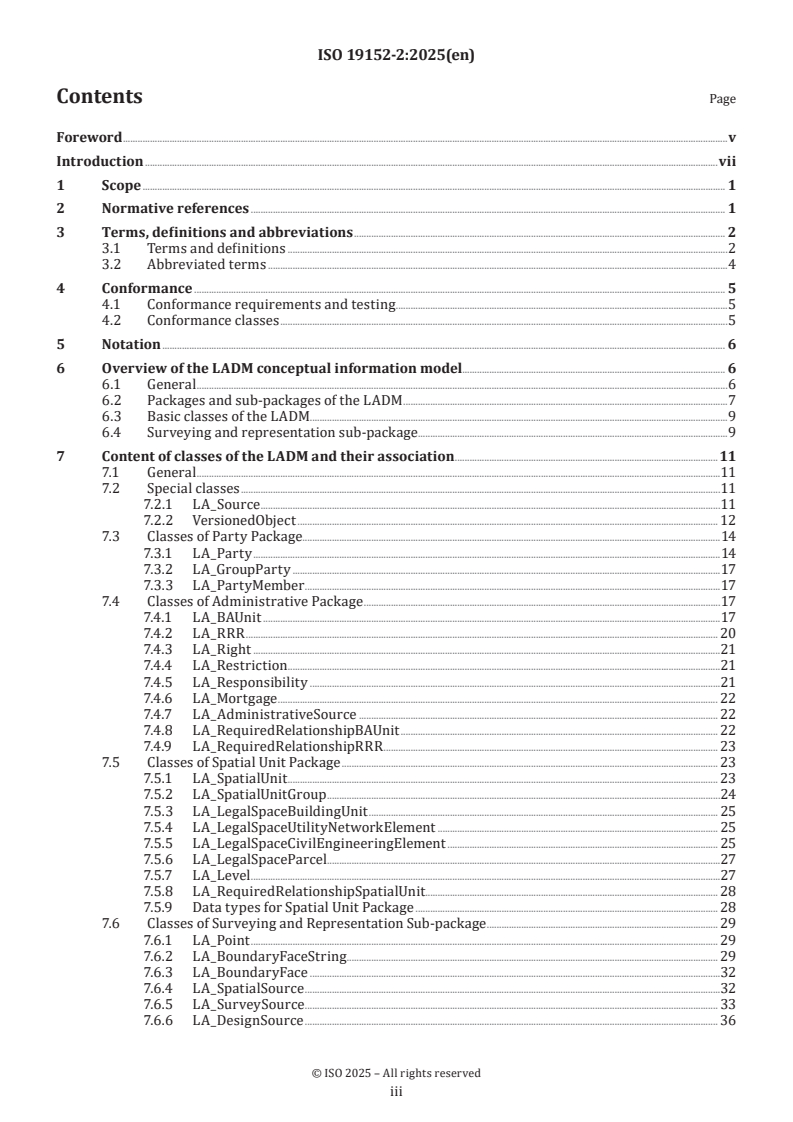
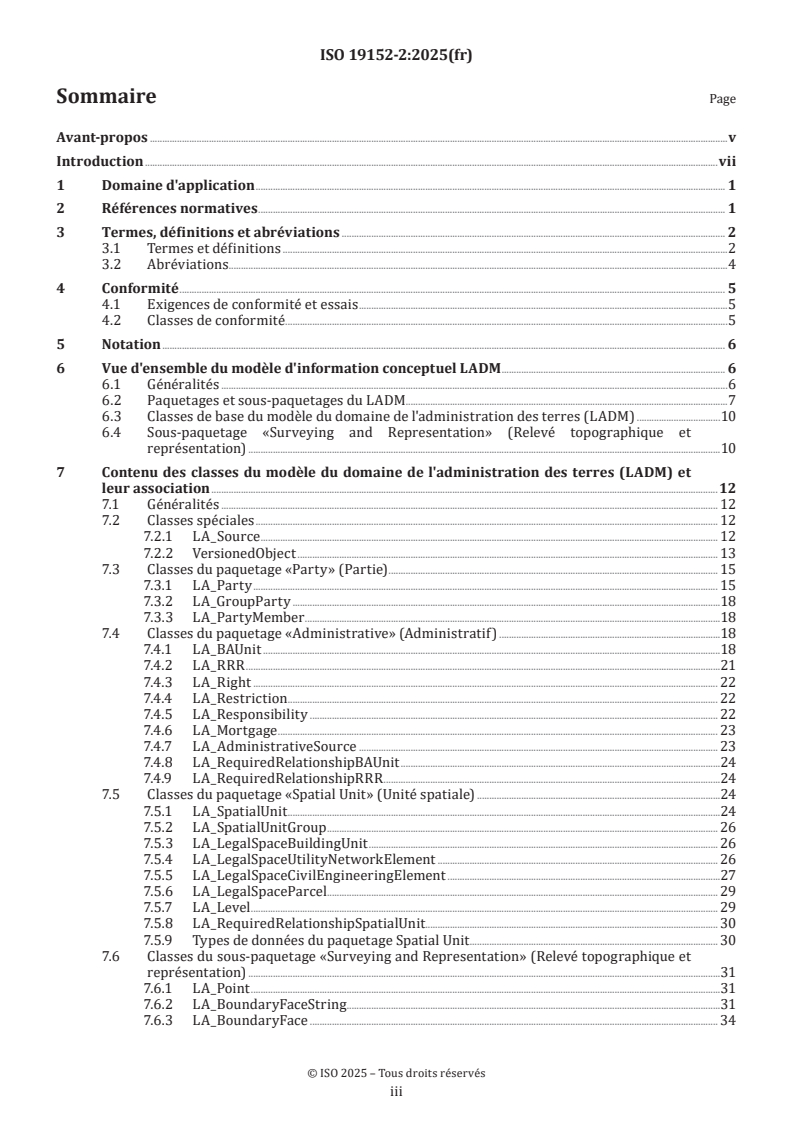
Contents Page
Foreword .v
Introduction .vii
1 Scope . 1
2 Normative references . 1
3 Terms, definitions and abbreviations . 2
3.1 Terms and definitions .2
3.2 Abbreviated terms .4
4 Conformance . 5
4.1 Conformance requirements and testing .5
4.2 Conformance classes .5
5 Notation . 6
6 Overview of the LADM conceptual information model. 6
6.1 General .6
6.2 Packages and sub-packages of the LADM .7
6.3 Basic classes of the LADM.9
6.4 Surveying and representation sub-package .9
7 Content of classes of the LADM and their association .11
7.1 General .11
7.2 Special classes .11
7.2.1 LA_Source .11
7.2.2 VersionedObject . 12
7.3 Classes of Party Package.14
7.3.1 LA_Party .14
7.3.2 LA_GroupParty .17
7.3.3 LA_PartyMember .17
7.4 Classes of Administrative Package .17
7.4.1 LA_BAUnit .17
7.4.2 LA_RRR . 20
7.4.3 LA_Right .21
7.4.4 LA_Restriction . .21
7.4.5 LA_Responsibility .21
7.4.6 LA_Mortgage . 22
7.4.7 LA_AdministrativeSource . 22
7.4.8 LA_RequiredRelationshipBAUnit . 22
7.4.9 LA_RequiredRelationshipRRR . 23
7.5 Classes of Spatial Unit Package . 23
7.5.1 LA_SpatialUnit . 23
7.5.2 LA_SpatialUnitGroup .24
7.5.3 LA_LegalSpaceBuildingUnit . 25
7.5.4 LA_LegalSpaceUtilityNetworkElement . 25
7.5.5 LA_LegalSpaceCivilEngineeringElement . 25
7.5.6 LA_LegalSpaceParcel .27
7.5.7 LA_Level .27
7.5.8 LA_RequiredRelationshipSpatialUnit . 28
7.5.9 Data types for Spatial Unit Package . 28
7.6 Classes of Surveying and Representation Sub-package . 29
7.6.1 LA_Point . 29
7.6.2 LA_BoundaryFaceString . . 29
7.6.3 LA_BoundaryFace .32
7.6.4 LA_SpatialSource .32
7.6.5 LA_SurveySource . 33
7.6.6 LA_DesignSource . 36
iii
7.6.7 LA_SurveyRelation . 36
7.6.8 LA_DistanceObservation . 36
7.6.9 LA_LevelObservation . 36
7.6.10 LA_AngularObservation .37
7.6.11 LA_ImageObservation .37
7.6.12 LA_TPSObservation . 38
7.6.13 LA_PointCloudObservation . 39
7.6.14 LA_GNSSObservation . 39
7.6.15 LA_GNSSCorrection . 40
7.6.16 LA_GPRObservation . 40
7.6.17 LA_MBESObservation .41
7.6.18 Data types for Surveying and Representation Sub-package .41
7.7 Associations between classes .42
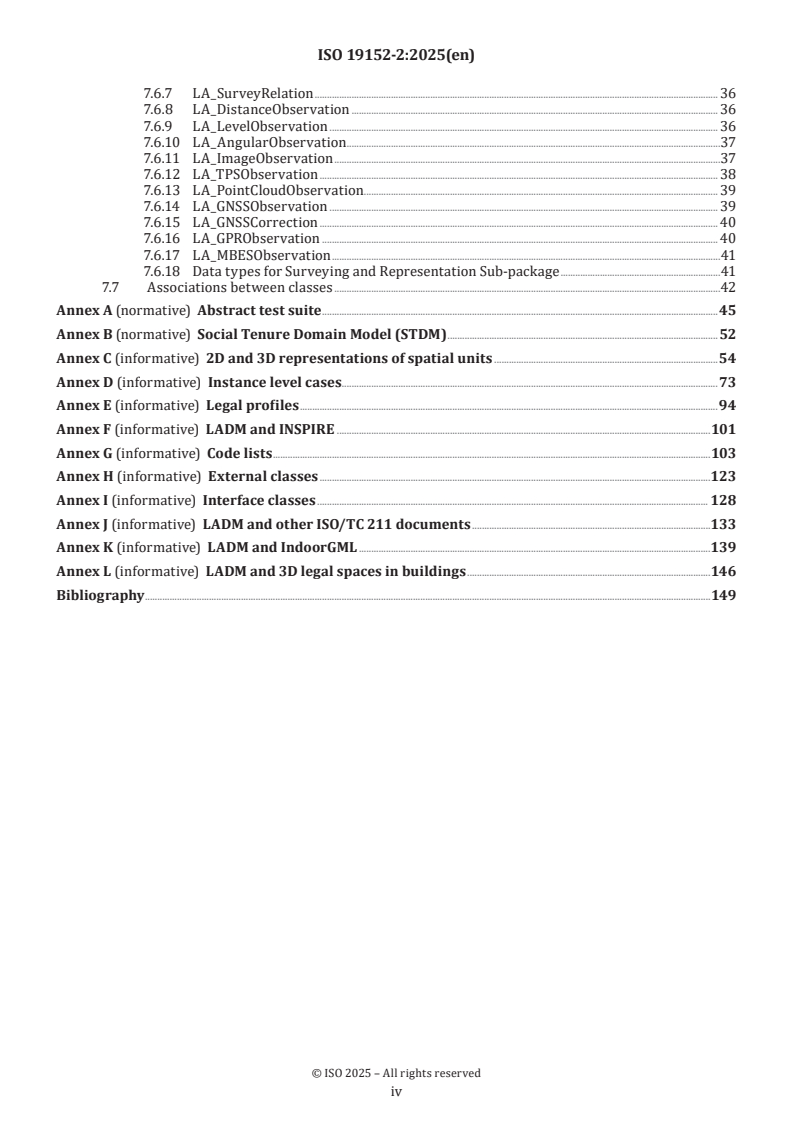
Annex A (normative) Abstract test suite .45
Annex B (normative) Social Tenure Domain Model (STDM) .52
Annex C (informative) 2D and 3D representations of spatial units .54
Annex D (informative) Instance level cases.73
Annex E (informative) Legal profiles .94
Annex F (informative) LADM and INSPIRE .101
Annex G (informative) Code lists .103
Annex H (informative) External classes .123
Annex I (informative) Interface classes . 128
Annex J (informative) LADM and other ISO/TC 211 documents .133
Annex K (informative) LADM and IndoorGML .139
Annex L (informative) LADM and 3D legal spaces in buildings .146
Bibliography .149
iv
Foreword
ISO (the International Organization for Standardization) is a worldwide federation of national standards
bodies (ISO member bodies). The work of preparing International Standards is normally carried out through
ISO technical committees. Each member body interested in a subject for which a technical committee
has been established has the right to be represented on that committee. International organizations,
governmental and non-governmental, in liaison with ISO, also take part in the work. ISO collaborates closely
with the International Electrotechnical Commission (IEC) on all matters of electrotechnical standardization.
The procedures used to develop this document and those intended for its further maintenance are described
in the ISO/IEC Directives, Part 1. In particular, the different approval criteria needed for the different types
of ISO document should be noted. This document was drafted in accordance with the editorial rules of the
ISO/IEC Directives, Part 2 (see www.iso.org/directives).
ISO draws attention to the possibility that the implementation of this document may involve the use of (a)
patent(s). ISO takes no position concerning the evidence, validity or applicability of any claimed patent
rights in respect thereof. As of the date of publication of this document, ISO had not received notice of (a)
patent(s) which may be required to implement this document. However, implementers are cautioned that
this may not represent the latest information, which may be obtained from the patent database available at
www.iso.org/patents. ISO shall not be held responsible for identifying any or all such patent rights.
Any trade name used in this document is information given for the convenience of users and does not
constitute an endorsement.
For an explanation of the voluntary nature of standards, the meaning of ISO specific terms and expressions
related to conformity assessment, as well as information about ISO's adherence to the World Trade
Organization (WTO) principles in the Technical Barriers to Trade (TBT), see www.iso.org/iso/foreword.html.
This document was prepared by Technical Committee ISO/TC 211, Geographic information/Geomatics, in
collaboration with the European Committee for Standardization (CEN) Technical Committee CEN/TC 287,
Geographic Information, in accordance with the Agreement on technical cooperation between ISO and CEN
(Vienna Agreement).
This edition of ISO 19152-2, together with all other parts of the ISO 19152 series, cancels and replaces the
first edition (ISO 19152:2012), which has been technically revised.
The main changes are as follows:
— This document defines fundamental terms, basic components, relationships, attributes and constraints
for land registration. A detailed overview of the model has been presented in its individual packages.
— The terms, although unchanged in principle, have been defined more rigorously (i.e. administrative
source, liminal spatial unit), enriched with examples and notes. Updates in other ISO/TC 211 documents
(i.e. definitions, data types) have been reflected, and corresponding adjustments have been made where
necessary.
— Requirements to which a land registration system can conform have been formulated.
— This document introduces 13 new (featureType) classes (LA_SurveySource, LA_DesignSource,
LA_SurveyRelation, LA_DistanceObservation, LA_LevelObservation, LA_AngularObservation, LA_
ImageObservation, LA_TPSObservation, LA_PointCloudObservation, LA_GNSSObservation, LA_
GNSSCorrection, LA_GPRObservation, LA_MBESObservation), which are different from ISO 19152:2012.
These new classes also include specific attributes. In addition, the attributes of the 3 new (featureType)
classes of ISO 19152-1 (LA_RequiredRelationshipRRR, LA_LegalSpaceCivilEngineeringElement, LA_
LegalSpaceParcel) have been introduced into this document. No (featureType) classes originally specified
in ISO 19152:2012 have been removed.
— The surveying and representation sub-packages have been refined with types of observation information,
such as distance, level, angular, image, terrestrial positioning system (TPS), point cloud, global navigation
satellite system (GNSS) and ground-penetrating radar (GPR).
v
— In order to support all types of spatial units, two new subclasses for LA_SpatialUnit have been introduced:
LA_LegalSpaceCivilEngineeringElement and LA_LegalSpaceParcel. An optional geometry attribute has
been added to LA_SpatialUnit.
— The LA_LegalSpaceUtilityNetwork (featureType) class has been renamed to LA_
LegalSpaceUtilityNetworkElement. LA_UtilityNetworkType code list has been renamed to LA_
UtilityNetworkElementType.
— In order to represent topological relationships between spatial units, two new (dataType) classes (i.e.
TopoRelation and IntersectionPatternMatrix) have been created and introduced, based on the definition
given in ISO 19107. In addition, 3 code lists (i.e. TopoRelationType, DimensionExtension and SetMask)
have been introduced based on the definition given in ISO 19107.
— The optional attributes human sex, signature, fingerprint, photo and civil status have been added to
LA_Party.
— One multiplicity of an association has been changed so that a point can now be associated with more
than one spatial unit.
— The former Annex I has been refined and repositioned as Annex B (normative).
— The former Annex A has been redesigned in accordance with the requirements of the main body of this
document.
— A new Annex K and Annex L have been introduced
— The former Annex H and Annex N have been deleted.
— All the other annexes not mentioned have been updated and refined, including notably:
— Annex C, which has been refined and extended to support all types of spatial unit representation; and
— Annex G, which has been refined and extended to support semantically enriched code list values. Generic
definitions for code list values have been provided. Existing code lists have been refined with new
values, and 24 new code lists have been introduced (i.e. LA_CivilEngineeringType, LA_ParcelUseType,
LA_SurveyPurposeType, LA_AutomationLevelType, LA_PlatformType, LA_SurveyMethodType,
LA_ObservationsAccuracyType, LA_LifecyclePhaseType, LA_DesignFileCreatorRoleType, LA_
DesignObjectType, LA_SourceFileType, LA_SpatialTransactionType, LA_DistanceType, LA_
AngleType, LA_SatelliteSystemType, LA_GNSSSurveyType, LA_GNSSReferenceStationsNetworkType,
LA_GNSSReferenceStationsNetworkScale, LA_CorrectionServiceType, LA_GNSSFrequencyType, LA_
SSR_Error_Components, TopoRelationType, DimensionExtension and SetMask).
— The bibliography has been revised to include additional references and has been reformatted.
A list of all parts in the ISO 19152 series can be found on the ISO website.
Any feedback or questions on this document should be directed to the user’s national standards body. A
complete listing of these bodies can be found at www.iso.org/members.html.
vi
Introduction
This document defines the land administration domain model (LADM). The LADM is a conceptual model,
and not a data product specification (in the sense of ISO 19131).
The purpose of the LADM is not to replace existing systems, but rather to provide a formal language for
describing them, so that their similarities and differences can be better understood. This document is a
descriptive standard, not a prescriptive standard.
Land administration/geo-regulation is a large field; the focus of this document is on that part of land
administration (LA) that concerns parties and the rights, responsibilities and restrictions affecting land,
and the geometrical (geospatial) components thereof. The LADM provides a reference model which will
serve two goals:
a) to provide an extensible basis for the development and refinement of efficient and effective land
administration systems, based on a model driven architecture (MDA); and
b) to enable involved parties, both within one country and between different countries, to communicate,
based on the shared vocabulary (i.e. an ontology), implied by the model.
The second goal is relevant for creating standardized information services in a national and international
context, where land administration/geo-regulation domain semantics have to be shared between regions, or
countries, in order to enable necessary translations. Four considerations during the design of the model were:
— it will cover the common aspects of land administration/geo-regulation worldwide;
— it will be based on the conceptual framework of “Cadastre 2014” of the International Federation of
[52]
Surveyors (FIG);
— it will be as simple as possible to be useful in practice;
— the geospatial aspects will follow the ISO/TC 211 conceptual model.
ISO 19152:2012 concentrated on land administration, land registration and cadastre. This information is
about the relationship between people and land. This is now included in this document with a more refined
survey model.
Until now, most countries (or states, provinces) have developed their own land administration system (LAS).
Some systems are centralized, and others decentralized. Some are based on a general boundaries approach,
others on fixed boundaries. Some systems have a fiscal background, others a legal one. The different
implementations (foundations) of the various LASs do not facilitate meaningful communication across
borders. However, looking from a distance, it can be observed that the different systems are in principle
largely the same: they are all based on the relationships between people and land, linked by (ownership
or use) rights, and are in most countries influenced by developments in information and communication
technology (ICT). Furthermore, the two main functions of every land administration (including cadastre
and/or land registry) are:
1) keeping the contents of these relationships up-to-date (based on regulations and related transactions); and
2) providing information from the (national) registers.
Land administration is the process of recording and distributing information about the relationship between
people and land (this concerns ownership, value and the use of land and its associated resources). Every LAS
includes some form of land registration, which is a process for recording, and in some countries guaranteeing,
information about the ownership of land. If ownership is understood as the mechanism through which
rights to land are held, then it can be viewed as a type of land tenure. A main characteristic of land tenure is
that it reflects a social relationship regarding rights to land, which means that in a certain jurisdiction the
relationship between people and land is recognized as a legally valid one. These recognized rights are in
principle eligible for registration, with the purpose being to assign a certain legal meaning to the registered
right (e.g. a title). Therefore, land administration systems are not just “handling geographic information”, as
they represent a lawfully meaningful relationship amongst people, and between people and land.
vii
LA activity deals with huge amounts of data, which are of a dynamic nature, and requires a continuous
maintenance process. The role of ICT is therefore of strategic importance. Without the availability of
information systems, it will be difficult to guarantee good performance with respect to meeting changing
customer demands. Organizations are now increasingly confronted with rapid developments in technology,
a technology push (the Internet, geospatial databases, modelling standards, open systems, building
information models and geographical information systems), as well as a growing demand for new services
and a market pull (e-governance, sustainable development, electronic conveyance, and the integration
of public data and systems). Modelling is a basic tool, facilitating appropriate system development and
reengineering. In addition, it forms the basis for meaningful communication between different systems.
Standardization has become a well-known process in the work of LA and land registries. In both paper-based
systems and computerized systems, standards are required to identify objects, transactions, relationships
between objects (e.g. parcels, generally referred to as spatial units) and persons (e.g. citizens and generally
referred to as parties), classification of land use, land value, map representations of spatial units, etc.
Computerized systems require further standardization when topology and the identification of single
boundaries are introduced. In existing LASs and land registries, standardization is generally limited to the
region, or jurisdiction, where the LA (including cadastre and/or land registry) is in operation. Open markets,
globalization, and effective and efficient development and maintenance of flexible (generic) systems, require
further standardization.
Conformance in relation to this document is laid out in Clause 4, and a conformance test is specified in
Annex A. Clause 5 provides notation and context. Clause 6 gives a global overview of packages. Clause 7
introduces the classes, attributes and associations in detail. Annex B gives an overview of Social Tenure
Domain Model (STDM). Annex C explains the 2D and 3D representations of spatial units, spatial unit profiles
and the refined survey model. A comprehensive set of informative examples (using instance level cases) is
available in Annex D.
This document provides a generic domain model. It is expandable and it is likely that additional attributes,
operators, associations, and perhaps even additional classes, will be needed for a specific region or country.
Code list values in the main text are informative (not normative) and can only be considered as examples.
Specific parts of the LADM are further detailed in the legal profiles in Annex E. Some examples of using the
LADM in a specific context are provided in the INSPIRE cadastral parcels discussed in Annex F. It is possible
to use only a subset, or profile, of the LADM for a specific implementation. Annex G presents the LADM code
lists as a basis for describing a flexible enumeration and gives an overview of semantic technologies for
representing code list values.
The construction of external databases, with party data, address data, taxation data, land cover data,
physical utility network data and archive data, is outside the scope of the LADM. However, the LADM
provides stereotype classes for these data sets (if available); see Annex H. Interface classes are covered in
Annex I. Annex J explains the link between this document and other ISO International Standards. Annex K
presents a framework for the integration of the LADM and IndoorGML. Annex L proposes a framework for
representing legal spaces in buildings.
viii
International Standard ISO 19152-2:2025(en)
Geographic information — Land Administration Domain
Model (LADM) —
Part 2:
Land registration
1 Scope
This document:
— defines a reference land administration domain model (LADM) covering basic information-related
components of land registration (including elements above and below the surface of the Earth);
— provides an abstract, conceptual model with three packages and one sub-package related to:
— parties (people and organizations);
— basic administrative units, rights, responsibilities and restrictions (RRRs);
— spatial units (parcels, and the legal space of buildings and utility networks and other geometry)
with a sub-package on surveying and spatial representation (geometry and topology);
— provides terminology for land administration (LA), based on various national and international systems,
that is as simple as possible in order to be useful in practice. The terminology allows a shared description
of different formal or informal practices and procedures in various jurisdictions;
— provides a platform for comparison and monitoring that is based on indicators;
— provides a basis for national and regional profiles; and
— enables the combination of land administration information from different sources in a coherent manner.
The following is outside the scope of this document:
— interference with (national) land administration laws with potentially legal implications; and
— construction of external databases with party data, address data, land cover data, physical utility
network data, archive data and taxation data. However, the LADM provides stereotype classes for these
data sets to indicate which data set elements the LADM expects from these external sources, if available.
This document provides the concepts and the detailed structure for standardization in the land
administration domain.
2 Normative references
The following documents are referred to in the text in such a way that some or all of their content constitutes
requirements of this document. For dated references, only the edition cited applies. For undated references,
the latest edition of the referenced document (including any amendments) applies.
ISO 19152-1, Geographic information — Land Administration Domain Model (LADM) — Part 1: Generic
conceptual model
3 Terms, definitions and abbreviations
3.1 Terms and definitions
For the purposes of this document, the terms and definitions given in ISO 19152-1 and the following apply.
ISO and IEC maintain terminology databases for use in standardization at the following addresses:
— ISO Online browsing platform: available at https:// www .iso .org/ obp
— IEC Electropedia: available at https:// www .electropedia .org/
3.1.1
administrative source
source comprised of the administrative description (where applicable) of the parties involved, the
rights, restrictions and responsibilities created, and the basic administrative units affected
EXAMPLE 1 The evidence of a party’s right to a basic administrative unit.
EXAMPLE 2 A document describing a transaction (a deed) or a judgement (operational decision) of the
responsible party.
3.1.2
boundary
set that represents the limit of an entity
Note 1 to entry: Boundary is most commonly used in the context of geometry, where the set is a collection of points
or a collection of objects that represent those points. In other areas, the term is used metaphorically to describe the
transition between an entity and the rest of its domain of discourse.
[SOURCE: ISO 19107:2019, 3.6]
3.1.3
boundary face
face that is used in the 3-dimensional representation of a boundary of a spatial unit
Note 1 to entry: Boundary faces are used when the implied vertical and unbounded faces of a boundary face string are
not sufficient to describe 3D spatial units. Boundary faces close volumes in height (e.g. every apartment floor), or in
depth (e.g. an underground parking garage), or in all other directions to form a bounded volume.
3.1.4
boundary face string
boundary forming part of the outside of a spatial unit
Note 1 to entry: Boundary face strings are used to represent the boundaries of spatial units by means of line strings in
2D. This 2D representation is a 2D boundary in a 2D land administration system. In a 3D land administration system, it
represents a series of vertical boundary faces where an unbounded volume is assumed, surrounded by boundary faces
which intersect the Earth’s surface (such as traditionally depicted in the cadastral map).
3.1.5
face
2-dimensional topological primitive
Note 1 to entry: The geometric realization of a face is a surface. The boundary of a face is the set of directed edges
within the same topological complex that are associated with the face via the boundary relations. These can be
organized as rings.
[SOURCE: ISO 19107:2019, 3.38]
3.1.6
level
set of spatial units with either a single geometric, topologic coherence, or thematic coherence or a
combination of these coherences
EXAMPLE 1 One level of spatial units for an urban cadastre and another for spatial units for a rural cadastre.
EXAMPLE 2 One level of spatial units to define basic administrative units associated with rights and another level
of spatial units to define basic administrative units associated with restrictions.
EXAMPLE 3 One level of spatial units to define basic administrative units associated with formal rights, a second
level for spatial units to define basic administrative units associated with informal rights and a third level for spatial
units to define basic administrative units associated with customary rights.
EXAMPLE 4 One level with point-based spatial units, a second level with line-based spatial units, and a third level
with polygon-based spatial units.
EXAMPLE 5 A spatial unit can have no topology at a certain moment in time and the same spatial unit can have
topology at a later moment in time. This indicates the same spatial unit with a different representation in two levels.
3.1.7
liminal spatial unit
spatial unit with a geometry represented as a combination of boundary face strings (2D) and
boundary faces (3D)
Note 1 to entry: A liminal spatial unit is represented by a spatial unit on the threshold between 2D and 3D
representations.
3.1.8
point
0-dimensional geometric primitive, representing a position
Note 1 to entry: The boundary of a point is the empty set.
Note 2 to entry: Points can be used to define one or more boundary faces or boundary face strings.
Note 3 to entry: Points can be observed by, for example, terrestrial surveying, but also by photo interpretation, image
interpretation, or identification on an existing map.
Note 4 to entry: A single point can represent a spatial unit.
[SOURCE: ISO 19136-1:2020, 3.1.47, modified — Notes 2, 3 and 4 to entry have been added.]
3.1.9
utility network
network describing the legal space of the topology of a utility
EXAMPLE The legal space needed to locate and maintain the network.
Note 1 to entry: A utility network can be attributed with information about its legal, recorded or informal space.
Note 2 to entry: A utility network can also be modelled as a basic administrative unit.
3.2 Abbreviated terms
BAUnit basic administrative unit
CRS Coordinate Reference System
CSV comma-separated values
DBMS data base management system
F&G Framework and Guidelines
FIG International Federation of Surveyors
GDOP geometric dilution of precision
GLII Global Land Indicator Initiative
GNSS global navigation satellite system
GPR ground-penetrating radar
GPS Global Positioning System
HTML Hypertext Markup Language
ICT information and communication technology
INSPIRE Infrastructure for Spatial Information in the European Community
LA land administration
LADM land administration domain model
LAS land administration system
LGAF Land Governance Assessment Framework
lidar light detection and ranging
MBES multibeam echosounder
MDA model driven architecture
MLGT Multi-Lingual Glossary of Terms (ISO/TC 211)
OGC Open Geospatial Consortium
OWL Web Ontology Language
RDF Resource Description Framework
RRR right, restriction, responsibility
SDG Sustainable Development Goal
SDI spatial data infrastructure
SKOS Simple Knowledge Organization System
SSR state space representation
STDM Social Tenure Domain Model
TPS terrestrial positioning system
VGGTs Voluntary Guidelines on the Responsible Governance on Tenure of Land, Fisheries and Forests
UML Unified Modeling Language
XML Extensible Markup Language
4 Conformance
4.1 Conformance requirements and testing
Conformance to this document (ISO 19152-2 – Land registration) consists of alignment with the requirements
established in 4.2 and Clauses 6 and 7. The methodology described in the abstract test suite given in Annex A
(following ISO 19105) shall be used for testing conformance to these requirements.
The name and contact information of the maintenance agency for this document can be found at www .iso
.org/ maintenance _agencies.
4.2 Conformance classes
1) BasedOnGenericConceptualModel
https:// standards .isotc211 .org/ 19152/ -2/ 1/ req/ basedonge nericconce ptualmodel
Requirement 1: This document is based on ISO 19152-1 – Generic conceptual model. All requirements
contained in ISO 19152-1 shall apply to this document.
2) ContinuumOfRights
https:// standards .isotc211 .org/ 19152/ -2/ 1/ req/ continuumofrights
Requirement 2: The continuum of land rights shall be supported. This includes recognizing, recording and
administering a variety of appropriate and legitimate land tenure forms, such as registered freehold, lease,
group tenure, adverse possession, occupancy and customary.
3) GroupingPeopleLand
https:// standards .isotc211 .org/ 19152/ -2/ 1/ req/ groupingpeopleland
Requirement 3: Groupings of people and land shall be supported. The flexibility of the LA model can be
based on the recognition that people-to-land relationships appear in many different ways, depending on
local tradition, culture, religion and behaviour.
4) DifferentOrganizations
https:// standards .isotc211 .org/ 19152/ -2/ 1/ req/ di fferentorg anizations
Requirement 4: LA data can be maintained by different organizations, and within one organization at many
sites. Administrative territories for organizations can be completely different. The LADM-based systems
shall be implemented as a distributed set of (geo-) information systems, each supporting the maintenance
processes (transactions in land rights, establishment of rights, restrictions and responsibilities) and the
information supply of parts of the data set, represented in this model.
5) KeepDataToSource
https:// standards .isotc211 .org/ 19152/ -2/ 1/ req/ keepdatatosource
Requirement 5: LA data shall be kept to the source within spatial data infrastructure (SDI). Today, all data
(spatial and thematic) can be stored in a data base management system (DBMS). Information products
are becoming flexible combinations of digital data components and additional facilities and services. This
can replace the exchange of copies of data sets between organizations. Multi-source information products
require avoidance of redundancy and good standardization protocols.
5 Notation
The conceptual schema specified in this document is described using the Unified Modeling Language (UML),
following the guidance of ISO 19103.
Several model elements used in this schema are defined in other ISO geographic information standards.
By convention with some ISO/TC 211 International Standards (e.g. ISO 19115-1, ISO 19156), names of UML
classes, with the exception of basic data type classes, include a two-letter prefix that identifies the document
and the UML package in which the class is defined. This provides a global unique name for the class. UML
classes defined in this document have the two-letter prefix of LA. Table 1 lists the prefixes as defined for
some of the other parts of the ISO 19152 series. The same prefix is used for ISO 19152-1 and this document
(ISO 19152-2) to support backward compatibility. Table 2 lists the prefixes used by LADM.
Table 1 — Sources of internally defined UML classes
Prefix Document Part
LA ISO 19152-1 Generic conceptual model
LA ISO 19152-2 Land registration
MG ISO 19152-3 Marine georegulation
a
VM ISO 19152-4 Valuation information
b
SP ISO 19152-5 Spatial plan information
a
Under preparation. Stage at the time of publication: ISO/FDIS 19152-4:2025.
b
Under preparation. Stage at the time of publication: ISO/FDIS 19152-5:2025.
Table
...
Norme
internationale
ISO 19152-2
Première édition
Information géographique —
2025-05
Modèle du domaine de
l’administration des terres
(LADM) —
Partie 2:
Enregistrement foncier
Geographic information — Land Administration Domain Model
(LADM) —
Part 2: Land registration
Numéro de référence
DOCUMENT PROTÉGÉ PAR COPYRIGHT
© ISO 2025
Tous droits réservés. Sauf prescription différente ou nécessité dans le contexte de sa mise en œuvre, aucune partie de cette
publication ne peut être reproduite ni utilisée sous quelque forme que ce soit et par aucun procédé, électronique ou mécanique,
y compris la photocopie, ou la diffusion sur l’internet ou sur un intranet, sans autorisation écrite préalable. Une autorisation peut
être demandée à l’ISO à l’adresse ci-après ou au comité membre de l’ISO dans le pays du demandeur.
ISO copyright office
Case postale 401 • Ch. de Blandonnet 8
CH-1214 Vernier, Genève
Tél.: +41 22 749 01 11
E-mail: copyright@iso.org
Web: www.iso.org
Publié en Suisse
ii
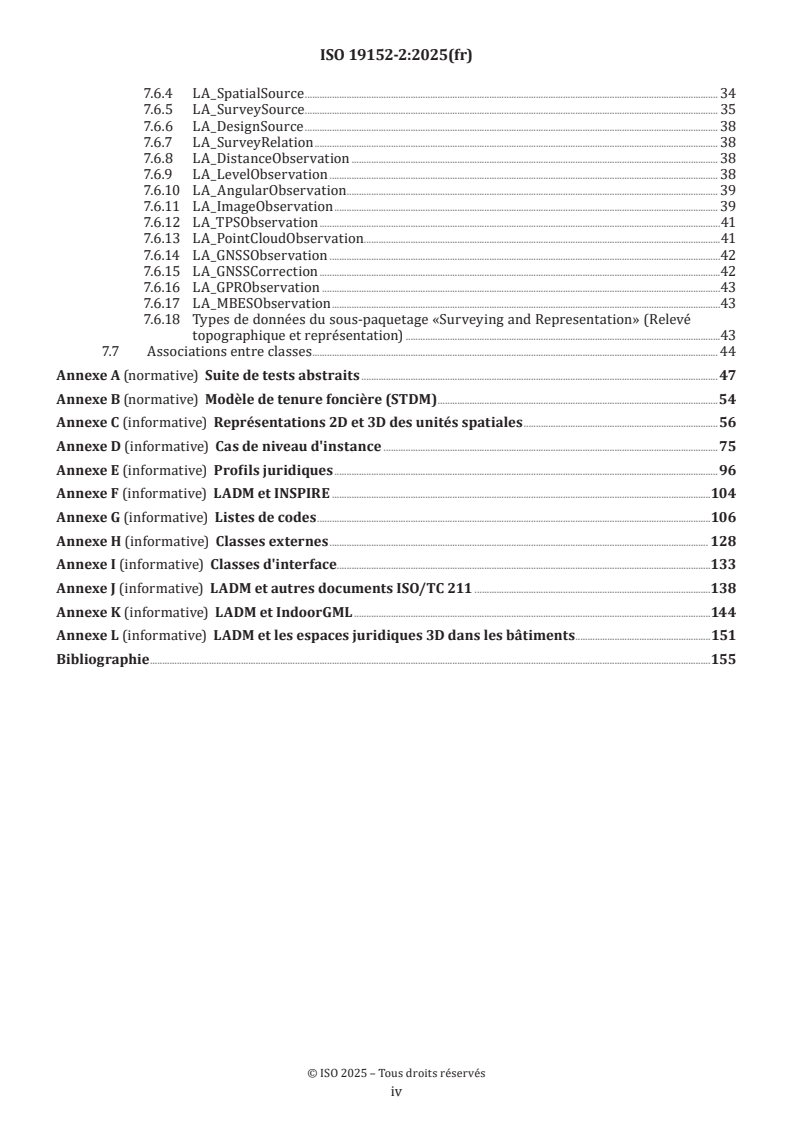
Sommaire Page
Avant-propos .v
Introduction .vii
1 Domaine d'application . 1
2 Références normatives . 1
3 Termes, définitions et abréviations . 2
3.1 Termes et définitions .2
3.2 Abréviations.4
4 Conformité . 5
4.1 Exigences de conformité et essais .5
4.2 Classes de conformité . .5
5 Notation . 6
6 Vue d'ensemble du modèle d'information conceptuel LADM . 6
6.1 Généralités .6
6.2 Paquetages et sous-paquetages du LADM .7
6.3 Classes de base du modèle du domaine de l'administration des terres (LADM) .10
6.4 Sous-paquetage «Surveying and Representation» (Relevé topographique et
représentation) .10
7 Contenu des classes du modèle du domaine de l'administration des terres (LADM) et
leur association .12
7.1 Généralités . 12
7.2 Classes spéciales . 12
7.2.1 LA_Source . 12
7.2.2 VersionedObject . 13
7.3 Classes du paquetage «Party» (Partie) . 15
7.3.1 LA_Party . 15
7.3.2 LA_GroupParty .18
7.3.3 LA_PartyMember .18
7.4 Classes du paquetage «Administrative» (Administratif) .18
7.4.1 LA_BAUnit .18
7.4.2 LA_RRR .21
7.4.3 LA_Right . 22
7.4.4 LA_Restriction . . 22
7.4.5 LA_Responsibility . 22
7.4.6 LA_Mortgage . 23
7.4.7 LA_AdministrativeSource . 23
7.4.8 LA_RequiredRelationshipBAUnit .24
7.4.9 LA_RequiredRelationshipRRR .24
7.5 Classes du paquetage «Spatial Unit» (Unité spatiale) .24
7.5.1 LA_SpatialUnit .24
7.5.2 LA_SpatialUnitGroup . 26
7.5.3 LA_LegalSpaceBuildingUnit . 26
7.5.4 LA_LegalSpaceUtilityNetworkElement . 26
7.5.5 LA_LegalSpaceCivilEngineeringElement .27
7.5.6 LA_LegalSpaceParcel . 29
7.5.7 LA_Level . 29
7.5.8 LA_RequiredRelationshipSpatialUnit . 30
7.5.9 Types de données du paquetage Spatial Unit . 30
7.6 Classes du sous-paquetage «Surveying and Representation» (Relevé topographique et
représentation) .31
7.6.1 LA_Point .31
7.6.2 LA_BoundaryFaceString . .31
7.6.3 LA_BoundaryFace . 34
iii
7.6.4 LA_SpatialSource . 34
7.6.5 LA_SurveySource . 35
7.6.6 LA_DesignSource . 38
7.6.7 LA_SurveyRelation . 38
7.6.8 LA_DistanceObservation . 38
7.6.9 LA_LevelObservation . 38
7.6.10 LA_AngularObservation . 39
7.6.11 LA_ImageObservation . 39
7.6.12 LA_TPSObservation .41
7.6.13 LA_PointCloudObservation .41
7.6.14 LA_GNSSObservation .42
7.6.15 LA_GNSSCorrection .42
7.6.16 LA_GPRObservation .43
7.6.17 LA_MBESObservation .43
7.6.18 Types de données du sous-paquetage «Surveying and Representation» (Relevé
topographique et représentation) .43
7.7 Associations entre classes . 44
Annexe A (normative) Suite de tests abstraits . 47
Annexe B (normative) Modèle de tenure foncière (STDM) .54
Annexe C (informative) Représentations 2D et 3D des unités spatiales .56
Annexe D (informative) Cas de niveau d'instance .75
Annexe E (informative) Profils juridiques .96
Annexe F (informative) LADM et INSPIRE .104
Annexe G (informative) Listes de codes .106
Annexe H (informative) Classes externes . 128
Annexe I (informative) Classes d'interface.133
Annexe J (informative) LADM et autres documents ISO/TC 211 .138
Annexe K (informative) LADM et IndoorGML .144
Annexe L (informative) LADM et les espaces juridiques 3D dans les bâtiments .151
Bibliographie .155
iv
Avant-propos
L’ISO (Organisation internationale de normalisation) est une fédération mondiale d’organismes nationaux
de normalisation (comités membres de l’ISO). L’élaboration des Normes internationales est en général
confiée aux comités techniques de l’ISO. Chaque comité membre intéressé par une étude a le droit de faire
partie du comité technique créé à cet effet. Les organisations internationales, gouvernementales et non
gouvernementales, en liaison avec l’ISO participent également aux travaux. L’ISO collabore étroitement avec
la Commission électrotechnique internationale (IEC) en ce qui concerne la normalisation électrotechnique.
Les procédures utilisées pour élaborer le présent document et celles destinées à sa mise à jour sont
décrites dans les Directives ISO/IEC, Partie 1. Il convient, en particulier, de prendre note des différents
critères d’approbation requis pour les différents types de documents ISO. Le présent document a
été rédigé conformément aux règles de rédaction données dans les Directives ISO/IEC, Partie 2 (voir
www.iso.org/directives).
L’ISO attire l’attention sur le fait que la mise en application du présent document peut entraîner l’utilisation
d’un ou de plusieurs brevets. L’ISO ne prend pas position quant à la preuve, à la validité et à l’applicabilité de
tout droit de brevet revendiqué à cet égard. À la date de publication du présent document, l’ISO n’avait pas
reçu notification qu’un ou plusieurs brevets pouvaient être nécessaires à sa mise en application. Toutefois,
il y a lieu d’avertir les responsables de la mise en application du présent document que des informations
plus récentes sont susceptibles de figurer dans la base de données de brevets, disponible à l’adresse
www.iso.org/brevets. L’ISO ne saurait être tenue pour responsable de ne pas avoir identifié tout ou partie de
tels droits de propriété.
Les appellations commerciales éventuellement mentionnées dans le présent document sont données pour
information, par souci de commodité, à l’intention des utilisateurs et ne sauraient constituer un engagement.
Pour une explication de la nature volontaire des normes, la signification des termes et expressions
spécifiques de l’ISO liés à l’évaluation de la conformité, ou pour toute information au sujet de l’adhésion de
l’ISO aux principes de l’Organisation mondiale du commerce (OMC) concernant les obstacles techniques au
commerce (OTC), voir www.iso.org/avant-propos.
Le présent document a été élaboré par le comité technique ISO/TC 211, Information géographique/
Géomatique, en collaboration avec le comité technique CEN/TC 287, Information géographique, du Comité
européen de normalisation (CEN) conformément à l’Accord de coopération technique entre l’ISO et le CEN
(Accord de Vienne).
La présente édition de l’ISO 19152-2, ainsi que de toutes les autres parties de la série ISO 19152, annule et
remplace la première édition (ISO 19152:2012), qui a fait l’objet d’une révision technique.
Les principales modifications sont les suivantes:
— le présent document définit les termes fondamentaux, les composants de base, les relations, les attributs
et les contraintes de l’enregistrement foncier. Une vue d’ensemble détaillée du modèle a été présentée
dans ses paquetages individuels;
— les termes, bien qu’inchangés dans leur principe, ont été définis plus rigoureusement (c’est-à-dire
source administrative, unité spatiale liminaire), enrichis d’exemples et de notes. Les mises à jour des
autres documents de l’ISO/TC 211 (définitions et types de données) sont reflétées et les ajustements
correspondants ont été réalisés si nécessaire;
— les exigences auxquelles un système d’enregistrement foncier peut être conforme ont été formulées;
— le présent document introduit 13 nouvelles classes (featureType) (LA_SurveySource, LA_DesignSource,
LA_SurveyRelation, LA_DistanceObservation, LA_LevelObservation, LA_AngularObservation,
LA_ImageObservation, LA_TPSObservation, LA_PointCloudObservation, LA_GNSSObservation,
LA_GNSSCorrection, LA_GPRObservation, LA_MBESObservation), qui sont différentes de
l’ISO 19152:2012. Ces nouvelles classes comprennent également des attributs spécifiques. De plus, les
attributs des 3 nouvelles classes (featureType) de l’ISO 19152-1 (LA_RequiredRelationshipRRR, LA_
v
LegalSpaceCivilEngineeringElement, LA_LegalSpaceParcel) ont été introduits dans le présent document.
Aucune classe (featureType) initialement spécifiée dans l’ISO 19152:2012 n’a été supprimée;
— les sous-paquetages «Surveying and Representation» (Relevé topographique et représentation) ont été
affinés avec des types d’informations d’observation, telles que la distance, le niveau, l’angle, l’image, le
système terrestre de localisation (TPS), le nuage de points, le système global de navigation par satellite
(GNSS) et le radar à pénétration de sol (GPR);
— afin de prendre en charge tous les types d’unités spatiales, deux nouvelles sous-classes pour LA_
SpatialUnit ont été introduites: LA_LegalSpaceCivilEngineeringElement et LA_LegalSpaceParcel. Un
attribut de géométrie optionnel a été ajouté à LA_SpatialUnit;
— la classe LA_LegalSpaceUtilityNetwork (featureType) a été renommée LA_
LegalSpaceUtilityNetworkElement. La liste de codes LA_UtilityNetworkType a été renommée LA_
UtilityNetworkElementType;
— pour représenter les relations topologiques entre les unités spatiales, deux nouvelles classes (dataType) (à
savoir TopoRelation et IntersectionPatternMatrix) ont été créées et introduites sur la base de la définition
donnée dans l’ISO 19107. En outre, 3 listes de codes (à savoir TopoRelationType, DimensionExtension et
SetMask) ont été introduites sur la base de la définition donnée dans l’ISO 19107;
— les attributs facultatifs que sont le sexe humain, la signature, l’empreinte digitale, la photo et l’état civil
ont été ajoutés à LA_Party;
— une multiplicité d’une association a été modifiée de sorte qu’un point puisse désormais être associé à
plusieurs unités spatiales;
— l’ancienne Annexe I a été affinée et repositionnée en tant qu’Annexe B (normative);
— l’ancienne Annexe A a été remaniée conformément aux exigences du corps du texte du présent document;
— les nouvelles Annexe K et Annexe L ont été introduites;
— les anciennes Annexe H et Annexe N ont été supprimées;
— toutes les autres annexes non mentionnées ont été mises à jour et affinées, notamment:
— l’Annexe C, qui a été affinée et détaillée afin de prendre en charge tous les types de représentation
d’unités spatiales; et
— l’Annexe G, qui a été affinée et détaillée afin de prendre en charge les valeurs des listes de codes
enrichies sémantiquement. Des définitions génériques ont été fournies pour les valeurs des listes
de codes. Les listes de codes existantes ont été affinées avec de nouvelles valeurs et 24 nouvelles
listes de codes ont été ajoutées (à savoir LA_CivilEngineeringType, LA_ParcelUseType, LA_
SurveyPurposeType, LA_AutomationLevelType, LA_PlatformType, LA_SurveyMethodType,
LA_ObservationsAccuracyType, LA_LifecyclePhaseType, LA_DesignFileCreatorRoleType, LA_
DesignObjectType, LA_SourceFileType, LA_SpatialTransactionType, LA_DistanceType, LA_
AngleType, LA_SatelliteSystemType, LA_GNSSSurveyType, LA_GNSSReferenceStationsNetworkType,
LA_GNSSReferenceStationsNetworkScale, LA_CorrectionServiceType, LA_GNSSFrequencyType, LA_
SSR_Error_Components, TopoRelationType, DimensionExtension et SetMask);
— la bibliographie a été révisée de sorte à inclure des références supplémentaires et a été réorganisée.
Une liste de toutes les parties de la série ISO 19152 se trouve sur le site web de l’ISO.
Il convient que l’utilisateur adresse tout retour d’information ou toute question concernant le présent
document à l’organisme national de normalisation de son pays. Une liste exhaustive desdits organismes se
trouve à l’adresse www.iso.org/fr/members.html.
vi
Introduction
Le présent document définit le modèle du domaine de l'administration des terres (LADM). Le LADM est un
modèle conceptuel, en aucun cas une spécification de contenu informationnel (au sens de l’ISO 19131).
Le LADM n'a pas pour objet de remplacer les systèmes existants, mais de fournir un langage formel
permettant de les décrire de manière à mieux appréhender leurs similitudes et leurs différences. Le présent
document est une norme descriptive, et non normative.
L'administration des terres/la géo-réglementation est un vaste domaine. Le présent document se concentre
sur la partie de l'administration des terres (LA) qui concerne les parties et les droits, les responsabilités et
les restrictions relatifs à la terre, et aux composants géométriques (géospatiaux) associés. Le modèle du
domaine de l'administration des terres (LADM) propose un modèle de référence dont les deux objectifs sont
les suivants:
a) offrir une base évolutive pour le développement et l’amélioration de systèmes d’administration des
terres efficients et efficaces, fondés sur une architecture dirigée par les modèles (MDA); et
b) permettre aux parties impliquées, à la fois au sein d’un pays et entre différents pays, de communiquer,
grâce au vocabulaire commun (c'est-à-dire une ontologie) précisé dans le modèle.
Le second objectif est pertinent pour la création de services d'information normalisés dans un contexte
national et international, où la sémantique relative à l'administration des terres/géo-réglementation doit
être commune aux régions ou aux pays afin de permettre les traductions nécessaires. Quatre considérations
ont été prises en compte lors de la conception du modèle:
— le modèle couvre les aspects communs de l'administration des terres et de la géo-réglementation dans le
monde entier;
— il s'appuie sur le cadre conceptuel du «Cadastre 2014» de la Fédération internationale des
[52]
géomètres (FIG) ;
— il est aussi simple que possible afin d'être utile dans la pratique;
— les aspects géospatiaux sont conformes au modèle conceptuel de l'ISO/TC 211.
L'ISO 19152:2012 se concentrait sur l'administration des terres, l'enregistrement foncier et le cadastre. Ces
informations concernent la relation entre les personnes et les terres. Celles-ci sont maintenant incluses dans
le présent document avec un modèle de relevé plus affiné.
Jusqu'alors, la plupart des pays (des États, des provinces) ont développé leur propre système d'administration
des terres (LAS). Certains systèmes sont centralisés, d'autres décentralisés. Certains se fondent sur une
approche de limites générales, d'autres sur des limites fixes. Certains systèmes sont associés à un contexte
fiscal, d'autres à un contexte juridique. Les différentes mises en œuvre (fondements) des divers LAS ne
facilitent pas l'obtention de communications constructives entre les pays. Toutefois, en prenant un peu de
recul, il est possible de constater que les différents systèmes sont dans une large mesure identiques: ils
reposent tous sur les relations entre les individus et les terres, liés par des droits (de propriété ou de
jouissance) et sont, dans la plupart des pays, influencés par les développements en matière de technologies
de l'information et de la communication (TIC). De plus, les deux principales fonctions de chaque système
d'administration des terres (y compris le cadastre et/ou l'enregistrement foncier) sont les suivantes:
1) tenir à jour le contenu de ces relations (conformément aux règlements et aux transactions
correspondantes); et
2) fournir des informations issues des registres (nationaux).
L'administration des terres est le processus consistant à enregistrer et diffuser des informations relatives à
la relation entre les individus et les terres (cela concerne la propriété, la valeur et l'utilisation des terres et
des ressources qui leur sont associées). Chaque LAS comprend une forme d'enregistrement foncier, qui est
un processus d'enregistrement, et dans certains pays de garantie, des informations relatives à la propriété
foncière. Si la propriété est comprise comme étant le mécanisme par lequel les droits fonciers sont maintenus,
vii
elle peut être considérée comme un type de propriété foncière. Une des principales caractéristiques de
la propriété foncière est qu'elle reflète une relation sociale relative aux droits fonciers. Par conséquent,
dans une certaine juridiction, la relation entre les individus et les terres est reconnue comme une relation
valide d'un point de vue juridique. Ces droits reconnus ont en principe le droit d'être enregistrés, l'objectif
consistant à conférer un certain sens juridique au droit enregistré (par ex. un titre). Par conséquent, les
systèmes d'administration des terres ne se contentent pas de «gérer des informations géographiques», car
ils représentent une relation signifiante d'un point de vue légal entre les individus et entre les individus et
les terres.
L'activité d'administration des terres concerne une quantité considérable de données, de nature
dynamique, et nécessite un processus de maintenance continu. Le rôle des technologies de l'information
et de la communication (TIC) est alors d'une importance stratégique. Sans la disponibilité des systèmes
d'information, il serait difficile de garantir de bonnes performances en ce qui concerne la satisfaction des
demandes des clients, qui évoluent. Les organisations sont maintenant de plus en plus souvent confrontées
à des développements rapides dans le domaine de la technologie, à une poussée technologique (Internet,
bases de données géospatiales, normes de modélisation, systèmes ouverts, modèles d'informations de
construction et systèmes d'informations géographiques) ainsi qu'à une demande croissante en nouveaux
services et à une forte demande du marché (gouvernance électronique, développement durable, acte
translatif électronique et intégration de données et de systèmes publics). La modélisation est un outil de
base qui facilite le développement et la réingénierie appropriés des systèmes. De plus, elle constitue la base
d'une communication constructive entre différents systèmes.
La normalisation s'est imposée comme un processus établi dans le domaine de l'administration des terres et
de l'enregistrement foncier. Pour les systèmes papier comme pour les systèmes informatisés, des normes sont
requises pour identifier les objets, les transactions, les relations entre les objets (les parcelles, par exemple,
généralement appelées unités spatiales) et les individus (par exemple les citoyens, généralement appelés
parties), la classification de l'utilisation des terres, la valeur des terres, les représentations cartographiques
des unités spatiales, etc. Les systèmes informatisés nécessitent une normalisation supplémentaire s'ils
intègrent la topologie et l'identification des limites uniques. Dans les LAS et les enregistrements fonciers
existants, la normalisation se limite en général à la région ou à la juridiction où l'administration des terres
(y compris le cadastre et/ou l'enregistrement foncier) a lieu. Les marchés libres, la mondialisation, ainsi
que le développement et la maintenance efficaces de systèmes (génériques) flexibles requièrent une
normalisation supplémentaire.
La conformité au présent document est indiquée à l'Article 4, et un test de conformité est spécifié à l'Annexe A.
L'Article 5 fournit la notation et le contexte. L'Article 6 donne un aperçu général des paquetages. L'Article 7
présente les classes, les attributs et les associations en détail. L'Annexe B donne une vue d'ensemble
du modèle de domaine de tenure foncière (STDM). L'Annexe C explique les représentations 2D et 3D des
unités spatiales, des profils d'unités spatiales et le modèle d'étude affiné. Un ensemble exhaustif d'exemples
informatifs (utilisant les cas de niveau d'instance) est disponible à l'Annexe D.
Le présent document fournit un modèle de domaine générique. Il est extensible et il est probable que
des attributs, des opérateurs, des associations et peut-être même des classes supplémentaires seront
nécessaires pour une région ou un pays spécifique. Les valeurs des listes de codes dans le texte principal
sont informatives (non normatives) et ne peuvent être considérées que comme des exemples. Les parties
spécifiques du LADM sont détaillées dans les profils juridiques de l'Annexe E. Des exemples d'utilisation
du LADM dans un contexte spécifique sont donnés dans les parcelles cadastrales INSPIRE discutées
dans l'Annexe F. Il est possible d'utiliser uniquement un sous-ensemble, ou un profil, du LADM pour une
implémentation spécifique. L'Annexe G présente les listes de codes LADM comme base pour décrire une
énumération flexible et donne une vue d'ensemble des technologies sémantiques pour représenter les
valeurs des listes de codes.
L'élaboration de bases de données externes avec les données relatives à la partie, l'adresse, l'imposition,
l'occupation du sol, les données sur le réseau public physique et les données d'archives ne s'inscrit pas dans
le domaine d'application du LADM. Cependant, le LADM propose des classes type pour ces jeux de données
(le cas échéant); voir l'Annexe H. Les classes d'interface sont couvertes à l'Annexe I. L'Annexe J explique le
lien entre le présent document et d'autres normes ISO internationales. L'Annexe K présente un cadre pour
l'intégration du LADM et de l'IndoorGML. L'Annexe L propose un cadre pour représenter les espaces légaux
dans les bâtiments.
viii
Norme internationale ISO 19152-2:2025(fr)
Information géographique — Modèle du domaine de
l’administration des terres (LADM) —
Partie 2:
Enregistrement foncier
1 Domaine d'application
Le présent document:
— définit un modèle de référence du domaine de l'administration des terres (LADM) qui concerne les
composants relatifs aux informations de base sur l'enregistrement foncier (y compris les éléments situés
au-dessus et en dessous de la surface de la Terre);
— fournit un modèle abstrait et conceptuel composé de trois paquetages et un sous-paquetage liés:
— aux parties (individus et organisations);
— aux unités administratives de base, droits, responsabilités et restrictions (RRR);
— aux unités spatiales (parcelles, espace juridique des bâtiments, réseaux publics et autres géométries)
avec un sous-paquetage sur le relevé et la représentation spatiale (géométrie et topologie);
— propose une terminologie pour l'administration des terres (LA), fondée sur divers systèmes nationaux
et internationaux, aussi simple que possible afin d'être utile dans la pratique. La terminologie permet
d'obtenir une description commune de différentes pratiques et procédures, officielles ou non, dans
diverses juridictions;
— fournit une plateforme de comparaison et de surveillance fondée sur des indicateurs;
— propose une base pour les profils nationaux et régionaux; et
— permet la combinaison cohérente des informations relatives à l'administration des terres issues de
différentes sources.
Les éléments suivants ne relèvent pas du domaine d'application du présent document:
— les interférences avec les lois (nationales) d'administration des terres susceptibles d'engendrer des
implications juridiques; et
— l'élaboration de bases de données externes avec les données relatives aux parties, aux adresses, à
l'occupation des terres, au réseau public physique, aux archives et à la fiscalité. Cependant, le modèle du
domaine de l'administration des terres (LADM) propose des classes type pour ces jeux de données, afin
d'indiquer quels éléments des jeux de données le LADM attend de ces sources externes, lorsqu'elles sont
disponibles.
Le présent document fournit les concepts et la structure détaillée de la normalisation dans le domaine de
l'administration des terres.
2 Références normatives
Les documents suivants sont cités dans le texte de sorte qu’ils constituent, pour tout ou partie de leur
contenu, des exigences du présent document. Pour les références datées, seule l’édition citée s’applique. Pour
les références non datées, la dernière édition du document de référence s'applique (y compris les éventuels
amendements).
ISO 19152-1, Information géographique — Modèle du domaine de l'administration des terres (LADM) — Partie
1: Modèle conceptuel générique
3 Termes, définitions et abréviations
3.1 Termes et définitions
Pour les besoins du présent document, les termes et les définitions de l'ISO 19152-1 ainsi que les suivants
s’appliquent.
L’ISO et l’IEC tiennent à jour des bases de données terminologiques destinées à être utilisées en normalisation,
consultables aux adresses suivantes:
— ISO Online browsing platform: disponible à l’adresse https:// www .iso .org/ obp
— IEC Electropedia: disponible à l’adresse https:// www .electropedia .org/
3.1.1
source administrative
source comprenant la description administrative (le cas échéant) des parties concernées, les droits,
les restrictions et les responsabilités créés, et les unités administratives de base concernées
EXEMPLE 1 La preuve du droit d'une partie relatif à une unité administrative de base.
EXEMPLE 2 Document décrivant une transaction (un acte) ou un jugement (décision opérationnelle) de la partie
responsable.
3.1.2
limite
ensemble qui représente la frontière d'une entité
Note 1 à l'article: La limite est le plus souvent utilisée en géométrie, lorsqu'il s'agit d’une collection de points ou d'un
ensemble d'objets représentant ces points. Dans d'autres domaines, ce terme est utilisé de manière métaphorique
pour décrire la transition entre une entité et le reste de son domaine de discours.
[SOURCE: ISO 19107:2019, 3.6]
3.1.3
face limite
face utilisée pour la représentation 3D de la limite d'une unité spatiale
Note 1 à l'article: Les faces limites sont utilisées lorsque les faces verticales implicites et non délimitées d'une chaîne de
faces limites ne suffisent pas à décrire des unités spatiales 3D. Les faces limites délimitent les volumes en hauteur (par
ex. les étages d'un immeuble) ou en profondeur (par ex. un parking souterrain) ou dans toutes les autres directions
pour former un volume délimité.
3.1.4
chaîne de faces limites
limite qui fait partie de l'extérieur d'une unité spatiale
Note 1 à l'article: Les chaînes de faces limites sont utilisées pour représenter les limites des unités spatiales au moyen
de segments de droite 2D. Cette représentation 2D est une limite d'un système 2D d'administration des terres. Dans
un système 3D d'administration des terres, elle représente une série de faces limites verticales dans laquelle un
volume non délimité est supposé être entouré de faces limites coupant la surface de la Terre (comme le représente
généralement un plan cadastral).
3.1.5
face
primitive topologique à 2 dimensions
Note 1 à l'article: La réalisation géométrique d'une face est une surface. La limite d'une face est l'ensemble des arêtes
orientées au sein du même complexe topologique qui sont associées à la face par l'intermédiaire des relations de
frontière. Celles-ci peuvent être organisées en anneaux.
[SOURCE: ISO 19107:2019, 3.38]
3.1.6
niveau
ensemble d'unités spatiales ayant une cohérence géométrique, topologique ou thématique, ou une
combinaison de ces cohérences
EXEMPLE 1 Un niveau d'unités spatiales pour un cadastre urbain et un autre pour les unités spatiales d'un
cadastre rural.
EXEMPLE 2 Un niveau d'unités spatiales pour définir les unités administratives de base associées à des droits et un
autre niveau d'unités spatiales pour définir les unités administratives de base associées à des restrictions.
EXEMPLE 3 Un niveau d'unités spatiales pour définir les unités administratives de base associées à des droits
formels, un deuxième niveau pour définir les unités administratives de base associées à des droits informels et un
troisième niveau pour définir les unités administratives de base associées à des droits coutumiers.
EXEMPLE 4 Un niveau pour les unités spatiales fondées sur un point, un deuxième pour les unités spatiales fondées
sur une ligne et un troisième pour les unités spatiales fondées sur un polygone.
EXEMPLE 5 Une unité spatiale peut n'avoir aucune topologie à un certain moment dans le temps et la même unité
spatiale peut avoir une topologie à un moment ultérieur dans le temps. Cela indique la même unité spatiale avec une
représentation différente dans deux niveaux.
3.1.7
unité spatiale liminaire
unité spatiale dont la géométrie est représentée par une combinaison de chaînes de faces
limites (2D) et de faces limites (3D)
Note 1 à l'article: Une unité spatiale liminale est représentée par une unité spatiale située au seuil entre les
représentations 2D et 3D.
3.1.8
point
primitive géométrique de dimension 0 représentant une position
Note 1 à l'article: La limite d'un point est l'ensemble vide.
Note 2 à l'article: Des points peuvent être utilisés pour définir une ou plusieurs faces limites ou chaînes de faces limites.
Note 3 à l'article: Les points peuvent être observés, par exemple, par le relevé terrestre, mais également par
l'interprétation de photographies, l'interprétation d'images ou l'identification sur une carte existante.
Note 4 à l'article: Un seul point peut représenter une unité spatiale.
[SOURCE: ISO 19136-1:2020, 3.1.47, modifié — Les Notes 2, 3 et 4 à l'article ont été ajoutées.]
3.1.9
réseau public
réseau représentant l'espace juridique de la topologie d'un service public
EXEMPLE Espace juridique nécessaire pour localiser et maintenir le réseau.
Note 1 à l'article: Un réseau public peut être associé à des informations sur son espace juridique, enregistré ou informel.
Note 2 à l'article: Un réseau public peut également être modélisé sous la forme d'une unité administrative de base.
3.2 Abréviations
BAUnit Basic Administrative Unit (Unité administrative de base)
CRS Coordinate Reference System (Système de référence de coordonnées)
CSV Comma-Separated Values (Valeurs séparées par des virgules)
F&G Framework and Guidelines (Cadre et lignes directrices)
FIG International Federation of Surveyors (Fédération internationale des géomètres)
GDOP Geometric Dilution of Precision (Dilution de la précision géométrique)
GLII Global Land Indicator Initiative
GNSS Global Navigation Satellite System (Système global de navigation par satellites)
GPR Ground-Penetrating Radar (Radar à pénétration de sol)
GPS Global Positioning System (Système mondial de localisation)
HTML Hypertext Markup Language
INSPIRE Infrastructure for Spatial Information in the European Community (Infrastructure d'informa-
tion géographique dans la Communauté européenne)
LA Land Administration (Administration des terres)
LADM Land Administration Domain Model (Modèle du domaine de l'administration des terres)
LAS Land Administration System (Système d'administration des terres)
LGAF Land Governance Assessment Framework
lidar light detection and ranging (Détection de la lumière et rayonnement)
MBES Multibeam Echosounder (Échosonde multifaisceaux)
MDA Model Driven Architecture (Architecture dirigée par les modèles)
MLGT Multi-Lingual Glossary of Terms (ISO/TC 211)
OGC Open Geospatial Consortium (Consortium définissant des standards pour le géospatial)
OWL Web Ontology Language (Langage d'ontologie pour le Web)
RDF Resource Description Framework (Cadre de description de ressource)
RRR Right, Restriction, Responsibility (Droit, restriction, responsabi
...