

ISO/TS 19124-2:2025
(Main)Geographic information — Calibration and validation of remote sensing data and derived products — Part 2: Synthetic aperture radar (SAR)
General Information
- Abstract
This document defines the calibration and validation of Earth observing (EO) data acquired by synthetic aperture radar (SAR) sensors and products derived from SAR data. The specified SAR sensors include general working modes and advanced working modes. In this document, calibration addresses the process to correct the data, not only geometrically and radiometrically, but also characteristically for qualitative and quantitative applications. Validation addresses an evaluation of the quality and accuracy of the calibrated data and derived products. This document also addresses the associated metadata related to calibration and validation that has not been defined in other geographic information International Standards. This document does not apply to the calibration of SAR sensors and validation of SAR sensor calibration, which are covered by ISO/TS 19159-3. However, the calibration and validation procedure can be also applied and referenced among others.
- Status
- Published
- Publication Date
- 15-Dec-2025
- Technical Committee
- ISO/TC 211 - Geographic information/Geomatics
- Drafting Committee
- ISO/TC 211 - Geographic information/Geomatics
- Current Stage
- 6060 - International Standard published
- Start Date
- 16-Dec-2025
- Due Date
- 15-Nov-2025
- Completion Date
- 16-Dec-2025


Overview
ISO/TS 19124-2:2025 - Geographic information - Calibration and validation of remote sensing data and derived products - Part 2: Synthetic aperture radar (SAR) - defines standardized procedures for calibrating and validating Earth observation (EO) data acquired by SAR sensors and products derived from SAR. The specification covers general and advanced SAR working modes, metadata needed for calibration/validation, and evaluation criteria to ensure SAR data and SAR-derived products are interoperable and fit for quantitative and qualitative use. It explicitly does not replace sensor-hardware calibration (see ISO/TS 19159-3).
Key topics and technical requirements
- Calibration scope: geometric correction, radiometric calibration/correction, and calibration of characteristic parameters for both qualitative and quantitative applications.
- Validation scope: evaluation of calibrated data and derived products against quality metrics and accuracy requirements.
- SAR data characteristics: definitions and requirements for general working modes and multi-dimensional modes (multi-polarimetric, multi-aspect, multi-temporal, multi-frequency).
- Quality metrics: resolution and swath width, imaging quality (e.g., azimuth ambiguity, ISLR), geometric accuracy, and radiometric accuracy.
- SAR-derived products: classification of geophysical products (numerical, categorical, multi-dimensional) and their specific validation considerations.
- Metadata and conformance: metadata elements related to calibration/validation that are not defined elsewhere; conformance criteria and reference abstract test suite.
- Supporting content: normative annexes such as an abstract test suite and data dictionary; informative annexes with examples (imagery level definitions, 3D SAR products, multi-polarimetric data).
Applications and who uses it
ISO/TS 19124-2:2025 is intended for:
- Satellite operators and mission teams implementing SAR data processing chains.
- Remote sensing data processors and software vendors delivering calibrated SAR imagery and value-added products.
- GIS and EO analysts who integrate multi-source SAR data for applications like disaster monitoring, geological mapping, land cover classification, and environmental monitoring.
- Validation laboratories and national mapping agencies performing quality assurance and interoperability testing.
- Researchers and standards bodies developing methods for SAR product generation and assessment.
Practical benefits include consistent radiometric/geometric corrections, comparable cross-sensor products, clear metadata for QA, and standardized validation workflows to support operational decision-making.
Related standards
- ISO/TS 19124-1 - Fundamentals of calibration and validation for remote sensing data.
- ISO/TS 19159-3 - Calibration and validation of SAR/InSAR sensors (hardware-level sensor calibration; complementary to ISO/TS 19124-2).
Keywords: ISO/TS 19124-2:2025, SAR calibration, SAR validation, synthetic aperture radar, remote sensing, EO data, radiometric calibration, geometric correction, SAR-derived products, multi-polarimetric SAR.
Relations
- Effective Date
- 12-Feb-2026
- Effective Date
- 04-Feb-2023
Get Certified
Connect with accredited certification bodies for this standard

BSI Group
BSI (British Standards Institution) is the business standards company that helps organizations make excellence a habit.

NYCE
Mexican standards and certification body.
Sponsored listings
Frequently Asked Questions
ISO/TS 19124-2:2025 is a technical specification published by the International Organization for Standardization (ISO). Its full title is "Geographic information — Calibration and validation of remote sensing data and derived products — Part 2: Synthetic aperture radar (SAR)". This standard covers: This document defines the calibration and validation of Earth observing (EO) data acquired by synthetic aperture radar (SAR) sensors and products derived from SAR data. The specified SAR sensors include general working modes and advanced working modes. In this document, calibration addresses the process to correct the data, not only geometrically and radiometrically, but also characteristically for qualitative and quantitative applications. Validation addresses an evaluation of the quality and accuracy of the calibrated data and derived products. This document also addresses the associated metadata related to calibration and validation that has not been defined in other geographic information International Standards. This document does not apply to the calibration of SAR sensors and validation of SAR sensor calibration, which are covered by ISO/TS 19159-3. However, the calibration and validation procedure can be also applied and referenced among others.
This document defines the calibration and validation of Earth observing (EO) data acquired by synthetic aperture radar (SAR) sensors and products derived from SAR data. The specified SAR sensors include general working modes and advanced working modes. In this document, calibration addresses the process to correct the data, not only geometrically and radiometrically, but also characteristically for qualitative and quantitative applications. Validation addresses an evaluation of the quality and accuracy of the calibrated data and derived products. This document also addresses the associated metadata related to calibration and validation that has not been defined in other geographic information International Standards. This document does not apply to the calibration of SAR sensors and validation of SAR sensor calibration, which are covered by ISO/TS 19159-3. However, the calibration and validation procedure can be also applied and referenced among others.
ISO/TS 19124-2:2025 is classified under the following ICS (International Classification for Standards) categories: 35.240.70 - IT applications in science. The ICS classification helps identify the subject area and facilitates finding related standards.
ISO/TS 19124-2:2025 has the following relationships with other standards: It is inter standard links to CEN ISO/TS 19124-2:2025, ISO 6887-3:2017/Amd 1:2020. Understanding these relationships helps ensure you are using the most current and applicable version of the standard.
ISO/TS 19124-2:2025 is available in PDF format for immediate download after purchase. The document can be added to your cart and obtained through the secure checkout process. Digital delivery ensures instant access to the complete standard document.
Standards Content (Sample)
Technical
Specification
ISO/TS 19124-2
First edition
Geographic information —
2025-12
Calibration and validation of
remote sensing data and derived
products —
Part 2:
Synthetic aperture radar (SAR)
Information géographique — Calibration et validation des
données de télédétection et produits dérivés —
Partie 2: Radar à synthèse d'ouverture (SAR)
Reference number
© ISO 2025
All rights reserved. Unless otherwise specified, or required in the context of its implementation, no part of this publication may
be reproduced or utilized otherwise in any form or by any means, electronic or mechanical, including photocopying, or posting on
the internet or an intranet, without prior written permission. Permission can be requested from either ISO at the address below
or ISO’s member body in the country of the requester.
ISO copyright office
CP 401 • Ch. de Blandonnet 8
CH-1214 Vernier, Geneva
Phone: +41 22 749 01 11
Email: copyright@iso.org
Website: www.iso.org
Published in Switzerland
ii
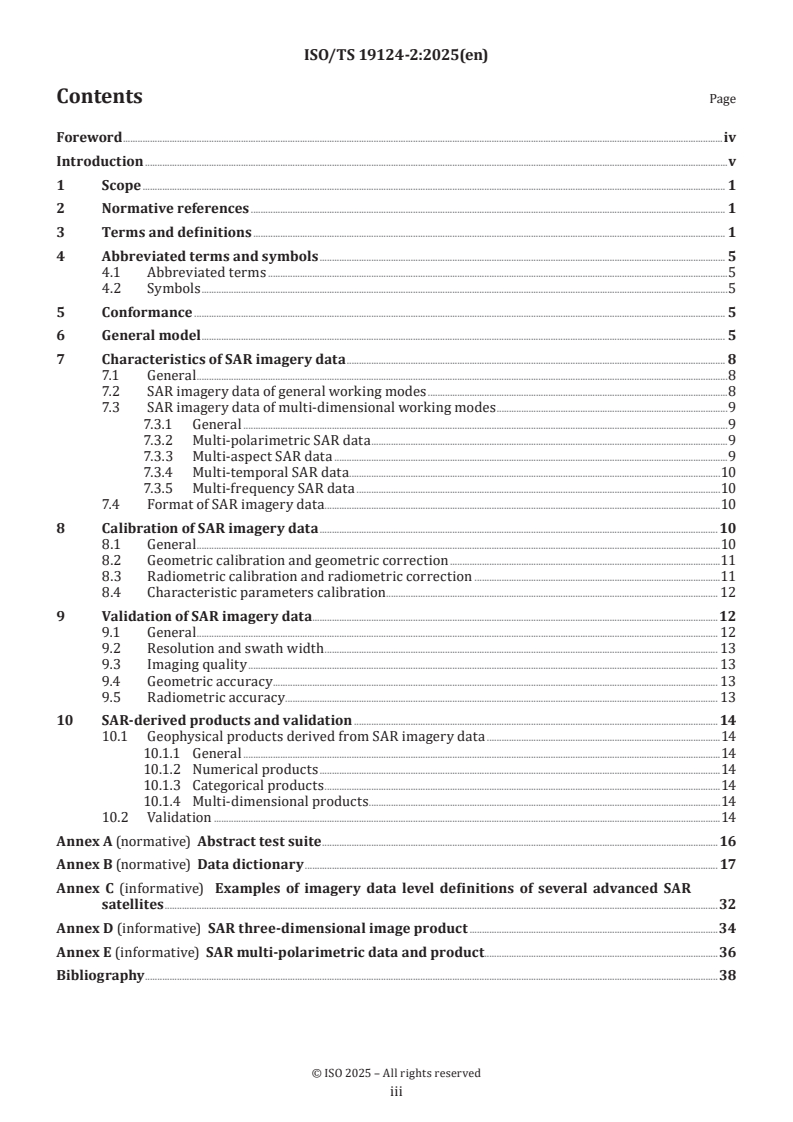
Contents Page
Foreword .iv
Introduction .v
1 Scope . 1
2 Normative references . 1
3 Terms and definitions . 1
4 Abbreviated terms and symbols . 5
4.1 Abbreviated terms .5
4.2 Symbols .5
5 Conformance . 5
6 General model . 5
7 Characteristics of SAR imagery data . 8
7.1 General .8
7.2 SAR imagery data of general working modes .8
7.3 SAR imagery data of multi-dimensional working modes .9
7.3.1 General .9
7.3.2 Multi-polarimetric SAR data .9
7.3.3 Multi-aspect SAR data .9
7.3.4 Multi-temporal SAR data . . .10
7.3.5 Multi-frequency SAR data .10
7.4 Format of SAR imagery data.10
8 Calibration of SAR imagery data . 10
8.1 General .10
8.2 Geometric calibration and geometric correction .11
8.3 Radiometric calibration and radiometric correction .11
8.4 Characteristic parameters calibration . 12
9 Validation of SAR imagery data . .12
9.1 General . 12
9.2 Resolution and swath width . 13
9.3 Imaging quality . 13
9.4 Geometric accuracy . 13
9.5 Radiometric accuracy . 13
10 SAR-derived products and validation . 14
10.1 Geophysical products derived from SAR imagery data .14
10.1.1 General .14
10.1.2 Numerical products .14
10.1.3 Categorical products .14
10.1.4 Multi-dimensional products.14
10.2 Validation .14
Annex A (normative) Abstract test suite .16
Annex B (normative) Data dictionary . 17
Annex C (informative) Examples of imagery data level definitions of several advanced SAR
satellites .32
Annex D (informative) SAR three-dimensional image product .34
Annex E (informative) SAR multi-polarimetric data and product .36
Bibliography .38
iii
Foreword
ISO (the International Organization for Standardization) is a worldwide federation of national standards
bodies (ISO member bodies). The work of preparing International Standards is normally carried out through
ISO technical committees. Each member body interested in a subject for which a technical committee
has been established has the right to be represented on that committee. International organizations,
governmental and non-governmental, in liaison with ISO, also take part in the work. ISO collaborates closely
with the International Electrotechnical Commission (IEC) on all matters of electrotechnical standardization.
The procedures used to develop this document and those intended for its further maintenance are described
in the ISO/IEC Directives, Part 1. In particular, the different approval criteria needed for the different types
of ISO document should be noted. This document was drafted in accordance with the editorial rules of the
ISO/IEC Directives, Part 2 (see www.iso.org/directives).
ISO draws attention to the possibility that the implementation of this document may involve the use of (a)
patent(s). ISO takes no position concerning the evidence, validity or applicability of any claimed patent
rights in respect thereof. As of the date of publication of this document, ISO had not received notice of (a)
patent(s) which may be required to implement this document. However, implementers are cautioned that
this may not represent the latest information, which may be obtained from the patent database available at
www.iso.org/patents. ISO shall not be held responsible for identifying any or all such patent rights.
Any trade name used in this document is information given for the convenience of users and does not
constitute an endorsement.
For an explanation of the voluntary nature of standards, the meaning of ISO specific terms and expressions
related to conformity assessment, as well as information about ISO’s adherence to the World Trade
Organization (WTO) principles in the Technical Barriers to Trade (TBT), see www.iso.org/iso/foreword.html.
This document was prepared by Technical Committee ISO/TC 211, Geographic information/Geomatics, in
collaboration with the European Committee for Standardization (CEN) Technical Committee CEN/TC 287
Geographic Information, in accordance with the Agreement on technical cooperation between ISO and CEN
(Vienna Agreement).
A list of all parts in the ISO 19124 series can be found on the ISO website.
Any feedback or questions on this document should be directed to the user’s national standards body. A
complete listing of these bodies can be found at www.iso.org/members.html.
iv
Introduction
Remote sensing is one of the major data sources for geographic information. As a kind of active imaging
radar sensor, SAR has the ability to observe the earth in both day and night, and for almost all weather
conditions. As a result, SAR data and their derived products have been widely used in various fields such as
disaster monitoring, geological mapping, environmental protection, etc.
Such applications can integrate SAR data from different suppliers and different sensors. The quality of
those data and products is essential for the success of such applications. Calibration and validation are the
fundamental processes to assess and improve the data quality and ensure the Earth observing (EO) data
and derived products from different sources are comparable and interoperable.
The calibration and validation include the SAR sensors themselves, SAR data collected by sensors, and
products derived from SAR data. ISO/TC 211 has developed the ISO 19159 series of Technical Specifications
to cover the calibration of sensor hardware and validation of the calibration results. ISO/TS 19159-3 is
about calibration and validation of SAR/InSAR sensors. The ISO 19124 series standardizes calibration and
validation of remote sensing data and products:
— ISO/TS 19124-1 addresses the overall framework and common calibration and validation processes
related to EO data and derived products from different types of remote sensors.
— This document (ISO/TS 19124-2) standardizes the calibration and validation of SAR data and their
derived products.
v
Technical Specification ISO/TS 19124-2:2025(en)
Geographic information — Calibration and validation of
remote sensing data and derived products —
Part 2:
Synthetic aperture radar (SAR)
1 Scope
This document defines the calibration and validation of Earth observing (EO) data acquired by synthetic
aperture radar (SAR) sensors and products derived from SAR data. The specified SAR sensors include
general working modes and advanced working modes.
In this document, calibration addresses the process to correct the data, not only geometrically and
radiometrically, but also characteristically for qualitative and quantitative applications. Validation addresses
an evaluation of the quality and accuracy of the calibrated data and derived products.
This document also addresses the associated metadata related to calibration and validation that has not
been defined in other geographic information International Standards.
This document does not apply to the calibration of SAR sensors and validation of SAR sensor calibration,
which are covered by ISO/TS 19159-3. However, the calibration and validation procedure can be also applied
and referenced among others.
2 Normative references
The following documents are referred to in the text in such a way that some or all of their content constitutes
requirements of this document. For dated references, only the edition cited applies. For undated references,
the latest edition of the referenced document (including any amendments) applies.
ISO/TS 19124-1, Geographic information — Calibration and validation of remote sensing data and derived
products — Part 1: Fundamentals
3 Terms and definitions
For the purposes of this document, the terms and definitions given in ISO/TS 19124-1 and the following apply.
ISO and IEC maintain terminology databases for use in standardization at the following addresses:
— ISO Online browsing platform: available at https:// www .iso .org/ obp
— IEC Electropedia: available at https:// www .electropedia .org/
3.1
azimuth ambiguity
azimuth quality degradation of SAR images as a result of the azimuth spectrum aliasing of the side
lobes of the antenna pattern
Note 1 to entry: Azimuth ambiguity is mainly caused by under-sampling of Doppler frequency, when the pulse
repetition frequency is too low during SAR satellite scanning detection.
Note 2 to entry: In severe cases, azimuth ambiguity can even produce false targets, known as “ghost shadows”.
3.2
azimuth resolution
resolution in the cross-range direction
Note 1 to entry: This is usually measured in terms of the impulse response of the SAR sensor and processing system.
It is a function of the size of the synthetic aperture, or alternatively the dwell time (i.e. a larger aperture results in a
longer dwell time results in better resolution).
Note 2 to entry: 3dB width of the impulse response is the normal value of measurements.
Note 3 to entry: Cross-range direction is also the same as along-track direction.
[SOURCE: ISO 19130-1:2018, 3.7, modified — Notes 2 and 3 to entry added.]
3.3
backscattering coefficient
average radar cross section (3.9) per unit area
Note 1 to entry: If the radar return from the illuminated area is contributed by a number of independent scattering
elements, it is described by the backscattering coefficient instead of radar cross section used for the point target. It is
calculated as:
σ
σ =
A
where
σ is the total radar cross section of an area A;
0 0
σ
is a dimensionless parameter and is usually expressed in decibels (dB) as σσ= 10log .
dB 10
Note 2 to entry: “Backscattering coefficient” is sometimes called “normalized radar cross section”.
[SOURCE: ISO/TS 19159-3:2018, 3.6]
3.4
cross-talk
any signal or circuit unintentionally affecting another signal or circuit
Note 1 to entry: For PolSAR sensor, if the transmitting channel is horizontally (H) polarized, the cross-talk on
transmitting defines the ratio of V polarization transmitting power to H polarization transmitting power, expressed
in decibels (dB). The cross-talk on receiving is similar to that on transmitting.
[SOURCE: ISO/TS 19159-3:2018, 3.10]
3.5
integrated side lobe ratio
ISLR
ratio between the side lobe power and the main lobe power of the impulse response of point targets in the
radar imaging scene
Note 1 to entry: The ISLR can be obtained by integrating the power of the impulse response over suitable regions. The
ISLR is expressed as:
PP−
totalmain
ISLR =10 log
P
main
where
P is the total power;
total
P is the main lobe power.
main
Note 2 to entry: The main lobe width can be taken as α times the impulse response width (IRW), centred around the
peak, where α is a predefined constant, usually between 2 and 2,5.
[SOURCE: ISO/TS 19159-3:2018, 3.15]
3.6
multi-dimensional synthetic aperture radar
multi-dimensional SAR
method of obtaining multi-dimensional joint observation data of the target in polarization, frequency, angle,
time and other dimensions based on the basic observation method of SAR
Note 1 to entry: Multi-dimensional SAR can be used to obtain the microwave scattering characteristics of the target
with the changes of these dimensions, and then extract the target’s geometric structure, bio-physical and other
parameters. In contrast, single-dimensional SAR refers to the SAR observation method when the parameters such as
polarization, frequency, angle, time, etc. are fixed, and obtains the microwave scattering characteristics of the target
under fixed observation conditions.
3.7
multi-dimensional product
product that involves multiple dimensions or variables, which provides the
geometrical, bio-physical and backscattering parameter information from the multi-dimensional data,
except for conventional image products
3.8
peak side lobe ratio
PSLR
ratio between the peak power of the largest side lobe and the peak power of the main lobe of the impulse
response of point targets in the SAR image
Note 1 to entry: The PSLR is usually expressed in decibels (dB) and computed as follows:
P
sidepeak
PSLR =10 log
P
mainpeak
where
P is the peak power of the main lobe;
sidepeak
P is the peak power of the largest side lobe.
mainpeak
[SOURCE: ISO/TS 19159-3:2018, 3.19]
3.9
radar cross section
measure of the capability of the object to scatter the transmitted radar power
Note 1 to entry: Radar cross section is calculated as:
||E
2 s
σ = lim 4πR
R→∞
||E
i
where
σ is the radar cross section;
E is the electric-field strength of the incident wave;
i
E is the electric-field strength of the scattered wave at the radar with a distance away from the
s
target.
Note 2 to entry: Radar cross section has the dimensions of area, with the unit of square metres. Usually, it is expressed
in the form of logarithm with the unit of dBsm as follows:
σσ=10 log
dBsm 10
[SOURCE: ISO/TS 19159-3:2018, 3.23]
3.10
range ambiguity
range quality degradation of the SAR image as a result from the pulse echoes of the ambiguous region
superimposed on that of the target region
Note 1 to entry: The time dispersion of useful echo signals within the swath may exceed the pulse repetition interval
(PRT). The preceding and succeeding pulse echoes reflected from the range ambiguous region arriving at the antenna
at the same time as the echoes of the target region, which results in the image superimposition of the target and the
ambiguous region.
3.11
range resolution
spatial resolution in the range direction
Note 1 to entry: For a SAR sensor, it is usually measured in terms of the impulse response of the sensor and processing
system. It is a function of the bandwidth of the pulse.
Note 2 to entry: 3dB width of the impulse response is the normal value of measurements.
[SOURCE: ISO 19130-1:2018, 3.71, modified — Note 2 to entry added.]
3.12
ScanSAR mode
special case of stripmap mode (3.14) that uses an electronically steerable antenna to quickly change the
swath being imaged during collection to collect multiple parallel swaths in one pass
[SOURCE: ISO 19130-1:2018, 3.78]
3.13
spotlight mode
SAR mode in which the antenna beam is steered to illuminate one area during collection
Note 1 to entry: Spotlight mode provides the ability to collect higher resolution SAR data over relatively smaller
patches of ground surface.
[SOURCE: ISO 19130-1:2018, 3.83]
3.14
stripmap mode
SAR mode in which the antenna beam is fixed throughout the collection of an image
Note 1 to entry: Doppler angle in processed products is fixed for all pixels. It provides the ability to collect SAR data
over strips of land over a fixed swath of ground range parallel to the direction of flight.
[SOURCE: ISO 19130-1:2018, 3.85]
3.15
Terrain Observation by Progressive Scans SAR
TOPSAR
TOPS
SAR mode that uses burst mode and azimuth beam active scanning to obtain the wide swath
4 Abbreviated terms and symbols
4.1 Abbreviated terms
Cal/Val calibration and validation
DEM digital elevation model
InSAR interferometric synthetic aperture radar
PolSAR polarimetric synthetic aperture radar
PolInSAR polarimetric synthetic aperture radar interferometry
RD range-Doppler
SLC Single Look Complex
4.2 Symbols
σ radar cross section
σ scattering coefficient
E electric-field strength of the incident wave
i
E electric-field strength of the scattered wave at the radar with a distance away from the target
s
P total power of the impulse response
total
P total power of the main lobe
main
P peak power of the main lobe
mainpeak
P peak power of the largest side lobe
sidepeak
R range from the antenna phase centre to the target
5 Conformance
This document specifies two conformance classes. Details of the conformance classes are given in the
abstract test suite in Annex A. For any set of calibration and validation information of SAR data and derived
products, claiming conformance to this document shall satisfy the requirements described in the abstract
test suite Clause A.1 or Clause A.2, respectively.
6 General model
Figure 1 shows the top-level UML model of ISO/TS 19124-1.
CA_CalibrationValidation is a specified class of MD_ContentInfo. CA_CalibrationValidation is aggregated
from the CA_Methods class, which describes the Cal/Val methods common to different types of sensors
and data, and CA_RefSources class, which describes reference sources commonly used for Cal/Val of data
acquired by multiple types of sensors.
CA_CalibrationValidation has two specialized subclasses: CA_SensorCalVal, which describes the Cal/Val of
sensor, and CA_DataProductCalVal, which describes the Cal/Val of remotely sensed data and derived products
and is supported by CA_SensorCalVal. The Cal/Val of SAR sensors are defined in ISO/TS 19159-3:2018.
The CA_DataProductCalVal class has two specialized classes, CA_RSDataCalVal and CA_
DerivedProductCalVal. CA_RSDataCalVal defines the Cal/Val of remotely sensed data, whose attribute
values are still in a sensor unit (e.g. digital number or radiance).
The subclasses of CA_RSDataCalVal include CA_DataIR, CA_DataActiveOptical, CA_DataPassiveMicrowave,
CA_DataActiveMicrowave, etc. as described in ISO/TS 19124-1.
CA_SARDataCalVal is a subclass of CA_DataActiveMicrowave, which shall describe the details of Cal/Val of
SAR data in this document.
The details of CA_SARDataCalVal and its subclasses are shown in Figure 2 and described in Clause 7, Clause 8
and Clause 9.
Figure 1 — Top-level UML model of ISO/TS 19124-1
Figure 2 — Model CA_ SARDataCalVal
The CA_DerivedProductCalVal class shown in Figure 3 defines the validation of thematic products derived
at least in part from remotely sensed data via algorithms or models.
As described in ISO/TS 19124-1, it has two specialized subclasses, CA_NumericalProduct and CA_
CategoricalProduct. They deal with the validation of thematic products whose attribute values are
continuous physically and categorical physically, respectively.
A new specialized subclass CA_SARMultiDimensionalProduct is added in this document. The details are
described in Clause 10.
Figure 3 — Model CA_DerivedProductCalVal
7 Characteristics of SAR imagery data
7.1 General
As shown in Figure 4, The class CA_SARDataCalVal has two specialized subclasses: CA_GeneralModeSARData
and CA_MultiDimensionModeData. This clause describes the characteristics of SAR imagery data of general
working modes and multi-dimensional working modes, respectively.
Figure 4 — CA_SARDataCalVal
7.2 SAR imagery data of general working modes
General working modes of SAR system include strip, spotlight, scan, TOPS, etc. Echo data received by SAR
sensors is inverted to imagery data through imaging processing. According to different processing steps, the
generated SAR imagery data can be defined as different levels, such as SLC imaging, multi-look processing,
converting complex images into amplitude images, geometric correction, etc. Different SAR satellite systems
have different data level definitions.
Annex C lists the imagery data level definitions of several advanced SAR satellites in the world as examples.
The class CA_GeneralModeSARData contains useful information to characterize the imagery data of general
working modes (see Figure 4).
Requirement 1 /req/SARDataCalVal/GeneralModeSARData
The CA_GeneralModeSARData class shall be used to describe SAR imagery data of general working mode, as
specified in Table B.4.
7.3 SAR imagery data of multi-dimensional working modes
7.3.1 General
With fast development of SAR system technology, many advanced working modes have been developed,
including interferometric SAR (InSAR), polarimetric SAR (PolSAR), polarimetric SAR interferometry
(PolInSAR), multi-angle SAR, time series SAR, multi-frequency SAR, etc.
Furthermore, the SAR system is extended from a single observation space to a multi-dimensional observation
space. Under certain constraints, the SAR basic observation method is used to carry out a joint observation
in at least two spaces among polarization, frequency, angle and time spaces, so that multiple observation
data sets can be obtained, which is called “multi-dimensional SAR”.
For those new SAR working modes, SAR imagery data are not only a single imagery, but also expanded into a
multi-dimensional data set.
While describing these data sets, in addition to the same data level definition as the general working mode,
it is also necessary to describe the multi-dimensional parameters of the data to ensure the correlation and
consistency between multiple imagery in the data set.
The class CA_MultiDimensionModeSARData and its subclasses contain useful information to describing the
SAR imagery data of multi-dimensional mode (see Figure 4).
Requirement 2 /req/SARDataCalVal/MultiDimensionModeSARData
The CA_MultiDimensionModeSARData class and its subclasses shall be used to describe SAR imagery data
to multi-dimensional working mode, as specified in Table B.5.
7.3.2 Multi-polarimetric SAR data
Polarimetry refers to the direction of electric field vector of transmitted/received electromagnetic wave. The
polarization channels of SAR data are the combination in polarimetric modes of transmitted and received
[1]
radar waves. For example, general linear polarimetric mode includes horizontal(H) and vertical(V)
direction, so the corresponding polarization channels of SAR data are HH, HV, VH and VV. SAR data with
more than one polarization channel are called “multi-polarimetric SAR”.
Multi-polarimetric SAR data processing consists of second-order statistics conversion, speckle filtering,
target decomposition, segmentation, classification, parameter inversion, etc. The processing steps of PolSAR
data are required to retain the relative relation between the complex information of polarimetric channels,
[2]
both in amplitude and phase.
The class CA_SARMultiPolData contains useful information related to the multi-polarimetric SAR data set.
Its attributes and associations shall be used as described in the data dictionary of Clause B.4.
7.3.3 Multi-aspect SAR data
Multi-aspect SAR observes the scene from different aspect angles and describes the changes of target
[3][4]
scattering, imaging geometry, and other characteristics with the aspect angle.
As the imaging geometry varies with the different observing geometry, it is necessary to process the echo
data received from different aspect angles in a unified coordinate system to obtain multi-aspect image
sequence.
The main parameters of multi-aspect SAR, including the number of images, the synthetic aperture
accumulation time of each image and the acquisition aspect angle, etc., should be defined to describe the
multi-aspect SAR data set.
The class CA_SARMultiAngleData contains useful information related to the multi-aspect SAR data set. Its
attributes and associations shall be used as described in the data dictionary of Clause B.4.
7.3.4 Multi-temporal SAR data
Multi-temporal SAR repeatedly observes the scene at different times. It is very useful in the field of detecting
the change of target or scene state with time.
As the precondition of change detection is to register the data of different time phase in the unified geometry
coordinate system, it is necessary to process the echo data received at different times in a unified coordinate
system to obtain multi-temporal image sequence.
The main parameters of multi-temporal SAR include the data acquisition time, registration process, etc.
The class CA_SARMultiTempData contains useful information related to the multi-temporal SAR data set. Its
attributes and associations shall be used as described in the data dictionary of Clause B.4.
7.3.5 Multi-frequency SAR data
Multi-frequency SAR data refers to SAR datasets with central frequencies in different bands of the
electromagnetic spectrum, covering the same observation areas and typically acquired simultaneously or
within a limited time interval.
Since the central frequency is different, the resolution and scattering centre of multi-frequency SAR data are
not the same. Accordingly, the data processing steps mainly refer to resolution normalization by upsampling
or downsampling, single-frequency data feature extraction and multi-frequency feature fusion.
The class CA_SARMultiFreqData contains useful information related to the multi-frequency SAR data set. Its
attributes and associations shall be used as described in the data dictionary of Clause B.4.
7.4 Format of SAR imagery data
SAR imagery data of different modes, different data levels or different platforms have a different data
format. Especially for the advanced SAR working mode, the imagery data are not only a static imagery, but
a series of data sets. The series labels such as phase, angle and polarization and the correlation between
multiple images should be reflected in the data, and the corresponding data format also has particularity.
As examples, Annex C presents the imagery data formats of different levels for several advanced satellites in
the world. This document also addresses the metadata related to the format of SAR imagery data.
8 Calibration of SAR imagery data
8.1 General
The calibration of SAR imagery data includes geometric calibration, radiometric calibration and
characteristic parameter calibration.
The class CA_SARDataCal is an abstract superclass for describing the common attributes of SAR data
calibration (see Figure 5).
Requirement 3 /req/SARDataCalVal/SARDataCa/
The CA_SARDataCal class shall describe the common attributes as specified in Clause B.5.
Figure 5 — CA_SARDataCal
8.2 Geometric calibration and geometric correction
For many scientific applications such as geologic mapping and land surveys, the geometric fidelity of SAR
imagery data is critically important. Generally, the source of geometric distortion can be categorized
as resulting from sensor instability, platform instability, signal propagation effects, terrain height- and
[5]
processor-induced errors. Geometric calibration is defined as the process of measuring the various error
sources and characterizing them in terms of the calibration accuracy parameters. Relevant contents are
covered in ISO/TS 19159-3:2018.
Geometric correction describes the processing step where the SAR imagery is resampled from its distorted
projection into a format better suited to scientific analysis.
Pixel geographic location is carried out at first according to the location model with the calibrated platform
position and velocity, signal propagation delay and other system parameters. Then the imagery is resampled
into a specific output image format, namely a uniform earth-fixed grid, which is typically a standard map
projection such as Universal Transverse Mercator (UTM). This procedure is called “geocoding”.
The class CA_SARDataGeoCal describes the details of SAR data geometric correction. Its attributes and
associations shall be used as described in the data dictionary of Clause B.5.
8.3 Radiometric calibration and radiometric correction
The radiometric accuracy of the SAR imagery data is dependent on radar antenna and sensor electronics,
atmospheric propagation, platform attitude control, data downlink and ground processor. Radiometric
calibration is the process of characterizing the performance of the end-to-end SAR system, in terms of its
ability to measure the amplitude and phase of the backscattered signal.
The radiometric calibration can be divided into two categories: internal calibration and external calibration.
Internal calibration is the process of characterizing the radar system performance using calibration signals
injected into the radar data stream by built-in devices such as calibration tone and chirp replica. External
calibration is the process of characterizing the system performance exploring calibration signals originating
from or scattered by ground targets. These ground targets can be either point targets with known radar
cross section such as corner reflectors or transponders, or distributed targets with known scattering
[5][6]
characteristics. The relevant radiometric calibration parameters are defined in ISO/TS 19159-3.
Corner reflectors are passive devices most frequently used for SAR calibration. They are usually made from
two or more intersecting metal screens and oriented on the ground toward the radar to provide a bright
pixel. These devices span a geometric area much less than a resolution cell, but exhibit a radar cross section
that is bright with respect to the total backscattered power from the surrounding target area within the
resolution cell. As a result, they can be regarded as point targets for image radiometric calibration. Corner
reflectors of known size, shape, orientation and radar cross section have been placed at strategic locations
in the test sites for the external calibration.
The radiometric calibration processing involves the analysis of internal calibration and external calibration
data, generation of calibration correction factors and application of these corrections to the SAR imagery
data. This document addresses the processing steps of SAR radiometric correction.
The class CA_SARDataRadioCal describes the details of SAR data radiometric correction. Its attributes and
associations shall be used as described in the data dictionary of Clause B.5.
8.4 Characteristic parameters calibration
Multi-dimensional SAR system can realize comprehensive processing of multi-parameter data acquisition,
multi-variable signal processing and multi-dimensional information inversion.
As a result, the complex multi-layer and multi-mechanism scattering characteristics of the observed object
can be obtained and its new geometric, physical and biological characteristic parameters can be derived.
In this complex observation mode, an empirical or semi empirical forward scattering model can be
established according to the SAR scattering mechanism. However, the model is usually a function of one
or more parameters. These parameters are not constant and should be calibrated using the ground truth.
According to the calibrated model, more accurate thematic products can be inversed. Besides general
geometric and radiometric calibration, this document also addresses characteristic parameters calibration
of SAR imagery data for qualitative and quantitative applications.
The class CA_SARDataChaParaCal describes the details of SAR data characteristic parameter calibration. Its
attributes and associations shall be used as described in the data dictionary of Clause B.5.
Annex E provides an example of the calibration of characteristic parameters used for soil moisture inversion
by SAR multi-polarimetric data.
9 Validation of SAR imagery data
9.1 General
The validation of SAR imagery data refers to the quality evaluation of SAR imagery data in different
processing levels using several indexes.
The class CA_SARDataVal contains the detailed information of SAR data quality evaluation as shown in
Figure 6.
Requirement 4 /req/SARDataCalVal/SARDataVal/
The CA_SARDataVal class and its attributes and associations shall be used to describe SAR data quality
evaluation as specified in Clause B.6.
Figure 6 — CA_SARDataVal
9.2 Resolution and swath width
Resolution of SAR imagery describes the smallest distance between two objects that can be separately
resolved in a SAR image. It includes range resolution and azimuth resolution.
Swath width describes the area width that can be covered by the range beam of SAR antenna and meet the
requirements of imaging quality.
9.3 Imaging quality
The indexes of SAR imaging quality include peak side lobe ratio (PSLR), integrated side lobe ratio (ISLR),
range ambiguity, azimuth ambiguity, etc.
Point target analysis method is usually used to measure SAR image quality parameters. As the SAR system
is linear, it is natural to characterize its performance through its impulse response, which is obtained by
measuring the system response to a single isolated scatterer on the ground such as a corner reflector. Such
a small discrete scatterer is called a point target. PSLR and ISLR can be estimated from measurement of the
point target response. As the SAR imagery data are two-dimensional, PSLR and ISLR should be estimated in
the range and azimuth direction, respectively.
9.4 Geometric accuracy
The geometric accuracy indexes of SAR imagery include absolute location accuracy and relative location
accuracy. As point target devices span a geometric area much less than a resolution cell with bright intensity
in the image, they are usually used to carry out geometric calibration and validation. Through deploying the
point targets such as corner reflectors on the ground, the geometric location accuracy of SAR imagery can
be evaluated according to the real three-dimensional position of the target and the location result from the
imagery.
9.5 Radiometric accuracy
For the single channel SAR imagery data, absolute radiometric accuracy and relative radiometric accuracy
are generally used to specify the radiometric performance of the imagery data.
For the multiple channel SAR imagery data, it is also necessary to evaluate the imbalance of the amplitude
and the phase between channels. Particularly, polarization cross-talk also exists for a multipolarization
SAR system. Therefore, in addition to channel imbalance, polarization isolation should be evaluated for the
PolSAR imagery data.
The absolute and relative radiometric calibration accuracy of the SAR imagery data can be validated by
establishing ground verification sites either equipped with point target devices, or covering homogeneous
backscatter regions of known backscattering coefficient.
10 SAR-derived products and validation
10.1 Geophysical products derived from SAR imagery data
10.1.1 General
The products derived from SAR imagery data can be divided into three categories: numerical products (see
10.1.2), categorical products (see 10.1.3) and multi-dimensional products (see 10.1.4).
10.1.2 Numerical products
There are many kinds of numerical products derived from SAR imagery data in different working modes,
such as DEM, forest tree height, surface deformation and deformation rate, etc.
10.1.3 Categorical products
SAR imagery data of different working modes can also produce categorical products. For example,
polarimetric SAR data can generate land cover classification and sea ice classification products. PolInSAR
can inverse forest structure products, etc.
10.1.4 Multi-dimensional pr
...