


ISO 3260:2015
(Main)Pulps — Determination of chlorine consumption (Degree of delignification)
Pulps — Determination of chlorine consumption (Degree of delignification)
ISO 3260:2015 specifies a method for the determination of the degree of delignification of pulp by measuring its chlorine consumption. This method is applicable to all kinds of pulp.
Pâtes — Détermination de la consommation en chlore (Degré de délignification)
General Information
- Status
- Published
- Publication Date
- 01-Apr-2015
- Technical Committee
- ISO/TC 6 - Paper, board and pulps
- Drafting Committee
- ISO/TC 6 - Paper, board and pulps
- Current Stage
- 9093 - International Standard confirmed
- Start Date
- 05-Jun-2026
- Completion Date
- 06-Jun-2026
Buy Documents
ISO 3260:2015 - Pulps -- Determination of chlorine consumption (Degree of delignification)
ISO 3260:2015 - Pulps — Determination of chlorine consumption (Degree of delignification)/2/2015
Relations
- Effective Date
- 17-May-2014
Overview
ISO 3260:2015 is an international standard established by the International Organization for Standardization (ISO) that specifies a precise method for determining the degree of delignification in pulp by measuring its chlorine consumption. This test method is essential for quality control and research in the pulp and paper industry, offering a reliable way to assess pulp lignin content through its reaction with chlorine.
The standard applies universally to all kinds of pulp, making it versatile for laboratories and industries handling various pulp types. The method involves the measurement of active chlorine consumed by pulp under controlled conditions and provides results that correlate linearly with the total lignin content. This facilitates accurate monitoring of pulping processes and final product quality.
Key Topics
Scope and Applicability
The standard provides a unified procedure for evaluating chlorine consumption as an indicator of delignification across all pulp types.Principle of Measurement
Pulp samples are treated with chlorine generated from acidified sodium hypochlorite under precise temperature and time conditions. The residual chlorine is then quantified through iodometric titration to calculate chlorine consumption.Sample Preparation
Different forms of pulp-air-dried sheets, screened slush pulps, and unscreened pulps-are prepared according to detailed guidelines to ensure consistent test results.Reagents and Apparatus
The test requires specified reagents including sodium hypochlorite, hydrochloric acid, potassium iodide, sodium thiosulfate, and starch indicator. Specialized apparatus includes high-speed disintegrators, conical flasks with ground joints, separating funnels, magnetic stirrers, water baths, and vacuum pumps.Test Procedure
Accurate mass measurements of the pulp are followed by dispersion in water, chemical treatment in a controlled temperature water bath, and precise timing of reagent addition. Titration results are used to determine chlorine consumption, applying correction factors as necessary.Expression of Results
Chlorine consumption is expressed as a percentage by mass, corrected for residual chlorine, and reported as the average of duplicate tests for accuracy.Safety Precautions
Given the use of hazardous chemicals, the standard emphasizes strict adherence to safety protocols during the test.
Applications
Pulp Quality Assessment
Operators and researchers can use ISO 3260:2015 to quantify the lignin removal efficiency during pulp processing, helping optimize bleaching and delignification steps.Process Control in Pulp Mills
The test facilitates monitoring of delignification degree, ensuring compliance with environmental and production standards.Comparative Material Analysis
The method supports comparative studies of pulps derived from different raw materials or manufacturing technologies.Research and Development
Scientists and engineers apply this standardized method to develop new pulping techniques and improve existing ones, linking chlorine consumption to lignin content changes.
Related Standards
ISO 302: Pulps - Determination of Kappa number
This related standard measures the degree of delignification by potassium permanganate consumption and complements the chlorine consumption method described in ISO 3260.ISO 638: Paper, Board and Pulps - Determination of Dry Matter Content
Defines oven-drying procedures essential for calculating pulp dry mass during sample preparation for chlorine consumption tests.ISO/IEC Directives
Provides guidance on the development, editing, and maintenance of ISO standards including ISO 3260.
By adhering to the procedures outlined in ISO 3260:2015, pulp and paper professionals can achieve consistent, reliable assessments of pulp lignin content through chlorine consumption measurement, enhancing product quality and processing efficiency. Keywords: chlorine consumption, degree of delignification, pulp testing, ISO 3260, pulp quality control, lignin content measurement, pulp and paper standards.
Buy Documents
ISO 3260:2015 - Pulps -- Determination of chlorine consumption (Degree of delignification)
ISO 3260:2015 - Pulps — Determination of chlorine consumption (Degree of delignification)/2/2015
Get Certified
Connect with accredited certification bodies for this standard

Control Union Certifications
Global certification for agriculture and sustainability.

Gozdarski inštitut Slovenije
Slovenian Forestry Institute. Forest management certification support, timber testing.
Sponsored listings
Frequently Asked Questions
ISO 3260:2015 is a standard published by the International Organization for Standardization (ISO). Its full title is "Pulps — Determination of chlorine consumption (Degree of delignification)". This standard covers: ISO 3260:2015 specifies a method for the determination of the degree of delignification of pulp by measuring its chlorine consumption. This method is applicable to all kinds of pulp.
ISO 3260:2015 specifies a method for the determination of the degree of delignification of pulp by measuring its chlorine consumption. This method is applicable to all kinds of pulp.
ISO 3260:2015 is classified under the following ICS (International Classification for Standards) categories: 85.040 - Pulps. The ICS classification helps identify the subject area and facilitates finding related standards.
ISO 3260:2015 has the following relationships with other standards: It is inter standard links to ISO 3260:1982. Understanding these relationships helps ensure you are using the most current and applicable version of the standard.
ISO 3260:2015 is available in PDF format for immediate download after purchase. The document can be added to your cart and obtained through the secure checkout process. Digital delivery ensures instant access to the complete standard document.
Standards Content (Sample)
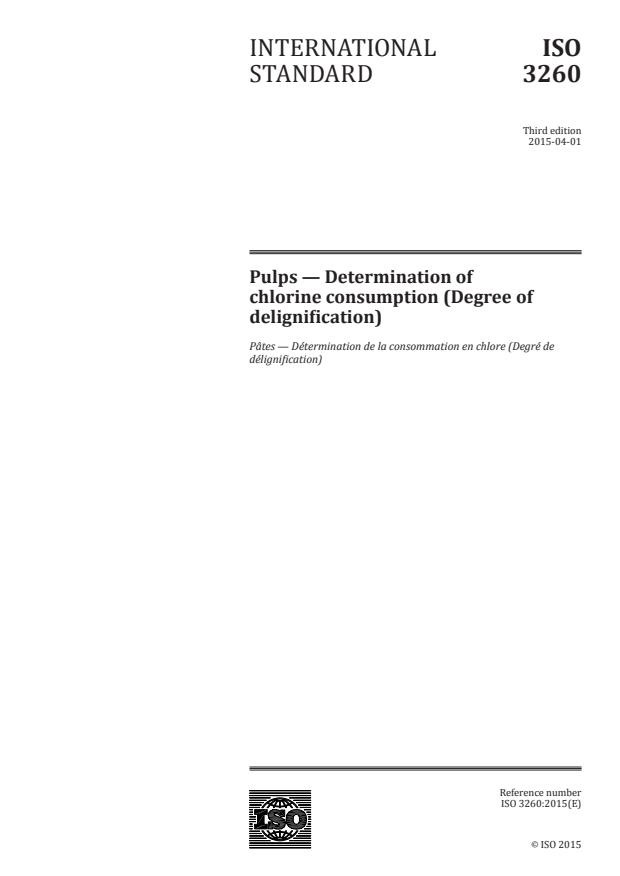
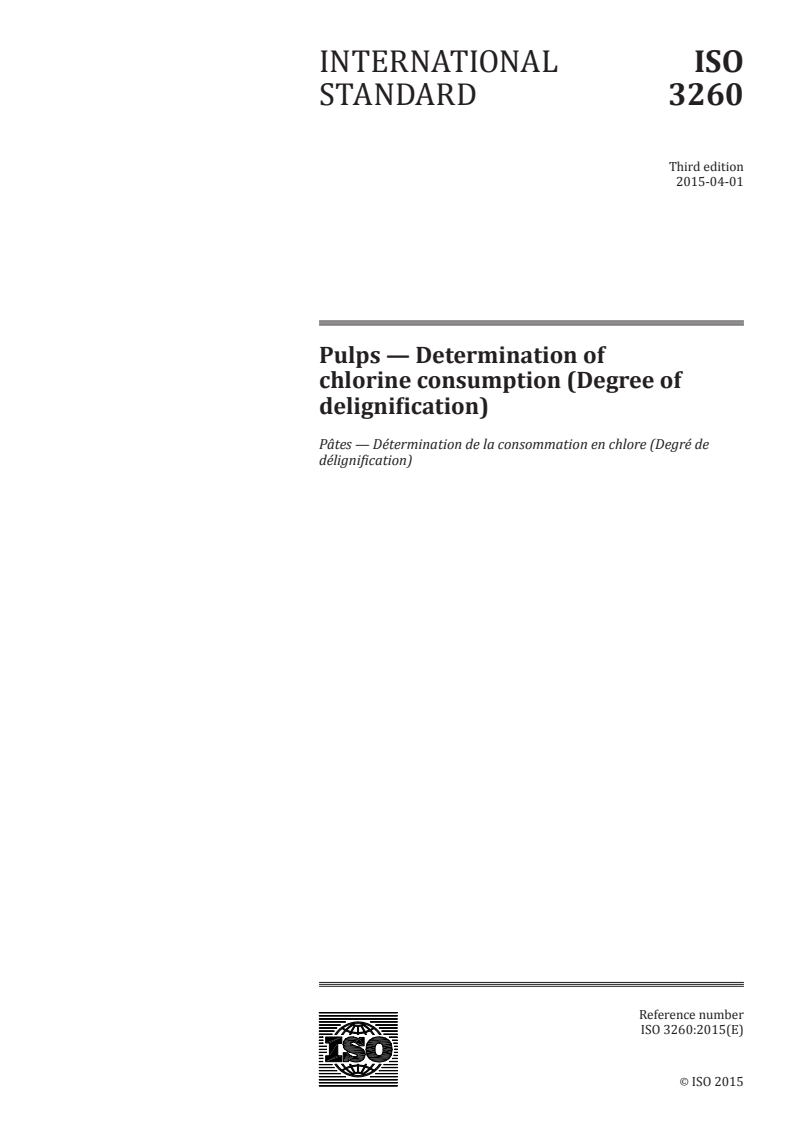
INTERNATIONAL ISO
STANDARD 3260
Third edition
2015-04-01
Pulps — Determination of
chlorine consumption (Degree of
delignification)
Pâtes — Détermination de la consommation en chlore (Degré de
délignification)
Reference number
©
ISO 2015
© ISO 2015
All rights reserved. Unless otherwise specified, no part of this publication may be reproduced or utilized otherwise in any form
or by any means, electronic or mechanical, including photocopying, or posting on the internet or an intranet, without prior
written permission. Permission can be requested from either ISO at the address below or ISO’s member body in the country of
the requester.
ISO copyright office
Case postale 56 • CH-1211 Geneva 20
Tel. + 41 22 749 01 11
Fax + 41 22 749 09 47
E-mail copyright@iso.org
Web www.iso.org
Published in Switzerland
ii © ISO 2015 – All rights reserved
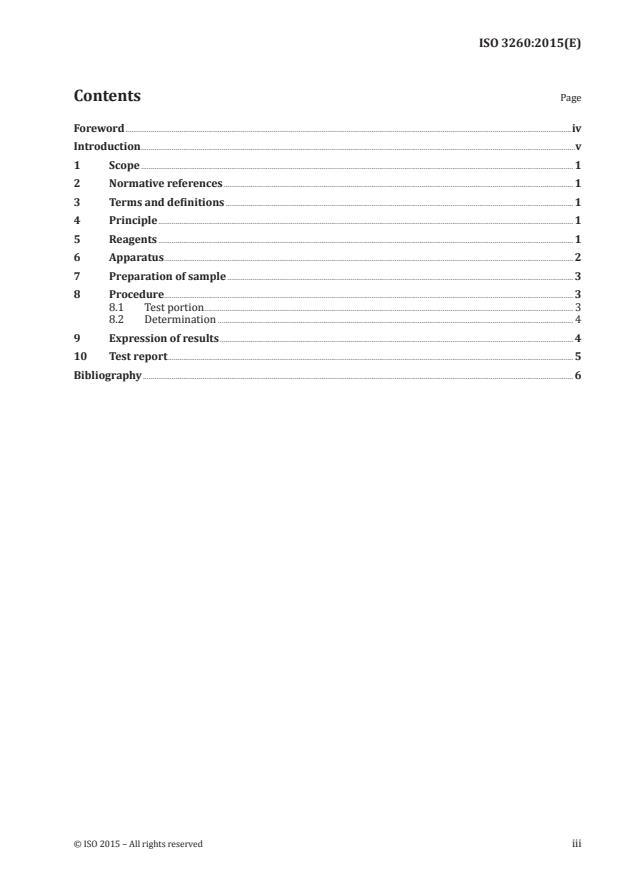
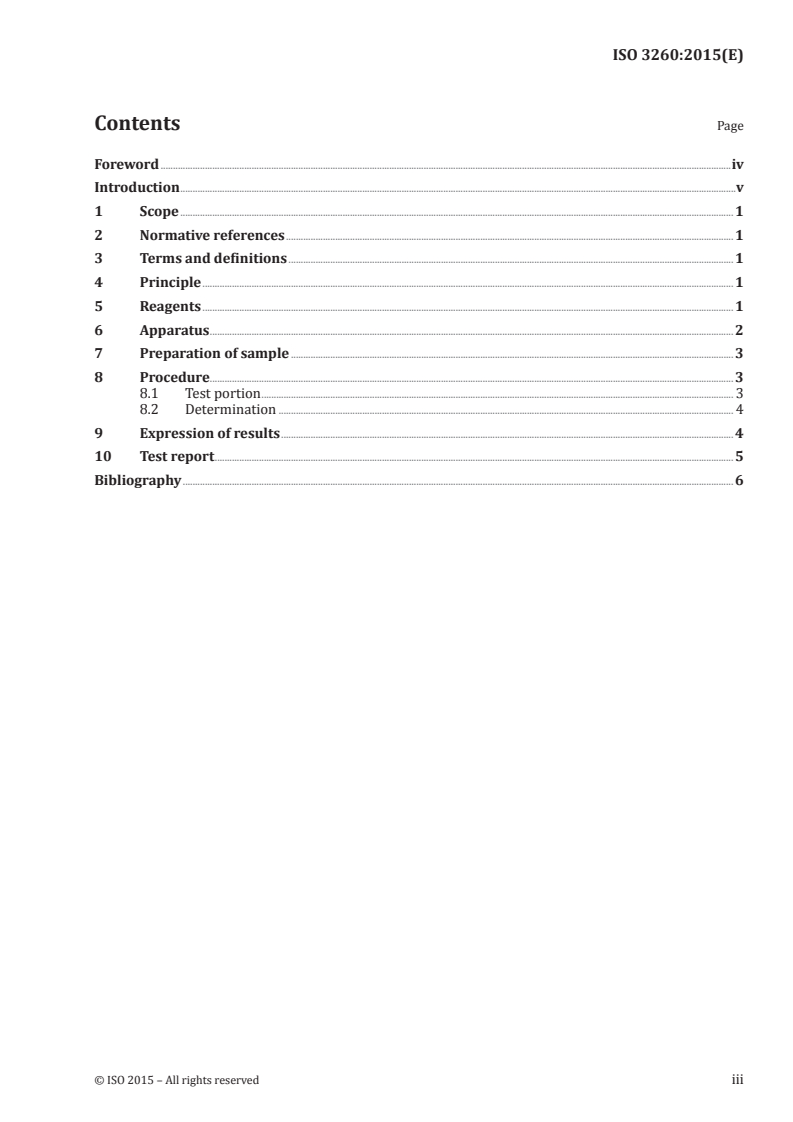
Contents Page
Foreword .iv
Introduction .v
1 Scope . 1
2 Normative references . 1
3 Terms and definitions . 1
4 Principle . 1
5 Reagents . 1
6 Apparatus . 2
7 Preparation of sample . 3
8 Procedure. 3
8.1 Test portion . 3
8.2 Determination . 4
9 Expression of results . 4
10 Test report . 5
Bibliography . 6
Foreword
ISO (the International Organization for Standardization) is a worldwide federation of national standards
bodies (ISO member bodies). The work of preparing International Standards is normally carried out
through ISO technical committees. Each member body interested in a subject for which a technical
committee has been established has the right to be represented on that committee. International
organizations, governmental and non-governmental, in liaison with ISO, also take part in the work.
ISO collaborates closely with the International Electrotechnical Commission (IEC) on all matters of
electrotechnical standardization.
The procedures used to develop this document and those intended for its further maintenance are
described in the ISO/IEC Directives, Part 1. In particular the different approval criteria needed for the
different types of ISO documents should be noted. This document was drafted in accordance with the
editorial rules of the ISO/IEC Directives, Part 2 (see www.iso.org/directives).
Attention is drawn to the possibility that some of the elements of this document may be the subject of
patent rights. ISO shall not be held responsible for identifying any or all such patent rights. Details of any
patent rights identified during the development of the document will be in the Introduction and/or on
the ISO list of patent declarations received (see www.iso.org/patents).
Any trade name used in this document is information given for the convenience of users and does not
constitute an endorsement.
For an explanation on the meaning of ISO specific terms and expressions related to conformity
assessment, as well as information about ISO’s adherence to the WTO principles in the Technical Barriers
to Trade (TBT), see the following URL: Foreword — Supplementary information.
The committee responsible for this document is ISO/TC 6, Paper, board and pulps.
This third edition cancels and replaces the second edition (ISO 3260:1982), of which it constitutes a
minor revision.
iv © ISO 2015 – All rights reserved
Introduction
The method specified in this International Standard for determining the degree of delignification of pulp
by measuring its chlorine consumption under specified conditions is related to that for determining
the degree of delignification of pulp by measuring its potassium permanganate consumption under
specified conditions, given in ISO 302, Pulps — Determination of Kappa number. Unlike that method, the
method for the determination of chlorine consumption has the merit of not being restricted to pulps
obtained in yields under 60 %.
It has been shown experimentally that there is a linear relationship between the chlorine consumption
and the total lignin content of pulp. This relationship is independent of the method used in the
manufacture of the pulp.
INTERNATIONAL STANDARD ISO 3260:2015(E)
Pulps — Determination of chlorine consumption (Degree
of delignification)
WARNING — The method specified in this International Standard involves the use of hazardous
chemicals. Appropriate precautions must be taken to ensure the proper use and disposal of
these chemicals.
1 Scope
This International Standard specifies a method for the determination of the degree of delignification of
pulp by measuring its chlorine consumption.
This method is applicable to all kinds of pulp.
2 Normative references
The following referenced documents are indispensable for the application of this document. For dated
references, only the edition cited applies. For undated references, the latest edition of the referenced
document (including any amendments) applies.
ISO 638, Paper, board and pulps — Determination of dry matter content — Oven-drying method
3 Terms and definitions
For the purposes of this do
...
INTERNATIONAL ISO
STANDARD 3260
Third edition
2015-04-01
Pulps — Determination of
chlorine consumption (Degree of
delignification)
Pâtes — Détermination de la consommation en chlore (Degré de
délignification)
Reference number
©
ISO 2015
© ISO 2015
All rights reserved. Unless otherwise specified, no part of this publication may be reproduced or utilized otherwise in any form
or by any means, electronic or mechanical, including photocopying, or posting on the internet or an intranet, without prior
written permission. Permission can be requested from either ISO at the address below or ISO’s member body in the country of
the requester.
ISO copyright office
Case postale 56 • CH-1211 Geneva 20
Tel. + 41 22 749 01 11
Fax + 41 22 749 09 47
E-mail copyright@iso.org
Web www.iso.org
Published in Switzerland
ii © ISO 2015 – All rights reserved
Contents Page
Foreword .iv
Introduction .v
1 Scope . 1
2 Normative references . 1
3 Terms and definitions . 1
4 Principle . 1
5 Reagents . 1
6 Apparatus . 2
7 Preparation of sample . 3
8 Procedure. 3
8.1 Test portion . 3
8.2 Determination . 4
9 Expression of results . 4
10 Test report . 5
Bibliography . 6
Foreword
ISO (the International Organization for Standardization) is a worldwide federation of national standards
bodies (ISO member bodies). The work of preparing International Standards is normally carried out
through ISO technical committees. Each member body interested in a subject for which a technical
committee has been established has the right to be represented on that committee. International
organizations, governmental and non-governmental, in liaison with ISO, also take part in the work.
ISO collaborates closely with the International Electrotechnical Commission (IEC) on all matters of
electrotechnical standardization.
The procedures used to develop this document and those intended for its further maintenance are
described in the ISO/IEC Directives, Part 1. In particular the different approval criteria needed for the
different types of ISO documents should be noted. This document was drafted in accordance with the
editorial rules of the ISO/IEC Directives, Part 2 (see www.iso.org/directives).
Attention is drawn to the possibility that some of the elements of this document may be the subject of
patent rights. ISO shall not be held responsible for identifying any or all such patent rights. Details of any
patent rights identified during the development of the document will be in the Introduction and/or on
the ISO list of patent declarations received (see www.iso.org/patents).
Any trade name used in this document is information given for the convenience of users and does not
constitute an endorsement.
For an explanation on the meaning of ISO specific terms and expressions related to conformity
assessment, as well as information about ISO’s adherence to the WTO principles in the Technical Barriers
to Trade (TBT), see the following URL: Foreword — Supplementary information.
The committee responsible for this document is ISO/TC 6, Paper, board and pulps.
This third edition cancels and replaces the second edition (ISO 3260:1982), of which it constitutes a
minor revision.
iv © ISO 2015 – All rights reserved
Introduction
The method specified in this International Standard for determining the degree of delignification of pulp
by measuring its chlorine consumption under specified conditions is related to that for determining
the degree of delignification of pulp by measuring its potassium permanganate consumption under
specified conditions, given in ISO 302, Pulps — Determination of Kappa number. Unlike that method, the
method for the determination of chlorine consumption has the merit of not being restricted to pulps
obtained in yields under 60 %.
It has been shown experimentally that there is a linear relationship between the chlorine consumption
and the total lignin content of pulp. This relationship is independent of the method used in the
manufacture of the pulp.
INTERNATIONAL STANDARD ISO 3260:2015(E)
Pulps — Determination of chlorine consumption (Degree
of delignification)
WARNING — The method specified in this International Standard involves the use of hazardous
chemicals. Appropriate precautions must be taken to ensure the proper use and disposal of
these chemicals.
1 Scope
This International Standard specifies a method for the determination of the degree of delignification of
pulp by measuring its chlorine consumption.
This method is applicable to all kinds of pulp.
2 Normative references
The following referenced documents are indispensable for the application of this document. For dated
references, only the edition cited applies. For undated references, the latest edition of the referenced
document (including any amendments) applies.
ISO 638, Paper, board and pulps — Determination of dry matter content — Oven-drying method
3 Terms and definitions
For the purposes of this do
...