


ISO 13232-5:1996
(Main)Motorcycles — Test and analysis procedures for research evaluation of rider crash protective devices fitted to motorcycles — Part 5: Injury indices and risk/benefit analysis
Motorcycles — Test and analysis procedures for research evaluation of rider crash protective devices fitted to motorcycles — Part 5: Injury indices and risk/benefit analysis
Provides injury indices, formulae which relate injury indices to probable injury costs, a means of doing risk/benefit analysis of protective devices fitted to motor cycles.
Motocycles — Méthodes d'essai et d'analyse de l'évaluation par la recherche des dispositifs, montés sur les motocycles, visant à la protection des motocyclistes contre les collisions — Partie 5: Indices de blessure et analyse risque/bénéfice
General Information
- Status
- Withdrawn
- Publication Date
- 25-Dec-1996
- Withdrawal Date
- 25-Dec-1996
- Technical Committee
- ISO/TC 22 - Road vehicles
- Drafting Committee
- ISO/TC 22 - Road vehicles
- Current Stage
- 9599 - Withdrawal of International Standard
- Start Date
- 08-Dec-2005
- Completion Date
- 12-Feb-2026
Relations
- Effective Date
- 15-Apr-2008
Get Certified
Connect with accredited certification bodies for this standard

TÜV Rheinland
TÜV Rheinland is a leading international provider of technical services.

TÜV SÜD
TÜV SÜD is a trusted partner of choice for safety, security and sustainability solutions.

AIAG (Automotive Industry Action Group)
American automotive industry standards and training.
Sponsored listings
Frequently Asked Questions
ISO 13232-5:1996 is a standard published by the International Organization for Standardization (ISO). Its full title is "Motorcycles — Test and analysis procedures for research evaluation of rider crash protective devices fitted to motorcycles — Part 5: Injury indices and risk/benefit analysis". This standard covers: Provides injury indices, formulae which relate injury indices to probable injury costs, a means of doing risk/benefit analysis of protective devices fitted to motor cycles.
Provides injury indices, formulae which relate injury indices to probable injury costs, a means of doing risk/benefit analysis of protective devices fitted to motor cycles.
ISO 13232-5:1996 is classified under the following ICS (International Classification for Standards) categories: 43.140 - Motorcycles and mopeds. The ICS classification helps identify the subject area and facilitates finding related standards.
ISO 13232-5:1996 has the following relationships with other standards: It is inter standard links to ISO 13232-5:2005. Understanding these relationships helps ensure you are using the most current and applicable version of the standard.
ISO 13232-5:1996 is available in PDF format for immediate download after purchase. The document can be added to your cart and obtained through the secure checkout process. Digital delivery ensures instant access to the complete standard document.
Standards Content (Sample)
INTERNATIONAL IS0
STANDARD 13232-5
First edition
1996-12-15
Motorcycles - Test and analysis
procedures for research evaluation of rider
crash protective devices fitted to
motorcycles -
Part 5:
Injury indices and risk/benefit analysis
- Mgthodes d ’essai et d ’analyse de I’kvaluation par la
Motocycles
recherche des dispositifs, months sur /es motocycles, visant i la protection
des motocyclistes con tre /es collisions -
Partie 5: Indices de blessure et analyse risque/b&Gfice
Reference number
IS0 13232-5: 1996(E)
IS0 13232-5: 1996(E)
Page
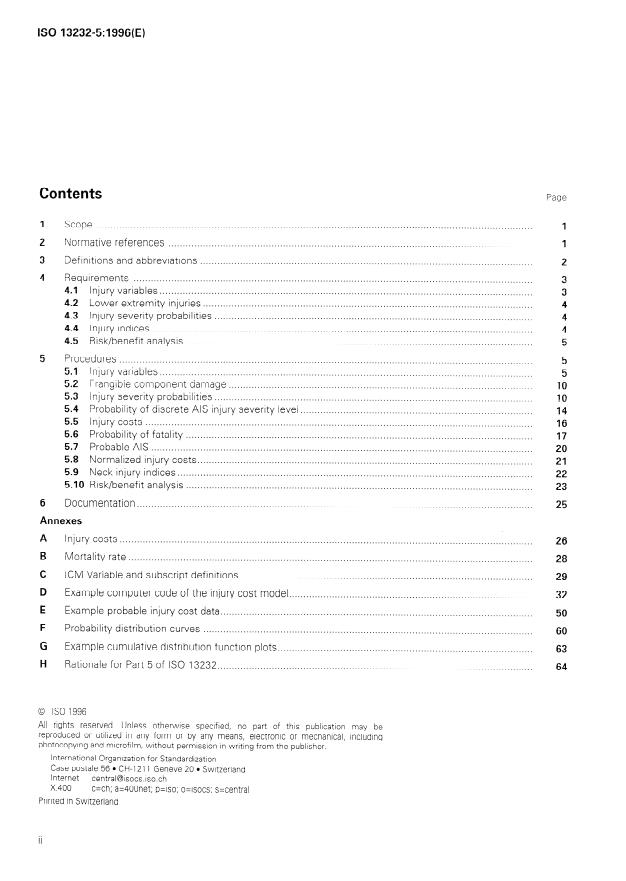
Contents
Scope
........................................................................................................................................................
...............................................................................................................................
2 Normative references
abbrevratrons . 2
3 Defrnitrons and
4 Requirements .
4.1 Injury variables
..................................................................................................................................
4.2 Lower extremity injuries .
............................................................................................................... 4
4.3 injury severity probabilities
,. 4
4.4 l njury indices. . .
4.5 Risk/benefit analysis .
Procedures
................................................................................................................................................
5.1 injury variables. .
5.2 Frangibie component damage .
Injury severity probabilities .
5.3
Probability of discrete AIS injury severity ievei. .
5.4
5.5 Injury costs .
5.6 Probability of fatality .
5.7 Probable AIS .
5.8 Normalized injury costs. .
Neck injury indices. .
5.9
.........................................................................................................................
5.10 Risk/benefit analysis
m. 25
6 Documentation . . . . . . . . . . . . . . . . . . . . . . . . . . . . . . . . . . . . . . . . . . . . . . . . . . . . . . . . . . . . . . . . . . . . . . . . . . . . . . . . . . . . . . . . . . . . . . . . . . . . . . . .
Annexes
A Injury costs
..............................................................................................................
........................................................................................................... 28
B IMortaiity rate
KM ‘Variable and subscript definitions . . . . . . . . . . . . . . . . . . . . . . . . . . . . . . . . . . . . . . . . . . . . . . . . . . . . . . . . . . . . . . . . . . . . 29
C
D Example computer code of the injury cost model . . . . . . . . . . . . . . . . . . . . . . . . . . . . . . . . . . . . . . . . . . . . . . . . . . .
E Example probable injury cost data. . 50
F . 60
Probability distribution curves
plots. . 63
G Example cumulative distribution function
H Rationale for Part 5 of IS0 13232. .
0 IS0 1996
All rights reserved. Unless otherwise specified, no part of this publication may be
reproduced or utilized in any form or by any means, electronrc or mechanrcai, including
photocopyrng and mrcrofilm, without permission in writing from the publisher.
International Organization for Standardization
Case postale 56 l W-1 211 Geneve 20 0 Switzerland
Internet centraI@?isocs.rso.ch
x.400 c=ch; a=400net; p=iso; O=ISOCS; s=centraI
Printed in Switzerland
ii
IS0 13232=5:1996(E)
Foreword
IS0 (the International Organization for Standardization) is a worldwide federation of national standards bodies (IS0
member bodies). The work of preparing International Standards is normally carried out through IS0 technical
committees. Each member body interested in a subject for which a technical committee has been established has
the right to be represented on that committee. International organizations, governmental and non-governmental, in
liaison with ISO, also take part in the work. IS0 collaborates closely with the International Electrotechnical
Commission (I EC) on all matters of electrotechnical standardization.
Draft Int e rnational Standards adopted by the technical co mmittees are circulated to the member bodies for voting.
nternationa I Standar .d requi res approval by at least 75 % of the
Publicati 0 n as an I me mber bodies casting a vote.
This part of IS0 13232 was prepared by Technical Committee lSO/TC 22, Road vehicles, Subcommittee SC 22,
Motorcycles.
At the request of the United Nations Economic Commission for Europe, Group for Road Vehicle General Safety
(UN/ECE/TRANS/SCI/WP29/GRSG), this International Standard has been prepared by lSO/rC 22/SC 22,
Motorcycles, as eight interrelated parts, on the basis of original working documents submitted by the International
Motorcycle Manufacturers Association (IMMA).
This is the first version of the standard.
IS0 13232 consists of the following parts, under the general title Motorcycles - Test and analysis procedures for
research evaluation of rider crash protective devices fitted to motorcycles:
Part 1: Definitions, symbols and general considerations
Part 2: Definition of impact conditions in relation to accident data
- Part 3: Anthropometric impact dummy
- Part 4: Variables to be measured, instrumentation and measurement procedures
Part 5: Injury indices and risk/benefit analysis
- Part 6: Full-scale impact-test procedures
Part 7: Standardized procedures for performing computer simulations of motorcycle impact tests
Part 8: Documentation and reports
Annexes A and B form an integral part of this part of IS0 13232. Annexes C, D, E, F, G and H are for information
only.
IS0 13232-5: 1996(E)
Introduction
This International Standard has been prepared on the basis of existing technology.
Its purpose is to define common
research methods and a means for making an overall evaluation of the effect that devices which are fitted to motor
cycles and intended for the crash protection of riders, have on injuries, when assessed over a range of impact
conditions based on accident data.
It is intended that the methods and recommendations contained in this International Standard should be used in all
basic feasibility research. However, researchers should also consider variations in the specified conditions (for
example, rider size) when evaluating the overall feasibility of any protective device. In addition, researchers may
wish to vary or extend elements of the methodology in order to research issues which are of particular interest to
them. In all such cases which go beyond the basic research, if reference is to be made to this International
Standard, a clear explanation of how the procedures used differ from the basic methodology should be provided.
iv
INTERNATIONAL STANDARD @ IS0 IS0 13232=5:1996(E)
Motorcycles - Test and analysis procedures for research
evaluation of rider crash protective devices fitted to
motorcycles -
Part 5:
Injury indices and risk/benefit analysis
1 Scope
This International Standard specifies the minimum requirements for research into the feasibility of protective devices
fitted to motor cycles, which are intended to protect the rider in the event of a collision.
This International Standard is applicable to impact tests involving
- two wheeled motor cycles;
- the specified type of opposing vehicle;
- either a stationary and a moving vehicle or two moving vehicles;
- for any moving vehicle, a steady speed and straight line motion immediately prior to impact;
- one helmeted dummy in a normal seating position on an upright motor cycle;
- the measurement of the potential for specified types of injury, by body region;
- evaluation of the results of paired impact tests (i.e., comparisons between motor cycles fitted and not
fitted with the proposed devices).
This part of IS0 13232 provides
- performance indices which can be correlated with human injuries;
- formulae which relate injury indices to probable injury cost;
- a consistent means of interpreting impact test results;
- a means of relating the results obtained from film analysis and instrumentation of the dummy to injuries
sustained in accidents;
- a means of assessing both the combined and relative effects of multiple injuries;
- an objective means of quantifying injury cost using a single index;
- a means of verifying the analysis;
- a means of doing risk/benefit analysis of protective devices fitted to motor cycles, based upon the
population of impact conditions identified in IS0 13232-2.
In order to apply this International Standard properly, it is strongly recommended that all eight parts be used
together, particularly if the results are to be published.
2 Normative references
The following standards contain provisions which, through reference in this text, constitute provisions of this
International Standard. At the time of publication, the editions indicated were valid. All standards are subject to
revision, and parties to agreements based on this part of IS0 13232 are encouraged to investigate the possibility of
0 IS0
IS0 13232=5:1996(E)
rece nt editions of the standards indicated below. Members of IEC and IS0 maintain registers of
the most
applying
currently valid lnte rnati onal Standard s.
IS0 132324: nalysi s procedures for research evaluation of rider crash protective
1996, Motor cycles - Test and a
tions, symbols and general considerations.
devices fitted to motor cycles - Part 1 - Defini
IS0 13232-2: 1996, Motor cycles - Test and analysis procedures for research evaluation of rider crash protective
devices fitted to motor cycles - Part 2 - Definition of impact conditions in relation to accident data.
IS0 13232-4: 1996, Motor cycles - Test and analysis procedures for research evaluation of rider crash protective
devices fitted to motor cycles - Part 4 - Variables to be measured, instrumentation and measurement procedures.
IS0 13232-7: 1996, Motor cycles - Test and analysis procedures for research evaluation of rider crash protective
devices fitted to motor cycles - Part 7 - Standardized procedures for performing computer simulations of motor cycle
impact tests.
IS0 13232-8: 1 996, Motor cycles - Te st and analysis proce dures for research evaluation of rider crash protective
devices fitted to motor cycles - Par ‘t 8 - D ocumentation and reports.
AIS-90: 1990, American Association of Automotive Medicine (AAAM). The abbreviated injury scale. 1990
revision. Des Plaines, II.
SAE J21 1: 1980, Instrumentation for impact tests.
SAE J885: 1986, Human tolerance to impact conditions as related to motor vehicle design. Warrendale,
Pennsylvania, USA.
3 Definitions and abbreviations
For the purposes of this part of IS0 13232, the definitions given in IS0 13232-1 apply, of which the following are of
particular relevance to this part of IS0 13232.
- abbreviated injury scale (AIS);
- abdomen maximum residual penetration (pA max);
I
- ancillary costs (AC);
- cost of fatality (CF);
- entire impact sequence;
generalized acceleration model for brain injury tolerance (GAMBIT, G);
head injury criterion (HIC);
injury assessment function;
injury assessment variable;
injury costs (IC);
- injury index;
injury potential variable;
- injury severity probability (ISP);
lower extremities (IE);
- maximum PAIS;
IS0 13232=5:1996(E)
@ IS0
- medical costs (MDC);
- normalized injury cost (ICnorm);
- permanent partial incapacity (PPI);
- primary impact period;
- probability of fatality (PF);
- probable AIS (PAW;
- secondary impact period;
- total PAIS;
- upper (or lower) sternum maximum normalized compression (C,, max nOrrn or C,, MBX norm);
I I I I
- upper (or lower) sternum maximum velocity-compression (VC,, rnax or VC,, max);
I I
- upper (or lower) sternum velocity (V,, or V,J.
4 Requirements
4.1 Injury variables
4.1.1 Injury assessment variables
The following injury assessment variables shall be evaluated over the primary impact period and also over the entire
impact sequence using the calculations presented in 5.1 and the measurement methods given in 5.2.1 and 5.2.3.3
of IS0 13232-4:
- head maximum GAMBIT (G,,,);
- head injury criterion (HIC);
- head maximum resultant linear acceleration (a, H &;
I I
- upper sternum maximum normalized compression (C,, rnax norm);
I
I
- lower sternum maximum normalized compression (Cls rnax ,.,orm);
I I
- upper sternum maximum velocity-compression WC,, max) for V,, 2 3 m/s;
I
- lower sternum maximum velocity-compression (VC,, max) for V,, 2 3 m/s;
I
- abdomen maximum residual penetration (p* max).
I
For head p rotective device research, the following neck injury assessment variables shall also be evaluated over the
same time periods:
- maximum resultant shear force (Fxy ,, max);
I I
- maximum tension force (FZ n max);
I I
- minimum compression force (FZ n min);
I I
- maximum flexion moment (My n max);
I I
- minimum extension moment (My n min);
I I
- peak torsion moment (Mz n peak).
I I
@ IS0
IS0 13232-5: 1996(E)
4.1.2 Injury potential variables
The following injury potential variables shall be determined by evaluating them using the methods described in
5.2.4.2 of IS0 13232-4. the variables shall be evaluated over the interval from 0,050 s before first MC/OV contact
until first helmet/OV contact, or until the helmet leaves the field of view, whichever occurs sooner, unless otherwise
stated. In order to calculate velocities, the results shall be differentiated according to 5.1.7 of this part of
IS0 13232, over this same time interval. The specific values listed below shall be identified from the velocity time
histories:
- helmet trajectory in initial longitudinal-vertical plane of MC travel (zh versus xj,);
- helmet resultant velocity at first helmet/OV Contact (Vr h f&;
8 I
(Vx h fc);
- helmet longitudinal velocity at first helmet/OV Contact
I I
- helmet lateral velocity at first helmet/OV Contact (Vy h fc);
# 8
- helmet vertical velocity at first helmet/OV Contact (Vz j,, fc).
I I
4.2 Lower extremity injuries
The following lower extremity injuries shall be evaluated, based on observations and measurements of the frangible
components, as described in 5.2.3 of IS0 13232-4:
- non-displaced bone fractures;
- displaced bone fractures;
- knee partial dislocations;
- knee complete dislocations.
4.3 Injury severity probabilities
The following injury severity probabilities (ISP) shall be determined for each severity level, AIS r 1 through the
highest level, using the methods described in 5.3:
- closed head ISPH;
- upper sternum compression lSPc ds;
I
- lower compression lSPc Is;
sternum
I
velocity-compression ISP
- upper sternum
vc,us;
- lower sternum velocity-compression lSPvc Is;
I
- intra-abdominal penetration ISPA.
4.4 Injury indices
The probability of each discrete AIS injury severity level shall be calculated for each of the four body regions: the
head, thorax, abdomen, and lower extremities, using the procedures described in 5.4.
The medical and ancillary costs associated with injuries to each of the four body regions shall be calculated using
The cost of fatality shall be determined as defined in
the procedures described in 5.5.1 and 5.5.2, respectively.
annex A.
The probability of fatality shall be calculated using the procedures described in 5.6.
0 IS0 IS0 13232-5: 1996(E)
The risk of life threatening brain injury shall be calculated from HIC using the procedures described in 5.6.4.
The probable AIS (PAIS) shall be determined by body region, using the procedures described in 5.7.1. The
maximum PAIS and total PAIS shall be determined across all body regions using the procedures described in 5.7.2
and 5.7.3, respectively.
The normalized injury costs of survival and fatality and the total normalized injury
cost shall be determined using the
in 5.8.
procedures described
NOTE 1 - The term “cost” is used in this subclause in a specific and limited sense, and for test comparison
purposes only (see def 3.5.7 of IS0 13232-l for specific cost definitions). The “costs,” as used here,
represent average costs based on a simplified model of samples of bioeconomic data; collected over a
particular time period and region; and for a limited range of specific injury types, severities, and body regions,
which may be monitored in crash tests, and which can exclude the majority of the types, severities, and
locations of human body injuries, and some types of cost components. In no way do such injury costs
consider, nor are they intended to consider, the market level costs of a proposed protective device. The
“costs” described herein are only intended to provided a convenient, common basis for combining and
comparing across body regions and crash tests and on a relative basis, different types, locations, and
severities of injuries. For the foregoing reasons, such costs have limited applicability and are not intended nor
appropriate for calculating, for example, the actual cost of a specific real accident, or the total societal or
economic cost of a given device or design.
In addition, for head protective device research, the neck injury indices for shear, tension, compression, f lexion,
ex tension, and torsio n shall be calcula ted using the procedures described in 5.9.
NOTE 2 - Extreme caution should be used in interpreting the neck injury indices. Evaluation of neck loads is
considered to be crucial for head protective device research. However, the critical force and moment values
given in the denominators in 5.9 are based on an extrapolation of the Hybrid Ill injury assessment curves, in
order to represent the possible neck strength of the target population.
In addition, the Hybrid Ill neck and
injury assessment curves were developed for fore/aft inertial loading of the head, and not for oblique, direct
loading and displacement of the head, which can occur in motor cycle impact testing. In addition, cadaver
based research suggests that the critical loads specified in 5.9 might be too large; whereas some full-scale test
and computer simulation research suggests they might be too small, in comparison to the observed frequency
of neck injury in motor cycle accident data. It is unknown the extent to which the source of such uncertainty
may be shortcomings in the dummy neck biofidelity for specific types of loading; in the measurement method;
or in the injury indices (e.g., due to the time dependency or type of loading); and this can only be resolved
through further research.
4.5 Risk/benefit analysis
Any risk/benefit analysis of a proposed rider crash protective device fitted to a motor cycle, which forms a part of
the overall evaluation described in IS0 13232-2 or which may be used to identify potential failure modes of a
proposed device for purposes of further testing, shall use the methods described in 5.10.
5 Procedures
5.1 Injury variables
Compute the maximum values of the variables over time, for example, G,,, (t).
5.1 .l Resultants
Calculate the head resultant linear and angular accelerations, using the time histories of the linear and angular
accelerations as calculated in 5.2.1 of IS0 13232-4, and shown in the example for the resultant linear acceleration,
given below:
(4 + 4 + 4)1/*
a, =
IS0 13232=5:1996(E)
where
a, is the resultant linear acceleration, in g units;
ax is the linear acceleration in the x direction, in g units;
ay is the linear acceleration in the y direction, in g units;
a, is the linear acceleration in the z direction, in g units.
Where only two components are included in a resultant, calculate the resultant of those two components, as shown
in the example for the resultant shear force, given below:
2 l/2
F F
xy= x
+ FY
( 1
where
F,, is the resultant force, in kilonewtons;
F, is the force in the x direction, in kilonewtons;
Fy is the force in the y direction, in kilonewtons.
5.1.2 GAMBIT
Calculate GAMBIT using the equation given below:
where
G is GAMBIT
a r H is the head resultant linear acceleration, in g Units;
I
a, H is the head resultant angular acceleration, in radians per second squared.
I
250 is the normalization factor for linear acceleration in GAMBIT, in g units;
25 000 is the normalization factor for angular acceleration in GAMBIT, in radians per second squared.
Identify the maximum value of GAMBIT, G,,,.
5.1.3 HIC
Calculate HIC using the equation given below ”:
HIC = max
a
(t> dt
CH
s
1) SAE J885, July 1986.
0 IS0
IS0 13232-5: 1996(E)
where
HIC is the head injury criterion;
a r H is the head resultant linear acceleration, in g units;
I
t, and t2 are all possible initial and final times which are separated by not more than 0,036 s, in seconds.
5.1.4 Upper and lower sternum compression
Use the upper and lower sternum displacement time histories recorded and reduced as described in 4.4.1.3 and
5.2.1 of IS0 13232-4. Calculate the upper and lower sternum deflections and compressions, as shown in the
example equations for the upper sternum, given below and referring to figure 1:
UL + 4L)2 - ( ‘UR + A ’UR)
(’
D
y,us =
f
- -
D [(iuR + AiuR;i% - Dy,us) d
us
x, us -
-
D
x, us
P -
x 100
%s,norm -
187,5
where
D is the upper sternum deflection in the y direction, in millimetres;
YIUS
I,, is the cable length of the upper left string pot, in millimetres;
AluL is the change in cable length of the upper left string pot (positive is longer), in millimetres;
I,, is the cable length of the upper right string pot, in millimetres;
is the change in cable length of the upper right string pot (positive is longer), in millimetres;
“uR
W, R is the lateral distance between the left and right string pots, in millimetres;
I
D x us is the upper sternum deflection in the x direction, in millimetres;
,
d,, is the unde ormed icular distance from the plane containi
perpend ng the string pot pivot axes to the
ster num, f rib 2 where the str ings are attached, in mill
at the centre 0 imetres;
upper
187,5 is the dimensional factor used to normalize compression of the Hybrid Ill chest, in millimetres;
C is the normalized upper sternum compression for a Hybrid Ill dummy, expressed as a
us,norm
percentage.
Identify the maximum normalized upper and lower sternum compressions, C,, mSIX and C,, max, respectively.
If at any time D, us or D, Is exceeds 75 mm, document this result in accordance with lSO ’l3232-8.
I ,
IS0 13232=5:1996(E)
X
Undeflected string pot attachment point position
l Deflected string pot attachment point position
L
Y
0 String pot pivot points
Chest potentiometer geometry shown for the upper sternum
Figure 1 -
@ IS0 IS0 13232-5: 1996(E)
5.1.5 Upper and lower sternum velocity
Calculate the upper and lower sternum compression velocities by differentiating the upper and lower sternum
deflections, respectively, using the trapezoidal rule, as shown below for the upper sternum. Filter the velocities
using the SAE J21 1 Class 60 and convert the velocities to metres per second.
1 000
where
V,, is the upper sternum velocity, in metres per second;
D
x us is the upper sternum deflection in the x direction, in millimetres;
I
t is the time, in seconds;
1 000 is the conversion factor from millimetres to metres.
5.1.6 Upper and lower sternum velocity-compression
Calculate the upper and lower sternum velocity-compressions, as shown in the example equation for the upper
sternum, given below:
VC,, is the upper sternum velocity-compression, in metres per second;
Vu, is the upper sternum velocity, in metres per second;
D x us is the upper sternum deflection in the x direction, in millimetres;
I
1,3 is the factor to correct internally measured upper (or lower) sternum variables to external application;
229 is the dim nal factor used to normalize upper (or lower) sternum deflection for the VC calculation, in
millimetres.
Identify the maximum lower ster num velocity- compre ssions, vc and vc for Vu, and
upper and
us.max Is,max
ys 2 3 m/s, respectiv ering only cases where both V and D, have’ negative values.
ely, consid
5.1.7 Helmet centroid point component velocities
Plot the helmet centroid point trajectory as described in 4.1.2. Evaluate V, h fc, V relative to the
, and ‘z h fc
I I
inertial axis system and using the procedures described in annex A of IS0
l,3,232-l:h,fC
Calculate the helmet centroid point compon ent velocities in the x, y, and z directions from the high speed film data,
as shown in the example for the x direction hel met centroid point velocity, given below:
‘h, i+l - ‘h,i-1
V
x,h,i =
l Ooo (ti+j - ti-j )
V x h i is the helmet centroid point velocity in the x direction at analysis frame i, in metres per second;
I I
IS0 13232-5: 1996(E)
xh i +, is the position of the helmet centroid point in the x direction at analysis frame i + 1, in millimetres;
,
is the time of analysis frame i + 1, in seconds;
ti+ 1
1 000 is the conversion factor from millimetres to metres.
5.2 Frangible component damage
Record the number of displaced and non-displaced fractures for each femur and tibia frangible bone. Record partial
or complete dislocation or no injury for each knee. Record pA maxa Use the evaluation methods described in 5.2.3
I
of IS0 13232-4.
5.3 Injury severity probabilities
Insert the injury variable values into the following relationships to determine the injury severity probability (ISP) for
each AIS injury severity level, for each body region.
5.3.1 Head
Calculate the closed head ISP, as a function of G,,, for each minimum AIS using the injury assessment functions
given in table 1.
5.32 Chest
For each minimum AIS calculate the upper and lower thoracic compression ISP, us and ISP, ,s as a function of
C respectively, and the upper and lower thoracic velocity-compression ISPv, ds and ISP,, Is, as
and ‘is max’
respectively, using the injury assessment functions given tables 2 and 3,
a?irYZon of VC,, max
and “Is max’
I I
respectively.
The thoracic compression ISP, for each AIS injury severity level, j, is defined as the larger of either ISP, us j or
ISP c Is j. The thoracic velocity-compression lSPvc for each severity level, j, is defined as the larger of either
for each AIS injury severity level, j, is defined as the larger
ISP The overall thoracic ISP, ISPTh,
V ’c is ’ Or “‘VC Is j’
Of either’ SP, j or ISP,, j.
I I
5.3.3 Abdomen
omina
Calculate the intra-abd I pene tration ISP, as a function of pA max for each minimum AIS using the injury
I
given
assessment functions in tabl e 4.
NOTE - The researcher may choose to calculate ISP,, the injury indices, and the injury costs by:
- replacing the measured value Of pA max with a zero;
I
- calculating the injury indices and injury costs as described in this part of IS0 13232;
- reporting both sets of values and the measured value of pA max in the documentation;
I
- noting this deviation in the documentation.
IO
IS0 13232=5:1996(E)
Table 1 - Closed head injury severity probability as a function of G,,,
Minimum
Severity level G Injury assessment function
m-ax
required
AIS 2 1 0 = 1 - exp HG,,, / 0,755)3,5]
IspH, 1
AIS 1 2 0,125 = 1 - exp bUGmax - 0,l 25)/0,70)3,5]
“‘H.2
AIS r 3 0,375
= 1 - exp [-UGmax - 0,375)/0,64)3,51
IspH,3
AIS 2 4 0,438
= 1 - exp H(G,,, - 0,438)/0,62)3r5]
IspH,4
AIS 2 5 0,650 = 1 - exp I-((G,,, - 0,650)/0,54)2f2]
IspH,5
AIS = 6 0,680 = 1 - exp MG,,, - 0,680)/0,60) ‘,*]
ISPH,6
where
ISPH j is the probability of a head injury of at least AIS severity level j;
I
AIS is defined in AIS-90;
maX is the maximum value of GAMBIT.
G
IS0 13232-5: 1996(E)
Table 2 - Thoracic compression injury severity probability as a function of Cd, max and C,, max
I I
Minimum
Severity level
C,, maX Injury assessment function *
required
AIS 2 1 I,77 1 - exp [-((Cd, max - 1 ,77)/24)6,001
ISPC, “S, 1 = I
7,47 ISP = 1 - exp [-((C,, max - 7,47)/24)6,001
AIS r 2
c,us,2
I
ISP = 1 - exp [-((C,, mBX - 1 3,22)/24)6,001
AIS r 3 13,22
c,us,3
I
18,97 ISP = 1 - exp [-UC,, max - 1 8,97)/24)6fool
AIS > 4
c,us,4 I
24,72 = 1 - exp [-(Ku, max - 24,72)/24)6rool
AIS r 5
ISPc,us,5
I
AIS = 6 32,52 ISP = 1 - exp [-(Ku, max - 32,52)/24)6,001
C,us,G
I
where
ISP c us j is the probability of an upper thoracic compression injury of at least AIS
seventy level j;
AIS is defined in AIS-90;
C is the upper sternum maximum compression, expressed as a percentage.
us,max
*The ISP calculation shown is for C,, max. Calculate the ISP for C,, max, also.
I I
IS0 13232-5:1996(E)
Table 3 - Thoracic injury velocity-compression severity probability as a function of VC,, max and VC,, max
I I
Minimum
Severity level VC,, lTlaX
Injury assessment function *
required
AIS 2 1 0 1 - exp WC,, max / 0,30) “,ggl
ISPVC, “S, 1 =
AIS 2 2 0 = 1 - exp [-(Ku, max / 0,68) ‘,461
ISPvc,us,2
I
AIS > 3 0 1 - exp [-(VCUs max / 1 ,40)2,851
%c,us,3 =
I
AIS 2 4 ISP
= 1 - exp [-WC,, rnax - 0,4)/l ,291 )3,101
vc,us,4
I
AIS 2 5 1 ,oo 1 - exp [-(WC,, rnax - 1 ,00)/0,995)3,101
Y/c,us,5 =
I
AIS = 6 ISP
1,50 = 1 - exp [-WC,, max - 1,50)/0,78)3,101
VC,us,G
,
where
ISP is the probability of an upper thoracic velocity-compression injury of at least
VC,us,j
AIS severity level j;
AIS is defined in AIS-90;
is the upper sternum maximum velocity-compression, in metres per second;
vc
us,max
*The ISP calculation shown is for VC,, max. Calculate the ISP for VC,, max, also.
I
I
IS0 13232=5:1996(E)
Table 4 - Intra-abdominal penetration injury severity probability as a function of pA max
I
Severity level Injury assessment function
I
AIS r 1 = 1 ,57 x lo-2 PA max
IspA, 1
I
AIS zz 2 = I,23 x lo-2 PA max
‘spA,2
I
AIS 2 3 = 1 ,55 x lo-4 (PA max)2800
IspA,
I
AIS = 4 IsPA, = 9,36 x lo-l3 (PA max)6850
I
where
ISPA i is the probability of an abdominal injury of at least AIS
seveky level j;
AIS is defined in AIS-90;
pA max is the maximum penetration of the abdominal insert, in
miliimetres.
5.4 Probability of discrete AIS injury severity level
5.4.1 Head, thorax, abdomen
For each of the three body regions and each of the AIS injury severity levels, calculate the probability of sustaining
an injury of the specific AIS injury severity level. Use the equation given below:
= ISPi j - ISpi j+ 1
‘i j
I I I
where
Pi j is the probability of sustaining an injury of specific severity level j to the body region i;
I
ISPi j is the probability of sustaining an injury of at least severity level j to the body region i.
I
5.42 Lower extremities
5.4.2.1 Number of injuries
Based upon the frangible leg component damage recorded in 5.2, determine the number of injuries and AIS injury
severity level of each, for the femur, tibia, and knee, using table 5.
5.4.2.2 Probability of an injury of a specific severity level
Because of the nature of the frangible leg components used, the probability of sustaining a lower extremity injury of
a specific AIS injury severity level, P,, i is equal to either 0 or 1 for each of the three AIS injury severity levels listed
in table 5. Determine the highest AlS ’jnjury severity level among all six leg components. Set P,E j equal to 1 for
that AIS injury severity level, j, and set P,, j equal to 0 for the other two AIS injury severity levels,.
I
IS0 13232-5: 1996(E)
Table 5 - AIS injury severity level for frangible component damage
Tibia mid-shaft AIS severity
Femur mid-shaft Knee
fracture type dislocation fracture type level
None None 0
None
Partial Non-displaced 2
Displaced or non-displaced Complete Displaced 3
For example, if there are only two leg components damaged during the test, a left knee partial dislocation and a
right femur displaced fracture, P,, . is determined to be 1 for AIS injury severity level 3 and 0 for AIS injury severity
levels 0 and 2, as shown in table ’ 6 .
Table 6 - Example PIE j determination
I
Damaged Damage type
‘IE,j
component
left tibia none 0 0
0 0
right tibia none
partial dislocation 2 0
left knee
none 0 0
right knee
0 0
left femur none
right femur non-displaced fracture 3 1
where
PIE j is the probability of sustaining any lower
ext ’remity injury of the AIS injury severity level j.
5.4.2.3 Permanent partial incapacity
Determine the number of damaged frangible leg components and the AIS injury severity level for each one. Using
the criteria listed in table 7, determine the maximum permanent partial incapacity (PPI) which would result from
sustaining comparable injuries to the lower extremities.
@ IS0
IS0 13232=5:1996(E)
Table 7 - Permanent partial incapacity determination
PPI =
If
0,38
NF,3 + NK,3 + NK,2 + NT,3 + Nl,2 2 3
0,27
NF,3 + NK,3 + NK,2 + NT,3 + NT,2 = 2
=
1 0,15
NF,3 Or NT,3 Or NK,2
=
1 0,22
NK,3
=
1 0,07
NT,2
=
N 080
leg
where
N. . is the number of damaged frangible leg components i of
Ai* injury severity level j;
F is the femur component;
T is the tibia component;
K is the knee component.
For the example given in 5.4.2.2, the PPI is determined as follows:
= 2, therefore PPI = 0,27.
NK,2 + NF,3
5.5 Injury costs
NOTE - The termYost” is used in this subclause in a specific and limited sense, and for test comparison
purposes only (see def 3.5.7 of IS0 13232-l for specific cost definitions). The “costs,” as used here,
represent average costs based on a simplified model of samples of bioeconomic data; collected over a
particular time period and region; and for a limited range of specific injury types, severities, and body regions,
which may be monitored in crash tests, and which can excluse the majority of the types, severities and
locations of human body injuries, and some types of cost components. In no way do such injury costs
consider, nor are they intended to consider, the market level costs of a proposed protective device. The
“costs” described herein are only intended to provide a convenient, comon basis for combining and comparing
across body regions and crash tests and on a relative basis, different types, locations, and severities of
injuries. For the foregoing reasons, such costs have limited applicability and are not intended nor appropriate
for calculating, for example, the actual cost of a specific real accident, or the total societal or economic cost of
a given device or design.
5.5.1 Medical costs
Determine the medical costs associated with each
Tabulate the injuries by body region and AIS injury severity level.
body region injury and each discrete AIS injury severity level, for each country, using the cost data listed in annex
A. Calculate the total medical cost associated with the injuries for each of the three body regions, including the
head, thorax, and abdomen, using the equation given below:
MDCitot = C Pij x MDCij
, , t
j=l
IS0 13232-5: 1996(E)
is the total medical- cost associated with injuries to the body region i;
MDci tot
I
Pi j is the probability of sustaining an injury of specific severity level j to the body region i;
I
i of AIS injury severity level j.
MDC, j is the medical cost associated with an injury to the body region
I
with the lower extremity injuries , having the maximum AIS severity using
Determine the medi cal cost associated
the respective cost data listed in annex A.
Determine the overall medical cost of injuries to the head, thorax, abdomen, and lower extremities as given below:
= max (MDC, tot)
MDC
I
MDC is the overall medical cost;
is the total medical cost associated with injuries to the body region i.
MDci I tot
5.5.2 Ancillary costs
Tabulate the injuries by body region and AIS injury severity level. Determine the ancillary costs associated with
each body region injury and each discrete AIS injury severity level, for each country in the cost data listed in
annex A. Calculate the total ancillary cost associated with the injuries for each of the three body regions, including
the head, thorax, and abdomen, using the equation given below:
P ij
AC X ACij
i,tot = c 9
j=l ’
is the total ancillary cost associated with injuries sustained to the body region i;
ACi tot
I
Pi j is the probability of sustaining an injury of AIS injury severity level j to the body region i;
I
AC, j is the ancillary cost associated with an injury to the body region i of AIS injury severity level j.
I
Determine the total ancillary cost associated with lower extremity injuries using the maximum PPI value, as
determined in 5.4.2.3, and the respective cost data table given in annex A.
Determine the overall ancillary cost of injuries to the head, thorax, abdomen, and lower extremities as given below:
AC = max (AC, tot)
I
AC is the overall ancillary cost;
is the total ancillary cost associated with injuries sustained to the body region i.
ACi tot
I
5.5.3 Fatality cost
Determine the cost of fatality as defined in annex A.
5.6 Probability of fatality
5.6.1 Due to AIS 6 injuries
Calcul ate the probability of fatality due to AIS 6 injuries to the head and/or the thorax using the equation given
below
IS0 13232=5:1996(E)
= 1 - ((1 - pH,s) x (1 - pTt.,6)1
‘fatal,6
where
Pfata, 6 is the probability of fatality due to an AIS 6 injury;
I
P, 6 is the probability of sustaining an AIS 6 head injury;
I
PT, 6 is the probability of sustaining an AIS 6 thoracic injury.
I
5.6.2 Due to non-AIS 6 injuries
Construct a table as shown in table 8. In the table, for each AIS injury severity level, list the values for the
previously calculated probabilities of injury for the head, thorax, abdomen, and lower extremities, and the number of
lower extremity injuries. Consider that both of the legs comprise a single body region named lower extremities.
Table 8 - Injury probability and probable AIS
Body region
Lower extremities
Abdomen
Probability Number of injuries
‘Th,O ‘A,0 ‘I,,0
‘H,O
pA,1
PHI1 ‘Th, 1
‘IE,2
‘Th,2 ‘A,2
‘HI2
‘A,3 ‘IE,3
‘HI3 ‘Th,3
‘A,4
‘HI4 ‘Th,4
0 0
‘H,5 ‘Th,5
0 0
‘Th,6
PHI6
PAISlE
PAISH PAI+, PAlSA
Probable
AIS
I
The probability of fatality due to non-AIS 6 injuries includes the probability of fatality from all possible combinations
of non-AIS 6 injuries. Calculate the probability of fatality for each possible combination of four non-AIS 6 injuries,
one from each body region, and total them.
For each combination of four injury probabilities, determine the three largest corresponding AIS injury severity levels.
Using these three AIS injury severity levels and table B.l in annex B, determine the associated mortality rate for that
Calculate the probability of dying from that combination of non-AIS 6
combination of AIS injury severity levels.
severity levels.
For example, calculate the probability of fatality from a given combination of non-AIS 6 injuries, as shown below,
for:
- head AIS 4;
- thorax AIS 1;
- abdomen AIS 2;
IS0 13232-5:1996(E)
- lower extremities AIS 3.
Determine the mortal ity rate for the given combination of non-AIS 6 injuries using AIS 4, 3, and 2, because they are
the three large st AIS injury severity levels. The mortality rate is, then
= 23,7099
MR432
MR432 is the mortality rate, from table B. 1, for the three largest AIS values of the four body regions,
4, 3, 2, expressed as a percentage.
Calculate the probability of fatality for the given combination of non-AIS 6 injuries using the following equation:
100 x 23,709gx p” 4 x PTh 1 x pA,2 x P,E 3
Pfatal,41 23 I I I
is the probability of fatality for the given combination of non-AIS 6 injuries;
Pfatal,41 23
PR 4 is the probability a head injury of AIS 4;
I
PTf, l is the probability of a thorax injury of AIS 1;
I
PA 2 is the probability of an abdomen injury of AIS 2;
I
PjE 3 is the probability of a lower extremities injury of AIS 3.
I
Calculate the probability of fatality from all combinations of non-AIS 6 injuries using the equation given below:
5 5 5 5
P
& ’ c c c c MRjH, jTh, jA, jlE ’ ‘H,jH ’ ‘Th,jTh x ‘A,jA x ‘lE,jIE
fatal,5 =
jH=O jTh=O jA=O jlE=O
Pfata, 5 is the probability of fatality from all combinations of non-AIS 6 injuries;
I
MR is the mortality rate, from table B. 1, with the three largest AIS values in descending order;
Pi j is the probability of sustaining an injury to the body region i of the AIS injury severity level j, where i is H,
Th, A, or IE;
jH is the AIS injury severity level for the head;
jTh is the AIS injury severity level for the thorax;
jA is the AIS injury severity level for the abdomen;
jlE is the AIS injury severity level for the lower extremities.
5.6.3 Overall
Calculate the overall probability of fatality using the equation below:
‘fatal = ‘fatal,6 + ‘fatal,5
IS0 13232=5:1996(E)
where
is the overall probability of fatality;
P
fatal
Pfata, 6 is the probability of fatality from an AIS 6 injury;
I
Pfata, 5 is the probability of fatality from non-AIS 6 injuries.
I
5.6.4 Risk of life threatening brain injury
Determine the risk of life threatening brain injury using the value for HIC calculated in 5.1.3 and the plot given in
figure 2. Locate the calculated HIC value on the horizontal axis and determine the corresponding risk of life
threatening brain injury on the vertical axis.
--
c
.-
c
.-
D
F
0 500 loo0 1500 2000 2500 3000
HIC
Figure 2 - Risk of life threatening brain injury
for HIC for t2 - tl 5 0,036 s
5.7 Probable AIS
5.7.1 By body region
Calculate a single weighted average PAIS for each body region as shown in the equation below:
...
Questions, Comments and Discussion
Ask us and Technical Secretary will try to provide an answer. You can facilitate discussion about the standard in here.
Loading comments...