


ISO 8605:2024
(Main)Fibre-reinforced plastics — Sheet moulding compound (SMC) — Requirements and specifications
Fibre-reinforced plastics — Sheet moulding compound (SMC) — Requirements and specifications
This document establishes requirements and specifications for sheet moulding compound (SMC) used in the production of composite parts by hot moulding. It is suitable for sheet moulding compound with glass fibres (GF) and carbon fibres (CF) as the sole or main reinforcement. Other fibre (e.g. natural fibre) reinforced sheet moulding compounds can also be used with this document.
Plastiques renforcés de fibres — Préimprégnés en feuille SMC — Exigences et spécifications
General Information
- Status
- Published
- Publication Date
- 29-Feb-2024
- Technical Committee
- ISO/TC 61/SC 13 - Composites and reinforcement fibres
- Drafting Committee
- ISO/TC 61/SC 13 - Composites and reinforcement fibres
- Current Stage
- 6060 - International Standard published
- Start Date
- 01-Mar-2024
- Due Date
- 18-Jul-2025
- Completion Date
- 01-Mar-2024
Relations
- Effective Date
- 06-Jun-2022
Overview - ISO 8605:2024 (Sheet moulding compound, SMC)
ISO 8605:2024 defines requirements and specifications for sheet moulding compound (SMC) used to produce composite parts by hot moulding. This third edition updates and broadens the 2001 version: it adds fibre type and shrinkage codes, a formal designation system, expanded test properties, and guidance on sampling position. The standard covers SMC reinforced mainly with glass fibres (GF) or carbon fibres (CF) but is also applicable to other fibre types (for example, natural fibres). Typical SMC thicknesses are generally between 1 mm and 25 mm.
Key topics and technical requirements
- Scope & definitions: Clear definitions for SMC and related terms used in composite manufacture and testing.
- Classification:
- By composition (resin/matrix, reinforcement, fillers, additives, mode of reinforcement).
- By shrinkage behaviour (general-purpose, low-shrinkage, low-profile, Class A).
- Resin types: Unsaturated polyester (UP), epoxy (EP), polyurethane (PU), vinyl ester (VE), phenolic (P) - referenced to relevant resin standards.
- Properties and tests:
- Properties to describe SMC for acceptance (physical, chemical, appearance).
- Properties for moulded specimens (mechanical, physical, electrical).
- References to established test methods for tensile, flexural, impact, density, cure, shrinkage, moisture uptake and electrical characteristics.
- Sampling and conditioning: Procedures for representative sampling and conditioning of SMC before testing.
- Shelf life, packing, packaging and labelling: Requirements to support traceability, storage and transport.
- Designation and documentation: Standardized naming and documentation of SMC grades for procurement and quality control.
Practical applications and who uses ISO 8605:2024
ISO 8605:2024 is intended for organizations involved in the manufacture, specification, testing and procurement of SMC for composite parts produced by hot moulding. Typical users include:
- SMC manufacturers and formulators (material development and quality control)
- Automotive and transportation OEMs (body panels, structural components)
- Electrical and electronics manufacturers (insulating housings, enclosures)
- Aerospace, marine and consumer-goods designers specifying composite materials
- Testing laboratories and certification bodies conducting acceptance and performance tests
- Purchasing and compliance teams using standardized designations and test criteria
Adoption of ISO 8605 helps ensure consistent material properties, reliable production outcomes and clearer supplier specifications for SMC-based composite parts.
Related standards (examples)
ISO 8605 references several established test and material standards, including:
- ISO 527-4 (tensile properties of fibre-reinforced composites)
- ISO 12115 (flowability, maturation and shelf life of thermosetting moulding compounds)
- ISO 14125 (flexural properties)
- ISO 2577 / EN 1842 (shrinkage determination)
- IEC standards for electrical and flammability testing
Keywords: ISO 8605:2024, sheet moulding compound, SMC requirements, fibre-reinforced plastics, glass fibre SMC, carbon fibre SMC, composite parts, hot moulding.
Get Certified
Connect with accredited certification bodies for this standard

Smithers Quality Assessments
US management systems and product certification.

DIN CERTCO
DIN Group product certification.
Sponsored listings
Frequently Asked Questions
ISO 8605:2024 is a standard published by the International Organization for Standardization (ISO). Its full title is "Fibre-reinforced plastics — Sheet moulding compound (SMC) — Requirements and specifications". This standard covers: This document establishes requirements and specifications for sheet moulding compound (SMC) used in the production of composite parts by hot moulding. It is suitable for sheet moulding compound with glass fibres (GF) and carbon fibres (CF) as the sole or main reinforcement. Other fibre (e.g. natural fibre) reinforced sheet moulding compounds can also be used with this document.
This document establishes requirements and specifications for sheet moulding compound (SMC) used in the production of composite parts by hot moulding. It is suitable for sheet moulding compound with glass fibres (GF) and carbon fibres (CF) as the sole or main reinforcement. Other fibre (e.g. natural fibre) reinforced sheet moulding compounds can also be used with this document.
ISO 8605:2024 is classified under the following ICS (International Classification for Standards) categories: 83.120 - Reinforced plastics. The ICS classification helps identify the subject area and facilitates finding related standards.
ISO 8605:2024 has the following relationships with other standards: It is inter standard links to ISO 8605:2001. Understanding these relationships helps ensure you are using the most current and applicable version of the standard.
ISO 8605:2024 is available in PDF format for immediate download after purchase. The document can be added to your cart and obtained through the secure checkout process. Digital delivery ensures instant access to the complete standard document.
Standards Content (Sample)
International
Standard
ISO 8605
Third edition
Fibre-reinforced plastics — Sheet
2024-03
moulding compound (SMC) —
Requirements and specifications
Plastiques renforcés de fibres — Préimprégnés en feuille SMC —
Exigences et spécifications
Reference number
© ISO 2024
All rights reserved. Unless otherwise specified, or required in the context of its implementation, no part of this publication may
be reproduced or utilized otherwise in any form or by any means, electronic or mechanical, including photocopying, or posting on
the internet or an intranet, without prior written permission. Permission can be requested from either ISO at the address below
or ISO’s member body in the country of the requester.
ISO copyright office
CP 401 • Ch. de Blandonnet 8
CH-1214 Vernier, Geneva
Phone: +41 22 749 01 11
Email: copyright@iso.org
Website: www.iso.org
Published in Switzerland
ii
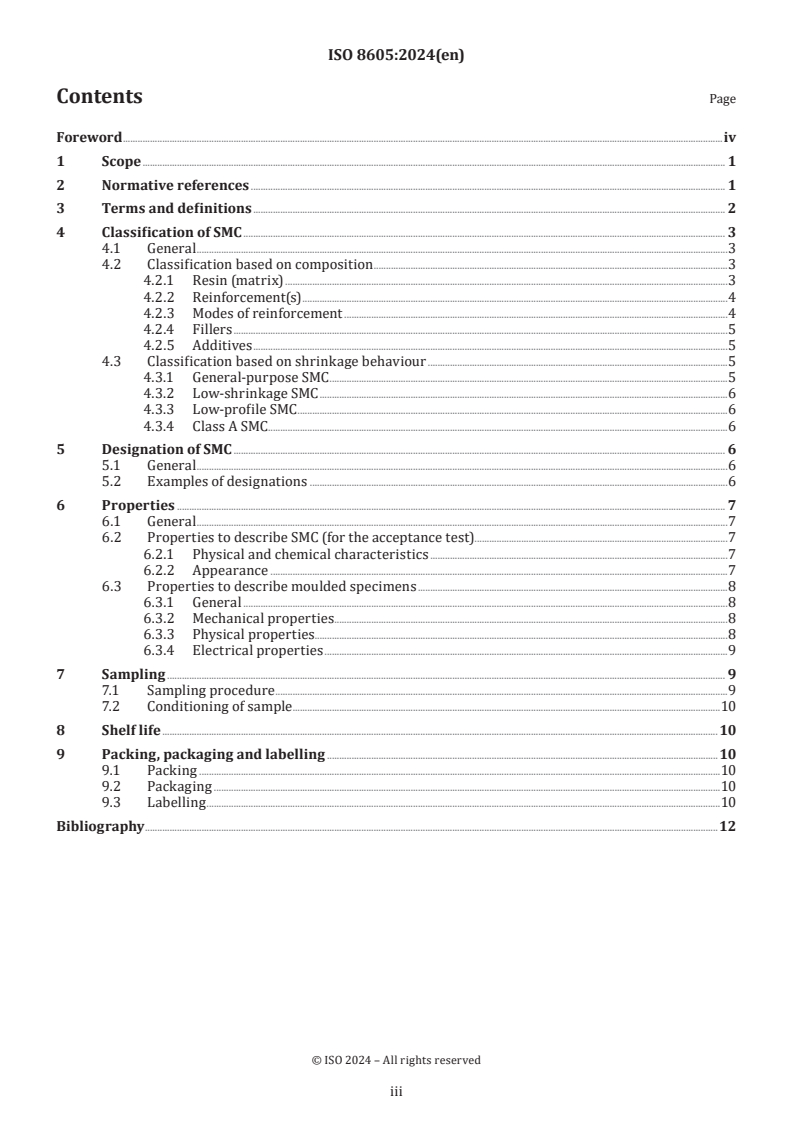
Contents Page
Foreword .iv
1 Scope . 1
2 Normative references . 1
3 Terms and definitions . 2
4 Classification of SMC . 3
4.1 General .3
4.2 Classification based on composition .3
4.2.1 Resin (matrix) .3
4.2.2 Reinforcement(s) .4
4.2.3 Modes of reinforcement .4
4.2.4 Fillers .5
4.2.5 Additives .5
4.3 Classification based on shrinkage behaviour .5
4.3.1 General-purpose SMC .5
4.3.2 Low-shrinkage SMC .6
4.3.3 Low-profile SMC .6
4.3.4 Class A SMC.6
5 Designation of SMC . 6
5.1 General .6
5.2 Examples of designations .6
6 Properties . 7
6.1 General .7
6.2 Properties to describe SMC (for the acceptance test).7
6.2.1 Physical and chemical characteristics .7
6.2.2 Appearance .7
6.3 Properties to describe moulded specimens .8
6.3.1 General .8
6.3.2 Mechanical properties . .8
6.3.3 Physical properties.8
6.3.4 Electrical properties .9
7 Sampling . 9
7.1 Sampling procedure .9
7.2 Conditioning of sample .10
8 Shelf life . 10
9 Packing, packaging and labelling .10
9.1 Packing .10
9.2 Packaging .10
9.3 Labelling .10
Bibliography .12
iii
Foreword
ISO (the International Organization for Standardization) is a worldwide federation of national standards
bodies (ISO member bodies). The work of preparing International Standards is normally carried out through
ISO technical committees. Each member body interested in a subject for which a technical committee
has been established has the right to be represented on that committee. International organizations,
governmental and non-governmental, in liaison with ISO, also take part in the work. ISO collaborates closely
with the International Electrotechnical Commission (IEC) on all matters of electrotechnical standardization.
The procedures used to develop this document and those intended for its further maintenance are described
in the ISO/IEC Directives, Part 1. In particular, the different approval criteria needed for the different types
of ISO document should be noted. This document was drafted in accordance with the editorial rules of the
ISO/IEC Directives, Part 2 (see www.iso.org/directives).
ISO draws attention to the possibility that the implementation of this document may involve the use of (a)
patent(s). ISO takes no position concerning the evidence, validity or applicability of any claimed patent
rights in respect thereof. As of the date of publication of this document, ISO had not received notice of (a)
patent(s) which may be required to implement this document. However, implementers are cautioned that
this may not represent the latest information, which may be obtained from the patent database available at
www.iso.org/patents. ISO shall not be held responsible for identifying any or all such patent rights.
Any trade name used in this document is information given for the convenience of users and does not
constitute an endorsement.
For an explanation of the voluntary nature of standards, the meaning of ISO specific terms and expressions
related to conformity assessment, as well as information about ISO's adherence to the World Trade
Organization (WTO) principles in the Technical Barriers to Trade (TBT), see www.iso.org/iso/foreword.html.
This document was prepared by Technical Committee ISO/TC 61, Plastics, Subcommittee SC 13, Composites
and reinforcement fibres.
This third edition cancels and replaces the second edition (ISO 8605:2001), which has been technically
revised.
The main changes are as follows:
— the title has been modified from "Textile-glass-reinforced plastics — Sheet moulding compound (SMC)
— Basis for a specification" to " Fibre-reinforced plastics — Sheet moulding compound (SMC) —
Requirements and specifications";
— fibre type and shrinkage code have been added;
— the designation of SMC has been added;
— test properties have been added;
— sampling position has been added.
Any feedback or questions on this document should be directed to the user’s national standards body. A
complete listing of these bodies can be found at www.iso.org/members.html.
iv
International Standard ISO 8605:2024(en)
Fibre-reinforced plastics — Sheet moulding compound (SMC)
— Requirements and specifications
1 Scope
This document establishes requirements and specifications for sheet moulding compound (SMC) used in the
production of composite parts by hot moulding.
It is suitable for sheet moulding compound with glass fibres (GF) and carbon fibres (CF) as the sole or main
reinforcement. Other fibre (e.g. natural fibre) reinforced sheet moulding compounds can also be used with
this document.
2 Normative references
The following documents are referred to in the text in such a way that some or all of their content constitutes
requirements of this document. For dated references, only the edition cited applies. For undated references,
the latest edition of the referenced document (including any amendments) applies.
ISO 62:2008, Plastics — Determination of water absorption
ISO 75-2:2013, Plastics — Determination of temperature of deflection under load — Part 2: Plastics and ebonite
ISO 179-1, Plastics — Determination of Charpy impact properties — Part 1: Non-instrumented impact test
ISO 179-2, Plastics — Determination of Charpy impact properties — Part 2: Instrumented impact test
ISO 180, Plastics — Determination of Izod impact strength
ISO 291, Plastics — Standard atmospheres for conditioning and testing
ISO 472, Plastics — Vocabulary
ISO 527-4:2023, Plastics — Determination of tensile properties — Part 4: Test conditions for isotropic and
orthotropic fibre-reinforced plastic composites
ISO 1172, Textile-glass-reinforced plastics — Prepregs, moulding compounds and laminates — Determination of
the textile-glass and mineral-filler content using calcination methods
ISO 1183-1, Plastics — Methods for determining the density of non-cellular plastics — Part 1: Immersion method,
liquid pycnometer method and titration method
ISO 1183-2, Plastics — Methods for determining the density of non-cellular plastics — Part 2: Density gradient
column method
ISO 1183-3, Plastics — Methods for determining the density of non-cellular plastics — Part 3: Gas pyknometer
method
ISO 1268 (all parts), Fibre-reinforced plastics — Methods of producing test plates
ISO 2577, Plastics — Thermosetting moulding materials — Determination of shrinkage
ISO 4589-2, Plastics — Determination of burning behaviour by oxygen index — Part 2: Ambient-temperature
test
ISO 9782, Plastics — Reinforced moulding compounds and prepregs — Determination of apparent volatile-
matter content
ISO 10352, Fibre-reinforced plastics — Moulding compounds and prepregs — Determination of mass per unit
area and fibre mass per unit area
ISO 11359-2, Plastics — Thermomechanical analysis (TMA) — Part 2: Determination of coefficient of linear
thermal expansion and glass transition temperature
ISO 11667, Fibre-reinforced plastics — Moulding compounds and prepregs — Determination of resin, reinforced-
fibre and mineral-filler content — Dissolution methods
ISO 12114, Fibre-reinforced plastics — Thermosetting moulding compounds and prepregs — Determination of
cure characteristics
ISO 12115, Fibre-reinforced plastics — Thermosetting moulding compounds and prepregs — Determination of
flowability, maturation and shelf life
ISO 14125, Fibre-reinforced plastic composites — Determination of flexural properties
ISO 14126, Fibre-reinforced plastic composites — Determination of compressive properties in the in-plane
direction
ISO 14127, Carbon-fibre-reinforced composites — Determination of the resin, fibre and void contents
ISO 14130, Fibre-reinforced plastic composites — Determination of apparent interlaminar shear strength by
short-beam method
ISO 17771, Plastics — Thermoset moulding compounds — Determination of the degree of fibre wetting in SMC
ISO 22821, Carbon-fibre-reinforced composites — Determination of fibre weight content by thermogravimetry
(TG)
ISO 22836, Fibre-reinforced composites — Method for accelerated moisture absorption and supersaturated
conditioning by moisture using sealed pressure vessel
IEC 60112, Method for the determination of the proof and the comparative tracking indices of solid insulating
materials
IEC 60243 (all parts), Electric strength of insulating materials — Test methods
IEC 60695-2-12, Fire hazard testing — Part 2-12: Glowing/hot-wire based test methods — Glow-wire
flammability index (GWFI) test method for materials
IEC 60695-11-10, Fire hazard testing — Part 11-10: Test flames — 50 W horizontal and vertical flame test
methods
IEC 61621, Dry, solid insulating materials — Resistance test to high-voltage, low-current arc discharges
IEC 62631-2-1, Dielectric and resistive properties of solid insulating materials — Part 2-1: Relative permittivity
and dissipation factor — Technical Frequencies (0,1 Hz - 10 MHz) — AC Methods
IEC 62631-3-1, Dielectric and resistive properties of solid insulating materials — Part 3-1: Determination of
resistive properties (DC methods) — Volume resistance and volume resistivity — General method
IEC 62631-3-2, Dielectric and resistive properties of solid insulating materials — Part 3-2: Determination of
resistive properties (DC methods) — Surface resistance and surface resistivity
EN 1842, Plastics — Thermoset moulding compounds (SMC - BMC) — Determination of compression moulding
shrinkage
3 Terms and definitions
For the purposes of this document, the terms and definitions given in ISO 472 and the following apply.
ISO and IEC maintain terminology databases for use in standardization at the following addresses:
— ISO Online browsing platform: available at https:// www .iso .org/ obp
— IEC Electropedia: available at https:// www .electropedia
...
Questions, Comments and Discussion
Ask us and Technical Secretary will try to provide an answer. You can facilitate discussion about the standard in here.
Loading comments...