

ISO 18980
(Main)Tourism and related services — Camping tourism — Requirements and recommendations for campsite facilities and services
- Abstract
This document applies to campsites located in natural or developed areas, designed and managed for the purpose of accommodating tents, recreational vehicles, or camping houses used for accommodating guests. This document outlines considerations for the facilities, amenities, services, and management practices necessary to ensure a quality camping experience for all guests. The scope of this document includes requirements and recommendations related to the following areas: - Campsite layout and design - Sanitation and other important facilities - Sustainability - Accessibility - Safety and Security The document is intended to be used by campsite owners, operators, and regulators to ensure that campsites meet basic safety and environmental requirements, while providing a quality camping experience for guests.
- Status
- Not Published
- Technical Committee
- ISO/TC 228 - Tourism and related services
- Drafting Committee
- ISO/TC 228 - Tourism and related services
- Current Stage
- 6000 - International Standard under publication
- Start Date
- 25-Aug-2026
- Completion Date
- 10-Oct-2026
Buy Documents
ISO/FDIS 18980 - Tourism and related services — Camping tourism — Requirements and recommendations for campsite facilities and services
REDLINE ISO/FDIS 18980 - Tourism and related services — Camping tourism — Requirements and recommendations for campsite facilities and services
ISO 18980 is an ISO standard for camping tourism. It specifies requirements and recommendations for campsite facilities and services for campsite owners, operators and regulators. The document covers campsite layout, sanitation, sustainability, accessibility, safety, services, staffing and assessment.
What does ISO 18980 specify?
ISO 18980 applies to campsites in natural or developed areas that are designed and managed for guests using tents, recreational vehicles, caravans, camper vans or camping houses supplied by the operator. It is written for campsite owners, operators and regulators who need a common reference for basic service and facility provision.
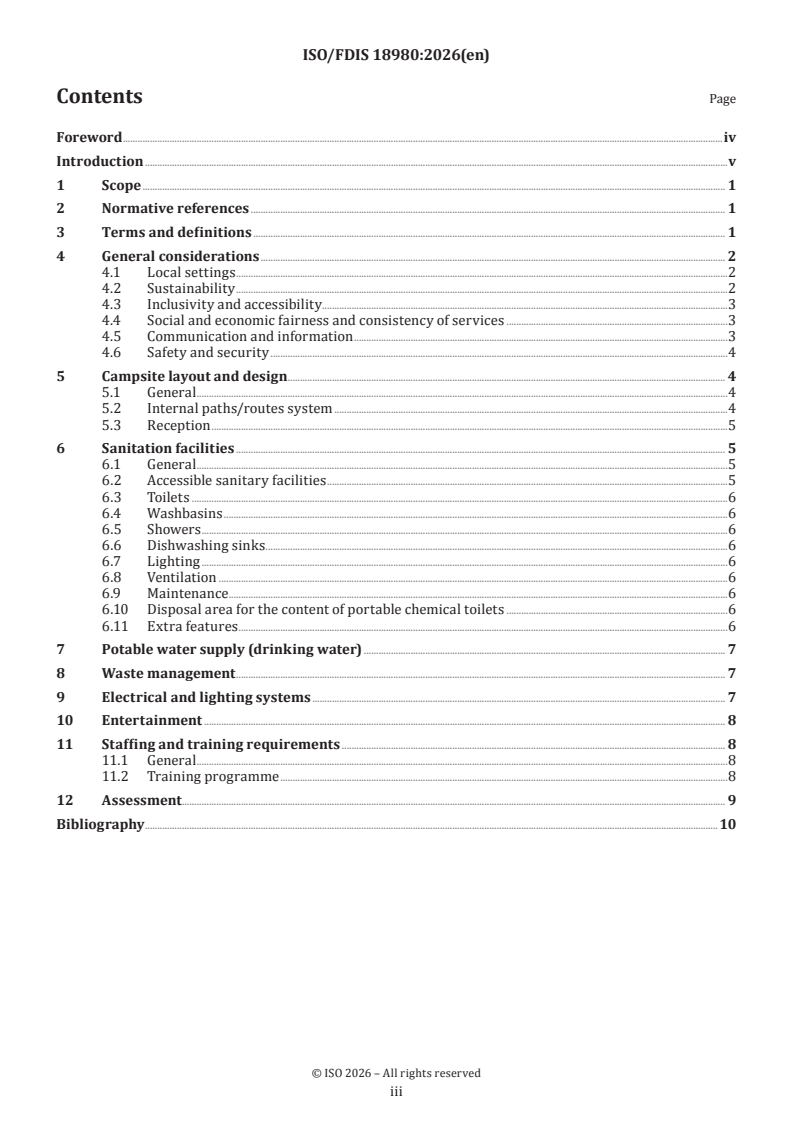
The document is organized into 12 clauses: Scope, Normative references, Terms and definitions, General considerations, Campsite layout and design, Sanitation facilities, Potable water supply, Waste management, Electrical and lighting systems, Entertainment, Staffing and training requirements, and Assessment. It is followed by a bibliography.
What are the key requirements of ISO 18980?
Clause 4.1 to 4.6 sets the operating principles for the site. ISO 18980 asks campsites to reflect local culture and landscape, address sustainability, support inclusivity and accessibility, provide fair and consistent service, communicate clearly, and manage safety and security. In practice, this means the site is not only a place to stay - it also needs planned environmental, social and safety measures.
Clause 4.2 and 4.3 make sustainability and access part of the design. The standard covers sustainable development, resource use, biodiversity protection, guest education, accessible routes, parking, washrooms and pitches. For operators, this means accessibility and environmental performance should be built into site planning rather than added later.
Clause 4.6 and Clause 5.2 focus on safety, security and emergency movement. Campsites shall address first aid, fire prevention, firefighting equipment, evacuation planning and safe spacing. Internal paths/routes must allow emergency access and evacuation. This matters because emergency vehicles and guests need clear circulation even under difficult weather or crowding.
Clause 5.3 and Clause 6 set the core guest facilities. Reception should be visible, accessible and able to provide key contact details outside opening hours. Sanitation facilities should include toilets, washbasins and showers in sufficient numbers, with accessible sanitary facilities where sanitary buildings are provided. The practical result is a campsite that can operate smoothly and meet basic hygiene and arrival needs.
Clause 6.7 to 6.10, Clause 7 and Clause 8 cover water, waste and sanitation support services. The standard addresses lighting and ventilation in washrooms, disposal for portable chemical toilets, potable water supply, and waste separation, recycling, composting, hazardous waste handling and regular collection. For operators, this means the site needs working systems for cleanliness, water access and waste control, not just bins and taps.
Clause 9 and Clause 10 cover electrical supply and optional guest services. Electrical and lighting systems should be safe, maintained by qualified professionals, energy-efficient and, where feasible, include EV charging stations. If a campsite offers pools, saunas, sports, playgrounds, restaurants or organized entertainment, those services should be maintained, clean and properly staffed.
Clause 11 and Clause 12 focus on people and control. Staff should be qualified, trained in cross-cultural service and supported by a training programme covering customer service, health and safety, emergency response and first aid. Management should carry out inspections or audits and use guest and employee feedback to improve services.
What terms does ISO 18980 define?
- campsite - A designated outdoor area in natural or developed surroundings that provides pitches for guests using their own camping units and/or accommodation supplied by the operator.
- camping accommodation - A fixed or semi-permanent rental unit on a campsite, such as a mobile home, rental caravan, pod, safari tent or similar unit.
- pitch - A delimited area reserved for one guest or party for a guest-owned camping unit or camping accommodation.
- leisure accommodation vehicle - A road vehicle or trailer that provides living accommodation for recreational use and complies with the relevant road vehicle requirements.
Who uses ISO 18980?
ISO 18980 is used by campsite owners and operators to plan, run and review campsite services. It also serves regulators and inspectors who assess whether a campsite provides the required facilities, safety measures and management practices. In day-to-day work, it supports reception, maintenance, sanitation, training and audit activities.
Which standards are used with ISO 18980?
- ISO 18513:2021 provides the tourism accommodation vocabulary used in Clause 2 and Clause 3.
- ISO 21401 is cited for more detailed sustainability management requirements for accommodation establishments.
- ISO 18065 is cited for campsites located in natural protected areas.
- ISO 21902 is cited for further accessibility requirements and recommendations.
- IEC 60364-7-708 is cited for safe low-voltage electrical installations in caravan parks, camping parks and similar locations.
What does the ISO 18980 document contain?
ISO 18980 contains a clause-by-clause framework for campsite facilities and services. It covers site planning, internal routes, reception arrangements, sanitation room features, potable water, waste handling, electrical systems, entertainment services, staff training and assessment. It also gives practical details such as after-hours contact information, accessible sanitary layouts, washroom features, disposal points for chemical toilets and the use of inspections, audits and feedback for continual improvement.
Buy Documents
ISO/FDIS 18980 - Tourism and related services — Camping tourism — Requirements and recommendations for campsite facilities and services
REDLINE ISO/FDIS 18980 - Tourism and related services — Camping tourism — Requirements and recommendations for campsite facilities and services
Get Certified
Connect with accredited certification bodies for this standard

Great Wall Tianjin Quality Assurance Center
Established 1993, first batch to receive national accreditation with IAF recognition.
Hong Kong Quality Assurance Agency (HKQAA)
Hong Kong's leading certification body.

Innovative Quality Certifications Pvt. Ltd. (IQCPL)
Known for integrity, providing ethical & impartial Assessment & Certification. CMMI Institute Partner.
Sponsored listings
Frequently Asked Questions
ISO 18980 is a draft published by the International Organization for Standardization (ISO). Its full title is "Tourism and related services — Camping tourism — Requirements and recommendations for campsite facilities and services". This standard covers: This document applies to campsites located in natural or developed areas, designed and managed for the purpose of accommodating tents, recreational vehicles, or camping houses used for accommodating guests. This document outlines considerations for the facilities, amenities, services, and management practices necessary to ensure a quality camping experience for all guests. The scope of this document includes requirements and recommendations related to the following areas: - Campsite layout and design - Sanitation and other important facilities - Sustainability - Accessibility - Safety and Security The document is intended to be used by campsite owners, operators, and regulators to ensure that campsites meet basic safety and environmental requirements, while providing a quality camping experience for guests.
This document applies to campsites located in natural or developed areas, designed and managed for the purpose of accommodating tents, recreational vehicles, or camping houses used for accommodating guests. This document outlines considerations for the facilities, amenities, services, and management practices necessary to ensure a quality camping experience for all guests. The scope of this document includes requirements and recommendations related to the following areas: - Campsite layout and design - Sanitation and other important facilities - Sustainability - Accessibility - Safety and Security The document is intended to be used by campsite owners, operators, and regulators to ensure that campsites meet basic safety and environmental requirements, while providing a quality camping experience for guests.
ISO 18980 is classified under the following ICS (International Classification for Standards) categories: 03.200.01 - Leisure and tourism in general; 97.200.30 - Camping equipment and camp-sites. The ICS classification helps identify the subject area and facilitates finding related standards.
ISO 18980 is available in PDF format for immediate download after purchase. The document can be added to your cart and obtained through the secure checkout process. Digital delivery ensures instant access to the complete standard document.
Standards Content (Sample)
FINAL DRAFT
International
Standard
ISO/FDIS 18980
ISO/TC 228
Tourism and related services —
Secretariat: UNE
Camping tourism — Requirements
Voting begins on:
and recommendations for campsite
2026-06-29
facilities and services
Voting terminates on:
2026-08-24
Tourisme et services connexes — Tourisme en camping —
Exigences et recommandations pour les installations et les
services des terrains de camping
RECIPIENTS OF THIS DRAFT ARE INVITED TO SUBMIT,
WITH THEIR COMMENTS, NOTIFICATION OF ANY
RELEVANT PATENT RIGHTS OF WHICH THEY ARE AWARE
AND TO PROVIDE SUPPOR TING DOCUMENTATION.
IN ADDITION TO THEIR EVALUATION AS
BEING ACCEPTABLE FOR INDUSTRIAL, TECHNO
LOGICAL, COMMERCIAL AND USER PURPOSES, DRAFT
INTERNATIONAL STANDARDS MAY ON OCCASION HAVE
TO BE CONSIDERED IN THE LIGHT OF THEIR POTENTIAL
TO BECOME STAN DARDS TO WHICH REFERENCE MAY BE
MADE IN NATIONAL REGULATIONS.
Reference number
ISO/FDIS 18980:2026(en) © ISO 2026
FINAL DRAFT
ISO/FDIS 18980:2026(en)
International
Standard
ISO/FDIS 18980
ISO/TC 228
Tourism and related services —
Secretariat: UNE
Camping tourism — Requirements
Voting begins on:
and recommendations for campsite
facilities and services
Voting terminates on:
Tourisme et services connexes — Tourisme en camping —
Exigences et recommandations pour les installations et les
services des terrains de camping
RECIPIENTS OF THIS DRAFT ARE INVITED TO SUBMIT,
WITH THEIR COMMENTS, NOTIFICATION OF ANY
RELEVANT PATENT RIGHTS OF WHICH THEY ARE AWARE
AND TO PROVIDE SUPPOR TING DOCUMENTATION.
© ISO 2026
IN ADDITION TO THEIR EVALUATION AS
All rights reserved. Unless otherwise specified, or required in the context of its implementation, no part of this publication may
BEING ACCEPTABLE FOR INDUSTRIAL, TECHNO
LOGICAL, COMMERCIAL AND USER PURPOSES, DRAFT
be reproduced or utilized otherwise in any form or by any means, electronic or mechanical, including photocopying, or posting on
INTERNATIONAL STANDARDS MAY ON OCCASION HAVE
the internet or an intranet, without prior written permission. Permission can be requested from either ISO at the address below
TO BE CONSIDERED IN THE LIGHT OF THEIR POTENTIAL
or ISO’s member body in the country of the requester.
TO BECOME STAN DARDS TO WHICH REFERENCE MAY BE
MADE IN NATIONAL REGULATIONS.
ISO copyright office
CP 401 • Ch. de Blandonnet 8
CH-1214 Vernier, Geneva
Phone: +41 22 749 01 11
Email: copyright@iso.org
Website: www.iso.org
Published in Switzerland Reference number
ISO/FDIS 18980:2026(en) © ISO 2026
ii
ISO/FDIS 18980:2026(en)
Contents Page
Foreword .iv
Introduction .v
1 Scope . 1
2 Normative references . 1
3 Terms and definitions . 1
4 General considerations . 2
4.1 Local settings .2
4.2 Sustainability .2
4.3 Inclusivity and accessibility.3
4.4 Social and economic fairness and consistency of services .3
4.5 Communication and information .3
4.6 Safety and security .4
5 Campsite layout and design . 4
5.1 General .4
5.2 Internal paths/routes system .4
5.3 Reception .5
6 Sanitation facilities . 5
6.1 General .5
6.2 Accessible sanitary facilities .5
6.3 Toilets .6
6.4 Washbasins .6
6.5 Showers .6
6.6 Dishwashing sinks .6
6.7 Lighting .6
6.8 Ventilation .6
6.9 Maintenance .6
6.10 Disposal area for the content of portable chemical toilets .6
6.11 Extra features .6
7 Potable water supply (drinking water) . 7
8 Waste management . 7
9 Electrical and lighting systems . 7
10 Entertainment . 8
11 Staffing and training requirements . 8
11.1 General .8
11.2 Training programme .8
12 Assessment . . 9
Bibliography .10
iii
ISO/FDIS 18980:2026(en)
Foreword
ISO (the International Organization for Standardization) is a worldwide federation of national standards
bodies (ISO member bodies). The work of preparing International Standards is normally carried out through
ISO technical committees. Each member body interested in a subject for which a technical committee
has been established has the right to be represented on that committee. International organizations,
governmental and non-governmental, in liaison with ISO, also take part in the work. ISO collaborates closely
with the International Electrotechnical Commission (IEC) on all matters of electrotechnical standardization.
The procedures used to develop this document and those intended for its further maintenance are described
in the ISO/IEC Directives, Part 1. In particular, the different approval criteria needed for the different types
of ISO document should be noted. This document was drafted in accordance with the editorial rules of the
ISO/IEC Directives, Part 2 (see www.iso.org/directives).
ISO draws attention to the possibility that the implementation of this document may involve the use of (a)
patent(s). ISO takes no position concerning the evidence, validity or applicability of any claimed patent rights
in respect thereof. As of the date of publication of this document, ISO had not received notice of (a) patent(s)
which may be required to implement this document. However, implementers are cautioned that this may not
represent the latest information, which may be obtained from the patent database available at www.iso.org/
patents. ISO shall not be held responsible for identifying any or all such patent rights.
Any trade name used in this document is information given for the convenience of users and does not
constitute an endorsement. For an explanation of the voluntary nature of standards, the meaning of ISO
specific terms and expressions related to conformity assessment, as well as information about ISO's
adherence to the World Trade Organization (WTO) principles in the Technical Barriers to Trade (TBT), see
www.iso.org/iso/foreword.html.
This document was prepared by Technical Committee ISO/TC 228, Tourism and related services.
Any feedback or questions on this document should be directed to the user’s national standards body. A
complete listing of these bodies can be found at www.iso.org/members.html.
iv
ISO/FDIS 18980:2026(en)
Introduction
A campsite is a place specifically designed to allocate a tent, campervan, caravan, or other form of leisure
accommodation vehicle. It provides leisure services for guests and is therefore an integral type of tourism
accommodation.
This document provides a common, bottom-line and attainable reference for all campsites in terms of
quality service provision. It has been developed considering the different types of campsites in the world,
existing categorization systems, star-rating systems, business models, sizes and services offered, as well as
the current demands of guests and global trends.
v
FINAL DRAFT International Standard ISO/FDIS 18980:2026(en)
Tourism and related services — Camping tourism —
Requirements and recommendations for campsite facilities
and services
1 Scope
This document specifies requirements and provides recommendations for campsite facilities and services,
covering the following:
— campsite layout and design;
— sanitation and other important facilities;
— sustainability;
— inclusivity and accessibility;
— safety and security.
This document aims to ensure that campsite facilities, amenities, services and management practices meet
basic safety and environmental requirements, while providing a good quality camping experience for guests.
This document applies to campsites in natural or developed areas that are designed and managed to provide
pitches for guests using their own camping units (such as tents, leisure accommodation vehicles including
caravans, motor caravans or camper vans) and/or static or semi-permanent accommodation units (such as
camping houses, mobile homes, rental caravans, safari tents or similar) supplied by the campsite operator.
This document applies to campsite owners, operators and regulators.
2 Normative references
The following documents are referred to in the text in such a way that some or all of their content constitutes
requirements of this document. For dated references, only the edition cited applies. For undated references,
the latest edition of the referenced document (including any amendments) applies.
ISO 18513, Tourism services — Hotels and other types of tourism accommodation — Vocabulary
3 Terms and definitions
For the purposes of this document, terms and definitions given in ISO 18513, as well as the following apply.
ISO and IEC maintain terminology databases for use in standardization at the following addresses:
— ISO Online browsing platform: available at https:// www .iso .org/ obp
— IEC Electropedia: available at https:// www .electropedia .org/
ISO/FDIS 18980:2026(en)
3.1
campsite
camping park
camping site
campground
holiday park
caravan park
designated outdoor area in natural or developed surroundings that is designed and managed to provide
two or more pitches (3.3) for guests using their own camping units (such as tents, leisure accommodation
vehicle (3.4) including caravans, motor caravans or camper vans) and/or camping accommodation (3.2) units
supplied by the campsite operator
Note 1 to entry: A campsite typically includes associated facilities and services such as sanitary buildings, reception,
waste disposal points, roads and paths, play or recreation areas and, where provided, food and beverage outlets or
shops.
3.2
camping accommodation
fixed or semi-permanent rental unit on a campsite (3.1), provided by the campsite operator for guest
occupancy, such as camping houses, bungalows, mobile homes, rental caravans, pods, safari tents, tree
houses or similar units
Note 1 to entry: Camping accommodation is distinct from camping units owned and brought by the guests (such as
their own tents, caravans, motor caravans or camper vans).
Note 2 to entry: Depending on national regulations, some types of camping accommodation can be classified as
buildings or as leisure accommodation vehicle (3.4) .
3.3
pitch
delimited area on a campsite (3.1) designated for the exclusive use of an individual guest or party, intended
for placing a guest-owned camping unit or a camping accommodation (3.2)
Note 1 to entry: Depending on the layout of the campsite (3.1) a pitch may include associated space for a vehicle,
outdoor seating, awnings or similar camping equipment.
3.4
leisure accommodation vehicle
road vehicle or trailer, providing living accommodation for recreational use, which complies with the
relevant requirements for the construction and use of road vehicles
Note 1 to entry: On a campsite (3.1), leisure accommodation vehicles may be used by short-stay tourists, by seasonal
or long-stay guests, or be installed and operated as rental units by the campsite operator. When permanently installed
and rented out by the operator, a leisure accommodation vehicle is considered camping accommodation (3.2) .
4 General considerations
4.1 Local settings
The campsites shall be designed to optimize the guest's experience. This includes reflecting, communicating
and celebrating local, regional and national culture, heritage, traditions and landscape.
4.2 Sustainability
Sustainability aspects including the following shall be addressed in campsites.
a) Development principles: Address the principle of sustainable development in the process of site
selection, design, construction, and operations of a campsite.
[1]
NOTE 1 ISO 21401 provides detailed requirements.
ISO/FDIS 18980:2026(en)
b) Environmental responsibility: Minimize ecological impact, conserve natural resources, and promote
sustainable practices such as waste reduction, water conservation, energy efficiency and the use of
renewable energy sources.
[2]
NOTE 2 If the campsite is located in a natural protected area, see ISO 18065 for detailed requirements.
c) Biodiversity conservation: Protect and preserve biodiversity by minimizing disturbance to wildlife and
their habitats, promoting responsible wildlife viewing, and supporting conservation initiatives.
d) Compliance and monitoring: Comply with applicable industry standards, regularly monitor and evaluate
sustainable development performance to promote continuous improvement.
e) Guest education: Promote awareness and inform on sustainable behaviour, outdoor ethics, and
conservation practices.
4.3 Inclusivity and accessibility
Accessibility and inclusivity aspects including the following shall be addressed in campsites.
a) Physical accessibility: Ensure campsites and facilities are designed and maintained to be accessible to
individuals with disabilities, providing accessible pathways, parking spaces, and facilities.
1) Parking: Provid
...
Formatted: French (Switzerland)
ISO/DISFDIS 18980
Formatted: French (Switzerland)
ISO/TC 228
Secretariat: UNE
Date: 2026-05-0406-15
Tourism and related services — Camping tourism — Requirements
and recommendations for campsite facilities and services
Tourisme et services connexes — Tourisme en camping — Exigences et recommandations pour les installations
et les services des terrains de camping
DISFDIS stage
VVototiinngg b beeggiinnss on on:: 22002255--0099--0088
VVootintingg te termrmiinnaatetess o onn:: 2 2002255--1122--0011
ISO/DISFDIS 18980:2026(en)
All rights reserved. Unless otherwise specified, or required in the context of its implementation, no part of this publication
may be reproduced or utilized otherwise in any form or by any means, electronic or mechanical, including photocopying,
or posting on the internet or an intranet, without prior written permission. Permission can be requested from either ISO
at the address below or ISO’s member body in the country of the requester.
ISO copyright office
CP 401 • Ch. de Blandonnet 8
CH-1214 Vernier, Geneva
Phone: + 41 22 749 01 11
E-mail: copyright@iso.org
Formatted: German (Germany)
Website: www.iso.org
Formatted: German (Germany)
Published in Switzerland
Formatted: German (Germany)
Field Code Changed
ii
ISO/DISFDIS 18980:2026(en)
Contents
Foreword . iii
Introduction . iii
Scope . iii
Normative references . iii
Terms and definitions . iii
General considerations . iii
Local settings. iii
Sustainability . iii
Inclusivity and accessibility . iii
Social and economic fairness and consistency of services . iii
Communication and information . iii
Safety and security . iii
Campsite layout and design . iii
General . iii
Internal paths/routes system . iii
Reception . iii
Sanitation facilities . iii
General . iii
Accessible sanitary facilities . iii
Toilets . iii
Washbasins . iii
Showers . iii
Dishwashing sinks . iii
Lighting . iii
Ventilation . iii
Maintenance . iii
Disposal area for the content of portable chemical toilets . iii
Extra features . iii
Potable water supply (drinking water) . iii
Waste management . iii
Electrical and lighting systems . iii
Entertainment . iii
Staffing and training requirements . iii
General . iii
Training programme . iii
Assessment . iii
Bibliography . iii
Foreword . v
Introduction . vi
1 Scope . 1
2 Normative references . 1
3 Terms and definitions . 1
4 General considerations . 2
iii
ISO/DISFDIS 18980:2026(en)
4.1 Local settings . 2
4.2 Sustainability . 2
4.3 Inclusivity and accessibility . 3
4.4 Social and economic fairness and consistency of services . 3
4.5 Communication and information . 3
4.6 Safety and security . 4
5 Campsite layout and design . 4
5.1 General. 4
5.2 Internal paths/routes system. 4
5.3 Reception . 5
6 Sanitation facilities . 5
6.1 General. 5
6.2 Accessible sanitary facilities . 6
6.3 Toilets . 6
6.4 Washbasins . 6
6.5 Showers . 6
6.6 Dishwashing sinks . 6
6.7 Lighting . 6
6.8 Ventilation . 7
6.9 Maintenance . 7
6.10 Disposal area for the content of portable chemical toilets . 7
6.11 Extra features . 7
7 Potable water supply (drinking water) . 7
8 Waste management . 7
9 Electrical and lighting systems . 8
10 Entertainment . 8
11 Staffing and training requirements . 8
11.1 General. 8
11.2 Training programme . 9
12 Assessment . 9
Bibliography . 11
iv
ISO/DISFDIS 18980:2026(en)
Foreword
ISO (the International Organization for Standardization) is a worldwide federation of national standards
bodies (ISO member bodies). The work of preparing International Standards is normally carried out through
ISO technical committees. Each member body interested in a subject for which a technical committee has been
established has the right to be represented on that committee. International organizations, governmental and
non-governmental, in liaison with ISO, also take part in the work. ISO collaborates closely with the
International Electrotechnical Commission (IEC) on all matters of electrotechnical standardization. The
procedures used to develop this document and those intended for its further maintenance are described in
the ISO/IEC Directives, Part 1. In particular, the different approval criteria needed for the different types of
ISO document should be noted. This document was drafted in accordance with the editorial rules of the
ISO/IEC Directives, Part 2 (see www.iso.org/directives).www.iso.org/directives).
ISO draws attention to the possibility that the implementation of this document may involve the use of (a)
patent(s). ISO takes no position concerning the evidence, validity or applicability of any claimed patent rights
in respect thereof. As of the date of publication of this document, ISO had not received notice of (a) patent(s)
which may be required to implement this document. However, implementers are cautioned that this may not
represent the latest information, which may be obtained from the patent database available at
www.iso.org/patents. ISO shall not be held responsible for identifying any or all such patent rights.
Any trade name used in this document is information given for the convenience of users and does not
constitute an endorsement. For an explanation of the voluntary nature of standards, the meaning of ISO
specific terms and expressions related to conformity assessment, as well as information about ISO's adherence
to the World Trade Organization (WTO) principles in the Technical Barriers to Trade (TBT), see
www.iso.org/iso/foreword.html.www.iso.org/iso/foreword.html.
This document was prepared by Technical Committee ISO/TC 228, Tourism and related services.
Any feedback or questions on this document should be directed to the user’s national standards body. A
complete listing of these bodies can be found at www.iso.org/members.html.www.iso.org/members.html.
v
ISO/DISFDIS 18980:2026(en)
Introduction
A campsite is a place specifically designed to allocate a tent, campervan, caravan, or other form of leisure
accommodation vehicle. It provides leisure services for guests and is therefore an integral type of tourism
accommodation.
This document provides a common, bottom-line and attainable reference for all campsites in terms of quality
service provision. It has been developed considering the different types of campsites in the world, existing
categorization systems, star-rating systems, business models, sizes and services offered, as well as the current
demands of guests and global trends.
vi
ISO/DISFDIS 18980:2026(en)
Tourism and related services — Camping tourism — Requirements
and recommendations for campsite facilities and services
1 Scope
This document specifies requirements and provides recommendations for campsite facilities and services in,
covering the following areas:
— campsite layout and design;
— sanitation and other important facilities;
— sustainability;
— inclusivity and accessibility;
— safety and security.
This document specifies requirements and gives recommendations foraims to ensure that campsite facilities,
amenities, services and management practices so that campsites meet basic safety and environmental
requirements, while providing a good quality camping experience for guests.
This document applies to campsites in natural or developed areas that are designed and managed to provide
pitches for guests using their own camping units (such as tents, leisure accommodation vehiclevehicles
including caravans, motor caravans or camper vans) and/or static or semi-permanent accommodation units
(such as camping houses, mobile homes, rental caravans, safari tents or similar) supplied by the campsite
operator.
TheThis document applies to campsite owners, operators and regulators.
2 Normative references
The following documents are referred to in the text in such a way that some or all of their content constitutes
requirements of this document. For dated references, only the edition cited applies. For undated references,
the latest edition of the referenced document (including any amendments) applies.
ISO 18513:2021, Tourism services — Hotels and other types of tourism accommodation — Vocabulary
3 Terms and definitions
For the purposes of this document, terms and definitions given in ISO 18513:2021 , as well as the following
Formatted: Font: Not Italic
apply.
ISO and IEC maintain terminology databases for use in standardization at the following addresses:
— — ISO Online browsing platform: available at https://www.iso.org/obphttps://www.iso.org/obp
Formatted: List Continue 1
— — IEC Electropedia: available at https://www.electropedia.org/https://www.electropedia.org/
3.1
campsite, noun
camping park, noun
camping site, noun
campground, noun
ISO/DISFDIS 18980:2026(en)
holiday park, noun
caravan park, noun
designated outdoor area in natural or developed surroundings that is designed and managed to provide two
or more pitchpitches (3.3) for guests using their own camping units (such as tents, leisure accommodation
vehicle (3.4) including caravans, motor caravans or camper vans) and/or camping accommodation (3.2) units
supplied by the campsite operator
Note 1 to entry: A campsite typically includes associated facilities and services such as sanitary buildings, reception,
waste disposal points, roads and paths, play or recreation areas and, where provided, food and beverage outlets or shops.
3.2
camping accommodation, noun
fixed or semi-permanent rental unit on a campsite (3.1) ,), provided by the campsite operator for guest
occupancy, such as camping houses, bungalows, mobile homes, rental caravans, pods, safari tents, tree houses
or similar units
Note 1 to entry: campingCamping accommodation (3.2) is distinct from camping units owned and brought by the guests
Formatted: Font: Not Italic
(such as their own tents, caravans, motor caravans or camper vans).
Note 2 to entry: Depending on national regulations, some types of camping accommodation (3.2) can be classified as
Formatted: Font: Not Italic
buildings or as leisure accommodation vehicle (3.4) .
3.3
pitch, noun
delimited area on a campsite (3.1) designated for the exclusive use of an individual guest or party, intended
for placing a guest-owned camping unit or a camping accommodation (3.2)
Note 1 to entry: Depending on the layout of the campsite (3.1) a pitch may include associated space for a vehicle, outdoor
seating, awnings or similar camping equipment.
3.4
leisure accommodation vehicle
road vehicle or trailer, providing living accommodation for recreational use, which complies with the relevant
requirements for the construction and use of road vehicles
Note 1 to entry: On a campsite (3.1), leisure accommodation vehicle (3.4)vehicles may be used by short-stay tourists, by
Formatted: Font: Not Italic
seasonal or long-stay guests, or be installed and operated as rental units by the campsite operator. When permanently
installed and rented out by the operator, a leisure accommodation vehicle (3.4) is considered camping accommodation
Formatted: Font: Not Italic
(3.2) .).
4 General considerations
4.1 Local settings
The campsites shall be designed to optimize the guest's experience. This includes reflecting, communicating
and celebrating local, regional and national culture, heritage, traditions and landscape, etc.
4.2 Sustainability
Sustainability aspects including the following shall be addressed in campsites.
a) Development principles: Address the principle of sustainable development in the process of site selection,
Formatted: Numbered + Level: 1 + Numbering Style: a,
design, construction, and operations of a campsite . b, c, … + Start at: 1 + Alignment: Left + Aligned at: 0
cm + Indent at: 0 cm
[1]
NOTE 1 ISO 21401 provides detailed requirements.
Formatted: No underline, Font color: Auto
ISO/DISFDIS 18980:2026(en)
b) Environmental responsibility: Minimize ecological impact, conserve natural resources, and promote
Formatted: Numbered + Level: 1 + Numbering Style: a,
sustainable practices such as waste reduction, water conservation, energy efficiency and the use of b, c, … + Start at: 2 + Alignment: Left + Aligned at: 0
renewable energy sources. cm + Indent at: 0 cm
[2]
NOTE 2 In caseIf the campsite is located in a natural protected area, see ISO 18065 for detailed requirements.
Formatted: No underline, Font color: Auto
Formatted: Note indent
c) Biodiversity conservation: Protect and preserve biodiversity by minimizing disturbance to wildlife and
their habitats, promoting responsible wildlife viewing, and supporting conservation initiatives. Formatted: Numbered + Level: 1 + Numbering Style: a,
b, c, … + Start at: 3 + Alignment: Left + Aligned at: 0
d) Compliance and monitoring: Comply with applicable industry standards, regularly monitor and evaluate cm + Indent at: 0 cm
sustainable development performance to promote continuous improvement.
Formatted: Numbered + Level: 1 + Numbering Style: a,
b, c, … + Start at: 4 + Alignment: Left + Aligned at: 0
e) Guest education: Promote awareness and inform on sustainable behaviour, outdoor ethics, and
cm + Indent at: 0 cm
conservation practices.
Formatted: Numbered + Level: 1 + Numbering Style: a,
b, c, … + Start at: 5 + Alignment: Left + Aligned at: 0
4.3 Inclusivity and accessibility
cm + Indent at: 0 cm
Accessibility and inclusivity aspects including the following shall be addressed in campsites.
a) Physical accessibility: Ensure campsites and facilities are designed and maintained to be accessible to
Formatted: Numbered + Level: 1 + Numbering Style: a,
individuals with disabilities, providing accessible pathways, parking spaces, and facilities:.
b, c, … + Start at: 1 + Alignment: Left + Aligned at: 0
cm + Indent at: 0 cm
1) Parking: Provide designated
...