

ISO 27916:2026
(Main)Carbon dioxide capture, transportation and storage — Carbon dioxide storage using enhanced oil recovery (CO2-EOR)
- Abstract
This document provides requirements for demonstrating that the site in question is adequate to provide safe, long-term containment of CO2, for demonstrating that the CO2 flood is operated in a way to assure containment of the CO2 in the EOR complex, and for quantifying associated storage. This document applies to CO2 that is injected in enhanced recovery operations for oil and other hydrocarbons, including natural gas, (CO2-EOR) for which quantification of CO2 that is safely stored long-term in association with the CO2-EOR project is sought. Recognizing that some CO2-EOR projects use non-anthropogenic CO2 in combination with anthropogenic CO2, the document also shows how allocation ratios can be utilized for optional calculations to quantify the portion of associated storage comprised of anthropogenic CO2 (see Annex A). This document does not apply to quantification of CO2 injected into reservoirs where no hydrocarbon production is anticipated or occurring. Storage of CO2 in geologic formations that do not contain hydrocarbons is covered by ISO 27914 even if located above or below hydrocarbon producing reservoirs. If storage of CO2 is conducted in a reservoir from which hydrocarbons were previously produced but will no longer be produced in paying or commercial quantities, such storage would be subject to the requirements of ISO 27914. This document addresses: safe, long-term containment of CO2 within the EOR complex; CO2 leakage from the EOR complex through leakage pathways; and on-site CO2-EOR project loss of CO2 from wells, equipment, or other facilities. This document does not address the following: lifecycle emissions, including but not limited to CO2 emissions from capture or transportation of CO2, on-site emissions from combustion or power generation, and CO2 emissions resulting from the combustion of produced hydrocarbons; storage of CO2 above ground; buffer and seasonal storage of CO2 below ground (similar to natural gas storage); )any technique or product that does not involve injection of CO2 into the subsurface; and emissions of any greenhouse gases (GHGs) other than CO2. NOTE Some authorities can require other GHG components of the CO2 stream to be quantified.
- Status
- Published
- Publication Date
- 23-Jun-2026
- Technical Committee
- ISO/TC 265 - Carbon dioxide capture, transportation, and geological storage
- Drafting Committee
- ISO/TC 265/WG 6 - EOR Issues
- Current Stage
- 6060 - International Standard published
- Start Date
- 24-Jun-2026
- Due Date
- 28-Feb-2027
- Completion Date
- 24-Jun-2026



ISO 27916:2026 is an International Standard from ISO on carbon dioxide storage using enhanced oil recovery (CO2-EOR). ISO 27916:2026 specifies how to demonstrate that a CO2-EOR site can contain CO2 safely and long term, how to operate the flood to maintain that containment, and how to quantify associated storage. It is written for operators, engineers, verifiers, regulators and others who need a defensible method for documenting CO2 stored in association with CO2-EOR projects.
What does ISO 27916:2026 specify?
ISO 27916:2026 sets requirements for documenting the EOR complex, assuring containment, monitoring for loss and leakage, quantifying stored CO2, verifying the quantification, keeping records, and terminating a project. Its scope covers CO2 injected for enhanced recovery of oil and other hydrocarbons, including natural gas, when the aim is to quantify CO2 safely stored long term in association with the project.
| Annex | What it covers |
|---|---|
| Annex A | An informative example calculation, including allocation ratios for the anthropogenic CO2 portion |
| Annex B | Informative unit conversion for common oilfield and SI units |
The document is organized into clauses on scope, documentation, EOR complex description and qualification, containment assurance and monitoring, well construction, quantification and verification, recordkeeping and missing data, and project termination. That structure matters in practice because the standard links site description, monitoring, metering, accounting and closure into one chain of evidence.
The scope also separates CO2-EOR from other storage cases. It does not apply where CO2 is injected into reservoirs with no hydrocarbon production, and geologic storage in formations without hydrocarbons is covered by ISO 27914.
What are the key requirements of ISO 27916:2026?
ISO 27916:2026 requires an operator to build a documented case for containment first, then to quantify stored CO2 from measured input minus documented losses. The practical result is that the project record has to show both physical containment and an auditable carbon accounting trail.
Documentation and project planning
Clause 4 requires initial documentation before the quantification period and periodic documentation during it. The initial package includes the EOR complex description, initial containment assurance, the monitoring program, the maximum allowable bottom hole injection pressure, starting CO2 inventory, estimated associated storage over the life of the project, the chosen quantification method, and an initial termination plan.
Clause 4 also allows existing data already held and approved by the authority to be reused. In practice, this prevents duplicate paperwork when oil and gas permits already cover part of the needed information.
EOR complex description and qualification
Clause 5 requires an EOR operation management plan that describes the EOR complex and engineered system and shows that it can provide safe, long-term containment. The plan covers geological characterization, facilities, wells and other engineered features, reservoir operations history, engineering controls, monitoring, loss management, quantification data, and the project termination plan.
For a buyer, auditor or engineer, this means the standard expects a site-specific technical file, not a generic statement. The geology, facilities and existing wells have to be understood well enough to support containment claims and later termination decisions.
Containment assurance and monitoring
Clause 6 requires initial containment assurance and operational containment assurance throughout the quantification period. The monitoring program has to address potential leakage pathways, define tools and methods, set a detection threshold, and be updated as operations change.
The operator must also review changes that could affect containment, such as adding or abandoning wells, changing the areal extent of the reservoir, or discovering CO2 beyond the EOR complex boundary. In practice, this keeps monitoring tied to real operational risk instead of fixed paperwork.
Wells, construction, intervention and abandonment
Clause 7 requires new wells and well modifications to be designed and tested for safe, long-term containment, with materials selected for the expected thermomechanical and geochemical environment, including CO2 where present. Wells that penetrate the EOR complex must be cemented through each cap rock with suitable cement.
For abandonment, Clause 7 requires isolation of groundwater and hydrocarbons, maintained well control during plugging and abandonment, and verification by logs and repairs where needed. This matters because well integrity is one of the main containment barriers in CO2-EOR projects.
Quantification and verification
Clause 8 defines associated storage as input minus loss, all in mass units or volumetric units convertible to mass. It separates input into CO2 received at the custody transfer meter and, where approved, native CO2 recovered from the reservoir, and separates loss into operational loss and EOR complex leakage loss.
Clause 8 also requires the operator to prevent double-counting, quantify CO2 transferred offsite, and handle de minimis losses using the monitoring detection threshold. For projects that mix anthropogenic and non-anthropogenic CO2, Annex A shows how allocation ratios can be used to quantify the anthropogenic portion.
Verification under Clause 8 can be internal or external, but the verifier must assess the supporting data and issue a verification opinion. This gives readers a clear choice of assurance model while keeping the evidence requirements explicit.
Records, missing data and termination
Clause 9 requires supporting records to be retained for the duration of the operator’s involvement and to be offered to the authority after termination of the lease or permit. It also requires procedures for estimating missing monitoring, sampling and testing data without overstating stored CO2.
Clause 10 requires a termination plan, periodic assurance if injection stops before closure, and documented requisites for termination. The project can terminate only when CO2 injection has stopped, hydrocarbon production has stopped, and the termination requisites have been met.
What terms does ISO 27916:2026 define?
ISO 27916:2026 defines the terms that control how CO2-EOR storage is described and accounted for. These definitions are important because the standard distinguishes storage, loss, leakage and project boundaries very precisely.
- Anthropogenic carbon dioxide - carbon dioxide initially produced as a by-product of a combustion, chemical or separation process.
- Associated storage - CO2 stored in association with CO2-EOR as an inherent result of hydrocarbon production operations.
- Containment assurance - the demonstration that the project features and geology can provide safe, long-term containment of CO2.
- EOR complex - the project reservoir, trap and defined surrounding subsurface volume within which injected CO2 will remain contained.
- Injection-withdrawal ratio - the ratio of fluids and gases injected to those produced over a defined period, at reservoir conditions.
- Loss - leakage, intended or unintended releases from the project, and transfers of the CO2 stream out of the project.
- Safe, long-term containment - associated storage for the period needed to be considered secure under the applicable quantification system.
- Termination - the process ending with the operator demonstrating conformity.
Who uses ISO 27916:2026?
ISO 27916:2026 is used by CO2-EOR project operators, reservoir engineers, geologists, production engineers and well integrity specialists. It is also relevant to metering teams, monitoring specialists, verifiers, auditors and regulatory authorities that review storage claims.
In practice, operators use it to prepare project documentation, design monitoring programs, quantify stored CO2, and support closure decisions. Buyers and contracting parties can use it to understand what technical evidence a project needs before a stored-CO2 claim is credible.
What changed in ISO 27916:2026 from the previous edition?
ISO 27916:2026 is the second edition and replaces ISO 27916:2019. The foreword states that the revision technically updates the standard.
The stated changes are:
- Clause 3 clarifies the distinction between loss and leakage.
- Clauses 4, 5 and 7 were reorganized to reflect observed actual practices.
- Clause 8 was updated and reorganized to better incorporate verification criteria, and the graphics were updated.
- Annex A was reorganized, with selected common EOR project description information removed because it appears in other source documents, and the annex was updated.
- The whole text was editorially revised.
Which standards are used with ISO 27916:2026?
ISO 27916:2026 points users to ISO 14064-1, ISO 14064-2 and ISO 14064-3 for greenhouse gas quantification, project accounting, verification and validation contexts. The introduction explains that results from this standard can feed broader greenhouse gas reporting and verification systems.
ISO 27914 is the companion standard named in the scope for geologic storage in formations that do not contain hydrocarbons. The bibliography also lists many pipeline, well construction, materials, metering and monitoring standards that may be used alongside CO2-EOR projects, depending on the site and equipment.
What does the ISO 27916:2026 document contain?
ISO 27916:2026 contains a full set of project requirements, definitions, formulas, tables and example calculations for CO2-EOR storage accounting. Clause 8 provides the quantification framework, including input, loss, allocation ratios, de minimis loss handling, double-counting avoidance and verification.
Annex A gives a worked example for total associated storage and for the anthropogenic CO2 portion, including allocation logic across received CO2, native CO2, operational loss and EOR complex loss. Annex B provides conversion factors between field units and SI units, which supports documentation and reporting without changing the accounting method.
The document also includes figures that illustrate native CO2 behavior in typical production and in CO2-EOR with recycling, helping readers understand why recycled CO2 is not counted as new associated storage.
Relations
- Effective Date
- 02-Mar-2024
Get Certified
Connect with accredited certification bodies for this standard

BSI Group
BSI (British Standards Institution) is the business standards company that helps organizations make excellence a habit.

Bureau Veritas
Bureau Veritas is a world leader in laboratory testing, inspection and certification services.

DNV
DNV is an independent assurance and risk management provider.
Sponsored listings
Frequently Asked Questions
ISO 27916:2026 is a standard published by the International Organization for Standardization (ISO). Its full title is "Carbon dioxide capture, transportation and storage — Carbon dioxide storage using enhanced oil recovery (CO2-EOR)". This standard covers: This document provides requirements for demonstrating that the site in question is adequate to provide safe, long-term containment of CO2, for demonstrating that the CO2 flood is operated in a way to assure containment of the CO2 in the EOR complex, and for quantifying associated storage. This document applies to CO2 that is injected in enhanced recovery operations for oil and other hydrocarbons, including natural gas, (CO2-EOR) for which quantification of CO2 that is safely stored long-term in association with the CO2-EOR project is sought. Recognizing that some CO2-EOR projects use non-anthropogenic CO2 in combination with anthropogenic CO2, the document also shows how allocation ratios can be utilized for optional calculations to quantify the portion of associated storage comprised of anthropogenic CO2 (see Annex A). This document does not apply to quantification of CO2 injected into reservoirs where no hydrocarbon production is anticipated or occurring. Storage of CO2 in geologic formations that do not contain hydrocarbons is covered by ISO 27914 even if located above or below hydrocarbon producing reservoirs. If storage of CO2 is conducted in a reservoir from which hydrocarbons were previously produced but will no longer be produced in paying or commercial quantities, such storage would be subject to the requirements of ISO 27914. This document addresses: safe, long-term containment of CO2 within the EOR complex; CO2 leakage from the EOR complex through leakage pathways; and on-site CO2-EOR project loss of CO2 from wells, equipment, or other facilities. This document does not address the following: lifecycle emissions, including but not limited to CO2 emissions from capture or transportation of CO2, on-site emissions from combustion or power generation, and CO2 emissions resulting from the combustion of produced hydrocarbons; storage of CO2 above ground; buffer and seasonal storage of CO2 below ground (similar to natural gas storage); )any technique or product that does not involve injection of CO2 into the subsurface; and emissions of any greenhouse gases (GHGs) other than CO2. NOTE Some authorities can require other GHG components of the CO2 stream to be quantified.
This document provides requirements for demonstrating that the site in question is adequate to provide safe, long-term containment of CO2, for demonstrating that the CO2 flood is operated in a way to assure containment of the CO2 in the EOR complex, and for quantifying associated storage. This document applies to CO2 that is injected in enhanced recovery operations for oil and other hydrocarbons, including natural gas, (CO2-EOR) for which quantification of CO2 that is safely stored long-term in association with the CO2-EOR project is sought. Recognizing that some CO2-EOR projects use non-anthropogenic CO2 in combination with anthropogenic CO2, the document also shows how allocation ratios can be utilized for optional calculations to quantify the portion of associated storage comprised of anthropogenic CO2 (see Annex A). This document does not apply to quantification of CO2 injected into reservoirs where no hydrocarbon production is anticipated or occurring. Storage of CO2 in geologic formations that do not contain hydrocarbons is covered by ISO 27914 even if located above or below hydrocarbon producing reservoirs. If storage of CO2 is conducted in a reservoir from which hydrocarbons were previously produced but will no longer be produced in paying or commercial quantities, such storage would be subject to the requirements of ISO 27914. This document addresses: safe, long-term containment of CO2 within the EOR complex; CO2 leakage from the EOR complex through leakage pathways; and on-site CO2-EOR project loss of CO2 from wells, equipment, or other facilities. This document does not address the following: lifecycle emissions, including but not limited to CO2 emissions from capture or transportation of CO2, on-site emissions from combustion or power generation, and CO2 emissions resulting from the combustion of produced hydrocarbons; storage of CO2 above ground; buffer and seasonal storage of CO2 below ground (similar to natural gas storage); )any technique or product that does not involve injection of CO2 into the subsurface; and emissions of any greenhouse gases (GHGs) other than CO2. NOTE Some authorities can require other GHG components of the CO2 stream to be quantified.
ISO 27916:2026 is classified under the following ICS (International Classification for Standards) categories: 13.020.40 - Pollution, pollution control and conservation. The ICS classification helps identify the subject area and facilitates finding related standards.
ISO 27916:2026 has the following relationships with other standards: It is inter standard links to ISO 27916:2019. Understanding these relationships helps ensure you are using the most current and applicable version of the standard.
ISO 27916:2026 is available in PDF format for immediate download after purchase. The document can be added to your cart and obtained through the secure checkout process. Digital delivery ensures instant access to the complete standard document.
Standards Content (Sample)
International
Standard
ISO 27916
Second edition
Carbon dioxide capture,
2026-06
transportation and storage —
Carbon dioxide storage using
enhanced oil recovery (CO2-EOR)
Captage, transport et stockage du dioxyde de carbone —
Stockage du dioxyde de carbone au moyen de la récupération
assistée du pétrole (RAP-CO2)
Reference number
© ISO 2026
All rights reserved. Unless otherwise specified, or required in the context of its implementation, no part of this publication may
be reproduced or utilized otherwise in any form or by any means, electronic or mechanical, including photocopying, or posting on
the internet or an intranet, without prior written permission. Permission can be requested from either ISO at the address below
or ISO’s member body in the country of the requester.
ISO copyright office
CP 401 • Ch. de Blandonnet 8
CH-1214 Vernier, Geneva
Phone: +41 22 749 01 11
Email: copyright@iso.org
Website: www.iso.org
Published in Switzerland
ii
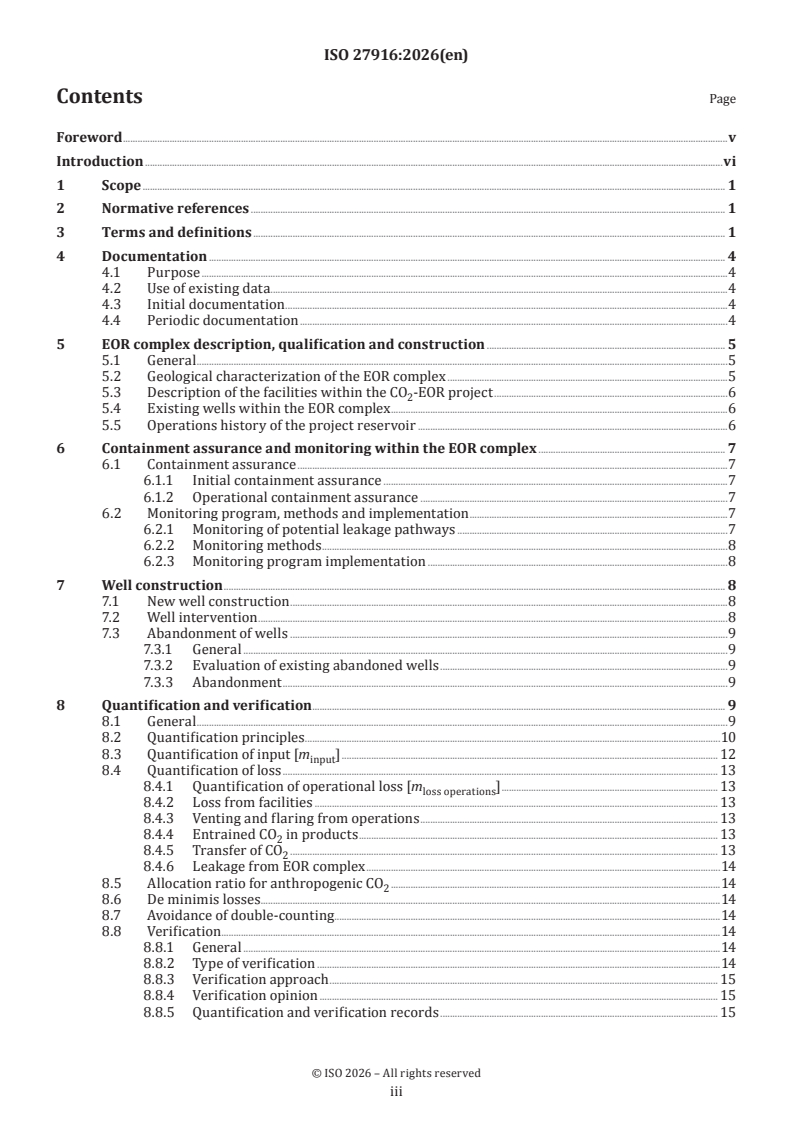
Contents Page
Foreword .v
Introduction .vi
1 Scope . 1
2 Normative references . 1
3 Terms and definitions . 1
4 Documentation . 4
4.1 Purpose .4
4.2 Use of existing data.4
4.3 Initial documentation .4
4.4 Periodic documentation .4
5 EOR complex description, qualification and construction . 5
5.1 General .5
5.2 Geological characterization of the EOR complex .5
5.3 Description of the facilities within the CO -EOR project .6
5.4 Existing wells within the EOR complex .6
5.5 Operations history of the project reservoir .6
6 Containment assurance and monitoring within the EOR complex . 7
6.1 Containment assurance .7
6.1.1 Initial containment assurance .7
6.1.2 Operational containment assurance .7
6.2 Monitoring program, methods and implementation .7
6.2.1 Monitoring of potential leakage pathways .7
6.2.2 Monitoring methods .8
6.2.3 Monitoring program implementation .8
7 Well construction . 8
7.1 New well construction .8
7.2 Well intervention .8
7.3 Abandonment of wells .9
7.3.1 General .9
7.3.2 Evaluation of existing abandoned wells .9
7.3.3 Abandonment .9
8 Quantification and verification . . 9
8.1 General .9
8.2 Quantification principles . .10
8.3 Quantification of input [m ] . 12
input
8.4 Quantification of loss . 13
8.4.1 Quantification of operational loss [m ] . 13
loss operations
8.4.2 Loss from facilities . 13
8.4.3 Venting and flaring from operations . 13
8.4.4 Entrained CO in products . 13
8.4.5 Transfer of CO . 13
8.4.6 Leakage from EOR complex .14
8.5 Allocation ratio for anthropogenic CO .14
8.6 De minimis losses.14
8.7 Avoidance of double-counting.14
8.8 Verification . .14
8.8.1 General .14
8.8.2 Type of verification .14
8.8.3 Verification approach . 15
8.8.4 Verification opinion . 15
8.8.5 Quantification and verification records . 15
iii
9 Recordkeeping and missing data .16
9.1 Record retention .16
9.2 Missing data procedures .16
10 Project termination . 16
10.1 General .16
10.2 Periodic assurance of containment .16
10.3 Termination plan .16
10.4 Requisites for termination .16
10.5 CO -EOR project termination .17
10.6 Post termination .17
Annex A (informative) Example quantification calculation .18
Annex B (informative) Unit conversion .27
Bibliography .28
iv
Foreword
ISO (the International Organization for Standardization) is a worldwide federation of national standards
bodies (ISO member bodies). The work of preparing International Standards is normally carried out through
ISO technical committees. Each member body interested in a subject for which a technical committee
has been established has the right to be represented on that committee. International organizations,
governmental and non-governmental, in liaison with ISO, also take part in the work. ISO collaborates closely
with the International Electrotechnical Commission (IEC) on all matters of electrotechnical standardization.
The procedures used to develop this document and those intended for its further maintenance are described
in the ISO/IEC Directives, Part 1. In particular, the different approval criteria needed for the different types
of ISO documents should be noted. This document was drafted in accordance with the editorial rules of the
ISO/IEC Directives, Part 2 (see www.iso.org/directives).
ISO draws attention to the possibility that the implementation of this document may involve the use of (a)
patent(s). ISO takes no position concerning the evidence, validity, or applicability of any claimed patent
rights in respect thereof. As of the date of publication of this document, ISO had not received notice of (a)
patent(s) which may be required to implement this document. However, implementers are cautioned that
this may not represent the latest information, which may be obtained from the patent database available at
www.iso.org/patents. ISO shall not be held responsible for identifying any or all such patent rights.
Any trade name used in this document is information given for the convenience of users and does not
constitute an endorsement.
For an explanation of the voluntary nature of standards, the meaning of ISO specific terms and expressions
related to conformity assessment, as well as information about ISO's adherence to the World Trade
Organization (WTO) principles in the Technical Barriers to Trade (TBT), see www.iso.org/iso/foreword.html.
This document was prepared by Technical Committee ISO/TC 265, Carbon dioxide capture, transportation,
and storage.
This second edition cancels and replaces the first edition (ISO 27916:2019), which has been technically
revised.
The main changes are as follows:
— Clause 3 clarifies distinctions between definitions of “loss" and “leakage”;
— Clause 4 has been reorganized to reflect observed actual practices;
— Clause 5 has been reorganized to reflect observed actual practices;
— Clause 7 has been reorganized to reflect observed actual practices;
— Clause 8 has been updated and reorganized to better incorporate verification criteria, and graphics have
been updated;
— Annex A has been reorganized, eliminating selected common EOR project description information found
in other source documents and has been updated;
— the entire text has been editorially revised.
Any feedback or questions on this document should be directed to the user’s national standards body. A
complete listing of these bodies can be found at www.iso.org/members.html.
v
Introduction
Carbon dioxide enhanced oil recovery (CO -EOR) is a technique for increasing the recovery of hydrocarbons
through the injection of carbon dioxide (CO ). At present, the technique is used principally for increased
recovery of liquid hydrocarbons (i.e. oil) but can also be used for recovery of gaseous hydrocarbons. This
document focuses primarily on the recovery of liquid hydrocarbons, but applies regardless of whether the
production stream is predominantly liquid or gaseous.
The process involves using wells to inject volumes of CO at pressures where the injected CO usually mixes
2 2
with the oil, changing the properties of the oil and enabling it to flow more freely to production wells. In
most cases, a CO -EOR project is designed as a closed-loop system whereby some of the injected CO is co-
2 2
produced with the oil or other hydrocarbon and then separated in above-ground recycling facilities prior to
being reinjected into the oil reservoir.
CO that is injected into the project reservoir is contained as an inherent element of the injection and
production operations, and this document requires that such containment be demonstrated. CO that is
injected and remains trapped in the “EOR complex” during and after oil production activities is referred
to as “associated storage” when the CO is not released to the atmosphere. Associated storage occurs as an
intrinsic part of CO -EOR operations.
Although methane is often present in EOR project reservoirs, this document does not specifically address
methane or other greenhouse gases. The demonstration requirements for safe, long-term containment,
however, address assessment of trapping and potential leakage pathways that would likely assure
containment of methane as well as CO . CO -EOR has been deployed internationally for several decades and
2 2
has potential to expand. CO -EOR is commercially valuable today because it allows for the additional recovery
of hydrocarbon resources while simultaneously trapping injected CO for safe, long-term containment as a
part of the process.
This document provides requirements for the quantification of the CO (and optionally the portion of any
anthropogenic CO ) that is stored in association with CO -EOR operations. The purpose of this document
2 2
is to facilitate the exchange of goods and services related to the increased use and emissions reductions
through associated storage by providing methods for demonstrating the safe, long-term containment of, and
determining the quantity of, CO stored in association with CO -EOR. The document does not address any
2 2
financial consequences that result from documenting storage of CO in association with CO -EOR operations.
2 2
This document does not provide requirements for the selection, characterization, or permitting of sites for
CO -EOR projects because those sites are selected, characterized, and permitted pursuant to requirements
and standards applicable to oil and gas exploration and production. Likewise, this document does not
specify environment, health and safety protections, or corrective action and mitigation requirements that
are provided by the regulations and standards applicable to all hydrocarbon production operations. A list of
many of the existing standards applicable to CO injection wells and oil and gas operations is presented in
the Bibliography.
The results of quantifications under this document can be used as input for calculations conducted according
to a number of other standards, protocols, or programs for the quantification or reporting of greenhouse
gas emissions, mitigation, or reductions, including those conforming with ISO 14064-1, ISO 14064-2 and
ISO 14064-3. Specifically, this document provides methodology for the identification and quantification of
CO losses (including fugitive emissions) and quantification of the amount of CO stored in association with
2 2
CO -EOR projects. Such quantification can be used in a broader scheme for the quantification and verification
of emissions and emission reductions over the entire carbon capture, transportation, and storage chain. The
quantification of the storage associated with a CO -EOR project that occurs as part of a carbon capture and
storage (CCS) project chain can be combined with the quantification of one or more capture, transportation,
and geological storage systems to produce a total quantification for the entire CCS project chain. Under some
emissions quantification and reporting regimes, CO quantities stored in association with CO -EOR are
2 2
either treated as not emitted and excluded from calculations or subtracted as offsets.
vi
International Standard ISO 27916:2026(en)
Carbon dioxide capture, transportation and storage — Carbon
dioxide storage using enhanced oil recovery (CO2-EOR)
1 Scope
This document provides requirements for demonstrating that the site in question is adequate to provide
safe, long-term containment of CO , for demonstrating that the CO flood is operated in a way to assure
2 2
containment of the CO in the EOR complex, and for quantifying associated storage.
This document applies to CO that is injected in enhanced recovery operations for oil and other hydrocarbons,
including natural gas, (CO -EOR) for which quantification of CO that is safely stored long-term in association
2 2
with the CO -EOR project is sought. Recognizing that some CO -EOR projects use non-anthropogenic CO
2 2 2
in combination with anthropogenic CO , the document also shows how allocation ratios can be utilized for
optional calculations to quantify the portion of associated storage comprised of anthropogenic CO (see
Annex A).
This document does not apply to quantification of CO injected into reservoirs where no hydrocarbon
production is anticipated or occurring.
Storage of CO in geologic formations that do not contain hydrocarbons is covered by ISO 27914 even if
located above or below hydrocarbon producing reservoirs. If storage of CO is conducted in a reservoir from
which hydrocarbons were previously produced but will no longer be produced in paying or commercial
quantities, such storage would be subject to the requirements of ISO 27914.
This document addresses:
a) safe, long-term containment of CO within the EOR complex;
b) CO leakage from the EOR complex through leakage pathways; and
c) on-site CO -EOR project loss of CO from wells, equipment, or other facilities.
2 2
This document does not address the following:
d) lifecycle emissions, including but not limited to CO emissions from capture or transportation of CO , on-
2 2
site emissions from combustion or power generation, and CO emissions resulting from the combustion
of produced hydrocarbons;
e) storage of CO above ground;
f) buffer and seasonal storage of CO below ground (similar to natural gas storage);
g) any technique or product that does not involve injection of CO into the subsurface; and
h) emissions of any greenhouse gases (GHGs) other than CO .
NOTE Some authorities can require other GHG components of the CO stream to be quantified.
2 Normative references
There are no normative references in this document.
3 Terms and definitions
For the purposes of this document, the following terms and definitions apply.
ISO and IEC maintain terminology databases for use in standardization at the following addresses:
— ISO Online browsing platform: available at https:// www .iso .org/ obp
— IEC Electropedia: available at https:// www .electropedia .org/
3.1
anthropogenic carbon dioxide
anthropogenic CO
carbon dioxide that is initially produced as a by-product of a combustion, chemical, or separation process
(including separation of hydrocarbon-bearing fluids or gases)
3.2
associated storage
CO stored in association with CO -EOR (3.4) that occurs as an inherent result of a hydrocarbon production
2 2
operation
Note 1 to entry: The requirements of this document are intended to ensure that CO stored in association with a CO -
2 2
EOR operation is stored as effectively as CO stored in a geologic storage operation that complies with ISO 27914.
3.3
authority
competent governmental entity or entities with legal power to regulate or permit CO -EOR (3.4), to regulate
storage of CO in association with a CO -EOR (3.4) operation, or to regulate quantification of the storage of
2 2
CO in association with a CO -EOR (3.4) operation
2 2
3.4
CO enhanced oil recovery
CO -EOR
process designed to produce liquid or gaseous hydrocarbons from a reservoir using the injection of CO
3.5
CO enhanced oil recovery project
CO -EOR project
EOR complex (3.9), underground equipment, wells, surface or above seabed equipment, activities, and rights
necessary to an enhanced oil recovery operation
3.6
CO injection well
well used to inject CO into a project reservoir (3.17)
3.7
CO stream
stream consisting overwhelmingly of carbon dioxide
Note 1 to entry: The CO stream typically includes impurities and can include substances added to the stream to either
improve performance of hydrocarbon recovery operation, or facilitate CO detection, or both.
3.8
containment assurance
demonstration that the features and geologic structure of the CO -EOR project (3.5) are adequate to provide
safe, long-term containment (3.19) of CO , and that the CO flood is operated in a way to assure containment
2 2
of the CO in the EOR complex (3.9)
3.9
EOR complex
project reservoir (3.17), trap (3.21), and such additional surrounding volume in the subsurface as defined by
the operator (3.15) within which injected CO will remain in safe, long-term containment (3.19)
3.10
injection-withdrawal ratio
ratio, during a defined period, of the volume of all fluids and gases injected into the project reservoir (3.17)
to the volume of all fluids and gases produced from the project reservoir as determined using reservoir
temperature and pressure conditions
3.11
leakage
unintended release of CO out of the EOR complex (3.9)
3.12
leakage pathway
geological or artificial conduit for leakage (3.11) of CO out of the EOR complex (3.9)
3.13
loss
leakage (3.11), intended and unintended releases of CO from the CO -EOR project (3.5) and transfers of the
2 2
CO stream (3.7) out of the CO -EOR project
2 2
3.14
native CO
CO present and indigenous within the project reservoir (3.17) prior to hydrocarbon production or any CO
2 2
injection
3.15
operator
entity responsible for the CO -EOR project (3.5)
3.16
plug and abandon
plugging and abandonment
process designed to permanently close a well or wellbore to prevent inter-formational movement of fluids
into strata, into freshwater aquifers, and out of the well
Note 1 to entry: In most cases, a series of cement plugs is set in the wellbore, with an inflow or integrity test made at
each stage to confirm hydraulic isolation.
3.17
project reservoir
geologic formation into which CO is injected for production of hydrocarbons in paying or commercial
quantities
3.18
quantification period
period of time during which associated storage (3.2) is being quantified
3.19
safe, long-term containment
associated storage (3.2) for the period necessary to be considered secure by the system under which the
quantification is being implemented
3.20
termination
process ending with operator (3.14) demonstrating conformity
Note 1 to entry: The criteria for conformity are outlined in 10.5.
3.21
trap
feature or mechanism that alone or in combination provides safe, long-term containment (3.19)
4 Documentation
4.1 Purpose
The provisions of this clause are intended to facilitate documentation to demonstrate the safe, long-term
containment and the quantification of associated storage.
4.2 Use of existing data
Documentation and demonstration requirements throughout this document can be satisfied by information
that has already been required, is held, approved by, and available from the authority, because in many
cases, EOR operations are addressed by existing oil and gas regulations. To the extent that information
fully satisfies the requirements and has already been provided to and is available from the authority, such
information is not required to be developed again for purposes of this document.
4.3 Initial documentation
Initial documentation for the quantification period shall include:
a) a description of the EOR complex and engineered systems (see Clause 5);
b) the initial containment assurance (see 6.1.1);
c) the monitoring program (see 6.2);
d) the maximum allowable bottom hole injection pressure;
e) the total mass of previously injected CO within the EOR complex at the start of quantification
period (see 8.5 and Annex A);
f) the estimated associated storage mass within the EOR complex over the life of the project;
g) the quantification method to be used (see Clause 8 and Annex A); and
h) an initial termination plan (see 10.3).
The initial documentation shall be offered to the authority.
4.4 Periodic documentation
Periodic documentation should be prepared at least annually and shall provide the following information:
a) the quantity of associated storage in specified units of mass, or volumetric units convertible to mass
(see 8.2) during the period covered by the documentation;
b) the cumulative quantity of associated storage in specified units of mass, or volumetric units convertible
to mass (see 8.2) since the beginning of the quantification period;
c) the formula and data used to quantify the mass of associated storage, including the mass of CO delivered
to the CO -EOR project and losses during the period covered by the documentation (see Clause 8 and
Annex A);
d) the methods used to estimate missing data and the amounts estimated as described in 9.2;
e) the approach and method for quantification utilized by the operator, including accuracy, precision, and
uncertainties (see Clause 8 and Annex A);
f) a statement describing the nature of validation or verification of the statement, including the date of
review, process, findings, and responsible person or entity;
g) termination plan; and
h) source of each CO stream quantified as associated storage (see 8.3).
The periodic documentation shall be offered to the authority.
NOTE The operator can determine that more frequent recordkeeping and documentation are required to meet
the goals or requirements of the CO -EOR project.
5 EOR complex description, qualification and construction
5.1 General
An EOR operation management plan shall provide a description of the EOR complex and engineered system,
establish that the EOR complex is adequate to provide safe, long-term containment of CO , and include site-
specific and other information pertaining to:
a) geologic characterization of the EOR complex;
b) a description of the facilities within the CO -EOR project;
c) a description of all wells and other engineered features in the CO -EOR project;
d) the operations history of the project reservoir;
e) procedures for setting and managing engineering controls that support safe operation and containment
assurance during injection and production;
f) periodic assessment of reservoir performance as compared with expected behaviour in accordance
with 6.1.2;
g) assessment of containment by geologic features and engineering systems in accordance with 6.1.2;
h) assessment and management of monitoring technologies and procedures (see 6.2), including definition
of detection thresholds that are sufficient to meet the requirements of 8.6;
i) method of quantification of CO below the detection threshold in accordance with 8.6;
j) corrective measures for potential loss or unintended releases of CO ;
k) data for associated storage quantification; and
l) termination plan for the CO -EOR project that specifies criteria for termination and outlines the
termination qualification process sufficient to meet the requirements of Clause 10.
The EOR operation management plan shall be periodically updated.
5.2 Geological characterization of the EOR complex
The general geologic characterization of the EOR complex shall be based on site-specific subsurface and
other data collected at the site (augmented where appropriate with data from analogous fields), including
any features that can affect safe, long-term containment of CO and evidence of the integrity of the reservoirs
and traps. The description of the EOR complex should include, but not necessarily be limited to:
a) general lithologic description of the stratigraphic column above the EOR complex;
b) depth to the top of the EOR complex;
c) thickness of the defined stratigraphy within the EOR complex;
d) structural and rock properties;
e) lateral boundaries and any spill points relevant to containment;
f) hydraulic/petrophysical/geochemical/geomechanical properties;
g) associated storage capacity in the EOR complex; and
h) engineering data as needed for initial characterization (6.1.1) and during operations (6.1.2).
5.3 Description of the facilities within the CO -EOR project
The description of the facilities within the CO -EOR project shall provide an overview of the equipment,
downstream of the CO custody transfer meter used to handle CO and production, including design
2 2
specifications. This should typically include:
a) piping;
b) separators;
c) processing and dehydration equipment;
d) pumps;
e) compressors; and
f) any other equipment relevant to CO handling and production.
It should specifically address vent, release, sampling, and metering points, including a description of
metering accuracy and estimation techniques.
5.4 Existing wells within the EOR complex
The description of wells shall identify each well penetrating the EOR complex and provide evidence it has
been constructed, remediated, or plugged and abandoned in such a manner as to provide safe, long-term
containment of CO . Such wells include injection, production, monitoring, temporarily abandoned, shut-in,
and plugged and abandoned wells. The following information shall be provided where available:
a) well name;
b) unique well identifier;
c) spud and completion dates;
d) well status (e.g. injection, production, monitoring, temporarily abandoned, shut-in, plugged and
abandoned);
e) surface or seabed location;
f) total and measured depth;
g) plugged and abandoned well information;
h) well construction, completion, and well integrity technical details;
i) significant equipment remaining in the well; and
j) well intervention details and history.
In some cases, remote sensing methods or field or aerial surveys to locate old wells can be necessary.
5.5 Operations history of the project reservoir
The operations history of the EOR complex shall include available:
a) production and injection data for the project reservoir;
b) temperature and pressure history, including current distribution;
c) interaction with adjacent reservoirs;
d) any known leakage incidents; and
e) history of seismic activity.
6 Containment assurance and monitoring within the EOR complex
6.1 Containment assurance
6.1.1 Initial containment assurance
The EOR operation management plan shall include the initial containment assurance plan that identifies and
assesses potential geologic, engineered, and engineering-affected leakage pathways that will possibly lead
to loss of CO from the EOR complex.
6.1.2 Operational containment assurance
The operator shall provide operational containment assurance during the quantification period, based on the
EOR operation management plan and engineering data encompassing such items as the results of reservoir
management practices, including injection-withdrawal ratio monitoring, well integrity monitoring, pressure
monitoring, monitoring of CO movement within leakage pathways identified in the initial containment
assurance plan, and monitoring of pressure response within the boundary of the EOR complex.
The operational containment assurance can include results from other monitoring activities. These results
shall be used when periodically providing evidence of containment, including the supporting rationale.
Containment assurance and reservoir management shall be reviewed, and the EOR operation management
plan shall be revised as necessary if changes occur that have the potential to adversely affect containment,
which can include:
a) unexpected changes in project performance that have the potential to influence associated storage;
b) addition or abandonment of injection zones;
c) change to the areal extent of the project reservoir;
d) addition or abandonment of wells;
e) anomalous change of injection-withdrawal ratio;
f) development of reservoirs which are located above or below the project reservoir; or
g) discovery of CO beyond the boundary of the EOR complex.
6.2 Monitoring program, methods and implementation
6.2.1 Monitoring of potential leakage pathways
The monitoring program shall address the identified inventory of potential leakage pathways from the
initial containment assurance plan (see 6.1.1) to determine, for each potential leakage pathway, whether it
is:
a) not active and excluded from the monitoring program;
b) not active, but will possibly activate under operation of the CO -EOR project and is thus to be addressed
by the monitoring program; or
c) active.
The operator shall conduct the potential leakage pathway assessment in accordance with the EOR operation
management plan. A final leakage pathway assessment shall be conducted prior to project termination.
NOTE It is likely that the monitoring program can require collection of data prior to start of the quantification
period (see 5.5).
6.2.2 Monitoring methods
The monitoring program shall describe tools, methods, applicability, and frequency for detecting and
quantifying losses (see 8.4). Details of the monitoring program and data assessed (including relevant data
prior to the quantification period) shall be provided in the initial documentation (see 4.3), along with the
threshold beneath which there would be no detection. The detection threshold shall be specified in the EOR
operation management plan in accordance with 8.6.
6.2.3 Monitoring program implementation
The monitoring program shall be implemented to address CO -EOR project losses in accordance with the
EOR operation management plan (see 5.1) as applied to the inventory of potential leakage pathways (see
6.2.1). The monitoring program shall be reviewed and revised as EOR operational practices are modified.
7 Well construction
7.1 New well construction
A description of the new wells shall provide evidence that the well, after modifications, will provide safe,
long-term containment of CO . Well materials, including metals, cements, and elastomers, shall be selected
based on their ability to withstand the expected operational environment, including the thermomechanical
stress of operation and the geochemistry (including CO where present) of the subsurface. At a minimum,
wells that penetrate the EOR complex shall be cemented through each cap rock using cement that is suitable
for the thermomechanical and geochemical environment for safe, long-term containment. To the extent not
provided by other evidence of suitable construction (e.g., reference to information that has been provided to
the authority during permitting of CO -EOR operations), the following information shall be provided:
a) well name;
b) unique well identifier;
c) spud date, completion date;
d) status (e.g. injection, production, monitoring, temporarily abandoned, shut-in, plugged and abandoned);
e) surface or seabed location;
f) total and measured depth;
g) well construction, completion, and well integrity technical details; and
h) significant equipment remaining in the well.
7.2 Well intervention
A description of the well modifications shall provide evidence that they are designed, constructed, and
tested to provide safe, long-term containment Well materials, including metals, cements, and elastomers,
shall be selected based on their ability to withstand the expected operational environment, including the
thermomechanical stress of operation and the geochemistry (including CO where present) of the subsurface.
To the extent not provided by other evidence that the well modifications performed are suitable (e.g.,
reference to information that has been provided to the authority during permitting of well intervention), the
following information shall be provided:
a) well name;
b) unique well identifier;
c) intervention type and date;
d) status after intervention (e.g. injection, production, monitoring, temporarily abandoned, shut-in,
plugged and abandoned);
e) surface or seabed location;
f) total and measured depth;
g) plugged and abandoned well information;
h) well intervention details; and
i) significant equipment remaining in the well.
7.3 Abandonment of wells
7.3.1 General
Well abandonment design shall ensure the protection and isolation of the EOR complex to, prevent leakage
or release of formation fluids, and ensure that the surface is returned to near-original condition. Well
abandonment shall ensure that all resources penetrated by project wells, including groundwater as a
drinking water resource and hydrocarbons, are isolated and protected from migrating CO or formation
fluid.
7.3.2 Evaluation of existing abandoned wells
For evaluation of existing abandoned wells, see 7.2.
7.3.3 Abandonment
Well abandonment during construction or at the end of the life of a well up to project termination shall
be conducted in a manner that meets the objectives of Clause 10 and utilizes materials and techniques
consistent with 7.2. Well control shall be always maintained during plugging and abandonment operations.
All CO should be flushed from the wellbore, and the wellbore should be filled with a fluid of a density that
will maintain well control. Casing and cement integrity logs should be re-run and compared to the original
baseline logs to confirm cement and wellbore integrity. If either the cement or the casing is found to be
deficient and the deficiency impairs the ability to plug and abandon the well successfully, repairs shall be
made prior to abandoning the well. All open perforations should be sealed and then plugged and abandoned
or isolated. Well abandonment materials shall be fit for purpose and selected based on their ability to
withstand the expected operational environment, including the thermomechanical stress of operation and
the ge
...