

ISO 3416:1986
(Main)Textile floor coverings — Determination of thickness loss after prolonged, heavy static loading
General Information
- Abstract
Intended to simulate the effect of the pressure exerted by a chair leg for a short period. Applicable to all textile floor coverings of uniform thickness and construction. Not applicable to other textile floor coverings unless the areas of different thickness or construction can be separately tested. The determination of thickness loss after prolonged, heavy static loading see ISO 3416. - Replaces the first edition (ISO 3415-1975), the clauses 4 and 7 of which have been technically revised.
- Status
- Published
- Publication Date
- 12-Nov-1986
- Technical Committee
- ISO/TC 219 - Floor coverings
- Drafting Committee
- ISO/TC 219 - Floor coverings
- Current Stage
- 9093 - International Standard confirmed
Buy Documents
ISO 3416:1986 - Textile floor coverings -- Determination of thickness loss after prolonged, heavy static loading
ISO 3416:1986 - Textile floor coverings — Determination of thickness loss after prolonged, heavy static loading/13/1986
ISO 3416:1986 - Revetements de sol textiles -- Détermination de la perte d'épaisseur apres application prolongée d'une charge statique élevée
ISO 3416:1986 - Revetements de sol textiles -- Détermination de la perte d'épaisseur apres application prolongée d'une charge statique élevée
ISO 3416:1986 - Revêtements de sol textiles — Détermination de la perte d'épaisseur après application prolongée d'une charge statique élevée/13/1986
ISO 3416:1986 - Revêtements de sol textiles — Détermination de la perte d'épaisseur après application prolongée d'une charge statique élevée/13/1986
Overview
ISO 3416:1986 is an international standard developed by ISO for the determination of thickness loss in textile floor coverings after prolonged, heavy static loading. This procedure is designed to simulate the pressure effects typically exerted by a chair leg or similar object over a short period. It is applicable to all textile floor coverings with uniform thickness and construction. Areas of different thickness or construction may be tested if they can be isolated-otherwise, the standard does not apply. This second edition replaces the first (ISO 3416:1975), with technical revisions in several clauses.
The standard provides a reliable method for manufacturers, quality control departments, and laboratories to assess product durability and performance through controlled compression testing.
Key Topics
- Scope and Applicability
- Applicable to textile floor coverings of uniform thickness and construction.
- Not applicable to products with multiple thicknesses or constructions unless tested separately.
- Testing Method
- Involves subjecting specimens to a defined heavy, static load for a prolonged period.
- Measurement of thickness is performed before loading and at designated intervals after the load is removed.
- Specimen Preparation
- Requires at least five specimens, each of defined dimensions, conditioned in a standard atmosphere.
- Details preparation of specimens using adhesive tape and conditioning requirements.
- Measurement and Reporting
- Outlines procedures for initial and post-loading thickness measurements using calibrated equipment.
- Specifies calculation methods for thickness loss and recommends arithmetic mean calculations for comparative results.
- Equipment Specifications
- Defines required performance of the thickness tester and static loading machine.
- Details apparatus and atmospheric conditions for test accuracy.
Applications
ISO 3416:1986 provides essential value in a range of practical scenarios within the textile and flooring industries:
- Product Development
- Assists manufacturers in designing textile floor coverings with improved resistance to compression and wear.
- Quality Control
- Used by production and QA teams to ensure products meet durability standards before market release.
- Performance Benchmarking
- Allows comparative analysis of different textile floor covering products, supporting consumer claims and marketing.
- Compliance Verification
- Enables companies to demonstrate adherence to recognized international standards in tender processes or regulatory contexts.
- Research and Testing
- Provides test laboratories a standardized method for evaluating the resilience of new materials and innovations in floor coverings.
Related Standards
ISO 3416:1986 references and complements several other important international standards related to textile testing:
- ISO 139 - Standard atmospheres for conditioning and testing textiles
- ISO 1765 - Determination of thickness of machine-made textile floor coverings
- ISO 1957 - Sampling and cutting specimens for physical tests of machine-made textile floor coverings
- ISO 3415 - Method for determination of thickness loss after brief, moderate static loading
These related standards help create a comprehensive framework for measuring and ensuring the performance and quality of textile floor coverings, particularly regarding thickness retention and durability under static loads.
By following ISO 3416:1986, firms in the textile floor covering industry ensure that their products are tested for resistance to thickness loss, supporting enhanced durability, consumer satisfaction, and international market access.
Relations
- Effective Date
- 25-Aug-2026
- Effective Date
- 25-Aug-2026
- Effective Date
- 25-Aug-2026
- Effective Date
- 25-Aug-2026
- Effective Date
- 08-Apr-2026
- Effective Date
- 15-Apr-2008
Buy Documents
ISO 3416:1986 - Textile floor coverings -- Determination of thickness loss after prolonged, heavy static loading
ISO 3416:1986 - Textile floor coverings — Determination of thickness loss after prolonged, heavy static loading/13/1986
ISO 3416:1986 - Revetements de sol textiles -- Détermination de la perte d'épaisseur apres application prolongée d'une charge statique élevée
ISO 3416:1986 - Revetements de sol textiles -- Détermination de la perte d'épaisseur apres application prolongée d'une charge statique élevée
ISO 3416:1986 - Revêtements de sol textiles — Détermination de la perte d'épaisseur après application prolongée d'une charge statique élevée/13/1986
ISO 3416:1986 - Revêtements de sol textiles — Détermination de la perte d'épaisseur après application prolongée d'une charge statique élevée/13/1986
Get Certified
Connect with accredited certification bodies for this standard

Control Union Certifications
Global certification for agriculture and sustainability.

Hohenstein Institut
Textile testing and certification.

Bureau Veritas Bangladesh
Bureau Veritas certification services in Bangladesh.
Sponsored listings
Frequently Asked Questions
ISO 3416:1986 is a standard published by the International Organization for Standardization (ISO). Its full title is "Textile floor coverings — Determination of thickness loss after prolonged, heavy static loading". This standard covers: Intended to simulate the effect of the pressure exerted by a chair leg for a short period. Applicable to all textile floor coverings of uniform thickness and construction. Not applicable to other textile floor coverings unless the areas of different thickness or construction can be separately tested. The determination of thickness loss after prolonged, heavy static loading see ISO 3416. - Replaces the first edition (ISO 3415-1975), the clauses 4 and 7 of which have been technically revised.
Intended to simulate the effect of the pressure exerted by a chair leg for a short period. Applicable to all textile floor coverings of uniform thickness and construction. Not applicable to other textile floor coverings unless the areas of different thickness or construction can be separately tested. The determination of thickness loss after prolonged, heavy static loading see ISO 3416. - Replaces the first edition (ISO 3415-1975), the clauses 4 and 7 of which have been technically revised.
ISO 3416:1986 is classified under the following ICS (International Classification for Standards) categories: 59.080.60 - Textile floor coverings; 97.150 - Floor coverings. The ICS classification helps identify the subject area and facilitates finding related standards.
ISO 3416:1986 has the following relationships with other standards: It is inter standard links to EN 14499:2004, EN 13524:2003+A1:2009, EN 17106-4:2021, EN 14499:2015, EN 14499:2024, ISO 3416:1975. Understanding these relationships helps ensure you are using the most current and applicable version of the standard.
ISO 3416:1986 is available in PDF format for immediate download after purchase. The document can be added to your cart and obtained through the secure checkout process. Digital delivery ensures instant access to the complete standard document.
Standards Content (Sample)
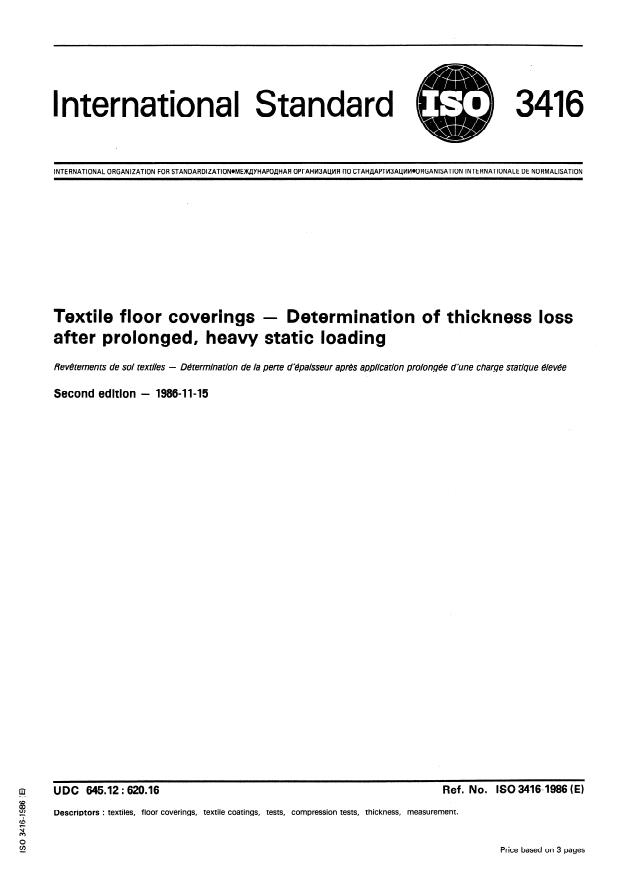
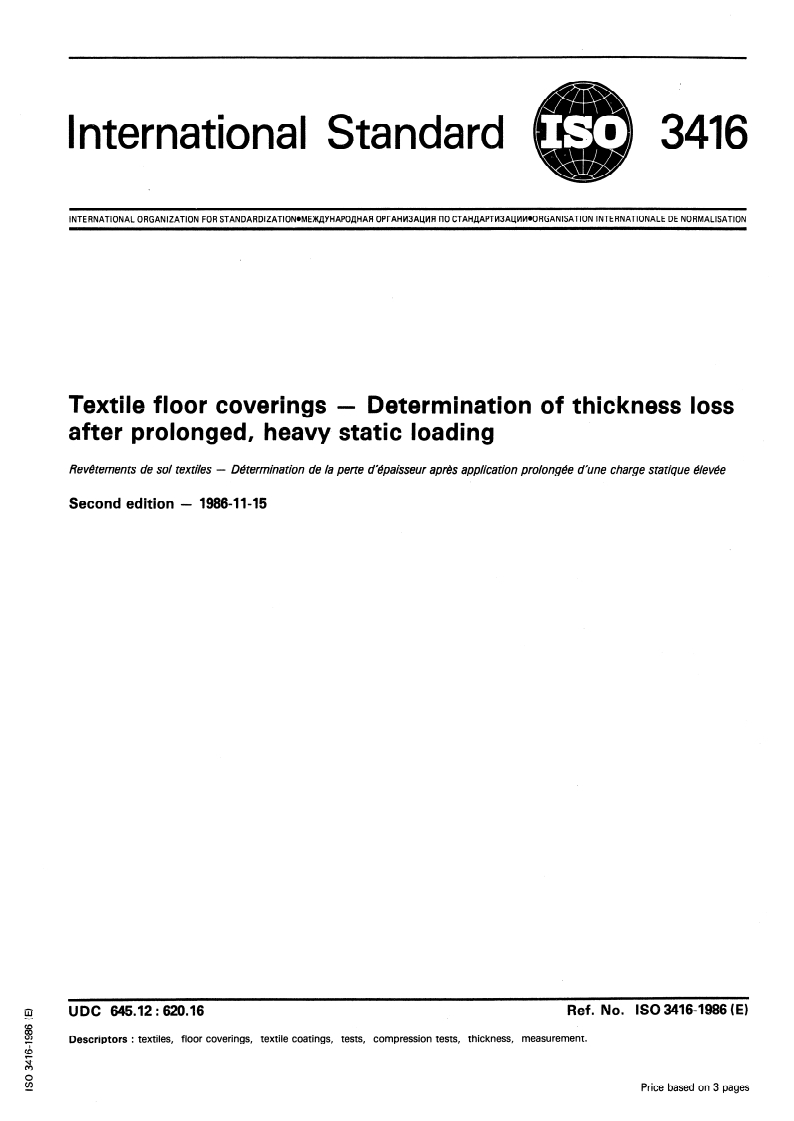
International Standard
INTERNATIONAL ORGANIZATION FOR STANDARDIZATION.ME)t(L1YHAPOflHAFI OPTAHM3ALWl fl0 CTAH~APTM3AL(Ml4.ORGANISATION INTERNATIONALE DE NORMALISATION
Textile floor coverings - Determination of thic’kness loss
after prolonged, heavy static loading
Rev&emen ts de sol textiles - Determination de Ia perte d’epaisseur aprhs application prolongee d’une Charge statique &evke
Second edition - 19864145
Ref. No. IS0 34164986 (EI
UDC 645.12: 620.16
Descriptors : textiles, floor coverings, textile coatings, tests, compression tests, thickness, measurement.
Price based on 3 pages
Foreword
ISO (the International Organization for Standardization) is a worldwide federation of
national Standards bodies (ISO member bedies). The work of preparing International
Standards is normally carried out through ISO technical committees. Esch member
body interested in a subject for which a technical committee has been established has
the right to be represented on that committee. International organizations, govern-
mental and non-governmental, in liaison with ISO, also take part in the work.
Draft International Standards adopted by the technical committees are circulated to
the member bodies for approval before their acceptance as International Standards by
the ISO Council. They are approved in accordance with ISO procedures requiring at
least 75 % approval by the member bodies voting.
International Standard ISO 3416 was prepared by Technical Committee ISO/TC 38,
Textiles.
This second edition cancels and replaces the first edition (ISO 3416-19751, clauses 4
and 7 of which have been technically revised.
Users should note that all International Standards undergo revision from time to time
and that any reference made herein to any other International Standard implies its
Jatest edition, unless otherwise stated.
@ International Organization for Standardization, 1986 l
Printed in Switzerland
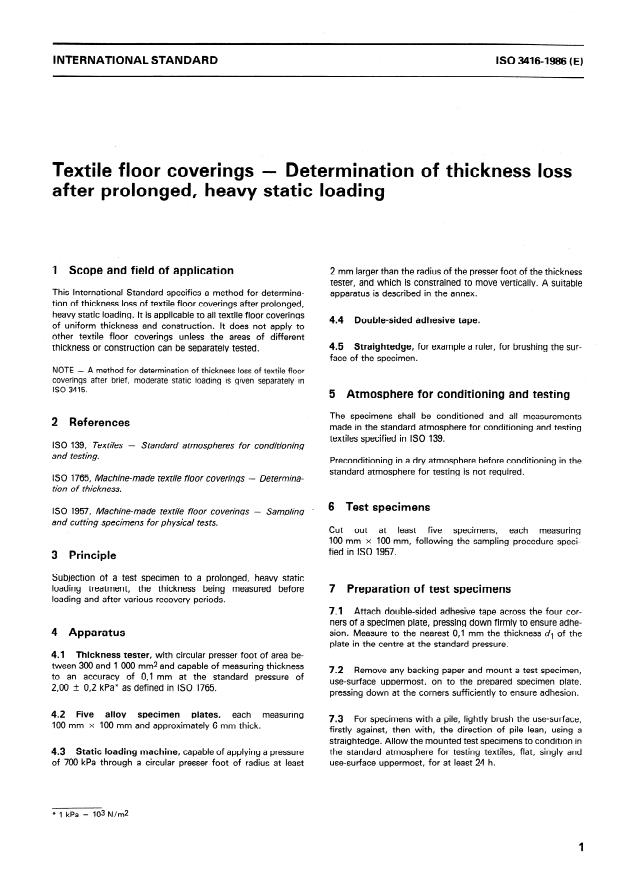
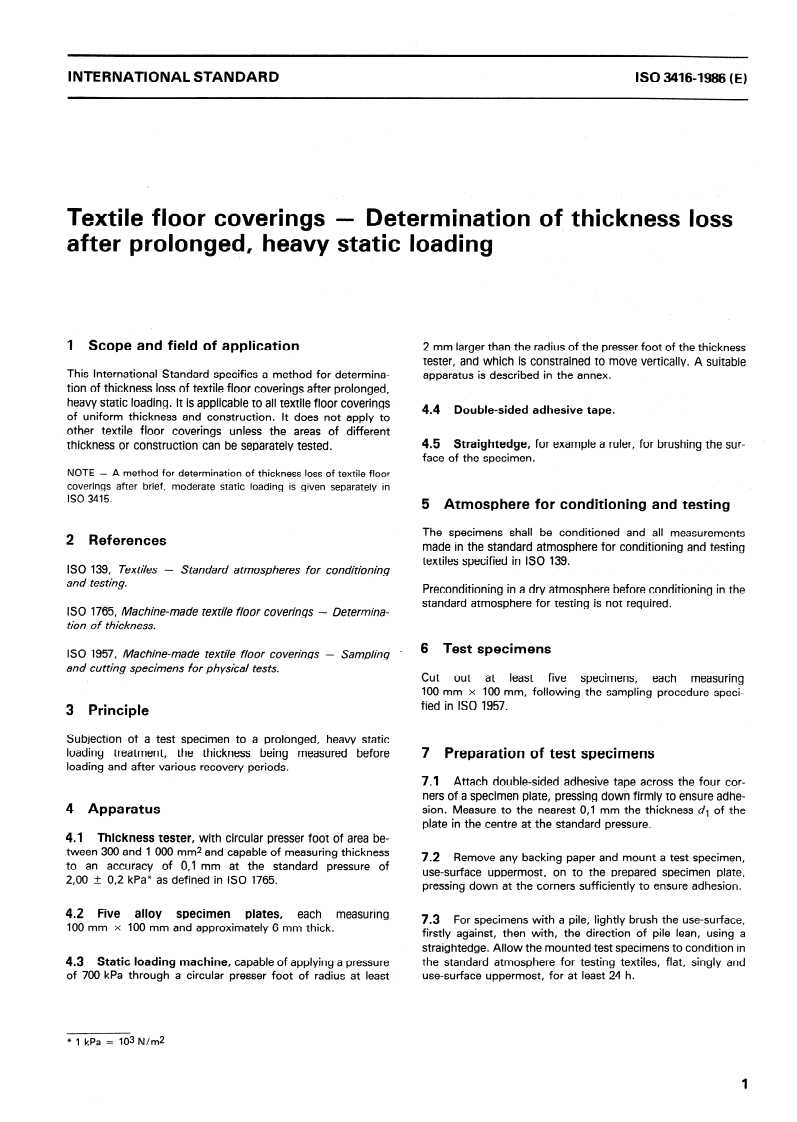
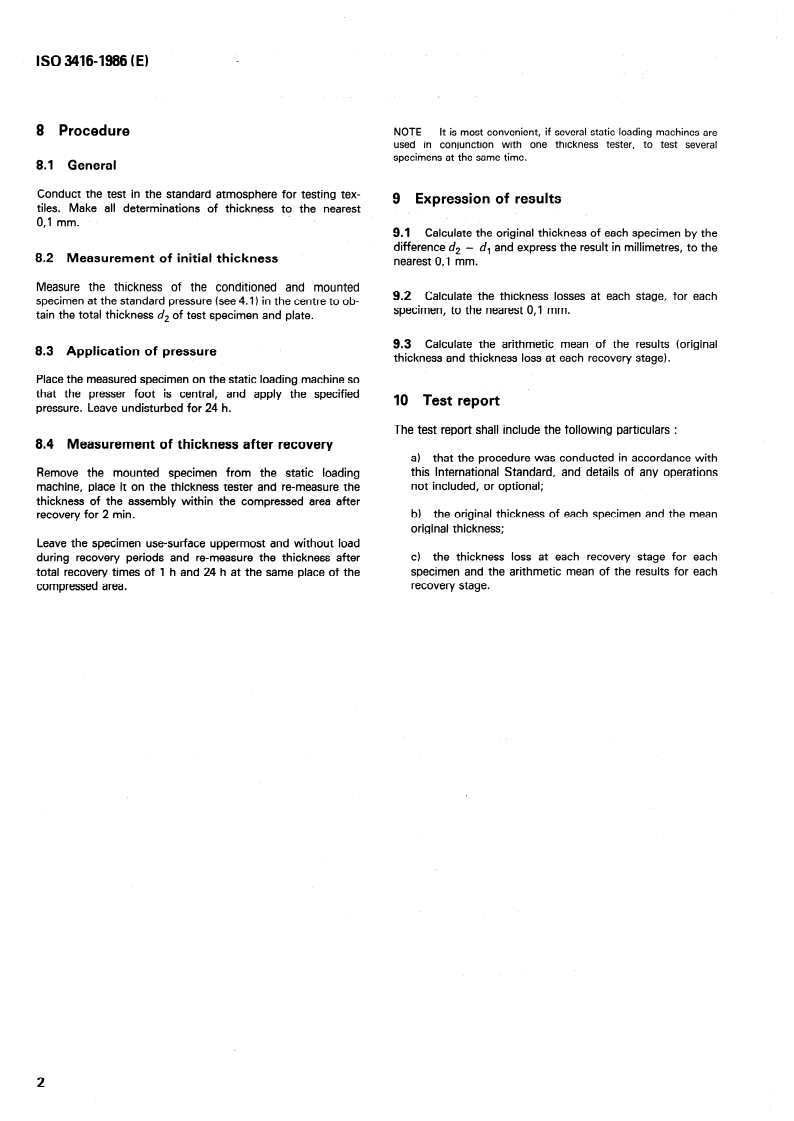
INTERNATIONAL STANDARD ISO 3416-1986 (E)
Determination of thickness loss
Textile floor coverings -
loading
after prolonged, heavy static
1 Scope and field of application 2 mm larger than the radius of the presser foot of the thickness
tester, and which is constrained to move vertically. A suitable
This International Standard specifies a method for determina- apparatus is described in the annex.
tion of thickness loss sf textile floor coverings after prolonged,
heavy static loading. lt is applicable to all textile floor coverings
4.4 Double-sided adhesive tape.
of uniform thickness and construction. lt does not apply to
other textile floor coverings unless the areas of different
4.5 Straightedge, for example a ruler, for brushing the sur-
thickness or construction tan be separately tested.
face of the specimen.
NOTE - A method for determination of thickness loss of textile fioor
coverings after brief, moderate static loading is given separately in
ISO 3415.
5 Atmosphere for conditioning and testing
The specimens shall be conditioned and all measurements
2 References
made in the Standard atmosphere for conditioning and testing
textiles specified in ISO 139.
ISO 139, Textiles - Standard atmospheres for conditioning
and testing.
Preconditioning in a dry atmosphere before conditioning in the
Standard atmosphere for testing is not required.
ISO 1765, Machine-made textile floor coverings - Deterrnina-
.
tion of thickness.
6 Test specimens
ISO 1957, Machine-made textile floor coverings - Samplinq
.
and cutting specimens for ph ysical tests.
Cut out at least five specimens, each measuring
100 mm x 100 mm, following the sampling procedure speci-
fied in ISO 1957.
3 Principle
Subjection of a test specimen to a prolonged, heavy static
loading treatment, the thickness being measured before 7 Preparation of test specimens
loading and after various recovery periods.
7.1 Attach double-sided adhesive tape across the four cor-
ners of a specimen plate, pressing down firmly to ensure adhe-
sion. Measure to
...
International Standard
INTERNATIONAL ORGANIZATION FOR STANDARDIZATION.ME)t(L1YHAPOflHAFI OPTAHM3ALWl fl0 CTAH~APTM3AL(Ml4.ORGANISATION INTERNATIONALE DE NORMALISATION
Textile floor coverings - Determination of thic’kness loss
after prolonged, heavy static loading
Rev&emen ts de sol textiles - Determination de Ia perte d’epaisseur aprhs application prolongee d’une Charge statique &evke
Second edition - 19864145
Ref. No. IS0 34164986 (EI
UDC 645.12: 620.16
Descriptors : textiles, floor coverings, textile coatings, tests, compression tests, thickness, measurement.
Price based on 3 pages
Foreword
ISO (the International Organization for Standardization) is a worldwide federation of
national Standards bodies (ISO member bedies). The work of preparing International
Standards is normally carried out through ISO technical committees. Esch member
body interested in a subject for which a technical committee has been established has
the right to be represented on that committee. International organizations, govern-
mental and non-governmental, in liaison with ISO, also take part in the work.
Draft International Standards adopted by the technical committees are circulated to
the member bodies for approval before their acceptance as International Standards by
the ISO Council. They are approved in accordance with ISO procedures requiring at
least 75 % approval by the member bodies voting.
International Standard ISO 3416 was prepared by Technical Committee ISO/TC 38,
Textiles.
This second edition cancels and replaces the first edition (ISO 3416-19751, clauses 4
and 7 of which have been technically revised.
Users should note that all International Standards undergo revision from time to time
and that any reference made herein to any other International Standard implies its
Jatest edition, unless otherwise stated.
@ International Organization for Standardization, 1986 l
Printed in Switzerland
INTERNATIONAL STANDARD ISO 3416-1986 (E)
Determination of thickness loss
Textile floor coverings -
loading
after prolonged, heavy static
1 Scope and field of application 2 mm larger than the radius of the presser foot of the thickness
tester, and which is constrained to move vertically. A suitable
This International Standard specifies a method for determina- apparatus is described in the annex.
tion of thickness loss sf textile floor coverings after prolonged,
heavy static loading. lt is applicable to all textile floor coverings
4.4 Double-sided adhesive tape.
of uniform thickness and construction. lt does not apply to
other textile floor coverings unless the areas of different
4.5 Straightedge, for example a ruler, for brushing the sur-
thickness or construction tan be separately tested.
face of the specimen.
NOTE - A method for determination of thickness loss of textile fioor
coverings after brief, moderate static loading is given separately in
ISO 3415.
5 Atmosphere for conditioning and testing
The specimens shall be conditioned and all measurements
2 References
made in the Standard atmosphere for conditioning and testing
textiles specified in ISO 139.
ISO 139, Textiles - Standard atmospheres for conditioning
and testing.
Preconditioning in a dry atmosphere before conditioning in the
Standard atmosphere for testing is not required.
ISO 1765, Machine-made textile floor coverings - Deterrnina-
.
tion of thickness.
6 Test specimens
ISO 1957, Machine-made textile floor coverings - Samplinq
.
and cutting specimens for ph ysical tests.
Cut out at least five specimens, each measuring
100 mm x 100 mm, following the sampling procedure speci-
fied in ISO 1957.
3 Principle
Subjection of a test specimen to a prolonged, heavy static
loading treatment, the thickness being measured before 7 Preparation of test specimens
loading and after various recovery periods.
7.1 Attach double-sided adhesive tape across the four cor-
ners of a specimen plate, pressing down firmly to ensure adhe-
sion. Measure to
...
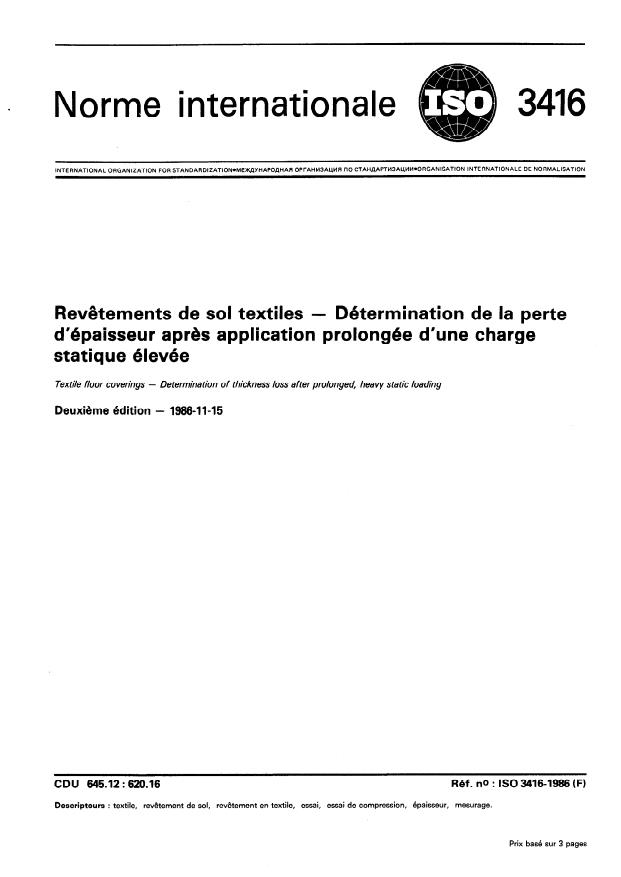
Norme internationale
INTERNATIONAL ORGANIZATION FOR STANDARDIZATIONOME~YHAPO~HAR OPTAHMJALWIR n0 CTAHAAPTH3Al&lVI@ORGANISATION INTERNATIONALE DE NORMALISATION
Revêtements de sol textiles - Détermination de la perte
d’épaisseur après application prolongée d’une charge
statique élevée
Textile floor coverings -
Determination of thickness Ioss after prolonged, heavy static loading
Deuxième édition - 1986-1145
CDU 645.12: 620.16
Réf. no : ISO 34164986 (FI
Descripteurs : textile, revêtement de sol, revêtement en textile, essai, essai de compression, épaisseur, mesurage.
Prix basé sur 3 pages
Avant-propos
L’ISO (Organisation internationale de normalisation) est une fédération mondiale
d’organismes nationaux de normalisation (comités membres de I’ISO). L’élaboration
des Normes internationales est confiée aux comités techniques de I’ISO. Chaque
comite membre interessé par une étude a le droit de faire partie du comité technique
créé à cet effet. Les organisations internationales, gouvèrnementales et non gouverne-
mentales, en liaison avec I’ISO participent également aux travaux.
Les projets de Normes internationales adoptés par les comités techniques sont soumis
aux comités membres pour approbation, avant leur acceptation comme Normes inter-
nationales par le Conseil de I’ISO. Les Normes internationales sont approuvées confor-
mément aux procédures de I’ISO qui requiérent l’approbation de 75 % au moins des
comites membres votants.
La Norme internationale ISO 3416 a été élaborée par le comité technique ISO/TC 38,
Textiles.
Cette deuxième édition annule et remplace la première édition (ISO 3416-1975), dont
les chapitres 4 et 7 ont fait l’objet d’une révision technique.
L’attention des utilisateurs est attirée sur le fait que toutes les Normes internationales
sont de temps en temps soumises à révision et que toute référence faite à une autre
Norme internationale dans le présent document implique qu’il s’agit, sauf indication
contraire, de la dernière édition.
@ Organisation internationale de normalisation, 1986 l
Imprimé en Suisse
ISO 3416-1986 (FI
PROJET DE NORME INTERNATIONALE
Revêtements de sol textiles - Détermination de la perte
d’épaisseur après application prolongée d’une charge
statique élevée
4.3 Appareil de charge statique, permettant l’application
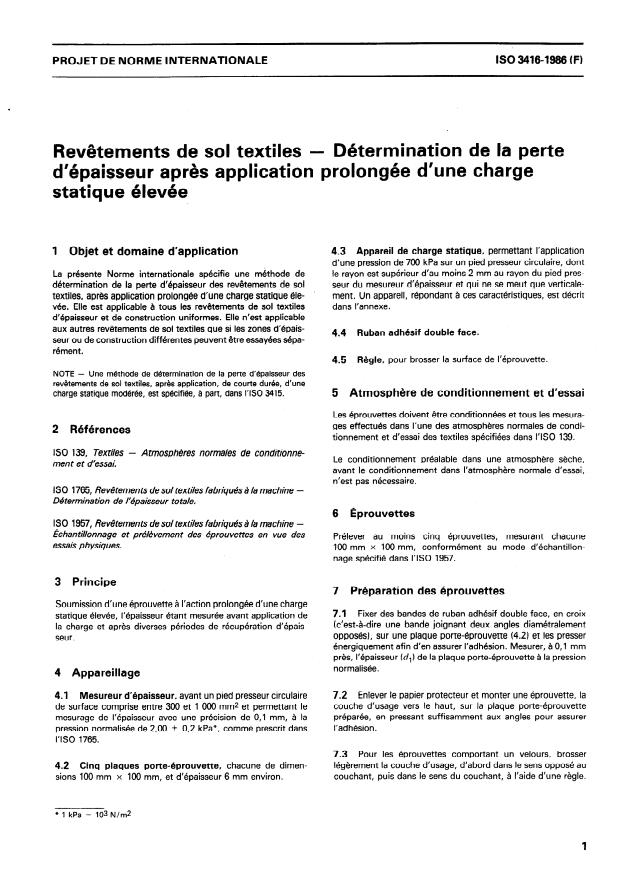
1 Objet et domaine d’application
d’une pression de 700 kPa sur un pied presseur circulaire, dont
La présente Norme internationale spécifie une méthode de le rayon est supérieur d’au moins 2 mm au rayon du pied pres-
seur du mesureur d’épaisseur et qui ne se meut que verticale-
détermination de la perte d’épaisseur des revêtements de sol
textiles, après application prolongée d’une charge statique éle- ment. Un appareil, répondant ,à ces caractéristiques, est décrit
dans l’annexe.
vée. Elle est applicable à tous les revêtements de sol textiles
d’épaisseur et de construction uniformes. Elle n’est applicable
aux autres revêtements de sol textiles que si les zones d’épais-
4.4 Ruban adhésif double face.
seur ou de construction différentes peuvent être essayées sépa-
rément.
4.5 Règle, pour brosser la surface de l’éprouvette.
NOTE
- Une méthode de détermination de la perte d’épaisseur des
revêtements de sol textiles, aprés application, de courte durée, d’une
charge statique modérée, est spécifiée, à part, dans I’ISO 3415. 5 Atmosphère de conditionnement et d’essai
Les éprouvettes doivent être conditionnées et tous les mesura-
ges effectués dans l’une des atmosphéres normales de condi-
2 Réfbrences
tionnement et d’essai des textiles spécifiées dans I’ISO 139.
ISO 139, Textiles - Atmosphéres normales de conditionne-
Le conditionnement préalable dans une atmosphère sèche,
ment et d’essai.
avant le conditionnement dans l’atmosphère normale d’essai,
n’est pas nécessaire.
ISO 1765, Revêtements de sol textiles fabriqués à la machine -
Dé termina tion de l’épaisseur totale.
6 Éprouvettes
ISO 1957, Revêtements de sol textiles fabriqués à la machine -
Échantillonnage et prélèvement des éprouvettes en vue des
Prélever au moins cinq éprouvettes, mesurant chacune
essais physiques.
100 mm x 100 mm, conformément au mode d’échantillon-
nage spécifié dans I’ISO 1957.
3 Principe
7 Préparation des éprouvettes
Soumission d’une éprouvette à l’action prolongée d’une charge
7.1 Fixer des bandes de ruban adhésif double face, en croix
statique élevée, l’épaisseur étant mesurée avant application de
(c’est-à-dire une bande joignant deux angles diamétralement
la charge et après diverses périodes de récupération d’épais-
opp
...
Norme internationale
INTERNATIONAL ORGANIZATION FOR STANDARDIZATIONOME~YHAPO~HAR OPTAHMJALWIR n0 CTAHAAPTH3Al&lVI@ORGANISATION INTERNATIONALE DE NORMALISATION
Revêtements de sol textiles - Détermination de la perte
d’épaisseur après application prolongée d’une charge
statique élevée
Textile floor coverings -
Determination of thickness Ioss after prolonged, heavy static loading
Deuxième édition - 1986-1145
CDU 645.12: 620.16
Réf. no : ISO 34164986 (FI
Descripteurs : textile, revêtement de sol, revêtement en textile, essai, essai de compression, épaisseur, mesurage.
Prix basé sur 3 pages
Avant-propos
L’ISO (Organisation internationale de normalisation) est une fédération mondiale
d’organismes nationaux de normalisation (comités membres de I’ISO). L’élaboration
des Normes internationales est confiée aux comités techniques de I’ISO. Chaque
comite membre interessé par une étude a le droit de faire partie du comité technique
créé à cet effet. Les organisations internationales, gouvèrnementales et non gouverne-
mentales, en liaison avec I’ISO participent également aux travaux.
Les projets de Normes internationales adoptés par les comités techniques sont soumis
aux comités membres pour approbation, avant leur acceptation comme Normes inter-
nationales par le Conseil de I’ISO. Les Normes internationales sont approuvées confor-
mément aux procédures de I’ISO qui requiérent l’approbation de 75 % au moins des
comites membres votants.
La Norme internationale ISO 3416 a été élaborée par le comité technique ISO/TC 38,
Textiles.
Cette deuxième édition annule et remplace la première édition (ISO 3416-1975), dont
les chapitres 4 et 7 ont fait l’objet d’une révision technique.
L’attention des utilisateurs est attirée sur le fait que toutes les Normes internationales
sont de temps en temps soumises à révision et que toute référence faite à une autre
Norme internationale dans le présent document implique qu’il s’agit, sauf indication
contraire, de la dernière édition.
@ Organisation internationale de normalisation, 1986 l
Imprimé en Suisse
ISO 3416-1986 (FI
PROJET DE NORME INTERNATIONALE
Revêtements de sol textiles - Détermination de la perte
d’épaisseur après application prolongée d’une charge
statique élevée
4.3 Appareil de charge statique, permettant l’application
1 Objet et domaine d’application
d’une pression de 700 kPa sur un pied presseur circulaire, dont
La présente Norme internationale spécifie une méthode de le rayon est supérieur d’au moins 2 mm au rayon du pied pres-
seur du mesureur d’épaisseur et qui ne se meut que verticale-
détermination de la perte d’épaisseur des revêtements de sol
textiles, après application prolongée d’une charge statique éle- ment. Un appareil, répondant ,à ces caractéristiques, est décrit
dans l’annexe.
vée. Elle est applicable à tous les revêtements de sol textiles
d’épaisseur et de construction uniformes. Elle n’est applicable
aux autres revêtements de sol textiles que si les zones d’épais-
4.4 Ruban adhésif double face.
seur ou de construction différentes peuvent être essayées sépa-
rément.
4.5 Règle, pour brosser la surface de l’éprouvette.
NOTE
- Une méthode de détermination de la perte d’épaisseur des
revêtements de sol textiles, aprés application, de courte durée, d’une
charge statique modérée, est spécifiée, à part, dans I’ISO 3415. 5 Atmosphère de conditionnement et d’essai
Les éprouvettes doivent être conditionnées et tous les mesura-
ges effectués dans l’une des atmosphéres normales de condi-
2 Réfbrences
tionnement et d’essai des textiles spécifiées dans I’ISO 139.
ISO 139, Textiles - Atmosphéres normales de conditionne-
Le conditionnement préalable dans une atmosphère sèche,
ment et d’essai.
avant le conditionnement dans l’atmosphère normale d’essai,
n’est pas nécessaire.
ISO 1765, Revêtements de sol textiles fabriqués à la machine -
Dé termina tion de l’épaisseur totale.
6 Éprouvettes
ISO 1957, Revêtements de sol textiles fabriqués à la machine -
Échantillonnage et prélèvement des éprouvettes en vue des
Prélever au moins cinq éprouvettes, mesurant chacune
essais physiques.
100 mm x 100 mm, conformément au mode d’échantillon-
nage spécifié dans I’ISO 1957.
3 Principe
7 Préparation des éprouvettes
Soumission d’une éprouvette à l’action prolongée d’une charge
7.1 Fixer des bandes de ruban adhésif double face, en croix
statique élevée, l’épaisseur étant mesurée avant application de
(c’est-à-dire une bande joignant deux angles diamétralement
la charge et après diverses périodes de récupération d’épais-
opp
...
Norme internationale
INTERNATIONAL ORGANIZATION FOR STANDARDIZATIONOME~YHAPO~HAR OPTAHMJALWIR n0 CTAHAAPTH3Al&lVI@ORGANISATION INTERNATIONALE DE NORMALISATION
Revêtements de sol textiles - Détermination de la perte
d’épaisseur après application prolongée d’une charge
statique élevée
Textile floor coverings -
Determination of thickness Ioss after prolonged, heavy static loading
Deuxième édition - 1986-1145
CDU 645.12: 620.16
Réf. no : ISO 34164986 (FI
Descripteurs : textile, revêtement de sol, revêtement en textile, essai, essai de compression, épaisseur, mesurage.
Prix basé sur 3 pages
Avant-propos
L’ISO (Organisation internationale de normalisation) est une fédération mondiale
d’organismes nationaux de normalisation (comités membres de I’ISO). L’élaboration
des Normes internationales est confiée aux comités techniques de I’ISO. Chaque
comite membre interessé par une étude a le droit de faire partie du comité technique
créé à cet effet. Les organisations internationales, gouvèrnementales et non gouverne-
mentales, en liaison avec I’ISO participent également aux travaux.
Les projets de Normes internationales adoptés par les comités techniques sont soumis
aux comités membres pour approbation, avant leur acceptation comme Normes inter-
nationales par le Conseil de I’ISO. Les Normes internationales sont approuvées confor-
mément aux procédures de I’ISO qui requiérent l’approbation de 75 % au moins des
comites membres votants.
La Norme internationale ISO 3416 a été élaborée par le comité technique ISO/TC 38,
Textiles.
Cette deuxième édition annule et remplace la première édition (ISO 3416-1975), dont
les chapitres 4 et 7 ont fait l’objet d’une révision technique.
L’attention des utilisateurs est attirée sur le fait que toutes les Normes internationales
sont de temps en temps soumises à révision et que toute référence faite à une autre
Norme internationale dans le présent document implique qu’il s’agit, sauf indication
contraire, de la dernière édition.
@ Organisation internationale de normalisation, 1986 l
Imprimé en Suisse
ISO 3416-1986 (FI
PROJET DE NORME INTERNATIONALE
Revêtements de sol textiles - Détermination de la perte
d’épaisseur après application prolongée d’une charge
statique élevée
4.3 Appareil de charge statique, permettant l’application
1 Objet et domaine d’application
d’une pression de 700 kPa sur un pied presseur circulaire, dont
La présente Norme internationale spécifie une méthode de le rayon est supérieur d’au moins 2 mm au rayon du pied pres-
seur du mesureur d’épaisseur et qui ne se meut que verticale-
détermination de la perte d’épaisseur des revêtements de sol
textiles, après application prolongée d’une charge statique éle- ment. Un appareil, répondant ,à ces caractéristiques, est décrit
dans l’annexe.
vée. Elle est applicable à tous les revêtements de sol textiles
d’épaisseur et de construction uniformes. Elle n’est applicable
aux autres revêtements de sol textiles que si les zones d’épais-
4.4 Ruban adhésif double face.
seur ou de construction différentes peuvent être essayées sépa-
rément.
4.5 Règle, pour brosser la surface de l’éprouvette.
NOTE
- Une méthode de détermination de la perte d’épaisseur des
revêtements de sol textiles, aprés application, de courte durée, d’une
charge statique modérée, est spécifiée, à part, dans I’ISO 3415. 5 Atmosphère de conditionnement et d’essai
Les éprouvettes doivent être conditionnées et tous les mesura-
ges effectués dans l’une des atmosphéres normales de condi-
2 Réfbrences
tionnement et d’essai des textiles spécifiées dans I’ISO 139.
ISO 139, Textiles - Atmosphéres normales de conditionne-
Le conditionnement préalable dans une atmosphère sèche,
ment et d’essai.
avant le conditionnement dans l’atmosphère normale d’essai,
n’est pas nécessaire.
ISO 1765, Revêtements de sol textiles fabriqués à la machine -
Dé termina tion de l’épaisseur totale.
6 Éprouvettes
ISO 1957, Revêtements de sol textiles fabriqués à la machine -
Échantillonnage et prélèvement des éprouvettes en vue des
Prélever au moins cinq éprouvettes, mesurant chacune
essais physiques.
100 mm x 100 mm, conformément au mode d’échantillon-
nage spécifié dans I’ISO 1957.
3 Principe
7 Préparation des éprouvettes
Soumission d’une éprouvette à l’action prolongée d’une charge
7.1 Fixer des bandes de ruban adhésif double face, en croix
statique élevée, l’épaisseur étant mesurée avant application de
(c’est-à-dire une bande joignant deux angles diamétralement
la charge et après diverses périodes de récupération d’épais-
opp
...
Norme internationale
INTERNATIONAL ORGANIZATION FOR STANDARDIZATIONOME~YHAPO~HAR OPTAHMJALWIR n0 CTAHAAPTH3Al&lVI@ORGANISATION INTERNATIONALE DE NORMALISATION
Revêtements de sol textiles - Détermination de la perte
d’épaisseur après application prolongée d’une charge
statique élevée
Textile floor coverings -
Determination of thickness Ioss after prolonged, heavy static loading
Deuxième édition - 1986-1145
CDU 645.12: 620.16
Réf. no : ISO 34164986 (FI
Descripteurs : textile, revêtement de sol, revêtement en textile, essai, essai de compression, épaisseur, mesurage.
Prix basé sur 3 pages
Avant-propos
L’ISO (Organisation internationale de normalisation) est une fédération mondiale
d’organismes nationaux de normalisation (comités membres de I’ISO). L’élaboration
des Normes internationales est confiée aux comités techniques de I’ISO. Chaque
comite membre interessé par une étude a le droit de faire partie du comité technique
créé à cet effet. Les organisations internationales, gouvèrnementales et non gouverne-
mentales, en liaison avec I’ISO participent également aux travaux.
Les projets de Normes internationales adoptés par les comités techniques sont soumis
aux comités membres pour approbation, avant leur acceptation comme Normes inter-
nationales par le Conseil de I’ISO. Les Normes internationales sont approuvées confor-
mément aux procédures de I’ISO qui requiérent l’approbation de 75 % au moins des
comites membres votants.
La Norme internationale ISO 3416 a été élaborée par le comité technique ISO/TC 38,
Textiles.
Cette deuxième édition annule et remplace la première édition (ISO 3416-1975), dont
les chapitres 4 et 7 ont fait l’objet d’une révision technique.
L’attention des utilisateurs est attirée sur le fait que toutes les Normes internationales
sont de temps en temps soumises à révision et que toute référence faite à une autre
Norme internationale dans le présent document implique qu’il s’agit, sauf indication
contraire, de la dernière édition.
@ Organisation internationale de normalisation, 1986 l
Imprimé en Suisse
ISO 3416-1986 (FI
PROJET DE NORME INTERNATIONALE
Revêtements de sol textiles - Détermination de la perte
d’épaisseur après application prolongée d’une charge
statique élevée
4.3 Appareil de charge statique, permettant l’application
1 Objet et domaine d’application
d’une pression de 700 kPa sur un pied presseur circulaire, dont
La présente Norme internationale spécifie une méthode de le rayon est supérieur d’au moins 2 mm au rayon du pied pres-
seur du mesureur d’épaisseur et qui ne se meut que verticale-
détermination de la perte d’épaisseur des revêtements de sol
textiles, après application prolongée d’une charge statique éle- ment. Un appareil, répondant ,à ces caractéristiques, est décrit
dans l’annexe.
vée. Elle est applicable à tous les revêtements de sol textiles
d’épaisseur et de construction uniformes. Elle n’est applicable
aux autres revêtements de sol textiles que si les zones d’épais-
4.4 Ruban adhésif double face.
seur ou de construction différentes peuvent être essayées sépa-
rément.
4.5 Règle, pour brosser la surface de l’éprouvette.
NOTE
- Une méthode de détermination de la perte d’épaisseur des
revêtements de sol textiles, aprés application, de courte durée, d’une
charge statique modérée, est spécifiée, à part, dans I’ISO 3415. 5 Atmosphère de conditionnement et d’essai
Les éprouvettes doivent être conditionnées et tous les mesura-
ges effectués dans l’une des atmosphéres normales de condi-
2 Réfbrences
tionnement et d’essai des textiles spécifiées dans I’ISO 139.
ISO 139, Textiles - Atmosphéres normales de conditionne-
Le conditionnement préalable dans une atmosphère sèche,
ment et d’essai.
avant le conditionnement dans l’atmosphère normale d’essai,
n’est pas nécessaire.
ISO 1765, Revêtements de sol textiles fabriqués à la machine -
Dé termina tion de l’épaisseur totale.
6 Éprouvettes
ISO 1957, Revêtements de sol textiles fabriqués à la machine -
Échantillonnage et prélèvement des éprouvettes en vue des
Prélever au moins cinq éprouvettes, mesurant chacune
essais physiques.
100 mm x 100 mm, conformément au mode d’échantillon-
nage spécifié dans I’ISO 1957.
3 Principe
7 Préparation des éprouvettes
Soumission d’une éprouvette à l’action prolongée d’une charge
7.1 Fixer des bandes de ruban adhésif double face, en croix
statique élevée, l’épaisseur étant mesurée avant application de
(c’est-à-dire une bande joignant deux angles diamétralement
la charge et après diverses périodes de récupération d’épais-
opp
...