

ISO 3505:1975
(Main)Ropes and cordage — Equivalence between natural fibre ropes and man-made fibre ropes for use in the mooring of vessels
- Abstract
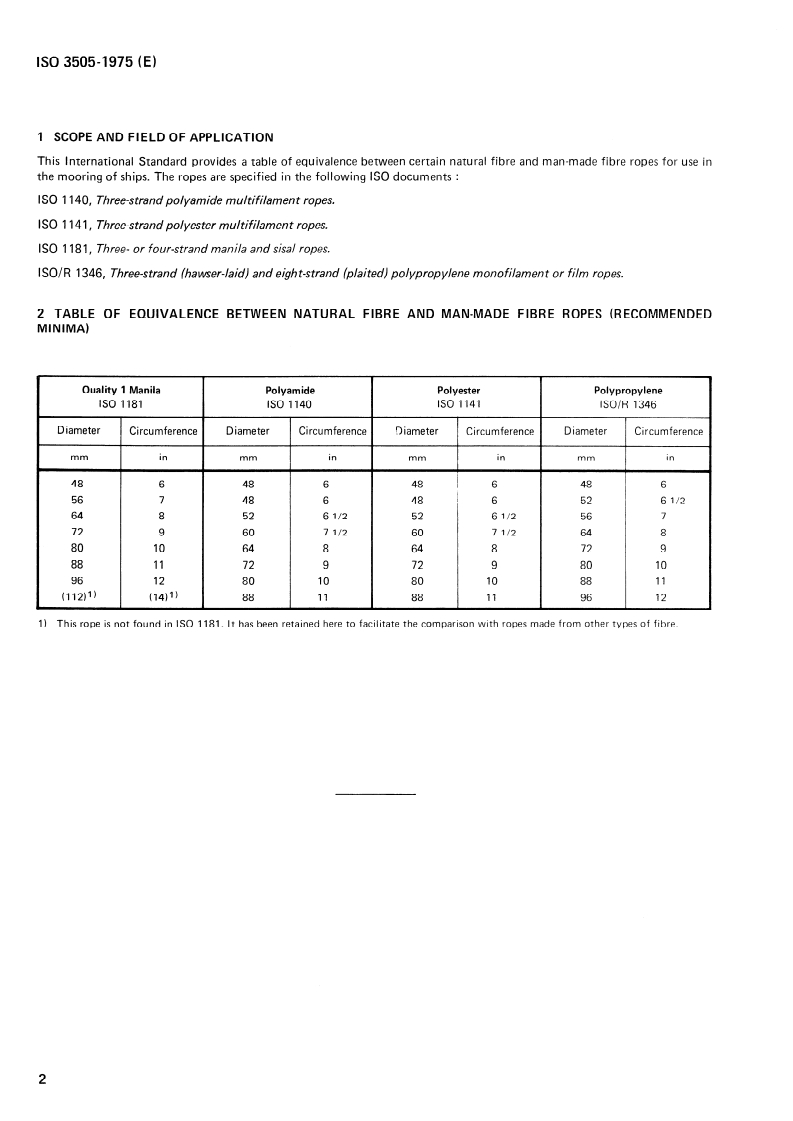
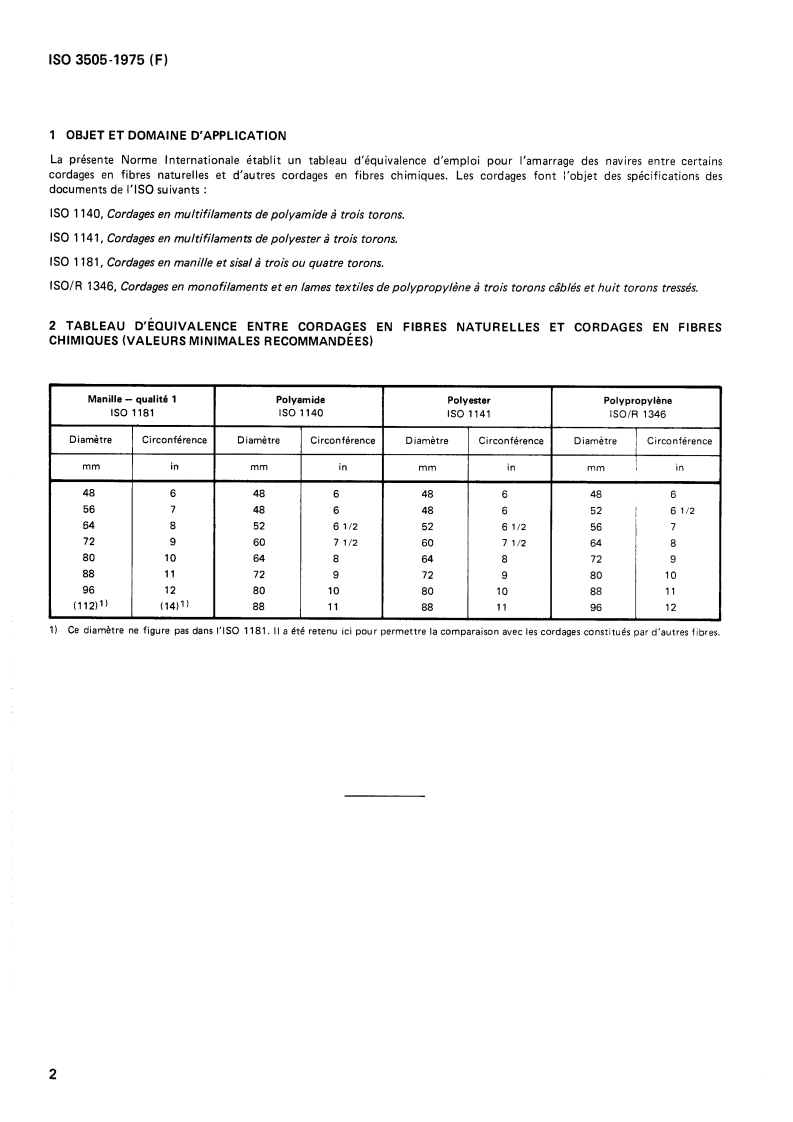
Ropes made from man-made firbres are now very widely used for mooring and towing and it is important that sizes of the various man-made ropes which are equivalent to natural fibre ropes should specified in an international agreement. Equivalence between natural fibre and man-made fibre ropes (recommended minimal values) is laid down in a table.
- Status
- Published
- Publication Date
- 31-Aug-1975
- Technical Committee
- ISO/TC 38 - Textiles
- Drafting Committee
- ISO/TC 38/WG 21 - Ropes, cordage, slings and netting
- Current Stage
- 9093 - International Standard confirmed - 90 Review
- Start Date
- 18-Sep-2026
Buy Documents
ISO 3505:1975 - Ropes and cordage — Equivalence between natural fibre ropes and man-made fibre ropes for use in the mooring of vessels/1/1975
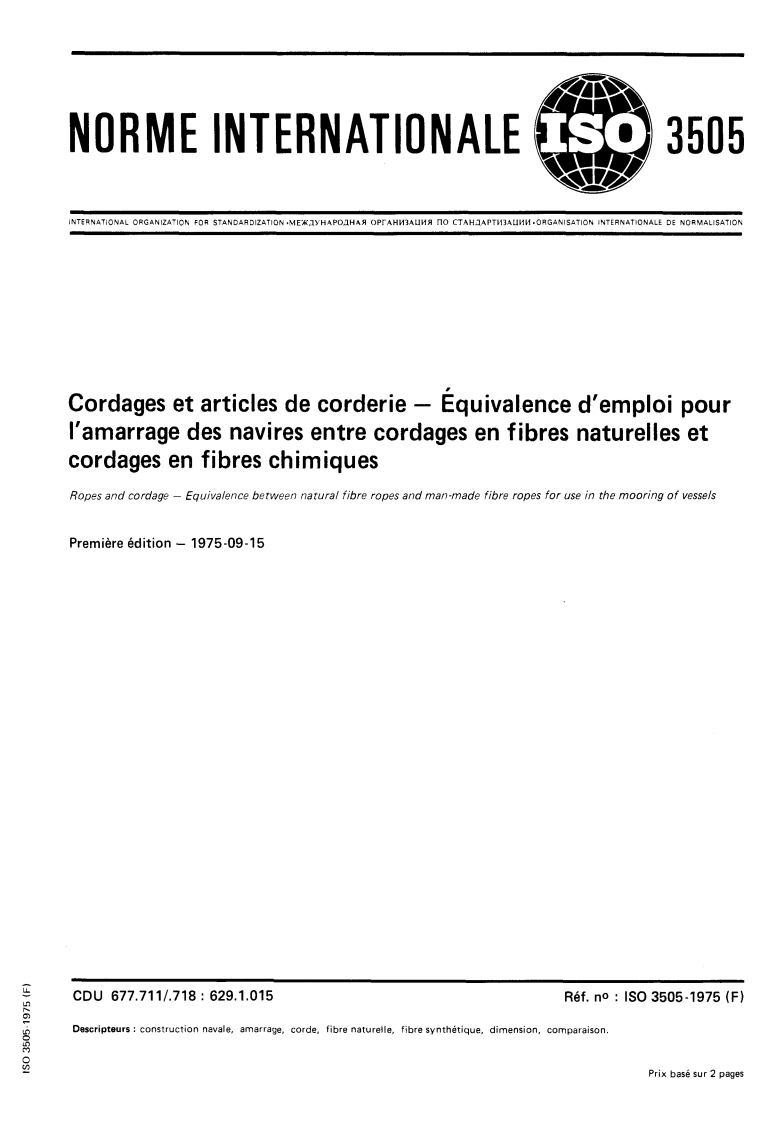
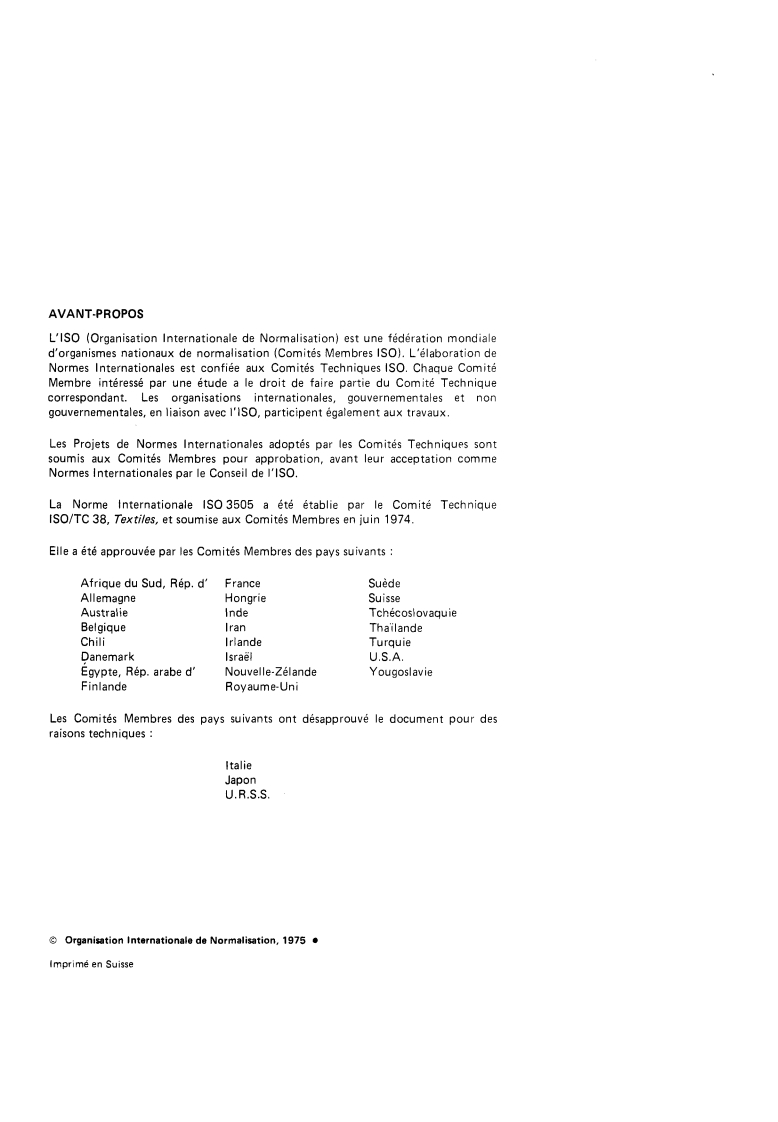
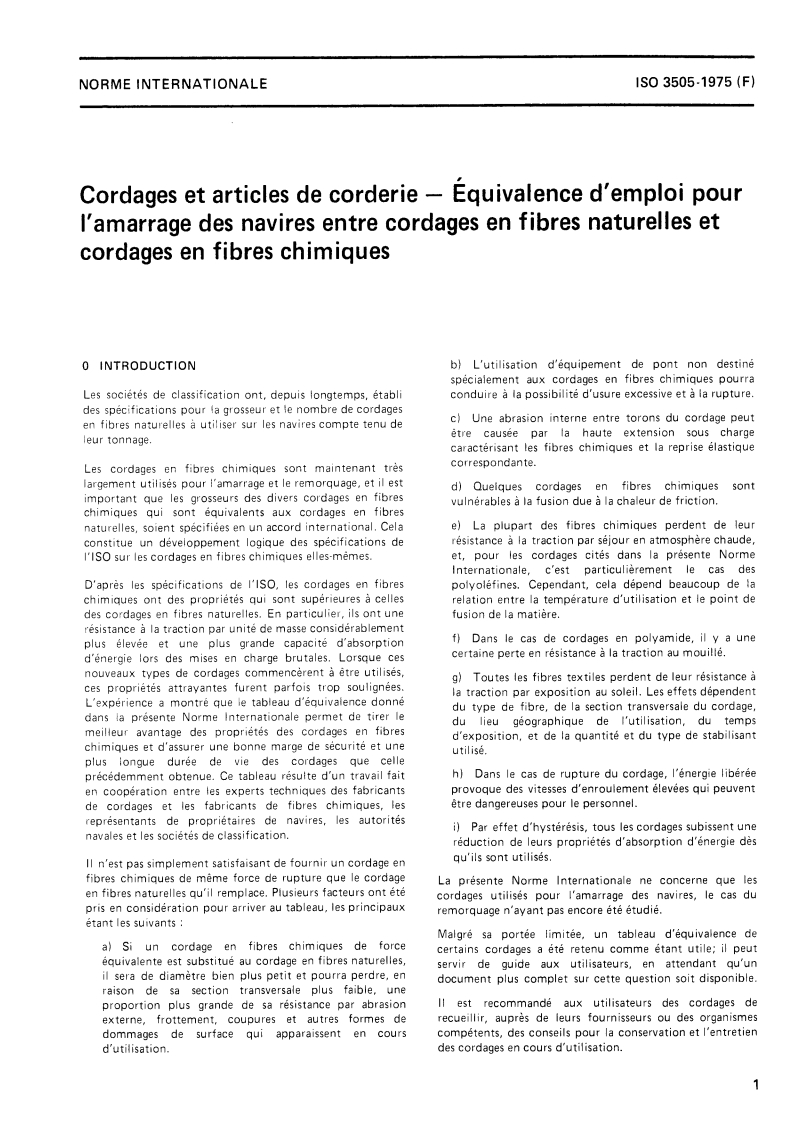
ISO 3505:1975 - Cordages et articles de corderie — Équivalence d'emploi pour l'amarrage des navires entre cordages en fibres naturelles et cordages en fibres chimiques/1/1975
ISO 3505:1975 - Cordages et articles de corderie — Équivalence d'emploi pour l'amarrage des navires entre cordages en fibres naturelles et cordages en fibres chimiques/1/1975
Overview
ISO 3505:1975 is an international standard published by the International Organization for Standardization (ISO) that establishes the equivalence between natural fibre ropes and man-made fibre ropes specifically for use in the mooring of vessels. Given the widespread adoption of man-made fibre ropes in maritime mooring and towing applications, this standard provides essential guidance on the sizes and types of ropes that can safely replace traditional natural fibre ropes without compromising strength and durability. It ensures a harmonized, global agreement on rope equivalence, helping shipbuilders, vessel operators, and maritime safety authorities maintain consistent standards in mooring equipment.
Key Topics
- Scope: ISO 3505 applies only to ropes used for mooring vessels, detailing equivalencies between natural fibre ropes (such as manila and sisal) and man-made fibre ropes (including polyamide, polyester, and polypropylene).
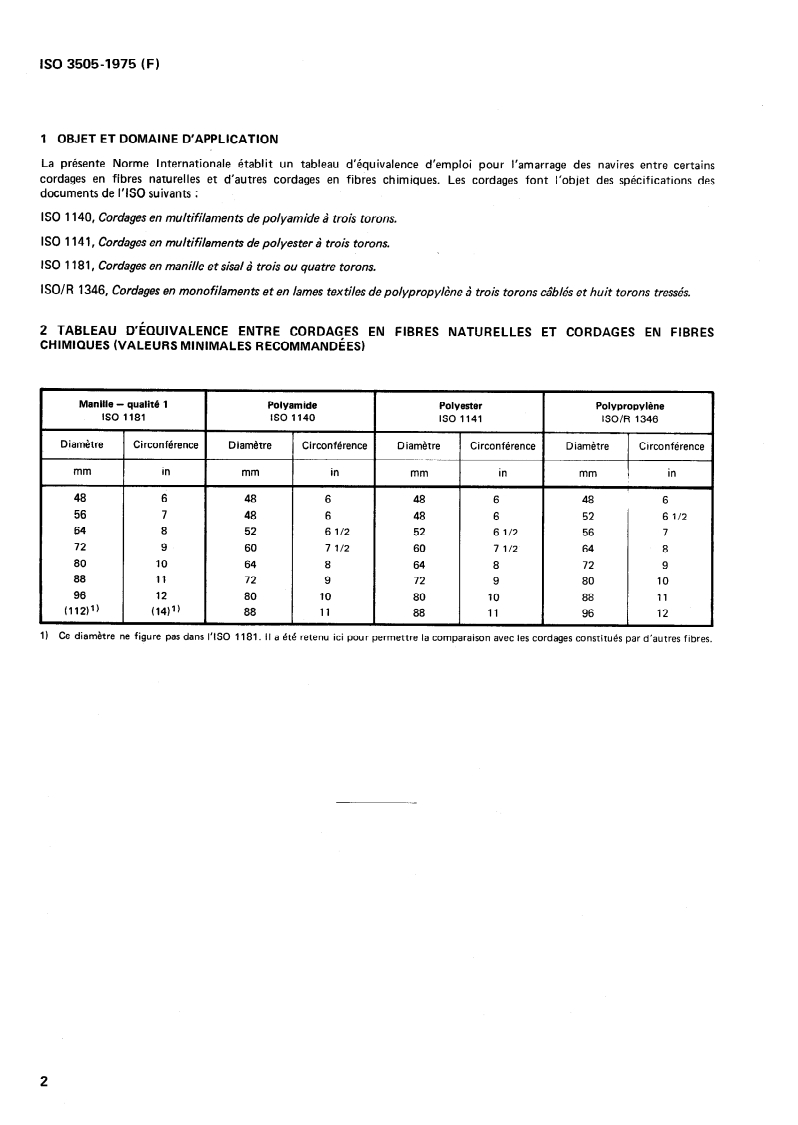
- Equivalence Tables: The core of the standard is a table recommending minimum diameters and circumferences for equivalent ropes made from different fibres, ensuring that man-made ropes meet or exceed the performance of traditional natural fibre ropes.
- Technical Considerations:
- Man-made fibre ropes generally have a higher strength-to-weight ratio and superior energy absorption compared to natural fibre ropes.
- The standard addresses factors like abrasion resistance, extension under load, susceptibility to heat and melting, and effects of moisture on rope strength, particularly noting the behavior of polyamide ropes when wet.
- It highlights risks such as hysteresis effects reducing energy absorption over time and increased recoil speeds when ropes break, underscoring the need for proper handling and care.
- Material-Specific Insights:
- Polyolefin ropes can lose strength at elevated temperatures.
- All textile fibres degrade under sunlight to varying degrees, influenced by fibre type, exposure time, and stabilizers used.
- Limitations: The document focuses solely on mooring applications; towing rope equivalences are not yet standardized but preliminary guidance is provided.
Applications
- Maritime Industry: Shipbuilders and shipowners use ISO 3505 to specify correct rope types and dimensions for mooring lines, ensuring safe and effective vessel securement at ports and anchorages.
- Classification Societies and Naval Authorities: This standard supports regulatory bodies in certifying and approving appropriate mooring equipment that meets international safety requirements.
- Rope Manufacturers: Enables manufacturers to produce ropes that comply with recognized equivalence dimensions, facilitating global trade and uniformity in product offerings.
- Safety and Maintenance: Helps users understand potential issues such as abrasion, heat vulnerability, and UV deterioration, promoting better rope handling practices and longer service life.
- Equipment Design: Influences deck machinery design, which must accommodate the specific dimensions and behaviors of man-made fibre ropes substituted for traditional natural fibre options.
Related Standards
- ISO 1140: Specifications for three-strand polyamide multifilament ropes.
- ISO 1141: Specifications for three-strand polyester multifilament ropes.
- ISO 1181: Details specifications for three- or four-strand manila and sisal ropes.
- ISO/R 1346: Covers three-strand (hawser-laid) and eight-strand (plaited) polypropylene monofilament or film ropes.
These standards, referenced within ISO 3505, provide detailed material and construction parameters that support the equivalency determinations and ensure consistency in rope quality and performance.
Keywords: ISO 3505, natural fibre ropes, man-made fibre ropes, vessel mooring, rope equivalence, maritime standards, polyamide ropes, polyester ropes, polypropylene ropes, rope dimensions, mooring safety, rope abrasion, marine rope standards.
Buy Documents
ISO 3505:1975 - Ropes and cordage — Equivalence between natural fibre ropes and man-made fibre ropes for use in the mooring of vessels/1/1975
ISO 3505:1975 - Cordages et articles de corderie — Équivalence d'emploi pour l'amarrage des navires entre cordages en fibres naturelles et cordages en fibres chimiques/1/1975
ISO 3505:1975 - Cordages et articles de corderie — Équivalence d'emploi pour l'amarrage des navires entre cordages en fibres naturelles et cordages en fibres chimiques/1/1975
Get Certified
Connect with accredited certification bodies for this standard

Control Union Certifications
Global certification for agriculture and sustainability.

Hohenstein Institut
Textile testing and certification.

Bureau Veritas Bangladesh
Bureau Veritas certification services in Bangladesh.
Sponsored listings
Frequently Asked Questions
ISO 3505:1975 is a standard published by the International Organization for Standardization (ISO). Its full title is "Ropes and cordage — Equivalence between natural fibre ropes and man-made fibre ropes for use in the mooring of vessels". This standard covers: Ropes made from man-made firbres are now very widely used for mooring and towing and it is important that sizes of the various man-made ropes which are equivalent to natural fibre ropes should specified in an international agreement. Equivalence between natural fibre and man-made fibre ropes (recommended minimal values) is laid down in a table.
Ropes made from man-made firbres are now very widely used for mooring and towing and it is important that sizes of the various man-made ropes which are equivalent to natural fibre ropes should specified in an international agreement. Equivalence between natural fibre and man-made fibre ropes (recommended minimal values) is laid down in a table.
ISO 3505:1975 is classified under the following ICS (International Classification for Standards) categories: 59.080.50 - Ropes. The ICS classification helps identify the subject area and facilitates finding related standards.
ISO 3505:1975 is available in PDF format for immediate download after purchase. The document can be added to your cart and obtained through the secure checkout process. Digital delivery ensures instant access to the complete standard document.
Standards Content (Sample)
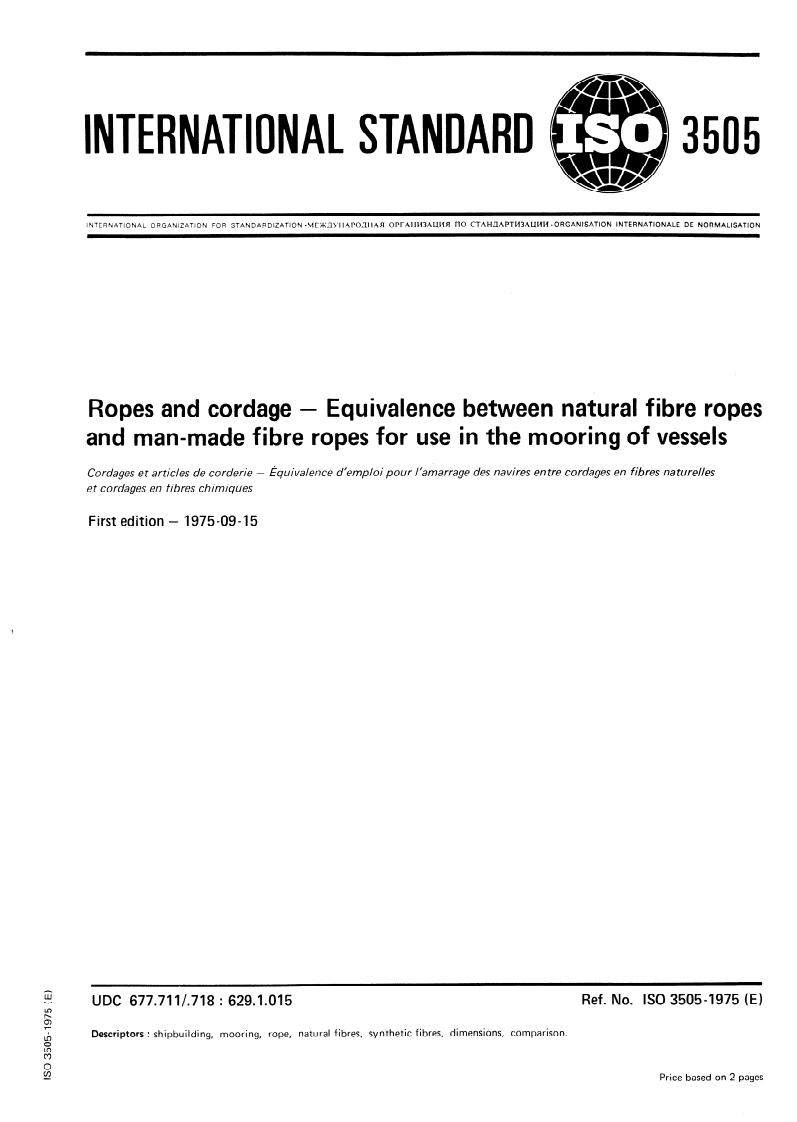
INTERNATIONAL STANDARD
INTERNATIONAL ORGANIZATION FOR STANDARDIZATION l MEX~lYHAPO~HAII OPrAHM3ALIMR l-IO CTAHilAPTM3AJJMM-ORGANISATION INTERNATIONALE DE NORMALISATION
Equivalence between natura1 f ibre ropes
Ropes and cordage -
and man-made fibre ropes for use in the mooring of vessels
Cordages et articles de corderie - Equivalence demploi pour Jamarrage des navires entre cordages en fibres naturelles
et cordages en fibres chimiques
First edition - 1975-09-15
Ref. No. ISO 3505-1975 CE)
UDC 677.711/.718 : 629.1.015
natura1 fibres, synthetic fibres, dimensions, comparison.
Descriptors : shipbuilding, mooring, rope,
Price based on 2 pages
FOREWORD
ISO (the International Organization for Standardization) is a worldwide federation
of national Standards institutes (ISO Member Bodies). The work of developing
International Standards is carried out through ISO Technical Committees. Every
Member Body interested in a subject for which a Technical Committee has been set
up has the right to be represented on that Committee. International organizations,
governmental and non-governmental, in liaison with ISO, also take part in the work.
Draft International Standards adopted by the Technical Committees are circulated
to the Member Bodies for approval before their acceptance as International
Standards by the ISO Council.
International Standard ISO 3505 was drawn up by Technical Committee
ISO/TC 38, Textiles, and circulated to the Member Bodies in June 1974.
It has been approved by the Member Bodies of the following countries :
Australia Germany Sweden
Switzerland
Belgium Hungary
Chile India Thailand
Czechoslovakia Iran Turkey
Denmark I reland United Kingdom
Egypt, Arab Rep. of Israel U.S.A.
Finland New Zealand Yugoslavia
France South Africa, Rep. of
The Member Bodies of the following countries expressed disapproval of the
document on technical grounds :
Italy
Japan
U.S.S.R.
@ International Organkation for Standardkation, 1975 0
Printed in Switzerland
INTERNATIONAL STANDARD ISO 35054975 (E)
Ropes and cordage - Equivalence between natura1 f ibre ropes
and man-made fibre ropes for use in the mooring of vessels
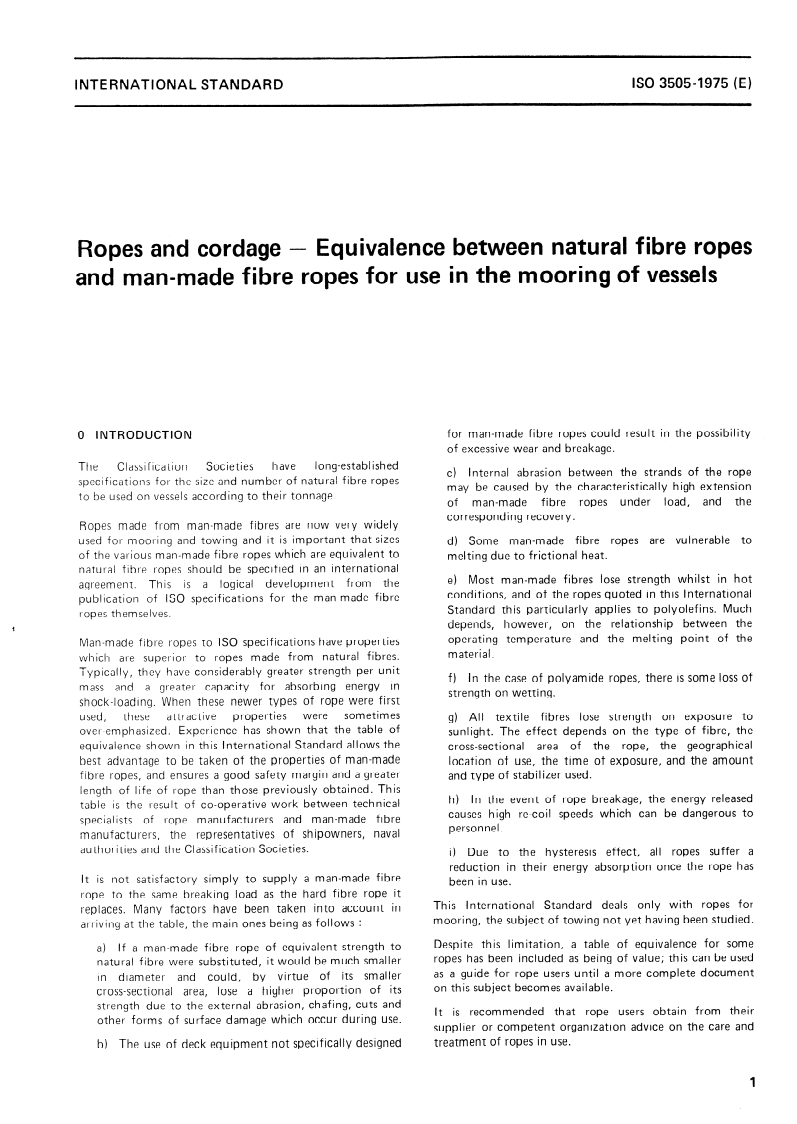
0 INTRODUCTION for man-made fibre ropes could result in the possibility
of excessive wear and breakage.
The Classification Societies have Iong-established
c) Internal abrasion between the Strands of the rope
specifications for the size and number of natura1 fibre ropes
may be caused by the characteristically high extension
to be used on vessels according to their tonnage.
man-made fibre ropes under load, and the
of
corresponding recovery.
Ropes made from man-made fibres are now very widely
used for mooring and towing and it is important that sizes
d) Some man-made fibre ropes are vulnerable to
of the various man-made fibre ropes which are equivalent to
melting due to frictional heat.
natura1 fibre ropes should be specified in an international
e) Most man-made fibres lose strength whilst in hot
agreement. This is a Iogical development from the
conditions, and of the ropes quoted in this International
publication of ISO specifications for the man-made fibre
Standard this particularly applies to polyolefins. Much
ropes themselves.
depends, however, on the relationship between the
operating temperature and the melting Point of the
Man-made fibre ropes to ISO specifications have properties
material.
which are super& to ropes made from natura1 fibres.
Typically, they have considerably greater strength per unit
...
NORME INTERNATIONALE
~ ~~~~ ~~
INTERNATIONAL ORGANIZATION FOR STANDARDIZATION nMEXJYHAPOJHAR OPrAHM3AUMR no CTAHJAPTM3AUMM .ORGANISATION INTERNATIONALE DE NORMALISATION
Cordages et articles de corderie - Équivalence
d'emploi pour
l'amarrage des navires entre cordages en fibres
naturelles et
cordages en fibres chimiques
Ropes and cordage - Equivalence between natural fibre ropes and man-made fibre ropes for use in the mooring of vessels
Première édition - 1975-09-15
I
LL
-
CDU 677.711/.718 : 629.1.015 Réf. no : IS0 3505-1975 (FI
in
b
z
ii, Descripteurs : construction navale, amarrage, corde, fibre naturelle, fibre synthétique, dimension, comparaison.
O
in
E
Prix base sur 2 pages
AVANT-PROPOS
L’ISO (Organisation Internationale de Normalisation) est une fédération mondiale
d’organismes nationaux de normalisation (Comités Membres ISO). L’élaboration de
Normes Internationales est confiée aux Comités Techniques ISO. Chaque Comité
Membre intéressé par une etude a le droit de faire partie du Comité Technique
correspondant. Les organisations internationales, gouvernementales et non
gouvernementales, en liaison avec I’ISO, participent également aux travaux.
Les Projets de Normes Internationales adoptés par les Comités Techniques sont
soumis aux Comités Membres pour approbation, avant leur acceptation comme
Normes Internationales par le Conseil de I’ISO.
La Norme Internationale IS0 3505 a été établie par le Comité Technique
ISO/TC 38, Textiles, et soumise aux Comités Membres en juin 1974.
Elle a été approuvée par les Comités Membres des pays suivants :
Afrique du Sud, Rép. d’ France Suède
Allemagne Hongrie Suisse
Australie Inde Tchécoslovaquie
Belgique
I ran Thaïlande
Chili Irlande Turquie
Danemark
Israël U.S.A.
Egypte, Rép. arabe d’ Nouvelle-Zélande Yougoslavie
Finlande Royaume- Uni
Les Comités Membres des pays suivants ont désapprouvé le document pour des
raisons techniques :
Italie
Japon
U.R.S.S.
O Organisation Internationale de Normalisation, 1975
lmorimé en Suisse
~~ ~
IS0 3505-1975 (FI
NORME INTER NATIONALE
Cordages et articles de corderie - Équivalence d‘emploi pour
l‘amarrage des navires entre cordages en fibres naturelles et
cordages en fibres chimiques
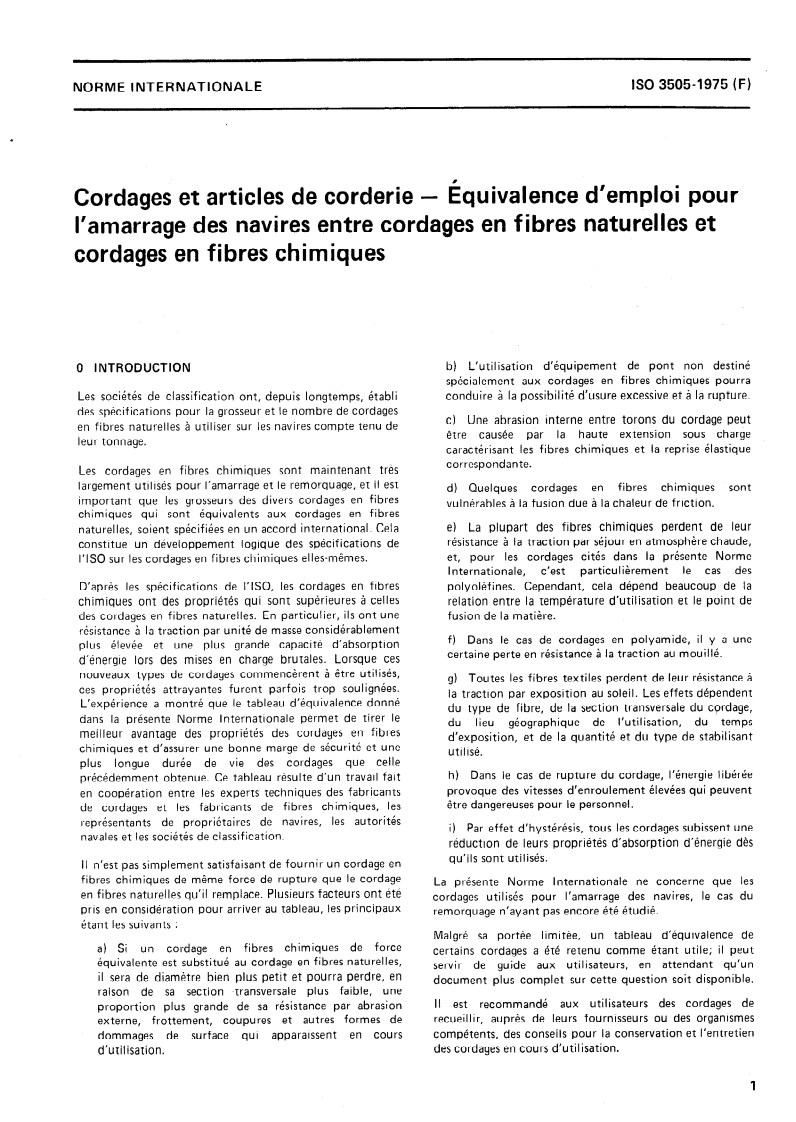
O INTRODUCTION b) L’utilisation d‘équipement de pont non destiné
spécialement aux cordages en fibres chimiques pourra
Les sociétés de classification ont, depuis longtemps, établi
conduire a la possibilité d‘usure excessive et a la rupture.
des spécifications pour la grosseur et le nombre de cordages
c) Une abrasion interne entre torons du cordage peut
en fibres naturelles à utiliser sur les navit-es compte tenu de
étt-e causée par la haute extension sous charge
leur tonnage.
cat.actérisant les fibres chimiques et la reprise élastique
correspondante.
Les cordages en fibres chimiques sont maintenant très
largement utilisés pour l’amarrage et le remorquage, et il est
d) Quelques cordages en fibres chimiques sont
important que les grosseurs des divers cordages en fibres
vulnérables a la fusion due à la chaleur de friction.
chimiques qui sont équivalents aux cordages en fibres
e) La plupart des fibres chimiques perdent de leur
naturelles, soient spécifiées en un accord international. Cela
constitue un développement logique des spécifications de I-ésistance à la traction par séjour en atmosphère chaude,
I’ISO sur les cordages en fibres chimiques elles-mémes. et, pour les cordages cités dans la présente Norme
Internationale, c’est particulièrement le cas des
D’après les spécifications de I’ISO, les cordages en fibres
polyoléfines. Cependant, cela dépend beaucoup de la
chimiques ont des propriétés qui sont supérieures a celles
relation entre la température d‘utilisation et le point de
des cordages en fibt-es naturelles. En particuliet-, ils ont une
fusion de la matière.
résistance à la traction par unité de masse considérablement
f) Dans le cas de cordages en polyamide, il y a une
p
...
NORME INTERNATIONALE
INTERNATIONAL ORGANQATION FOR STANDARDIZATION +lE-XAYHAPOAHAJI OPI-AHM3AUMfl l-I0 CTAHAAPTM3AUMM~ORGANISATION INTERNATIONALE DE NORMALISATION
Cordages et articles de corderie - Équivalence d’emploi pour
l’amarrage des navires entre cordages en fibres naturelles et
cordages en fibres chimiques
Ropes and cordage - Equivalence between natural fibre ropes and man-made fibre ropes for use in the mooring of vessek
Prerhière édition - 1975-09-15
-
LL
Y
CDU 677.711/.718 : 629.1.015 Réf. no : ISO 35054975 (F)
Ln
f-
Descripteurs : construction navale, amarrage, corde, fibre naturelle, fibre synthétique, dimension, comparaison.
Prix basé sur 2 pages
AVANT-PROPOS
L’ISO (Organisation Internationale de Normalisation), est une fédération mondiale
d’organismes nationaux de normalisation (Comités Membres ISO). L’élaboration de
Normes Internationales est confiée aux Comités Techniques ISO. Chaque Comité
Membre intéressé par une étude a le droit de faire partie du Comité Technique
correspondant. Les organisations internationales, gouvernementales et non
gouvernementales, en liaison avec I’ISO, participent également aux travaux.
Les Projets de Normes Internationales adoptés par les Comités Techniques sont
soumis aux Comités Membres pour approbation, avant leur acceptation comme
Normes Internationales par le Conseil de I’ISO.
La Norme Internationale ISO 3505 a été établie par le Comité Technique
ISO/TC 38, Textiles, et soumise aux Comités Membres en juin 1974.
Elle a été approuvée par les Comités Membres des pays suivants :
Afrique du Sud, Rép. d’ France Suède
Allemagne Hongrie Suisse
Australie Inde Tchécoslovaquie
Belgique Iran Thaïlande
Chili Irlande Turquie
Danemark Israël U.S.A.
Égypte, Rép. arabe d’ Nouvel le-Zélande Yougoslavie
Finlande Royaume-Uni
Les Comités Membres des pays suivants ont désapprouvé le document pour des
raisons techniques :
Italie
Japon
U.R.S.S.
0 Organisation Internationale de Normalisation, 1975 l
Imprimé en Suisse
ISO 3505-1975 (F)
NORME INTERNATIONALE
Cordages et articles de corderie - Équivalence d’emploi pour
l’amarrage des navires entre cordages en fibres naturelles et
en fibres chimiques
cordages
b) L’utilisation d’équipement de pont non destiné
0 INTRODUCTION
spécialement aux cordages en fibres chimiques pourra
Les sociétés de classification ont, depuis longtemps, établi conduire à la possibilité d’usure excessive et à la rupture.
des spécifications pour la grosseur et le nombre de cordages
c) Une abrasion interne entre torons du cordage peut
en fibres naturelles à utiliser sur les navires compte tenu de
par la haute extension sous charge
être causée
leur tonnage.
caractérisant les fibres chimiques et la reprise élastique
correspondante.
Les cordages en fibres chimiques sont maintenant très
largement utilisés pour l’amarrage et le remorquage, et il est
d) Quelques cordages en fibres chimiques sont
important que les grosseurs des divers cordages en fibres
vulnérables à la fusion due à la chaleur de friction.
chimiques qui sont équivalents aux cordages en fibres
e) La plupart des fibres chimiques perdent de leur
naturelles, soient spécifiées en un accord international. Cela
résistance à la traction par séjour en atmosphère chaude,
constitue un développement logique des spécifications de
et, pour les cordages cités dans la présente Norme
I’ISO sur les cordages en fibres chimiques elles-mêmes.
Internationale, c’est particulièrement le cas des
D’après les spécifications de I’ISO, les cordages en fibres polyoléfines. Cependant, cela dépend beaucoup de la
chimiques ont des propriétés qui sont supérieures à celles relation entre la température d’utilisation et le point de
des cordages en fibres naturelles. En particulier, ils ont une fusion de la matière.
résistance à la traction par unité de masse considérablement
f) Dans le cas de cordages en polyamide, il y a une
plus élevée et une plus grande c
...