

ISO 11567:2018
(Main)Carbon fibre — Determination of filament diameter and cross-sectional area
General Information
- Abstract
This document specifies five test methods used for the determination of the diameter and cross-sectional area of single carbon fibre filaments. The shape of the cross-section of the filaments from different suppliers can vary significantly. The term "diameter" used in this document applies to all cases, from a "true" diameter, where the filament is exactly circular in cross-section, to an "apparent" diameter where the filament is not circular. The methods proposed are not necessarily directly applicable to all types of filament. The product specification determines the method to be used. If there is no specification, the selection of the appropriate method is a matter of judgement. The details given here are considered to be sufficiently precise to enable this choice to be made.
- Status
- Published
- Publication Date
- 08-Aug-2018
- Technical Committee
- ISO/TC 61/SC 13 - Composites and reinforcement fibres
- Drafting Committee
- ISO/TC 61/SC 13/WG 1 - Reinforcements and reinforcement products
- Current Stage
- 9093 - International Standard confirmed
- Start Date
- 05-Dec-2023
- Completion Date
- 29-Aug-2026
Buy Documents
ISO 11567:2018 - Carbon fibre -- Determination of filament diameter and cross-sectional area
ISO 11567:2018 - Carbon fibre — Determination of filament diameter and cross-sectional area/17/2020
Overview
ISO 11567:2018 - "Carbon fibre - Determination of filament diameter and cross‑sectional area" specifies five accepted test methods for measuring the diameter and cross‑sectional area of single carbon fibre filaments. It covers both “true” diameters (circular cross‑section) and “apparent” diameters (non‑circular cross‑sections), and gives guidance on selecting an appropriate method when no product specification exists. The second edition (2018, corrected 2020) adds a scanning electron microscopy (SEM) method and clarifies specimen numbers.
Key topics and technical requirements
- Five measurement methods:
- Method A - Calculation from yarn linear density (ISO 1889), fibre density (ISO 10119) and filament count; yields an average filament diameter.
- Method B - Optical microscopy (side view) to measure apparent diameter; recommended magnifications ≥×100 (locating) and ≥×1 000 (measurement). Not recommended for diameters < 10 µm due to diffraction.
- Method C - Microscopy of transversely cut filaments to determine actual diameter and cross‑sectional area (optical or SEM).
- Method D - Laser diffractometry for diameter determination.
- Method E - Scanning electron microscopy (SEM) measurement of filament diameter (new in this edition).
- Specimen guidance:
- Account for intrinsic variability: recommended measurement of 20 filaments for statistical analysis.
- Minimum specimen counts: Method A - at least 2 yarn specimens; Methods B & D - ≥20 filaments; Method C - one yarn specimen containing ≥20 filaments; Method E - ≥20 filaments.
- Typical filament lengths: Methods B & D ~50 mm; Method C yarn ~30 mm; Method E depends on SEM stage size.
- Calibration & preparation: Microscope calibration with a stage micrometer and graduated eyepiece; use of appropriate mounting fluids (refractive index 1.43–1.53) for optical methods.
- Reporting & precision: The standard requires statistical treatment of results and includes instructions for test reporting and precision.
Applications and users
ISO 11567:2018 is essential for:
- Carbon fibre manufacturers and suppliers validating filament geometry for product specifications.
- Composite material producers and R&D labs assessing reinforcement properties.
- Quality control engineers verifying filament consistency and batch acceptance.
- Standards bodies and testing laboratories establishing measurement protocols.
Practical applications include product qualification, process control, specification compliance, and research into fibre performance in composites.
Related standards
- ISO 1888:2006 - Textile glass diameter determination
- ISO 1889 - Reinforcement yarns linear density
- ISO 10119 - Carbon fibre density determination
- ISO 11566 - Tensile properties of single filaments
Keywords: ISO 11567:2018, carbon fibre, filament diameter, cross‑sectional area, optical microscopy, SEM, laser diffractometry, filament measurement, test methods.
Relations
- Effective Date
- 02-Jan-2016
Buy Documents
ISO 11567:2018 - Carbon fibre -- Determination of filament diameter and cross-sectional area
ISO 11567:2018 - Carbon fibre — Determination of filament diameter and cross-sectional area/17/2020
Get Certified
Connect with accredited certification bodies for this standard

Control Union Certifications
Global certification for agriculture and sustainability.

Hohenstein Institut
Textile testing and certification.

Bureau Veritas Bangladesh
Bureau Veritas certification services in Bangladesh.
Sponsored listings
Frequently Asked Questions
ISO 11567:2018 is a standard published by the International Organization for Standardization (ISO). Its full title is "Carbon fibre — Determination of filament diameter and cross-sectional area". This standard covers: This document specifies five test methods used for the determination of the diameter and cross-sectional area of single carbon fibre filaments. The shape of the cross-section of the filaments from different suppliers can vary significantly. The term "diameter" used in this document applies to all cases, from a "true" diameter, where the filament is exactly circular in cross-section, to an "apparent" diameter where the filament is not circular. The methods proposed are not necessarily directly applicable to all types of filament. The product specification determines the method to be used. If there is no specification, the selection of the appropriate method is a matter of judgement. The details given here are considered to be sufficiently precise to enable this choice to be made.
This document specifies five test methods used for the determination of the diameter and cross-sectional area of single carbon fibre filaments. The shape of the cross-section of the filaments from different suppliers can vary significantly. The term "diameter" used in this document applies to all cases, from a "true" diameter, where the filament is exactly circular in cross-section, to an "apparent" diameter where the filament is not circular. The methods proposed are not necessarily directly applicable to all types of filament. The product specification determines the method to be used. If there is no specification, the selection of the appropriate method is a matter of judgement. The details given here are considered to be sufficiently precise to enable this choice to be made.
ISO 11567:2018 is classified under the following ICS (International Classification for Standards) categories: 59.100.20 - Carbon materials. The ICS classification helps identify the subject area and facilitates finding related standards.
ISO 11567:2018 has the following relationships with other standards: It is inter standard links to ISO 11567:1995. Understanding these relationships helps ensure you are using the most current and applicable version of the standard.
ISO 11567:2018 is available in PDF format for immediate download after purchase. The document can be added to your cart and obtained through the secure checkout process. Digital delivery ensures instant access to the complete standard document.
Standards Content (Sample)
INTERNATIONAL ISO
STANDARD 11567
Second edition
2018-08
Corrected version
2020-02
Carbon fibre — Determination
of filament diameter and cross-
sectional area
Fibres de carbone — Détermination du diamètre et de l'aire de la
section transversale des filaments
Reference number
©
ISO 2018
© ISO 2018
All rights reserved. Unless otherwise specified, or required in the context of its implementation, no part of this publication may
be reproduced or utilized otherwise in any form or by any means, electronic or mechanical, including photocopying, or posting
on the internet or an intranet, without prior written permission. Permission can be requested from either ISO at the address
below or ISO’s member body in the country of the requester.
ISO copyright office
CP 401 • Ch. de Blandonnet 8
CH-1214 Vernier, Geneva
Phone: +41 22 749 01 11
Fax: +41 22 749 09 47
Email: copyright@iso.org
Website: www.iso.org
Published in Switzerland
ii © ISO 2018 – All rights reserved
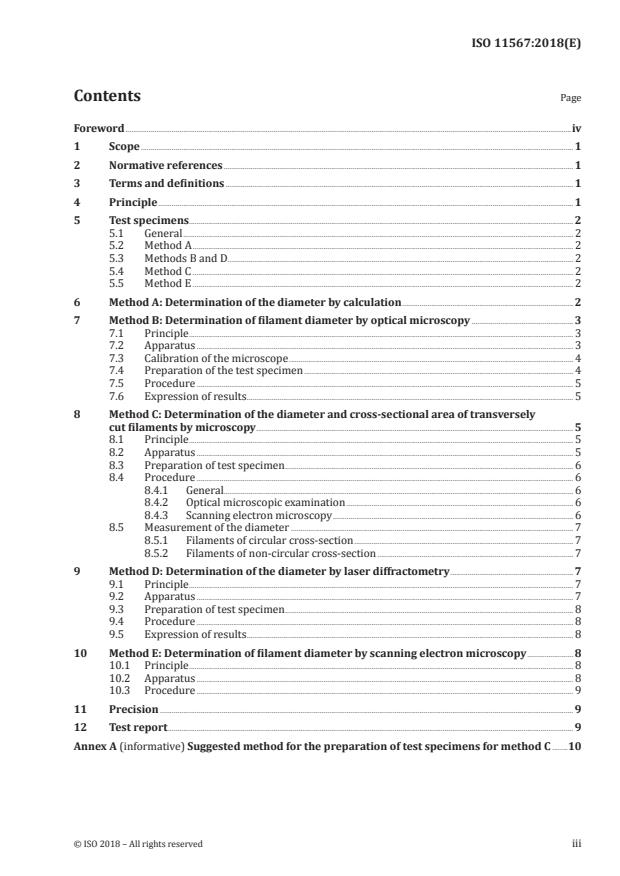
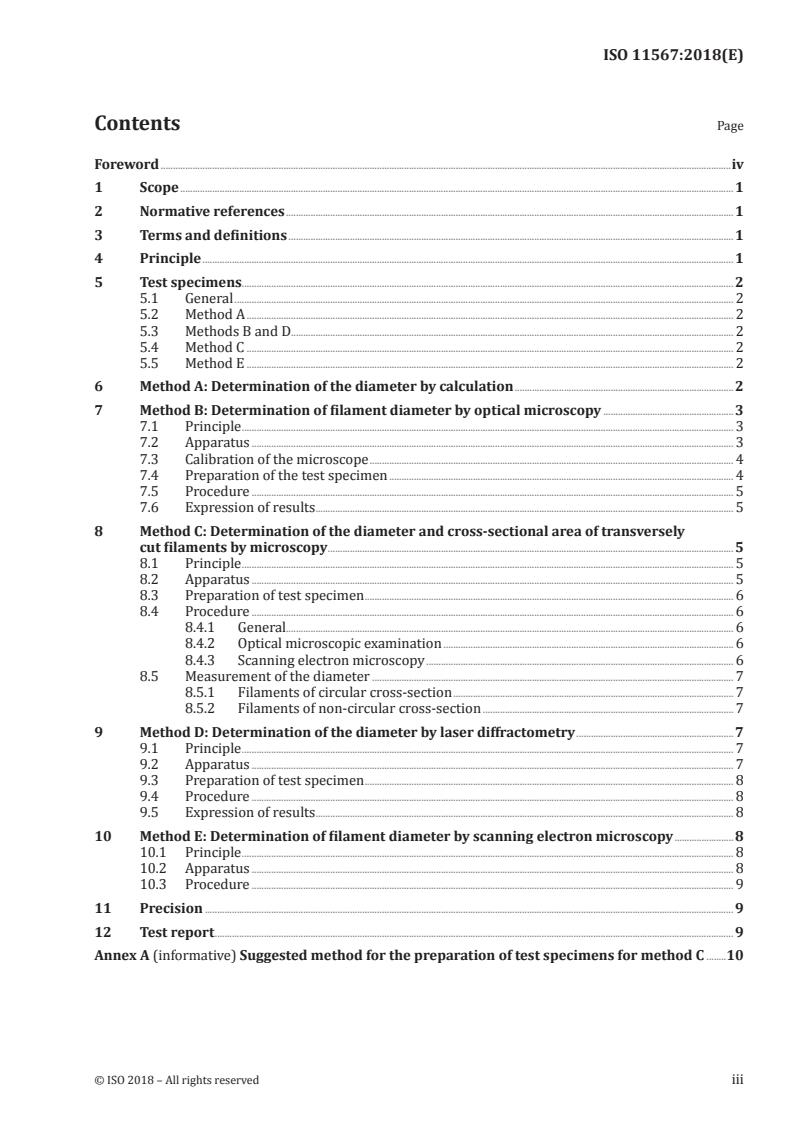
Contents Page
Foreword .iv
1 Scope . 1
2 Normative references . 1
3 Terms and definitions . 1
4 Principle . 1
5 Test specimens. 2
5.1 General . 2
5.2 Method A . 2
5.3 Methods B and D. 2
5.4 Method C . 2
5.5 Method E . 2
6 Method A: Determination of the diameter by calculation . 2
7 Method B: Determination of filament diameter by optical microscopy .3
7.1 Principle . 3
7.2 Apparatus . 3
7.3 Calibration of the microscope . 4
7.4 Preparation of the test specimen . 4
7.5 Procedure . 5
7.6 Expression of results . 5
8 Method C: Determination of the diameter and cross-sectional area of transversely
cut filaments by microscopy . 5
8.1 Principle . 5
8.2 Apparatus . 5
8.3 Preparation of test specimen . 6
8.4 Procedure . 6
8.4.1 General. 6
8.4.2 Optical microscopic examination . 6
8.4.3 Scanning electron microscopy . 6
8.5 Measurement of the diameter . 7
8.5.1 Filaments of circular cross-section . 7
8.5.2 Filaments of non-circular cross-section . 7
9 Method D: Determination of the diameter by laser diffractometry .7
9.1 Principle . 7
9.2 Apparatus . 7
9.3 Preparation of test specimen . 8
9.4 Procedure . 8
9.5 Expression of results . 8
10 Method E: Determination of filament diameter by scanning electron microscopy .8
10.1 Principle . 8
10.2 Apparatus . 8
10.3 Procedure . 9
11 Precision . 9
12 Test report . 9
Annex A (informative) Suggested method for the preparation of test specimens for method C .10
Foreword
ISO (the International Organization for Standardization) is a worldwide federation of national standards
bodies (ISO member bodies). The work of preparing International Standards is normally carried out
through ISO technical committees. Each member body interested in a subject for which a technical
committee has been established has the right to be represented on that committee. International
organizations, governmental and non-governmental, in liaison with ISO, also take part in the work.
ISO collaborates closely with the International Electrotechnical Commission (IEC) on all matters of
electrotechnical standardization.
The procedures used to develop this document and those intended for its further maintenance are
described in the ISO/IEC Directives, Part 1. In particular the different approval criteria needed for the
different types of ISO documents should be noted. This document was drafted in accordance with the
editorial rules of the ISO/IEC Directives, Part 2 (see www .iso .org/ directives).
Attention is drawn to the possibility that some of the elements of this document may be the subject of
patent rights. ISO shall not be held responsible for identifying any or all such patent rights. Details of
any patent rights identified during the development of the document will be in the Introduction and/or
on the ISO list of patent declarations received (see www .iso .org/ patents).
Any trade name used in this document is information given for the convenience of users and does not
constitute an endorsement.
For an explanation on the voluntary nature of standards, the meaning of ISO specific terms and
expressions related to conformity assessment, as well as information about ISO's adherence to the
World Trade Organization (WTO) principles in the Technical Barriers to Trade (TBT) see the following
URL: www .iso .org/ iso/ foreword .html.
This document was prepared by Technical Committee ISO/TC 61, Plastics, Subcommittee SC 13,
Composites and reinforcement fibres.
This second edition cancels and replaces the first edition (ISO 11567:1995), which has been technically
revised.
The main changes compared to the previous edition are as follows.
a) Method E, Determination of the diameter by scanning electron microscopy, has been added.
b) The number of the test specimens in method A, method B, method C and method D has been
identified.
Any feedback or questions on this document should be directed to the user’s national standards body. A
complete listing of these bodies can be found at www .iso .org/ members .html.
This corrected version of ISO 11567:2018 incorporates the following corrections:
— Formula (1) in Clause 6 has been corrected.
iv © ISO 2018 – All rights reserved
INTERNATIONAL STANDARD ISO 11567:2018(E)
Carbon fibre — Determination of filament diameter and
cross-sectional area
1 Scope
This document specifies five test methods used for the determination of the diameter and cross-
sectional area of single carbon fibre filaments.
The shape of the cross-section of the filaments from different suppliers can vary significantly. The term
“diameter” used in this document applies to all cases, from a “true” diameter, where the filament is
exactly circular in cross-section, to an “apparent” diameter where the filament is not circular.
The methods proposed are not necessarily directly applicable to all types of filament. The product
specification determines the method to be used. If there is no specification, the selection of the
appropriate method is a matter of judgement. The details given here are considered to be sufficiently
precise to enable this choice to be made.
2 Normative references
The following documents are referred to in the text in such a way that some or all of their content
constitutes requirements of this document. For dated references, only the edition cited applies. For
undated references, the latest edition of the referenced document (including any amendments) applies.
ISO 1888:2006, Textile glass — Staple fibres or filaments — Determination of average diameter
ISO 1889, Reinforcement yarns — Determination of linear density
ISO 10119, Carbon fibre — Determination of density
ISO 11566, Carbon fibre — Determination of the tensile properties of single-filament specimens
3 Terms and definitions
No terms and definitions are listed in this document.
ISO and IEC maintain terminological databases for use in standardization at the following addresses:
— ISO Online browsing platform: available at https:// www .iso .org/ obp
— IEC Electropedia: available at http:// www .electropedia .org/
4 Principle
Five methods are proposed for the determination of the diameter and cross-sectional area of carbon
fibre filaments:
— Method A:
Determination of the diameter by calculation.
— Method B:
Determination of the diameter by optical microscopy.
— Method C:
Determination of the diameter and cross-sectional area of transversely cut filaments by microscopy.
— Method D:
Determination of the diameter by laser diffractometry.
— Method E:
Determination of the diameter by scanning electron microscopy.
NOTE Method A gives only an average value of the diameter, which can be sufficient in certain cases, while
methods B, C, D and E, which are experimental methods, provide actual values.
5 Test specimens
5.1 General
Because of the intrinsic variability in filament diameter between filaments and along the length of a
filament, it is recommended that the diameter or cross-sectional area of 20 filaments in the yarn sample
be measured and a statistical analysis of these results carried out.
Test specimens shall be taken from each yarn sample.
5.2 Method A
Yarns are used as test specimens, the amount of yarn taken are specified in ISO 10119 and ISO 1889.
Prepare at least 2 test specimens.
5.3 Methods B and D
Filaments taken from the yarns are used as test specimens, the length of the filaments are
approximately 50 mm.
Prepare at least 20 test specimens.
5.4 Method C
Yarns are used as test specimens, the length of yarn taken are approximately 30 mm.
Prepare one test specimen, which consists of at least 20 filaments.
5.5 Method E
Filaments taken from the yarns are used as test specimens, the length of the filaments are determined
according to the stage size of the scanning electron microscope.
Prepare at least 20 test specimens.
6 Method A: Determination of the diameter by calculation
An average filament diameter is determined from the linear density of the unsized yarn determined
in accordance with ISO 1889, the density determined in accordance with ISO 10119 and the number
of filaments in the yarn. The number of filaments in the yarn shall be given by the carbon fibre
manufacturer.
2 © ISO 2018 – All rights reserved
ISO 1156
...
INTERNATIONAL ISO
STANDARD 11567
Second edition
2018-08
Corrected version
2020-02
Carbon fibre — Determination
of filament diameter and cross-
sectional area
Fibres de carbone — Détermination du diamètre et de l'aire de la
section transversale des filaments
Reference number
©
ISO 2018
© ISO 2018
All rights reserved. Unless otherwise specified, or required in the context of its implementation, no part of this publication may
be reproduced or utilized otherwise in any form or by any means, electronic or mechanical, including photocopying, or posting
on the internet or an intranet, without prior written permission. Permission can be requested from either ISO at the address
below or ISO’s member body in the country of the requester.
ISO copyright office
CP 401 • Ch. de Blandonnet 8
CH-1214 Vernier, Geneva
Phone: +41 22 749 01 11
Fax: +41 22 749 09 47
Email: copyright@iso.org
Website: www.iso.org
Published in Switzerland
ii © ISO 2018 – All rights reserved
Contents Page
Foreword .iv
1 Scope . 1
2 Normative references . 1
3 Terms and definitions . 1
4 Principle . 1
5 Test specimens. 2
5.1 General . 2
5.2 Method A . 2
5.3 Methods B and D. 2
5.4 Method C . 2
5.5 Method E . 2
6 Method A: Determination of the diameter by calculation . 2
7 Method B: Determination of filament diameter by optical microscopy .3
7.1 Principle . 3
7.2 Apparatus . 3
7.3 Calibration of the microscope . 4
7.4 Preparation of the test specimen . 4
7.5 Procedure . 5
7.6 Expression of results . 5
8 Method C: Determination of the diameter and cross-sectional area of transversely
cut filaments by microscopy . 5
8.1 Principle . 5
8.2 Apparatus . 5
8.3 Preparation of test specimen . 6
8.4 Procedure . 6
8.4.1 General. 6
8.4.2 Optical microscopic examination . 6
8.4.3 Scanning electron microscopy . 6
8.5 Measurement of the diameter . 7
8.5.1 Filaments of circular cross-section . 7
8.5.2 Filaments of non-circular cross-section . 7
9 Method D: Determination of the diameter by laser diffractometry .7
9.1 Principle . 7
9.2 Apparatus . 7
9.3 Preparation of test specimen . 8
9.4 Procedure . 8
9.5 Expression of results . 8
10 Method E: Determination of filament diameter by scanning electron microscopy .8
10.1 Principle . 8
10.2 Apparatus . 8
10.3 Procedure . 9
11 Precision . 9
12 Test report . 9
Annex A (informative) Suggested method for the preparation of test specimens for method C .10
Foreword
ISO (the International Organization for Standardization) is a worldwide federation of national standards
bodies (ISO member bodies). The work of preparing International Standards is normally carried out
through ISO technical committees. Each member body interested in a subject for which a technical
committee has been established has the right to be represented on that committee. International
organizations, governmental and non-governmental, in liaison with ISO, also take part in the work.
ISO collaborates closely with the International Electrotechnical Commission (IEC) on all matters of
electrotechnical standardization.
The procedures used to develop this document and those intended for its further maintenance are
described in the ISO/IEC Directives, Part 1. In particular the different approval criteria needed for the
different types of ISO documents should be noted. This document was drafted in accordance with the
editorial rules of the ISO/IEC Directives, Part 2 (see www .iso .org/ directives).
Attention is drawn to the possibility that some of the elements of this document may be the subject of
patent rights. ISO shall not be held responsible for identifying any or all such patent rights. Details of
any patent rights identified during the development of the document will be in the Introduction and/or
on the ISO list of patent declarations received (see www .iso .org/ patents).
Any trade name used in this document is information given for the convenience of users and does not
constitute an endorsement.
For an explanation on the voluntary nature of standards, the meaning of ISO specific terms and
expressions related to conformity assessment, as well as information about ISO's adherence to the
World Trade Organization (WTO) principles in the Technical Barriers to Trade (TBT) see the following
URL: www .iso .org/ iso/ foreword .html.
This document was prepared by Technical Committee ISO/TC 61, Plastics, Subcommittee SC 13,
Composites and reinforcement fibres.
This second edition cancels and replaces the first edition (ISO 11567:1995), which has been technically
revised.
The main changes compared to the previous edition are as follows.
a) Method E, Determination of the diameter by scanning electron microscopy, has been added.
b) The number of the test specimens in method A, method B, method C and method D has been
identified.
Any feedback or questions on this document should be directed to the user’s national standards body. A
complete listing of these bodies can be found at www .iso .org/ members .html.
This corrected version of ISO 11567:2018 incorporates the following corrections:
— Formula (1) in Clause 6 has been corrected.
iv © ISO 2018 – All rights reserved
INTERNATIONAL STANDARD ISO 11567:2018(E)
Carbon fibre — Determination of filament diameter and
cross-sectional area
1 Scope
This document specifies five test methods used for the determination of the diameter and cross-
sectional area of single carbon fibre filaments.
The shape of the cross-section of the filaments from different suppliers can vary significantly. The term
“diameter” used in this document applies to all cases, from a “true” diameter, where the filament is
exactly circular in cross-section, to an “apparent” diameter where the filament is not circular.
The methods proposed are not necessarily directly applicable to all types of filament. The product
specification determines the method to be used. If there is no specification, the selection of the
appropriate method is a matter of judgement. The details given here are considered to be sufficiently
precise to enable this choice to be made.
2 Normative references
The following documents are referred to in the text in such a way that some or all of their content
constitutes requirements of this document. For dated references, only the edition cited applies. For
undated references, the latest edition of the referenced document (including any amendments) applies.
ISO 1888:2006, Textile glass — Staple fibres or filaments — Determination of average diameter
ISO 1889, Reinforcement yarns — Determination of linear density
ISO 10119, Carbon fibre — Determination of density
ISO 11566, Carbon fibre — Determination of the tensile properties of single-filament specimens
3 Terms and definitions
No terms and definitions are listed in this document.
ISO and IEC maintain terminological databases for use in standardization at the following addresses:
— ISO Online browsing platform: available at https:// www .iso .org/ obp
— IEC Electropedia: available at http:// www .electropedia .org/
4 Principle
Five methods are proposed for the determination of the diameter and cross-sectional area of carbon
fibre filaments:
— Method A:
Determination of the diameter by calculation.
— Method B:
Determination of the diameter by optical microscopy.
— Method C:
Determination of the diameter and cross-sectional area of transversely cut filaments by microscopy.
— Method D:
Determination of the diameter by laser diffractometry.
— Method E:
Determination of the diameter by scanning electron microscopy.
NOTE Method A gives only an average value of the diameter, which can be sufficient in certain cases, while
methods B, C, D and E, which are experimental methods, provide actual values.
5 Test specimens
5.1 General
Because of the intrinsic variability in filament diameter between filaments and along the length of a
filament, it is recommended that the diameter or cross-sectional area of 20 filaments in the yarn sample
be measured and a statistical analysis of these results carried out.
Test specimens shall be taken from each yarn sample.
5.2 Method A
Yarns are used as test specimens, the amount of yarn taken are specified in ISO 10119 and ISO 1889.
Prepare at least 2 test specimens.
5.3 Methods B and D
Filaments taken from the yarns are used as test specimens, the length of the filaments are
approximately 50 mm.
Prepare at least 20 test specimens.
5.4 Method C
Yarns are used as test specimens, the length of yarn taken are approximately 30 mm.
Prepare one test specimen, which consists of at least 20 filaments.
5.5 Method E
Filaments taken from the yarns are used as test specimens, the length of the filaments are determined
according to the stage size of the scanning electron microscope.
Prepare at least 20 test specimens.
6 Method A: Determination of the diameter by calculation
An average filament diameter is determined from the linear density of the unsized yarn determined
in accordance with ISO 1889, the density determined in accordance with ISO 10119 and the number
of filaments in the yarn. The number of filaments in the yarn shall be given by the carbon fibre
manufacturer.
2 © ISO 2018 – All rights reserved
ISO 1156
...