


ISO 6934-5:2024
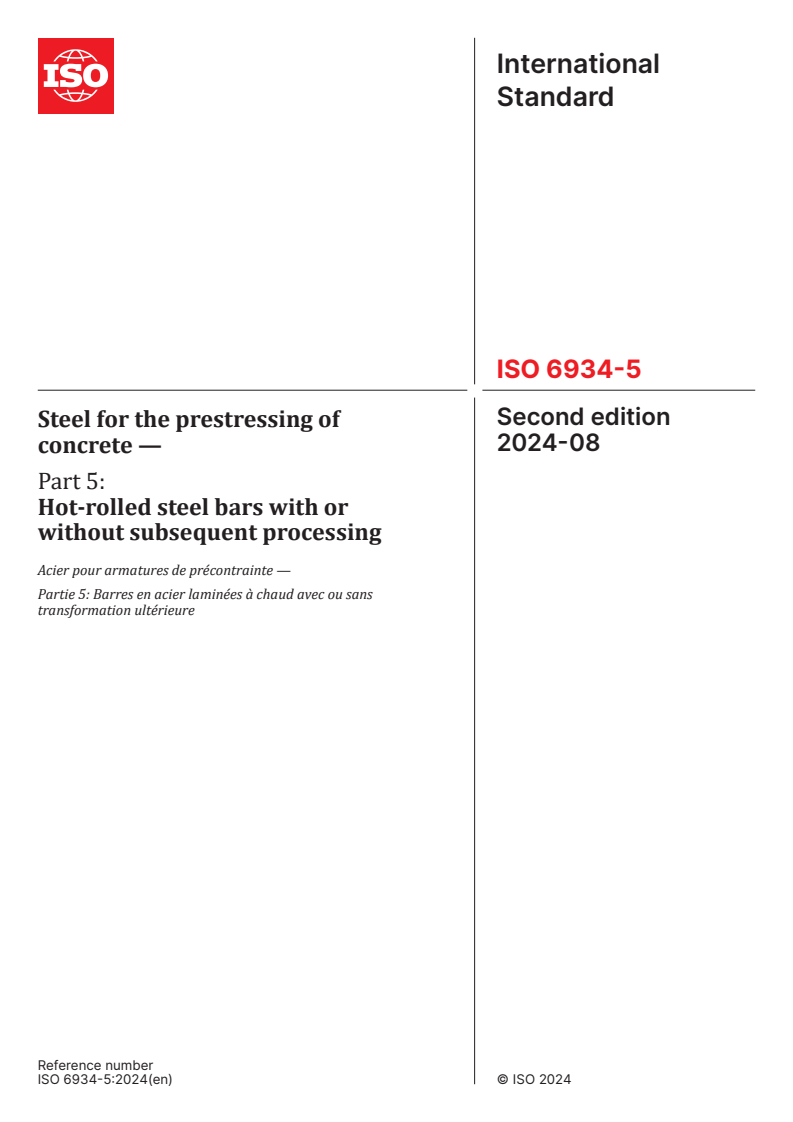
(Main)Steel for the prestressing of concrete — Part 5: Hot-rolled steel bars with or without subsequent processing
Steel for the prestressing of concrete — Part 5: Hot-rolled steel bars with or without subsequent processing
This document specifies requirements for round high tensile strength steel bars for the prestressing of concrete. The surface can be plain or threaded.
Acier pour armatures de précontrainte — Partie 5: Barres en acier laminées à chaud avec ou sans transformation ultérieure
General Information
- Status
- Published
- Publication Date
- 05-Aug-2024
- Technical Committee
- ISO/TC 17/SC 16 - Steels for the reinforcement and prestressing of concrete
- Current Stage
- 6060 - International Standard published
- Start Date
- 06-Aug-2024
- Due Date
- 17-Feb-2025
- Completion Date
- 06-Aug-2024
Relations
- Effective Date
- 06-Jun-2022
Overview
ISO 6934-5:2024 is an international standard that specifies the technical requirements for hot-rolled steel bars used in the prestressing of concrete. These bars are designed with high tensile strength and are intended to enhance the load-bearing capacity of concrete structures. The bars covered by this standard can have either a plain or threaded surface and are manufactured following stringent quality and performance criteria. This standard applies to round steel bars with nominal diameters ranging from 15 mm to 75 mm, ensuring consistency and reliability in prestressing applications.
Key Topics
Steel Specification and Manufacturing Conditions
The steel used must meet the general requirements defined in ISO 6934-1 and be hot-rolled to achieve specified mechanical properties. Bars can be delivered either just hot-rolled or with subsequent processing, depending on purchaser requirements.Surface Configuration
The bars may feature a plain or threaded surface. For threaded bars, parameters such as rib height, spacing, inclination, and core diameter are controlled to ensure proper performance in prestressing applications.Mechanical Properties
The standard defines critical mechanical properties including:- Tensile strength (ranging from 980 N/mm² to 1230 N/mm² depending on steel grade)
- Total elongation (minimum 3.5% at maximum force)
- Bendability, fatigue resistance, relaxation, and durability requirements
Threaded Bars
Threaded ends are cold rolled with parameters agreed upon by purchaser and manufacturer. Threaded bars must have multiple rows of threads evenly spaced around the bar's perimeter to optimize bonding with concrete.Testing and Quality Assurance
The standard specifies testing methods for tensile strength, relaxation, fatigue, and corrosion resistance where applicable. Retesting protocols are outlined if initial test results fail to meet requirements.Designation and Identification
Bars are designated according to diameter, tensile strength, and surface type (plain or threaded), providing clear identification for ordering and verification.
Applications
ISO 6934-5:2024 steel bars are essential components in the construction industry, particularly for:
Prestressed Concrete Structures
These bars are integral to prestressing techniques used in bridges, buildings, and infrastructure projects to enhance strength and durability.Load-Bearing Concrete Elements
High tensile steel bars improve the resistance of concrete beams, slabs, and columns to tension forces, helping manage and transfer loads more effectively.Civil Engineering Projects
The consistent quality and mechanical properties enable reliable use in tunnels, dams, and other large-scale civil works where prestressed concrete technology is employed.Custom Engineering Solutions
Thanks to the option of specifying threaded or plain surfaces and various diameters, engineers can select bars that best meet specific structural design requirements.
Related Standards
- ISO 6934-1: General requirements for steel for prestressing concrete, setting foundational characteristics for steel grades and quality.
- ISO 15630-3: Defines methods for testing prestressing steel, including tensile, bend, fatigue, and relaxation tests relevant to ISO 6934-5 bars.
- ISO 404: Covers general technical delivery requirements for steel and steel products, applicable to retesting and quality control procedures.
- ISO 6934 series: Includes other parts for different types of prestressing steels, providing comprehensive coverage of materials for prestressed concrete.
By adhering to ISO 6934-5:2024, manufacturers and construction professionals ensure the use of high-quality, reliable steel bars optimized for the prestressing of concrete, enhancing structural performance and safety in a variety of engineering applications.
Get Certified
Connect with accredited certification bodies for this standard

Element Materials Technology
Materials testing and product certification.

ICC Evaluation Service
Building products evaluation and certification.

QAI Laboratories
Building and construction product testing and certification.
Sponsored listings
Frequently Asked Questions
ISO 6934-5:2024 is a standard published by the International Organization for Standardization (ISO). Its full title is "Steel for the prestressing of concrete — Part 5: Hot-rolled steel bars with or without subsequent processing". This standard covers: This document specifies requirements for round high tensile strength steel bars for the prestressing of concrete. The surface can be plain or threaded.
This document specifies requirements for round high tensile strength steel bars for the prestressing of concrete. The surface can be plain or threaded.
ISO 6934-5:2024 is classified under the following ICS (International Classification for Standards) categories: 77.140.15 - Steels for reinforcement of concrete; 91.080.40 - Concrete structures. The ICS classification helps identify the subject area and facilitates finding related standards.
ISO 6934-5:2024 has the following relationships with other standards: It is inter standard links to ISO 6934-5:1991. Understanding these relationships helps ensure you are using the most current and applicable version of the standard.
ISO 6934-5:2024 is available in PDF format for immediate download after purchase. The document can be added to your cart and obtained through the secure checkout process. Digital delivery ensures instant access to the complete standard document.
Standards Content (Sample)
International
Standard
ISO 6934-5
Second edition
Steel for the prestressing of
2024-08
concrete —
Part 5:
Hot-rolled steel bars with or
without subsequent processing
Acier pour armatures de précontrainte —
Partie 5: Barres en acier laminées à chaud avec ou sans
transformation ultérieure
Reference number
© ISO 2024
All rights reserved. Unless otherwise specified, or required in the context of its implementation, no part of this publication may
be reproduced or utilized otherwise in any form or by any means, electronic or mechanical, including photocopying, or posting on
the internet or an intranet, without prior written permission. Permission can be requested from either ISO at the address below
or ISO’s member body in the country of the requester.
ISO copyright office
CP 401 • Ch. de Blandonnet 8
CH-1214 Vernier, Geneva
Phone: +41 22 749 01 11
Email: copyright@iso.org
Website: www.iso.org
Published in Switzerland
ii
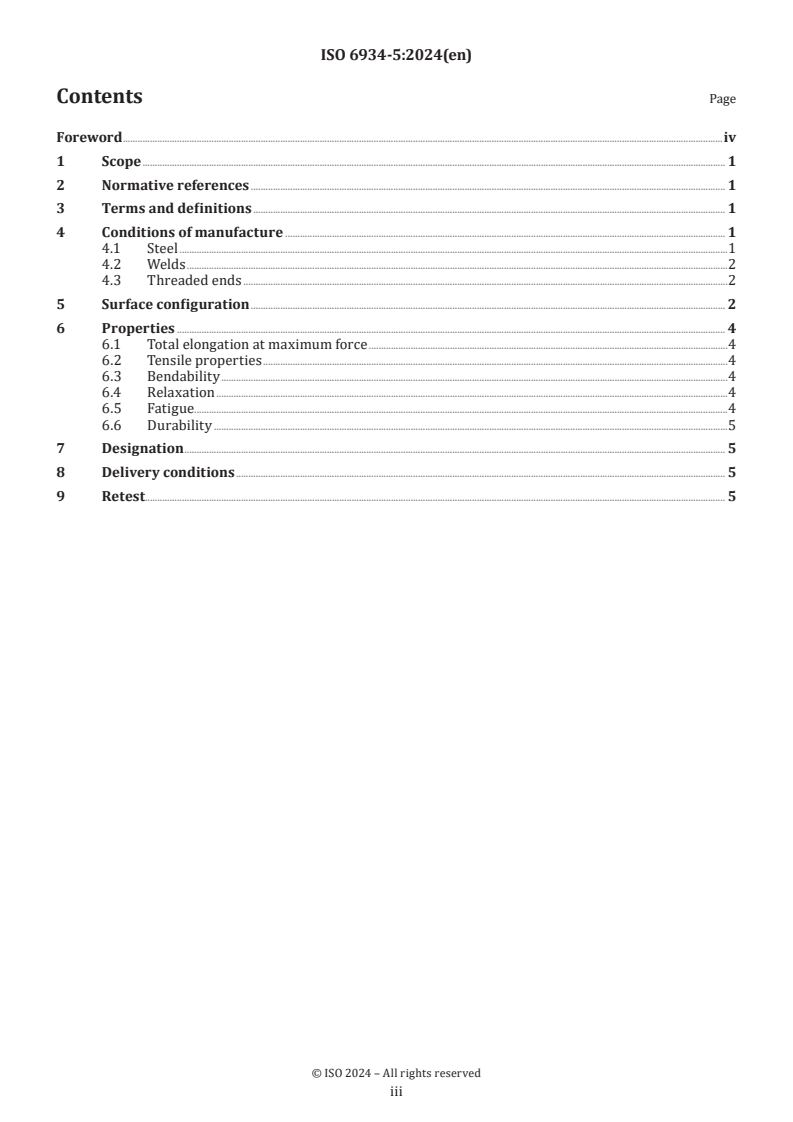
Contents Page
Foreword .iv
1 Scope . 1
2 Normative references . 1
3 Terms and definitions . 1
4 Conditions of manufacture . 1
4.1 Steel .1
4.2 Welds .2
4.3 Threaded ends .2
5 Surface configuration . 2
6 Properties . 4
6.1 Total elongation at maximum force .4
6.2 Tensile properties .4
6.3 Bendability .4
6.4 Relaxation .4
6.5 Fatigue .4
6.6 Durability .5
7 Designation . 5
8 Delivery conditions . 5
9 Retest. 5
iii
Foreword
ISO (the International Organization for Standardization) is a worldwide federation of national standards
bodies (ISO member bodies). The work of preparing International Standards is normally carried out through
ISO technical committees. Each member body interested in a subject for which a technical committee
has been established has the right to be represented on that committee. International organizations,
governmental and non-governmental, in liaison with ISO, also take part in the work. ISO collaborates closely
with the International Electrotechnical Commission (IEC) on all matters of electrotechnical standardization.
The procedures used to develop this document and those intended for its further maintenance are described
in the ISO/IEC Directives, Part 1. In particular, the different approval criteria needed for the different types
of ISO document should be noted. This document was drafted in accordance with the editorial rules of the
ISO/IEC Directives, Part 2 (see www.iso.org/directives).
ISO draws attention to the possibility that the implementation of this document may involve the use of (a)
patent(s). ISO takes no position concerning the evidence, validity or applicability of any claimed patent
rights in respect thereof. As of the date of publication of this document, ISO had not received notice of (a)
patent(s) which may be required to implement this document. However, implementers are cautioned that
this may not represent the latest information, which may be obtained from the patent database available at
www.iso.org/patents. ISO shall not be held responsible for identifying any or all such patent rights.
Any trade name used in this document is information given for the convenience of users and does not
constitute an endorsement.
For an explanation of the voluntary nature of standards, the meaning of ISO specific terms and expressions
related to conformity assessment, as well as information about ISO's adherence to the World Trade
Organization (WTO) principles in the Technical Barriers to Trade (TBT), see www.iso.org/iso/foreword.html.
This document was prepared by Technical Committee ISO/TC 17, Steel, Subcommittee SC 16, Steels for the
reinforcement and prestressing of concrete.
This second edition cancels and replaces the first edition (ISO 6934-5:1991), which has been technically
revised.
The main changes are as follows:
— the normative references, steel grade and test method have been revised;
— Table 1 have been split to Table 1 and Table 2;
— retest requirements have been added (see Clause 9).
A list of all parts in the ISO 6934 series can be found on the ISO website.
Any feedback or questions on this document should be directed to the
...
Questions, Comments and Discussion
Ask us and Technical Secretary will try to provide an answer. You can facilitate discussion about the standard in here.
Loading comments...