

ISO 24013:2023
(Main)Optics and photonics — Lasers and laser-related equipment — Measurement of phase retardation of optical components for polarized laser radiation
General Information
- Abstract
This document specifies test methods for the determination of the linear optical phase retardation of optical components by polarized laser beams.
- Status
- Published
- Publication Date
- 29-Jun-2023
- Technical Committee
- ISO/TC 172/SC 9 - Laser and electro-optical systems
- Drafting Committee
- ISO/TC 172/SC 9 - Laser and electro-optical systems
- Current Stage
- 6060 - International Standard published
- Start Date
- 30-Jun-2023
- Due Date
- 31-Dec-2023
- Completion Date
- 30-Jun-2023
Buy Documents

ISO 24013:2023 - Optics and photonics — Lasers and laser-related equipment — Measurement of phase retardation of optical components for polarized laser radiation Released:30. 06. 2023

ISO 24013:2023 - Optique et photonique — Lasers et équipements associés aux lasers — Mesurage du retard de phase des composants optiques pour le rayonnement laser polarisé/21/2023
Overview
ISO 24013:2023 - "Optics and photonics - Lasers and laser-related equipment - Measurement of phase retardation of optical components for polarized laser radiation" - specifies standardized test methods for determining the linear optical phase retardation introduced by optical components when illuminated by polarized laser beams. The document is intended for use with transmissive and reflective optics and defines measurement principles, sample preparation, alignment/calibration, test procedures, evaluation and test reporting.
Key topics and technical requirements
- Measurement principle: The phase retardation is obtained from changes in the state of polarization after the optical component is illuminated with a defined polarized laser beam. Use circularly polarized probe beams when expected retardation is near zero, and linearly polarized probe beams when expected retardation is close to π/2.
- Test arrangement: A laser source, polarizer (to generate linear or circular polarization), the test sample, an analyser and a power detector are required. Reflective tests use an alignment laser and positional sensitive detector for reproducible angle alignment.
- Sample preparation and environment: Storage, cleaning and handling per manufacturer instructions; recommended test environment is dust-reduced filtered air (e.g., clean-room ISO class 7) with 40–60% relative humidity.
- Alignment and tolerances:
- Angle of incidence shall match manufacturer’s specifications; deviation for reflective samples shall be controlled (example tolerance in the standard: less than 2 mrad).
- For linearly polarized probe beams on reflective samples, the polarization direction relative to the plane of incidence should be π/4 rad ± 2 mrad.
- Polarization purity and verification: The state of polarization must be prepared and verified with the analyser before inserting the sample. Optical elements in the setup should not significantly degrade the prepared polarization state.
- Procedures and evaluation: The standard provides separate test procedures and evaluation methods for near-zero and near-π/2 retardances, including cases with and without absorptance differences between polarization directions.
- Reporting: Clause 9 defines the content of the test report to ensure traceability and reproducibility.
Practical applications and users
ISO 24013:2023 is used by:
- Optics manufacturers and suppliers for incoming/outgoing quality control of waveplates, polarizers, mirrors, coatings and beam-splitting optics.
- Test and calibration laboratories performing polarization metrology and acceptance testing.
- R&D and system integrators validating polarization-sensitive laser systems (e.g., circular-polarization generation, polarization-maintaining optics).
- Quality assurance teams in photonics and laser manufacturing who require standardized, repeatable phase-retardation measurements.
Practical benefits include consistent acceptance criteria, reproducible alignment/calibration workflows, and traceable reporting for procurement and compliance.
Related standards
- ISO 11145 - Vocabulary and symbols (optics and photonics)
- ISO 12005 - Test methods for laser beam parameters - Polarization
- ISO 14644-1 - Cleanroom classification (referenced for test environment recommendations)
Keywords: ISO 24013:2023, phase retardation measurement, polarized laser radiation, optics and photonics, polarization testing, laser component metrology, phase retarders.
Relations
- Effective Date
- 12-Feb-2026
- Consolidates
ISO 22519:2019 - Purified water and water for injection pretreatment and production systems - Effective Date
- 06-Jun-2022
- Effective Date
- 06-Jun-2022
Buy Documents
ISO 24013:2023 - Optics and photonics — Lasers and laser-related equipment — Measurement of phase retardation of optical components for polarized laser radiation Released:30. 06. 2023
ISO 24013:2023 - Optique et photonique — Lasers et équipements associés aux lasers — Mesurage du retard de phase des composants optiques pour le rayonnement laser polarisé/21/2023
Frequently Asked Questions
ISO 24013:2023 is a standard published by the International Organization for Standardization (ISO). Its full title is "Optics and photonics — Lasers and laser-related equipment — Measurement of phase retardation of optical components for polarized laser radiation". This standard covers: This document specifies test methods for the determination of the linear optical phase retardation of optical components by polarized laser beams.
This document specifies test methods for the determination of the linear optical phase retardation of optical components by polarized laser beams.
ISO 24013:2023 is classified under the following ICS (International Classification for Standards) categories: 31.260 - Optoelectronics. Laser equipment. The ICS classification helps identify the subject area and facilitates finding related standards.
ISO 24013:2023 has the following relationships with other standards: It is inter standard links to EN ISO 24013:2023, ISO 22519:2019, ISO 24013:2006. Understanding these relationships helps ensure you are using the most current and applicable version of the standard.
ISO 24013:2023 is available in PDF format for immediate download after purchase. The document can be added to your cart and obtained through the secure checkout process. Digital delivery ensures instant access to the complete standard document.
Standards Content (Sample)
INTERNATIONAL ISO
STANDARD 24013
Second edition
2023-06
Optics and photonics — Lasers
and laser-related equipment —
Measurement of phase retardation of
optical components for polarized laser
radiation
Optique et photonique — Lasers et équipements associés aux lasers
— Mesurage du retard de phase des composants optiques pour le
rayonnement laser polarisé
Reference number
© ISO 2023
All rights reserved. Unless otherwise specified, or required in the context of its implementation, no part of this publication may
be reproduced or utilized otherwise in any form or by any means, electronic or mechanical, including photocopying, or posting on
the internet or an intranet, without prior written permission. Permission can be requested from either ISO at the address below
or ISO’s member body in the country of the requester.
ISO copyright office
CP 401 • Ch. de Blandonnet 8
CH-1214 Vernier, Geneva
Phone: +41 22 749 01 11
Email: copyright@iso.org
Website: www.iso.org
Published in Switzerland
ii
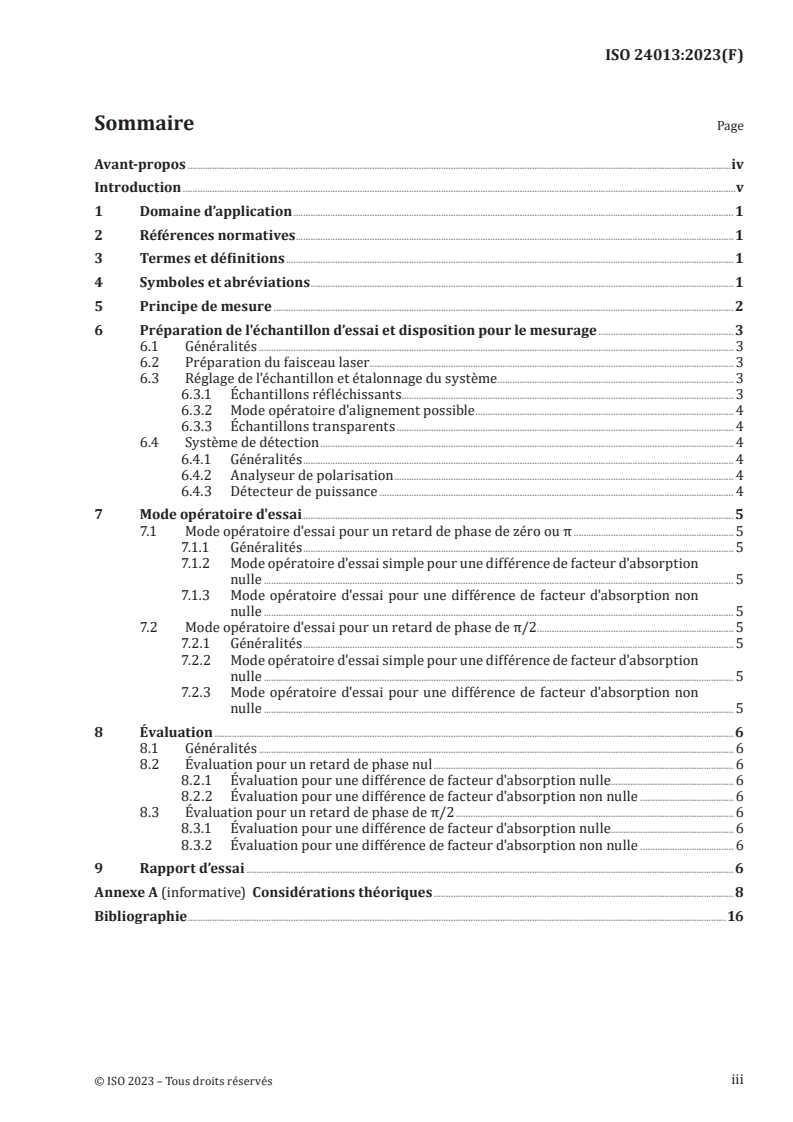
Contents Page
Foreword .iv
Introduction .v
1 Scope . 1
2 Normative references . 1
3 Terms and definitions . 1
4 Symbols and abbreviated terms.1
5 Measurement principle . 2
6 Preparation of test sample and measuring arrangement . 3
6.1 General . 3
6.2 Laser beam preparation . 3
6.3 Sample adjustment and system calibration . 3
6.3.1 Reflective samples . 3
6.3.2 Possible alignment procedure . 4
6.3.3 Transmissive samples . 4
6.4 Detection system . 4
6.4.1 General . 4
6.4.2 Polarization analyser . 4
6.4.3 Power detector . 4
7 Test procedure .5
7.1 Test procedure for zero or π phase retardation . 5
7.1.1 General . 5
7.1.2 Simple test procedure for zero absorptance difference . 5
7.1.3 Test procedure for non zero absorptance difference . 5
7.2 Test procedure for π/2 phase retardation . 5
7.2.1 General . 5
7.2.2 Simple test procedure for zero absorptance difference . 5
7.2.3 Test procedure for non zero absorptance difference . 5
8 Evaluation . 6
8.1 General . 6
8.2 Evaluation for zero phase retardation . 6
8.2.1 Evaluation for zero absorptance difference . 6
8.2.2 Evaluation for non-zero absorptance difference . 6
8.3 Evaluation for π/2 phase retardation . 6
8.3.1 Evaluation for zero absorptance difference . 6
8.3.2 Evaluation for non-zero absorptance difference . 6
9 Test report . 6
Annex A (informative) Theoretical background . 8
Bibliography .16
iii
Foreword
ISO (the International Organization for Standardization) is a worldwide federation of national standards
bodies (ISO member bodies). The work of preparing International Standards is normally carried out
through ISO technical committees. Each member body interested in a subject for which a technical
committee has been established has the right to be represented on that committee. International
organizations, governmental and non-governmental, in liaison with ISO, also take part in the work.
ISO collaborates closely with the International Electrotechnical Commission (IEC) on all matters of
electrotechnical standardization.
The procedures used to develop this document and those intended for its further maintenance are
described in the ISO/IEC Directives, Part 1. In particular, the different approval criteria needed for the
different types of ISO documents should be noted. This document was drafted in accordance with the
editorial rules of the ISO/IEC Directives, Part 2 (see www.iso.org/directives).
Attention is drawn to the possibility that some of the elements of this document may be the subject of
patent rights. ISO shall not be held responsible for identifying any or all such patent rights. Details of
any patent rights identified during the development of the document will be in the Introduction and/or
on the ISO list of patent declarations received (see www.iso.org/patents).
Any trade name used in this document is information given for the convenience of users and does not
constitute an endorsement.
For an explanation of the voluntary nature of standards, the meaning of ISO specific terms and
expressions related to conformity assessment, as well as information about ISO's adherence to
the World Trade Organization (WTO) principles in the Technical Barriers to Trade (TBT), see
www.iso.org/iso/foreword.html.
This document was prepared by Technical Committee ISO/TC 172, Optics and Photonics, Subcommittee
SC 9, Laser and electro-optical systems, in collaboration with the European Committee for Standardization
(CEN) Technical Committee CEN/TC 123, Lasers and photonics, in accordance with the agreement on
technical cooperation between ISO and CEN (Vienna Agreement).
This second edition cancels and replaces the first edition (ISO 24013:2006), which has been technically
revised.
The main changes are as follows:
— 6.3.3 was amended to add an additional step requiring that a transmitting optic be aligned so that
its optical axis is horizontal;
— Clauses 2 and 6.1 were amended to reflect that ISO 14644-1:1999 does not need the year;
— 6.3.1, (π/4 ± 2) mrad was changed to π/4 rad ± 2 mrad;
— 7.1 and 8.1 were updated to account for phase retardances close to π.
Any feedback or questions on this document should be directed to the user’s national standards body. A
complete listing of these bodies can be found at www.iso.org/members.html.
iv
Introduction
Normally it is desirable that the state of polarization be not influenced by the optical components used.
For the generation or maintenance of specific states of polarization the influence of optical components
on the beam polarization is crucial. For generating circularly polarized radiation from linearly polarized
radiation π/2 phase retarders are used.
This document describes methods to determine the relative phase retardation of optical components
with respect to the X- and Y-axes of the polarization and s- and p-polarization, respectively. This
document is necessary for optics manufacturers, suppliers and customers of such optics for the
determination of the influence of phase retardation of optical components.
v
INTERNATIONAL STANDARD ISO 24013:2023(E)
Optics and photonics — Lasers and laser-related
equipment — Measurement of phase retardation of optical
components for polarized laser radiation
1 Scope
This document specifies test methods for the determination of the linear optical phase retardation of
optical components by polarized laser beams.
2 Normative references
The following documents are referred to in the text in such a way that some or all of their content
constitutes requirements of this document. For dated references, only the edition cited applies. For
undated references, the latest edition of the referenced document (including any amendments) applies.
ISO 11145, Optics and photonics — Lasers and laser-related equipment — Vocabulary and symbols
ISO 12005, Lasers and laser-related equipment — Test methods for laser beam parameters — Polarization
3 Terms and definitions
For the purposes of this document, the terms and definitions given in ISO 11145 and ISO 12005 apply.
ISO and IEC maintain terminological databases for use in standardization at the following addresses:
— ISO Online browsing platform: available at https:// www .iso .org/ obp
— IEC Electropedia: available at https:// www .electropedia .org/
4 Symbols and abbreviated terms
Table 1 — Symbols used and units of measure
Symbol Term Unit
p degree of linear polarization 1
L
ϕ angle of analyser rad
a amplitude of electric field in X-direction V/m
a amplitude of electric field in Y-direction V/m
a, b principal axes of the polarization ellipse V/m
δ phase difference rad
Δδ phase retardation rad
E electric field vector amplitude V/m
P radiant power W
α absorptance in X-direction 1
X
α absorptance in Y-direction 1
Y
ψ angle of the principle axis of the polarization ellipse rad
5 Measurement principle
The optical component under test is irradiated by a laser beam with a defined state of polarization.
After passing the component the state of polarization of the beam is determined by using an analyser.
The phase retardation is then evaluated from the change of the state of polarization.
There are two cases to distinguish:
a) the expected phase retardation is near zero: in this case a circularly polarized beam shall be used
for the test;
b) the expected phase retardation is near π/2: in this case a linearly polarized beam shall be used for
the test.
Figure 1 shows the measuring set up.
a) Optical path for reflective samples
b) Optical path for transmissive samples
Key
1 radiation source
2 polarizer (linear or circular)
3 sample under test
4 analyser
5 detector
6 alignment laser
7 positional sensitive detector
Figure 1 — Schematic drawing of the measuring set up
A laser and a polarizer generating linearly or circularly polarized radiation shall be used in combination
with an analyser and a power detector. For measuring reflective samples an alignment laser in
combination with a positional sensitive detector ensures a reproducible angle alignment of the sample
under test.
6 Preparation of test sample and measuring arrangement
6.1 General
Storage, cleaning and the preparation of the test samples are carried out in accordance with the
manufacturer's instructions for normal use.
The environment of the testing place consists of dust-free filtered air with between 40 % and 60 %
relative humidity. It is recommended that the residual dust be reduced in accordance with, for example,
the clean-room ISO class 7 as specified in ISO 14644-1.
A linearly polarized and monochromatic source, such as a laser, shall be used as the radiation source. To
keep errors as low as possible, the beam power stability should be as high as possible.
Wavelength, angle of incidence and state of polarization of the laser radiation used for the measurement
shall correspond to the values specified by the manufacturer for the use of the test sample. If ranges
are accepted for these three quantities, any combination of wavelength, angle of incidence and state of
polarization may be chosen from these ranges.
6.2 Laser beam preparation
The accuracy of the measurement is strongly influenced by a clear definition of the state of polarization
of the laser beam. Therefore, it is necessary to prepare the polarization state of the probe beam (linearly
or circularly) carefully.
If the expected phase retardation is near π/2, a linearly polarized beam shall be used. The quantity
−3
(1 − p ), where p is the degree of linear polarization, shall be less than 10 . This shall be verified by
L L
using the analyser without the sample in the beam path.
NOTE 1 Such a state of polarization can be achieved by using a linearly polarized laser beam in combination
with additional polarizing elements.
If the expected phase retardation is near zero, a circularly polarized beam shall be used. The degree
−3
of linear polarization p shall be less than 10 . This shall be verified by using the analyser without the
L
sample in the beam path.
NOTE 2 Such a state of polarization can be achieved by using a linearly polarized laser beam in combination
with additional linearly polarizing elements and a π/2 phase retarding element.
All optical elements shall not increase the quantity (1 − p ) in the case of a linearly polarized beam
L
−3
and p in the case of a circularly polarized beam, by more than 10 . For this reason, the use of folding
L
mirrors in the test setup is discouraged and all other optical elements shall be used under normal
incidence.
6.3 Sample adjustment and system calibration
6.3.1 Reflective samples
The sample shall be mounted very accurately at the angle of incidence according to the manufacturer's
specification. The deviation from the intended angle of use shall be less than 2 mrad. For this purpose
the
...
NORME ISO
INTERNATIONALE 24013
Deuxième édition
2023-06
Optique et photonique — Lasers et
équipements associés aux lasers
— Mesurage du retard de phase
des composants optiques pour le
rayonnement laser polarisé
Optics and photonics — Lasers and laser-related equipment —
Measurement of phase retardation of optical components for
polarized laser radiation
Numéro de référence
DOCUMENT PROTÉGÉ PAR COPYRIGHT
© ISO 2023
Tous droits réservés. Sauf prescription différente ou nécessité dans le contexte de sa mise en œuvre, aucune partie de cette
publication ne peut être reproduite ni utilisée sous quelque forme que ce soit et par aucun procédé, électronique ou mécanique,
y compris la photocopie, ou la diffusion sur l’internet ou sur un intranet, sans autorisation écrite préalable. Une autorisation peut
être demandée à l’ISO à l’adresse ci-après ou au comité membre de l’ISO dans le pays du demandeur.
ISO copyright office
Case postale 401 • Ch. de Blandonnet 8
CH-1214 Vernier, Genève
Tél.: +41 22 749 01 11
E-mail: copyright@iso.org
Web: www.iso.org
Publié en Suisse
ii
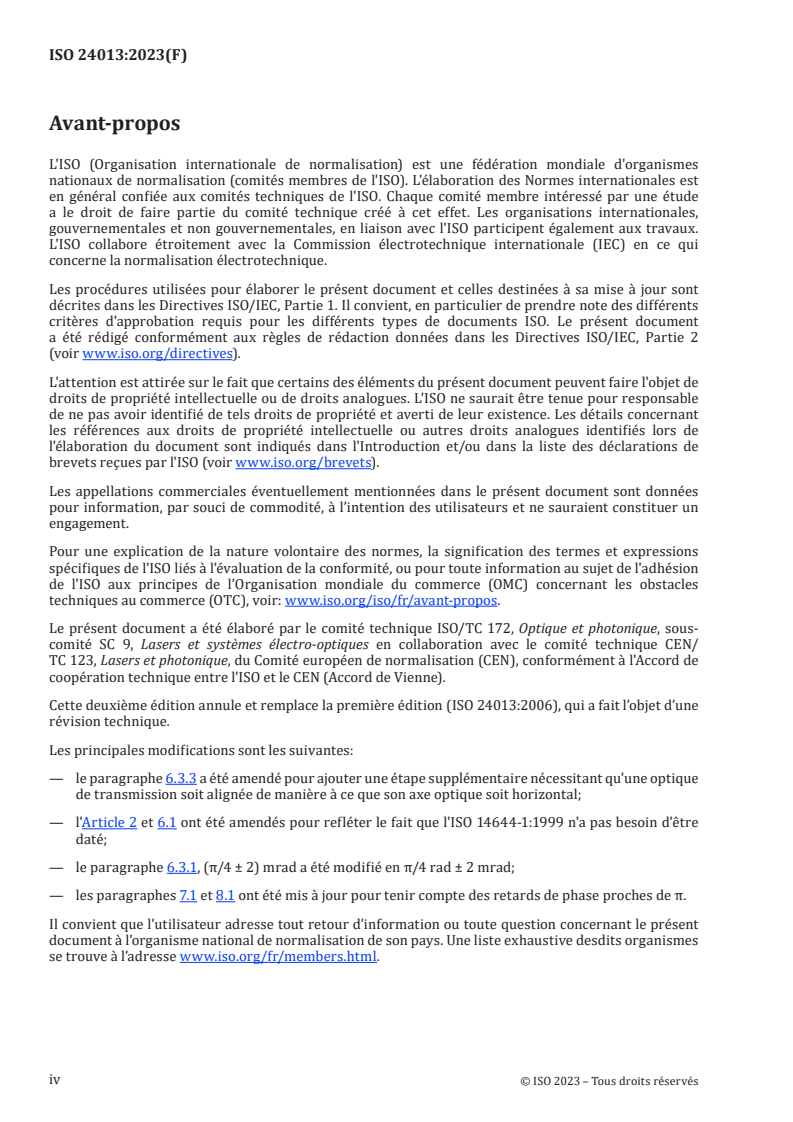
Sommaire Page
Avant-propos .iv
Introduction .v
1 Domaine d’application . 1
2 Références normatives .1
3 Termes et définitions . 1
4 Symboles et abréviations .1
5 Principe de mesure . 2
6 Préparation de l'échantillon d’essai et disposition pour le mesurage .3
6.1 Généralités . 3
6.2 Préparation du faisceau laser . . 3
6.3 Réglage de l'échantillon et étalonnage du système . 3
6.3.1 Échantillons réfléchissants . . 3
6.3.2 Mode opératoire d'alignement possible . 4
6.3.3 Échantillons transparents . 4
6.4 Système de détection . 4
6.4.1 Généralités . 4
6.4.2 Analyseur de polarisation . 4
6.4.3 Détecteur de puissance . 4
7 Mode opératoire d'essai . 5
7.1 Mode opératoire d'essai pour un retard de phase de zéro ou π . 5
7.1.1 Généralités . 5
7.1.2 Mode opératoire d'essai simple pour une différence de facteur d'absorption
nulle . 5
7.1.3 Mode opératoire d'essai pour une différence de facteur d'absorption non
nulle . 5
7.2 Mode opératoire d'essai pour un retard de phase de π/2 . . 5
7.2.1 Généralités . 5
7.2.2 Mode opératoire d'essai simple pour une différence de facteur d'absorption
nulle . 5
7.2.3 Mode opératoire d'essai pour une différence de facteur d'absorption non
nulle . 5
8 Évaluation . 6
8.1 Généralités . 6
8.2 Évaluation pour un retard de phase nul . 6
8.2.1 Évaluation pour une différence de facteur d'absorption nulle. 6
8.2.2 Évaluation pour une différence de facteur d'absorption non nulle . 6
8.3 Évaluation pour un retard de phase de π/2 . 6
8.3.1 Évaluation pour une différence de facteur d'absorption nulle. 6
8.3.2 Évaluation pour une différence de facteur d'absorption non nulle . 6
9 Rapport d’essai . 6
Annexe A (informative) Considérations théoriques . 8
Bibliographie .16
iii
Avant-propos
L'ISO (Organisation internationale de normalisation) est une fédération mondiale d'organismes
nationaux de normalisation (comités membres de l'ISO). L'élaboration des Normes internationales est
en général confiée aux comités techniques de l'ISO. Chaque comité membre intéressé par une étude
a le droit de faire partie du comité technique créé à cet effet. Les organisations internationales,
gouvernementales et non gouvernementales, en liaison avec l'ISO participent également aux travaux.
L'ISO collabore étroitement avec la Commission électrotechnique internationale (IEC) en ce qui
concerne la normalisation électrotechnique.
Les procédures utilisées pour élaborer le présent document et celles destinées à sa mise à jour sont
décrites dans les Directives ISO/IEC, Partie 1. Il convient, en particulier de prendre note des différents
critères d'approbation requis pour les différents types de documents ISO. Le présent document
a été rédigé conformément aux règles de rédaction données dans les Directives ISO/IEC, Partie 2
(voir www.iso.org/directives).
L'attention est attirée sur le fait que certains des éléments du présent document peuvent faire l'objet de
droits de propriété intellectuelle ou de droits analogues. L'ISO ne saurait être tenue pour responsable
de ne pas avoir identifié de tels droits de propriété et averti de leur existence. Les détails concernant
les références aux droits de propriété intellectuelle ou autres droits analogues identifiés lors de
l'élaboration du document sont indiqués dans l'Introduction et/ou dans la liste des déclarations de
brevets reçues par l'ISO (voir www.iso.org/brevets).
Les appellations commerciales éventuellement mentionnées dans le présent document sont données
pour information, par souci de commodité, à l’intention des utilisateurs et ne sauraient constituer un
engagement.
Pour une explication de la nature volontaire des normes, la signification des termes et expressions
spécifiques de l'ISO liés à l'évaluation de la conformité, ou pour toute information au sujet de l'adhésion
de l'ISO aux principes de l’Organisation mondiale du commerce (OMC) concernant les obstacles
techniques au commerce (OTC), voir: www.iso.org/iso/fr/avant-propos.
Le présent document a été élaboré par le comité technique ISO/TC 172, Optique et photonique, sous-
comité SC 9, Lasers et systèmes électro-optiques en collaboration avec le comité technique CEN/
TC 123, Lasers et photonique, du Comité européen de normalisation (CEN), conformément à l'Accord de
coopération technique entre l'ISO et le CEN (Accord de Vienne).
Cette deuxième édition annule et remplace la première édition (ISO 24013:2006), qui a fait l’objet d’une
révision technique.
Les principales modifications sont les suivantes:
— le paragraphe 6.3.3 a été amendé pour ajouter une étape supplémentaire nécessitant qu'une optique
de transmission soit alignée de manière à ce que son axe optique soit horizontal;
— l'Article 2 et 6.1 ont été amendés pour refléter le fait que l'ISO 14644-1:1999 n'a pas besoin d'être
daté;
— le paragraphe 6.3.1, (π/4 ± 2) mrad a été modifié en π/4 rad ± 2 mrad;
— les paragraphes 7.1 et 8.1 ont été mis à jour pour tenir compte des retards de phase proches de π.
Il convient que l’utilisateur adresse tout retour d’information ou toute question concernant le présent
document à l’organisme national de normalisation de son pays. Une liste exhaustive desdits organismes
se trouve à l’adresse www.iso.org/fr/members.html.
iv
Introduction
De manière générale, il est souhaitable que l'état de polarisation ne soit pas influencé par les composants
optiques utilisés. L'influence des composants optiques sur la polarisation du faisceau est déterminante
pour générer ou entretenir des états de polarisation spécifiques. Pour générer un rayonnement à
polarisation circulaire à partir d'un rayonnement à polarisation linéaire, des retardateurs de phase de
π/2 sont utilisés.
Le présent document décrit des méthodes pour déterminer le retard de phase relatif des composants
optiques par rapport aux axes X et Y de polarisation et à la polarisation s et p, respectivement. Le
présent document permet aux fabricants et aux fournisseurs de composants optiques, ainsi qu'à leurs
clients, de déterminer l'influence du retard de phase des composants optiques.
v
NORME INTERNATIONALE ISO 24013:2023(F)
Optique et photonique — Lasers et équipements associés
aux lasers — Mesurage du retard de phase des composants
optiques pour le rayonnement laser polarisé
1 Domaine d’application
Le présent document spécifie des méthodes d'essai pour la détermination du retard de phase optique
linéaire de composants optiques par rapport aux faisceaux laser polarisés.
2 Références normatives
Les documents suivants sont cités dans le texte de sorte qu’ils constituent, pour tout ou partie de leur
contenu, des exigences du présent document. Pour les références datées, seule l'édition citée s'applique.
Pour les références non datées, la dernière édition du document de référence s'applique (y compris les
éventuels amendements).
ISO 11145, Optique et photonique — Lasers et équipements associés aux lasers — Vocabulaire et symboles
ISO 12005, Lasers et équipements associés aux lasers — Méthodes d'essai des paramètres du faisceau
laser — Polarisation
3 Termes et définitions
Pour les besoins du présent document, les termes et définitions donnés dans l'ISO 11145 et dans
l'ISO 12005 s'appliquent.
L’ISO et l’IEC tiennent à jour des bases de données terminologiques destinées à être utilisées en
normalisation, consultables aux adresses suivantes:
— ISO Online browsing platform: disponible à l’adresse https:// www .iso .org/ obp
— IEC Electropedia: disponible à l’adresse https:// www .electropedia .org/
4 Symboles et abréviations
Tableau 1 — Symboles utilisés et unités de mesure
Symbole Terme Unité
p degré de polarisation linéaire 1
L
ϕ angle de l’analyseur rad
a amplitude du champ électrique dans la direction X V/m
a amplitude du champ électrique dans la direction Y V/m
a, b axes principaux de l'ellipse de polarisation V/m
δ déphasage rad
Δδ retard de phase rad
E amplitude du vecteur champ électrique V/m
P flux énergétique W
α facteur d'absorption dans la direction X 1
X
α facteur d'absorption dans la direction Y 1
Y
TTabableleaauu 1 1 ((ssuuiitte)e)
Symbole Terme Unité
ψ angle de l'axe principal de l'ellipse de polarisation rad
5 Principe de mesure
Le composant optique soumis à essai est irradié par un faisceau laser dont l'état de polarisation est
défini. Après le passage à travers le composant, l'état de polarisation du faisceau est déterminé
en utilisant un analyseur. Le retard de phase est ensuite évalué à partir du changement de l'état de
polarisation.
Deux cas se distinguent:
a) le retard de phase prévu est proche de zéro: dans ce cas, un faisceau à polarisation circulaire doit
être utilisé pour l'essai;
b) le retard de phase prévu est proche de π/2: dans ce cas, un faisceau à polarisation linéaire doit être
utilisé pour l'essai.
L'installation de mesure est illustrée à la Figure 1.
a) Trajet optique pour les échantillons réfléchissants
b) Trajet optique pour les échantillons transparents
Légende
1 source de rayonnement
2 polariseur (linéaire ou circulaire)
3 échantillon soumis à essai
4 analyseur
5 détecteur
6 laser d'alignement
7 détecteur de position
Figure 1 — Schéma de l'installation de mesure
Un laser et un polariseur générant un rayonnement à polarisation circulaire ou linéaire doivent
être utilisés conjointement à un analyseur et à un détecteur de puissance. Lorsque des échantillons
réfléchissants sont mesurés, l'utilisation d'un laser d'alignement associé à un détecteur de position
permet de garantir un alignement angulaire reproductible de l'échantillon soumis à essai.
6 Préparation de l'échantillon d’essai et disposition pour le mesurage
6.1 Généralités
Le stockage, le nettoyage et la préparation des échantillons d’essai sont réalisés conformément aux
instructions du fabricant pour l'utilisation normale.
L'environnement du local d'essai est constitué d'air filtré exempt de poussière avec une humidité
relative entre 40 % et 60 %. Il est recommandé que la poussière résiduelle soit réduite conformément à,
par exemple, la Classe ISO 7 des salles propres, tel que spécifié dans l'ISO 14644-1.
Une source à polarisation linéaire et monochromatique, telle qu’un laser, doit être utilisée comme
source de rayonnement. Pour maintenir un niveau d'erreurs aussi bas que possible, il convient que la
stabilité de la puissance du faisceau soit la plus élevée possible.
La longueur d'onde, l'angle d'incidence et l'état de polarisation du rayonnement laser utilisé pour le
mesurage doivent correspondre aux valeurs spécifiées par le fabricant pour l'utilisation de l'échantillon
d’essai. Si des plages sont acceptées pour ces trois quantités, toute combinaison de longueur d'onde,
d'angle d'incidence et d'état de polarisation peut être choisie dans les limites de ces plages.
6.2 Préparation du faisceau laser
Une définition claire de l'état de polarisation du faisceau laser a une influence considérable sur
l'exactitude de mesure. Par conséquent, il est nécessaire de préparer soigneusement l'état de
polarisation du faisceau sonde (linéaire ou circulaire).
Si le retard de phase prévu est proche de π/2, un faisceau à polarisation linéaire doit être utilisé. La
−3
quantité (1 − p ), où p est le degré de polarisation linéaire, doit être inférieure à 10 . Cela doit être
L L
vérifié en utilisant un analyseur sans échantillon sur le trajet du faisceau.
NOTE 1 Un tel état de polarisation peut être obtenu en utilisant un faisceau laser à polarisation linéaire
conjointement à d'autres éléments polarisants.
Si le retard de phase prévu est proche de zéro, un faisceau à polarisation circulaire doit être utilisé. Le
−3
degré de polarisation linéaire p doit être inférieur à 10 . Cela doit être vérifié en utilisant un analyseur
L
sans échantillon sur le trajet du faisceau.
NOTE 2 Un tel état de polarisation peut être obtenu en utilisant un faisceau laser à polarisation linéaire
conjointement à d'autres éléments polarisants linéaires et à un élément de retardement de phase de π/2.
L'ensemble des dispositifs optiques ne doit pas entraîner une augmentation de la grandeur (1 − p ) pour
L
−3
un faisceau à polarisation linéaire, et p pour un faisceau à polarisation circulaire, de plus de 10 . À
L
cet effet, l'utilisation de miroirs de renvoi dans le montage d'essai est déconseillée et tous les autres
dispositifs optiques doivent être utilisés sous une incidence normale.
6.3 Réglage de l'échantillon et étalonnage du système
6.3.1 Échantillons réfléchissants
L'échantillon doit être monté avec une grande exactitude à l'angle d'incidence spécif
...