

ISO/TS 12769
(Main)Nanotechnologies — Phytotoxicity assessment of manufactured nanomaterials using soil grown Arabidopsis thaliana
- Abstract
This document describes a method for rapidly assessing the phytotoxicity of MNMs in the soil. It includes information on the advantages of using the plant Arabidopsis thaliana and a complete protocol for the toxicity assessment of MNMs using this plant.
- Status
- Not Published
- Technical Committee
- ISO/TC 229 - Nanotechnologies
- Current Stage
- 6000 - International Standard under publication - 60 Publication
- Start Date
- 21-Oct-2026
Buy Documents

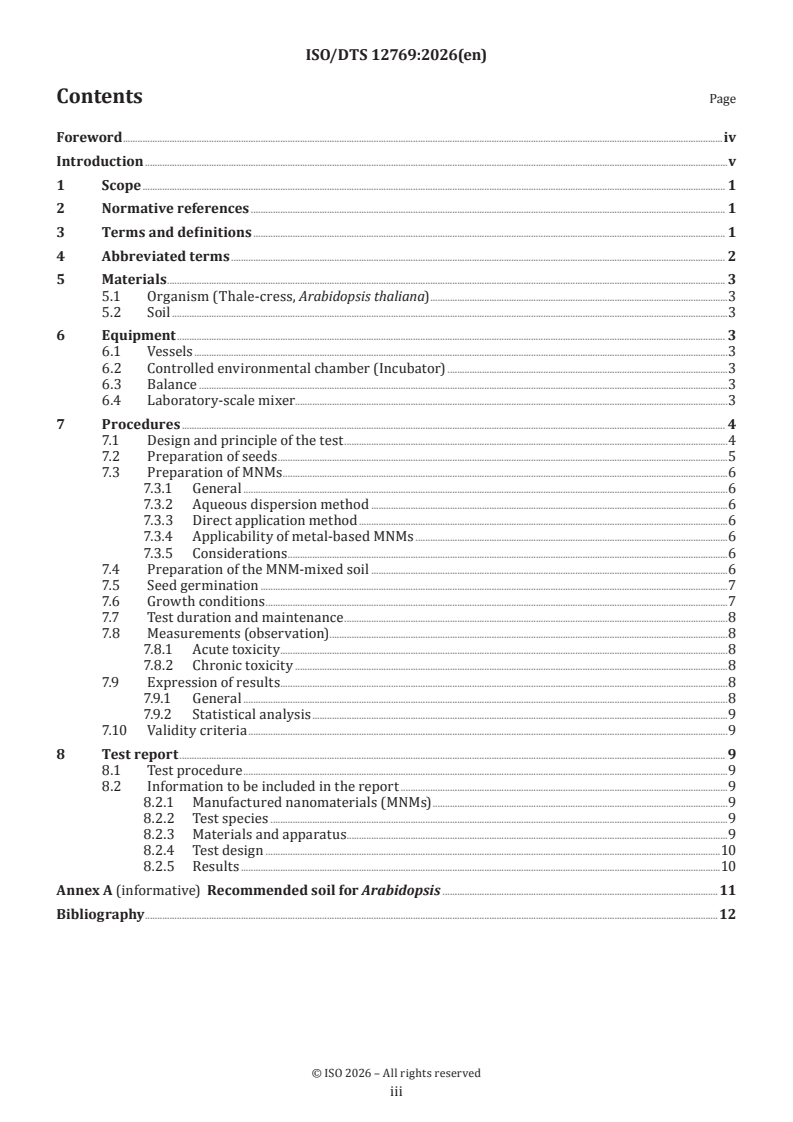

ISO/DTS 12769 - Nanotechnologies — Phytotoxicity assessment of manufactured nanomaterials using soil grown Arabidopsis thaliana

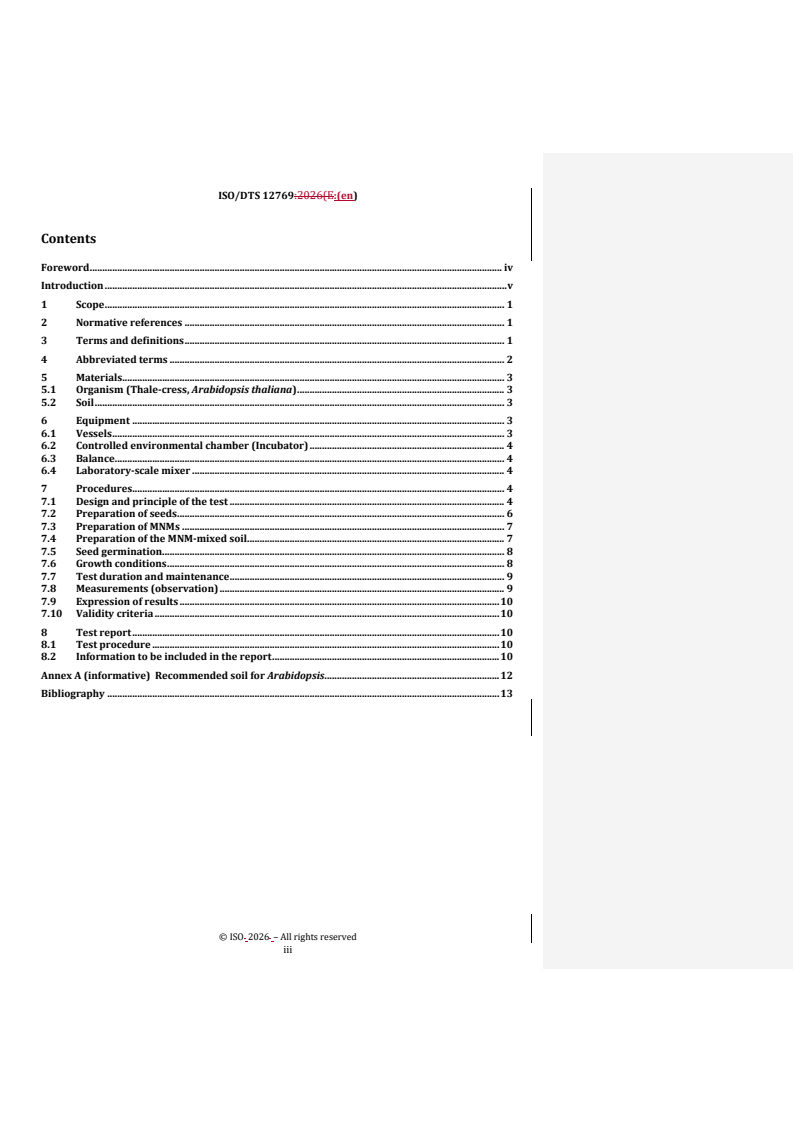
REDLINE ISO/DTS 12769 - Nanotechnologies — Phytotoxicity assessment of manufactured nanomaterials using soil grown Arabidopsis thaliana
ISO/TS 12769 is an ISO technical specification for assessing the phytotoxicity of manufactured nanomaterials (MNM) in soil using Arabidopsis thaliana (A. thaliana). It sets out a laboratory method, the materials and equipment needed, the test sequence, the endpoints to measure, and the way to report results. The document is aimed at labs and technical teams that need a repeatable way to judge how MNMs affect a soil-grown terrestrial plant.
What does ISO/TS 12769 specify?
ISO/TS 12769 specifies a rapid phytotoxicity test for MNMs using soil-grown A. thaliana, and it recommends standardized soil to improve comparability between tests. The document is organized into clauses on scope, normative references, terms, abbreviated terms, materials, equipment, procedures, and test report, with informative Annex A covering recommended soil for Arabidopsis.
The method is centered on a single model plant and on soil exposure, so readers can use the same setup to compare different MNMs under controlled conditions. In practice, that makes it useful for screening and for building a concentration-response dataset with consistent growth conditions.
What are the key requirements of ISO/TS 12769?
ISO/TS 12769 combines test design, sample preparation, plant handling, growth control, measurement, and reporting requirements into one protocol. The points below are the main parts that shape how the test is run and how results are interpreted.
Test design and endpoints
Clause 7.1 describes acute and chronic toxicity testing. Acute exposure focuses on germination rate and root elongation, while chronic exposure adds endpoints such as plant viability and dry shoot biomass. The test can be run as a single-concentration limit test or as a multi-concentration study to produce a dose-response curve and calculate ECx and NOEC values.
MNM preparation and controls
Clause 7.3 requires the user to choose between an aqueous dispersion method and direct application to soil, depending on the MNM’s stability, dissolution, and dispersibility. Solubilizing agents are not recommended, because they can change the behavior of the MNMs and affect the result. For metal-based MNMs, the test design includes a non-MNM control containing the same dissolved ions, so the laboratory can distinguish particle effects from ion effects.
Soil preparation and pot conditions
Clause 7.4 requires the MNM-treated soil to be mixed thoroughly, kept at suitable moisture, and checked for pH after mixing. The soil pH is adjusted into the range suitable for A. thaliana if needed, so that plant stress from the soil itself does not mask MNM effects. Clause 6.1 also requires non-porous pots with parallel sides and a perforated base, which helps prevent adsorption and root restriction.
Plant handling and growth conditions
Clauses 7.5 to 7.7 describe seed sterilization, sowing, replication, and controlled growth. The document uses three sterilized seeds per pot, ten replicates per group, random pot placement, and a controlled environment chamber. Table 1 gives the recommended day and night conditions for light, temperature, humidity, and carbon dioxide, and the test continues for 10 days in acute exposure or 24 days in chronic exposure.
Observation, statistics, and validity
Clause 7.8 covers the observations to record. Acute testing uses germination and root length; chronic testing includes visible phytotoxicity such as chlorosis and necrosis, stunting, survival, and dry shoot weight. Clause 7.9 requires appropriate statistics, including variance checking, ANOVA when suitable, and non-parametric tests where needed. Clause 7.10 sets control-performance criteria, so the run is only accepted when the control plants grow normally enough for the results to be meaningful.
What terms does ISO/TS 12769 define?
- ECx - the calculated concentration expected to produce x percent effect.
- NOEC - the highest tested concentration with no statistically significant effect.
- Range-finding test - a preliminary broad-concentration test used to choose concentrations for the definitive study.
- Manufactured nanomaterial (MNM) - a nanomaterial intentionally produced to have selected properties or composition.
- Aggregation - strongly bonded or fused particles whose combined external surface area is smaller than the sum of the individual parts.
- Suspension - a heterogeneous mixture of a liquid and finely dispersed solid material.
- DI - deionized water, used for preparation, washing, and moisture control.
Who uses ISO/TS 12769?
ISO/TS 12769 is used by laboratories that test nanomaterial effects on plants, environmental and ecotoxicology teams, and researchers studying terrestrial plant responses to engineered nanomaterials. It is also relevant to quality, regulatory, and development teams that need comparable phytotoxicity data for MNMs. In practice, they use it to screen materials, compare formulations, select test concentrations, and document environmental hazard data.
Which standards are used with ISO/TS 12769?
ISO/TS 12769 relies on several companion documents for terminology and test context:
- ISO 11269-1:2012 - provides the root-growth inhibition method for soil flora.
- ISO 11269-2:2013 - covers effects of contaminated soil on emergence and early growth of higher plants.
- ISO 80004-1 - supplies core nanotechnology vocabulary.
- ISO 80004-6 - supplies nano-object characterization vocabulary.
- ISO/TR 18196 - supports the measurement technique matrix for nano-object characterization.
- OECD TG 208 and OECD TG 227 - provide terrestrial plant test frameworks used in the terminology and test context.
- US EPA OCSPP 850.4230 and US EPA OCSPP 850.4100 - provide related early seedling and seedling emergence test guidance.
What does the ISO/TS 12769 document contain?
ISO/TS 12769 contains a flowchart for acute and chronic phytotoxicity testing, a table of recommended growth conditions, and a reporting structure for test results. Clause 8 lists the information to include in the test report, including the test substance, seed origin, apparatus, soil characteristics, treatment design, and measured endpoints. Annex A provides recommended soil characteristics for Arabidopsis, and the bibliography points to supporting methods for dispersion stability, characterization, and plant-response measurements.
Buy Documents
ISO/DTS 12769 - Nanotechnologies — Phytotoxicity assessment of manufactured nanomaterials using soil grown Arabidopsis thaliana
REDLINE ISO/DTS 12769 - Nanotechnologies — Phytotoxicity assessment of manufactured nanomaterials using soil grown Arabidopsis thaliana
Frequently Asked Questions
ISO/TS 12769 is a draft published by the International Organization for Standardization (ISO). Its full title is "Nanotechnologies — Phytotoxicity assessment of manufactured nanomaterials using soil grown Arabidopsis thaliana". This standard covers: This document describes a method for rapidly assessing the phytotoxicity of MNMs in the soil. It includes information on the advantages of using the plant Arabidopsis thaliana and a complete protocol for the toxicity assessment of MNMs using this plant.
This document describes a method for rapidly assessing the phytotoxicity of MNMs in the soil. It includes information on the advantages of using the plant Arabidopsis thaliana and a complete protocol for the toxicity assessment of MNMs using this plant.
ISO/TS 12769 is classified under the following ICS (International Classification for Standards) categories: 07.120 - Nanotechnologies. The ICS classification helps identify the subject area and facilitates finding related standards.
ISO/TS 12769 is available in PDF format for immediate download after purchase. The document can be added to your cart and obtained through the secure checkout process. Digital delivery ensures instant access to the complete standard document.
Standards Content (Sample)
Contents
- Introduction
- 1 Scope
- 2 Normative references
- 3 Terms and definitions
- 3.1 ECx
- 3.2 no observed effect concentration
- 3.3 range-finding test
- 3.4 monocotyledon
- 3.5 dicotyledon
- 3.6 shoot
- 3.7 manufactured nanomaterial
- 3.8 aggregation
- 3.9 suspension
- 4 Abbreviated terms
- 5 Materials
- 5.1 Organism (Thale-cress, Arabidopsis thaliana)
- 5.2 Soil
- 6 Equipment
- 6.1 Vessels
- 6.2 Controlled environmental chamber (Incubator)
- 6.3 Balance
- 6.4 Laboratory-scale mixer
- 7 Procedures
- 7.1 Design and principle of the test
- 7.2 Preparation of seeds
- 7.3 Preparation of MNMs
- 7.4 Preparation of the MNM-mixed soil
- 7.5 Seed germination
- 7.6 Growth conditions
- 7.7 Test duration and maintenance
- 7.8 Measurements (observation)
- 7.9 Expression of results
- 7.10 Validity criteria
- 8 Test report
- 8.1 Test procedure
- 8.2 Information to be included in the report
- Annex A
- Bibliography
Introduction
With the recent increase in industrial demand for manufactured nanomaterials (MNMs), efforts to [1][2][3][4] understand the environmental risks of MNMs have also been steadily increasing. Phytotoxicity assays are essential and widely used tools for evaluating the toxicity of chemicals in the terrestrial environment.
Most of studies applied the existing methods for assessing the toxicity of available chemical substances as it is or slightly modified. Additionally, the test organisms used for the toxicity assessment of MNMs are mainly aquatic organisms such as algae, daphnia, fish, etc. The Organization for Economic Cooperation and Development (OECD) is working on updating its toxicity test guidelines to ensure their applicability to nanomaterials. The existing test guideline addressing effects to plants (e.g., OECD TG 208, 227, etc.) consider various environmental conditions and situations such as pollutants, climate, and plant species. This document provides an optimized procedure to test the MNMs toxicity and recommendations for conducting phytotoxicity assays in the soil.
It is important to note that the method might not be applicable to other types of plants. This document provides a method for evaluating the phytotoxicity of nanomaterials using plants, which was not included in previous standards.
FINAL DRAFT Technical Specification ISO/DTS 12769:2026(en) Nanotechnologies — Phytotoxicity assessment of manufactured nanomaterials using soil grown Arabidopsis thaliana
1 Scope
This document describes a method for rapidly assessing the phytotoxicity of MNMs using the soil grown Arabidopsis thaliana. It includes information on the advantages of using the plant Arabidopsis thaliana and a complete protocol for the phytotoxicity assessment of MNMs using this plant species. Additionally, this document suggests the use of standardized soil in the experiment for consistency of experimental results.
2 Normative references
The following documents are referred to in the text in such a way that some or all of their content constitutes requirements of this document. For dated references, only the edition cited applies. For undated references, the latest edition of the referenced document (including any amendments) applies. ISO 11269-1, Soil quality — Determination of the effects of pollutants on soil flora — Part 1: Method for the measurement of inhibition of root growth ISO 11269-2, Soil quality –Determination of the effects of pollutants on soil flora, Part 2: Effects of contaminated soil on the emergence and early growth of higher plants ISO 80004-1, Nanotechnologies – Vocabulary — Part 1: Core vocabulary ISO 80004-6, Nanotechnologies — Vocabulary — Part 6: Nano-object characterization ISO/TR 18196, Nanotechnologies — Measurement technique matrix for the characterization of nano-objects OECD. Test No. 208: Terrestrial Plant Test: Seedling Emergence and Seedling Growth Test. OECD Guidelines for the Testing of Chemicals. Section 2. OECD Publishing, Paris, 2006 OECD. Test No. 227: Terrestrial Plant Test: Vegetative Vigour Test. OECD Guidelines for the Testing of Chemicals. Section 2. OECD Publishing, Paris, 2006 US EPA Ecological Effects Test Guidelines OCSPP 850.4230: Early Seedling Growth Toxicity Test, 2012 US EPA Ecological Effects Test Guidelines OCSPP 850.4100: Seedling Emergence and Seedling Growth, 2012
3 Terms and definitions
For the purposes of this document, the terms and definitions given in ISO 11269-1, ISO 11269-2, ISO 80004-1, ISO 80004-6, ISO/TR 18196, OECD TG 208, EPA OCSPP 850.4230, and EPA OCSPP 850.4100 and the following apply.
ISO and IEC maintain terminology databases for use in standardization at the following addresses:
- ISO Online browsing platform: available at https:// www .iso .org/ obp
- IEC Electropedia: available at https:// www .electropedia .org/
3.1 ECx
calculated concentration from which an effect of x % is expected
ISO/DTS 12769:2026(en)
3.2 no observed effect concentration
NOEC highest concentration of the test substance at which no effect was observed Note 1 to entry: In the test, the concentration corresponding to the NOEC, has no statistically significant effect (p < 0,05) within a given exposure period when compared to the control.
3.3 range-finding test
abbreviated acute test that exposes test organisms to a broad range of nanomaterial testing solutions to establish the range of concentrations to be used in the definitive test
3.4 monocotyledon
flowering that seed has only one embryonic leaf or cotyledon
3.5 dicotyledon
flowering plant that seed has two embryonic leaves or cotyledon
3.6 shoot
all portions of the plant above the soil surface (i.e., doesn’t include root)
3.7 manufactured nanomaterial
MNM nanomaterial intentionally produced to have selected properties or composition [SOURCE: ISO 80004-1:2023, 3.1.9]
3.8 aggregation
strongly bonded or fused particles where the resulting external surface area is significantly smaller than the sum of surface areas of the individual components
3.9 suspension
heterogeneous mixture of materials comprising a liquid and a finely dispersed solid material
4 Abbreviated terms
TG test guideline DI deionized SEM scanning electron microscopy TEM transmission electron microscopy DLS dynamic light scattering ICP-MS inductively coupled plasma – mass spectrometry
ISO/DTS 12769:2026(en)
5 Materials
5.1 Organism (Thale-cress, Arabidopsis thaliana)
Arabidopsis thaliana (A. thaliana) is a small flowering plant native to Eurasia and Africa. This plant is easily found anywhere in the world. It has been used extensively as a model for terrestrial plants, especially because of its small genome. A. thaliana has the following advantages for use in phytotoxicity assays:
- small size (convenient for cultivation in a small space);
- rapid life cycle (6 wks from germination to maturity);
- produce many seeds (selfing nature);
- small genome size (120 MB to130 MB; the first plant to have its genome fully sequenced);
- little tolerance to pollutants (i.e., reacts sensitively to the toxic substances). A. thaliana has a short growth period and relatively easy cultivation which is beneficial for obtaining rapid experimental data.
NOTE In addition to one dicotyledonous species (A. thaliana), other monocotyledonous plant species (e.g., barley, corn, etc.) can be selected for more specific testing. This is because it has been recognized that the uptake rates and mechanism of nanomaterials into plants differ due to the difference between plant groups (e.g., monocotyledon vs. dicotyledon).
5.2 Soil
The soil selected for assessing phytotoxicity should have a pH range that is non-toxic to the test species. For example, for Arabidopsis thaliana, the pH should be between 5 and 6. The soil must be sieved through a 2 mm screen to remove coarse particles, and the organic matter content should not exceed 5 % (1,66 ± 0,60). The mineral contents of the soil such as nitrate, phosphorus, potassium, calcium, magnesium should be characterized by using ICP-MS and reported. Other physicochemical properties of the soil are determined according to ISO 11269-2.
6 Equipment
6.1 Vessels
Test vessels should be non-porous so that the test MNMs are not adsorbed and do not react in any way with the container. Glass containers with drainage holes can be used as plant pots. Polypropylene pots are also acceptable test vessels. The test vessels shall be cylindrical or tetrahedral, at least 6 cm in diameter (length and breadth) and 7 cm in height, and shall have parallel sides to ensure that the roots of seedlings are not restricted and do not encounter tapering side walls. The base of the pots shall be perforated and covered with filter paper.
6.2 Controlled environmental chamber (Incubator)
Phytotron suitable for controlling the specified conditions (temperature, photoperiod, humidity, light intensity).
6.3 Balance
Two balances are required; one is for general use with an accuracy of 0,1 g, and the other for heavy weighing (e.g., 10 kg).
6.4 Laboratory-scale mixer
Used to mix MNMs with soil.
ISO/DTS 12769:2026(en)
7 Procedures
7.1 Design and principle of the test
The procedure assesses the acute and chronic toxicity of MNMs on Arabidopsis plants following exposure in standard soil. Seeds are placed in contact with the soil treated with the MNMs and evaluated for the effects following typically 10 d (acute) to 24 d (chronic) after 70 % emergence of the seedling in the control group. Endpoints measure the germination rate and root elongation in the case of the acute toxicity test. For chronic toxicity test, the viability and dry shoot weight biomass can be measured. Further measurements such as gas exchange in the leaves, chlorophyll content, number of flowers, silique count, and other may be undertaken, however, the procedures are included in this standardized method. These measurements are compared to the untreated control group and the non-MNM control (i.e., consisting of the same ions dissolved from MNMs). After mixing MNMs in the soil, the soil is transferred into pots and then seeds of the Arabidopsis are directly planted in the soil. All experimental groups and controls are then placed under appropriate conditions to support germination and growth of the plants. The test can be conducted to determine the dose-response curve or at a single concentration as a limit test according to the aim of the study. If results from the single concentration test exceed a certain toxicity level (e.g., whether effects more significant than x % (or mg/kg soil) are observed), a range-finding test is carried out to determine upper and lower limits for toxicity followed by multiple concentration tests to generate a dose-response curve. An appropriate statistical analysis is used to obtain the effective concentration ECx (e.g., EC , EC ) for the most sensitive parameter(s) of interest. Also, the no observed effect concentration 25 50 (NOEC) can be calculated in this test.
Figure 1 illustrates, in flowchart form, procedures for carrying out acute and chronic phytotoxicity testing.
ISO/DTS 12769:2026(en)
a DAE: days after 70 % emergence of the seedling in the control group. Figure 1 — Procedures of acute and chronic phytotoxicity test methods
7.2 Preparation of seeds
The Arabidopsis species should be selected as a wild-type of A. thaliana to compare reliable results everywhere. Additionally, wild-type seeds are readily available from standard seed sources worldwide. These uniformed seeds can also give reproducible results within and across testing facilities. Seeds should be stored in a desiccator and refrigerated until needed.
ISO/DTS 12769:2026(en)
...
Contents
- Introduction
- 1 Scope
- 2 Normative references
- 3 Terms and definitions
- 4 Abbreviated terms
- 5 Materials
- 5.1 Organism (Thale-cress, Arabidopsis thaliana)
- 5.2 Soil
- 6 Equipment
- 6.1 Vessels
- 6.2 Controlled environmental chamber (Incubator)
- 6.3 Balance
- 6.4 Laboratory-scale mixer
- 7 Procedures
- 7.1 Design and principle of the test
- 7.2 Preparation of seeds
- 7.3 Preparation of MNMs
- 7.4 Preparation of the MNM-mixed soil
- 7.5 Seed germination
- 7.6 Growth conditions
- 7.7 Test duration and maintenance
- 7.8 Measurements (observation)
- 7.9 Expression of results
- 7.10 Validity criteria
- 8 Test report
- 8.1 Test procedure
- 8.2 Information to be included in the report
- Annex A
- Bibliography
Introduction
With the recent increase in industrial demand for manufactured nanomaterials (MNMs), efforts to understand [1] [2] [3] [4] the environmental risks of MNMs have also been steadily increasing [1][2][3][4].. Phytotoxicity assays are essential and widely used tools for evaluating the toxicity of chemicals in the terrestrial environment.
Most of studies applied the existing methods for assessing the toxicity of available chemical substances as it is or slightly modified. Additionally, the test organisms used for the toxicity assessment of MNMs are mainly aquatic organisms such as algae, daphnia, fish, etc. The Organization for Economic Cooperation and Development (OECD) is working on updating its toxicity test guidelines to ensure their applicability to nanomaterials. The existing test guideline addressing effects to plants (e.g., OECD TG 208, 227, etc.) consider various environmental conditions and situations such as pollutants, climate, and plant species. This document provides an optimized procedure to test the MNMs toxicity and recommendations for conducting phytotoxicity assays in the soil.
It is important to note that the method might not be applicable to other types of plants. This document provides a method for evaluating the phytotoxicity of nanomaterials using plants, which was not included in previous standards.
ISO/DTS 12769:(en) Nanotechnologies — Phytotoxicity assessment of manufactured nanomaterials using soil grown Arabidopsis thaliana
1 Scope
This document describes a method for rapidly assessing the phytotoxicity of MNMs using the soil grown Arabidopsis thaliana. It includes information on the advantages of using the plant Arabidopsis thaliana and a complete protocol for the phytotoxicity assessment of MNMs using this plant species. Additionally, this document suggests the use of standardized soil in the experiment for consistency of experimental results.
2 Normative references
The following documents are referred to in the text in such a way that some or all of their content constitutes requirements of this document. For dated references, only the edition cited applies. For undated references, the latest edition of the referenced document (including any amendments) applies. ISO 11269-1:2012 “, Soil quality –— Determination of the effects of pollutants on soil flora, — Part 1: Method for the measurement of inhibition of root growth” ISO 11269-2:2013 “, Soil quality –Determination of the effects of pollutants on soil flora, Part 2: Effects of contaminated soil on the emergence and early growth of higher plants” ISO 80004-1, Nanotechnologies – Vocabulary — Part 1: Core vocabulary ISO 80004-6, Nanotechnologies — Vocabulary — Part 6: Nano-object characterization ISO/TR 18196, Nanotechnologies — Measurement technique matrix for the characterization of nano-objects OECD. Test No. 208: Terrestrial Plant Test: Seedling Emergence and Seedling Growth Test. OECD Guidelines for the Testing of Chemicals. Section 2. OECD Publishing, Paris, 2006 OECD. Test No. 227: Terrestrial Plant Test: Vegetative Vigour Test. OECD Guidelines for the Testing of Chemicals. Section 2. OECD Publishing, Paris, 2006 US EPA Ecological Effects Test Guidelines OCSPP 850.4230: Early Seedling Growth Toxicity Test, 2012 US EPA Ecological Effects Test Guidelines OCSPP 850.4100: Seedling Emergence and Seedling Growth, 2012
3 Terms and definitions
For the purposes of this document, the terms and definitions given in ISO 11269-1:2012, ISO 11269-2:2013, ISO 80004-1, ISO 80004-6: 2021, ISO/TR 18196: 2016, OECD TG 208, EPA OCSPP 850.4230, and EPA OCSPP 850.4100 and the following apply.
ISO and IEC maintain terminology databases for use in standardization at the following addresses:
- ISO Online browsing platform: available at https://www.iso.org/obp Field Code Changed
- IEC Electropedia: available at https://www.electropedia.org/ Field Code Changed 3.1 3.1 ECx calculated concentration from which an effect of x % is expected
ISO/DTS 12769:(en) 3.2 3.2 no observed effect concentration
NOEC highest concentration of the test substance at which no effect was observed. Note 1 to entry: In the test, the concentration corresponding to the NOEC, has no statistically significant effect (p < 0,05) within a given exposure period when compared to the control.
3.3 3.3 range-finding test abbreviated acute test that exposes test organisms to a broad range of nanomaterial testing solutions to establish the range of concentrations to be used in the definitive test 3.4 3.4 monocotyledon flowering that seed has only one embryonic leaf or cotyledon 3.5 3.5 dicotyledon flowering plant that seed has two embryonic leaves or cotyledon 3.6 3.6 shoot all portions of the plant above the soil surface (i.e., doesn’t include root) 3.7 3.7 manufactured nanomaterial
MNM nanomaterial intentionally produced to have selected properties or composition [SOURCE: ISO 80004-1:2023, 3.1.9] 3.8 3.8 aggregation strongly bonded or fused particles where the resulting external surface area is significantly smaller than the sum of surface areas of the individual components 3.9 3.9 suspension heterogeneous mixture of materials comprising a liquid and a finely dispersed solid material
4 Abbreviated terms
TG test guideline DI deionized SEM Scanning electron microscopy TEM Transmission electron microscopy DLS Dynamic light scattering ICP-MS Inductively coupled plasma – mass spectrometry
ISO/DTS 12769:(en) TG test guideline DI deionized SEM scanning electron microscopy TEM transmission electron microscopy DLS dynamic light scattering ICP-MS inductively coupled plasma – mass spectrometry
5 Materials
5.1 Organism (Thale-cress, Arabidopsis thaliana)
Arabidopsis thaliana (A. thaliana) is a small flowering plant native to Eurasia and Africa. This plant is easily found anywhere in the world. It has been used extensively as a model for terrestrial plants, especially because of its small genome. A. thaliana has the following advantages for use in phytotoxicity assays:
- small size (convenient for cultivation in a small space);
- rapid life cycle (6 wks from germination to maturity);
- produce many seeds (selfing nature);
- small genome size (120 MB to130 MB; Thethe first plant to have its genome fully sequenced);
- little tolerance to pollutants (i.e., reacts sensitively to the toxic substances). A. thaliana has a short growth period and relatively easy cultivation which is beneficial for obtaining rapid experimental data.
NOTE In addition to one dicotyledonous species (A. thaliana), other monocotyledonous plant species (e.g., barley, corn, etc.) mightcan be selected for more specific testing. This is because it has been recognized that the uptake rates and mechanism of nanomaterials into plants differ due to the difference between plant groups (e.g., monocotyledon vs. dicotyledon).
5.2 Soil
The soil selected for assessing phytotoxicity should have a pH range that is non-toxic to the test species. For example, for Arabidopsis thaliana, the pH should be between 5 and 6. The soil must be sieved through a 2 mm screen to remove coarse particles, and the organic matter content should not exceed 5 % (1,66 ± ± 0,60). The mineral contents of the soil such as nitrate, phosphorus, potassium, calcium, magnesium should be characterized by using ICP-MS and reported. Other physicochemical properties of the soil are determined according to ISO 11269-2.
6 Equipment
6.1 Vessels
Test vessels should be non-porous so that the test MNMs are not adsorbed and do not react in any way with the container. Glass containers with drainage holes can be used as plant pots. Polypropylene pots are also acceptable test vessels. The test vessels shall be cylindrical or tetrahedral, at least 6 cm in diameter (length and breadth) and 7 cm in height, and shall have parallel sides to ensure that the roots of seedlings are not restricted and do not encounter tapering side walls. The base of the pots shall be perforated and covered with filter paper.
ISO/DTS 12769:(en)
6.2 Controlled environmental chamber (Incubator)
Phytotron suitable for controlling the specified conditions (temperature, photoperiod, humidity, light intensity).
6.3 Balance
Two balances are required; one is for general use with an accuracy of 0,1 g, and the other for heavy weighing (e.g., 10 kg).
6.4 Laboratory-scale mixer
Used to mix MNMs with soil.
7 Procedures
7.1 Design and principle of the test
The procedure assesses the acute and chronic toxicity of MNMs on Arabidopsis plants following exposure in standard soil. Seeds are placed in contact with the soil treated with the MNMs and evaluated for the effects following typically 10 d (acute) to 24 d (chronic) after 70 % emergence of the seedling in the control group. Endpoints measure the germination rate and root elongation in the case of the acute toxicity test. For chronic toxicity test, the viability and dry shoot weight biomass can be measured. Further measurements such as gas exchange in the leaves, chlorophyll content, number of flowers, silique count, and other may be undertaken, however, the procedures are included in this standardized method. These measurements are compared to the untreated control group and the non-MNM control (i.e., consisting of the same ions dissolved from MNMs). After mixing MNMs in the soil, the soil is transferred into pots and then seeds of the Arabidopsis are directly planted in the soil. All experimental groups and controls are then placed under appropriate conditions to support germination and growth of the plants.
The test can be conducted to determine the dose-response curve or at a single concentration as a limit test according to the aim of the study. If results from the single concentration test exceed a certain toxicity level (e.g., whether effects more significant than x % (or mg/kg soil) are observed), a range-finding test is carried out to determine upper and lower limits for toxicity followed by multiple concentration tests to generate a dose-response curve. An appropriate statistical analysis is used to obtain the effective concentration ECx (e.g., EC , EC ) for the most sensitive parameter(s) of interest. Also, the no observed effect concentration (NOEC) 25 50 can be calculated in this test.
Figure 1Figure 1 illustrates, in flowchart form, procedures for carrying out acute and chronic phytotoxicity testing.
ISO/DTS 12769:(en)
ISO/DTS 12769:(en)
a DAE: days after 70 % emergence of the seedling in the control group. Figure 1 — Procedures of acute and chronic phytotoxicity test methods
7.2 Preparation of seeds
The Arabidopsis species should be selected as a wild-type of A. thaliana to compare reliable results everywhere. Additionally, wild-type seeds are readily available from standard seed sources worldwide. These uniformed seeds can also give reproducible results within and across testing facilities. Seeds should be stored in a desiccator and refrigerated until needed.
ISO/DTS 12769:(en)
...