

ISO 16830:2025
(Main)Specification of bamboo drinking straws
General Information
- Abstract
This document specifies the requirements, test methods, handling, storage, packaging, and marking and labelling of bamboo drinking straws. It is applicable to bamboo drinking straws: — made of natural hollow-cylindrical-shape bamboo culms and branches; — made by drilling holes on sticks processed from bamboo culm wall; and — made by rolling bamboo veneer.
- Status
- Published
- Publication Date
- 21-Jan-2025
- Technical Committee
- ISO/TC 296 - Bamboo and rattan
- Drafting Committee
- ISO/TC 296 - Bamboo and rattan
- Current Stage
- 6060 - International Standard published
- Start Date
- 22-Jan-2025
- Due Date
- 09-Jun-2025
- Completion Date
- 22-Jan-2025
Overview
ISO 16830:2025 - Specification of bamboo drinking straws is an international standard published by ISO/TC 296 that defines requirements, test methods, handling, storage, packaging, marking and labelling for bamboo drinking straws. The standard covers three product types: natural hollow-cylindrical bamboo culms and branches, drilled bamboo straws (holes drilled in culm wall sticks), and coiled (rolled) bamboo veneer straws. It is intended to support safe, consistent, and market-ready bamboo straws as a sustainable alternative to single‑use plastics.
Key Topics and Requirements
- Scope and materials
- Raw material: bamboo culms aged two years or more; no insect or decay defects.
- Applicable to natural, drilled, and coiled bamboo straws.
- Sensory and appearance
- Odour: free of mildew and other peculiar odours; natural bamboo scent permitted.
- Surface: clean, smooth, and free from splinters, decay, wormholes, cracks, stains, and dust.
- Pointed straw tips: avoid overly sharp tips for safety.
- Dimensions and shape
- Length deviation: typically ±3% (unless otherwise agreed).
- Outer/inner diameter deviation: ±10% (drilled/natural) or ±5% (coiled), per order agreement.
- Bow: ≤3% for drilled and natural straws; not applicable for coiled in standard.
- Bevel angle for pointed straws: ≥40°.
- Physical and mechanical
- Moisture content: < 12% before first delivery (unless agreed otherwise).
- Heat endurance: required for coiled bamboo straws - no cracks or defects after test.
- Compressive load (perpendicular to length): ≥110 N for drilled and natural; ≥30 N for coiled.
- Test methods and inspection
- Odour sniff test at 50 mm; visual/ tactile appearance inspection under normal lighting.
- Dimensional measurements: ruler to 0.5 mm for length; vernier caliper to 0.02 mm for diameters; formulas specified for deviation calculations.
- Sampling and acceptability: sampling referenced to ISO 2859-1 (AQL sampling).
- Packaging, labelling, transport and storage
- Requirements for packaging integrity, labelling on packaging, and storage/transport conditions are specified to preserve product quality.
Applications and Who Uses This Standard
- Manufacturers and processors of bamboo straws to design and certify products that meet consistent quality and safety benchmarks.
- Quality control labs and testing bodies for standardized test methods and acceptance criteria.
- Buyers, importers and distributors to set procurement specifications and supplier agreements.
- Hospitality and foodservice operators seeking compliant, food-contact bamboo straws.
- Regulators and procurement officers promoting sustainable alternatives to plastic straws and ensuring market conformity.
Related Standards
- ISO 2859-1 (Sampling procedures for inspection by attributes - AQL schemes) is normatively referenced.
- ISO 16830 complements applicable national/regional food contact and environmental regulations for disposable utensils.
Keywords: ISO 16830:2025, bamboo drinking straws, specification, test methods, moisture content, heat endurance, compressive load, packaging, labelling, sustainable straws.
Get Certified
Connect with accredited certification bodies for this standard

BSI Group
BSI (British Standards Institution) is the business standards company that helps organizations make excellence a habit.

Bureau Veritas
Bureau Veritas is a world leader in laboratory testing, inspection and certification services.

DNV
DNV is an independent assurance and risk management provider.
Sponsored listings
Frequently Asked Questions
ISO 16830:2025 is a standard published by the International Organization for Standardization (ISO). Its full title is "Specification of bamboo drinking straws". This standard covers: This document specifies the requirements, test methods, handling, storage, packaging, and marking and labelling of bamboo drinking straws. It is applicable to bamboo drinking straws: — made of natural hollow-cylindrical-shape bamboo culms and branches; — made by drilling holes on sticks processed from bamboo culm wall; and — made by rolling bamboo veneer.
This document specifies the requirements, test methods, handling, storage, packaging, and marking and labelling of bamboo drinking straws. It is applicable to bamboo drinking straws: — made of natural hollow-cylindrical-shape bamboo culms and branches; — made by drilling holes on sticks processed from bamboo culm wall; and — made by rolling bamboo veneer.
ISO 16830:2025 is classified under the following ICS (International Classification for Standards) categories: 67.250 - Materials and articles in contact with foodstuffs. The ICS classification helps identify the subject area and facilitates finding related standards.
ISO 16830:2025 is available in PDF format for immediate download after purchase. The document can be added to your cart and obtained through the secure checkout process. Digital delivery ensures instant access to the complete standard document.
Standards Content (Sample)
International
Standard
ISO 16830
First edition
Specification of bamboo
2025-01
drinking straws
Spécifications des pailles en bambou
Reference number
© ISO 2025
All rights reserved. Unless otherwise specified, or required in the context of its implementation, no part of this publication may
be reproduced or utilized otherwise in any form or by any means, electronic or mechanical, including photocopying, or posting on
the internet or an intranet, without prior written permission. Permission can be requested from either ISO at the address below
or ISO’s member body in the country of the requester.
ISO copyright office
CP 401 • Ch. de Blandonnet 8
CH-1214 Vernier, Geneva
Phone: +41 22 749 01 11
Email: copyright@iso.org
Website: www.iso.org
Published in Switzerland
ii
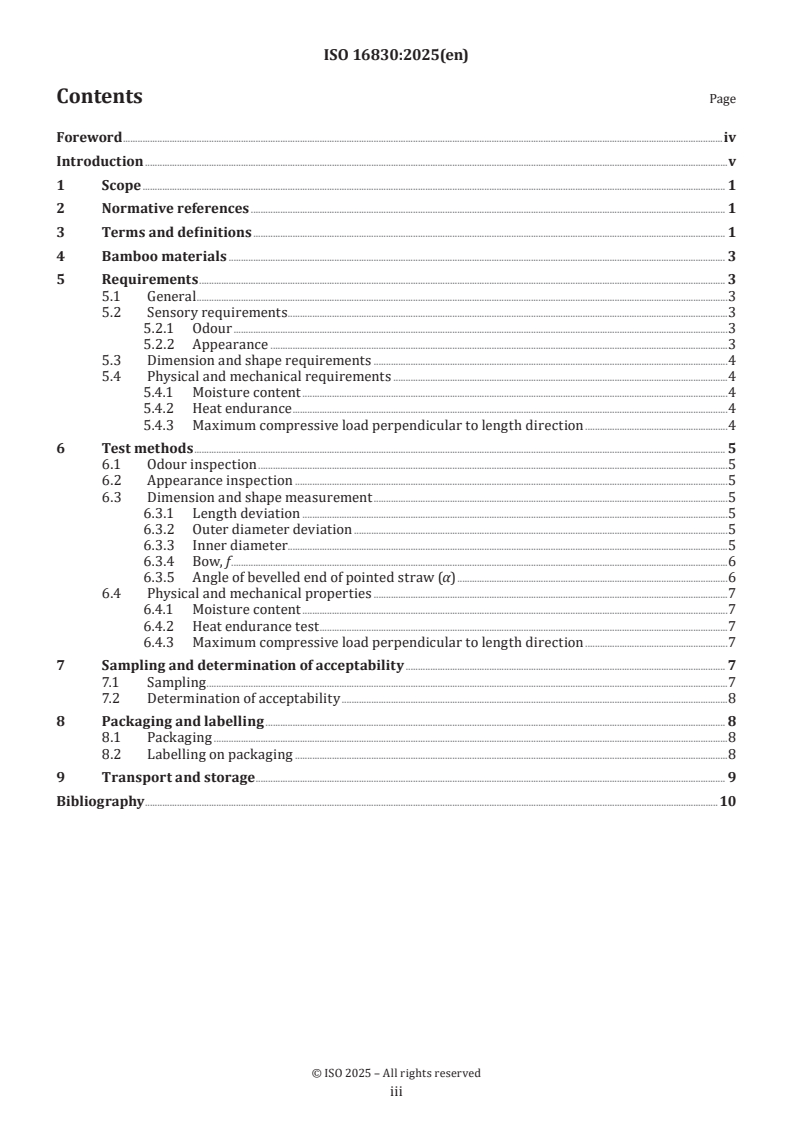
Contents Page
Foreword .iv
Introduction .v
1 Scope . 1
2 Normative references . 1
3 Terms and definitions . 1
4 Bamboo materials . 3
5 Requirements . 3
5.1 General .3
5.2 Sensory requirements.3
5.2.1 Odour .3
5.2.2 Appearance .3
5.3 Dimension and shape requirements .4
5.4 Physical and mechanical requirements .4
5.4.1 Moisture content .4
5.4.2 Heat endurance .4
5.4.3 Maximum compressive load perpendicular to length direction .4
6 Test methods . 5
6.1 Odour inspection .5
6.2 Appearance inspection .5
6.3 Dimension and shape measurement .5
6.3.1 Length deviation .5
6.3.2 Outer diameter deviation .5
6.3.3 Inner diameter.5
6.3.4 Bow, f .6
6.3.5 Angle of bevelled end of pointed straw (α) .6
6.4 Physical and mechanical properties .7
6.4.1 Moisture content .7
6.4.2 Heat endurance test .7
6.4.3 Maximum compressive load perpendicular to length direction .7
7 Sampling and determination of acceptability . 7
7.1 Sampling .7
7.2 Determination of acceptability .8
8 Packaging and labelling . 8
8.1 Packaging .8
8.2 Labelling on packaging .8
9 Transport and storage . 9
Bibliography .10
iii
Foreword
ISO (the International Organization for Standardization) is a worldwide federation of national standards
bodies (ISO member bodies). The work of preparing International Standards is normally carried out through
ISO technical committees. Each member body interested in a subject for which a technical committee
has been established has the right to be represented on that committee. International organizations,
governmental and non-governmental, in liaison with ISO, also take part in the work. ISO collaborates closely
with the International Electrotechnical Commission (IEC) on all matters of electrotechnical standardization.
The procedures used to develop this document and those intended for its further maintenance are described
in the ISO/IEC Directives, Part 1. In particular, the different approval criteria needed for the different types
of ISO document should be noted. This document was drafted in accordance with the editorial rules of the
ISO/IEC Directives, Part 2 (see www.iso.org/directives).
ISO draws attention to the possibility that the implementation of this document may involve the use of (a)
patent(s). ISO takes no position concerning the evidence, validity or applicability of any claimed patent
rights in respect thereof. As of the date of publication of this document, ISO had not received notice of (a)
patent(s) which may be required to implement this document. However, implementers are cautioned that
this may not represent the latest information, which may be obtained from the patent database available at
www.iso.org/patents. ISO shall not be held responsible for identifying any or all such patent rights.
Any trade name used in this document is information given for the convenience of users and does not
constitute an endorsement.
For an explanation of the voluntary nature of standards, the meaning of ISO specific terms and expressions
related to conformity assessment, as well as information about ISO's adherence to the World Trade
Organization (WTO) principles in the Technical Barriers to Trade (TBT), see www.iso.org/iso/foreword.html.
This document was prepared by Technical Committee ISO/TC 296, Bamboo and rattan.
Any feedback or questions on this document should be directed to the user’s national standards body. A
complete listing of these bodies can be found at www.iso.org/members.html.
iv
Introduction
More than 70 % of plastic products accumulate in landfills or are sloughed off in the natural environment
as litter. As a result, this plastic can end up in the ocean and have a detrimental impact on the ecosystem.
Plastic straws are one of the most widely used plastic products. For example, half a billion plastic straws are
[4]
used and discarded every day by people in the United States alone. In recent years, bans and restrictions
on single-use plastics have come into force across the globe. Plastic straws have been singled out for bans as
a result of the specific environmental problem they pose. Small, light and non-biodegradable plastic straws
can easily be swept into the ocean and break down into microplastic particles. They can also be consumed
by fish, seabirds and marine mammals, causing them harm and, in the case of fish, entering the food chain
for humans.
Owing to its fast growth, short rotation, and high mechanical strength, bamboo is a very abundant
renewable and biodegradable natural resource. The use of bamboo straws can help to alleviate the global
pollution caused by plastic straw, and also provide significant economic, social, and ecological benefits. The
low cost of bamboo straws manufactured with new technologies has a strong market competitiveness. This
document has been developed to address the need for a standard on bamboo drinking straws, promote their
use, and to contribute to the protection of the environment.
v
International Standard ISO 16830:2025(en)
Specification of bamboo drinking straws
1 Scope
This document specifies the requirements, test methods, handling, storage, packaging, and marking and
labelling of bamboo drinking straws.
It is applicable to bamboo drinking straws:
— made of natural hollow-cylindrical-shape bamboo culms and branches;
— made by drilling holes on sticks processed from bamboo culm wall; and
— made by rolling bamboo veneer.
2 Normative references
The following documents are referred to in the text in such a way that some or all of their content constitutes
requirements of this document. For dated references, only the edition cited applies. For undated references,
the latest edition of the referenced document (including any amendments) applies.
ISO 2859-1, Sampling procedures for inspection by attributes — Part 1: Sampling schemes indexed by acceptance
quality limit (AQL) for lot-by-lot inspection
3 Terms and definitions
For the purposes of this document, the following terms and definitions apply.
ISO and IEC maintain terminology databases for use in standardization at the following
...