

ISO 1013:2020
(Main)Coke — Determination of bulk density in a large container
General Information
- Abstract
This document specifies a method for the determination of the coke bulk density in a large container such as a wagon or skip.
- Status
- Published
- Publication Date
- 15-Oct-2020
- Technical Committee
- ISO/TC 27/SC 3 - Coke
- Drafting Committee
- ISO/TC 27/SC 3 - Coke
- Current Stage
- 9093 - International Standard confirmed
- Start Date
- 21-May-2026
- Completion Date
- 29-Aug-2026
Buy Documents

ISO 1013:2020 - Coke -- Determination of bulk density in a large container
ISO 1013:2020 - Coke — Determination of bulk density in a large container/16/2020
Overview
ISO 1013:2020 is an internationally recognized standard specifying the method for determining the bulk density of coke in large containers such as wagons or skips. Bulk density is a critical physical property affecting the handling, storage, and transportation of coke, an essential industrial fuel and raw material. The standard provides a precise and repeatable procedure to measure the coke bulk density, ensuring consistent quality assessment and compliance across industries.
This third edition of ISO 1013 updates the previous 1995 version with minor corrections and additional bibliographic references and reflects current best practices in coke testing.
Key Topics
- Scope and Application: Specifies the method for determining the bulk density of coke in large containers (minimum capacity around 3 metric tonnes).
- Definition of Bulk Density: Mass of coke per unit volume of the filled container, corrected for moisture content according to ISO 579.
- Apparatus Needed: A large container such as a wagon or skip, and a weighing machine with an accuracy of 0.2%.
- Procedure Summary:
- Weigh the empty container and measure its internal volume.
- Fill the container evenly with coke until heaped slightly above the rim.
- Level the surface with a straightedge to remove excess.
- Weigh the filled container and calculate bulk density using a standardized formula.
- Expression of Results:
- Bulk density is reported in kilograms per cubic meter (kg/m³), on a dry basis (moisture-corrected).
- For results on an "as sampled" basis, moisture correction can be omitted.
- Precision and Repeatability: Results from the same operator and apparatus should not differ by more than 10 kg/m³. Reproducibility across different sites is not guaranteed due to coke sample variability.
- Reporting Requirements: Include method reference, sample identification, test date, and results as per the standard.
Applications
- Industrial Quality Control: Ensures consistent bulk density measurement critical to steel manufacturing, foundry coke usage, and other metallurgical processes.
- Transportation Verification: Accurate density data assist logistics planning for wagon and skip transport, optimizing load capacities and reducing risks.
- Storage Management: Bulk density informs storage design and inventory control, preventing material degradation or handling issues.
- Research and Development: Provides a reliable testing protocol for evaluating coke physical characteristics under various production or treatment conditions.
By standardizing measurement methods, ISO 1013:2020 supports fair trade practices and regulatory compliance while enhancing operational efficiency in the coal and coke industries.
Related Standards
- ISO 567: Specifies the method for determination of bulk density of coke in small containers, complementing ISO 1013 for different scales.
- ISO 579: Defines the procedure for determining the total moisture content in coke, necessary for adjusting bulk density measurements.
- ISO 18283: Covers manual sampling techniques for hard coal and coke, foundational to obtaining representative test samples.
These related standards collectively ensure comprehensive quality assessment and characterization of coke products throughout the supply chain.
Keywords: ISO 1013:2020, coke bulk density, large container, coke testing, moisture correction, coke wagon, coke skip, industrial standards, metallurgical coke, coke quality control, coke storage, bulk density determination, coal and coke standards.
Relations
- Effective Date
- 23-Apr-2020
Buy Documents
ISO 1013:2020 - Coke -- Determination of bulk density in a large container
ISO 1013:2020 - Coke — Determination of bulk density in a large container/16/2020
Get Certified
Connect with accredited certification bodies for this standard

Element Materials Technology
Materials testing and product certification.

ABS Group Brazil
ABS Group certification services in Brazil.

ABS Quality Evaluations Inc.
American Bureau of Shipping quality certification.
Sponsored listings
Frequently Asked Questions
ISO 1013:2020 is a standard published by the International Organization for Standardization (ISO). Its full title is "Coke — Determination of bulk density in a large container". This standard covers: This document specifies a method for the determination of the coke bulk density in a large container such as a wagon or skip.
This document specifies a method for the determination of the coke bulk density in a large container such as a wagon or skip.
ISO 1013:2020 is classified under the following ICS (International Classification for Standards) categories: 75.160.10 - Solid fuels. The ICS classification helps identify the subject area and facilitates finding related standards.
ISO 1013:2020 has the following relationships with other standards: It is inter standard links to ISO 1013:1995. Understanding these relationships helps ensure you are using the most current and applicable version of the standard.
ISO 1013:2020 is available in PDF format for immediate download after purchase. The document can be added to your cart and obtained through the secure checkout process. Digital delivery ensures instant access to the complete standard document.
Standards Content (Sample)
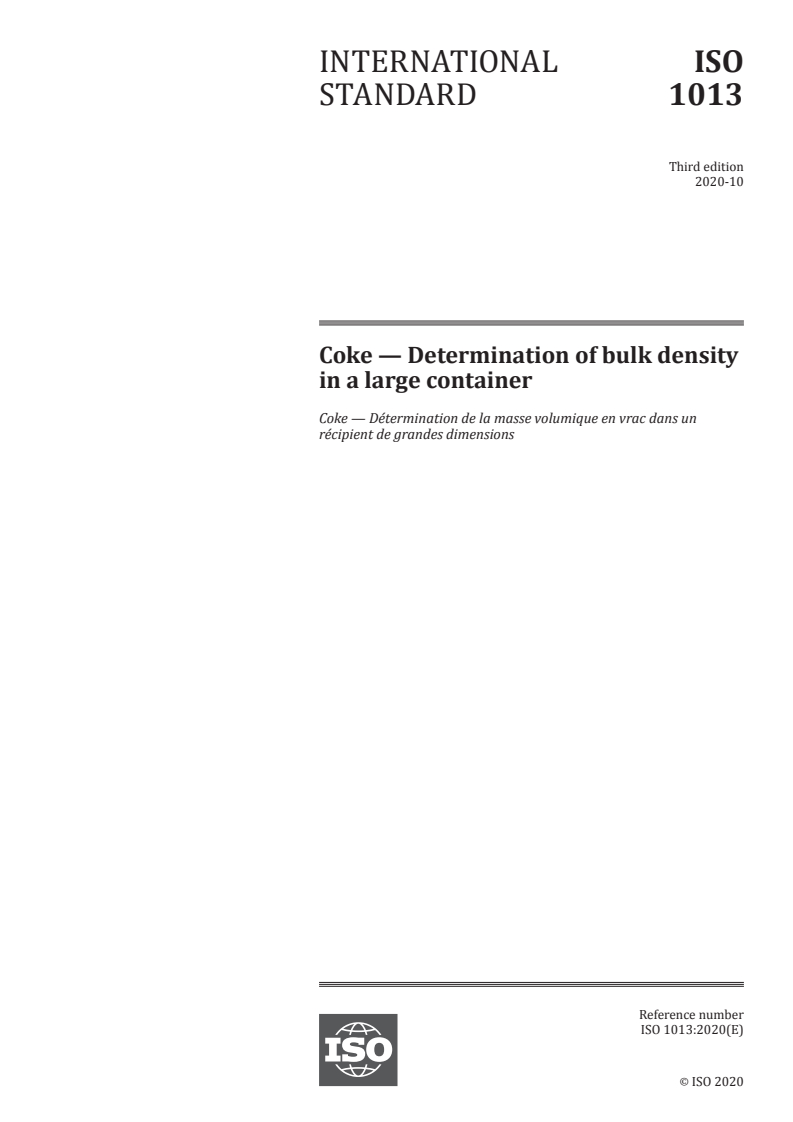
INTERNATIONAL ISO
STANDARD 1013
Third edition
2020-10
Coke — Determination of bulk density
in a large container
Coke — Détermination de la masse volumique en vrac dans un
récipient de grandes dimensions
Reference number
©
ISO 2020
© ISO 2020
All rights reserved. Unless otherwise specified, or required in the context of its implementation, no part of this publication may
be reproduced or utilized otherwise in any form or by any means, electronic or mechanical, including photocopying, or posting
on the internet or an intranet, without prior written permission. Permission can be requested from either ISO at the address
below or ISO’s member body in the country of the requester.
ISO copyright office
CP 401 • Ch. de Blandonnet 8
CH-1214 Vernier, Geneva
Phone: +41 22 749 01 11
Email: copyright@iso.org
Website: www.iso.org
Published in Switzerland
ii © ISO 2020 – All rights reserved
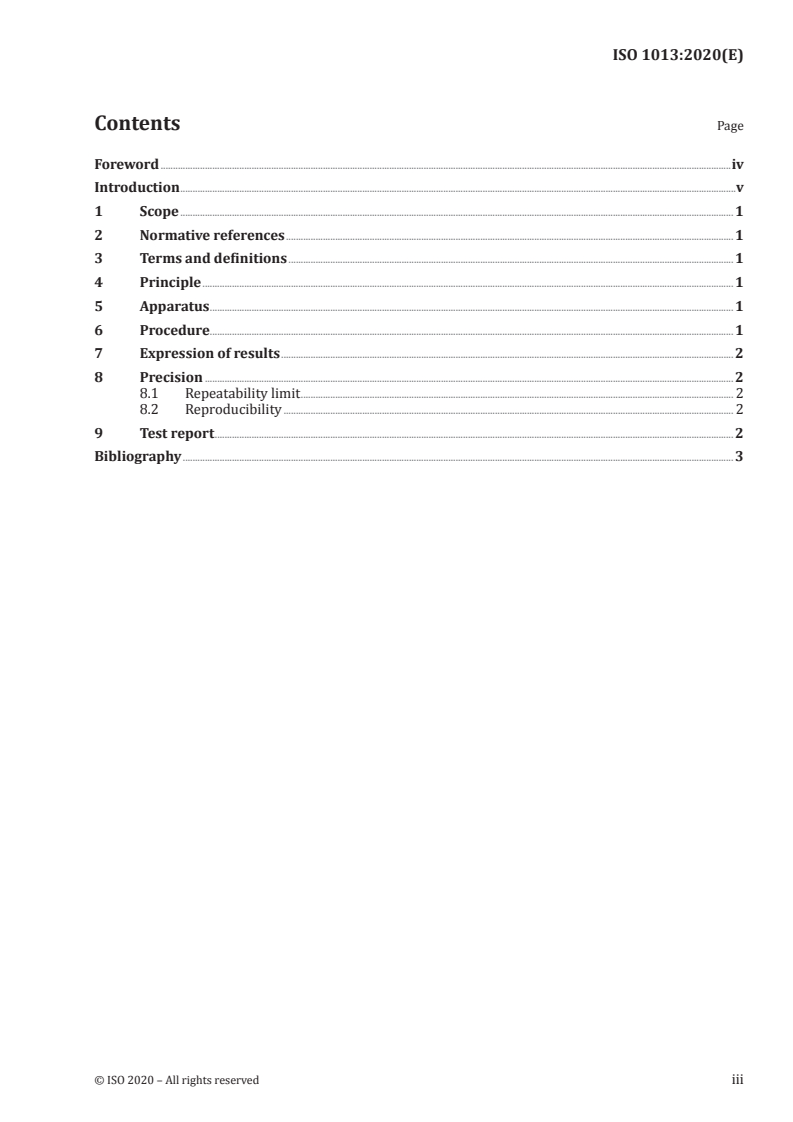
Contents Page
Foreword .iv
Introduction .v
1 Scope . 1
2 Normative references . 1
3 Terms and definitions . 1
4 Principle . 1
5 Apparatus . 1
6 Procedure. 1
7 Expression of results . 2
8 Precision . 2
8.1 Repeatability limit . 2
8.2 Reproducibility . 2
9 Test report . 2
Bibliography . 3
Foreword
ISO (the International Organization for Standardization) is a worldwide federation of national standards
bodies (ISO member bodies). The work of preparing International Standards is normally carried out
through ISO technical committees. Each member body interested in a subject for which a technical
committee has been established has the right to be represented on that committee. International
organizations, governmental and non-governmental, in liaison with ISO, also take part in the work.
ISO collaborates closely with the International Electrotechnical Commission (IEC) on all matters of
electrotechnical standardization.
The procedures used to develop this document and those intended for its further maintenance are
described in the ISO/IEC Directives, Part 1. In particular, the different approval criteria needed for the
different types of ISO documents should be noted. This document was drafted in accordance with the
editorial rules of the ISO/IEC Directives, Part 2 (see www .iso .org/ directives).
Attention is drawn to the possibility that some of the elements of this document may be the subject of
patent rights. ISO shall not be held responsible for identifying any or all such patent rights. Details of
any patent rights identified du
...
INTERNATIONAL ISO
STANDARD 1013
Third edition
2020-10
Coke — Determination of bulk density
in a large container
Coke — Détermination de la masse volumique en vrac dans un
récipient de grandes dimensions
Reference number
©
ISO 2020
© ISO 2020
All rights reserved. Unless otherwise specified, or required in the context of its implementation, no part of this publication may
be reproduced or utilized otherwise in any form or by any means, electronic or mechanical, including photocopying, or posting
on the internet or an intranet, without prior written permission. Permission can be requested from either ISO at the address
below or ISO’s member body in the country of the requester.
ISO copyright office
CP 401 • Ch. de Blandonnet 8
CH-1214 Vernier, Geneva
Phone: +41 22 749 01 11
Email: copyright@iso.org
Website: www.iso.org
Published in Switzerland
ii © ISO 2020 – All rights reserved
Contents Page
Foreword .iv
Introduction .v
1 Scope . 1
2 Normative references . 1
3 Terms and definitions . 1
4 Principle . 1
5 Apparatus . 1
6 Procedure. 1
7 Expression of results . 2
8 Precision . 2
8.1 Repeatability limit . 2
8.2 Reproducibility . 2
9 Test report . 2
Bibliography . 3
Foreword
ISO (the International Organization for Standardization) is a worldwide federation of national standards
bodies (ISO member bodies). The work of preparing International Standards is normally carried out
through ISO technical committees. Each member body interested in a subject for which a technical
committee has been established has the right to be represented on that committee. International
organizations, governmental and non-governmental, in liaison with ISO, also take part in the work.
ISO collaborates closely with the International Electrotechnical Commission (IEC) on all matters of
electrotechnical standardization.
The procedures used to develop this document and those intended for its further maintenance are
described in the ISO/IEC Directives, Part 1. In particular, the different approval criteria needed for the
different types of ISO documents should be noted. This document was drafted in accordance with the
editorial rules of the ISO/IEC Directives, Part 2 (see www .iso .org/ directives).
Attention is drawn to the possibility that some of the elements of this document may be the subject of
patent rights. ISO shall not be held responsible for identifying any or all such patent rights. Details of
any patent rights identified du
...