


ISO/IEC 15067-3-51:2024
(Main)Information technology — Home Electronic System (HES) application model — Part 3-51: Framework of a narrow AI engine for a premises energy management system using energy management agents
Information technology — Home Electronic System (HES) application model — Part 3-51: Framework of a narrow AI engine for a premises energy management system using energy management agents
This document specifies a Narrow AI Engine Framework including requirements for the Energy Management Agent (EMA) specified in ISO/IEC 15067-3. This standard includes specifications for an AI infrastructure to be embedded in an EMA serving a single structure (home or building) or community housing such as an apartment complex. The Narrow AI Engine specified in this standard for EMAs enables demand response functionality to be located in each EMA instead of an external energy management system. Thus, energy management can be adapted to local and customer needs. The Narrow AI Engine includes operational principles such as prediction, decision–making, and control. This standard builds upon the EMA functions of ISO/IEC 15067-3 and ISO/IEC 15067-3-3. The AI functions specified in this standard support complex decisions about energy management for devices attached to home and buildings networks. These AI specifications enable the EMA to allocate power from public sources (including conventional and nonconventional sources) and local sources (wind, solar, and storage) according to price, availability, appliance and electric vehicle demands, customer preferences, and the customer’s budget.
Titre manque — Partie 3-51: Titre manque
General Information
- Status
- Published
- Publication Date
- 02-Jul-2024
- Technical Committee
- ISO/IEC JTC 1/SC 25 - Interconnection of information technology equipment
- Current Stage
- 6060 - International Standard published
- Start Date
- 03-Jul-2024
- Due Date
- 28-Dec-2025
- Completion Date
- 03-Jul-2024
Overview
ISO/IEC 15067-3-51:2024 – Information technology - Home Electronic System (HES) application model - Part 3-51: Framework of a narrow AI engine for a premises energy management system using energy management agents – is an international standard published by ISO and IEC. This document defines a framework for embedding a narrow artificial intelligence (AI) engine within an Energy Management Agent (EMA) for residential, commercial, and community buildings. By specifying how AI can be locally deployed within premises, the standard supports adaptive, privacy-focused, and efficient energy management, particularly for environments leveraging renewable resources such as solar and wind, energy storage, and electric vehicle (EV) charging.
This standard expands on the EMA functions defined in existing HES standards by introducing intelligent, on-premises decision-making capabilities. The framework is designed to support real-time energy allocation based on pricing, supply, user preferences, and local conditions, ultimately enabling demand response and energy optimization at the device, home, or community level.
Key Topics
- Narrow AI Engine Framework: Outlines the architecture, operational modes, and interaction of the AI engine with other home or building systems.
- Energy Management Agent (EMA): Specifies AI-driven functions for managing energy generation, storage, and consumption, optimizing allocation based on data from appliances, EVs, and user preferences.
- Work Modes: Distinguishes between deployed (inference) mode for real-time operation, and learning mode for updating AI algorithms to adapt to changing conditions or new devices.
- Data Security and Privacy: Highlights the benefits of local, on-premises AI to ensure customer data is not shared externally without permission, supporting privacy and compliance.
- Integration with HES Gateway: Details support for seamless interoperability between local networks (HAN), external sources (WAN), and web-based energy services.
Applications
The ISO/IEC 15067-3-51:2024 standard has practical applications across several domains:
- Smart Homes and Buildings: Enables dynamic, intelligent control of energy consumption, generation, and storage for homes, apartments, and community buildings.
- Renewable Energy Integration: Facilitates efficient management of local renewable sources (solar, wind) and energy storage systems, maximizing self-consumption and grid interaction.
- Electric Vehicle Charging: Supports AI-driven scheduling and load management for home and community EV chargers to optimize for price, demand, and user preferences.
- Demand Response (DR): Allows for decentralized, automated DR participation, responding to real-time market signals directly within the premises rather than relying solely on central utility systems.
- User-Centric Optimization: Provides consumers with customized energy management experiences based on budget, appliance priorities, and environmental objectives.
This standard enables stakeholders – including device manufacturers, energy service providers, and building operators – to develop or integrate intelligent energy management systems that are secure, adaptive, and interoperable.
Related Standards
ISO/IEC 15067-3-51:2024 is part of a broader family of HES and energy management standards. Key related standards include:
- ISO/IEC 15067-3: Defines the model of a demand-response energy management system for HES.
- ISO/IEC 15067-3-3: Provides additional EMA requirements and details for demand response systems.
- ISO/IEC 15045-1 & ISO/IEC 15045-2: Specify the architecture and modularity of HES gateways for residential and building applications.
- ISO/IEC 18012-1 & 18012-2: Offer guidelines for product interoperability within HES environments.
Future parts (in development) are expected to address data models and service procedure/message flow for AI-based energy management, building a comprehensive ecosystem for intelligent home and building energy automation.
Keywords: Narrow AI engine, premises energy management, energy management agent, HES gateway, smart home, demand response, ISO/IEC 15067-3-51, renewable energy management, electric vehicle charging, privacy, home energy system standardization.
Buy Documents
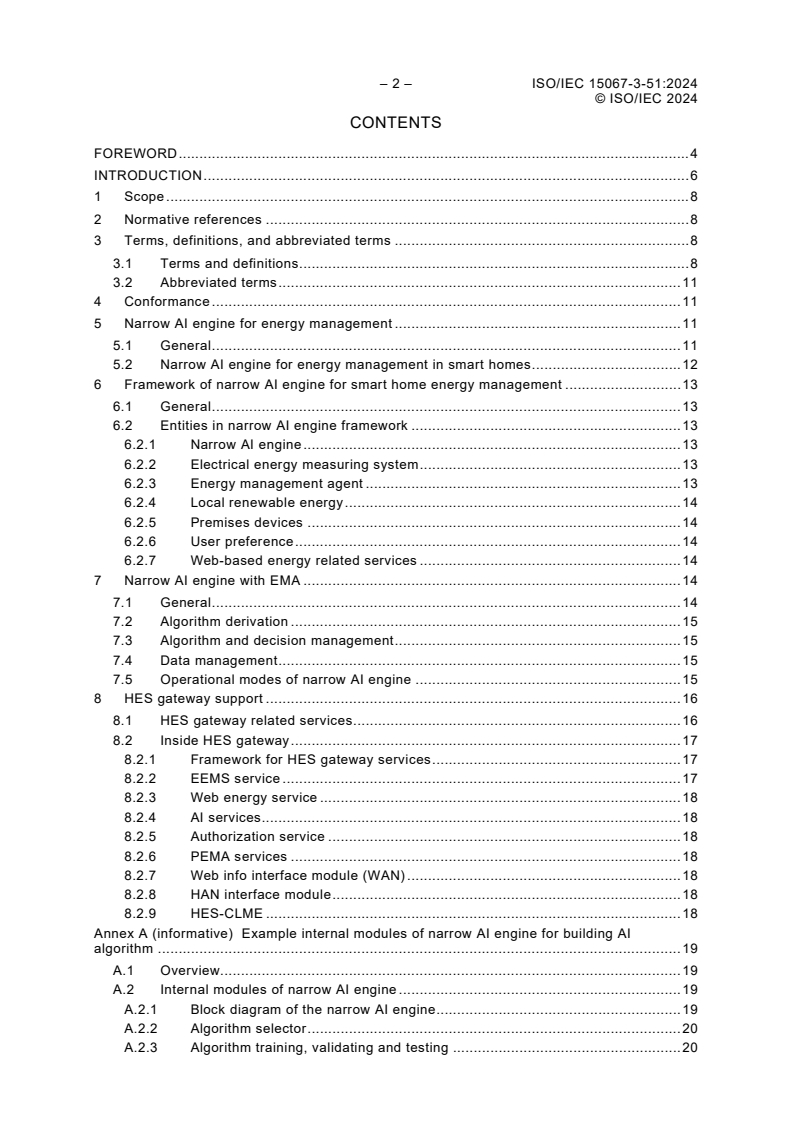
ISO/IEC 15067-3-51:2024 - Information technology — Home Electronic System (HES) application model — Part 3-51: Framework of a narrow AI engine for a premises energy management system using energy management agents Released:3. 07. 2024
Get Certified
Connect with accredited certification bodies for this standard

BSI Group
BSI (British Standards Institution) is the business standards company that helps organizations make excellence a habit.

NYCE
Mexican standards and certification body.
Sponsored listings
Frequently Asked Questions
ISO/IEC 15067-3-51:2024 is a standard published by the International Organization for Standardization (ISO). Its full title is "Information technology — Home Electronic System (HES) application model — Part 3-51: Framework of a narrow AI engine for a premises energy management system using energy management agents". This standard covers: This document specifies a Narrow AI Engine Framework including requirements for the Energy Management Agent (EMA) specified in ISO/IEC 15067-3. This standard includes specifications for an AI infrastructure to be embedded in an EMA serving a single structure (home or building) or community housing such as an apartment complex. The Narrow AI Engine specified in this standard for EMAs enables demand response functionality to be located in each EMA instead of an external energy management system. Thus, energy management can be adapted to local and customer needs. The Narrow AI Engine includes operational principles such as prediction, decision–making, and control. This standard builds upon the EMA functions of ISO/IEC 15067-3 and ISO/IEC 15067-3-3. The AI functions specified in this standard support complex decisions about energy management for devices attached to home and buildings networks. These AI specifications enable the EMA to allocate power from public sources (including conventional and nonconventional sources) and local sources (wind, solar, and storage) according to price, availability, appliance and electric vehicle demands, customer preferences, and the customer’s budget.
This document specifies a Narrow AI Engine Framework including requirements for the Energy Management Agent (EMA) specified in ISO/IEC 15067-3. This standard includes specifications for an AI infrastructure to be embedded in an EMA serving a single structure (home or building) or community housing such as an apartment complex. The Narrow AI Engine specified in this standard for EMAs enables demand response functionality to be located in each EMA instead of an external energy management system. Thus, energy management can be adapted to local and customer needs. The Narrow AI Engine includes operational principles such as prediction, decision–making, and control. This standard builds upon the EMA functions of ISO/IEC 15067-3 and ISO/IEC 15067-3-3. The AI functions specified in this standard support complex decisions about energy management for devices attached to home and buildings networks. These AI specifications enable the EMA to allocate power from public sources (including conventional and nonconventional sources) and local sources (wind, solar, and storage) according to price, availability, appliance and electric vehicle demands, customer preferences, and the customer’s budget.
ISO/IEC 15067-3-51:2024 is classified under the following ICS (International Classification for Standards) categories: 35.200 - Interface and interconnection equipment; 35.240.99 - IT applications in other fields; 97.120 - Automatic controls for household use. The ICS classification helps identify the subject area and facilitates finding related standards.
ISO/IEC 15067-3-51:2024 is available in PDF format for immediate download after purchase. The document can be added to your cart and obtained through the secure checkout process. Digital delivery ensures instant access to the complete standard document.
Standards Content (Sample)
ISO/IEC 15067-3-51
Edition 1.0 2024-06
INTERNATIONAL
STANDARD
colour
inside
Information technology – Home Electronic System (HES) application model –
Part 3-51: Framework of a narrow AI engine for a premises energy management
system using energy management agents
All rights reserved. Unless otherwise specified, no part of this publication may be reproduced or utilized in any form or
by any means, electronic or mechanical, including photocopying and microfilm, without permission in writing from either
IEC or IEC's member National Committee in the country of the requester. If you have any questions about ISO/IEC
copyright or have an enquiry about obtaining additional rights to this publication, please contact the address below or
your local IEC member National Committee for further information.
IEC Secretariat Tel.: +41 22 919 02 11
3, rue de Varembé info@iec.ch
CH-1211 Geneva 20 www.iec.ch
Switzerland
About the IEC
The International Electrotechnical Commission (IEC) is the leading global organization that prepares and publishes
International Standards for all electrical, electronic and related technologies.
About IEC publications
The technical content of IEC publications is kept under constant review by the IEC. Please make sure that you have the
latest edition, a corrigendum or an amendment might have been published.
IEC publications search - webstore.iec.ch/advsearchform IEC Products & Services Portal - products.iec.ch
The advanced search enables to find IEC publications by a Discover our powerful search engine and read freely all the
variety of criteria (reference number, text, technical publications previews, graphical symbols and the glossary.
committee, …). It also gives information on projects, replaced With a subscription you will always have access to up to date
and withdrawn publications. content tailored to your needs.
IEC Just Published - webstore.iec.ch/justpublished
Electropedia - www.electropedia.org
Stay up to date on all new IEC publications. Just Published
The world's leading online dictionary on electrotechnology,
details all new publications released. Available online and once
containing more than 22 500 terminological entries in English
a month by email.
and French, with equivalent terms in 25 additional languages.
Also known as the International Electrotechnical Vocabulary
IEC Customer Service Centre - webstore.iec.ch/csc
(IEV) online.
If you wish to give us your feedback on this publication or need
further assistance, please contact the Customer Service
Centre: sales@iec.ch.
ISO/IEC 15067-3-51
Edition 1.0 2024-06
INTERNATIONAL
STANDARD
colour
inside
Information technology – Home Electronic System (HES) application model –
Part 3-51: Framework of a narrow AI engine for a premises energy management
system using energy management agents
INTERNATIONAL
ELECTROTECHNICAL
COMMISSION
ICS 35.200 ISBN 978-2-8322-9183-2
– 2 – ISO/IEC 15067-3-51:2024
© ISO/IEC 2024
CONTENTS
FOREWORD . 4
INTRODUCTION . 6
1 Scope . 8
2 Normative references . 8
3 Terms, definitions, and abbreviated terms . 8
3.1 Terms and definitions . 8
3.2 Abbreviated terms . 11
4 Conformance . 11
5 Narrow AI engine for energy management . 11
5.1 General . 11
5.2 Narrow AI engine for energy management in smart homes . 12
6 Framework of narrow AI engine for smart home energy management . 13
6.1 General . 13
6.2 Entities in narrow AI engine framework . 13
6.2.1 Narrow AI engine . 13
6.2.2 Electrical energy measuring system . 13
6.2.3 Energy management agent . 13
6.2.4 Local renewable energy . 14
6.2.5 Premises devices . 14
6.2.6 User preference . 14
6.2.7 Web-based energy related services . 14
7 Narrow AI engine with EMA . 14
7.1 General . 14
7.2 Algorithm derivation . 15
7.3 Algorithm and decision management . 15
7.4 Data management . 15
7.5 Operational modes of narrow AI engine . 15
8 HES gateway support . 16
8.1 HES gateway related services . 16
8.2 Inside HES gateway . 17
8.2.1 Framework for HES gateway services . 17
8.2.2 EEMS service . 17
8.2.3 Web energy service . 18
8.2.4 AI services . 18
8.2.5 Authorization service . 18
8.2.6 PEMA services . 18
8.2.7 Web info interface module (WAN) . 18
8.2.8 HAN interface module . 18
8.2.9 HES-CLME . 18
Annex A (informative) Example internal modules of narrow AI engine for building AI
algorithm . 19
A.1 Overview. 19
A.2 Internal modules of narrow AI engine . 19
A.2.1 Block diagram of the narrow AI engine . 19
A.2.2 Algorithm selector . 20
A.2.3 Algorithm training, validating and testing . 20
© ISO/IEC 2024
A.2.4 Algorithm optimization . 21
A.2.5 Algorithm dictionary . 21
A.2.6 Algorithm store . 21
A.2.7 Decision handler . 21
A.2.8 Data pre-processing . 21
A.2.9 Data store . 22
A.2.10 Data collecting . 22
Annex B (informative) Use cases for an AI energy management engine . 23
B.1 Supply planning and DR prediction for efficient home management based on
narrow AI engine . 23
B.2 Use cases of narrow AI engine. 24
Bibliography . 25
Figure 1 – Core interoperability and HES gateway . 7
Figure 2 – HES AI applications . 7
Figure 3 – Logical framework of smart home energy management with support from
narrow AI engine in the deployed mode . 12
Figure 4 – Operating flow of narrow AI engine in deployed mode . 16
Figure 5 – Operating flow of narrow AI engine in learning mode . 16
Figure 6 – Narrow AI for PEMA application ISEE group . 17
Figure A.1 – Operating modules of the narrow AI engine in deployed mode . 19
Figure A.2 – Operating modules of the narrow AI engine in learning mode . 20
Figure B.1 – Scenario of an EMA with narrow AI engine for efficient smart houses . 23
Figure B.2 – Use case of DR management with and without narrow AI engine . 24
– 4 – ISO/IEC 15067-3-51:2024
© ISO/IEC 2024
INFORMATION TECHNOLOGY –
HOME ELECTRONIC SYSTEM (HES) APPLICATION MODEL –
Part 3-51: Framework of a narrow AI engine for a premises energy
management system using energy management agents
FOREWORD
1) ISO (the International Organization for Standardization) and IEC (the International Electrotechnical Commission)
form the specialized system for worldwide standardization. National bodies that are members of ISO or IEC
participate in the development of International Standards through technical committees established by the
respective organization to deal with particular fields of technical activity. ISO and IEC technical committees
collaborate in fields of mutual interest. Other international organizations, governmental and non-governmental,
in liaison with ISO and IEC, also take part in the work.
2) The formal decisions or agreements of IEC and ISO on technical matters express, as nearly as possible, an
international consensus of opinion on the relevant subjects since each technical committee has representation
from all interested IEC and ISO National bodies.
3) IEC and ISO documents have the form of recommendations for international use and are accepted by IEC and
ISO National bodies in that sense. While all reasonable efforts are made to ensure that the technical content of
IEC and ISO documents is accurate, IEC and ISO cannot be held responsible for the way in which they are used
or for any misinterpretation by any end user.
4) In order to promote international uniformity, IEC and ISO National bodies undertake to apply IEC and ISO
documents transparently to the maximum extent possible in their national and regional publications. Any
divergence between any IEC and ISO document and the corresponding national or regional publication shall be
clearly indicated in the latter.
5) IEC and ISO do not provide any attestation of conformity. Independent certification bodies provide conformity
assessment services and, in some areas, access to IEC and ISO marks of conformity. IEC and ISO are not
responsible for any services carried out by independent certification bodies.
6) All users should ensure that they have the latest edition of this document.
7) No liability shall attach to IEC and ISO or their directors, employees, servants or agents including individual
experts and members of its technical committees and IEC and ISO National bodies for any personal injury,
property damage or other damage of any nature whatsoever, whether direct or indirect, or for costs (including
legal fees) and expenses arising out of the publication, use of, or reliance upon, this ISO/IEC document or any
other IEC and ISO documents.
8) Attention is drawn to the Normative references cited in this document. Use of the referenced publications is
indispensable for the correct application of this document.
9) IEC and ISO draw attention to the possibility that the implementation of this document may involve the use of (a)
patent(s). IEC and ISO take no position concerning the evidence, validity or applicability of any claimed patent
rights in respect thereof. As of the date of publication of this document, IEC and ISO had not received notice of
(a) patent(s), which may be required to implement this document. However, implementers are cautioned that this
may not represent the latest information, which may be obtained from the patent database available at
https://patents.iec.ch and www.iso.org/patents. IEC and ISO shall not be held responsible for identifying any or
all such patent rights.
ISO/IEC 15067-3-51 has been prepared by subcommittee 25: Interconnection of information
technology equipment, of ISO/IEC joint technical committee 1: Information technology. It is an
International Standard.
The text of this International Standard is based on the following documents:
Draft Report on voting
JTC1-SC25/3225/FDIS JTC1-SC25/3245/RVD
Full information on the voting for its approval can be found in the report on voting indicated in
the above table.
The language used for the development of this International Standard is English.
This document was drafted in accordance with ISO/IEC Directives, Part 2, and developed in
accordance with ISO/IEC Directives, Part 1, and the ISO/IEC Directives, JTC 1 Supplement
available at www.iec.ch/members_experts/refdocs and www.iso.org/directives.
© ISO/IEC 2024
A list of all parts of the ISO/IEC 15067 series, published under the general title Information
technology – Home Electronic System (HES) application model, can be found on the IEC and
ISO websites.
IMPORTANT – The "colour inside" logo on the cover page of this document indicates
that it contains colours which are considered to be useful for the correct understanding
of its contents. Users should therefore print this document using a colour printer.
– 6 – ISO/IEC 15067-3-51:2024
© ISO/IEC 2024
INTRODUCTION
This document adds artificial intelligence (AI) functions to support the energy management
agent (EMA) specified in ISO/IEC 15067-3 for EMAs located on customer premises. A narrow
AI engine framework and guidelines for implementation in an EMA are provided. Furthermore,
the placement of AI support infrastructure in an EMA addresses the challenges of developing a
scalable energy management solution for home energy management. The narrow AI engine is
a system that is deployed inside a home to operate as the protected on-premises system for
energy management. The narrow AI engine responds to energy management events by
operating an AI algorithm customized for energy management.
The HES gateway, specified in the ISO/IEC 15045 series and ISO/IEC 18012 series, supports
the AI functionality. The term "premises energy management agent (PEMA)" is introduced as a
type of EMA that is hosted on the HES gateway. The PEMA primarily focuses on the needs,
including generation and storage, of the premises, while the connection to the public utility can
also be included when aligned with the needs of the premises.
The objective of the AI functions in an EMA is to help the consumer decide from which source
and when to acquire power and to which loads and at which times this power should be allocated.
Sources may include a public power utility, an aggregator, a prosumer (a producer and
consumer with excess power who offers the surplus for sale through a transactive energy
scheme), local generators (such as wind or solar), or batteries (stationary or mobile). Loads
can include consumer electronics, appliances, and EV chargers. The EMA decision assistance
is predicated on the consumer’s time and day preferences for appliance usage and electric
vehicle (EV) charging, constrained by the consumer’s budget for energy and any preference for
reducing greenhouse gas emissions to mitigate climate change. The EMA is introduced to
provide energy management focused on the needs of a premises, while considering local power
generation such as wind turbines and solar panels, and energy storage (collectively called
PER – premises energy resources).
This document specifies a high-level framework of a narrow AI engine to facilitate an energy
management system. The narrow AI engine provides several capabilities such as demand
prediction, decision making for energy consumption, and control. This AI framework offers a
robust and scalable energy management solution for home energy management.
The EMA provides automation to help the user make and execute complex decisions in real
time. We are seeking practical AI that can be deployed locally. On-premises deployment implies
that the narrow AI engine can be executed in consumer or commercial electronic devices that
are affordable in a competitive marketplace. Also, customer data are not shared with a service
provider in the cloud, thus protecting privacy. Energy consumption patterns can reveal
considerable information about equipment owned and activities identifiable by location and time.
For this reason, the AI implementation specified is called "protected on-premises." In many
cases, AI performance, and hence the value of the EMA, may be significantly increased if at
least part of the AI learning phase is performed in the cloud or at other computational entities
outside the premises. The cloud, as well as the use of additional local computational resources
outside the premises, allows for use of more computational power as well as access to
additional aggregated data that can improve the results of AI algorithms. If there is use of any
customer data outside the premises in a learning phase, it would be subject to customer
permission and may be protected by the HES gateway functions.
This AI framework may be extended beyond energy management for other home applications.
Figure 1 shows the core interoperability and HES gateway documents. Figure 2 shows the
narrow AI engine series of documents consisting of three parts:
– ISO/IEC 15067-3-51: Framework
– future planned parts on data model (ISO/IEC 15067-3-52) and service procedure and
message flow (ISO/IEC 15067-3-53).
© ISO/IEC 2024
Figure 1 – Core interoperability and HES gateway
Figure 2 – HES AI applications
NOTE Additional documents needed for implementation are under development.
– 8 – ISO/IEC 15067-3-51:2024
© ISO/IEC 2024
INFORMATION TECHNOLOGY –
HOME ELECTRONIC SYSTEM (HES) APPLICATION MODEL –
Part 3-51: Framework of a narrow AI engine for a premises energy
management system using energy management agents
1 Scope
This document specifies a framework for adding artificial intelligence (AI) functions to support
the energy management agent (EMA) specified in ISO/IEC 15067-3 for EMAs located on
customer premises. It also defines "premises EMA" (PEMA), a type of EMA that resides in the
HES gateway (specified in the ISO/IEC 15045 series and ISO/IEC 18012 series).
2 Normative references
The following documents are referred to in the text in such a way that some or all of their content
constitutes requirements of this document. For dated references, only the edition cited applies.
For undated references, the latest edition of the referenced document (including any
amendments) applies.
ISO/IEC 15045-1, Information technology – Home Electronic System (HES) gateway – Part 1:
A residential gateway model for HES
ISO/IEC 15045-2, Information technology – Home Electronic System (HES) gateway – Part 2:
Modularity and protocol
ISO/IEC 15067-3, Information technology – Home Electronic System (HES) application model –
Part 3: Model of a demand-response energy management system for HES
ISO/IEC 18012-1, Information technology – Home Electronic System – Guidelines for product
interoperability – Part 1: Introduction
ISO/IEC 18012-2, Information technology – Home Electronic System (HES) – Guidelines for
product interoperability – Part 2: Taxonomy and application interoperability model
3 Terms, definitions, and abbreviated terms
3.1 Terms and definitions
For the purposes of this document, the following terms and definitions apply.
ISO and IEC maintain terminology databases for use in standardization at the following
addresses:
• IEC Electropedia: available at https://www.electropedia.org/
• ISO Online browsing platform: available at https://www.iso.org/obp
© ISO/IEC 2024
3.1.1
agent
application process in a station which accesses the locally managed objects on behalf of the
manager
[SOURCE: IEC 61375-2-1:2012, 3.1.2]
3.1.2
artificial intelligence
AI
capability of an engineering system to acquire, process and apply knowledge and skills
[SOURCE: ISO/IEC 29119-11:2020, 3.1.13]
3.1.3
demand response
DR
method for matching the demand for energy to the available supply of energy
[SOURCE: ISO/IEC 15067-3:2012, 3.1.3]
3.1.4
distributed demand response
distributed DR
method for providing incentives for customers to match the demand for energy to the available
supply of energy such as price and event notices rather than control signals
3.1.5
electrical energy measuring system
EEMS
automatic meter reading (AMR), advanced metering infrastructure (AMI) and measurements of
energy consumption by appliances, chargers, inverters, and other devices in a premises
3.1.6
energy management agent
EMA
set of control functions that manage energy use, generation and storage as an agent for the
customer
3.1.7
home area network
HAN
network serving nodes, devices, components and functions within a premises
Note 1 to entry: For an HES gateway system, a HAN is a network within the protected area.
[SOURCE: ISO/IEC 15045-2:2012, 3.1.7, modified – In the definition, "network specifically
serving" has been replaced with "electronic network serving" and "home or premises" has been
replaced with "premises". Note 1 to entry has been added.]
3.1.8
home electronic system
HES
collection of devices and components operating within the premises and interconnected over
one or more networks in conformance with HES-related ISO/IEC standards
Note 1 to entry: The referenced ISO/IEC standards normally include HES in the title of each standard.
– 10 – ISO/IEC 15067-3-51:2024
© ISO/IEC 2024
3.1.9
HES gateway
electronic device that transfers messages among WANs and HANs providing interoperability,
privacy, security and safety according to the requirements of the ISO/IEC 15045 series and
ISO/IEC 18012 series
Note 1 to entry: For an HES gateway, a WAN is a network outside the protected area and a HAN is a network inside
the protected area.
3.1.10
interface
shared boundary in computing across which two or more separate components of a computer
system exchange information
3.1.11
interface, service, and event encoding group
ISEE group
group of interface modules, service modules and HES-CLME event encoding to support a
particular application or operation
3.1.12
machine learning
process by which a functional unit improves its performance by acquiring new knowledge or
skills, or by reorganizing existing knowledge or skills
[SOURCE: ISO/IEC 2382:2015, 2123789]
3.1.13
narrow artificial intelligence engine
narrow AI engine
module that performs decision making specified to handle a singular or limited task by
performing artificial intelligent computing
Note 1 to entry: Decision making includes data collecting, autonomous demand response management,
recommendation to the users, etc.
3.1.14
premises energy management agent
PEMA
EMA implemented on premises inside an HES gateway to focus on the needs, including
generation and storage, of the premises rather than those of a public utility
Note 1 to entry: The term "premises energy management agent" (PEMA) is introduced to specify a type of EMA that
is in the HES gateway and relies on gateway services, and to clarify that it is primarily focused on the needs of the
premises, while the needs of a public utility could be secondarily incorporated when they align with the needs of the
premises.
3.1.15
premises energy resources
PER
local power generators using local (e.g. generation) sources or local energy storage devices to
supply electrical loads in residential or commercial buildings situated at the local premises
Note 1 to entry: Renewable source may include solar, wind, and energy storage.
Note 2 to entry: A residential building may include an apartment complex, an apartment building, and a home.
© ISO/IEC 2024
3.1.16
wide area network
WAN
network that connects communication devices in the environment external to the premises
Note 1 to entry: For an HES gateway system, a WAN is a network outside the protected area.
3.2 Abbreviated terms
AI artificial intelligence
ARIMA autoregressive integrated moving average
CLME common language messaging exchange
DB database
DER distributed energy resources
DR demand response
EEMS electrical energy measuring system
EMA energy management agent
ESS energy storage system
EV electric vehicle
HES home electronic system
ISEE interface (e.g. HAN and WAN interface modules), service (e.g. service modules),
and event encoding (e.g. HES-CLME)
LSTM long short-term memory
PEMA premises energy management agent
TE time and expense
4 Conformance
This document specifies the components that comprise the framework for a set of EMA functions
to provide an infrastructure for a narrow AI engine for energy management. It also provides a
framework of services provided by the HES gateway in support of the narrow AI engine.
Products that claim conformance to the HES gateway shall conform to ISO/IEC 15045-1,
ISO/IEC 15045-2, ISO/IEC 18012-1, ISO/IEC 18012-2, and other standards in the
ISO/IEC 15045 series and ISO/IEC 18012 series as they become available.
5 Narrow AI engine for energy management
5.1 General
As specified in ISO/IEC 15067-3, the energy management agent (EMA) provides a high-level
conceptual model to control the allocation of energy from public utilities, energy service
providers, and local sources (such as solar, wind, and storage) to appliances and EV chargers.
Energy allocation is based on energy supply information, energy needs, consumer priorities for
appliance and EV operation and use of renewable energy, consumer’s budget for energy
expenditures, and other consumer constraints such as reducing greenhouse gas emissions to
mitigate climate change.
To enable autonomous EMA functions, embedded artificial intelligence (AI) technology is used.
AI may be used to acquire, process, and apply knowledge and skills for seamless energy
management of local generation, energy allocation, transactive energy, energy storage, and
consumption.
– 12 – ISO/IEC 15067-3-51:2024
© ISO/IEC 2024
5.2 Narrow AI engine for energy management in smart homes
The general logical diagram of the energy management with the support from narrow AI engine
is shown in Figure 3.
Figure 3 – Logical framework of smart home energy management
with support from narrow AI engine in the deployed mode
The narrow AI engine may collect energy supply data from sources such as local renewable
energy management systems and public power suppliers (such as a
...
Questions, Comments and Discussion
Ask us and Technical Secretary will try to provide an answer. You can facilitate discussion about the standard in here.
Loading comments...