

ISO 7240-27:2018
(Main)Fire detection and alarm systems — Part 27: Point type fire detectors using a smoke sensor in combination with a carbon monoxide sensor and, optionally, one or more heat sensors
General Information
- Abstract
This document specifies requirements, test methods and performance criteria for multi-sensor point fire detectors that incorporate a smoke sensor, a carbon monoxide (CO) sensor and, optionally, one or more heat sensors, for use in fire detection and alarm systems installed in buildings (see ISO 7240‑1). For the testing of other types of fire detectors using smoke, CO and, optionally, heat sensors working on different principles, this document can be used only for guidance. This document is not applicable to fire detectors using smoke, CO and, optionally heat sensors, which have special characteristics and which have been developed for specific risks.
- Status
- Withdrawn
- Publication Date
- 06-May-2018
- Technical Committee
- ISO/TC 21/SC 3 - Fire detection and alarm systems
- Drafting Committee
- ISO/TC 21/SC 3 - Fire detection and alarm systems
- Current Stage
- 9599 - Withdrawal of International Standard
- Start Date
- 01-Apr-2025
- Completion Date
- 29-Aug-2026
Buy Documents

ISO 7240-27:2018 - Fire detection and alarm systems — Part 27: Point type fire detectors using a smoke sensor in combination with a carbon monoxide sensor and, optionally, one or more heat sensors/7/2018

ISO 7240-27:2018 - Fire detection and alarm systems
Overview - ISO 7240-27:2018 (multi-sensor point fire detectors)
ISO 7240-27:2018 is an international standard for fire detection and alarm systems that defines requirements, test methods and performance criteria for multi-sensor point fire detectors that combine a smoke sensor with a carbon monoxide (CO) sensor and, optionally, one or more heat sensors. It applies to detectors intended for use in building fire detection and alarm systems (see ISO 7240‑1). The standard is intended for type testing and product evaluation and is not applicable to devices developed for highly specific risks or with special characteristics.
Key technical topics and requirements
This part of the ISO 7240 series covers both functional and environmental performance aspects, including:
- Response thresholds for smoke (optical scattered/transmitted light), CO and optional heat sensors
- Repeatability and reproducibility tests to ensure consistent smoke and CO response
- Directional dependence of sensor response and rate-sensitive CO behaviour
- Long-term stability and saturation tests for CO sensors
- Environmental and durability tests: dry heat, cold, air movement, chemical exposure at environmental concentrations, dazzling, and supply variation effects
- Software-controlled detector requirements, including software design and storage of programs/data
- Manufacturer and on-site adjustment provisions, monitoring of detachable detectors, and protection against ingress of foreign bodies
- Test methods and reporting, with specified atmospheric/operating conditions, mounting arrangements and tolerances
These topics reflect the standard’s emphasis on measurable performance, repeatable test procedures and clear criteria for acceptance.
Practical applications - who uses ISO 7240-27
ISO 7240-27 is used by a range of stakeholders in the fire safety ecosystem:
- Detector manufacturers - for design validation, type testing and product certification of multi-sensor point detectors (smoke + CO ± heat)
- Test laboratories - to perform standardized performance and environmental tests required for compliance and certification
- Fire safety engineers and system designers - to select appropriate detectors that meet specified response characteristics for building applications
- Installers, specifiers and authorities having jurisdiction (AHJs) - to verify that devices satisfy recognized performance criteria for building codes and fire alarm systems
- Facility owners and risk managers - to evaluate detector suitability for particular occupancies (offices, residential, retail, etc.)
Related standards
- ISO 7240‑1 (general requirements for fire detection and alarm systems) - referenced in the scope.
- Other parts of the ISO 7240 series cover different detector types and system components; ISO 7240-27 is specifically focused on point-type multi-sensor detectors combining smoke and CO sensing.
Keywords: ISO 7240-27, fire detection and alarm systems, multi-sensor point fire detectors, smoke sensor, carbon monoxide sensor, heat sensor, test methods, performance criteria, detector certification.
Relations
- Effective Date
- 17-Dec-2022
- Effective Date
- 03-Sep-2022
- Effective Date
- 01-Nov-2014
Buy Documents
ISO 7240-27:2018 - Fire detection and alarm systems — Part 27: Point type fire detectors using a smoke sensor in combination with a carbon monoxide sensor and, optionally, one or more heat sensors/7/2018
ISO 7240-27:2018 - Fire detection and alarm systems
Get Certified
Connect with accredited certification bodies for this standard

CIS Institut d.o.o.
Personal Protective Equipment (PPE) certification body. Notified Body NB-2890 for EU Regulation 2016/425 PPE.

Kiwa BDA Testing
Building and construction product certification.
Kmetijski inštitut Slovenije
Agricultural Institute of Slovenia. Soil testing, plant health, agricultural product analysis.
Sponsored listings
Frequently Asked Questions
ISO 7240-27:2018 is a standard published by the International Organization for Standardization (ISO). Its full title is "Fire detection and alarm systems — Part 27: Point type fire detectors using a smoke sensor in combination with a carbon monoxide sensor and, optionally, one or more heat sensors". This standard covers: This document specifies requirements, test methods and performance criteria for multi-sensor point fire detectors that incorporate a smoke sensor, a carbon monoxide (CO) sensor and, optionally, one or more heat sensors, for use in fire detection and alarm systems installed in buildings (see ISO 7240‑1). For the testing of other types of fire detectors using smoke, CO and, optionally, heat sensors working on different principles, this document can be used only for guidance. This document is not applicable to fire detectors using smoke, CO and, optionally heat sensors, which have special characteristics and which have been developed for specific risks.
This document specifies requirements, test methods and performance criteria for multi-sensor point fire detectors that incorporate a smoke sensor, a carbon monoxide (CO) sensor and, optionally, one or more heat sensors, for use in fire detection and alarm systems installed in buildings (see ISO 7240‑1). For the testing of other types of fire detectors using smoke, CO and, optionally, heat sensors working on different principles, this document can be used only for guidance. This document is not applicable to fire detectors using smoke, CO and, optionally heat sensors, which have special characteristics and which have been developed for specific risks.
ISO 7240-27:2018 is classified under the following ICS (International Classification for Standards) categories: 13.220.20 - Fire protection. The ICS classification helps identify the subject area and facilitates finding related standards.
ISO 7240-27:2018 has the following relationships with other standards: It is inter standard links to ISO 2063-1:2019, ISO 7240-27:2025, ISO 7240-27:2009. Understanding these relationships helps ensure you are using the most current and applicable version of the standard.
ISO 7240-27:2018 is available in PDF format for immediate download after purchase. The document can be added to your cart and obtained through the secure checkout process. Digital delivery ensures instant access to the complete standard document.
Standards Content (Sample)
INTERNATIONAL ISO
STANDARD 7240-27
Second edition
2018-05
Fire detection and alarm systems —
Part 27:
Point type fire detectors using a
smoke sensor in combination with
a carbon monoxide sensor and,
optionally, one or more heat sensors
Systèmes de détection et d'alarme d'incendie —
Partie 27: Détecteurs ponctuels d'incendie utilisant un capteur de
fumée en combinaison avec un capteur de monoxyde de carbone (CO)
et, optionnellement, un ou plusieurs capteurs de chaleur
Reference number
©
ISO 2018
© ISO 2018
All rights reserved. Unless otherwise specified, or required in the context of its implementation, no part of this publication may
be reproduced or utilized otherwise in any form or by any means, electronic or mechanical, including photocopying, or posting
on the internet or an intranet, without prior written permission. Permission can be requested from either ISO at the address
below or ISO’s member body in the country of the requester.
ISO copyright office
CP 401 • Ch. de Blandonnet 8
CH-1214 Vernier, Geneva
Phone: +41 22 749 01 11
Fax: +41 22 749 09 47
Email: copyright@iso.org
Website: www.iso.org
Published in Switzerland
ii © ISO 2018 – All rights reserved
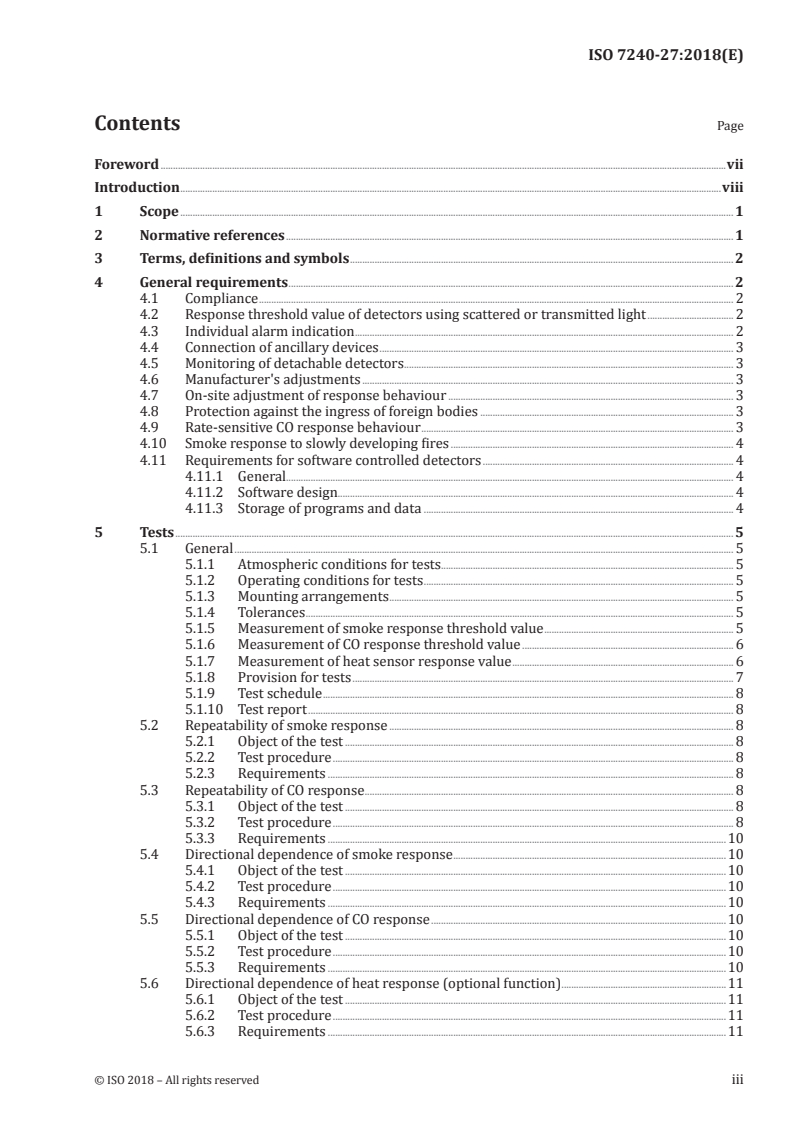
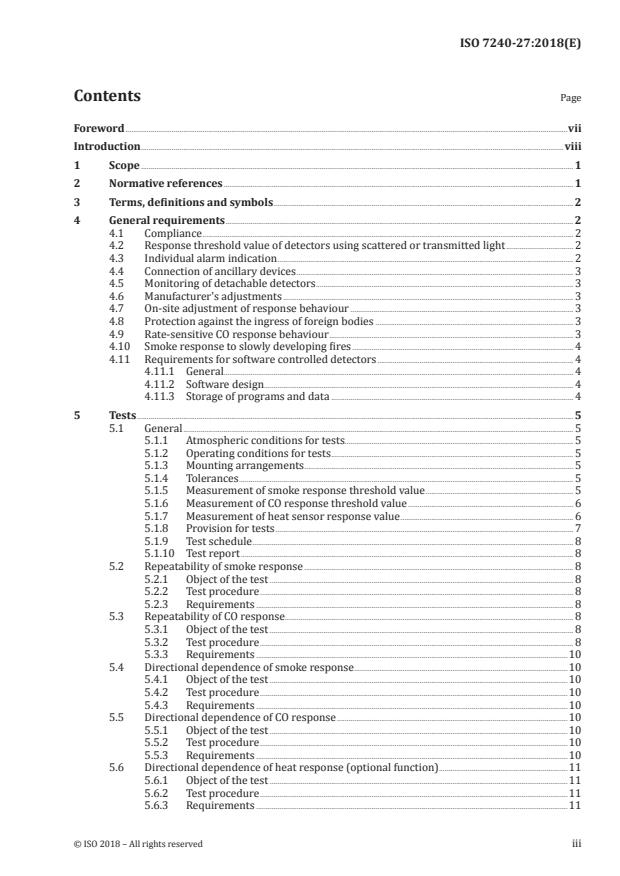
Contents Page
Foreword .vii
Introduction .viii
1 Scope . 1
2 Normative references . 1
3 Terms, definitions and symbols . 2
4 General requirements . 2
4.1 Compliance . 2
4.2 Response threshold value of detectors using scattered or transmitted light . 2
4.3 Individual alarm indication . 2
4.4 Connection of ancillary devices . 3
4.5 Monitoring of detachable detectors . 3
4.6 Manufacturer's adjustments . 3
4.7 On-site adjustment of response behaviour . 3
4.8 Protection against the ingress of foreign bodies . 3
4.9 Rate-sensitive CO response behaviour . 3
4.10 Smoke response to slowly developing fires . 4
4.11 Requirements for software controlled detectors . 4
4.11.1 General. 4
4.11.2 Software design. 4
4.11.3 Storage of programs and data . 4
5 Tests . 5
5.1 General . 5
5.1.1 Atmospheric conditions for tests. 5
5.1.2 Operating conditions for tests . 5
5.1.3 Mounting arrangements . 5
5.1.4 Tolerances . 5
5.1.5 Measurement of smoke response threshold value . 5
5.1.6 Measurement of CO response threshold value . 6
5.1.7 Measurement of heat sensor response value . 6
5.1.8 Provision for tests . 7
5.1.9 Test schedule . 8
5.1.10 Test report . 8
5.2 Repeatability of smoke response . 8
5.2.1 Object of the test . 8
5.2.2 Test procedure . 8
5.2.3 Requirements . 8
5.3 Repeatability of CO response . 8
5.3.1 Object of the test . 8
5.3.2 Test procedure . 8
5.3.3 Requirements .10
5.4 Directional dependence of smoke response .10
5.4.1 Object of the test .10
5.4.2 Test procedure .10
5.4.3 Requirements .10
5.5 Directional dependence of CO response .10
5.5.1 Object of the test .10
5.5.2 Test procedure .10
5.5.3 Requirements .10
5.6 Directional dependence of heat response (optional function) .11
5.6.1 Object of the test .11
5.6.2 Test procedure .11
5.6.3 Requirements .11
5.7 Lower limit of heat response (optional function).11
5.7.1 Object of the test .11
5.7.2 Test procedure .11
5.7.3 Requirements .11
5.8 Reproducibility of smoke response .12
5.8.1 Object of the test .12
5.8.2 Test procedure .12
5.8.3 Requirements .12
5.9 Reproducibility of CO response .12
5.9.1 Object of the test .12
5.9.2 Test procedure .12
5.9.3 Requirements .12
5.10 Reproducibility of heat response (optional function).12
5.10.1 Object of the test .12
5.10.2 Test procedure .13
5.10.3 Requirements .13
5.11 Exposure to chemical agents at environmental concentrations .13
5.11.1 Object of the test .13
5.11.2 Test procedure .13
5.11.3 Requirements .13
5.12 Long-term stability of CO response.14
5.12.1 Object of the test .14
5.12.2 Test procedure .14
5.12.3 Requirements .14
5.13 Saturation .14
5.13.1 Object of the test .14
5.13.2 Test procedure .14
5.13.3 Requirements .15
5.14 Variation in supply parameters .15
5.14.1 Object of the test .15
5.14.2 Test procedure .16
5.14.3 Requirements .16
5.15 Air movement.16
5.15.1 Object of the test .16
5.15.2 Test procedure .16
5.15.3 Requirements .17
5.16 Dazzling .17
5.16.1 Object of the test .17
5.16.2 Test procedure .17
5.16.3 Requirements .18
5.17 Dry heat (operational) .18
5.17.1 Object of the test .18
5.17.2 Test procedure .18
5.17.3 Requirements .19
5.18 Dry heat (endurance) .19
5.18.1 Object of the test .19
5.18.2 Test procedure .19
5.18.3 Requirements .19
5.19 Cold (operational), smoke .20
5.19.1 Object of the test .20
5.19.2 Test procedure .20
5.19.3 Requirements .20
5.20 Cold (operational), CO .20
5.20.1 Object of the test .20
5.20.2 Test procedure .21
5.20.3 Requirements .21
5.21 Damp heat, cyclic (operational) .21
5.21.1 Object of the test .21
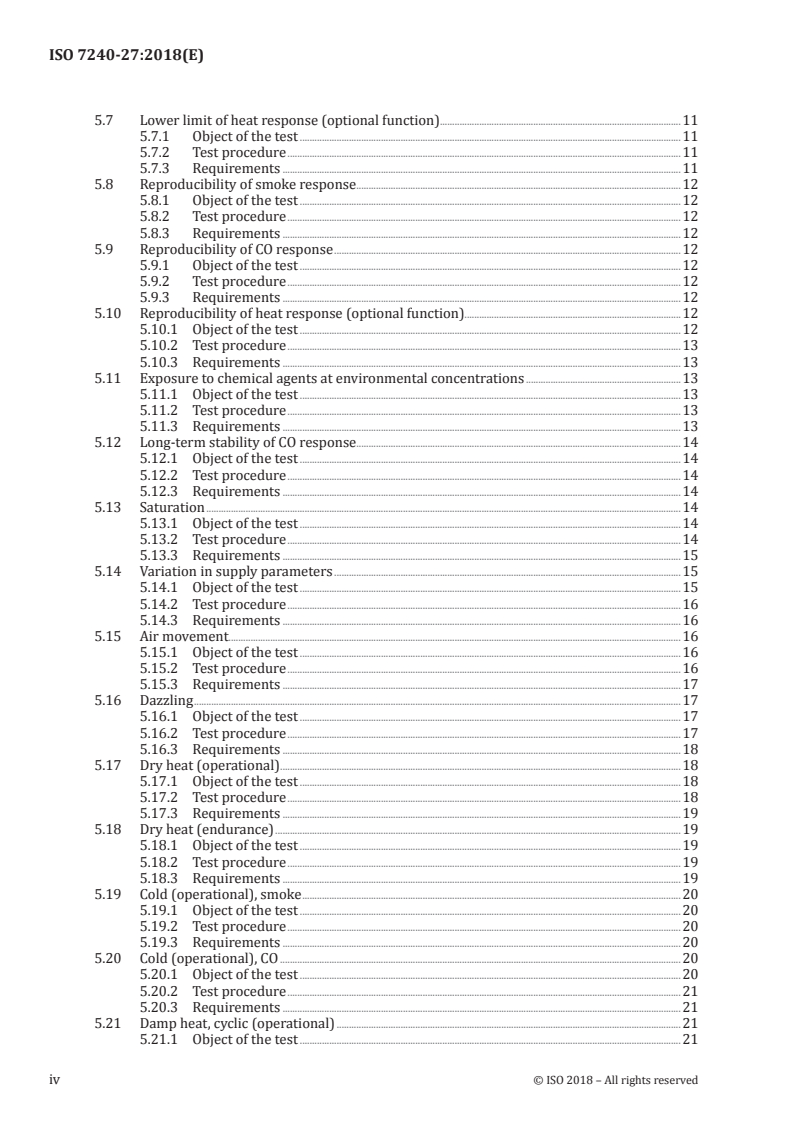
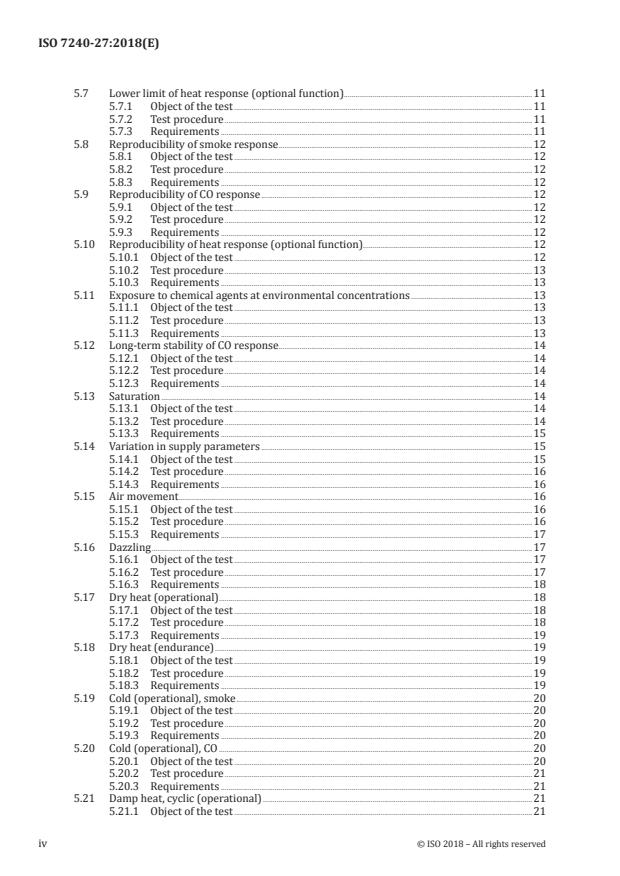
iv © ISO 2018 – All rights reserved
5.21.2 Test procedure .21
5.22 Damp heat, steady-state (operational).22
5.22.1 Object of the test .22
5.22.2 Test procedure .22
5.22.3 Requirements .23
5.23 Damp heat, steady-state (endurance) .23
5.23.1 Object of the test .23
5.23.2 Test procedure .23
5.23.3 Requirements .24
5.24 Low humidity, steady-state (endurance) .24
5.24.1 Object of the test .24
5.24.2 Test procedure .24
5.24.3 Requirements .25
5.25 Sulfur dioxide SO corrosion (endurance) .25
5.25.1 Object of the test .25
5.25.2 Test procedure .25
5.25.3 Requirements .26
5.26 Shock (operational) .26
5.26.1 Object of the test .26
5.26.2 Test procedure .26
5.26.3 Requirements .27
5.27 Impact (operational) .27
5.27.1 Object of the test .27
5.27.2 Requirements .28
5.28 Vibration, sinusoidal (operational) .28
5.28.1 Object of the test .28
5.28.2 Test procedure .28
5.28.3 Requirements .29
5.29 Vibration, sinusoidal (endurance) .29
5.29.1 Object of the test .29
5.29.2 Test procedure .29
5.29.3 Requirements .30
5.30 Electromagnetic compatibility (EMC) immunity tests (operational) .30
5.30.1 Object of the test .30
5.30.2 Requirements .31
5.31 Fire sensitivity .31
5.31.1 Object of the test .31
5.31.2 Test procedure .31
5.31.3 Requirements .32
6 Test report .32
7 Marking .33
8 Data .33
8.1 Hardware documentation .33
8.2 Software documentation .34
Annex A (normative) Gas test chamber for CO response threshold value and cross
sensitivity measurements .35
Annex B (normative) Construction of the heat tunnel .36
Annex C (normative) Apparatus for dazzling test .39
Annex D (normative) Apparatus for impact test .40
Annex E (normative) Fire test room .42
Annex F (normative) Smouldering (pyrolysis) wood fire (TF2) .44
Annex G (normative) Glowing smouldering cotton fire (TF3) .47
Annex H (normative) Flaming plastics (polyurethane) fire (TF4) .50
Annex I (normative) Liquid (heptane) fire (TF5).53
Annex J (normative) Low temperature black smoke (decalene) liquid fire (TF8) .56
Annex K (informative) Information concerning the construction of the gas test chamber .59
Bibliography .61
vi © ISO 2018 – All rights reserved
Foreword
ISO (the International Organization for Standardization) is a worldwide federation of national standards
bodies (ISO member bodies). The work of preparing International Standards is normally carried out
through ISO technical committees. Each member body interested in a subject for which a technical
committee has been established has the right to be represented on that committee. International
organizations, governmental and non-governmental, in liaison with ISO, also take part in the work.
ISO collaborates closely with the International Electrotechnical Commission (IEC) on all matters of
electrotechnical standardization.
The procedures used to develop this document and those intended for its further maintenance are
described in the ISO/IEC Directives, Part 1. In particular the different approval criteria needed for the
different types of ISO documents should be noted. This document was drafted in accordance with the
editorial rules of the ISO/IEC Directives, Part 2 (see www .iso .org/directives).
Attention is drawn to the possibility that some of the elements of this document may be the subject of
patent rights. ISO shall not be held responsible for identifying any or all such patent rights. Details of
any patent rights identified during the development of the document will be in the Introduction and/or
on the ISO list of patent declarations received (see www .iso .org/patents).
Any trade name used in this document is information given for the convenience of users and does not
constitute an endorsement.
For an explanation on the voluntary nature of standards, the meaning of ISO specific terms and
expressions related to conformity assessment, as well as information about ISO's adherence to the
World Trade Organization (WTO) principles in the Technical Barriers to Trade (TBT) see the following
URL: www .iso .org/iso/foreword .html.
This document was prepared by Technical Committee ISO/TC 21, Equipment for fire protection and fire
fighting, Subcommittee SC 3, Fire detection and alarm systems.
This second edition cancels and replaces the first edition (ISO 7240-27:2009), which has been
technically revised.
The main changes compared to the previous edition are as follows:
— other carbon monoxide sensing technologies are now permitted by introducing additional
environmental tests;
— a damp heat, steady-state (operational) test like that used in the European standard EN 54-31 has
been incorporated;
— for tests in the gas chamber, the allowable background of carbon monoxide has been increased from
1 µl/l to 1,5 µl/l;
— in the test for exposure to chemical agents at environmental concentrations, the concentration of
heptane and ethanol have been increased to 500 µl/l and 1000 µl/l, respectively and the exposure
times to NO and SO have been reduced to 1 h and 24 h, respectively;
2 2
— the test for exposure to chemical agents associated with a fire has been deleted as being too complex
and not relevant due to CO sensors having already responded when high concentrations of NO , SO
2 2
and CO have been reached;
— a Bibliography has been added which list standards and documents not used as normative references.
A list of all parts in the ISO 7247-series can be found on the ISO website.
Introduction
A fire detection and fire alarm system is required to function satisfactorily not only in the event of a
fire, but also during and after exposure to conditions likely to be met in practice such as corrosion,
vibration, direct impact, indirect shock and electromagnetic interference. Some tests specified are
intended to assess the performance of the fire detectors under such conditions.
The performance of fire detectors is assessed from results obtained in specific tests; this document is
not intended to place any other restrictions on the design and construction of such detectors.
Smoke detectors using ionization or optical sensors, and complying with ISO 7240-7, are well established
for the protection of life and property. Even so, they can respond to stimuli other than smoke and, in
some circumstances, can be prone to false alarms. False alarm rates are usually minimised by careful
application, giving some limitations in use, and occasionally with a reduction in protection provided.
It is generally accepted that fire detectors using carbon monoxide (CO) sensors alone, while suitable
for the detection of smouldering fires involving carbonaceous fuels, can be relatively insensitive to
free-burning fires supported by a plentiful supply of oxygen. This limitation can be largely overcome
by the inclusion of a heat sensor whose output is combined in some way with that of the CO sensor.
Performance requirements for CO fire detectors and for CO and heat detectors can be found in
ISO 7240-6 and ISO 7240-8 respectively.
Although the CO and heat detector is capable of responding to free-burning fires, it can still be relatively
insensitive to low-temperature fires that produce large amounts of visible smoke but low concentrations
of CO and little heat. This limitation prevents the CO and heat detector being a true replacement for a
smoke detector in life safety applications.
Many false alarm sources that affect smoke detectors do not produce CO. It is possible therefore that by
adding a CO sensor to a smoke detector, and combining its output in some way with that of the smoke
sensor, the incidence of false alarms be reduced. This reduction can be achieved while simultaneously
providing the ability to respond to a broader range of fire types than is possible with either a smoke or
CO detector alone.
It is possible to improve the performance even further by adding a heat sensor to assist in the response
to clean-burning high energy fires. This improvement is seen as secondary to the overall performance
and for this reason the heat sensor is treated as optional for compliance with this document.
viii © ISO 2018 – All rights reserved
INTERNATIONAL STANDARD ISO 7240-27:2018(E)
Fire detection and alarm systems —
Part 27:
Point type fire detectors using a smoke sensor in
combination with a carbon monoxide sensor and,
optionally, one or more heat sensors
1 Scope
This document specifies requirements, test methods and performance criteria for multi-sensor point
fire detectors that incorporate a smoke sensor, a carbon monoxide (CO) sensor and, optionally, one or
more heat sensors, for use in fire detection and alarm systems installed in buildings (see ISO 7240-1).
For the testing of other types of fire detectors using smoke, CO and, optionally, heat sensors working
on different principles, this document can be used only for guidance. This document is not applicable
to fire detectors using smoke, CO and, optionally heat sensors, which have special characteristics and
which have been developed for specific risks.
2 Normative references
The following documents are referred to in the text in such a way that some or all of their content
constitutes requirements of this document. For dated references, only the edition cited applies. For
undated references, the latest edition of the referenced document (including any amendments) applies.
ISO 209, Aluminium and aluminium alloys — Chemical composition
ISO 7240-1, Fire detection and alarm systems — Part 1: General and definitions
ISO 7240-5:2012, Fire detection and alarm systems — Part 5: Point-type heat detectors
ISO 7240-7:2011, Fire detection and alarm systems — Part 7: Point-type smoke detectors using scattered
light, transmitted light or ionization
IEC 60068-1, Environmental testing — Part 1: General and guidance
IEC 60068-2-1, Environmental testing — Part 2-1: Tests — Test A: Cold
IEC 60068-2-2, Environmental testing — Part 2-2: Tests — Test B: Dry heat
IEC 60068-2-6, Environmental testing — Part 2-6: Tests — Test Fc: Vibration (sinusoidal)
IEC 60068-2-27, Environmental testing — Part 2-27: Tests — Test Ea and guidance: Shock
IEC 60068-2-30, Environmental testing — Part 2-30: Tests — Test Db: Damp, cyclic (12 h + 12 h cycle)
IEC 60068-2-42, Environmental testing — Part 2-42: Tests — Test Kc: Sulphur dioxide test for contacts and
connections
IEC 60068-2-78, Environmental Testing — Part 2-78: Tests — Test 2-78: Body Cab: Damp Heat, Steady State
IEC 62599-2, Alarm systems — Part 2: Electromagnetic compatibility — Immunity requirements for
components of fire and security alarm systems
3 Terms, definitions and symbols
For the purposes of this document, the terms, definitions and symbols given in ISO 7240-1 and the
following apply.
ISO and IEC maintain terminological databases for use in standardization at the following addresses:
— IEC Electropedia: available at http: //www .electropedia .org/
— ISO Online browsing platform: available at https: //www .iso .org/obp
3.1
response threshold value
magnitude of the reference parameter at which the detector enters an alarm state when subjected to
changes in the smoke or carbon monoxide concentration or temperature
Note 1 to entry: See 5.1.5, 5.1.6 or 5.1.7 (as applicable).
EXAMPLE Smoke response threshold value, CO response threshold value.
Note 2 to entry: The response threshold value can depend on signal processing in the detector and in the control
and indicating equipment.
4 General requirements
4.1 Compliance
In order to comply with this document, the detector shall meet the requirements of:
Clause 4, which shall be verified by visual inspection or engineering assessment, shall be tested as
described in Clause 5 and shall meet the requirements of the tests.
Clauses 7 and 8, which shall be verified by visual inspection.
4.2 Response threshold value of detectors using scattered or transmitted light
Detectors using scattered or transmitted light shall conform to one of the two response threshold value
bands specified in Table 1 and the corresponding end-of-test conditions for the test fires specified in 5.31.
Table 1 — Response threshold value for detectors using scattered or transmitted light
Band Response threshold value in smoke
Test fires end-of-test conditions
tunnel (aerosol)
dB/m TF2 TF3 TF4 TF5
dB/m dB/m dimensionless dimensionless
1 0,05 < m < 0,3 m = 2 m = 2 y = 6 y = 6
2 0,2 < m < 0,6 m = 2 m = 2 y = 6,5 y = 7,5
NOTE The smaller the m value, the higher the sensitivity of the detectors.
4.3 Individual alarm indication
Each detector shall be provided with an integral red visual indicator, by which the individual detector
that released an alarm can be identified, until the alarm condition is reset. Where other conditions of
the detector can be visually indicated, these shall be clearly distinguishable from the alarm indication,
except when the detector is switched into a service mode. For detachable detectors, the indicator may
be integral with the base or the detector head.
2 © ISO 2018 – All rights reserved
The visual indicator shall be visible from a distance of 6 m in an ambient light intensity up to 500 lx at
an angle of up to
— 5° from the axis of the detector in any direction;
— 45° from the axis of the detector in at least one direction.
4.4 Connection of ancillary devices
The detector may provide for connections to ancillary devices (e.g. remote indicators, control relays,
etc.), but open- or short-circuit failures of these connections shall not prevent the correct operation of
the detector.
4.5 Monitoring of detachable detectors
For detachable detectors, a means shall be provided for a remote monitoring equipment (e.g. the control
and indicating equipment) to detect the removal of the head from the base, in order to give a fault signal.
4.6 Manufacturer's adjustments
It shall not be possible to change the manufacturer's settings except by special means (e.g. the use of a
special code or tool) or by breaking or removing a seal.
4.7 On-site adjustment of response behaviour
If there is provision for on-site adjustment of the response behaviour of the detector then:
a) for all of the settings, at which the manufacturer claims compliance with this document, the
detector shall comply with the requirements of this document and access to the adjustment means
shall be possible only by the use of a code or special tool or by removing the detector from its base
or mounting;
b) any setting(s) at which the manufacturer does not claim compliance with this docu
...
INTERNATIONAL ISO
STANDARD 7240-27
Second edition
2018-05
Fire detection and alarm systems —
Part 27:
Point type fire detectors using a
smoke sensor in combination with
a carbon monoxide sensor and,
optionally, one or more heat sensors
Systèmes de détection et d'alarme d'incendie —
Partie 27: Détecteurs ponctuels d'incendie utilisant un capteur de
fumée en combinaison avec un capteur de monoxyde de carbone (CO)
et, optionnellement, un ou plusieurs capteurs de chaleur
Reference number
©
ISO 2018
© ISO 2018
All rights reserved. Unless otherwise specified, or required in the context of its implementation, no part of this publication may
be reproduced or utilized otherwise in any form or by any means, electronic or mechanical, including photocopying, or posting
on the internet or an intranet, without prior written permission. Permission can be requested from either ISO at the address
below or ISO’s member body in the country of the requester.
ISO copyright office
CP 401 • Ch. de Blandonnet 8
CH-1214 Vernier, Geneva
Phone: +41 22 749 01 11
Fax: +41 22 749 09 47
Email: copyright@iso.org
Website: www.iso.org
Published in Switzerland
ii © ISO 2018 – All rights reserved
Contents Page
Foreword .vii
Introduction .viii
1 Scope . 1
2 Normative references . 1
3 Terms, definitions and symbols . 2
4 General requirements . 2
4.1 Compliance . 2
4.2 Response threshold value of detectors using scattered or transmitted light . 2
4.3 Individual alarm indication . 2
4.4 Connection of ancillary devices . 3
4.5 Monitoring of detachable detectors . 3
4.6 Manufacturer's adjustments . 3
4.7 On-site adjustment of response behaviour . 3
4.8 Protection against the ingress of foreign bodies . 3
4.9 Rate-sensitive CO response behaviour . 3
4.10 Smoke response to slowly developing fires . 4
4.11 Requirements for software controlled detectors . 4
4.11.1 General. 4
4.11.2 Software design. 4
4.11.3 Storage of programs and data . 4
5 Tests . 5
5.1 General . 5
5.1.1 Atmospheric conditions for tests. 5
5.1.2 Operating conditions for tests . 5
5.1.3 Mounting arrangements . 5
5.1.4 Tolerances . 5
5.1.5 Measurement of smoke response threshold value . 5
5.1.6 Measurement of CO response threshold value . 6
5.1.7 Measurement of heat sensor response value . 6
5.1.8 Provision for tests . 7
5.1.9 Test schedule . 8
5.1.10 Test report . 8
5.2 Repeatability of smoke response . 8
5.2.1 Object of the test . 8
5.2.2 Test procedure . 8
5.2.3 Requirements . 8
5.3 Repeatability of CO response . 8
5.3.1 Object of the test . 8
5.3.2 Test procedure . 8
5.3.3 Requirements .10
5.4 Directional dependence of smoke response .10
5.4.1 Object of the test .10
5.4.2 Test procedure .10
5.4.3 Requirements .10
5.5 Directional dependence of CO response .10
5.5.1 Object of the test .10
5.5.2 Test procedure .10
5.5.3 Requirements .10
5.6 Directional dependence of heat response (optional function) .11
5.6.1 Object of the test .11
5.6.2 Test procedure .11
5.6.3 Requirements .11
5.7 Lower limit of heat response (optional function).11
5.7.1 Object of the test .11
5.7.2 Test procedure .11
5.7.3 Requirements .11
5.8 Reproducibility of smoke response .12
5.8.1 Object of the test .12
5.8.2 Test procedure .12
5.8.3 Requirements .12
5.9 Reproducibility of CO response .12
5.9.1 Object of the test .12
5.9.2 Test procedure .12
5.9.3 Requirements .12
5.10 Reproducibility of heat response (optional function).12
5.10.1 Object of the test .12
5.10.2 Test procedure .13
5.10.3 Requirements .13
5.11 Exposure to chemical agents at environmental concentrations .13
5.11.1 Object of the test .13
5.11.2 Test procedure .13
5.11.3 Requirements .13
5.12 Long-term stability of CO response.14
5.12.1 Object of the test .14
5.12.2 Test procedure .14
5.12.3 Requirements .14
5.13 Saturation .14
5.13.1 Object of the test .14
5.13.2 Test procedure .14
5.13.3 Requirements .15
5.14 Variation in supply parameters .15
5.14.1 Object of the test .15
5.14.2 Test procedure .16
5.14.3 Requirements .16
5.15 Air movement.16
5.15.1 Object of the test .16
5.15.2 Test procedure .16
5.15.3 Requirements .17
5.16 Dazzling .17
5.16.1 Object of the test .17
5.16.2 Test procedure .17
5.16.3 Requirements .18
5.17 Dry heat (operational) .18
5.17.1 Object of the test .18
5.17.2 Test procedure .18
5.17.3 Requirements .19
5.18 Dry heat (endurance) .19
5.18.1 Object of the test .19
5.18.2 Test procedure .19
5.18.3 Requirements .19
5.19 Cold (operational), smoke .20
5.19.1 Object of the test .20
5.19.2 Test procedure .20
5.19.3 Requirements .20
5.20 Cold (operational), CO .20
5.20.1 Object of the test .20
5.20.2 Test procedure .21
5.20.3 Requirements .21
5.21 Damp heat, cyclic (operational) .21
5.21.1 Object of the test .21
iv © ISO 2018 – All rights reserved
5.21.2 Test procedure .21
5.22 Damp heat, steady-state (operational).22
5.22.1 Object of the test .22
5.22.2 Test procedure .22
5.22.3 Requirements .23
5.23 Damp heat, steady-state (endurance) .23
5.23.1 Object of the test .23
5.23.2 Test procedure .23
5.23.3 Requirements .24
5.24 Low humidity, steady-state (endurance) .24
5.24.1 Object of the test .24
5.24.2 Test procedure .24
5.24.3 Requirements .25
5.25 Sulfur dioxide SO corrosion (endurance) .25
5.25.1 Object of the test .25
5.25.2 Test procedure .25
5.25.3 Requirements .26
5.26 Shock (operational) .26
5.26.1 Object of the test .26
5.26.2 Test procedure .26
5.26.3 Requirements .27
5.27 Impact (operational) .27
5.27.1 Object of the test .27
5.27.2 Requirements .28
5.28 Vibration, sinusoidal (operational) .28
5.28.1 Object of the test .28
5.28.2 Test procedure .28
5.28.3 Requirements .29
5.29 Vibration, sinusoidal (endurance) .29
5.29.1 Object of the test .29
5.29.2 Test procedure .29
5.29.3 Requirements .30
5.30 Electromagnetic compatibility (EMC) immunity tests (operational) .30
5.30.1 Object of the test .30
5.30.2 Requirements .31
5.31 Fire sensitivity .31
5.31.1 Object of the test .31
5.31.2 Test procedure .31
5.31.3 Requirements .32
6 Test report .32
7 Marking .33
8 Data .33
8.1 Hardware documentation .33
8.2 Software documentation .34
Annex A (normative) Gas test chamber for CO response threshold value and cross
sensitivity measurements .35
Annex B (normative) Construction of the heat tunnel .36
Annex C (normative) Apparatus for dazzling test .39
Annex D (normative) Apparatus for impact test .40
Annex E (normative) Fire test room .42
Annex F (normative) Smouldering (pyrolysis) wood fire (TF2) .44
Annex G (normative) Glowing smouldering cotton fire (TF3) .47
Annex H (normative) Flaming plastics (polyurethane) fire (TF4) .50
Annex I (normative) Liquid (heptane) fire (TF5).53
Annex J (normative) Low temperature black smoke (decalene) liquid fire (TF8) .56
Annex K (informative) Information concerning the construction of the gas test chamber .59
Bibliography .61
vi © ISO 2018 – All rights reserved
Foreword
ISO (the International Organization for Standardization) is a worldwide federation of national standards
bodies (ISO member bodies). The work of preparing International Standards is normally carried out
through ISO technical committees. Each member body interested in a subject for which a technical
committee has been established has the right to be represented on that committee. International
organizations, governmental and non-governmental, in liaison with ISO, also take part in the work.
ISO collaborates closely with the International Electrotechnical Commission (IEC) on all matters of
electrotechnical standardization.
The procedures used to develop this document and those intended for its further maintenance are
described in the ISO/IEC Directives, Part 1. In particular the different approval criteria needed for the
different types of ISO documents should be noted. This document was drafted in accordance with the
editorial rules of the ISO/IEC Directives, Part 2 (see www .iso .org/directives).
Attention is drawn to the possibility that some of the elements of this document may be the subject of
patent rights. ISO shall not be held responsible for identifying any or all such patent rights. Details of
any patent rights identified during the development of the document will be in the Introduction and/or
on the ISO list of patent declarations received (see www .iso .org/patents).
Any trade name used in this document is information given for the convenience of users and does not
constitute an endorsement.
For an explanation on the voluntary nature of standards, the meaning of ISO specific terms and
expressions related to conformity assessment, as well as information about ISO's adherence to the
World Trade Organization (WTO) principles in the Technical Barriers to Trade (TBT) see the following
URL: www .iso .org/iso/foreword .html.
This document was prepared by Technical Committee ISO/TC 21, Equipment for fire protection and fire
fighting, Subcommittee SC 3, Fire detection and alarm systems.
This second edition cancels and replaces the first edition (ISO 7240-27:2009), which has been
technically revised.
The main changes compared to the previous edition are as follows:
— other carbon monoxide sensing technologies are now permitted by introducing additional
environmental tests;
— a damp heat, steady-state (operational) test like that used in the European standard EN 54-31 has
been incorporated;
— for tests in the gas chamber, the allowable background of carbon monoxide has been increased from
1 µl/l to 1,5 µl/l;
— in the test for exposure to chemical agents at environmental concentrations, the concentration of
heptane and ethanol have been increased to 500 µl/l and 1000 µl/l, respectively and the exposure
times to NO and SO have been reduced to 1 h and 24 h, respectively;
2 2
— the test for exposure to chemical agents associated with a fire has been deleted as being too complex
and not relevant due to CO sensors having already responded when high concentrations of NO , SO
2 2
and CO have been reached;
— a Bibliography has been added which list standards and documents not used as normative references.
A list of all parts in the ISO 7247-series can be found on the ISO website.
Introduction
A fire detection and fire alarm system is required to function satisfactorily not only in the event of a
fire, but also during and after exposure to conditions likely to be met in practice such as corrosion,
vibration, direct impact, indirect shock and electromagnetic interference. Some tests specified are
intended to assess the performance of the fire detectors under such conditions.
The performance of fire detectors is assessed from results obtained in specific tests; this document is
not intended to place any other restrictions on the design and construction of such detectors.
Smoke detectors using ionization or optical sensors, and complying with ISO 7240-7, are well established
for the protection of life and property. Even so, they can respond to stimuli other than smoke and, in
some circumstances, can be prone to false alarms. False alarm rates are usually minimised by careful
application, giving some limitations in use, and occasionally with a reduction in protection provided.
It is generally accepted that fire detectors using carbon monoxide (CO) sensors alone, while suitable
for the detection of smouldering fires involving carbonaceous fuels, can be relatively insensitive to
free-burning fires supported by a plentiful supply of oxygen. This limitation can be largely overcome
by the inclusion of a heat sensor whose output is combined in some way with that of the CO sensor.
Performance requirements for CO fire detectors and for CO and heat detectors can be found in
ISO 7240-6 and ISO 7240-8 respectively.
Although the CO and heat detector is capable of responding to free-burning fires, it can still be relatively
insensitive to low-temperature fires that produce large amounts of visible smoke but low concentrations
of CO and little heat. This limitation prevents the CO and heat detector being a true replacement for a
smoke detector in life safety applications.
Many false alarm sources that affect smoke detectors do not produce CO. It is possible therefore that by
adding a CO sensor to a smoke detector, and combining its output in some way with that of the smoke
sensor, the incidence of false alarms be reduced. This reduction can be achieved while simultaneously
providing the ability to respond to a broader range of fire types than is possible with either a smoke or
CO detector alone.
It is possible to improve the performance even further by adding a heat sensor to assist in the response
to clean-burning high energy fires. This improvement is seen as secondary to the overall performance
and for this reason the heat sensor is treated as optional for compliance with this document.
viii © ISO 2018 – All rights reserved
INTERNATIONAL STANDARD ISO 7240-27:2018(E)
Fire detection and alarm systems —
Part 27:
Point type fire detectors using a smoke sensor in
combination with a carbon monoxide sensor and,
optionally, one or more heat sensors
1 Scope
This document specifies requirements, test methods and performance criteria for multi-sensor point
fire detectors that incorporate a smoke sensor, a carbon monoxide (CO) sensor and, optionally, one or
more heat sensors, for use in fire detection and alarm systems installed in buildings (see ISO 7240-1).
For the testing of other types of fire detectors using smoke, CO and, optionally, heat sensors working
on different principles, this document can be used only for guidance. This document is not applicable
to fire detectors using smoke, CO and, optionally heat sensors, which have special characteristics and
which have been developed for specific risks.
2 Normative references
The following documents are referred to in the text in such a way that some or all of their content
constitutes requirements of this document. For dated references, only the edition cited applies. For
undated references, the latest edition of the referenced document (including any amendments) applies.
ISO 209, Aluminium and aluminium alloys — Chemical composition
ISO 7240-1, Fire detection and alarm systems — Part 1: General and definitions
ISO 7240-5:2012, Fire detection and alarm systems — Part 5: Point-type heat detectors
ISO 7240-7:2011, Fire detection and alarm systems — Part 7: Point-type smoke detectors using scattered
light, transmitted light or ionization
IEC 60068-1, Environmental testing — Part 1: General and guidance
IEC 60068-2-1, Environmental testing — Part 2-1: Tests — Test A: Cold
IEC 60068-2-2, Environmental testing — Part 2-2: Tests — Test B: Dry heat
IEC 60068-2-6, Environmental testing — Part 2-6: Tests — Test Fc: Vibration (sinusoidal)
IEC 60068-2-27, Environmental testing — Part 2-27: Tests — Test Ea and guidance: Shock
IEC 60068-2-30, Environmental testing — Part 2-30: Tests — Test Db: Damp, cyclic (12 h + 12 h cycle)
IEC 60068-2-42, Environmental testing — Part 2-42: Tests — Test Kc: Sulphur dioxide test for contacts and
connections
IEC 60068-2-78, Environmental Testing — Part 2-78: Tests — Test 2-78: Body Cab: Damp Heat, Steady State
IEC 62599-2, Alarm systems — Part 2: Electromagnetic compatibility — Immunity requirements for
components of fire and security alarm systems
3 Terms, definitions and symbols
For the purposes of this document, the terms, definitions and symbols given in ISO 7240-1 and the
following apply.
ISO and IEC maintain terminological databases for use in standardization at the following addresses:
— IEC Electropedia: available at http: //www .electropedia .org/
— ISO Online browsing platform: available at https: //www .iso .org/obp
3.1
response threshold value
magnitude of the reference parameter at which the detector enters an alarm state when subjected to
changes in the smoke or carbon monoxide concentration or temperature
Note 1 to entry: See 5.1.5, 5.1.6 or 5.1.7 (as applicable).
EXAMPLE Smoke response threshold value, CO response threshold value.
Note 2 to entry: The response threshold value can depend on signal processing in the detector and in the control
and indicating equipment.
4 General requirements
4.1 Compliance
In order to comply with this document, the detector shall meet the requirements of:
Clause 4, which shall be verified by visual inspection or engineering assessment, shall be tested as
described in Clause 5 and shall meet the requirements of the tests.
Clauses 7 and 8, which shall be verified by visual inspection.
4.2 Response threshold value of detectors using scattered or transmitted light
Detectors using scattered or transmitted light shall conform to one of the two response threshold value
bands specified in Table 1 and the corresponding end-of-test conditions for the test fires specified in 5.31.
Table 1 — Response threshold value for detectors using scattered or transmitted light
Band Response threshold value in smoke
Test fires end-of-test conditions
tunnel (aerosol)
dB/m TF2 TF3 TF4 TF5
dB/m dB/m dimensionless dimensionless
1 0,05 < m < 0,3 m = 2 m = 2 y = 6 y = 6
2 0,2 < m < 0,6 m = 2 m = 2 y = 6,5 y = 7,5
NOTE The smaller the m value, the higher the sensitivity of the detectors.
4.3 Individual alarm indication
Each detector shall be provided with an integral red visual indicator, by which the individual detector
that released an alarm can be identified, until the alarm condition is reset. Where other conditions of
the detector can be visually indicated, these shall be clearly distinguishable from the alarm indication,
except when the detector is switched into a service mode. For detachable detectors, the indicator may
be integral with the base or the detector head.
2 © ISO 2018 – All rights reserved
The visual indicator shall be visible from a distance of 6 m in an ambient light intensity up to 500 lx at
an angle of up to
— 5° from the axis of the detector in any direction;
— 45° from the axis of the detector in at least one direction.
4.4 Connection of ancillary devices
The detector may provide for connections to ancillary devices (e.g. remote indicators, control relays,
etc.), but open- or short-circuit failures of these connections shall not prevent the correct operation of
the detector.
4.5 Monitoring of detachable detectors
For detachable detectors, a means shall be provided for a remote monitoring equipment (e.g. the control
and indicating equipment) to detect the removal of the head from the base, in order to give a fault signal.
4.6 Manufacturer's adjustments
It shall not be possible to change the manufacturer's settings except by special means (e.g. the use of a
special code or tool) or by breaking or removing a seal.
4.7 On-site adjustment of response behaviour
If there is provision for on-site adjustment of the response behaviour of the detector then:
a) for all of the settings, at which the manufacturer claims compliance with this document, the
detector shall comply with the requirements of this document and access to the adjustment means
shall be possible only by the use of a code or special tool or by removing the detector from its base
or mounting;
b) any setting(s) at which the manufacturer does not claim compliance with this docu
...