

ISO/FDIS 11135
(Main)Sterilization of health-care products — Ethylene oxide — Requirements for the development, validation and routine control of a sterilization process for medical devices
- Abstract
ISO 11135:2014 specifies requirements for the development, validation and routine control of an ethylene oxide sterilization process for medical devices in both the industrial and health care facility settings, and it acknowledges the similarities and differences between the two applications.
- Status
- Not Published
- Technical Committee
- ISO/TC 198 - Sterilization of health care products
- Drafting Committee
- ISO/TC 198/WG 1 - Industrial ethylene oxide sterilization
- Current Stage
- 5020 - FDIS ballot initiated: 2 months. Proof sent to secretariat
- Start Date
- 16-Sep-2026
- Completion Date
- 16-Sep-2026
Buy Documents

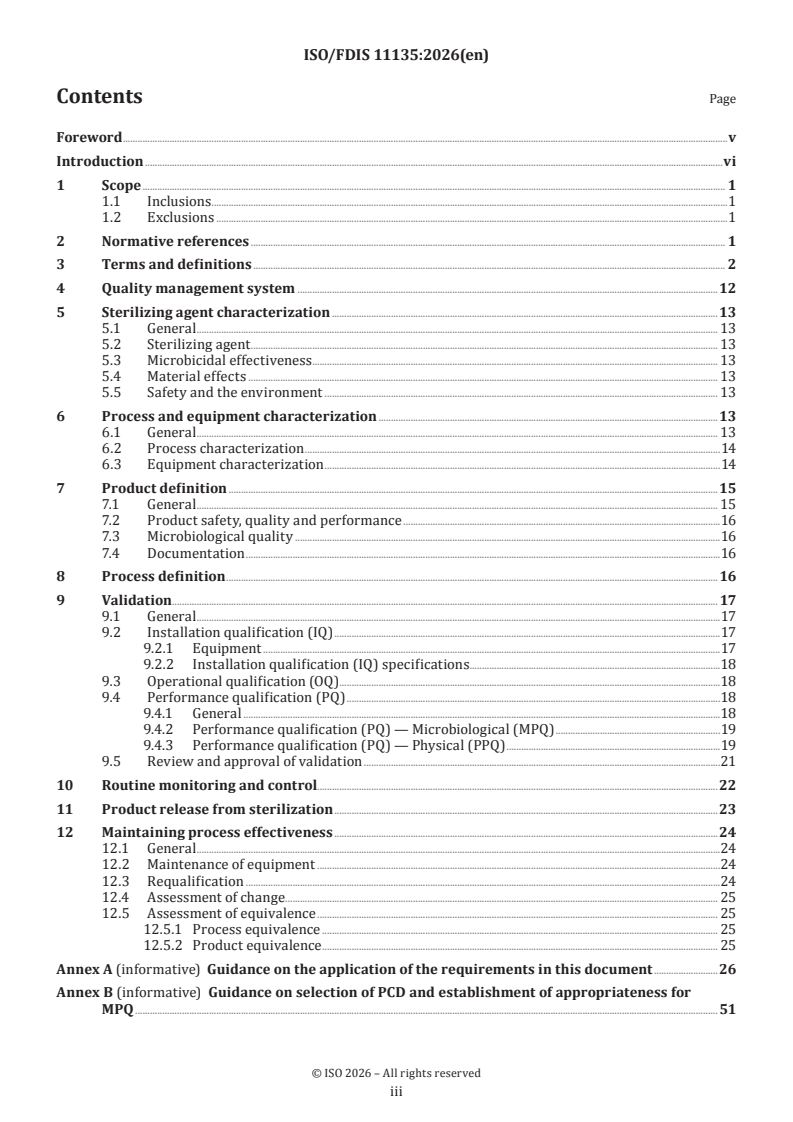
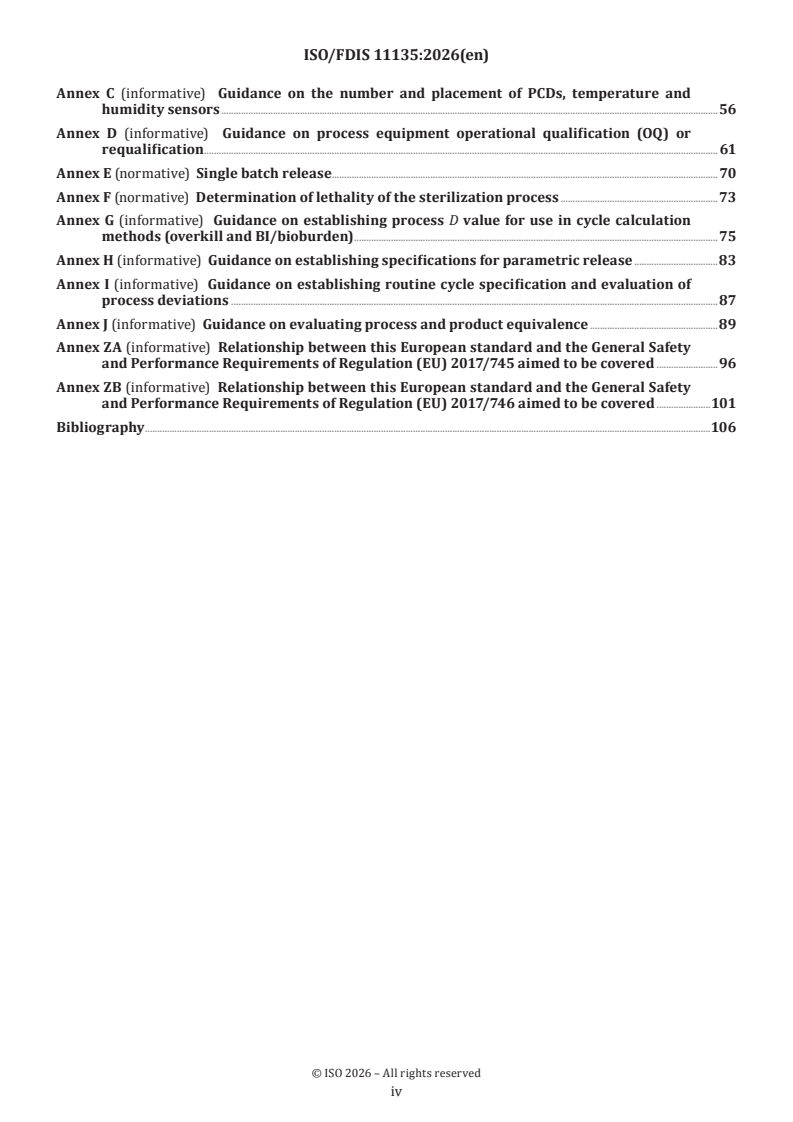
ISO/FDIS 11135 - Sterilization of health-care products — Ethylene oxide — Requirements for the development, validation and routine control of a sterilization process for medical devices
REDLINE ISO/FDIS 11135 - Sterilization of health-care products — Ethylene oxide — Requirements for the development, validation and routine control of a sterilization process for medical devices
ISO/FDIS 11135 is an ISO draft International Standard on ethylene oxide (EO) sterilization for health-care products. It specifies requirements for developing, validating and routinely controlling an EO sterilization process for medical devices in industrial and health care facility settings.
What does ISO/FDIS 11135 specify?
ISO/FDIS 11135 specifies how to define, qualify, monitor and maintain an EO sterilization process for medical devices. The scope covers both manufacturer and health care facility use, and it recognizes that those settings have different equipment, staff and product conditions.
The document is focused on the sterilization process itself. It excludes spongiform encephalopathy inactivation, occupational safety requirements for EO facilities, EO injection into packages or a flexible chamber, and analytical methods for EO residuals.
The structure is practical: Clauses 4 to 12 cover quality management, sterilizing agent characterization, process and equipment characterization, product definition, process definition, validation, routine monitoring and control, product release, and maintenance of effectiveness. The annexes then give guidance and method support.
| Annex | What it covers |
|---|---|
| Annex A | General guidance on applying the requirements |
| Annex B | Selecting a process challenge device (PCD) and showing it is appropriate for microbiological performance qualification (MPQ) |
| Annex C | Number and placement of PCDs, temperature sensors and humidity sensors |
| Annex D | Process equipment operational qualification (OQ) and requalification guidance |
| Annex E | Single batch release |
| Annex F | Determining lethality of the sterilization process |
| Annex G | Establishing process D value for cycle calculation methods |
| Annex H | Establishing specifications for parametric release |
| Annex I | Routine cycle specification and evaluation of process deviations |
| Annex J | Evaluating process and product equivalence |
What are the key requirements of ISO/FDIS 11135?
ISO/FDIS 11135 is built around a controlled, validated process lifecycle: define the product, define the process, validate it, monitor every routine run, then keep the process in control over time. That matters because EO sterilization cannot be fully verified by final inspection alone.
Quality system and control of the process
Clause 4 requires a quality management system around the sterilization process, including control of documentation, management responsibility, resources, external product, traceability, routine monitoring and non-conforming product. In practice, this means EO sterilization cannot be run as a standalone technical activity - it has to be managed with records, responsibilities and corrective action.
Clause 4 also requires a documented process for calibration and maintenance of all equipment and test instrumentation. That matters because the process depends on measured variables such as temperature, humidity, pressure and EO concentration.
Sterilizing agent, equipment and software
Clause 5 requires a documented specification for EO, including its composition and storage conditions where relevant. It also requires assessment of safety and environmental effects, with documented measures for environmental protection. For a user, this means the EO supply and handling conditions have to be controlled, not assumed.
Clause 6 requires characterization of the full process and the equipment that delivers it. The standard identifies the phases of EO sterilization, including preconditioning, sterilization and aeration, and the process variables for each phase. It also requires documentation of the equipment specification, including the chamber, gas delivery, instrumentation, alarms, safety features and installation requirements.
Clause 6 also requires software used to control or monitor the process to be prepared, validated and documented. That matters because a control system failure must not make an ineffective process appear acceptable.
Product definition and product protection
Clause 7 requires definition of the product to be sterilized, including its pre-sterilization microbiological quality, packaging and load configuration. The product, its packaging and the load arrangement have to allow air removal, EO penetration, heat and humidity transfer, and EO removal at the end of the process.
Clause 7 also requires proof that the process reaches the most difficult-to-sterilize location in the product. For a buyer or manufacturer, that means the validation must focus on the worst-case item or location, not just the easiest one.
For product safety, quality and performance, Clause 7 requires confirmation that the sterilized product and packaging still meet specified requirements. It also requires EO residual levels to conform with ISO 10993-7 before market release. That is important because a sterile product is not acceptable if residual EO is still too high.
Bioburden control and process definition
Clause 7 requires control of microbiological quality and cleanliness of the product presented for sterilization. For single-use medical devices, bioburden estimation has to be performed in accordance with ISO 11737-1. For reusable medical devices, the effectiveness of cleaning and, if applicable, disinfection has to be assessed first.
Clause 8 requires the process specification for the defined product to be established before validation studies and before routine processing. It also requires the microbiological inactivation rate at the hardest-to-sterilize location to be determined using Annex F or another method that demonstrates achievement of the selected sterility assurance level (SAL).
Biological indicators (BIs) used in process definition have to comply with ISO 11138-2, present a challenge at least as great as the product bioburden, and be placed in an appropriate PCD. Chemical indicators, if used, have to comply with ISO 11140-1 but cannot be the sole basis for defining the process or proving the selected SAL.
Validation, routine control and release
Clause 9 requires validation in three stages: installation qualification (IQ), operational qualification (OQ) and performance qualification (PQ). The validation studies cannot start until the procedures or protocols have been approved. OQ requires confirmed calibration of the instruments used to monitor and control the process. PQ uses product to show the process consistently meets acceptance criteria.
Clause 10 requires routine monitoring and recording of each sterilization process so the process specification can be shown to have been met. Clause 11 then uses those records as the basis for product release. If a process does not meet the release criteria, the cause must be investigated and the product is non-conforming.
Clause 12 requires the process to stay effective over time through preventive maintenance, periodic verification of instrumentation, annual review for requalification, and documented assessment of changes. This is the part that keeps a validated process valid after equipment work, product changes or load changes.
What terms does ISO/FDIS 11135 define?
ISO/FDIS 11135 defines the vocabulary used to control EO sterilization consistently.
- Ethylene oxide (EO) - the sterilizing agent used by the process.
- Biological indicator (BI) - a test system containing viable microorganisms with a specified resistance to a specified sterilization process.
- Process challenge device (PCD) - an item with defined resistance used to assess process performance.
- Internal PCD (IPCD) - a PCD used to demonstrate that the selected product SAL is achieved.
- External PCD (EPCD) - a PCD used for microbiological monitoring of routine production cycles.
- Sterility assurance level (SAL) - the probability of a single viable microorganism remaining on an item after sterilization.
- Installation qualification (IQ) - objective evidence that the installed equipment and ancillary systems comply with the approved specification.
- Performance qualification (PQ) - objective evidence that the process consistently produces product meeting predetermined requirements.
Who uses ISO/FDIS 11135?
ISO/FDIS 11135 is used by medical device manufacturers, contract sterilizers, and health care facilities that reprocess reusable devices with EO. It is also used by sterilization specialists, validation engineers, quality managers, production staff and regulatory or conformity assessment teams.
In practice, they use it to define a sterilization process, choose and place BIs and PCDs, validate equipment, set routine cycle limits, review deviations, release loads, and decide when requalification is needed.
What changed in ISO/FDIS 11135 from the previous edition?
The foreword states that this third edition cancels and replaces ISO 11135:2014 and incorporates ISO 11135:2014/Amd 1:2018. It also states the main changes: added guidance in informative Annexes B, D, E, G, H, I and J; revised and additional guidance in Annexes A and C; more defined requirements for microbiological performance qualification (MPQ) in Annex F; and incorporation of relevant elements of ISO/TS 21387:2020 into Annexes A and H.
Which standards are used with ISO/FDIS 11135?
ISO/FDIS 11135 uses five normative references to support its requirements:
| Standard | What it contributes |
|---|---|
| ISO 10993-7 | Requirements for EO residuals and reaction products |
| ISO 11138-2:2017 | Requirements for BIs for EO sterilization processes |
| ISO 11140-1 | General requirements for chemical indicators |
| ISO 11737-1 | Determination of the population of microorganisms on products |
| ISO 11737-2 | Tests of sterility used in definition, validation and maintenance |
The document also names related companion standards and guidance documents in the foreword and bibliography, including ISO 11139 for vocabulary, ISO 13485 for medical device quality management, ISO 14937 for EO processes outside this scope, and ISO 17664-1 for reprocessing information for reusable devices.
What does the ISO/FDIS 11135 document contain?
ISO/FDIS 11135 contains a full process framework rather than a single test method. It includes requirements for quality management, sterilizing agent characterization, process and equipment characterization, product definition, process definition, validation, routine monitoring, product release and maintaining process effectiveness.
The annexes add the practical methods that support those requirements. They cover PCD selection and placement, sensor placement, OQ and requalification, single batch release, lethality determination, D value calculation, parametric release, routine cycle evaluation, and product or process equivalence.
The document also contains a PQ flowchart in Annex A and detailed guidance for using BIs, PCDs, process data and microbiological challenge studies. For engineering and quality teams, that means the standard gives both the control structure and the supporting methods needed to build and maintain an EO sterilization process.
Relations
- Effective Date
- 12-Feb-2026
- Effective Date
- 27-Jul-2024
- Effective Date
- 27-Jul-2024
Buy Documents
ISO/FDIS 11135 - Sterilization of health-care products — Ethylene oxide — Requirements for the development, validation and routine control of a sterilization process for medical devices
REDLINE ISO/FDIS 11135 - Sterilization of health-care products — Ethylene oxide — Requirements for the development, validation and routine control of a sterilization process for medical devices
Get Certified
Connect with accredited certification bodies for this standard

BSI Group
BSI (British Standards Institution) is the business standards company that helps organizations make excellence a habit.

TÜV Rheinland
TÜV Rheinland is a leading international provider of technical services.

TÜV SÜD
TÜV SÜD is a trusted partner of choice for safety, security and sustainability solutions.
Sponsored listings
Frequently Asked Questions
ISO/FDIS 11135 is a draft published by the International Organization for Standardization (ISO). Its full title is "Sterilization of health-care products — Ethylene oxide — Requirements for the development, validation and routine control of a sterilization process for medical devices". This standard covers: ISO 11135:2014 specifies requirements for the development, validation and routine control of an ethylene oxide sterilization process for medical devices in both the industrial and health care facility settings, and it acknowledges the similarities and differences between the two applications.
ISO 11135:2014 specifies requirements for the development, validation and routine control of an ethylene oxide sterilization process for medical devices in both the industrial and health care facility settings, and it acknowledges the similarities and differences between the two applications.
ISO/FDIS 11135 is classified under the following ICS (International Classification for Standards) categories: 11.080.01 - Sterilization and disinfection in general. The ICS classification helps identify the subject area and facilitates finding related standards.
ISO/FDIS 11135 has the following relationships with other standards: It is inter standard links to FprEN ISO 11135, ISO 11135:2014, ISO 11135:2014/Amd 1:2018. Understanding these relationships helps ensure you are using the most current and applicable version of the standard.
ISO/FDIS 11135 is available in PDF format for immediate download after purchase. The document can be added to your cart and obtained through the secure checkout process. Digital delivery ensures instant access to the complete standard document.
Standards Content (Sample)
FINAL DRAFT
International
Standard
ISO/TC 198
Sterilization of health-care
Secretariat: ANSI
products — Ethylene oxide —
Voting begins on:
Requirements for the development,
2026-09-16
validation and routine control of
Voting terminates on:
a sterilization process for medical
2026-11-11
devices
Stérilisation des produits de santé — Oxyde d'éthylène —
Exigences de développement, de validation et de contrôle de
routine d'un processus de stérilisation pour des dispositifs
médicaux
RECIPIENTS OF THIS DRAFT ARE INVITED TO SUBMIT,
WITH THEIR COMMENTS, NOTIFICATION OF ANY
RELEVANT PATENT RIGHTS OF WHICH THEY ARE AWARE
AND TO PROVIDE SUPPOR TING DOCUMENTATION.
IN ADDITION TO THEIR EVALUATION AS
BEING ACCEPTABLE FOR INDUSTRIAL, TECHNO
ISO/CEN PARALLEL PROCESSING LOGICAL, COMMERCIAL AND USER PURPOSES, DRAFT
INTERNATIONAL STANDARDS MAY ON OCCASION HAVE
TO BE CONSIDERED IN THE LIGHT OF THEIR POTENTIAL
TO BECOME STAN DARDS TO WHICH REFERENCE MAY BE
MADE IN NATIONAL REGULATIONS.
Reference number
FINAL DRAFT
International
Standard
ISO/TC 198
Sterilization of health-care
Secretariat: ANSI
products — Ethylene oxide —
Voting begins on:
Requirements for the development,
validation and routine control of
Voting terminates on:
a sterilization process for medical
devices
Stérilisation des produits de santé — Oxyde d'éthylène —
Exigences de développement, de validation et de contrôle de
routine d'un processus de stérilisation pour des dispositifs
médicaux
RECIPIENTS OF THIS DRAFT ARE INVITED TO SUBMIT,
WITH THEIR COMMENTS, NOTIFICATION OF ANY
RELEVANT PATENT RIGHTS OF WHICH THEY ARE AWARE
AND TO PROVIDE SUPPOR TING DOCUMENTATION.
© ISO 2026
IN ADDITION TO THEIR EVALUATION AS
All rights reserved. Unless otherwise specified, or required in the context of its implementation, no part of this publication may
BEING ACCEPTABLE FOR INDUSTRIAL, TECHNO
ISO/CEN PARALLEL PROCESSING
LOGICAL, COMMERCIAL AND USER PURPOSES, DRAFT
be reproduced or utilized otherwise in any form or by any means, electronic or mechanical, including photocopying, or posting on
INTERNATIONAL STANDARDS MAY ON OCCASION HAVE
the internet or an intranet, without prior written permission. Permission can be requested from either ISO at the address below
TO BE CONSIDERED IN THE LIGHT OF THEIR POTENTIAL
or ISO’s member body in the country of the requester.
TO BECOME STAN DARDS TO WHICH REFERENCE MAY BE
MADE IN NATIONAL REGULATIONS.
ISO copyright office
CP 401 • Ch. de Blandonnet 8
CH-1214 Vernier, Geneva
Phone: +41 22 749 01 11
Email: copyright@iso.org
Website: www.iso.org
Published in Switzerland Reference number
ii
Contents Page
Foreword .v
Introduction .vi
1 Scope . 1
1.1 Inclusions.1
1.2 Exclusions .1
2 Normative references . 1
3 Terms and definitions . 2
4 Quality management system .12
5 Sterilizing agent characterization .13
5.1 General . 13
5.2 Sterilizing agent . 13
5.3 Microbicidal effectiveness . . 13
5.4 Material effects . 13
5.5 Safety and the environment . 13
6 Process and equipment characterization .13
6.1 General . 13
6.2 Process characterization .14
6.3 Equipment characterization .14
7 Product definition .15
7.1 General . 15
7.2 Product safety, quality and performance .16
7.3 Microbiological quality .16
7.4 Documentation .16
8 Process definition .16
9 Validation . . 17
9.1 General .17
9.2 Installation qualification (IQ) .17
9.2.1 Equipment .17
9.2.2 Installation qualification (IQ) specifications . .18
9.3 Operational qualification (OQ) .18
9.4 Performance qualification (PQ) .18
9.4.1 General .18
9.4.2 Performance qualification (PQ) — Microbiological (MPQ) .19
9.4.3 Performance qualification (PQ) — Physical (PPQ) .19
9.5 Review and approval of validation .21
10 Routine monitoring and control.22
11 Product release from sterilization .23
12 Maintaining process effectiveness .24
12.1 General .24
12.2 Maintenance of equipment .24
12.3 Requalification .24
12.4 Assessment of change . . 25
12.5 Assessment of equivalence . 25
12.5.1 Process equivalence . 25
12.5.2 Product equivalence . 25
Annex A (informative) Guidance on the application of the requirements in this document .26
Annex B (informative) Guidance on selection of PCD and establishment of appropriateness for
MPQ . 51
iii
Annex C (informative) Guidance on the number and placement of PCDs, temperature and
humidity sensors .56
Annex D (informative) Guidance on process equipment operational qualification (OQ) or
requalification . . 61
Annex E (normative) Single batch release . .70
Annex F (normative) Determination of lethality of the sterilization process .73
Annex G (informative) Guidance on establishing process D value for use in cycle calculation
methods (overkill and BI/bioburden) .75
Annex H (informative) Guidance on establishing specifications for parametric release .83
Annex I (informative) Guidance on establishing routine cycle specification and evaluation of
process deviations .87
Annex J (informative) Guidance on evaluating process and product equivalence .89
Annex ZA (informative) Relationship between this European standard and the General Safety
and Performance Requirements of Regulation (EU) 2017/745 aimed to be covered .96
Annex ZB (informative) Relationship between this European standard and the General Safety
and Performance Requirements of Regulation (EU) 2017/746 aimed to be covered .101
Bibliography .106
iv
Foreword
ISO (the International Organization for Standardization) is a worldwide federation of national standards
bodies (ISO member bodies). The work of preparing International Standards is normally carried out through
ISO technical committees. Each member body interested in a subject for which a technical committee
has been established has the right to be represented on that committee. International organizations,
governmental and non-governmental, in liaison with ISO, also take part in the work. ISO collaborates closely
with the International Electrotechnical Commission (IEC) on all matters of electrotechnical standardization.
The procedures used to develop this document and those intended for its further maintenance are described
in the ISO/IEC Directives, Part 1. In particular, the different approval criteria needed for the different types
of ISO documents should be noted. This document was drafted in accordance with the editorial rules of the
ISO/IEC Directives, Part 2 (see www.iso.org/directives).
ISO draws attention to the possibility that the implementation of this document may involve the use of (a)
patent(s). ISO takes no position concerning the evidence, validity or applicability of any claimed patent
rights in respect thereof. As of the date of publication of this document, ISO had not received notice of (a)
patent(s) which may be required to implement this document. However, implementers are cautioned that
this may not represent the latest information, which may be obtained from the patent database available at
www.iso.org/patents. ISO shall not be held responsible for identifying any or all such patent rights.
Any trade name used in this document is information given for the convenience of users and does not
constitute an endorsement.
For an explanation of the voluntary nature of standards, the meaning of ISO specific terms and expressions
related to conformity assessment, as well as information about ISO’s adherence to the World Trade
Organization (WTO) principles in the Technical Barriers to Trade (TBT), see www.iso.org/iso/foreword.html.
This document was prepared by Technical Committee ISO/TC 198, Sterilization of health care products, in
collaboration with the European Committee for Standardization (CEN) Technical Committee CEN/TC 204,
Sterilization of medical devices, in accordance with the Agreement on technical cooperation between ISO and
CEN (Vienna Agreement).
This third edition cancels and replaces the second edition (ISO 11135:2014), which has been technically
revised. It also incorporates the Amendment ISO 11135:2014/Amd 1:2018.
The main changes are as follows:
— addition of guidance in informative Annexes B, D, E, G, H, I and J;
— revised and additional guidance in Annexes A and C;
— more defined requirements for microbiological performance qualification (MPQ) in Annex F;
— incorporation of relevant elements of ISO/TS 21387:2020 into Annexes A and H.
Any feedback or questions on this document should be directed to the user’s national standards body. A
complete listing of these bodies can be found at www.iso.org/members.html.
v
Introduction
A sterile medical device is one that is free of viable microorganisms. Medical devices produced under
standard manufacturing conditions in accordance with the requirements for quality management systems
(e.g. ISO 13485) can, prior to sterilization, have microorganisms on them. Such medical devices are non-
sterile. The purpose of sterilization is to inactivate the microorganisms and thereby transform the non-
sterile medical devices into sterile ones.
The kinetics of inactivation of a pure culture of microorganisms by physical and chemical agents used to
sterilize medical devices can generally best be described by an exponential relationship between the
population of microorganisms surviving and the extent of treatment with the sterilant, ethylene oxide (EO).
Inevitably this means that there is always a finite probability that a microorganism can survive regardless
of the extent of treatment applied. For a given treatment, the probability of survival is determined by the
population and resistance of microorganisms and by the environment in which the organisms exist during
treatment. It follows that the sterility of any one medical device in a population subjected to sterilization
processing cannot be guaranteed and the sterility of a processed population is defined in terms of the
probability of there being a single viable microorganism present on a medical device.
This document specifies the requirements that, if met, will provide an EO sterilization process intended to
sterilize medical devices, which has appropriate microbicidal activity. Furthermore, conformance with the
requirements ensures that validations conducted according to this document provide products that meet
the defined requirements for sterile products with a high degree of confidence. The specification for this
probability is a matter for regulatory authorities and can vary from country to country (see for example
EN 556-1 and ANSI/AAMI ST67).
Generic requirements of the quality management systems for design and development, production,
installation and servicing are given in ISO 9001 and particular requirements for quality management
systems for medical device production are given in ISO 13485. These standards for quality management
systems recognize that, for certain processes used in manufacturing or reprocessing, the effectiveness of
the process cannot be fully verified by subsequent inspection and testing of the product. Sterilization is an
example of such a process. For this reason, sterilization processes are validated for use, the performance of
the sterilization process is monitored routinely, and the equipment is maintained and calibrated.
Exposure to a properly validated, accurately controlled sterilization process is not the only factor associated
with the provision of reliable assurance that the product is sterile and, in this regard, suitable for its intended
use. Other factors that should be considered include, but not limited to:
— the microbiological status of incoming raw materials or components, or both;
— the validation and routine control of any cleaning and disinfection procedures used on the product;
— the control of the environment in which the product is manufactured or reprocessed, assembled and
packaged;
— the control of equipment and processes;
— the control of personnel and their hygiene;
— the manner and materials in which the product is packaged;
— the conditions under which product is stored.
The type of contamination on a product to be sterilized varies and this impacts upon the effectiveness of
a sterilization process. Products that have been used in a health care setting and are being presented for
resterilization in accordance with the manufacturer’s instructions (see ISO 17664-1) are a special case.
Health care facilities differ from medical device manufacturers in the physical design of processing areas,
in the equipment used, and in the availability of personnel with adequate levels of training and experience.
The primary function of the health care facility is to provide patient care; medical device reprocessing is
just one of a myriad of activities that are performed to support that function. The major differences relate
vi
to the unique physical and organizational conditions in health care facilities, and to the initial condition of
reusable healthcare products being presented for sterilization.
Medical device manufacturers generally sterilize large numbers of similar single-use medical devices.
Health care facilities, on the other hand, handle and process both new medical devices and reusable medical
devices of different types and with varying levels of bioburden. They are, therefore, faced with the additional
challenges of cleaning, evaluating, preparing and packaging a medical device prior to sterilization. In this
document, alternative approaches and guidance specific to health care facilities are identified as such.
Clauses 1 through 12 and Annexes E and F of this document are the normative requirements with which
conformance is claimed. The guidance given in the informative Annexes (A, B, C, D, G, H, I and J) is not
normative and is not provided as a checklist for auditors, nor is it intended to infer that the guidance is
the only means of achieving conformance. The guidance provided is to improve understanding for the
implementation of the requirements by providing explanations and suggested methods for achieving
conformance. Methods other than those given in the guidance can be used, providing their performance
achieves conformance with requirements in this document.
The development, validation and routine control of a sterilization process comprises a number of discrete
but interrelated activities, e.g. calibration, maintenance, product definition, process definition, installation
qualification (IQ), operational qualification (OQ) and performance qualification (PQ). While the activities
required by this document have been grouped together and are presented in a particular order, this
document does not require that the activities be performed in the order in which they are presented. The
activities required are not necessarily sequential, as the programme of development and validation can be
iterative. It is possible that performing these different activities will involve a number of separate individuals
or organizations, each of whom undertakes one or more of these activities. This document does not specify
the particular individuals or organizations to carry out the activities.
Patient safety should be considered by minimizing exposure to EO and its by-products during product use.
ISO 10993-7 specifies limits for EO and ethylene chlorohydrin (ECH).
vii
FINAL DRAFT International Standard ISO/FDIS 11135:2026(en)
Sterilization of health-care products — Ethylene oxide —
Requirements for the development, validation and routine
control of a sterilization process for medical devices
1 Scope
1.1 Inclusions
This document specifies requirements for the development, validation and routine control of an ethylene
oxide (EO) sterilization process for medical devices in both the industrial and health care facility settings,
and it acknowledges the similarities and differences between the two applications.
Although the scope of this document is limited to medical devices, the requirements and guidance can be
applicable to other health care products.
1.2 Exclusions
1.2.1 This document does not specify requirements for the development, validation and routine control
of a process for inactivating the causative agents of spongiform encephalopathies, such as scrapie, bovine
spongiform encephalopathy and Creutzfeldt-Jakob disease, which are addressed in ISO 22442-3.
1.2.2 This document does not detail a specified requirement for designating a medical device as sterile.
1.2.3 This document does not specify requirements for occupational safety associated with the design
and operation of EO sterilization facilities.
1.2.4 This document does not cover sterilization by injecting EO or mixtures containing EO directly into
packages or a flexible chamber.
NOTE See ISO 14937 for validation of these types of EO processes.
1.2.5 This document does not cover analytical methods for determining levels of residual EO and its
reaction products.
NOTE For further information see ISO 10993-7.
2 Normative references
The following documents are referred to in the text in such a way that some or all of their content constitutes
requirements of this document. For dated references, only the edition cited applies. For undated references,
the latest edition of the referenced document (including any amendments) applies.
ISO 10993-7, Biological evaluation of medical devices — Part 7: Ethylene oxide sterilization residuals
ISO 11138-2:2017, Sterilization of health care products — Biological indicators — Part 2: Biological indicators
for ethylene oxide sterilization processes
ISO 11140-1, Sterilization of health care products — Chemical indicators — Part 1: General requirements
ISO 11737-1, Sterilization of health care products — Microbiological methods — Part 1: Determination of a
population of microorganisms on products
ISO 11737-2, Sterilization of health care products — Microbiological methods — Part 2: Tests of sterility
performed in the definition, validation and maintenance of a sterilization process
3 Terms and definitions
For the purposes of this document, the following terms and definitions apply.
ISO and IEC maintain terminology databases for use in standardization at the following addresses:
— ISO Online browsing platform: available at https:// www .iso .org/ obp
— IEC Electropedia: available at https:// www .electropedia .org/
3.1
aeration
part of the sterilization process (3.60) during which either the sterilizing agent (3.63) or its reaction products,
or both, desorb from the health care product (3.23) until predetermined levels are reached
Note 1 to entry: This can be performed within the sterilization chamber or in a separate chamber (3.6) or room.
[SOURCE: ISO 11139:2018, 3.7, modified — “sterilization cycle” was changed to “sterilization process” and
Note 1 to entry was added.]
3.2
aeration area
chamber (3.6) or room in which aeration (3.1) occurs under controlled conditions
3.3
bioburden
population of viable microorganisms (3.34) on or in either a product or sterile barrier system, or both
[SOURCE: ISO 11139:2018, 3.23]
3.4
biological indicator
BI
test system containing viable microorganisms (3.34) providing a specified resistance to a specified
sterilization process (3.60)
[SOURCE: ISO 11139:2018, 3.29, modified — The abbreviation “BI” was added.]
3.5
calibration
operation that, under specified conditions, in a first step, establishes a relation between the quantity values
with measurement uncertainties provided by measurement standards and corresponding indications with
associated measurement uncertainties and, in a second step, uses this information to establish a relation for
obtaining a measurement result from an indication
[SOURCE: ISO 11139:2018, 3.31]
3.6
chamber
part of equipment in which a load (3.27) is processed
[SOURCE: ISO 11139:2018, 3.36]
3.7
chamber volume
enclosed space of a chamber (3.6), including the volume of nozzles to the first connection or weld, and
excluding the volume of permanent internal parts
[SOURCE: ISO 11139:2018, 3.318.1]
3.8
chemical indicator
test system that reveals a change in one or more pre-specified process variables (3.43) based on a chemical
or physical change resulting from exposure to a process
[SOURCE: ISO 11139:2018, 3.43]
3.9
conditioning
treatment of product prior to the exposure phase (3.17) to attain a specified temperature, relative humidity
(3.25.2), or other process variable (3.43) throughout the load (3.27)
Note 1 to entry: This part of the sterilization cycle (3.59) can be carried out either at atmospheric pressure or under
vacuum.
[SOURCE: ISO 11139:2018, 3.58, modified — Note 1 to entry was added.]
3.10
control
regulation of variables within specified limits
[SOURCE: ISO 11139:2018, 3.63]
3.11
cycle parameter
value of a cycle variable including its tolerance used for control, monitoring, indication, and recording of an
operating cycle (3.36)
[SOURCE: ISO 11139:2018, 3.72]
3.12
D value
D value
time or dose required under stated conditions to achieve inactivation of 90 % of a population of the test
microorganisms (3.34)
[SOURCE: ISO 11139:2018, 3.75]
3.13
dew point
temperature at which the saturation water vapour pressure is equal to the partial pressure of the water
vapour in the atmosphere
Note 1 to entry: Any cooling of the atmosphere below the dew point produces water condensation.
[SOURCE: ISO 11139:2018, 3.80, modified — Note 1 to entry was added.]
3.14
EO dwell time
ethylene oxide dwell time
holding time (3.24) of an ethylene oxide (EO) process from the end of EO injection and inert gas (if used) to
the start of EO evacuation
3.15
EO injection time
ethylene oxide injection time
duration of the stage beginning with the first introduction of the EO (mixture) into the chamber (3.6) to the
completion of that injection
3.16
equilibration time
period between the attainment of defined sterilization process (3.60) parameters at the reference
measurement point and the attainment of the specified sterilization process parameters (3.42) at all points
within the load (3.27)
[SOURCE: ISO 11139:2018, 3.105]
3.17
exposure phase
cycle stage between the introduction of the sterilizing or disinfecting agent into the chamber (3.6) and when
the agent is removed
Note 1 to entry: For the purposes of an ethylene oxide (EO) process, this is illustrated in Figure A.1.
[SOURCE: ISO 11139:2018, 3.111, modified — Note 1 to entry was added.]
3.18
flushing
procedure by which ethylene oxide is removed from the load (3.27) and chamber (3.6) by either multiple
alternate admissions of filtered air, inert gas or steam and evacuation of the chamber or continuous passage
of filtered air, inert gas or steam through the load and chamber
3.19
fractional cycle
operating cycle (3.36) in which the exposure phase (3.17) is reduced compared with that specified for the
sterilization cycle (3.59)
Note 1 to entry: For ethylene oxide (EO) processes, the EO dwell time within the exposure phase is reduced.
[SOURCE: ISO 11139:2018, 3.123, modified — Note 1 to entry was added.]
3.20
gas concentration
weight of a specific gas in a given volume
Note 1 to entry: Concentration can be expressed as mg/l or g/m .
[SOURCE: ISO 11139:2018, 3.125]
3.21
half cycle
test cycle in which the extent of treatment is reduced by 50 % as compared with an operating cycle (3.36)
Note 1 to entry: A cycle in which the ethylene oxide (EO) dwell time (3.14) is reduced by 50 % compared to that specified
in the sterilization process (3.60).
[SOURCE: ISO 11139:2018, 3.129, modified — Note 1 to entry was added.]
3.22
health care facility
governmental, private organization or institution devoted to the promotion and maintenance of health, and
the prevention and treatment of diseases and injuries
EXAMPLE Hospital, nursing home, extended care facility, free-standing surgical centre, clinic, medical office,
dental office.
3.23
health care product
medical device (3.31), including in vitro diagnostic medical device, or medicinal product, including
biopharmaceutical
[SOURCE: ISO 11139:2018, 3.132]
3.24
holding time
period during which process parameters (3.42) are maintained, within their specified tolerances
[SOURCE: ISO 11139:2018, 3.133]
3.25
humidity
measure of water vapour present in a gas
Note 1 to entry: Humidity is usually expressed as absolute humidity (i.e. vapour pressure density), relative humidity
(3.25.2), or dew point.
[SOURCE: ISO 11139:2018, 3.136]
3.25.1
absolute humidity
AH
measure of water vapour in the air, regardless of temperature
Note 1 to entry: It is expressed as grams of moisture per cubic meter of air (g/m ).
[SOURCE: ISO 11139:2018, 3.136.1]
3.25.2
relative humidity
RH
measure of water vapour in the air expressed as a percentage of the maximum for a given temperature
Note 1 to entry: It is expressed as a percent.
[SOURCE: ISO 11139:2018, 3.136.2]
3.26
inoculated carrier
supporting material on or in which a specified number of viable test microorganisms (3.34) has been
deposited
[SOURCE: ISO 11139:2018, 3.144]
3.27
load
product, equipment, or materials to be processed together within an operating cycle (3.36)
[SOURCE: ISO 11139:2018, 3.155]
3.28
load configuration
distribution and orientation of a load (3.27)
[SOURCE: ISO 11139:2018, 3.156]
3.29
load volume
space occupied by product and any packaging and carrier(s)
[SOURCE: ISO 11139:2018, 3.318.3]
3.30
master product
health care product (3.23) or procedure set used to represent the most difficult to sterilize item in a product
family (3.45) or processing category (3.44)
[SOURCE: ISO 11139:2018, 3.160]
3.31
medical device
instrument, apparatus, implement, machine, appliance, implant, reagent for in vitro use, or software material,
or other similar or related article, intended by the manufacturer to be used, alone or in combination, for
human beings, for one or more of the specific medical purposes of:
— diagnosis, prevention, monitoring, treatment, or alleviation of disease;
— diagnosis, monitoring, treatment, alleviation of, or compensation for an injury;
— investigation, replacement, modification, or support of the anatomy, or of a physiological process;
— supporting or sustaining life;
— control of conception;
— disinfection of medical devices;
— providing information by means of in vitro examination of specimens derived from the human body;
and does not achieve its primary intended action by pharmacological, immunological, or metabolic means,
but which may be assisted in its intended function by such means
Note 1 to entry: Products which can be considered to be medical devices in some jurisdictions, but not in others
include:
— items specifically intended for cleaning or sterilization (3.58) of medical devices;
— pouches, reel goods, sterilization wrap, and reusable containers for packaging of medical devices for sterilization;
— disinfection substances;
— aids for persons with disabilities;
— devices incorporating animal and/or human tissues;
— devices for in vitro fertilization or assisted reproduction technologies.
[SOURCE: ISO 11139:2018, 3.166, modified — “may” was changed to “can” in Note 1 to entry.]
3.32
microbial challenge
challenge to the sterilization process (3.60) based on microbial resistance and population
3.33
microbial characterization
process by which microorganisms (3.34) are grouped into categories
Note 1 to entry: Categories can be broadly based, for example, on the use of selective media, colony or cellular
morphology, staining properties, or other characteristics.
[SOURCE: ISO 11139:2018, 3.170]
3.34
microorganism
entity of microscopic size, encompassing bacteria, fungi, protozoa and viruses
[SOURCE: ISO 11139:2018, 3.176]
3.35
monitoring
continual checking, supervising, critically observing, or determining the status, in order to identify change
from the performance level required or expected
[SOURCE: ISO 11139:2018, 3.180]
3.36
operating cycle
complete set of stages of a process that is carried out, in a specified sequence
Note 1 to entry: Loading and unloading are not part of the operating cycle.
[SOURCE: ISO 11139:2018, 3.188]
3.37
overkill approach
method of defining a sterilization process (3.60) that achieves a maximal sterility assurance level (SAL) for
−6
product substantially less than 10
[SOURCE: ISO 11139:2018, 3.190]
3.38
parametric release
declaration that product is sterile based on records demonstrating that the sterilization process (3.60)
variables were delivered within specified tolerances
Note 1 to entry: This method of process release does not include the use of biological indicators.
[SOURCE: ISO 11139:2018, 3.193, modified — Note 1 to entry was added.]
3.39
preconditioning
treatment of product, prior to the operating cycle (3.36), to attain specified values for temperature, relative
humidity (3.25.2), and/or other process variables (3.43)
[SOURCE: ISO 11139:2018, 3.200]
3.40
process challenge device
PCD
item providing a defined resistance to a cleaning, disinfection, or sterilization process (3.60) and used to
assess performance of the process
Note 1 to entry: For the purpose of this document, an item can be product, surrogate product (3.65) or another device
that is inoculated directly or indirectly.
Note 2 to entry: In this document, a distinction is made between an internal PCD (IPCD) and an external PCD (EPCD).
An IPCD is used to demonstrate that the selected product SAL is achieved. A PCD located within the confines of the
product or product shipper case is an IPCD, whereas a PCD located between shipper cases or on the exterior surfaces
of the load (3.27) is an EPCD. An EPCD is an item designed to be used for microbiological monitoring of routine
production cycles.
[SOURCE: ISO 11139:2018, 3.205, modified — Notes to entry were added.]
3.41
process control
specific activities to ensure process requirements are achieved
[SOURCE: ISO 11139:2018, 3.209]
3.42
process parameter
specified value for a process variable (3.43)
Note 1 to entry: The specification for a process includes the process parameters and their tolerances.
[SOURCE: ISO 11139:2018, 3.211]
3.43
process variable
chemical or physical attribute within a cleaning, disinfection, packaging, or sterilization process (3.60),
changes in which can alter its effectiveness
EXAMPLE Time, temperature, pressure, concentration, humidity, wavelength.
[SOURCE: ISO 11139:2018, 3.213]
3.44
processing category
collection of different products or product families that can be processed together
[SOURCE: ISO 11139:2018, 3.215]
3.45
product family
group or subgroup of product characterized by similar attributes determined to be equivalent for evaluation
and processing purposes
[SOURCE: ISO 11139:2018, 3.218]
3.46
qualification
activities undertaken to demonstrate that utilities, equipment, and methods or modes are suitable for their
intended use and perform properly
Note 1 to entry: Qualification of either equipment or processes, or both, generally includes installation qualification
(3.46.1), operational qualification (3.46.2), and performance qualification (3.46.3).
[SOURCE: ISO 11139:2018, 3.220]
3.46.1
installation qualification
IQ
process of establishing by objective evidence that all key aspects of the process equipment and ancillary
system installation comply with the approved specification
[SOURCE: ISO 11139:2018, 3.220.2]
3.46.2
operational qualification
OQ
process of obtaining and documenting evidence that installed equipment operates within predetermined
limits when used in accordance with its operational procedures
[SOURCE: ISO 11139:2018, 3.220.3]
3.46.3
performance qualification
PQ
process of establishing by objective evidence that the process, under anticipated conditions, consistently
produces a product which meets all predetermined requirements
[SOURCE: ISO 11139:2018, 3.220.4]
3.46.4
requalification
repetition of part or all of the validation (3.71) for the purpose of confirming the continued acceptability of a
specified process
[SOURCE: ISO 11139:2018, 3.220.5]
3.47
reference load
specified load (3.27) created to represent combinations of items that provide defined challenge(s) to a
process
Note 1 to entry: Reference load can also be referred to by other descriptions such as "dunnage", "dummy" or "simulated
load".
[SOURCE: ISO 11139:2018, 3.226. modified — Note 1 to entry was added.]
3.48
reference microorganism
microbial strain obtained from a recognized culture collection
[SOURCE: ISO 11139:2018, 3.228]
3.49
reusable medical device
medical device (3.31) designated or intended by the manufacturer as suitable for reprocessing and reuse
Note 1 to entry: This is not a medical device that is designated or intended by the manufacturer for single use only.
[SOURCE: ISO 11139:2018, 3.236]
3.50
single-use medical device
medical device (3.31) labelled or intended to be used on one individual during a single procedure
[SOURCE: ISO 11139:2018, 3.255]
3.51
specify
stipulate in detail within an approved document
[SOURCE: ISO 11139:2018, 3.259]
3.52
spore log reduction
SLR
negative exponent to the base 10 describing the decrease in the number of spores
Note 1 to entry: It is expressed as a logarithm.
[SOURCE: ISO 11139:2018, 3.260]
3.53
steady state period
portion of the exposure period which begins after the stabilization period and terminates at the end of the
exposure period
[SOURCE: ISO 11139:2018, 3.266]
3.54
sterile
free from viable microorganisms (3.34)
[SOURCE: ISO 11139:2018, 3.271]
3.55
sterile barrier system
SBS
minimum package that minimizes the risk of ingress of microorganisms (3.34) and allows aseptic
presentation of the sterile contents at the poin
...
ISO/TC 198
Secretariat: ANSI
Date: 2026-05-04 07-24
Sterilization of health-care products — Ethylene oxide —
Requirements for the development, validation and routine control of
a sterilization process for medical devices
Stérilisation des produits de santé — Oxyde d'éthylène — Exigences de développement, de validation et de
contrôle de routine d'un processus de stérilisation pour des dispositifs médicaux
FDIS stage
TThhiis drs draafftt i is s susubbmmiitttteed d ttoo aa ppaarraallellel l vvoottee i inn IISSOO,, CCEEN.N.
All rights reserved. Unless otherwise specified, or required in the context of its implementation, no part of this publication
may be reproduced or utilized otherwise in any form or by any means, electronic or mechanical, including photocopying,
or posting on the internet or an intranet, without prior written permission. Permission can be requested from either ISO
at the address below or ISO’s member body in the country of the requester.
ISO copyright office
CP 401 • Ch. de Blandonnet 8
CH-1214 Vernier, Geneva
Phone: + 41 22 749 01 11
EmailE-mail: copyright@iso.org
Website: www.iso.org
Published in Switzerland
ii
Contents
Foreword . v
Introduction . vi
1 Scope . 1
1.1 Inclusions . 1
1.2 Exclusions . 1
2 Normative references . 1
3 Terms and definitions . 2
4 Quality management system . 13
5 Sterilizing agent characterization . 14
5.1 General . 14
5.2 Sterilizing agent . 14
5.3 Microbicidal effectiveness . 14
5.4 Material effects . 14
5.5 Safety and the environment . 14
6 Process and equipment characterization . 15
6.1 General . 15
6.2 Process characterization . 15
6.3 Equipment characterization . 16
7 Product definition . 16
7.1 General . 16
7.2 Product safety, quality and performance . 17
7.3 Microbiological quality . 17
7.4 Documentation . 17
8 Process definition . 17
9 Validation . 18
9.1 General . 18
9.2 Installation qualification (IQ) . 19
9.3 Operational qualification (OQ) . 19
9.4 Performance qualification (PQ) . 19
9.5 Review and approval of validation . 23
10 Routine monitoring and control . 23
11 Product release from sterilization . 24
12 Maintaining process effectiveness . 25
12.1 General . 25
12.2 Maintenance of equipment . 25
12.3 Requalification . 26
12.4 Assessment of change . 26
12.5 Assessment of equivalence . 26
Annex A (informative) Guidance on the application of the requirements in this document . 28
Annex B (informative) Guidance on selection of PCD and establishment of appropriateness for
MPQ . 57
Annex C (informative) Guidance on the number and placement of PCDs, temperature and
humidity sensors . 63
iii
Annex D (informative) Guidance on process equipment operational qualification (OQ) or
requalification. 68
Annex E (normative) Single batch release . 78
Annex F (normative) Determination of lethality of the sterilization process . 81
Annex G (informative) Guidance on establishing process D value for use in cycle calculation
methods (overkill and BI/bioburden) . 83
Annex H (informative) Guidance on establishing specifications for parametric release . 92
Annex I (informative) Guidance on establishing routine cycle specification and evaluation of
process deviations . 96
Annex J (informative) Guidance on evaluating process and product equivalence . 99
Annex ZA (informative) Relationship between this European standard and the General Safety
and Performance Requirements of Regulation (EU) 2017/745 aimed to be covered . 107
Annex ZB (informative) Relationship between this European standard and the General Safety
and Performance Requirements of Regulation (EU) 2017/746 aimed to be covered . 112
Bibliography . 116
iv
Foreword
ISO (the International Organization for Standardization) is a worldwide federation of national standards
bodies (ISO member bodies). The work of preparing International Standards is normally carried out through
ISO technical committees. Each member body interested in a subject for which a technical committee has been
established has the right to be represented on that committee. International organizations, governmental and
non-governmental, in liaison with ISO, also take part in the work. ISO collaborates closely with the
International Electrotechnical Commission (IEC) on all matters of electrotechnical standardization.
The procedures used to develop this document and those intended for its further maintenance are described
in the ISO/IEC Directives, Part 1. In particular, the different approval criteria needed for the different types of
ISO documentdocuments should be noted. This document was drafted in accordance with the editorial rules
of the ISO/IEC Directives, Part 2 (see www.iso.org/directives).
ISO draws attention to the possibility that the implementation of this document may involve the use of (a)
patent(s). ISO takes no position concerning the evidence, validity or applicability of any claimed patent rights
in respect thereof. As of the date of publication of this document, ISO had not received notice of (a) patent(s)
which may be required to implement this document. However, implementers are cautioned that this may not
represent the latest information, which may be obtained from the patent database available at
www.iso.org/patents. ISO shall not be held responsible for identifying any or all such patent rights.
Any trade name used in this document is information given for the convenience of users and does not
constitute an endorsement.
For an explanation of the voluntary nature of standards, the meaning of ISO specific terms and expressions
related to conformity assessment, as well as information about ISO'sISO’s adherence to the World Trade
Organization (WTO) principles in the Technical Barriers to Trade (TBT), see www.iso.org/iso/foreword.html.
This document was prepared by Technical Committee ISO/TC 198, Sterilization of health care products, in
collaboration with the European Committee for Standardization (CEN) Technical Committee CEN/TC 204,
Sterilization of medical devices, in accordance with the Agreement on technical cooperation between ISO and
CEN (Vienna Agreement).
This third edition cancels and replaces the second edition (ISO 11135:2014), which has been technically
revised. It also incorporates the Amendment ISO 11135:2014/Amd 1:2018.
The main changes are as follows:
— addition of guidance in informative Annexes B, D, E, G, Hannexes B, D, E, G, H, I, I and JJ;;
— revised and additional guidance in Annexes Aannexes A and CC;;
— more defined requirements for microbiological performance qualification (MPQ) in Annex FAnnex F;;
— incorporation of relevant elements of ISO/TS 21387:2020 into Annexes Aannexes A and HH.
Any feedback or questions on this document should be directed to the user’s national standards body. A
complete listing of these bodies can be found at www.iso.org/members.html.
v
Introduction
A sterile medical device is one that is free of viable microorganisms. Medical devices produced under standard
manufacturing conditions in accordance with the requirements for quality management systems (e.g.
ISO 13485) can, prior to sterilization, have microorganisms on them. Such medical devices are non-sterile. The
purpose of sterilization is to inactivate the microorganisms and thereby transform the non-sterile medical
devices into sterile ones.
The kinetics of inactivation of a pure culture of microorganisms by physical and chemical agents used to
sterilize medical devices can generally best be described by an exponential relationship between the
population of microorganisms surviving and the extent of treatment with the sterilant, ethylene oxide (EO).
Inevitably this means that there is always a finite probability that a microorganism can survive regardless of
the extent of treatment applied. For a given treatment, the probability of survival is determined by the
population and resistance of microorganisms and by the environment in which the organisms exist during
treatment. It follows that the sterility of any one medical device in a population subjected to sterilization
processing cannot be guaranteed and the sterility of a processed population is defined in terms of the
probability of there being a single viable microorganism present on a medical device.
This document specifies the requirements that, if met, will provide an EO sterilization process intended to
sterilize medical devices, which has appropriate microbicidal activity. Furthermore, conformance with the
requirements ensures that validations conducted according to this document provide products that meet the
defined requirements for sterile products with a high degree of confidence. The specification for this
probability is a matter for regulatory authorities and can vary from country to country (see for example
EN 556--1 and ANSI/AAMI ST67).
Generic requirements of the quality management systems for design and development, production,
installation and servicing are given in ISO 9001 and particular requirements for quality management systems
for medical device production are given in ISO 13485. These standards for quality management systems
recognize that, for certain processes used in manufacturing or reprocessing, the effectiveness of the process
cannot be fully verified by subsequent inspection and testing of the product. Sterilization is an example of such
a process. For this reason, sterilization processes are validated for use, the performance of the sterilization
process is monitored routinely, and the equipment is maintained and calibrated.
Exposure to a properly validated, accurately controlled sterilization process is not the only factor associated
with the provision of reliable assurance that the product is sterile and, in this regard, suitable for its intended
use. Other factors that should be considered include, but not limited to:
— — the microbiological status of incoming raw materials or components, or both;
— — the validation and routine control of any cleaning and disinfection procedures used on the product;
— — the control of the environment in which the product is manufactured or reprocessed, assembled and
packaged;
— — the control of equipment and processes;
— — the control of personnel and their hygiene;
— — the manner and materials in which the product is packaged;
— — the conditions under which product is stored.
The type of contamination on a product to be sterilized varies and this impacts upon the effectiveness of a
sterilization process. Products that have been used in a health care setting and are being presented for
vi
resterilization in accordance with the manufacturer'smanufacturer’s instructions (see ISO 17664-1) are a
special case.
Health care facilities differ from medical device manufacturers in the physical design of processing areas, in
the equipment used, and in the availability of personnel with adequate levels of training and experience. The
primary function of the health care facility is to provide patient care; medical device reprocessing is just one
of a myriad of activities that are performed to support that function. The major differences relate to the unique
physical and organizational conditions in health care facilities, and to the initial condition of reusable
healthcare products being presented for sterilization.
Medical device manufacturers generally sterilize large numbers of similar single-use medical devices. Health
care facilities, on the other hand, handle and process both new medical devices and reusable medical devices
of different types and with varying levels of bioburden. They are, therefore, faced with the additional
challenges of cleaning, evaluating, preparing and packaging a medical device prior to sterilization. In this
document, alternative approaches and guidance specific to health care facilities are identified as such.
Clauses 1Clauses 1 through 1212 and Annexes EAnnexes E and FF of this document are the normative
requirements with which conformance is claimed. The guidance given in the informative Annexes (A, B, C, D,
G, Hannexes (A, B, C, D, G, H, I, I and JJ)) is not normative and is not provided as a checklist for auditors, nor is
it intended to infer that the guidance is the only means of achieving conformance. The guidance provided is to
improve understanding for the implementation of the requirements by providing explanations and suggested
methods for achieving conformance. Methods other than those given in the guidance can be used, providing
their performance achieves conformance with requirements in this document.
The development, validation and routine control of a sterilization process comprises a number of discrete but
interrelated activities, e.g. calibration, maintenance, product definition, process definition, installation
qualification (IQ), operational qualification (OQ) and performance qualification (PQ). While the activities
required by this document have been grouped together and are presented in a particular order, this document
does not require that the activities be performed in the order in which they are presented. The activities
required are not necessarily sequential, as the programme of development and validation can be iterative. It
is possible that performing these different activities will involve a number of separate individuals or
organizations, each of whom undertakes one or more of these activities. This document does not specify the
particular individuals or organizations to carry out the activities.
Patient safety should be considered by minimizing exposure to EO and its by-products during product use.
ISO 10993--7 specifies limits for EO and ethylene chlorohydrin (ECH).
vii
DRAFT International Standard ISO/FDIS 11135:2026(en)
Sterilization of health-care products — Ethylene oxide —
Requirements for the development, validation and routine control of
a sterilization process for medical devices
1 Scope
1.1 Inclusions
This document specifies requirements for the development, validation and routine control of an ethylene
oxide (EO) sterilization process for medical devices in both the industrial and health care facility settings, and
it acknowledges the similarities and differences between the two applications.
Although the scope of this document is limited to medical devices, the requirements and guidance can be
applicable to other health care products.
1.2 Exclusions
1.2.1 1.2.1 This document does not specify requirements for the development, validation and routine
control of a process for inactivating the causative agents of spongiform encephalopathies, such as scrapie,
bovine spongiform encephalopathy and Creutzfeldt-Jakob disease, which are addressed in ISO 22442-3.
1.2.2 1.2.2 This document does not detail a specified requirement for designating a medical device as
sterile.
1.2.3 1.2.3 This document does not specify requirements for occupational safety associated with the
design and operation of EO sterilization facilities.
1.2.4 1.2.4 This document does not cover sterilization by injecting EO or mixtures containing EO directly
into packages or a flexible chamber.
NOTE See ISO 14937 for validation of these types of EO processes.
1.2.5 1.2.5 This document does not cover analytical methods for determining levels of residual EO and its
reaction products.
NOTE For further information see ISO 10993--7.
2 Normative references
The following documents are referred to in the text in such a way that some or all of their content constitutes
requirements of this document. For dated references, only the edition cited applies. For undated references,
the latest edition of the referenced document (including any amendments) applies.
ISO 10993--7, Biological evaluation of medical devices — Part 7: Ethylene oxide sterilization residuals
ISO 11138--2:2017, Sterilization of health care products — Biological indicators — Part 2: Biological indicators
for ethylene oxide sterilization processes
ISO 11140--1, Sterilization of health care products — Chemical indicators — Part 1: General requirements
ISO 11737--1, Sterilization of health care products — Microbiological methods — Part 1: Determination of a
population of microorganisms on products
ISO 11737--2, Sterilization of health care products — Microbiological methods — Part 2: Tests of sterility
performed in the definition, validation and maintenance of a sterilization process
3 Terms and definitions
For the purposes of this document, the following terms and definitions apply.
ISO and IEC maintain terminology databases for use in standardization at the following addresses:
— — ISO Online browsing platform: available at https://www.iso.org/obp
— — IEC Electropedia: available at https://www.electropedia.org/
3.1 3.1
aeration
) or its reaction products,
part of the sterilization process (3.60) during which either the sterilizing agent (3.63
or both, desorb from the health care product (3.23) until predetermined levels are reached
Note 1 to entry: This can be performed within the sterilization chamber or in a separate chamber (3.6) or room.
[SOURCE: ISO 11139:2018, 3.7, modified — “sterilization cycle” was changed to “sterilization process” and
Note 1 to entry was added.]
3.2 3.2
aeration area
chamber (3.6) or room in which aeration (3.1) occurs under controlled conditions
3.3 3.3
bioburden
population of viable microorganisms (3.34) on or in either a product or sterile barrier system, or both
[SOURCE: ISO 11139:2018, 3.23]
3.4 3.4
biological indicator
BI
test system containing viable microorganisms (3.34) providing a specified resistance to a specified sterilization
process (3.60)
[SOURCE: ISO 11139:2018, 3.29, modified — Added theThe abbreviation “BI”.]” was added.]
3.5 3.5
calibration
operation that, under specified conditions, in a first step, establishes a relation between the quantity values
with measurement uncertainties provided by measurement standards and corresponding indications with
associated measurement uncertainties and, in a second step, uses this information to establish a relation for
obtaining a measurement result from an indication
[SOURCE: ISO 11139:2018, 3.31]
3.6 3.6
chamber
) is processed
part of equipment in which a load (3.27
[SOURCE: ISO 11139:2018, 3.36]
3.7 3.7
chamber volume
enclosed space of a chamber (3.6,), including the volume of nozzles to the first connection or weld, and
excluding the volume of permanent internal parts
[SOURCE: ISO 11139:2018, 3.318.1]
3.8 3.8
chemical indicator
test system that reveals a change in one or more pre-specified process variables (3.43) based on a chemical or
physical change resulting from exposure to a process
[SOURCE: ISO 11139:2018, 3.43]
3.9 3.9
conditioning
treatment of product prior to the exposure phase (3.17) to attain a specified temperature, relative humidity
(3.25.2,), or other process variable (3.43) throughout the load (3.27)
Note 1 to entry: This part of the sterilization cycle (3.59) can be carried out either at atmospheric pressure or under
vacuum.
[SOURCE: ISO 11139:2018, 3.58, modified — Note 1 to entry was added.]
3.10 3.10
control
regulation of variables within specified limits
[SOURCE: ISO 11139:2018, 3.63]
3.11 3.11
cycle parameter
value of a cycle variable including its tolerance used for control, monitoring, indication, and recording of an
operating cycle (3.36)
[SOURCE: ISO 11139:2018, 3.72]
3.12 3.12
D value
D value
time or dose required under stated conditions to achieve inactivation of 90 % of a population of the test
microorganisms (3.34)
[SOURCE: ISO 11139:2018, 3.75]
3.13 3.13
dew point
temperature at which the saturation water vapour pressure is equal to the partial pressure of the water
vapour in the atmosphere
Note 1 to entry: Any cooling of the atmosphere below the dew point produces water condensation.
[SOURCE: ISO 11139:2018, 3.80, modified — Note 1 to entry was added.]
3.14
3.14
EO dwell time
ethylene oxide (EO) dwell time
holding time (3.24) of an ethylene oxide (EO) process from the end of EO injection and inert gas (if used) to
the start of EO evacuation
3.143.15 3.15
EO injection time
ethylene oxide injection time
duration of the stage beginning with the first introduction of the EO (mixture) into the chamber (3.6) to the
completion of that injection
3.153.16 3.16
equilibration time
period between the attainment of defined sterilization process (3.60) parameters at the reference
measurement point and the attainment of the specified sterilization process parameters (3.42) at all points
within the load (3.27)
[SOURCE: ISO 11139:2018, 3.105]
3.163.17 3.17
exposure phase
cycle stage between the introduction of the sterilizing or disinfecting agent into the chamber (3.6) and when
the agent is removed
Note 1 to entry: For the purposes of an ethylene oxide (EO) process, this is illustrated in Figure A.1Figure A.1 .
[SOURCE: ISO 11139:2018, 3.111, modified — Note 1 to entry was added.]
3.173.18 3.18
flushing
procedure by which ethylene oxide is removed from the load (3.27) and chamber (3.6) by either multiple
alternate admissions of filtered air, inert gas or steam and evacuation of the chamber or continuous passage
of filtered air, inert gas or steam through the load and chamber
3.183.19 3.19
fractional cycle
operating cycle (3.36) in which the exposure phase (3.17) is reduced compared with that specified for the
sterilization cycle (3.59)
Note 1 to entry: For ethylene oxide (EO) processes, the EO dwell time within the exposure phase is reduced.
[SOURCE: ISO 11139:2018, 3.123, modified — Note 1 to entry was added.]
3.193.20 3.20
gas concentration
weight of a specific gas in a given volume
Note 1 to entry: Concentration can be expressed as mg/l or g/m .
[SOURCE: ISO 11139:2018, 3.125]
3.203.21 3.21
half cycle
test cycle in which the extent of treatment is reduced by 50 % as compared with an operating cycle (3.36)
Note 1 to entry: A cycle in which the ethylene oxide (EO) dwell time (3.14) is reduced by 50 % compared to that specified
in the sterilization process (3.60.).
[SOURCE: ISO 11139:2018, 3.129, modified — Note 1 to entry was added.]
3.213.22 3.22
health care facility
governmental, private organization or institution devoted to the promotion and maintenance of health, and
the prevention and treatment of diseases and injuries
EXAMPLE Hospital, nursing home, extended care facility, free-standing surgical centre, clinic, medical office, dental
office.
3.223.23 3.23
health care product
medical device (3.31,), including in vitro diagnostic medical device, or medicinal product, including
biopharmaceutical
[SOURCE: ISO 11139:2018, 3.132]
3.233.24 3.24
holding time
period during which process parameters (3.42) are maintained, within their specified tolerances
[SOURCE: ISO 11139:2018, 3.133]
3.243.25 3.25
humidity
measure of water vapour present in a gas
Note 1 to entry: Humidity is usually expressed as absolute humidity (i.e. vapour pressure density), relative humidity
(3.25.2,), or dew point.
[SOURCE: ISO 11139:2018, 3.136]
3.24.13.25.1 3.25.1
absolute humidity
(AH)
absolute humidity measure of water vapour in the air, regardless of temperature
Note 1 to entry: It is expressed as grams of moisture per cubic meter of air (g/m ).
[SOURCE: ISO 11139:2018, 3.136.1]
3.24.23.25.2 3.25.2
relative humidity
(RH)
relative humidity measure of water vapour in the air expressed as a percentage of the maximum for a given
temperature
Note 1 to entry: It is expressed as a percent.
[SOURCE: ISO 11139:2018, 3.136.2]
3.253.26 3.26
inoculated carrier
supporting material on or in which a specified number of viable test microorganisms (3.34) has been deposited
[SOURCE: ISO 11139:2018, 3.144]
3.263.27 3.27
load
product, equipment, or materials to be processed together within an operating cycle (3.36)
[SOURCE: ISO 11139:2018, 3.155]
3.273.28 3.28
load configuration
distribution and orientation of a load (3.27)
[SOURCE: ISO 11139:2018, 3.156]
3.283.29 3.29
load volume
space occupied by product and any packaging and carrier(s)
[SOURCE: ISO 11139:2018, 3.318.3]
3.293.30 3.30
master product
health care product (3.23) or procedure set used to represent the most difficult to sterilize item in a product
family (3.45) or processing category (3.44)
[SOURCE: ISO 11139:2018, 3.160]
3.303.31 3.31
medical device
instrument, apparatus, implement, machine, appliance, implant, reagent for in vitro use, or software material,
or other similar or related article, intended by the manufacturer to be used, alone or in combination, for human
beings, for one or more of the specific medical purposes of:
— — diagnosis, prevention, monitoring, treatment, or alleviation of disease;
— — diagnosis, monitoring, treatment, alleviation of, or compensation for an injury;
— — investigation, replacement, modification, or support of the anatomy, or of a physiological process;
— — supporting or sustaining life;
— — control of conception;
— — disinfection of medical devices;
— — providing information by means of in vitro examination of specimens derived from the human body;
and does not achieve its primary intended action by pharmacological, immunological, or metabolic means, but
which may be assisted in its intended function by such means
Note 1 to entry: Products which can be considered to be medical devices in some jurisdictions, but not in others include:
— — items specifically intended for cleaning or sterilization (3.58) of medical devices;
— — pouches, reel goods, sterilization wrap, and reusable containers for packaging of medical devices for
sterilization;
— — disinfection substances;
— — aids for persons with disabilities;
— — devices incorporating animal and/or human tissues;
— — devices for in vitro fertilization or assisted reproduction technologies.
[SOURCE: ISO 11139:2018, 3.166, modified — Changed “may” was changed to “can” in Note 1 to entry.]
3.313.32 3.32
microbial challenge
challenge to the sterilization process (3.60) based on microbial resistance and population
3.323.33
3.33
microbial characterization
process by which microorganisms (3.34) are grouped into categories
Note 1 to entry: Categories can be broadly based, for example, on the use of selective media, colony or cellular
morphology, staining properties, or other characteristics.
[SOURCE: ISO 11139:2018, 3.170]
3.333.34
3.34
microorganism
entity of microscopic size, encompassing bacteria, fungi, protozoa and viruses
[SOURCE: ISO 11139:2018, 3.176]
3.343.35 3.35
monitoring
continual checking, supervising, critically observing, or determining the status, in order to identify change
from the performance level required or expected
[SOURCE: ISO 11139:2018, 3.180]
3.353.36 3.36
operating cycle
complete set of stages of a process that is carried out, in a specified sequence
Note 1 to entry: Loading and unloading are not part of the operating cycle.
[SOURCE: ISO 11139:2018, 3.188]
3.363.37 3.37
overkill approach
method of defining a sterilization process (3.60) that achieves a maximal sterility assurance level (SAL) for
−6
product substantially less than 10
[SOURCE: ISO 11139:2018, 3.190]
3.373.38 3.38
parametric release
declaration that product is sterile based on records demonstrating that the sterilization process (3.60)
variables were delivered within specified tolerances
Note 1 to entry: This method of process release does not include the use of biological indicators.
[SOURCE: ISO 11139:2018, 3.193, modified — Note 1 to entry was added.]
3.383.39 3.39
preconditioning
treatment of product, prior to the operating cycle (3.36,), to attain specified values for temperature, relative
humidity (3.25.2,), and/or other process variables (3.43)
[SOURCE: ISO 11139:2018, 3.200]
3.393.40 3.40
process challenge device
PCD
item providing a defined resistance to a cleaning, disinfection, or sterilization process (3.60) and used to assess
performance of the process
Note 1 to entry: For the purpose of this document, an item can be product, surrogate product (3.65) or another device
that is inoculated directly or indirectly.
Note 2 to entry: In this document, a distinction is made between an internal PCD (IPCD) and an external PCD (EPCD). An
IPCD is used to demonstrate that the selected product SAL is achieved. A PCD located within the confines of the product
or product shipper case is an IPCD, whereas a PCD located between shipper cases or on the exterior surfaces of the load
(3.27) is an EPCD. An EPCD is an item designed to be used for microbiological monitoring of routine production cycles.
[SOURCE: ISO 11139:2018, 3.205, modified — Notes to entry were added.]
3.403.41 3.41
process control
specific activities to ensure process requirements are achieved
[SOURCE: ISO 11139:2018, 3.209]
3.413.42 3.42
process parameter
specified value for a process variable (3.43)
Note 1 to entry: The specification for a process includes the process parameters and their tolerances.
[SOURCE: ISO 11139:2018, 3.211]
3.423.43 3.43
process variable
chemical or physical attribute within a cleaning, disinfection, packaging, or sterilization process (3.60,),
changes in which can alter its effectiveness
EXAMPLESEXAMPLE Time, temperature, pressure, concentration, humidity, wavelength.
[SOURCE: ISO 11139:2018, 3.213]
3.433.44 3.44
processing category
collection of different products or product families that can be processed together
[SOURCE: ISO 11139:2018, 3.215]
3.443.45 3.45
product family
group or subgroup of product characterized by similar attributes determined to be equivalent for evaluation
and processing purposes
[SOURCE: ISO 11139:2018, 3.218]
3.453.46 3.46
qualification
activities undertaken to demonstrate that utilities, equipment, and methods or modes are suitable for their
intended use and perform properly
Note 1 to entry: Qualification of either equipment or processes, or both, generally includes installation qualification
(3.46.1,), operational qualification (3.46.2,), and performance qualification (3.46.3.).
[SOURCE: ISO 11139:2018, 3.220]
3.45.13.46.1 3.46.1
installation qualification
IQ
process of establishing by objective evidence that all key aspects of the process equipment and ancillary
system installation comply with the approved specification
[SOURCE: ISO 11139:2018, 3.220.2]
3.45.23.46.2 3.46.2
operational qualification
OQ
process of obtaining and documenting evidence that installed equipment operates within predetermined
limits when used in accordance with its operational procedures
[SOURCE: ISO 11139:2018, 3.220.3]
3.45.33.46.3 3.46.3
performance qualification
PQ
process of establishing by objective evidence that the process, under anticipated conditions, consistently
produces a product which meets all predetermined requirements
[SOURCE: ISO 11139:2018, 3.220.4]
3.45.43.46.4 3.46.4
requalification
repetition of part or all of the validation (3.71) for the purpose of confirming the continued acceptability of a
specified process
[SOURCE: ISO 11139:2018, 3.220.5]
3.463.47 3.47
reference load
specified load (3.27) created to represent combinations of items that provide defined challenge(s) to a process
Note 1 to entry: Reference load can also be referred to by other descriptions such as "dunnage", "dummy" or "simulated
load".
[SOURCE: ISO 11139:2018, 3.226. modified — Note 1 to entry was added.]
3.473.48 3.48
reference microorganism
microbial strain obtained from a recognized culture collection
[SOURCE: ISO 11139:2018, 3.228]
3.483.49 3.49
reusable medical device
medical device (3.31) designated or intended by the manufacturer as suitable for reprocessing and reuse
Note 1 to entry: This is not a medical device that is designated or intended by the manufacturer for single use only.
[SOURCE: ISO 11139:2018, 3.236]
3.493.50 3.50
single-use medical device
medical device (3.31) labelled or intended to be used on one individual during a single procedure
[SOURCE: ISO 11139:2018, 3.255]
3.503.51 3.51
specify
stipulate in detail within an approved document
[SOURCE: ISO 11139:2018, 3.259]
3.513.52 3.52
spore log reduction
SLR
negative exponent to the base 10 describing the decrease in the number of spores
Note 1 to entry: It is expressed as a logarithm.
[SOURCE: ISO 11139:2018, 3.260]
3.523.53 3.53
steady state period
portion of the exposure period which begins after the stabilization period and terminates at the end of the
exposure period
[SOURCE: ISO 11139:2018, 3.266]
3.533.54 3.54
sterile
free from viable microorganisms (3.34)
[SOURCE: ISO 11139:2018, 3.271]
3.543.55 3.55
sterile barrier system
SBS
minimum package that minimizes the risk of ingress of microorganisms (3.34) and allows aseptic presentation
of the sterile contents at the point of use
[SOURCE: ISO 11139:2018, 3.272]
3.553.56 3.56
sterility
state of being free from viable microorganisms (3.34)
Note 1 to entry: In practice, no such absolute statement regarding the absence of microorganisms can be proven.
[SOURCE: ISO 11139:2018, 3.274]
3.563.57 3.57
sterility assurance level
SAL
probability of a single viable microorganism (3.34) occurring on an item after sterilization (3.58)
Note 1 to entry: It is expressed as the negative exponent to the base 10.
[SOURCE: ISO 11139:2018, 3.275]
3.573.58 3.58
sterilization
validated process used to render product free from viable microorganisms (3.34)
Note 1 to entry: In a sterilization process (3.60,), the nature of microbial inactivation is exponential and thus the survival
of a microorganism on an individual item can be expressed in terms of probability. While this probability can be reduced
to a very low number, it can never be reduced to zero.
[SOURCE: ISO 11139:2018, 3.277]
3.583.59 3.59
sterilization cycle
predetermined sequence of stages performed in a sterilizer (3.62) to achieve product free of viable
microorganisms (3.34)
[SOURCE: ISO 11139:2018, 3.279]
3.593.60 3.60
sterilization process
series of actions or operations needed to achieve the specified requirements for sterility
Note 1 to entry: This series of actions includes pre-treatment of product (if necessary), exposure under specified
conditions to the sterilizing agent (3.63,), and any necessary post treatment. The sterilization process does not include
any cleaning, disinfection, or packaging operations that precede sterilization.
[SOURCE: ISO 11139:2018, 3.284]
3.603.61 3.61
sterilization specialist
person with technical knowledge of the sterilization process (3.60) being utilized.
3.613.62 3.62
sterilizer
equipment designed to achieve sterilization
[SOURCE: ISO 11139:2018, 3.287]
3.623.63 3.63
sterilizing agent
physical or chemical entity, or combination of entities, having sufficient microbicidal activity to achieve
sterility (3.56) under specified conditions
[SOURCE: ISO 11139:2018, 3.288]
3.633.64 3.64
sterilizing agent injection
introduction of sterilizing agent (3.63) into the evacuated chamber (3.6) until the set operating pressure has
been attained or the specified quantity of sterilizing agent has been delivered
Note 1 to entry: For the purposes of an EO process, this is illustrated in e) of Figure A.1Figure A.1.
[SOURCE: ISO 11139:2018, 3.269]
3.643.65 3.65
surrogate product
item designed to represent product in process simulations and which is comparable with the actual product
[SOURCE: ISO 11139:2018, 3.291]
3.653.66 3.66
survivor curve
graphical representation of the inactivation of a population of microorganisms (3.34) with increasing exposure
to a microbicidal agent under stated conditions
[SOURCE: ISO 11138-1:2017, 3.16]
3.663.67 3.67
terminal sterilization
process whereby a product is sterilized within its sterile barrier system
[SOURCE: ISO 11139:2018, 3.295]
3.673.68 3.68
test for sterility
technical operation specified in a pharmacopoeia performed on product following an aseptic process or
exposure to a sterilization process (3.60)
Note 1 to entry: it is not acceptable to release product based on the results of a test for sterility.
[SOURCE: ISO 11139:2018, 3.298, modified — Note 1 to entry was added.]
3.683.69 3.69
test of sterility
technical operation performed as part of development, validation (3.71,), or requalification to determine the
presence or absence of viable microorganisms (3.34) on product or portions thereof
[SOURCE: ISO 11139:2018, 3.299]
3.693.70 3.70
usable chamber space
specified geometry within the chamber (3.6) that is ava
...