


ISO/ASTM FDIS 52951
(Main)Additive manufacturing — Data — Data packages for AM parts
Additive manufacturing — Data — Data packages for AM parts
This document provides the methods, parameter sets and models to develop and utilize a data package for a part created using AM technologies (AM part). This document is scoped to the information requirements associated with workflow of the fabrication of an AM part, from design to acceptance. Peripheral information related to entities such as organization, facility, operator, security, and others is addressed for sake of completeness; but is not the focus of this document and can be defined elsewhere. This document provides the means to develop an organizational or application-specific data package for the communication between and amongst the designer, the manufacturer, and all acceptance authorities, among other potential stakeholders. This document does not impose a plan of execution to produce an AM part, though a digital thread is provided to establish a referenceable information workflow. The requirements set forth in this document are based on the fabrication of a part using the PBF-LB/M process. While specific details directly relate to PBF-LB/M, generalized workflow requirements can be related to any AM process.
Fabrication additive — Données — Paquets de données pour pièces de FA
General Information
- Status
- Not Published
- Technical Committee
- ISO/TC 261 - Additive manufacturing
- Current Stage
- 5020 - FDIS ballot initiated: 2 months. Proof sent to secretariat
- Start Date
- 06-Apr-2026
- Completion Date
- 06-Apr-2026
Relations
- Consolidates
FprEN ISO/ASTM 52951 - Additive manufacturing - Data - Data packages for AM parts (ISO/ASTM FDIS 52951:2026) - Effective Date
- 12-Feb-2026
- Consolidated By
ISO 6876:2025 - Dentistry — Endodontic sealing materials - Effective Date
- 22-Oct-2022
Overview
ISO/ASTM FDIS 52951: Additive Manufacturing - Data - Data Packages for AM Parts is an international standard developed by ISO and ASTM International to establish methods and models for constructing comprehensive data packages for parts fabricated using additive manufacturing (AM) technologies. The standard is focused on defining the information requirements throughout the workflow of AM part production-from design through acceptance. While it directly addresses the powder bed fusion-laser based/metal (PBF-LB/M) process, the workflow and data management principles can be adapted to other AM technologies.
The standard introduces concepts such as the digital thread and digital twin, emphasizing the need for robust data provenance and configuration management in AM part production. Its primary objective is to facilitate effective communication and traceability among designers, manufacturers, and acceptance authorities by articulating modular, scenario-specific data package requirements.
Key Topics
- Data Package Definition: Establishes the structure and content of AM data packages, which include all required information for design, manufacturing, inspection, acceptance, and traceability.
- Digital Thread and Digital Twin: Outlines the progression of digital representations throughout the AM part lifecycle to ensure consistency from design to final inspection.
- Modularity and Customization: Enables organizations to tailor data packages to specific scenarios by selecting relevant information modules and control levels.
- Configuration Management: Provides guidance for controlling and maintaining consistency of product and process data, ensuring integrity through the entire AM workflow.
- Control Levels and Capability Mapping: Suggests a multi-tiered system (high, medium, low) to align the stringency of data requirements with the criticality of the part and the capability of stakeholders.
- Workflow Stages: Covers all major phases including design, material selection, manufacturing, inspection, and final delivery, with associated data requirements for each.
- Security and Quality Considerations: Addresses peripheral information such as security, facility, and operator data to support quality compliance.
- Scenario-Based Applications: Defines methods for configuring data packages in different contexts, such as acquisition, in-house manufacturing, and verification.
Applications
Implementing ISO/ASTM FDIS 52951 brings practical value across multiple facets of additive manufacturing:
- Quality Assurance: Enables precise specification, verification, and archival of critical process and product data, supporting traceability and compliance in regulated industries (e.g., aerospace, medical devices).
- Collaboration and Communication: Facilitates clear and consistent information exchange among designers, manufacturers, suppliers, and regulatory authorities.
- Process Optimization: Supports data-driven improvement by capturing a complete digital thread, allowing analysis of process parameters and product performance.
- Regulatory and Customer Acceptance: Provides a framework to demonstrate conformance with internal and external requirements, making it easier to pass audits or inspections.
- Digital Twin Creation: Helps develop and manage digital representations of physical parts, enabling predictive maintenance, performance simulation, and lifecycle management.
- Customization for Organizational Needs: The modular approach supports the creation of data packages tailored to specific project, organizational, or application requirements.
Related Standards
Organizations seeking to implement comprehensive AM data management may also consider the following standards:
- ISO/ASTM 52900: Additive manufacturing - General principles - Fundamentals and vocabulary.
- ISO 10007: Quality management systems - Guidelines for configuration management.
- SAE EIA-649: Configuration Management Standard.
- ISO 23247 (series): Automation systems and integration - Digital twin framework for manufacturing.
- ASTM F3490: Additive Manufacturing - Machine Operator Qualifications.
Adopting ISO/ASTM FDIS 52951 supports a streamlined, secure, and transparent approach to additive manufacturing data management, promoting efficiency, reliability, and innovation in advanced manufacturing environments.
Buy Documents


ISO/ASTM FDIS 52951 - Additive manufacturing — Data — Data packages for AM parts
REDLINE ISO/ASTM FDIS 52951 - Additive manufacturing — Data — Data packages for AM parts

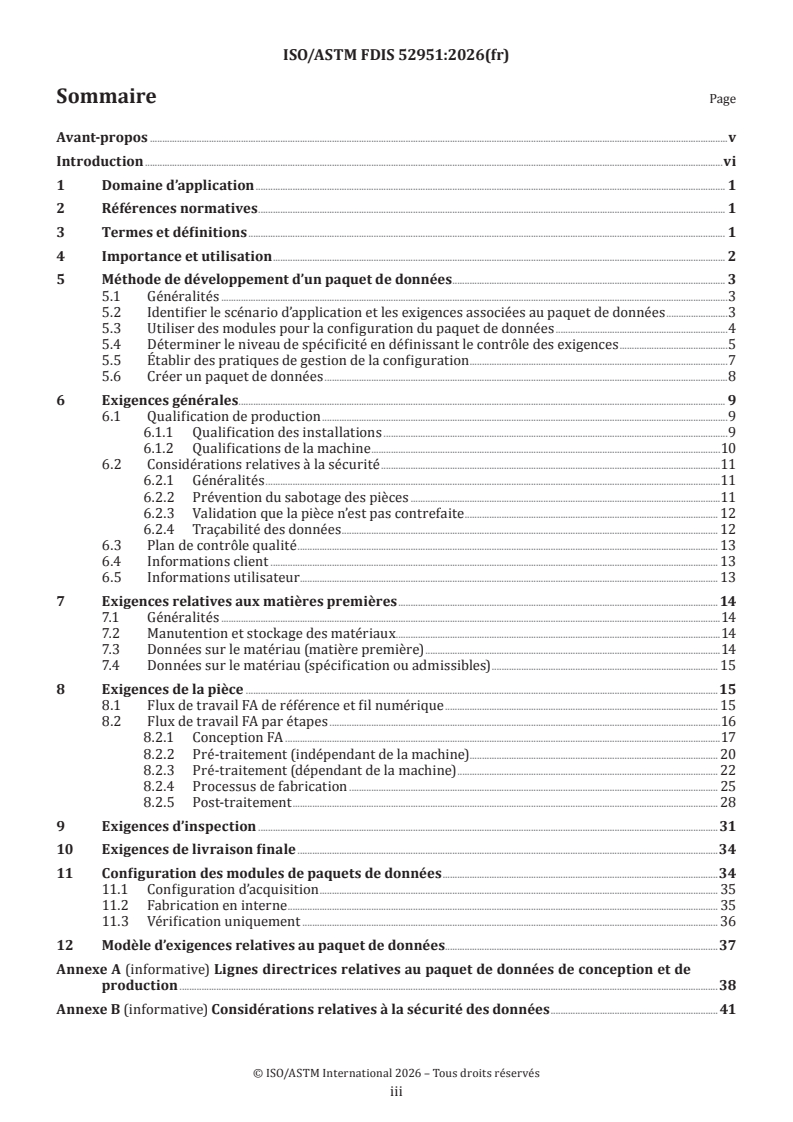

ISO/ASTM FDIS 52951 - Fabrication additive — Données — Paquets de données pour pièces de FA
Get Certified
Connect with accredited certification bodies for this standard

DVS-ZERT GmbH
German welding certification society.
CARES (UK Certification Authority for Reinforcing Steels)
UK certification for reinforcing steels and construction.
EWF/IIW (European/International Welding Federation)
International welding personnel certification.
Sponsored listings
Frequently Asked Questions
ISO/ASTM FDIS 52951 is a draft published by the International Organization for Standardization (ISO). Its full title is "Additive manufacturing — Data — Data packages for AM parts". This standard covers: This document provides the methods, parameter sets and models to develop and utilize a data package for a part created using AM technologies (AM part). This document is scoped to the information requirements associated with workflow of the fabrication of an AM part, from design to acceptance. Peripheral information related to entities such as organization, facility, operator, security, and others is addressed for sake of completeness; but is not the focus of this document and can be defined elsewhere. This document provides the means to develop an organizational or application-specific data package for the communication between and amongst the designer, the manufacturer, and all acceptance authorities, among other potential stakeholders. This document does not impose a plan of execution to produce an AM part, though a digital thread is provided to establish a referenceable information workflow. The requirements set forth in this document are based on the fabrication of a part using the PBF-LB/M process. While specific details directly relate to PBF-LB/M, generalized workflow requirements can be related to any AM process.
This document provides the methods, parameter sets and models to develop and utilize a data package for a part created using AM technologies (AM part). This document is scoped to the information requirements associated with workflow of the fabrication of an AM part, from design to acceptance. Peripheral information related to entities such as organization, facility, operator, security, and others is addressed for sake of completeness; but is not the focus of this document and can be defined elsewhere. This document provides the means to develop an organizational or application-specific data package for the communication between and amongst the designer, the manufacturer, and all acceptance authorities, among other potential stakeholders. This document does not impose a plan of execution to produce an AM part, though a digital thread is provided to establish a referenceable information workflow. The requirements set forth in this document are based on the fabrication of a part using the PBF-LB/M process. While specific details directly relate to PBF-LB/M, generalized workflow requirements can be related to any AM process.
ISO/ASTM FDIS 52951 is classified under the following ICS (International Classification for Standards) categories: 25.030 - Additive manufacturing. The ICS classification helps identify the subject area and facilitates finding related standards.
ISO/ASTM FDIS 52951 has the following relationships with other standards: It is inter standard links to FprEN ISO/ASTM 52951, ISO 6876:2025. Understanding these relationships helps ensure you are using the most current and applicable version of the standard.
ISO/ASTM FDIS 52951 is available in PDF format for immediate download after purchase. The document can be added to your cart and obtained through the secure checkout process. Digital delivery ensures instant access to the complete standard document.
Standards Content (Sample)
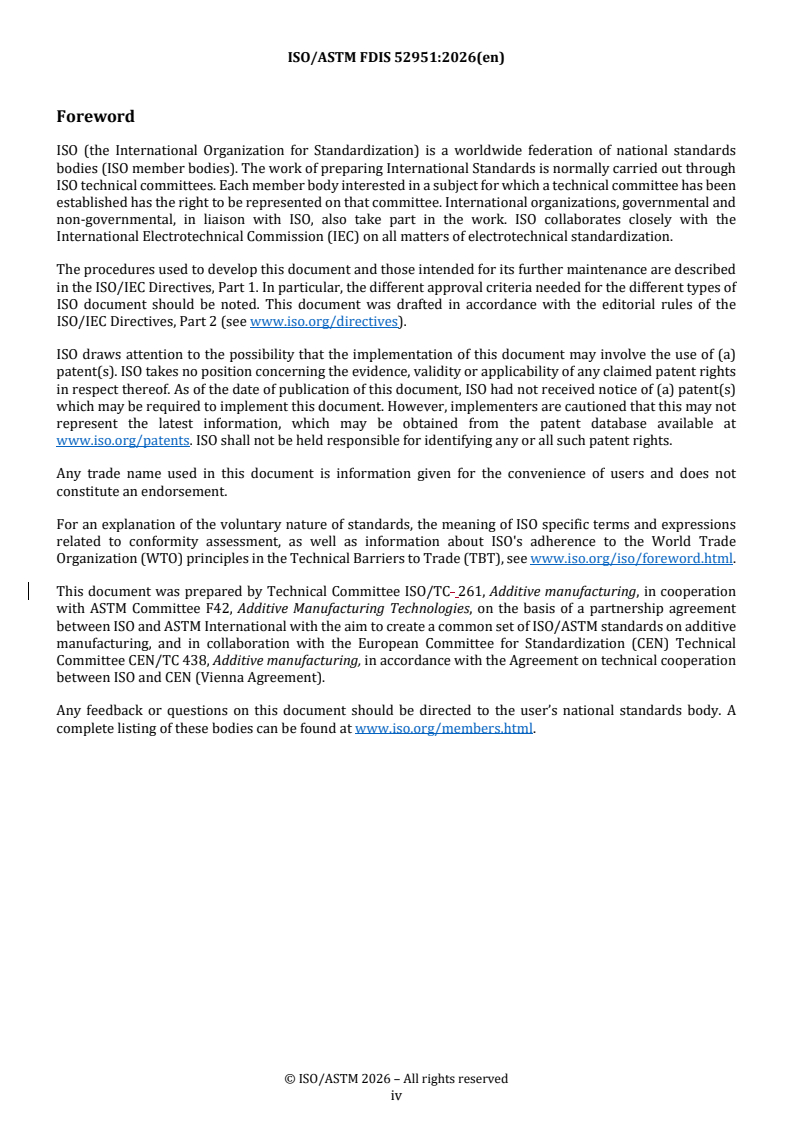
FINAL DRAFT
International
Standard
ISO/ASTM
FDIS
ISO/TC 261
Additive manufacturing — Data —
Secretariat: DIN
Data packages for AM parts
Voting begins on:
Fabrication additive — Données — Paquets de données pour 2026-04-06
pièces de FA
Voting terminates on:
2026-06-01
RECIPIENTS OF THIS DRAFT ARE INVITED TO SUBMIT,
WITH THEIR COMMENTS, NOTIFICATION OF ANY
RELEVANT PATENT RIGHTS OF WHICH THEY ARE AWARE
AND TO PROVIDE SUPPOR TING DOCUMENTATION.
IN ADDITION TO THEIR EVALUATION AS
BEING ACCEPTABLE FOR INDUSTRIAL, TECHNO
ISO/CEN PARALLEL PROCESSING LOGICAL, COMMERCIAL AND USER PURPOSES, DRAFT
INTERNATIONAL STANDARDS MAY ON OCCASION HAVE
TO BE CONSIDERED IN THE LIGHT OF THEIR POTENTIAL
TO BECOME STAN DARDS TO WHICH REFERENCE MAY BE
MADE IN NATIONAL REGULATIONS.
Reference number
FINAL DRAFT
International
Standard
ISO/ASTM
FDIS
ISO/TC 261
Additive manufacturing — Data —
Secretariat: DIN
Data packages for AM parts
Voting begins on:
Fabrication additive — Données — Paquets de données pour
pièces de FA
Voting terminates on:
RECIPIENTS OF THIS DRAFT ARE INVITED TO SUBMIT,
WITH THEIR COMMENTS, NOTIFICATION OF ANY
RELEVANT PATENT RIGHTS OF WHICH THEY ARE AWARE
© ISO/ASTM International 2026
AND TO PROVIDE SUPPOR TING DOCUMENTATION.
All rights reserved. Unless otherwise specified, or required in the context of its implementation, no part of this publication may
IN ADDITION TO THEIR EVALUATION AS
be reproduced or utilized otherwise in any form or by any means, electronic or mechanical, including photocopying, or posting on
BEING ACCEPTABLE FOR INDUSTRIAL, TECHNO
ISO/CEN PARALLEL PROCESSING
LOGICAL, COMMERCIAL AND USER PURPOSES, DRAFT
the internet or an intranet, without prior written permission. Permission can be requested from either ISO at the address below
INTERNATIONAL STANDARDS MAY ON OCCASION HAVE
or ISO’s member body in the country of the requester. In the United States, such requests should be sent to ASTM International.
TO BE CONSIDERED IN THE LIGHT OF THEIR POTENTIAL
ISO copyright office ASTM International TO BECOME STAN DARDS TO WHICH REFERENCE MAY BE
MADE IN NATIONAL REGULATIONS.
CP 401 • Ch. de Blandonnet 8 100 Barr Harbor Drive, PO Box C700
CH-1214 Vernier, Geneva West Conshohocken, PA 19428-2959, USA
Phone: +41 22 749 01 11 Phone: +610 832 9634
Fax: +610 832 9635
Email: copyright@iso.org Email: khooper@astm.org
Website: www.iso.org Website: www.astm.org
Published in Switzerland Reference number
© ISO/ASTM International 2026 – All rights reserved
ii
Contents Page
Foreword .v
Introduction .vi
1 Scope . 1
2 Normative references . 1
3 Terms and definitions . 1
4 Significance and use . 2
5 Method for data package development . 3
5.1 General .3
5.2 Identifying the application scenario and associated data package requirements .3
5.3 Using modules for data package configuration .4
5.4 Determining level of specificity by setting requirements control .5
5.5 Establishing configuration management practices .6
5.6 Creating a data package .8
6 General requirements . 9
6.1 Production qualification .9
6.1.1 Facility qualification .9
6.1.2 Machine qualifications .9
6.2 Security considerations .10
6.2.1 General .10
6.2.2 Prevention of part sabotage .10
6.2.3 Validation that part is not counterfeit .11
6.2.4 Data traceability . 12
6.3 Quality control plan . 12
6.4 Customer information . 12
6.5 User information . 12
7 Feedstock material requirements .13
7.1 General . 13
7.2 Material handling and storage . 13
7.3 Material data (Feedstock) . 13
7.4 Material data (Specification or allowable) .14
8 Part requirements . . 14
8.1 Reference AM workflow and digital thread .14
8.2 AM workflow by stages . 15
8.2.1 AM design .16
8.2.2 Pre-process (machine independent) .18
8.2.3 Pre-process (machine dependent) . 20
8.2.4 Build process . 23
8.2.5 Post process . 25
9 Inspection requirements .28
10 End delivery requirements .31
11 Configuration of data package modules .31
11.1 Acquisition configuration .31
11.2 Manufacture in house .32
11.3 Verification only . 33
12 Data package requirements template . .34
Annex A (informative) Design and production data package guidance .35
Annex B (informative) Data security considerations .37
Annex C (informative) Configuration management examples .42
© ISO/ASTM International 2026 – All rights reserved
iii
Bibliography .49
© ISO/ASTM International 2026 – All rights reserved
iv
Foreword
ISO (the International Organization for Standardization) is a worldwide federation of national standards
bodies (ISO member bodies). The work of preparing International Standards is normally carried out through
ISO technical committees. Each member body interested in a subject for which a technical committee
has been established has the right to be represented on that committee. International organizations,
governmental and non-governmental, in liaison with ISO, also take part in the work. ISO collaborates closely
with the International Electrotechnical Commission (IEC) on all matters of electrotechnical standardization.
The procedures used to develop this document and those intended for its further maintenance are described
in the ISO/IEC Directives, Part 1. In particular, the different approval criteria needed for the different types
of ISO document should be noted. This document was drafted in accordance with the editorial rules of the
ISO/IEC Directives, Part 2 (see www.iso.org/directives).
ISO draws attention to the possibility that the implementation of this document may involve the use of (a)
patent(s). ISO takes no position concerning the evidence, validity or applicability of any claimed patent
rights in respect thereof. As of the date of publication of this document, ISO had not received notice of (a)
patent(s) which may be required to implement this document. However, implementers are cautioned that
this may not represent the latest information, which may be obtained from the patent database available at
www.iso.org/patents. ISO shall not be held responsible for identifying any or all such patent rights.
Any trade name used in this document is information given for the convenience of users and does not
constitute an endorsement.
For an explanation of the voluntary nature of standards, the meaning of ISO specific terms and expressions
related to conformity assessment, as well as information about ISO's adherence to the World Trade
Organization (WTO) principles in the Technical Barriers to Trade (TBT), see www.iso.org/iso/foreword.html.
This document was prepared by Technical Committee ISO/TC 261, Additive manufacturing, in cooperation
with ASTM Committee F42, Additive Manufacturing Technologies, on the basis of a partnership agreement
between ISO and ASTM International with the aim to create a common set of ISO/ASTM standards on
additive manufacturing, and in collaboration with the European Committee for Standardization (CEN)
Technical Committee CEN/TC 438, Additive manufacturing, in accordance with the Agreement on technical
cooperation between ISO and CEN (Vienna Agreement).
Any feedback or questions on this document should be directed to the user’s national standards body. A
complete listing of these bodies can be found at www.iso.org/members.html.
© ISO/ASTM International 2026 – All rights reserved
v
Introduction
Additive Manufacturing (AM) processes follow many of the same manufacturing steps observed in more
“traditional” manufacturing processes, from design to manufacture to inspection. As an advanced
manufacturing process, AM introduces additional complexities to those steps within an AM workflow
(illustrated in Figure 1). AM-specific information is necessary to specify, verify, and archive data related to
parts that are manufactured using AM technologies. Key information associated with those steps includes
relevant facility, operator, machine, process, material, postprocess, inspection and other information (see
ASTM F3490).
[1]
Figure 1 — Illustrative additive manufacturing workflow
This document is developed on the premise that an overarching digital thread can represent the workflow
of a part fabricated using an AM process, such as shown in Figure 1. This digital thread is comprised of
the information requirements derived from various stages of fabrication, including design, manufacture,
and inspection. By identifying and selecting specific information requirements from the digital thread (see
Figure 2), a data package for a specific part can be developed for a specific application or scenario associated
with each individual stage of the workflow. Data packages serve to provide an organization with a means to
specify and organize part information requirements specific to a given application or scenario.
[1]
Figure 2 — Illustrative information requirements associated with data package development
© ISO/ASTM International 2026 – All rights reserved
vi
This document establishes a system to maximize an organization’s flexibility when determining its data
package requirements for various scenarios. The modularization of information requirements and their
level of specificity supports the general, broad adoption of this document while also supporting specific
organization needs and scenario requirements. In this sense, this document establishes principles for
modular, multi-tiered information requirements to support the development of data packages for various
scenarios with varying levels of control. Configuration management practices are used to identify acceptable
representations, including file formats and file types, for given data package requirements.
To support part acceptance, this document establishes general principles for data package requirements,
that, working in concert with data structure and configuration management, can be used to create a digital
representation, or a “digital twin” of an additively manufactured part. A digital twin (see Figure 3) is
developed by addressing the requirements of this document for a specific part and application scenario.
Figure 3 — The data package concept is central to the curation of additive manufacturing
information
In transitioning from a design to a manufactured part, the AM digital thread progresses through many
digital representations including: CAD design, simulation, tessellated geometry, sliced geometry, build file,
part with build data and part with evaluation data. At each of these stages, the digital provenance of the
part is evolving, with its digital twin maturing from the generation of new data at every stage. As a digital
representation of the intended physical counterpart, the digital twin provides important insight into the
state of the part through its design to product transformation. When accepting a final part, it is important
to have confidence in the processes used in the fabrication of the part, since differences in implementation
can mean different parts. The digital twin provides an important resource from which confidence can be
gained but can create its own uncertainty if not well-defined and well-understood, with the requirements
identified in the data package.
Clause 4 outlines the general procedure to be followed for an organization to develop a customized data
package, from identifying information requirements to adopting configuration management practices.
Clauses 5 to 10 outline the data requirements across the AM workflow. Clause 11 provides the specific
configurations to meet specified organizational requirements.
Key concepts used and discussed in this document include data package, data package requirement, digital
thread, digital twin, modular components, configurability, configuration management, capability (e.g.
software, equipment, facility, operator) and criticality (part or application).
© ISO/ASTM International 2026 – All rights reserved
vii
FINAL DRAFT International Standard ISO/ASTM FDIS 52951:2026(en)
Additive manufacturing — Data — Data packages for AM
parts
1 Scope
This document specifies the methods, parameter sets and models to develop and utilize a data package for a
part created using AM technologies (AM part). This document is applicable to the information requirements
associated with workflow of the fabrication of an AM part, from design to acceptance. Peripheral
information related to entities such as organization, facility, operator, security, and others is addressed for
sake of completeness; but is not the focus of this document and can be defined elsewhere. This document
provides the means to develop an organizational or application-specific data package for the communication
between and amongst the designer, the manufacturer, and all acceptance authorities, among other potential
stakeholders.
This document does not impose a plan of execution to produce an AM part, though a digital thread is
provided to establish a referenceable information workflow.
The requirements set forth in this document are based on the fabrication of a part using the PBF-LB/M
(powder bed fusion-laser based/metal) process. While specific details directly relate to PBF-LB/M,
generalized workflow requirements can be related to any AM process.
2 Normative references
The following documents are referred to in the text in such a way that some or all of their content constitutes
requirements of this document. For dated references, only the edition cited applies. For undated references,
the latest edition of the referenced document (including any amendments) applies.
ISO/ASTM 52900, Additive manufacturing — General principles — Fundamentals and vocabulary
3 Terms and definitions
For the purposes of this document, the terms and definitions given in ISO/ASTM 52900 and the following
apply.
ISO and IEC maintain terminology databases for use in standardization at the following addresses:
— ISO Online browsing platform: available at https:// www .iso .org/ obp
— IEC Electropedia: available at https:// www .electropedia .org/
3.1
AM data package, noun
set of information associated with an AM part, instantiated data package requirements that should confirm
established configuration management practices
3.2
AM digital thread, noun
digital component of the design to product transformation workflow of an AM part
3.3
AM workflow, noun
process applied to realize the design to product transformation of an AM part, including any acceptance
procedures
© ISO/ASTM International 2026 – All rights reserved
3.4
AM workflow stage, noun
specific sub-process within the larger AM workflow (3.3) that aligns with an activity associated with the
production of an AM part
3.5
configuration, noun
collection of an item’s descriptive and governing characteristics that can be expressed in functional and
physical terms
Note 1 to entry: This represents the requirements, architecture, design and implementation that define the version of
the system and its components.
3.6
configuration management, noun
process for establishing and maintaining consistency of a product’s performance, functional and physical
attributes with its requirements, design and operational information throughout its life
3.7
digital provenance, noun
aggregation of data and information that can be used to provide the history of the design, fabrication,
processing, testing, and acceptance of an AM part
4 Significance and use
Part design, manufacture, inspection and procurement can be relatively complex when AM processes
are used. Complexities of AM processes can create variabilities in AM parts; therefore, the specification
of additional process and workflow information is desired at times. Variabilities in AM processes and
workflows create challenges in the common specification interpretations of AM processes. This document
provides the methods, supported by a reference workflow and information flow, on which AM parts can be
consistently specified and interpreted for part design, manufacture, inspection, and procurement.
Additive manufacturing workflows come in varying levels of complexity, and the processes can be controlled
and specified at varying levels of detail. When adopting AM processes, explicit communication is vital to
satisfy organization objectives. Data packages provide an organization with the means for communicating
details about a part or a design. Under-specification can lead to loss of fidelity in the fabrication of AM parts,
while overspecification can lead to improper execution by underqualified personnel. Identifying the correct
requirements at the proper level of specificity is essential to successful delivery and acquisition of AM parts.
This document establishes a system to facilitate the identification of individual and subsets of information
requirements across this workflow to communicate desired levels of provenance for a given application
or scenario. The information requirements set forth at each workflow stage are only imposed when a
specific data-package configuration has been called into place. An organization shall identify a specific data
package and configuration-management plan to specify how selected requirements are to be met for a given
application or scenario.
This document establishes the concept of modularity to support various scenarios in which a data package
can be required. The requirements put forth by individual modules may not be inclusive, and these modules
can be extended and adopted as the organization sees fit. Different combinations of modules can be
developed to satisfy various application scenarios as outlined in Clause 5. Different levels of control within
each set of requirements can be specified based on capabilities of relevant organizations and individuals, as
detailed in Clause 5 and Annex A.
This document supplements existing data package practices with AM-specific considerations and does
not support requirements that can be put in place by an organization for parts manufactured with other
manufacturing processes; nor does it replace other standards that can be used to satisfy data package
requirements of non-additively manufactured parts. This document will leverage and reference existing
standards where appropriate.
© ISO/ASTM International 2026 – All rights reserved
This document gives guidance on the concept of a “digital twin” for completeness to relate the digital thread,
data packages, and configuration management. Digital twin is not a focus of this document, however, and
thus development of one is not required to meet outlined specifications. For a broader understanding of
digital twin concepts and related standards (e.g. ISO 23247 series and other standards under development
by ISO/TC 184/SC 4 and other committees), please refer to those respective standard documents.
5 Method for data package development
5.1 General
The method for creating an AM data package consists of 5 separate steps. This clause provides the necessary
guidance to create a customized data package to meet specific organizational or application requirements:
a) identifying application scenario and associated data package requirements;
b) using modules for data package configuration;
c) determining level of specificity by setting requirements control;
d) establishing configuration management practices;
e) creating a data package.
These steps are detailed in the following subclauses.
5.2 Identifying the application scenario and associated data package requirements
Depending on the scenario or application that a data package is being developed for, the requirements can
vary significantly. Therefore, the configuration of data packages will depend on the context for which they
are being developed. This context can be one of three data package application scenarios:
— Acquisition - this scenario occurs when an AM part is to be sourced from an outside party to meet a
pre-existing specification and the acquiring organization has a need to communicate specifics about the
design, fabrication, and testing of the AM part to the outside party.
— Manufacture in house - the scenario occurs when an AM part is to be fabricated within an organization
and communication between design, manufacture, testing, and acceptance is needed.
— Verification only - this scenario occurs when an AM part faces unique acceptance requirements (either
in house or external) but no further design or process communication is needed.
The three scenarios are further delineated based on the use history of the part to be fabricated:
— Prototype - this scenario occurs when a part is still progressing through design and manufacturing
iterations and final specifications have not yet been determined.
— New part- this scenario occurs when a fully documented version of the AM part does not exist, and the
part is being fabricated to specifications for the first time.
— Existing part - this scenario occurs when full specifications for the fabrication of an AM part exist, and
these specifications are to be used in fabrication of additional AM parts.
The three scenarios are further delineated based on the maturity of the part to be fabricated:
— Expeditionary - this scenario occurs when a part is being developed for individual or small use-case
scenarios.
— Developmental - this scenario occurs when an AM part has not yet reached full production status and
additional specifications are needed.
© ISO/ASTM International 2026 – All rights reserved
— Production - this scenario occurs when an AM part has fully matured into production status and any
implications associated with its fabrication are well understood and documented.
5.3 Using modules for data package configuration
Once the appropriate scenario has been chosen and effectively delineated, the information elements
associated with the scenario can be identified. These information elements, identified through appropriate
modules, determine what information will be required in the data package configuration.
11.1 provides suggested configurations of modules for each of the above scenarios in three separate
tables. Users of this document can choose to adopt a suggested configuration or simplify or expand on a
configuration. The final configuration of the data package requirements requires the user to identify the
specific modules to be satisfied (see Figure 4).
The data package requirements associated with each module are provided in Table 2 through Table 19.
How requirements are explicitly satisfied shall be agreed upon by involved parties, and levels of specificity
allows for adjustments of these requirements (high, medium or low). The provided requirements provide a
baseline for configurable data packages but are not meant to be inclusive. Additional requirements can be
added as needed.
Figure 4 — Configurable “blocks” of data within the AM workflow
(Highlighted spaces are examples of data package configurations (Adapted from Reference [2]))
© ISO/ASTM International 2026 – All rights reserved
5.4 Determining level of specificity by setting requirements control
The configuration of data package modules depends on the scenario. The specified amount of control will
depend on the criticality of the application scenario and the capability of stakeholders.
The information requirements within each module are satisfied using a multi-tiered approach to
establishing a level of specificity. Each tier adds an additional layer of specificity necessary to satisfy the
requirements of the data package. This document adopts a three-tier approach: low, medium, and high. High
has the most stringent data requirements, thus providing the most explicit control, while low leaves more
of the implementation up to the performer. The selection of low, medium, or high control is dependent on
assessed capabilities of a performer in respect to stakeholder requirements. This designation is adopted
throughout the data package tables provided in Clauses 6 to 9. As the three tiers are traversed, and new
data requirements are added, the amount of control over each stage increases. Control refers to how much
of the data requirements at each stage are specified and shall be met, as opposed to the relaxation of some
requirements based on the capabilities of the performer. Low control is associated with the least number of
requirements, while High control will specify maximum available requirements.
The amount of control desired for a stage is influenced by two critical factors: criticality and capability.
Highly critical parts will require the highest levels of control, while less critical parts can have less stringent
control requirements. For instance, at the design stage, if the geometry is critical, the designer should have
the most control. However, if geometry requirements can be relaxed, it can be better to let pre-process
performers determine final requirements.
The capability refers to the experience or capacity of the performer. The performer can refer to designer,
operator, technician, or procurement specialist. The capability of the performer can also refer to the quality
and capacity of the performer’s equipment. High-capability performers are expected to have the experience
needed to execute a high level of control over the process. Such performers are expected to follow and meet
all detailed requirements, to provide skilled input, and to meet acceptance requirements with minimal
guidance. Low capability performers can need additional specifications in order to perform their expected
duties, and they should not be asked to play critical roles in the fabrication of critical parts.
Table 1 provides a part versus performer capability map, where recommendations are made on the level of
guidance, or control, that should be expected based on the criticality of the part and the capability of the
performer(s). See Annex A for examples on how Table 1 is adopted.
Table 1 — Part versus performer capability maps the level of control to the criticality of the parts
and the capability of the performers
High capability Medium-High Medium capa- Medium-Low capa- Low capability
capability bility bility
High critical Medium control Medium to high High control Not recommended Not recommended
control
Medium-High Medium to low Medium control Medium to high High control Not recommended
critical control control
Medium crit- Low control Medium to low Medium control Medium to high High control
ical control control
Medium-Low Low control Low control Medium to low Medium control Medium to high
critical control control
Low critical Low control Low control Low control Medium to low Medium control
control
Capabilities are considered as:
— High capability: expertise is possessed in by the individual or organization responsible for manufacturing
the final part. High capability implies that the performer has the ability to meet designated requirements
and has access to all necessary equipment and information to do so.
— Low capability: familiarity with AM processes is present, but the performer can possibly not have the
knowledge or experience needed to execute to the highest levels. Some equipment is available to the
performer, but stringent requirements cannot be met.
© ISO/ASTM International 2026 – All rights reserved
— High control: the design and manufacture of the part has been developed under careful consideration.
The performer shall meet detailed part, process, and inspection requirements in order for any deliverable
to be deemed acceptable.
— Low control: the design of the part is of utmost importance, but the manufacture of the part is left
primarily to the performer. The expectation is that the performer will have the capability and know how
to manufacture the part to meet design and performance requirements without explicit instructions.
— High risk: generally, this implies that failure to meet any part requirement can result in catastrophic
failure. Risk levels are to be determined by the organization.
— Low risk: generally, this implies that failure to meet one or more part requirements can still result in a
serviceable part. Such failures can lead to inconveniences that can be overcome with replacement parts
or with sub-optimal performance. Risk levels are to be determined by the organization.
The high, medium and low control levels are used throughout the document from Table 2 to Table 19.
The suggested level of control is indicated by an “X” for each set of attributes. Annex A provides example
scenarios where different levels of control may be desired.
5.5 Establishing configuration management practices
Configuration-management techniques (see Figure 5) are required to control and manage data within the
AM production cycle, effectively constructing a digital twin from data provenance. As a physical AM part
traverses this lifecycle, the associated digital twin will undergo many digital transformations that mirror
the various lifecycle functions - from a raw design to a qualified product. Configuration management begins
early in the product design phase and aims at ensuring that the design intent is realized by monitoring and
controlling the subsequent processes. A configuration management plan
— defines the allowable representations on which requirements can be met,
— identifies allowable formats and configurations,
— establishes consistency in how data are captured and represented,
— provides consistent evaluation and qualification across AM part families.
The application of configuration management shall aim at reducing impermissible and unintended changes
and monitor/record the permissible changes. For example, increasing the component wall thicknesses in the
CAD (computer-aided design) digital twin to compensate for material removal in post-processing stages can
potentially disrupt an AM part’s definition. Format changes, such as converting the CAD digital twin into an
AM machine-readable format, is another process-driven modification that can influence the design intent
of the component. Since such examples can influence the design intent of the component, they should be
managed carefully. Figure 5 outlines a scenario where a configuration plan is iterated through.
© ISO/ASTM International 2026 – All rights reserved
Figure 5 — The approach for establishing configuration management for AM production (Adapted
from Reference [2])
Configuration management practices should be outlined as a configuration management plan. Configuration
management for AM should be planned during the earliest project stage. Procedures should be developed
for managing the configuration of the design and relevant data through to its disposal and throughout
the design-to-product transformation. Given the complexity of AM processes and the variability in how
these processes can be realized, additional considerations should be made for configuration between
organizations to ensure each organisation’s approach and coding schemes are consistent and compatible.
Configuration management plans should make the following considerations:
— Configuration identification - identification of Configuration Items (CI) requires the knowledge of
which items influence the integrity of the component data as well as which data items are required for
compliance consistency. All CIs and associated AM formats should be assigned an identifier and revision
controlled.
— Configuration control (process required to change a CI and re-baseline it) - configuration control can be
defined as “a systematic process that ensures that changes to released configuration documentation are
properly identified, documented, evaluated for impact, approved by an appropriate level of authority,
[3]
incorporated, and verified” . In documenting a CI change, critical information to be captured includes the
nature of the configuration change, the identification of previous and current states of the configuration
item, and any data transformation and losses.
— Configuration status accounting (traceability) - the configuration data shall be stored in a manner that
allows for configuration status retrievals. This allows for the component’s full digital provenance to be
accessed when required anywhere along its digital thread, from design to build to inspection.
— Configuration verification and audit - configuration baselines shall be periodically audited to verify their
contents and ensure conformance. This involves a functional and physical verification of the component
configuration.
Configuration-management standards and handbooks such as SAE EIA-649, ISO 10007 and MIL—HDBK-61B
define the configuration management process in five key functions as depicted in Figure 6. Annex C provides
an example of a configuration management scenario.
© ISO/ASTM International 2026 – All rights reserved
Figure 6 — Example of configuration management activity model
(Adapted from Reference [3])
5.6 Creating a data package
Upon completing steps 1 to 4, the content of the data package is ready to be finalized. Finalization of the data
package can require additional considerations (beyond steps 1 to 4) to construct realizable requirements for
the implementation of a data package. In determining what, if any, additional considerations are necessary,
the following steps should be considered:
a) ensuring proper module configuration and level of specificity for identified scenario;
b) confirming information leveraged in determining the data package requirements aligns with established
workflow;
c) recognizing how this information is represented in the digital thread and identifying acceptable data
format types in a configuration management plan;
d) Establishing specific data requirements based on confirmed data package requirements;
e) communicating requirements or datasets through explicit mapping to modules and configuration
management plan.
Application of this approach results in data packages that can incorporate multiple production phases and
workflow stages to specify and meet data package requirements. It shall be noted that the extent to which
configuration management is leveraged is dependent on the production application and scenario. Certain
application scenarios can require multiple qualification phases and versions, while others only require one.
Clause 12 provides a template on which data package requirements can be communicated. When a data
package is successfully created, communication of the data package can vary based on organizational
implementations, but the interpretation of the requirements will remain consistent.
When implementing a data package for acceptance, the resulting digital twins and corresponding digital
thread shall accurately provide full digital traceability and record of the AM product. In quality control
for additive manufacturing, establishing this digital provenance has become a necessary part of the part
qualification process.
© ISO/ASTM International 2026 – All rights reserved
6 General requirements
6.1 Production qualification
6.1.1 Facility qualification
The ability to successfully fabricate a part with AM technologies is strongly influenced by maintained
machines and established procedures in a facility. This subclause identifies information that communicates
characteristics of the facility where the manufacture of an AM part occurs. The attributes in Table 2 identify
information about the manufacturing facility to consider. Note that the control factors in Tables 2 to 19 of
low, medium and high are explained in
...
ISO/TC 261 & ASTM F 42
Secretariat: DIN
Date: 2026-02-23xx
Additive manufacturing — Data — Data packages for AM parts
Fabrication additive — Données — Paquets de données pour pièces de FA
FDIS stage
TThhiis drs draafftt i is s susubbmmiitttteed d ttoo aa ppaarraallellel l vvoottee i inn IISSOO,, CCEEN.N.
© ISO/ASTM International 2026
All rights reserved. Unless otherwise specified, or required in the context of its implementation, no part of this publication
may be reproduced or utilized otherwise in any form or by any means, electronic or mechanical, including photocopying,
or posting on the internet or an intranet, without prior written permission. Permission can be requested from either ISO
at the address below or ISO’s member body in the country of the requester. In the United States, such requests should be
sent to ASTM International.
ISO copyright office ASTM International
CP 401 • Ch. de Blandonnet 8 100 Barr Harbor Drive, PO Box C700
CH-1214 Vernier, Geneva West Conshohocken, PA 19428-2959, USA
Phone: + 41 22 749 01 11 Phone: +610 832 9634
Fax: +41 22 749 09 47 Fax: +610 832 9635
Email: Email: khooper@astmE-mail: copyright@iso.org
Website: www.iso.org Website:
Published in Switzerland
© ISO/ASTM 2026 – All rights reserved
ii
Contents
Foreword . iv
Introduction . v
1 Scope . 1
2 Normative references . 1
3 Terms and definitions . 1
4 Significance and use . 2
5 Method for data package development . 3
5.1 General . 3
5.2 Identifying the application scenario and associated data package requirements . 3
5.3 Using modules for data package configuration. 4
5.4 Determining level of specificity by setting requirements control . 5
5.5 Establishing configuration management practices . 7
5.6 Creating a data package . 9
6 General requirements . 10
6.1 Production qualification . 10
6.2 Security considerations . 11
6.3 Quality control plan . 13
6.4 Customer information . 14
6.5 User information . 14
7 Feedstock material requirements . 14
7.1 General . 14
7.2 Material handling and storage . 14
7.3 Material data (Feedstock) . 15
7.4 Material data (Specification or allowable) . 15
8 Part requirements . 16
8.1 Reference AM workflow and digital thread . 16
8.2 AM workflow by stages . 17
9 Inspection requirements. 32
10 End delivery requirements . 35
11 Configuration of data package modules . 35
11.1 Acquisition configuration . 36
11.2 Manufacture in house . 36
11.3 Verification only . 37
12 Data package requirements template . 38
Annex A (informative) Design and production data package guidance . 39
Annex B (informative) Data security considerations . 42
Annex C (informative) Configuration management examples . 47
Bibliography . 55
© ISO/ASTM 2026 – All rights reserved
iii
Foreword
ISO (the International Organization for Standardization) is a worldwide federation of national standards
bodies (ISO member bodies). The work of preparing International Standards is normally carried out through
ISO technical committees. Each member body interested in a subject for which a technical committee has been
established has the right to be represented on that committee. International organizations, governmental and
non-governmental, in liaison with ISO, also take part in the work. ISO collaborates closely with the
International Electrotechnical Commission (IEC) on all matters of electrotechnical standardization.
The procedures used to develop this document and those intended for its further maintenance are described
in the ISO/IEC Directives, Part 1. In particular, the different approval criteria needed for the different types of
ISO document should be noted. This document was drafted in accordance with the editorial rules of the
ISO/IEC Directives, Part 2 (see www.iso.org/directives).
ISO draws attention to the possibility that the implementation of this document may involve the use of (a)
patent(s). ISO takes no position concerning the evidence, validity or applicability of any claimed patent rights
in respect thereof. As of the date of publication of this document, ISO had not received notice of (a) patent(s)
which may be required to implement this document. However, implementers are cautioned that this may not
represent the latest information, which may be obtained from the patent database available at
www.iso.org/patents. ISO shall not be held responsible for identifying any or all such patent rights.
Any trade name used in this document is information given for the convenience of users and does not
constitute an endorsement.
For an explanation of the voluntary nature of standards, the meaning of ISO specific terms and expressions
related to conformity assessment, as well as information about ISO's adherence to the World Trade
Organization (WTO) principles in the Technical Barriers to Trade (TBT), see www.iso.org/iso/foreword.html.
This document was prepared by Technical Committee ISO/TC 261, Additive manufacturing, in cooperation
with ASTM Committee F42, Additive Manufacturing Technologies, on the basis of a partnership agreement
between ISO and ASTM International with the aim to create a common set of ISO/ASTM standards on additive
manufacturing, and in collaboration with the European Committee for Standardization (CEN) Technical
Committee CEN/TC 438, Additive manufacturing, in accordance with the Agreement on technical cooperation
between ISO and CEN (Vienna Agreement).
Any feedback or questions on this document should be directed to the user’s national standards body. A
complete listing of these bodies can be found at www.iso.org/members.html.
© ISO/ASTM 2026 – All rights reserved
iv
Introduction
Additive Manufacturing (AM) processes follow many of the same manufacturing steps observed in more
“traditional” manufacturing processes, from design to manufacture to inspection. As an advanced
manufacturing process, AM introduces additional complexities to those steps within an AM workflow
(illustrated in Figure 1Figure 1).). AM-specific information is necessary to specify, verify, and archive data
related to parts that are manufactured using AM technologies. Key information associated with those steps
includes relevant facility, operator, machine, process, material, postprocess, inspection and other information
(see ASTM F3490).
52951_ed1fig1.EPS
1[1]
Figure 1 — Illustrative additive manufacturing workflow
This document is developed on the premise that an overarching digital thread can represent the workflow of
a part fabricated using an AM process, such as shown in Figure 1Figure 1. This digital thread is comprised of
the information requirements derived from various stages of fabrication, including design, manufacture, and
inspection. By identifying and selecting specific information requirements from the digital thread (see
Figure 2Figure 2),), a data package for a specific part can be developed for a specific application or scenario
associated with each individual stage of the workflow. Data packages serve to provide an organization with a
means to specify and organize part information requirements specific to a given application or scenario.
© ISO/ASTM 2026 – All rights reserved
v
52951_ed1fig2.EPS
1[1]
Figure 2 — Illustrative information requirements associated with data package development
This document establishes a system to maximize an organization’s flexibility when determining its data
package requirements for various scenarios. The modularization of information requirements and their level
of specificity supports the general, broad adoption of this document while also supporting specific
organization needs and scenario requirements. In this sense, this document establishes principles for
modular, multi-tiered information requirements to support the development of data packages for various
scenarios with varying levels of control. Configuration management practices are used to identify acceptable
representations, including file formats and file types, for given data package requirements.
To support part acceptance, this document establishes general principles for data package requirements, that,
working in concert with data structure and configuration management, can be used to create a digital
representation, or a “digital twin” of an additively manufactured part. A digital twin (see Figure 3Figure 3)) is
developed by addressing the requirements of this document for a specific part and application scenario.
© ISO/ASTM 2026 – All rights reserved
vi
52951_ed1fig3.EPS
Figure 3 — The data package concept is central to the curation of additive manufacturing
information
In transitioning from a design to a manufactured part, the AM digital thread progresses through many digital
representations including: CAD design, simulation, tessellated geometry;, sliced geometry;, build file;, part
with build data; and part with evaluation data. At each of these stages, the digital provenance of the part is
evolving, with its digital twin maturing from the generation of new data at every stage. As a digital
representation of the intended physical counterpart, the digital twin provides important insight into the state
of the part through its design to product transformation. When accepting a final part, it is important to have
confidence in the processes used in the fabrication of the part, since differences in implementation can mean
different parts. The digital twin provides an important resource from which confidence can be gained but can
create its own uncertainty if not well-defined and well-understood, with the requirements identified in the
data package.
Clause 4Clause 4 outlines the general procedure to be followed for an organization to develop a customized
data package, from identifying information requirements to adopting configuration management practices.
Clauses 5Clauses 5 to 1010 outline the data requirements across the AM workflow. Clause 11Clause 11
provides the specific configurations to meet specified organizational requirements.
Key concepts used and discussed in this document include: data package;, data package requirement;, digital
thread;, digital twin;, modular components;, configurability;, configuration management;, capability (e.g.
software, equipment, facility, operator),) and criticality (part or application).
© ISO/ASTM 2026 – All rights reserved
vii
Additive manufacturing — Data — Data packages for AM parts
1 Scope
This document providesspecifies the methods, parameter sets and models to develop and utilize a data
package for a part created using AM technologies (AM part). This document is applicable to the information
requirements associated with workflow of the fabrication of an AM part, from design to acceptance. Peripheral
information related to entities such as organization, facility, operator, security, and others is addressed for
sake of completeness; but is not the focus of this document and can be defined elsewhere. This document
provides the means to develop an organizational or application-specific data package for the communication
between and amongst the designer, the manufacturer, and all acceptance authorities, among other potential
stakeholders.
This document does not impose a plan of execution to produce an AM part, though a digital thread is provided
to establish a referenceable information workflow.
The requirements set forth in this document are based on the fabrication of a part using the PBF-LB/M
(powder bed fusion- laser based/metal) process. While specific details directly relate to PBF-LB/M,
generalized workflow requirements can be related to any AM process.
2 Normative references
The following documents are referred to in the text in such a way that some or all of their content constitutes
requirements of this document. For dated references, only the edition cited applies. For undated references,
the latest edition of the referenced document (including any amendments) applies.
ISO/ASTM 52900, Additive manufacturing — General principles — Fundamentals and vocabulary
3 Terms and definitions
For the purposes of this document, the terms and definitions given in ISO/ASTM 52900 and the following
apply.
ISO and IEC maintain terminologicalterminology databases for use in standardization at the following
addresses:
— — ISO Online browsing platform: available at https://www.iso.org/obp
— — IEC Electropedia: available at https://www.electropedia.org/
3.1 3.1
AM data package, noun
set of information associated with an AM part, instantiated data package requirements that should confirm
established configuration management practices
3.2 3.2
AM digital thread, noun
digital component of the design to product transformation workflow of an AM part
3.3 3.3
AM workflow, noun
process applied to realize the design to product transformation of an AM part, including any acceptance
procedures
© ISO/ASTM 2026 – All rights reserved
3.4 3.4
AM workflow stage, noun
specific sub-process within the larger AM workflow (3.3(3.3)) that aligns with an activity associated with the
production of an AM part
3.5 3.5
configuration, noun
collection of an item’s descriptive and governing characteristics that can be expressed in functional and
physical terms
Note 1 to entry: This represents the requirements, architecture, design and implementation that define the version of
the system and its components.
3.6 3.6
configuration management, noun
process for establishing and maintaining consistency of a product’s performance, functional and physical
attributes with its requirements, design and operational information throughout its life
3.7 3.7
digital provenance, noun
aggregation of data and information that can be used to provide the history of the design, fabrication,
processing, testing, and acceptance of an AM part
4 Significance and use
Part design, manufacture, inspection, and procurement can be relatively complex when AM processes are
used. Complexities of AM processes can create variabilities in AM parts; therefore, the specification of
additional process and workflow information is desired at times. Variabilities in AM processes and workflows
create challenges in the common specification interpretations of AM processes. This document provides the
methods, supported by a reference workflow and information flow, on which AM parts can be consistently
specified and interpreted for part design, manufacture, inspection, and procurement.
Additive manufacturing workflows come in varying levels of complexity, and the processes can be controlled
and specified at varying levels of detail. When adopting AM processes, explicit communication is vital to satisfy
organization objectives. Data packages provide an organization(s) with the means for communicating details
about a part or a design. Under-specification can lead to loss of fidelity in the fabrication of AM parts, while
overspecification can lead to improper execution by underqualified personnel. Identifying the correct
requirements at the proper level of specificity is essential to successful delivery and acquisition of AM parts.
This document establishes a system to facilitate the identification of individual and subsets of information
requirements across this workflow to communicate desired levels of provenance for a given application or
scenario. The information requirements set forth at each workflow stage are only imposed when a specific
data-package configuration has been called into place. An organization shall identify a specific data package
and configuration-management plan to specify how selected requirements are to be met for a given
application or scenario.
This document establishes the concept of modularity to support various scenarios in which a data package
can be required. The requirements put forth by individual modules may not be inclusive, and these modules
can be extended and adopted as the organization sees fit. Different combinations of modules can be developed
to satisfy various application scenarios as outlined in Clause 5Clause 5. Different levels of control within each
set of requirements can be specified based on capabilities of relevant organizations and individuals, as detailed
in Clause 5Clause 5 and Annex AAnnex A.
This document supplements existing data package practices with AM-specific considerations and does not
support requirements that can be put in place by an organization for parts manufactured with other
© ISO/ASTM 2026 – All rights reserved
manufacturing processes; nor does it replace other standards that can be used to satisfy data package
requirements of non-additively manufactured parts. This document will leverage and reference existing
standards where appropriate.
This document gives guidance on the concept of a “digital twin” for completeness to relate the digital thread,
data packages, and configuration management. Digital twin is not a focus of this standarddocument, however,
and thus development of one is not required to meet outlined specifications. For a broader understanding of
digital twin concepts and related standards (e.g.,. ISO 23247 series and other standards under development
by ISO/TC 184/SC 4 and other committees), please refer to those respective standard documents.
5 Method for data package development
5.1 General
The method for creating an AM data package consists of 5 separate steps. This clause provides the necessary
guidance to create a customized data package to meet specific organizational or application requirements:
a) a) identifying application scenario and associated data package requirements;
b) b) using modules for data package configuration;
c) c) determining level of specificity by setting requirements control;
d) d) establishing configuration management practices;
e) e) creating a data package.
These steps are detailed in the following subclauses.
5.2 Identifying the application scenario and associated data package requirements
Depending on the scenario or application that a data package is being developed for, the requirements can
vary significantly. Therefore, the configuration of data packages will depend on the context for which they are
being developed. This context can be one of three data package application scenarios:
— — Acquisition - this scenario occurs when an AM part is to be sourced from an outside party to meet a
pre-existing specification and the acquiring organization has a need to communicate specifics about the
design, fabrication, and testing of the AM part to the outside party.
— — Manufacture in house - the scenario occurs when an AM part is to be fabricated within an organization
and communication between design, manufacture, testing, and acceptance is needed.
— — Verification only - this scenario occurs when an AM part faces unique acceptance requirements (either
in house or external) but no further design or process communication is needed.
The three scenarios are further delineated based on the use history of the part to be fabricated:
— — Prototype - this scenario occurs when a part is still progressing through design and manufacturing
iterations and final specifications have not yet been determined.
— — New part- this scenario occurs when a fully documented version of the AM part does not exist, and the
part is being fabricated to specifications for the first time.
— — Existing part - this scenario occurs when full specifications for the fabrication of an AM part exist, and
these specifications are to be used in fabrication of additional AM parts.
© ISO/ASTM 2026 – All rights reserved
The three scenarios are further delineated based on the maturity of the part to be fabricated:
— — Expeditionary - this scenario occurs when a part is being developed for individual or small use-case
scenarios.
— — Developmental - this scenario occurs when an AM part has not yet reached full production status and
additional specifications are needed.
— — Production - this scenario occurs when an AM part has fully matured into production status and any
implications associated with its fabrication are well understood and documented.
5.3 Using modules for data package configuration
Once the appropriate scenario has been chosen and effectively delineated, the information elements
associated with the scenario can be identified. These information elements, identified through appropriate
modules, determine what information will be required in the data package configuration.
11.1Subclause 11.1 provides suggested configurations of modules for each of the above scenarios in three
separate tables. Users of this document can choose to adopt a suggested configuration or simplify or expand
on a configuration. The final configuration of the data package requirements requires the user to identify the
specific modules to be satisfied (see Figure 4Figure 4).).
The data package requirements associated with each module are provided in Table 2Table 2 through
Table 19Table 19. How requirements are explicitly satisfied shall be agreed upon by involved parties, and
levels of specificity allows for adjustments of these requirements (high, medium, or low). The provided
requirements provide a baseline for configurable data packages but are not meant to be inclusive. Additional
requirements can be added as needed.
© ISO/ASTM 2026 – All rights reserved
52951_ed1fig4.EPS
Figure 4 — Configurable “blocks” of data within the AM workflow.
[2]
(Highlighted spaces are examples of data package configurations (Adapted from Reference [[2] ))
5.4 Determining level of specificity by setting requirements control
The configuration of data package modules depends on the scenario. The specified amount of control will
depend on the criticality of the application scenario and the capability of stakeholders.
The information requirements within each module are satisfied using a multi-tiered approach to establishing
a level of specificity. Each tier adds an additional layer of specificity necessary to satisfy the requirements of
the data package. This document adopts a three-tier approach: low, medium, and high. High has the most
stringent data requirements, thus providing the most explicit control, while low leaves more of the
implementation up to the performer. The selection of low, medium, or high control is dependent on assessed
capabilities of a performer in respect to stakeholder requirements. This designation is adopted throughout
the data package tables provided in Clauses 6Clauses 6 to 99. As the three tiers are traversed, and new data
requirements are added, the amount of control over each stage increases. Control refers to how much of the
data requirements at each stage are specified and shall be met, as opposed to the relaxation of some
© ISO/ASTM 2026 – All rights reserved
requirements based on the capabilities of the performer. Low control is associated with the least number of
requirements, while High control will specify maximum available requirements.
The amount of control desired for a stage is influenced by two critical factors: criticality and capability. Highly
critical parts will require the highest levels of control, while less critical parts can have less stringent control
requirements. For instance, at the design stage, if the geometry is critical, the designer should have the most
control. However, if geometry requirements can be relaxed, it can be better to let pre-process performers
determine final requirements.
The capability refers to the experience or capacity of the performer. The performer can refer to designer,
operator, technician, or procurement specialist. The capability of the performer can also refer to the quality
and capacity of the performer’s equipment. High-capability performers are expected to have the experience
needed to execute a high level of control over the process. Such performers are expected to follow and meet
all detailed requirements, to provide skilled input, and to meet acceptance requirements with minimal
guidance. Low capability performers can need additional specifications in order to perform their expected
duties, and they should not be asked to play critical roles in the fabrication of critical parts.
Table 1Table 1 provides a part versus performer capability map, where recommendations are made on the
level of guidance, or control, that should be expected based on the criticality of the part and the capability of
the performer(s). See Annex AAnnex A for examples on how Table 1Table 1 is adopted.
Table 1 — Part versus performer capability maps the level of control to the criticality of the parts
and the capability of the performers
High Medium-High Medium Medium-Low Low capability
capability capability capability capability
High critical Medium control Medium to high High control Not recommended Not recommended
control
Medium-High Medium to low Medium control Medium to high High control Not recommended
critical control control
Medium Low control Medium to low Medium control Medium to high High control
critical control control
Medium-Low Low control Low control Medium to low Medium control Medium to high
critical control control
Low critical Low control Low control Low control Medium to low Medium control
control
Capabilities are considered as:
— High capability: expertise is possessed in by the individual or organization responsible for manufacturing
the final part. High capability implies that the performer has the ability to meet designated requirements
and has access to all necessary equipment and information to do so.
— Low capability: familiarity with AM processes is present, but the performer can possibly not have the
knowledge or experience needed to execute to the highest levels. Some equipment is available to the
performer, but stringent requirements cannot be met.
— High control: the design and manufacture of the part has been developed under careful consideration. The
performer shall meet detailed part, process, and inspection requirements in order for any deliverable to
be deemed acceptable.
© ISO/ASTM 2026 – All rights reserved
— Low control: the design of the part is of utmost importance, but the manufacture of the part is left primarily
to the performer. The expectation is that the performer will have the capability and know how to
manufacture the part to meet design and performance requirements without explicit instructions.
— High risk: generally, this implies that failure to meet any part requirement can result in catastrophic
failure. Risk levels are to be determined by the organization.
— Low risk: generally, this implies that failure to meet one or more part requirements can still result in a
serviceable part. Such failures can lead to inconveniences that can be overcome with replacement parts or
with sub-optimal performance. Risk levels are to be determined by the organization.
The high, medium, and low control levels are used throughout the document in the tables, from Table 2Table 2
to Table 19Table 19. . The suggested level of control is indicated by an “X” for each set of attributes. Annex A
Annex A provides example scenarios where different levels of control may be desired.
5.5 Establishing configuration management practices
Configuration-management techniques (see Figure 5Figure 5)) are required to control and manage data
within the AM production cycle, effectively constructing a digital twin from data provenance. As a physical AM
part traverses this lifecycle, the associated digital twin will undergo many digital transformations that mirror
the various lifecycle functions - from a raw design to a qualified product. Configuration management begins
early in the product design phase and aims at ensuring that the design intent is realized by monitoring and
controlling the subsequent processes. A configuration management plan:
— — defines the allowable representations on which requirements can be met;,
— — identifies allowable formats and configurations;,
— — establishes consistency in how data are captured and represented;,
— — provides consistent evaluation and qualification across AM part families.
The application of configuration management shall aim at reducing impermissible and unintended changes
and monitor/record the permissible changes. For example, increasing the component wall thicknesses in the
CAD (computer-aided design) digital twin to compensate for material removal in post-processing stages can
potentially disrupt an AM part’s definition. Format changes, such as converting the CAD digital twin into an
AM machine-readable format, is another process-driven modification that can influence the design intent of
the component. Since such examples can influence the design intent of the component, they should be
managed carefully. Figure 5Figure 5 outlines a scenario where a configuration plan is iterated through.
© ISO/ASTM 2026 – All rights reserved
52951_ed1fig5.EPS
Figure 5 — The approach for establishing configuration management for AM production (Adapted
from Reference [2])[[2]
Configuration management practices should be outlined as a configuration management plan. Configuration
management for AM should be planned during the earliest project stage. Procedures should be developed for
managing the configuration of the design and relevant data through to its disposal and throughout the design-
to-product transformation. Given the complexity of AM processes and the variability in how these processes
can be realized, additional considerations should be made for configuration between organizations to ensure
each organisation’s approach and coding schemes are consistent and compatible. Configuration management
plans should make the following considerations:
— — Configuration identification - identification of Configuration Items (CI) requires the knowledge of
which items influence the integrity of the component data as well as which data items are required for
compliance consistency. All CIs and associated AM formats should be assigned an identifier and revision
controlled.
— — Configuration control (process required to change a CI and re-baseline it) - configuration control can
be defined as “a systematic process that ensures that changes to released configuration documentation
are properly identified, documented, evaluated for impact, approved by an appropriate level of authority,
[3] [3]
incorporated, and verified” ” . In documenting a CI change, critical information to be captured includes
the nature of the configuration change, the identification of previous and current states of the
configuration item, and any data transformation and losses.
— — Configuration status accounting (traceability) - the configuration data shall be stored in a manner that
allows for configuration status retrievals. This allows for the component’s full digital provenance to be
accessed when required anywhere along its digital thread, from design to build to inspection.
— — Configuration verification and audit - configuration baselines shall be periodically audited to verify
their contents and ensure conformance. This involves a functional and physical verification of the
component configuration.
Configuration-management standards and handbooks such as SAE EIA-649, ISO 10007 and MIL-—HDBK-
61B define the configuration management process in five key functions as depicted in Figure 6Figure 6.
Annex C. Annex C provides an example of a configuration management scenario.
© ISO/ASTM 2026 – All rights reserved
52951_ed1fig6.EPS
Figure 6 — Example of configuration management activity model
(Adapted from Reference [3])[[3]
5.6 Creating a data package
Upon completing steps 1 to 4, the content of the data package is ready to be finalized. Finalization of the data
package can require additional considerations (beyond steps 1 to 4) to construct realizable requirements for
the implementation of a data package. In determining what, if any, additional considerations are necessary,
the following steps should be considered:
a) a) ensuring proper module configuration and level of specificity for identified scenario,;
b) b) confirming information leveraged in determining the data package requirements aligns with
established workflow,;
c) c) recognizing how this information is represented in the digital thread and identifying
acceptable data format types in a configuration management plan,;
d) d) Establishing specific data requirements based on confirmed data package requirements, and;
e) e) communicating requirements or datasets through explicit mapping to modules and
configuration management plan.
Application of this approach results in data packages that can incorporate multiple production phases and
workflow stages to specify and meet data package requirements. It shall be noted that the extent to which
configuration management is leveraged is dependent on the production application and scenario. Certain
application scenarios can require multiple qualification phases and versions, while others only require one.
Clause 12Clause 12 provides a template on which data package requirements can be communicated. When a
data package is successfully created, communication of the data package can vary based on organizational
implementations, but the interpretation of the requirements will remain consistent.
© ISO/ASTM 2026 – All rights reserved
When implementing a data package for acceptance, the resulting digital twins and corresponding digital
thread shall accurately provide full digital traceability and record of the AM product. In quality control for
additive manufacturing, establishing this digital provenance has become a necessary part of the part
qualification process.
6 General requirements
6.1 Production qualification
6.1.1 Facility qualification
The ability to successfully fabricate a part with AM technologies is strongly influenced by maintained machines
and established procedures in a facility. This subclause identifies information that communicates
characteristics of the facility where the manufacture of an AM part occurs. The attributes in Table 2Table 2
identify information about the manufacturing facility to consider. Note that the control factors in
Tables 2Tables 2-19 to 19 of low, medium, and high are explained in Clause 5Clause 5, and examples are
provided in Annex AAnnex A.
Table 2 — G1.1: Data package requirements for AM facility
Mediu Relevant
Attributes Low High
m standards
Overall manufacturing sequence
— — include intermediate steps and acceptance
X X X
criteria (see 6.46.4))
AM facility and machine qualification and management
requirements
X X X
— — e.g.,. a machine and facility can be approved
for a specific material
G1. Process qualification requirements
1 ISO/ASTM 52920
X X X
— — e.g.,. facility or machine qualification plus
dimensional and external coupon testing sufficient
AM build parameter validation data
X X X
— — supporting data for AM process qualification
AM control system software
— — any software and version used by facility in
X X X
part fabrication
6.1.2 Machine qualifications
Table 3Table 3 identifies information to communicate characteristics of a specific machine to be used in the
manufacture of an AM part, including machine capabilities and condition.
© ISO/ASTM 2026 – All rights reserved
Table 3 — G1.2: Data package requirements for AM machine
Mediu Relevant
Attributes Low High
m standards
Machine manufacturer and model number
X X X
— to include identification of process used
Machine specifications
- X X
— build volume
— build plate characteristics
Machine software version
- X X
— to include software
versions ISO/ASTM TS
52930,
Machine maintenance schedule
ISO/ASTM
G1.
— to include last time machine underwent
52941,
- - X
maintenance
SAE AMS7003A,
— deviation to nominal configuration is to be
SAE AMS7032
reported
Machine calibration schedule
— to include last time machine was calibrated
- - X
— deviation to nominal configuration is to be
reported
Monitoring equipment used by machine
- X X
— to include last time equipment was calibrated
and calibration schedule
6.2 Security considerations
6.2.1 General
Security considerations for a part differ from general, cybersecurity considerations in that they do not focus
on file encryption; instead, they address the potential for broader threats throughout the AM workflow. Part-
dependent security should achieve several objectives, such as:
— — Demonstrate absence of intentional, workflow manipulation or part sabotage attempts by ensuring
that the part’s dimensional accuracy, geometry, and functional properties have not been degraded below
required characteristics.
— — Validate that the part is not a counterfeit through verification that it has been manufactured by a
specific manufacturer.
— — Secure traceability in the case of a part’s failure by preserving the availability and integrity of per-part,
digital thread information and establishing known, potential, threat vectors and a subsequent chain of
custody.
This subclause discusses the aforementioned security objectives and identifies data package requirements
associated with these objectives. See Annex BAnnex B for additional guidance on security considerations.
© ISO/ASTM 2026 – All rights reserved
6.2.2 Prevention of part sabotage
Though not unique to AM, sabotage by cyber, physical, and cyber-physical means are heightened for AM parts.
. Examples for cyber means include modifications to a design file or on the fly model modification by malicious
firmware. An example of physical means includes compromised feed stock (chemical composition, size/shape
of the powder particles). Examples for cyber-physical means include manipulation of the control and
command timings (without modification to the commands or their sequence) or compromised in-situ data in
a closed-loop AM system. Cyber-security measures should be applied to all activities and devices used in
fabrication of an AM part. Specifically:,
— — the integrity of part’s digital model shall be ensured through all stages of its transformation. It is not
enough to secure solely the CAD or derivative file. For example, the toolpath file can be modified.,
— — the integrity of software (e.g.,. positioning, orienting and nesting slicing, distortion correction, etc.))
and of its patches/updates shall be ensured for all software used in AM workflow activities.,
— — the integrity of firmware and of its patches/updates shall be ensured for all hardware used in AM
workflow activities.,
— — secure network protocols shall be applied if
...
PROJET FINAL
Norme
internationale
ISO/ASTM
FDIS
ISO/TC 261
Fabrication additive — Données —
Secrétariat: DIN
Paquets de données pour pièces de
Début de vote:
FA
2026-04-06
Additive manufacturing — Data — Data packages for AM parts
Vote clos le:
2026-06-01
LES DESTINATAIRES DU PRÉSENT PROJET SONT
INVITÉS À PRÉSENTER, AVEC LEURS OBSERVATIONS,
NOTIFICATION DES DROITS DE PROPRIÉTÉ DONT ILS
AURAIENT ÉVENTUELLEMENT CONNAISSANCE ET À
FOURNIR UNE DOCUMENTATION EXPLICATIVE.
OUTRE LE FAIT D’ÊTRE EXAMINÉS POUR
ÉTABLIR S’ILS SONT ACCEPTABLES À DES FINS
INDUSTRIELLES, TECHNOLOGIQUES ET COM-MERCIALES,
AINSI QUE DU POINT DE VUE DES UTILISATEURS, LES
PROJETS DE NORMES
TRAITEMENT PARALLÈLE ISO/CEN
INTERNATIONALES DOIVENT PARFOIS ÊTRE CONSIDÉRÉS
DU POINT DE VUE DE LEUR POSSI BILITÉ DE DEVENIR DES
NORMES POUVANT
SERVIR DE RÉFÉRENCE DANS LA RÉGLEMENTATION
NATIONALE.
Numéro de référence
PROJET FINAL
Norme
internationale
ISO/ASTM
FDIS
ISO/TC 261
Fabrication additive — Données —
Secrétariat: DIN
Paquets de données pour pièces de
Début de vote:
FA
2026-04-06
Additive manufacturing — Data — Data packages for AM parts
Vote clos le:
2026-06-01
LES DESTINATAIRES DU PRÉSENT PROJET SONT
INVITÉS À PRÉSENTER, AVEC LEURS OBSERVATIONS,
NOTIFICATION DES DROITS DE PROPRIÉTÉ DONT ILS
DOCUMENT PROTÉGÉ PAR COPYRIGHT
AURAIENT ÉVENTUELLEMENT CONNAISSANCE ET À
FOURNIR UNE DOCUMENTATION EXPLICATIVE.
© ISO/ASTM International 2026
OUTRE LE FAIT D’ÊTRE EXAMINÉS POUR
ÉTABLIR S’ILS SONT ACCEPTABLES À DES FINS
Tous droits réservés. Sauf prescription différente ou nécessité dans le contexte de sa mise en œuvre, aucune partie de cette
INDUSTRIELLES, TECHNOLOGIQUES ET COM-MERCIALES,
publication ne peut être reproduite ni utilisée sous quelque forme que ce soit et par aucun procédé, électronique ou mécanique,
AINSI QUE DU POINT DE VUE DES UTILISATEURS, LES
y compris la photocopie, ou la diffusion sur l’internet ou un intranet, sans autorisation écrite soit de l’ISO à l’adresse ci-après,
PROJETS DE NORMES
TRAITEMENT PARALLÈLE ISO/CEN
INTERNATIONALES DOIVENT PARFOIS ÊTRE CONSIDÉRÉS
soit d’un organisme membre de l’ISO dans le pays du demandeur. Aux États-Unis, les demandes doivent être adressées à ASTM
DU POINT DE VUE DE LEUR POSSI BILITÉ DE DEVENIR DES
International.
NORMES POUVANT
ISO copyright office ASTM International SERVIR DE RÉFÉRENCE DANS LA RÉGLEMENTATION
NATIONALE.
Case postale 401 • Ch. de Blandonnet 8 100 Barr Harbor Drive, PO Box C700
CH-1214 Vernier, Genève West Conshohocken, PA 19428-2959, USA
Tél.: +41 22 749 01 11 Tél.: +610 832 9634
Fax: +610 832 9635
E-mail: copyright@iso.org E-mail: khooper@astm.org
Web: www.iso.org Web: www.astm.org
Publié en Suisse Numéro de référence
© ISO/ASTM International 2026 – Tous droits réservés
ii
Sommaire Page
Avant-propos .v
Introduction .vi
1 Domaine d’application . 1
2 Références normatives . 1
3 Termes et définitions . 1
4 Importance et utilisation . 2
5 Méthode de développement d’un paquet de données . 3
5.1 Généralités .3
5.2 Identifier le scénario d’application et les exigences associées au paquet de données .3
5.3 Utiliser des modules pour la configuration du paquet de données .4
5.4 Déterminer le niveau de spécificité en définissant le contrôle des exigences .5
5.5 Établir des pratiques de gestion de la configuration .7
5.6 Créer un paquet de données .8
6 Exigences générales . . 9
6.1 Qualification de production .9
6.1.1 Qualification des installations .9
6.1.2 Qualifications de la machine .10
6.2 Considérations relatives à la sécurité .11
6.2.1 Généralités .11
6.2.2 Prévention du sabotage des pièces .11
6.2.3 Validation que la pièce n’est pas contrefaite . 12
6.2.4 Traçabilité des données . 12
6.3 Plan de contrôle qualité . 13
6.4 Informations client . 13
6.5 Informations utilisateur . . 13
7 Exigences relatives aux matières premières . 14
7.1 Généralités .14
7.2 Manutention et stockage des matériaux .14
7.3 Données sur le matériau (matière première) .14
7.4 Données sur le matériau (spécification ou admissibles) . 15
8 Exigences de la pièce .15
8.1 Flux de travail FA de référence et fil numérique . 15
8.2 Flux de travail FA par étapes .16
8.2.1 Conception FA .17
8.2.2 Pré-traitement (indépendant de la machine). 20
8.2.3 Pré-traitement (dépendant de la machine) . 22
8.2.4 Processus de fabrication . 25
8.2.5 Post-traitement . 28
9 Exigences d’inspection .31
10 Exigences de livraison finale .34
11 Configuration des modules de paquets de données .34
11.1 Configuration d’acquisition . 35
11.2 Fabrication en interne . 35
11.3 Vérification uniquement . 36
12 Modèle d’exigences relatives au paquet de données.37
Annexe A (informative) Lignes directrices relatives au paquet de données de conception et de
production .38
Annexe B (informative) Considérations relatives à la sécurité des données . 41
© ISO/ASTM International 2026 – Tous droits réservés
iii
Annexe C (informative) Exemples de gestion de la configuration .46
Bibliographie .54
© ISO/ASTM International 2026 – Tous droits réservés
iv
Avant-propos
L’ISO (Organisation internationale de normalisation) est une fédération mondiale d’organismes nationaux
de normalisation (comités membres de l’ISO). L’élaboration des Normes internationales est en général
confiée aux comités techniques de l’ISO. Chaque comité membre intéressé par une étude a le droit de faire
partie du comité technique créé à cet effet. Les organisations internationales, gouvernementales et non
gouvernementales, en liaison avec l’ISO participent également aux travaux. L’ISO collabore étroitement avec
la Commission électrotechnique internationale (IEC) en ce qui concerne la normalisation électrotechnique.
Les procédures utilisées pour élaborer le présent document et celles destinées à sa mise à jour sont
décrites dans les Directives ISO/IEC, Partie 1. Il convient, en particulier, de prendre note des différents
critères d’approbation requis pour les différents types de documents ISO. Le présent document a
été rédigé conformément aux règles de rédaction données dans les Directives ISO/IEC, Partie 2 (voir
www.iso.org/directives).
L’ISO attire l’attention sur le fait que la mise en application du présent document peut entraîner l’utilisation
d’un ou de plusieurs brevets. L’ISO ne prend pas position quant à la preuve, à la validité et à l’applicabilité de
tout droit de propriété revendiqué à cet égard. À la date de publication du présent document, l’ISO n'avait pas
reçu notification qu’un ou plusieurs brevets pouvaient être nécessaires à sa mise en application. Toutefois,
il y a lieu d’avertir les responsables de la mise en application du présent document que des informations
plus récentes sont susceptibles de figurer dans la base de données de brevets, disponible à l'adresse
www.iso.org/patents. L’ISO ne saurait être tenue pour responsable de ne pas avoir identifié tout ou partie de
tels droits de propriété.
Les appellations commerciales éventuellement mentionnées dans le présent document sont données pour
information, par souci de commodité, à l’intention des utilisateurs et ne sauraient constituer un engagement.
Pour une explication de la nature volontaire des normes, la signification des termes et expressions
spécifiques de l'ISO liés à l'évaluation de la conformité, ou pour toute information au sujet de l'adhésion de
l'ISO aux principes de l’Organisation mondiale du commerce (OMC) concernant les obstacles techniques au
commerce (OTC), voir www.iso.org/iso/foreword.html.
Le présent document a été élaboré par le comité technique ISO/TC 261, Fabrication additive, en coopération
avec le comité ASTM F42, Technologies de fabrication additive, dans le cadre d’un accord de partenariat
entre l’ISO et ASTM International dans le but de créer un ensemble commun de normes ISO/ASTM sur la
fabrication additive et en collaboration avec le Comité Européen de Normalisation (CEN), Comité technique
CEN/TC 438, Fabrication additive, conformément à l’Accord de coopération technique entre l’ISO et le CEN
(Accord de Vienne).
Il convient que tout retour d’information ou questions sur le présent document soit adressé à l'organisme
national de normalisation de l'utilisateur. Une liste exhaustive desdits organismes se trouve à l’adresse
www.iso.org/members.html.
© ISO/ASTM International 2026 – Tous droits réservés
v
Introduction
Les procédés de fabrication additive (FA) suivent de nombreuses étapes de fabrication similaires à celles
observées dans les procédés de fabrication plus «traditionnels», depuis la conception jusqu’à la fabrication
et à l’inspection. En tant que procédé de fabrication avancé, la FA introduit des complexités supplémentaires
à ces étapes dans un flux de travail FA (illustré à la Figure 1). Des informations spécifiques de la FA sont
nécessaires pour spécifier, vérifier et archiver les données relatives aux pièces qui sont fabriquées à l’aide
des technologies de FA. Les informations clés associées à ces étapes incluent l’installation pertinente,
l’opérateur, la machine, le procédé, le matériau, le post-traitement, l’inspection et d’autres informations (voir
l’ASTM F3490).
[1]
Figure 1 — Flux de travail pour la fabrication additive
Le présent document est élaboré en partant du principe qu’un fil numérique global peut représenter le flux
de travail d’une pièce fabriquée en utilisant un procédé de FA, comme illustré à la Figure 1. Ce fil numérique
comprend les exigences d’informations qui dérivent des différentes étapes de fabrication, y compris la
conception, la production et l’inspection. En identifiant et en sélectionnant des exigences d’informations
spécifiques à partir du fil numérique (voir la Figure 2), il est possible de développer un paquet de données
pour une pièce spécifique destinée à une application ou à un scénario spécifique associé(e) à chaque étape
individuelle du flux de travail. Les paquets de données servent à fournir à une organisation un moyen de
spécifier et d’organiser les exigences d’informations sur les pièces spécifiques d’une application ou d’un
scénario donné.
Figure 2 — Illustration d’exigences d’informations associées au développement d’un paquet de
[1]
données
© ISO/ASTM International 2026 – Tous droits réservés
vi
Le présent document établit un système pour maximiser la flexibilité d’une organisation lors de la
détermination de ses exigences en matière de paquets de données pour divers scénarios. La modularisation
des exigences d’informations et leur niveau de spécificité favorisent l’adoption générale et à grande échelle du
présent document, tout en répondant également aux besoins spécifiques des organisations et aux exigences
des scénarios. Dans ce sens, le présent document établit des principes pour des exigences d’informations
modulaires et multi-niveaux pour soutenir le développement de paquets de données pour divers scénarios
avec des niveaux de contrôle variables. Les pratiques de gestion de la configuration sont utilisées pour
identifier des représentations acceptables, y compris les formats de fichier et les types de fichier, pour des
exigences relatives au paquet de données concerné.
Pour favoriser l’acceptation des pièces, le présent document établit des principes généraux pour les exigences
de paquets de données qui, en conjugaison avec la structure des données et la gestion de la configuration,
peuvent être utilisées pour créer une représentation numérique, ou un «jumeau numérique», d’une pièce
fabriquée par fabrication additive. Un jumeau numérique (voir Figure 3) est développé en répondant aux
exigences du présent document pour une pièce et un scénario d’application spécifiques.
Figure 3 — Le concept de paquet de données est central pour le traitement des informations de
fabrication additive
Lors de la transition de la conception à la pièce fabriquée, le fil numérique FA progresse à travers de
nombreuses représentations numériques, notamment: CAO, simulation, géométrie pavée, géométrie en
tranches, fichier de fabrication, pièce avec données de fabrication et pièce avec données d’évaluation. À
chacune de ces étapes, la provenance numérique de la pièce évolue du fait que son jumeau numérique mûrit
à partir de la génération de nouvelles données à chaque étape. En tant que représentation numérique de
l’homologue physique prévu, le jumeau numérique fournit un aperçu important de l’état de la pièce de sa
conception jusqu’à sa transformation en produit. Lors de l’acceptation d’une pièce finie, il est important
d’avoir confiance dans les procédés utilisés pour la fabrication de la pièce, puisque des différences dans la
mise en œuvre peuvent conduire à des pièces différentes. Le jumeau numérique constitue une ressource
importante pour accroitre la confiance, mais il peut lui-même être une source d’incertitude s’il n’est pas bien
défini et bien compris, avec les exigences identifiées dans le paquet de données.
L’Article 4 présente la procédure générale à suivre pour qu’une organisation élabore un paquet de données
personnalisé, depuis l’identification des exigences d’informations jusqu’à l’adoption de pratiques de gestion
de la configuration. Les Articles 5 à 10 décrivent les exigences en matière de données à travers le flux de
travail FA. L’Article 11 fournit les configurations spécifiques pour répondre aux exigences organisationnelles
spécifiées.
Les concepts clés utilisés et discutés dans le présent document incluent paquet de données, exigences
relatives au paquet de données, fil numérique, jumeau numérique, composants modulaires, configurabilité,
gestion de la configuration, capacité (logiciel, équipement, installation, opérateur) et criticité (pièce ou
application).
© ISO/ASTM International 2026 – Tous droits réservés
vii
PROJET FINAL Norme internationale ISO/ASTM FDIS 52951:2026(fr)
Fabrication additive — Données — Paquets de données pour
pièces de FA
1 Domaine d’application
Le présent document spécifie les méthodes, ensembles de paramètres et modèles pour élaborer et utiliser
un paquet de données pour une pièce créée en utilisant les technologies de FA (pièce de FA). Le présent
document est applicable aux exigences d’informations associées au flux de travail de la fabrication d’une
pièce de FA, de la conception à l’acceptation. Les informations périphériques liées à des entités telles que
l’organisation, l’installation, l’opérateur, la sécurité et autres sont abordées pour des raisons d’exhaustivité
mais elles ne sont pas le sujet principal du présent document et peuvent être définies ailleurs. Le présent
document fournit les moyens d’élaborer un paquet de données spécifique d’une organisation ou d’une
application pour la communication entre le concepteur, le fabricant et toutes les autorités d’acceptation,
entre autres parties prenantes potentielles.
Le présent document n’impose pas de plan d’exécution pour produire une pièce de FA, bien qu’un fil
numérique soit fourni pour établir un flux de travail avec des informations référençables.
Les exigences énoncées dans le présent document reposent sur la fabrication d’une pièce en utilisant le
procédé de PBF-LB/M (fusion laser sur lit de poudre métallique – faisceau laser/métal). Tandis que certains
détails spécifiques se rapportent directement au PBF-LB/M, les exigences générales relatives au flux de
travail peuvent être liées à n’importe quel procédé de FA.
2 Références normatives
Les documents suivants sont cités dans le texte de sorte qu’ils constituent, pour tout ou partie de leur
contenu, des exigences du présent document. Pour les références datées, seule l’édition citée s’applique. Pour
les références non datées, la dernière édition du document de référence s’applique (y compris les éventuels
amendements).
ISO/ASTM 52900, Fabrication additive — Principes généraux — Fondamentaux et vocabulaire
3 Termes et définitions
Pour les besoins du présent document, les termes et définitions donnés dans l'ISO/ASTM 52900 ainsi que les
suivants s'appliquent.
L’ISO et l’IEC tiennent à jour des bases de données terminologiques destinées à être utilisées en normalisation,
consultables aux adresses suivantes:
— ISO Online browsing platform: disponible à l'adresse https:// www .iso .org/ obp
— IEC Electropedia: disponible à l'adresse https:// www .electropedia .org/
3.1
paquet de données FA, nom
ensemble d’informations associé à une pièce de FA, exigences de paquets de données instanciées qui
conviennent de confirmer les pratiques établies de gestion de la configuration
3.2
fil numérique FA, nom
composante numérique du flux de travail de la conception jusqu’à la transformation en produit d’une pièce
de FA
© ISO/ASTM International 2026 – Tous droits réservés
3.3
flux de travail FA, nom
processus appliqué pour réaliser la conception jusqu’à la transformation en produit d’une pièce de FA, y
compris les procédures d’acceptation éventuelles
3.4
étape du flux de travail FA, nom
sous-processus spécifique au sein du flux de travail FA (3.3) plus large, qui s’aligne avec une activité associée
à la production d’une pièce de FA
3.5
configuration, nom
collection des caractéristiques descriptives et directrices d’un élément qui peuvent être exprimées en
termes fonctionnels et physiques
Note 1 à l'article: Cela représente les exigences, l’architecture, la conception et la mise en œuvre qui définissent la
version du système et de ses composants.
3.6
gestion de la configuration, nom
processus d’établissement et de maintien de la constance des performances d’un produit, de ses attributs
fonctionnels et physiques, avec ses exigences, sa conception et ses informations opérationnelles tout au long
de son cycle de vie
3.7
provenance numérique, nom
agrégation de données et d’informations pouvant être utilisées pour fournir l’historique de la conception, de
la fabrication, du traitement, des essais et de l’acceptation d’une pièce de FA
4 Importance et utilisation
La conception, la fabrication, l’inspection et l’approvisionnement des pièces peuvent être relativement
complexes lorsque des procédés de FA sont utilisés. Les complexités des procédés de FA peuvent créer
des variabilités dans les pièces de FA; il est donc parfois souhaitable de spécifier des informations
supplémentaires sur le procédé et le flux de travail. Les variabilités dans les procédés et les flux de travail
FA créent des difficultés dans l’interprétation commune des spécifications des procédés de FA. Le présent
document fournit les méthodes, appuyées par un flux de travail et un flux d’informations de référence,
permettant de spécifier et d’interpréter de manière cohérente les pièces de FA pour la conception, la
fabrication, l’inspection et l’approvisionnement des pièces.
Les flux de travail de fabrication additive varient en complexité, et les procédés peuvent être contrôlés
et spécifiés à des niveaux de détails variés. Lors de l’adoption des procédés de FA, une communication
explicite est essentielle pour répondre aux objectifs de l’organisation. Les paquets de données fournissent
à une organisation les moyens de communiquer les détails concernant une pièce ou une conception. Une
sous-spécification peut entraîner une perte de fidélité dans la fabrication des pièces de FA, tandis qu’une
sur-spécification peut conduire à une exécution incorrecte par du personnel sous-qualifié. Identifier les
exigences correctes au niveau approprié de spécificité est essentiel pour la livraison et l’acquisition réussies
de pièces de FA.
Le présent document établit un système pour faciliter l’identification des exigences individuelles et des sous-
ensembles d’informations à travers ce flux de travail pour communiquer les niveaux souhaités de provenance
pour une application ou un scénario donné. Les exigences d’informations définies à chaque étape du flux de
travail ne sont imposées que lorsqu’une configuration spécifique de paquet de données a été mise en place.
Une organisation doit identifier un paquet de données spécifique et un plan de gestion de configuration pour
spécifier comment les exigences sélectionnées sont à satisfaire pour une application ou un scénario donné.
Le présent document établit le concept de modularité pour venir à l’appui de divers scénarios dans lesquels
un paquet de données peut être requis. Les exigences mises en avant par des modules individuels peuvent ne
pas être inclusives, et ces modules peuvent être étendus et adoptés comme l’organisation le juge approprié.
Différentes combinaisons de modules peuvent être développées pour satisfaire divers scénarios d’application
© ISO/ASTM International 2026 – Tous droits réservés
comme indiqué à l’Article 5. Différents niveaux de contrôle au sein de chaque ensemble d’exigences peuvent
être spécifiés en fonction des capacités des organisations et des individus concernés, comme détaillé à
l’Article 5 et dans l’Annexe A.
Le présent document complète les pratiques existantes relatives aux paquets de données avec des
considérations spécifiques de la FA et ne soutient pas les exigences qui peuvent être mises en place par
une organisation pour les pièces fabriquées avec d’autres procédés de fabrication, ni ne remplace d’autres
normes qui peuvent être utilisées pour satisfaire aux exigences relatives aux paquets de données pour des
pièces qui ne sont pas fabriquées par fabrication additive. Le présent document s’appuie sur et fait référence
à des normes existantes le cas échéant.
Le présent document donne des conseils sur le concept de «jumeau numérique» dans un but d’exhaustivité
pour faire le lien entre le fil numérique, les paquets de données et la gestion de la configuration. Le jumeau
numérique n’est toutefois pas le sujet principal de la présente norme, et le développement d’un jumeau
numérique n’est donc pas requis pour respecter les spécifications décrites. Pour une meilleure compréhension
des concepts de jumeaux numériques et des normes associées (par exemple, la série ISO 23247 et autres
normes développées par l’ISO/TC 184/SC 4 et d’autres comités), se référer à ces documents normatifs
respectifs.
5 Méthode de développement d’un paquet de données
5.1 Généralités
La méthode pour créer un paquet de données FA consiste en 5 étapes distinctes. Le présent article fournit les
lignes directrices nécessaires pour créer un paquet de données personnalisé afin de répondre aux exigences
spécifiques d’une organisation ou d’une application:
a) identifier le scénario d’application et les exigences associées au paquet de données;
b) utiliser des modules pour la configuration du paquet de données;
c) déterminer le niveau de spécificité en définissant le contrôle des exigences;
d) établir des pratiques de gestion de la configuration;
e) créer un paquet de données.
Ces étapes sont détaillées dans les paragraphes suivants.
5.2 Identifier le scénario d’application et les exigences associées au paquet de données
Selon le scénario ou l’application pour lesquels un paquet de données est développé, les exigences peuvent
varier considérablement. Par conséquent, la configuration des paquets de données dépendra du contexte
pour lequel ils sont développés. Ce contexte peut être l’un des trois scénarios d’application de paquet de
données:
— Acquisition - ce scénario se produit lorsqu’une pièce de FA est à fournir par une tierce partie pour
répondre à une spécification préexistante et que l’organisation acquérante a besoin de communiquer
des détails sur la conception, la fabrication et les essais de la pièce de FA à la tierce partie.
— Fabrication en interne - ce scénario se produit lorsqu’une pièce de FA est à fabriquer au sein d’une
organisation et qu’une communication entre la conception, la fabrication, les essais et l’acceptation est
nécessaire.
— Vérification uniquement - ce scénario se produit lorsqu’une pièce de FA est soumise à des exigences
uniques d’acceptation (soit en interne, soit externes), mais qu’aucune conception ou communication
supplémentaire sur le procédé n’est nécessaire.
© ISO/ASTM International 2026 – Tous droits réservés
Les trois scénarios se décomposent ensuite en fonction de l’historique d’utilisation de la pièce à fabriquer:
— Prototype - ce scénario se produit lorsqu’une pièce est encore en cours de progression à travers les
itérations de conception et de fabrication et que les spécifications finales n’ont pas encore été déterminées.
— Nouvelle pièce - ce scénario se produit lorsqu’il n’existe pas de version entièrement documentée de la
pièce de FA et que la pièce est fabriquée selon des spécifications pour la première fois.
— Pièce existante - ce scénario se produit lorsqu’il existe des spécifications complètes pour la fabrication
d’une pièce de FA et que ces spécifications sont à utiliser pour la fabrication de pièces de FA supplémentaires.
Les trois scénarios se décomposent ensuite en fonction de la maturité de la pièce à fabriquer:
— Expédition - ce scénario se produit lorsqu’une pièce est développée pour un usage individuel ou pour des
cas d’utilisation spécifiques et limités.
— Développement - ce scénario se produit lorsqu’une pièce de FA n’est pas encore entièrement passée au
stade de production et que des spécifications supplémentaires sont nécessaires.
— Production - ce scénario se produit lorsqu’une pièce de FA est entièrement passée au stade de production
et que toutes les implications liées à sa fabrication sont bien comprises et documentées.
5.3 Utiliser des modules pour la configuration du paquet de données
Une fois le scénario approprié choisi et bien délimité, il est possible d’identifier les éléments d’information
associés au scénario. Ces éléments d’information, identifiés par le biais de modules appropriés, déterminent
quelles informations seront requises pour la configuration du paquet de données.
Le paragraphe 11.1 fournit des configurations de modules suggérées pour chacun des scénarios ci-
dessus dans trois tableaux distincts. Les utilisateurs du présent document peuvent choisir d’adopter une
configuration suggérée ou de simplifier ou d’étendre une configuration. La configuration finale des exigences
relatives au paquet de données nécessite que l’utilisateur identifie les modules spécifiques à satisfaire
(Figure 4).
Les exigences relatives au paquet de données associées à chaque module sont fournies dans le Tableau 2 au
Tableau 19. La manière dont les exigences sont explicitement satisfaites doit être convenu entre les parties
concernées et les niveaux de spécificité permettent des ajustements de ces exigences (élevé, moyen ou
faible). Les exigences fournies établissent une base pour les paquets de données configurables, mais ne sont
pas censées être exhaustives. Des exigences supplémentaires peuvent être ajoutées selon les besoins.
© ISO/ASTM International 2026 – Tous droits réservés
Figure 4 — «Blocs» de données configurables dans le flux de travail FA. Les espaces mis en évidence
sont des exemples de configurations de paquets de données (adapté de la Référence [2])
5.4 Déterminer le niveau de spécificité en définissant le contrôle des exigences
La configuration des modules de paquet de données dépend du scénario. La quantité spécifiée de contrôle
dépendra de la criticité du scénario d’application et de la capacité des parties prenantes.
Les exigences d’informations au sein de chaque module sont satisfaites en utilisant une approche multi-
niveaux pour établir un niveau de spécificité. Chaque niveau ajoute une couche supplémentaire de spécificité
nécessaire pour satisfaire aux exigences du paquet de données. Le présent document adopte une approche en
trois niveaux: faible, moyen et élevé. Élevé implique les exigences de données les plus strictes, offrant ainsi
le contrôle le plus explicite, tandis que faible laisse une plus grande part de la mise en œuvre à la discrétion
de l’exécutant. Le choix d’un niveau de contrôle faible, moyen ou élevé dépend des capacités évaluées d’un
exécutant par rapport aux exigences de la partie prenante. Cette désignation est adoptée dans l’ensemble
des tableaux concernant le paquet de données fournis dans les Articles 6 à 9. À mesure que l’on progresse
à travers les trois niveaux et que de nouvelles exigences en matière de données sont ajoutées, le degré de
contrôle exercé à chaque étape augmente. Le contrôle fait référence au nombre d’exigences de données qui
est spécifié à chaque étape et qui doit être satisfait, par opposition à l’assouplissement de certaines exigences
en fonction des capacités de l’exécutant. Un faible contrôle est associé au nombre minimum d’exigences,
tandis qu’un contrôle Élevé spécifiera le maximum d’exigences disponibles.
© ISO/ASTM International 2026 – Tous droits réservés
La quantité de contrôle souhaitée pour une étape est influencée par deux facteurs critiques: la criticité et la
capacité. Les pièces hautement critiques nécessitent les niveaux les plus élevés de contrôle, tandis que les
pièces moins critiques peuvent avoir des exigences de contrôle moins strictes. Par exemple, au stade de la
conception, si la géométrie est critique, il convient que le concepteur ait le contrôle le plus strict. Cependant,
si les exigences géométriques peuvent être assouplies, il peut être préférable de laisser les exécutants de la
phase de pré-traitement déterminer les exigences finales.
La capacité désigne l’expérience ou l’aptitude de l’exécutant. L’exécutant peut faire référence au concepteur,
à l’opérateur, au technicien ou au spécialiste des achats. La capacité de l’exécutant peut également se référer
à la qualité et à la capacité de l’équipement de l’exécutant. Les exécutants à haute capacité sont censés avoir
l’expérience nécessaire pour exercer un niveau élevé de contrôle sur le processus. De tels exécutants sont
censés suivre et satisfaire toutes les exigences détaillées, fournir des contributions qualifiées et répondre
aux exigences d’acceptation avec un minimum de recommandations. Les exécutants à faible capacité peuvent
avoir besoin de spécifications supplémentaires pour exécuter leurs fonctions attendues, et il convient de ne
pas leur demander de jouer des rôles critiques dans la fabrication de pièces critiques.
Le Tableau 1 présente une carte des capacités pièce versus exécutant, où des recommandations sont faites
sur le niveau d’orientation, ou de contrôle, qu’il convient d’anticiper en fonction de la criticité de la pièce et
des capacités de l’exécutant (ou des exécutants). Voir l’Annexe A pour ces exemples de l’adoption du Tableau 1.
Tableau 1 — Carte des capacités pièce versus exécutant établissant la correspondance entre le
niveau de contrôle, la criticité des pièces et la capacité des exécutants
Capacité éle- Capacité Capacité Capacité Capacité faible
vée moyenne-élevée moyenne moyenne-faible
Hautement critique Contrôle moyen Contrôle moyen à Contrôle élevé Non recommandé Non recommandé
élevé
Moyennement à haute- Contrôle moyen Contrôle moyen Contrôle moyen Contrôle élevé Non recommandé
ment critique à faible à élevé
Moyennement critique Contrôle faible Contrôle moyen à Contrôle moyen Contrôle moyen à Contrôle élevé
faible élevé
Moyennement à faible- Contrôle faible Contrôle faible Contrôle moyen Contrôle moyen Contrôle moyen à
ment critique à faible élevé
Faiblement critique Contrôle faible Contrôle faible Contrôle faible Contrôle moyen à Contrôle moyen
faible
Les capacités sont considérées comme:
— Capacité élevée: l’expertise est détenue par l’individu ou l’organisation responsable de la fabrication de la
pièce finie. Une capacité élevée implique que l’exécutant est capable de satisfaire aux exigences désignées
et a accès à tout l’équipement et à toutes les informations nécessaires pour le faire.
— Capacité faible: la familiarité avec les procédés de FA est présente, mais l’exécutant peut ne pas posséder
les connaissances ou l’expérience nécessaires pour exécuter au plus haut niveau. Certains équipements
sont disponibles pour l’exécutant, mais les exigences strictes ne peuvent pas être satisfaites.
— Contrôle élevé: la conception et la fabrication de la pièce ont été réalisées avec une attention particulière.
L’exécutant doit respecter les exigences détaillées relatives à la pièce, au procédé et à l’inspection afin
que toute livraison soit jugée acceptable.
— Contrôle faible: la conception de la pièce est d’une importance capitale, mais la fabrication de la pièce est
laissée principalement à la discrétion de l’exécutant. L’attente est que l’exécutant dispose des capacités
et du savoir-faire nécessaires pour fabriquer la pièce afin de répondre aux exigences de conception et de
performance, sans instructions explicites.
— Risque élevé: en général, cela implique qu’un manquement à une exigence de la pièce peut entraîner une
défaillance catastrophique. Les niveaux de risque sont à déterminer par l’organisation.
— Risque faible: en général, cela implique qu’un manquement à une ou plusieurs exigences de la pièce peut
néanmoins aboutir à une pièce fonctionnelle. De telles défaillances peuvent entraîner des désagréments
© ISO/ASTM International 2026 – Tous droits réservés
qui peuvent être surmontés par le remplacement des pièces ou par des performances suboptimales. Les
niveaux de risque sont à déterminer par l’organisation.
Les niveaux de contrôle élevé, moyen et faible sont utilisés à travers le document dans les tableaux, du
Tableau 2 au Tableau 19. Le niveau de contrôle suggéré est indiqué par un «X» pour chaque lot d’attributs.
L’Annexe A fournit des exemples de scénarios pour lesquels différents niveaux de contrôle peuvent être
désirés.
5.5 Établir des pratiques de gestion de la configuration
Des techniques de gestion de configuration (voir la Figure 5) sont nécessaires pour contrôler et gérer les
données tout au long du cycle de production FA, permettant ainsi de construire efficacement un jumeau
numérique depuis la provenance des données. À mesure qu’une pièce de FA physique traverse ce cycle
de vie, le jumeau numérique associé subira de nombreuses transformations numériques qui reflètent les
différentes fonctions du cycle de vie - de la conception brute au produit qualifié. La gestion de la configuration
commence dès la phase de conception du produit et vise à garantir que l’intention de conception soit réalisée
en surveillant et en contrôlant les processus suivants. Un plan de gestion de la configuration
— définit les représentations autorisées sur lesquelles les exigences peuvent être respectées,
— identifie les formats et configurations autorisés,
— établit la constance dans la manière dont les données sont capturées et représentées,
— fournit une évaluation et une qualification cohérentes à travers les familles de pièces de FA.
L’application de la gestion de la configuration doit viser à réduire les modifications non autorisées et
non intentionnelles, et à surveiller/enregistrer les modifications autorisées. Par exemple, augmenter les
épaisseurs de paroi des composants dans le jumeau numérique de la CAO (conception assistée par ordinateur)
pour compenser l’enlèvement de matière lors des étapes de post-traitement peut potentiellement perturber
la définition d’une pièce de FA. Les modifications de format, telles que la conversion du jumeau numérique
de CAO en un format lisible par une machine de FA, constituent une autre modification axée sur le procédé
qui peut influencer l’intention de conception du composant. Comme de tels exemples peuvent influencer
l’intention de conception du composant, il convient de les gérer avec soin. La Figure 5 décrit un scénario où
un plan de configuration est itéré.
Figure 5 — Approche pour établir la gestion de la configuration pour la production FA (adapté de la
Référence [2])
Il convient que les pratiques de gestion de la configuration soient définies dans un plan de gestion de la
configuration. Il convient que la gestion de la configuration pour la FA soit planifiée dès la première étape
du projet. Il convient d’élaborer des procédures pour gérer la configuration de la conception et des données
pertinentes jusqu’à leur élimination et tout au long de la transformation conception-à-produit. En raison de la
complexité des procédés FA et de la variabilité des façons dont ces procédés peuvent être réalisés, il convient
© ISO/ASTM International 2026 – Tous droits réservés
...
Questions, Comments and Discussion
Ask us and Technical Secretary will try to provide an answer. You can facilitate discussion about the standard in here.
Loading comments...