

ISO 29061-3:2026
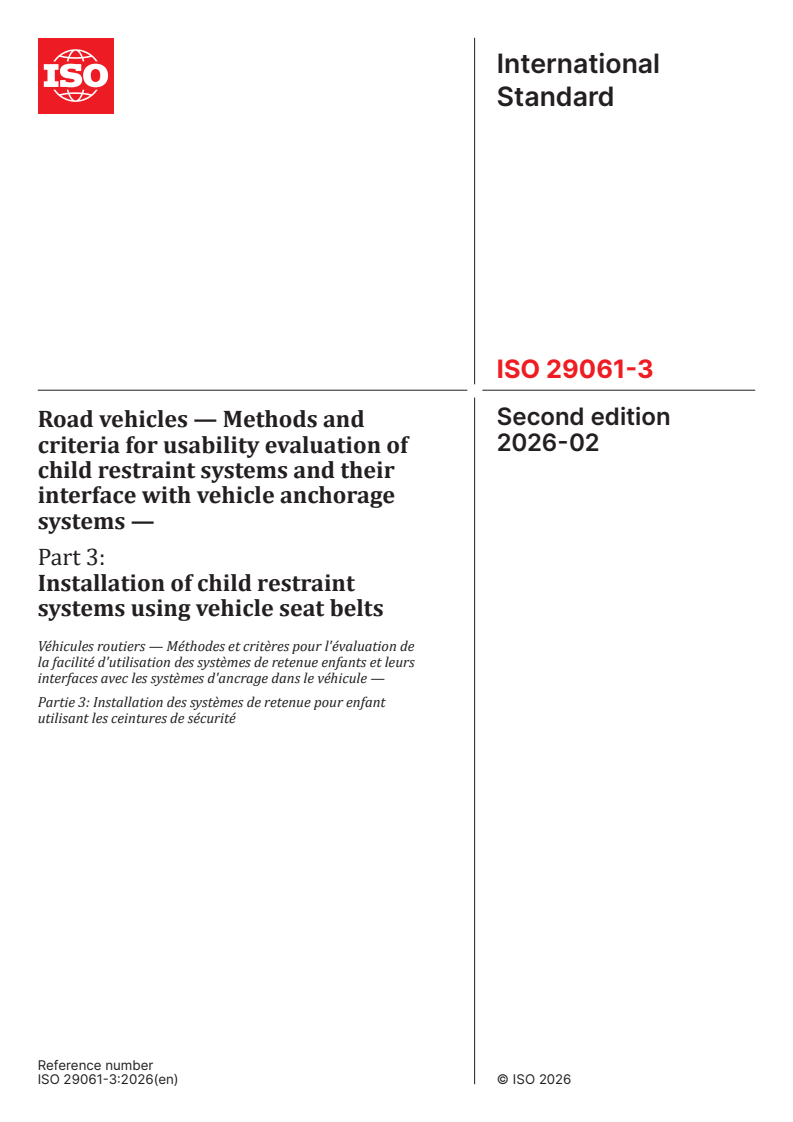
(Main)Road vehicles — Methods and criteria for usability evaluation of child restraint systems and their interface with vehicle anchorage systems — Part 3: Installation of child restraint systems using vehicle seat belts
General Information
- Abstract
This document specifies the criteria for judgement of usability of child restraint systems (CRSs) when installing them with vehicle seat belts. This document provides criteria for judgement of: ease of availability of instructions; clarity of instruction manual and labelling; and ease of use of design related features of the CRS related to the installation in a vehicle. NOTE 1 CRS includes enhanced child restraint systems (ECRS) according to UN Regulation No. 129. NOTE 2 This procedure can also be used for evaluation of vehicle integrated CRS. NOTE 3 Booster system usability evaluation is covered by ISO 29061-5.
- Status
- Published
- Publication Date
- 05-Feb-2026
- Technical Committee
- ISO/TC 22/SC 36 - Safety and impact testing
- Drafting Committee
- ISO/TC 22/SC 36 - Safety and impact testing
- Current Stage
- 6060 - International Standard published
- Start Date
- 06-Feb-2026
- Due Date
- 29-Aug-2026
- Completion Date
- 06-Feb-2026
Buy Documents
ISO 29061-3:2026 - Road vehicles — Methods and criteria for usability evaluation of child restraint systems and their interface with vehicle anchorage systems — Part 3: Installation of child restraint systems using vehicle seat belts Released:6. 02. 2026
Overview
ISO 29061-3:2026 provides internationally recognized methods and criteria for the usability evaluation of child restraint systems (CRSs) during installation with vehicle seat belts. Developed by ISO, this standard aims to ensure that CRSs-including enhanced child restraint systems (ECRS) in line with UN Regulation No. 129-can be installed correctly and easily in road vehicles. The usability assessment covers the availability and clarity of instructions and labelling, as well as the design features that impact installation with seat belts. This promotes improved child safety by helping manufacturers, vehicle designers, and consumers identify and select CRSs that are straightforward to use and secure.
Key Topics
- Instruction Availability: The standard details requirements for the ease with which users can access installation instructions-both printed and digital.
- Clarity of Manuals and Labels: Explicit criteria ensure instruction manuals and labelling are clear, consistent, and self-explanatory, minimizing ambiguities during installation.
- Usability of Design Features: Focus on features such as belt guides, anti-rotational devices (e.g., top tethers, support legs), and ease of assembly or conversion between restraint modes.
- Objective Evaluation Procedures: ISO 29061-3:2026 provides step-by-step procedures and scoring systems for usability assessment, enabling objective and repeatable evaluation.
- Scoring Principles: Assessment is scored based on item performance and importance, which collectively determine usability rating classes (from Excellent to Poor).
- Vehicle Interface Evaluation: The evaluation encompasses not just the child restraint, but the entire seat belt installation process, considering various seating positions and configurations.
- Special Notes: The procedure is adaptable for evaluating vehicle-integrated CRSs and acknowledges differences in usability across vehicle models and restraint types.
Applications
- Manufacturers: CRS and vehicle manufacturers use ISO 29061-3:2026 as a development and QA tool to design-user friendly, easily installable child restraints and interfaces.
- Consumer Information: Ratings derived from usability evaluation help parents and caregivers compare different CRSs based on ease of installation using seat belts.
- Regulatory Compliance: Demonstrating compliance with this ISO standard supports regulatory approvals and may be referenced in international tendering or procurement processes.
- Safety Testing: Organizations conducting crash and safety testing incorporate the usability measures to ensure that real-world usage aligns with safety expectations.
- Fleet and Institutional Buyers: Institutions responsible for child transport can use the assessment criteria to select CRSs that minimize misuse risk due to poor usability.
Related Standards
- ISO 29061-1: Usability evaluation for CRSs with ISOFIX anchorages.
- ISO 29061-4: Daily handling and securing of a child in CRS.
- ISO 29061-5: Usability evaluation of booster seat installation and securing of child.
- ISO 13216 Series: Vehicle anchorage systems for CRSs, including seat bight, top tether, and lower tether anchorages.
- UN Regulation No. 129: Enhanced Child Restraint Systems (ECRS).
- ISO 9241-11: General usability principles (referenced for definitions and concepts).
Practical Value
Adhering to ISO 29061-3:2026 improves child safety in vehicles by ensuring that restraint systems are practical, intuitive, and reduce the risk of misuse or incorrect installation. The systematic approach for usability evaluation benefits stakeholders across the supply chain, helps harmonize safety standards globally, and provides valuable, comparable information for both industry professionals and end users searching for the best child safety solutions.
For more guidance and detailed procedures, additional documents within the ISO 29061 series and ISO technical committee resources provide extensive support on implementing and assessing child restraint system usability.
Relations
- Effective Date
- 06-Jun-2022
Buy Documents
ISO 29061-3:2026 - Road vehicles — Methods and criteria for usability evaluation of child restraint systems and their interface with vehicle anchorage systems — Part 3: Installation of child restraint systems using vehicle seat belts Released:6. 02. 2026
Get Certified
Connect with accredited certification bodies for this standard

TÜV Rheinland
TÜV Rheinland is a leading international provider of technical services.

TÜV SÜD
TÜV SÜD is a trusted partner of choice for safety, security and sustainability solutions.

DEKRA Certification Inc.
DEKRA US certification services.
Sponsored listings
Frequently Asked Questions
ISO 29061-3:2026 is a standard published by the International Organization for Standardization (ISO). Its full title is "Road vehicles — Methods and criteria for usability evaluation of child restraint systems and their interface with vehicle anchorage systems — Part 3: Installation of child restraint systems using vehicle seat belts". This standard covers: This document specifies the criteria for judgement of usability of child restraint systems (CRSs) when installing them with vehicle seat belts. This document provides criteria for judgement of: ease of availability of instructions; clarity of instruction manual and labelling; and ease of use of design related features of the CRS related to the installation in a vehicle. NOTE 1 CRS includes enhanced child restraint systems (ECRS) according to UN Regulation No. 129. NOTE 2 This procedure can also be used for evaluation of vehicle integrated CRS. NOTE 3 Booster system usability evaluation is covered by ISO 29061-5.
This document specifies the criteria for judgement of usability of child restraint systems (CRSs) when installing them with vehicle seat belts. This document provides criteria for judgement of: ease of availability of instructions; clarity of instruction manual and labelling; and ease of use of design related features of the CRS related to the installation in a vehicle. NOTE 1 CRS includes enhanced child restraint systems (ECRS) according to UN Regulation No. 129. NOTE 2 This procedure can also be used for evaluation of vehicle integrated CRS. NOTE 3 Booster system usability evaluation is covered by ISO 29061-5.
ISO 29061-3:2026 is classified under the following ICS (International Classification for Standards) categories: 43.040.80 - Crash protection and restraint systems. The ICS classification helps identify the subject area and facilitates finding related standards.
ISO 29061-3:2026 has the following relationships with other standards: It is inter standard links to ISO 29061-3:2017. Understanding these relationships helps ensure you are using the most current and applicable version of the standard.
ISO 29061-3:2026 is available in PDF format for immediate download after purchase. The document can be added to your cart and obtained through the secure checkout process. Digital delivery ensures instant access to the complete standard document.
Standards Content (Sample)
International
Standard
ISO 29061-3
Second edition
Road vehicles — Methods and
2026-02
criteria for usability evaluation of
child restraint systems and their
interface with vehicle anchorage
systems —
Part 3:
Installation of child restraint
systems using vehicle seat belts
Véhicules routiers — Méthodes et critères pour l'évaluation de
la facilité d'utilisation des systèmes de retenue enfants et leurs
interfaces avec les systèmes d'ancrage dans le véhicule —
Partie 3: Installation des systèmes de retenue pour enfant
utilisant les ceintures de sécurité
Reference number
© ISO 2026
All rights reserved. Unless otherwise specified, or required in the context of its implementation, no part of this publication may
be reproduced or utilized otherwise in any form or by any means, electronic or mechanical, including photocopying, or posting on
the internet or an intranet, without prior written permission. Permission can be requested from either ISO at the address below
or ISO’s member body in the country of the requester.
ISO copyright office
CP 401 • Ch. de Blandonnet 8
CH-1214 Vernier, Geneva
Phone: +41 22 749 01 11
Email: copyright@iso.org
Website: www.iso.org
Published in Switzerland
ii
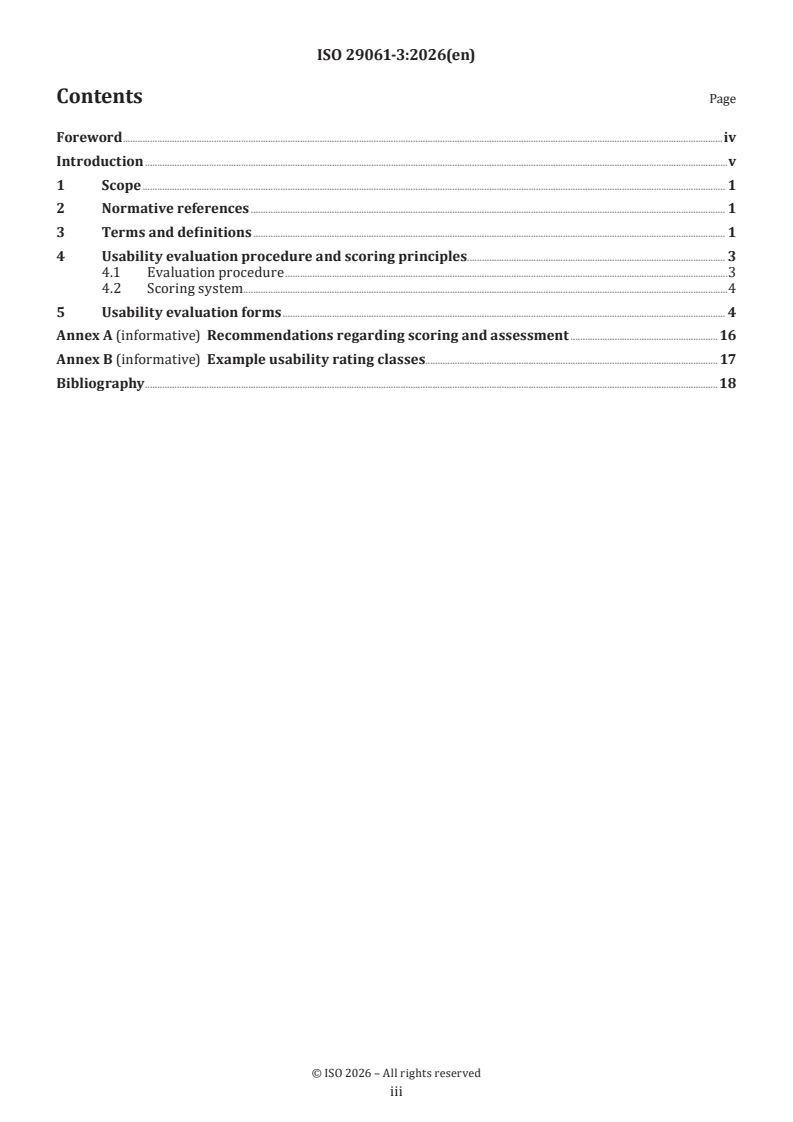
Contents Page
Foreword .iv
Introduction .v
1 Scope . 1
2 Normative references . 1
3 Terms and definitions . 1
4 Usability evaluation procedure and scoring principles . 3
4.1 Evaluation procedure .3
4.2 Scoring system . .4
5 Usability evaluation forms . 4
Annex A (informative) Recommendations regarding scoring and assessment .16
Annex B (informative) Example usability rating classes . 17
Bibliography .18
iii
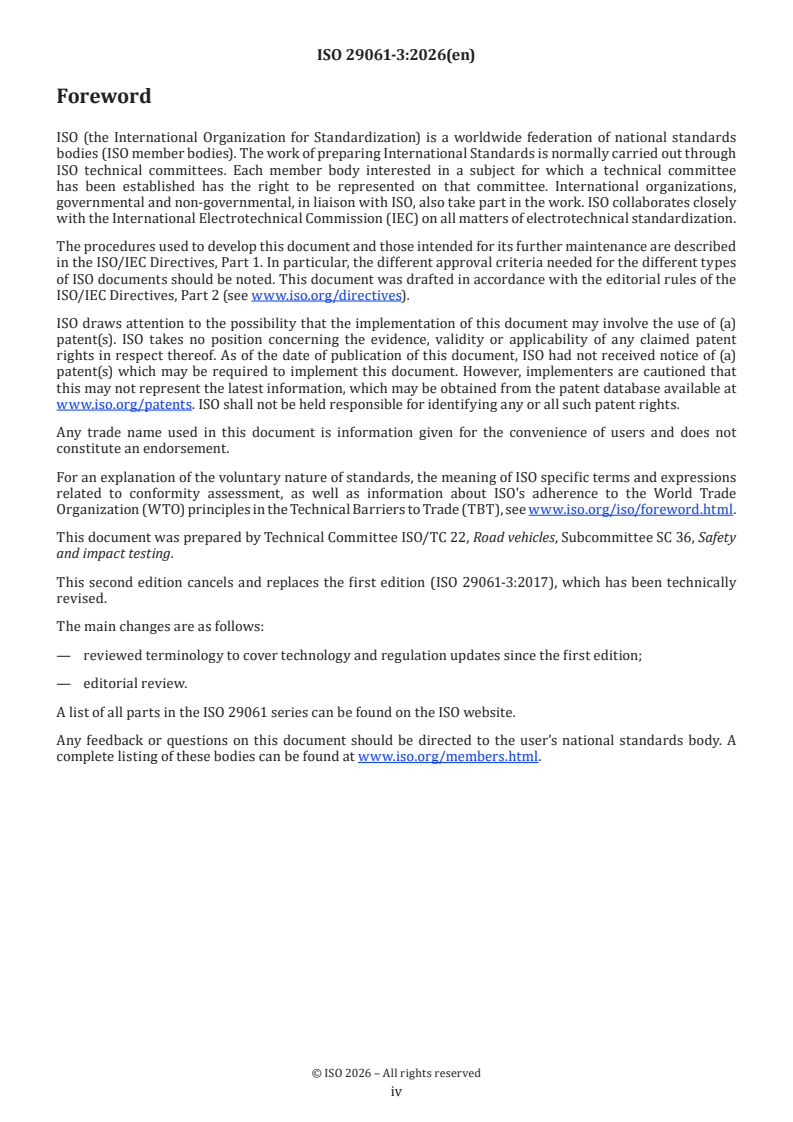
Foreword
ISO (the International Organization for Standardization) is a worldwide federation of national standards
bodies (ISO member bodies). The work of preparing International Standards is normally carried out through
ISO technical committees. Each member body interested in a subject for which a technical committee
has been established has the right to be represented on that committee. International organizations,
governmental and non-governmental, in liaison with ISO, also take part in the work. ISO collaborates closely
with the International Electrotechnical Commission (IEC) on all matters of electrotechnical standardization.
The procedures used to develop this document and those intended for its further maintenance are described
in the ISO/IEC Directives, Part 1. In particular, the different approval criteria needed for the different types
of ISO documents should be noted. This document was drafted in accordance with the editorial rules of the
ISO/IEC Directives, Part 2 (see www.iso.org/directives).
ISO draws attention to the possibility that the implementation of this document may involve the use of (a)
patent(s). ISO takes no position concerning the evidence, validity or applicability of any claimed patent
rights in respect thereof. As of the date of publication of this document, ISO had not received notice of (a)
patent(s) which may be required to implement this document. However, implementers are cautioned that
this may not represent the latest information, which may be obtained from the patent database available at
www.iso.org/patents. ISO shall not be held responsible for identifying any or all such patent rights.
Any trade name used in this document is information given for the convenience of users and does not
constitute an endorsement.
For an explanation of the voluntary nature of standards, the meaning of ISO specific terms and expressions
related to conformity assessment, as well as information about ISO's adherence to the World Trade
Organization (WTO) principles in the Technical Barriers to Trade (TBT), see www.iso.org/iso/foreword.html.
This document was prepared by Technical Committee ISO/TC 22, Road vehicles, Subcommittee SC 36, Safety
and impact testing.
This second edition cancels and replaces the first edition (ISO 29061-3:2017), which has been technically
revised.
The main changes are as follows:
— reviewed terminology to cover technology and regulation updates since the first edition;
— editorial review.
A list of all parts in the ISO 29061 series can be found on the ISO website.
Any feedback or questions on this document should be directed to the user’s national standards body. A
complete listing of these bodies can be found at www.iso.org/members.html.
iv
Introduction
The usability of a child restraint system (CRS) in terms of ease of:
— installation of CRSs in various vehicles; and
— day-to-day use with a child (e.g. securing, harnessing, adaption for a growing child)
is of utmost importance to ensure that a child restraint system is used properly in accordance with the
manufacturer's intentions, and to ensure that a correctly installed CRS will provide the best possible
protection in a crash situation. An international agreement on usability criteria and measurements is
beneficial for both consumers and manufacturers.
The aim of this document is to provide a usability evaluation system for installation of child restraint
systems with vehicle seat belts, to promote improved design for an easy and correct use.
It provides child restraint and vehicle manufacturers with a tool for the assessment of the usability of new
and current systems. At the same time, it provides consumers (parents and caregivers) with usability
information on the key features related to the proper use of the attachment system and assist them in
selecting child restraints and vehicles that are easy to use properly.
The ISO usability evaluation system has been developed with participation from, and considering the
experiences from, usability rating systems of Canada (Transport Canada and ICBC), USA (NHTSA, IIHS) and
the European Union (EU) (NPACS and consumer rating programmes, such as ICRT, ADAC).
v
International Standard ISO 29061-3:2026(en)
Road vehicles — Methods and criteria for usability evaluation
of child restraint systems and their interface with vehicle
anchorage systems —
Part 3:
Installation of child restraint systems using vehicle seat belts
1 Scope
This document specifies the criteria for judgement of usability of child restraint systems (CRSs) when
installing them with vehicle seat belts.
This document provides criteria for judgement of:
— ease of availability of instructions;
— clarity of instruction manual and labelling; and
— ease of use of design related features of the CRS related to the installation in a vehicle.
NOTE 1 CRS includes enhanced child restraint systems (ECRS) according to UN Regulation No. 129.
NOTE 2 This procedure can also be used for evaluation of vehicle integrated CRS.
NOTE 3 Booster system usability evaluation is covered by ISO 29061-5.
2 Normative references
There are no normative references in this document.
3 Terms and definitions
For the purposes of this document, the following terms and definitions apply.
ISO and IEC maintain terminology databases for use in standardization at the following addresses:
— ISO Online browsing platform: available at https:// www .iso .org/ obp
— IEC Electropedia: available at https:// www .electropedia .org/
3.1
audible
capable of being heard in normal environmental conditions
3.2
child restraint system
CRS
free-standing device intended to provide child vehicle occupants with an approved restraint
Note 1 to entry: CRSs comprise various categories such as car beds, infant-only restraints, toddler seats (forward or
rearward-facing), booster cushions, and booster seats. Combination products can cover two or more of these product
categories.
3.3
base
part of the child restraint system (CRS) (3.2) which can be attached with the vehicle seat belt separately from
the CRS shell
Note 1 to entry: The CRS shell is attached on the CRS base in the normal use.
3.4
rebound bar
type of anti-rotational device intended to restrict the rearward rotation of a rearward-facing child restraint
system (CRS) (3.2)
Note 1 to entry: It usually comprises a rigid device that, when in its operational position, rests against the vehicle
seatback.
3.5
lower tether
type of anti-rotational device intended to restrict the rearward rotation of a rearward-facing child restraint
system (CRS) (3.2)
Note 1 to entry: It usually comprises a tether strap or other hardware attached near the back or base (3.3) of the
CRS that connects to a lower tether anchorage (3.6). It incorporates a device to enable it to be connected to such an
anchorage.
3.6
lower tether anchorage
anchorage on the vehicle seat track or on or close to the vehicle floor to which a lower tether (3.5) can be
attached
3.7
single action
operation that can be completed without the need to undertake a secondary action
EXAMPLE This includes tightening a strap by pulling it without the need to release a locking system; or attaching
to an anchorage without the need to depress the seat cushion.
3.8
connector
connecting and locking device to the universal interface, provided with the child restraint system (CRS) (3.2)
and part of the attachment (3.9)
3.9
attachment
part of the universal interface provided with the child restraint system (CRS) (3.2)
3.10
harness
child restraint system (CRS) (3.2) belt assembly comprising shoulder restraints, a crotch strap and optionally
lap straps
3.11
slack
looseness of an adjustable strap that is likely to affect the performance of the child restraint system (CRS)
(3.2) adversely
3.12
support leg
type of anti-rotational device comprising a permanent attachment (3.9) to a child restraint system (CRS)
(3.2), or a base (3.3) of a CRS, creating a compressive load path between the CRS and a vehicle structure (for
example, the vehicle floor) to prevent or reduce forward rotation of the CRS
Note 1 to entry: A support leg can be adjustable.
3.13
top tether
tether strap (or equivalent) attached at or near the top of a child restraint system (CRS) (3.2), incorporating a
device to enable it to be connected to a top tether anchorage (3.13.1)
3.13.1
top tether anchorage
device, such as a ring, bar, bracket, or webbing loop, and its underlying structure, either user-ready or
aftermarket-installed, to which a top tether (3.13) can be attached
3.13.2
top tether strap
webbing strap which extends from the top of a child restraint system (CRS) (3.2) to the top tether anchorage
(3.13.1) and which is equipped with an adjustment device, a tension-relieving device and a top tether (3.13)
connector (3.8)
3.14
usability
extent to which a vehicle or child restraint system (CRS) (3.2) is capable of being used and is convenient and
practical in use (separately or combined)
4 Usability evaluation procedure and scoring principles
4.1 Evaluation procedure
This document provides a procedure to evaluate the usability of child restraint systems (CRSs), equipped
with an integral harness or a shield, intended to be installed in the vehicle using the vehicle seat belts. The
procedure evaluates ease of availability of instructions, clarity of instruction manual and labelling, and the
ease of use of design-related features of the CRS related to the installation in a vehicle.
The assessment is done in two steps:
— a separate assessment of the CRS; and
— a usability assessment when installing the CRS in specified vehicle seating positions.
The evaluation takes into consideration the various modes of installation and conversions between
installation modes. The usability protocol is intended to be objective and repeatable.
The evaluation is most easily accomplished using a team of two people having basic knowledge of child
restraints and being familiar with the technical terms used. However, they should preferably be unfamiliar
with the CRS model to be evaluated.
The procedure for all three aspects of the process, the CRS, the vehicle seating position and the resulting
interface, takes about 45 min.
The necessary materials include:
— the usability evaluation form (in either paper or electronic format);
— the vehicle owner’s instruction manual;
— the CRS instruction manual, including instruction video if applicable;
— a screwdriver, or a simple prying/turning tool;
— a force gauge for measuring belt tension.
A copy of the terms and definitions from this document can also be helpful.
Initially, the child restraint shall be in the condition as supplied to the consumer. The evaluation process
includes all the steps, including assembly, to complete the installation.
Unpacking the CRS, removing the box and plastic protections, detaching the handbook, etc. shall be
disregarded in the evaluation, but other initial one-time preparations are considered and assessed in the
forms.
The mode of use for the child restraint (i.e. forward-facing/rearward-facing, upright/reclined, with base/
without base) and the seating position in the vehicle shall be determined in advance and documented in the
evaluation form.
The evaluation process first addresses the labels and instructions, followed by the ease of installation and
removal of the CRS.
4.2 Scoring system
The scoring system consists of a good/average/poor rating (scored with 3/1/0 points) of each item assessed,
and an importance rating A/B/C (scored with 3/2/1 points) for each item. For each assessment, the scoring of
the above are multiplied. A maximum score for a "good" solution on an item with "A" importance is 9 points.
In this document, “average” means “mid-level” and shall not be perceived as a statistical average between
good and poor.
The maximum possible score will depend on the features and usage of the restraint and vehicle. Different
products can have different maximum possible scores, and therefore, comparisons of the raw number of total
points would not be appropriate. The final rating consists of a total number of points shall be expressed as a
percentage of the maximum possible score for the particular conditions. See also further recommendations
given in Annex A. Example of usability rating classes is given in Annex B.
In addition, in some instances the rating will result in a total poor rating (or fail) if the product evaluated
does not score either a “good” or “average” in the most crucial questions of this rating. These instances are
identified in the evaluation sheets in the “notes” column against the relevant questions.
5 Usability evaluation forms
The following are the usability evaluation forms:
— Form 1: separate evaluation of CRS: rearward facing (RF), forward facing (FF) or lateral/transverse
facing (LF) with internal harness or shield;
— Form 2: interface – Installing the CRS, or base with seat, in the vehicle;
To enhance the value and applicability of this document, the forms are also provided in a revisable [MS
1)
Excel ] format. These forms are provided at the following URL: https:// standards .iso .org/ iso/ 29061/ -3/ ed
-2/ en/ .
1) MS Excel is an example of a suitable product available commercially. This information is given for the convenience of
users of this document and does not constitute an endorsement by ISO of this product.
Form 1: Separate evaluation of CRS: Rearward facing (RF), forward facing (FF) or lateral/transverse facing (LF) with internal harness or shield
Date of evaluation Evaluated by Test no.
CRS evaluated Infant only CRS, RF Infant only CRS, LF RF only toddler CRS FF only CRS
Manufacturer Multiple modes CRS (2-in-1) Multiple modes CRS (3-in-1)
a
Child seat make/brand and model Base make/brand and model
Country/region of use Country/region of use
b b
Certification/type approval no. Approval no.
Production no. (serial no./SAI No, Production no. (serial no./SAI No,
etc.) etc.)
Date of manufacturing, yyyy-mm-dd Date of manufacturing, yyyy-mm-dd
Type (infant, group 0, integral, A2,
etc.) Primary anti-rotational device Top tether Support leg N/A
Lower tether Rebound bar
CRS has separate
...