

ISO 8196-1:2009
(Main)Milk — Definition and evaluation of the overall accuracy of alternative methods of milk analysis — Part 1: Analytical attributes of alternative methods
General Information
- Abstract
ISO 8196-1|IDF 128-1:2009 specifies various performance characteristics that constitute and serve to characterize the overall accuracy of an analytical method. It furthermore establishes general principles for the design of experiments and gives guidelines for the procedures to be used to evaluate these characteristics quantitatively.
- Status
- Published
- Publication Date
- 30-Sep-2009
- Technical Committee
- ISO/TC 34/SC 5 - Milk and milk products
- Drafting Committee
- ISO/TC 34/SC 5 - Milk and milk products
- Current Stage
- 9093 - International Standard confirmed
- Start Date
- 12-Dec-2023
- Completion Date
- 29-Aug-2026
Buy Documents
ISO 8196-1:2009 - Milk — Definition and evaluation of the overall accuracy of alternative methods of milk analysis — Part 1: Analytical attributes of alternative methods Released:10/1/2009
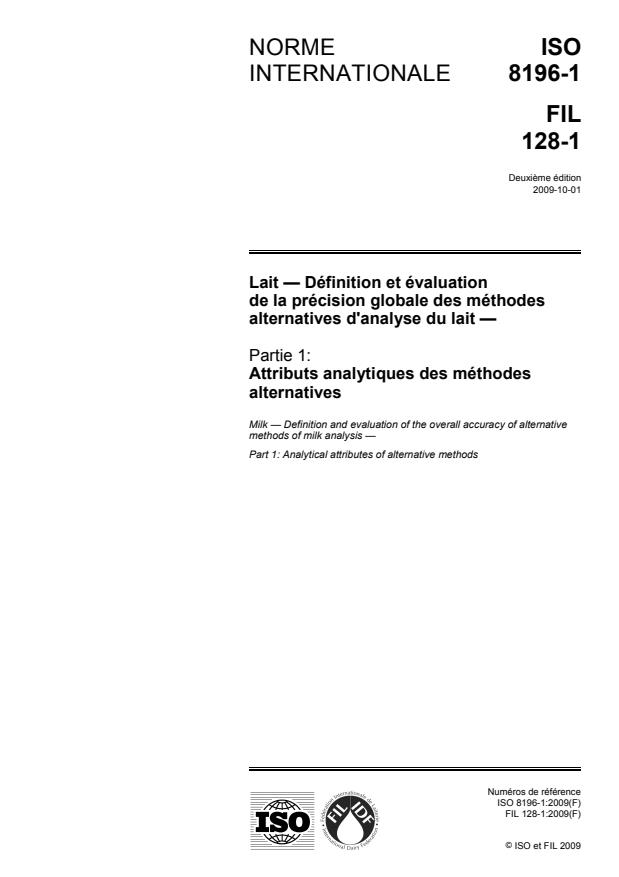
ISO 8196-1:2009 - Lait — Définition et évaluation de la précision globale des méthodes alternatives d'analyse du lait — Partie 1: Attributs analytiques des méthodes alternatives Released:10/1/2009
ISO 8196-1:2009 - Milk — Definition and evaluation of the overall accuracy of alternative methods of milk analysis — Part 1: Analytical attributes of alternative methods Released:4/24/2012
Overview
ISO 8196-1:2009 (IDF 128-1:2009) defines how to quantify the overall accuracy of alternative methods for milk analysis by specifying their analytical attributes and how to evaluate them. The standard sets out performance characteristics, general principles for experimental design, and guidelines for the statistical procedures needed to assess those characteristics quantitatively. It is focused particularly on alternative and rapid physico-chemical methods used in compositional testing of milk, treating multivariate data‑processing components as a “black box” that should be optimized prior to assessment.
Key Topics and Requirements
- Performance characteristics: Defines the measurable attributes that characterize method accuracy, including precision, trueness, selectivity, exactness of calibration, and accuracy of estimate.
- Precision metrics: Specifies repeatability (r) and reproducibility (R) limits - e.g., the 95% probability basis for pairwise differences under repeatability and reproducibility conditions.
- Trueness and bias: Describes trueness as closeness of the expectation of a result to the true value; bias is the usual measure.
- Experimental design: Provides general principles for designing experiments, including interlaboratory trials to assess precision and structured studies to evaluate accuracy.
- Statistical procedures: Recommends quantitative evaluation methods and references ISO 3534 and ISO 5725 for vocabulary and accuracy (trueness and precision) methodology.
- Method equivalence: Allows the single linear regression model as a simplified approach for demonstrating equivalence with a reference method, but notes its limitations and the need for alternative modelling when correlation is low.
- Scope of application: Emphasizes indirect (multivariate or surrogate) and direct methods that estimate the same measurand as a recognized reference method.
Applications and Users
ISO 8196-1:2009 is practical for:
- Instrument and method developers validating new analytical systems for milk composition.
- Dairy laboratories implementing or qualifying alternative routine methods.
- Quality assurance and regulatory bodies assessing method suitability and compliance.
- Proficiency testing and accreditation bodies designing interlaboratory studies and acceptance criteria. Typical applications include validation of rapid milk analyzers, assessing calibration accuracy, and determining method equivalence to internationally recognized reference methods.
Related Standards
- ISO 8196-2 | IDF 128-2: Calibration and quality control in the dairy laboratory (practical guidance).
- ISO 8196-3 | IDF 128-3: Protocols for evaluation/validation of alternative quantitative methods.
- ISO 3534 (statistics) and ISO 5725 (accuracy of measurement methods) - normative references used for definitions and statistical treatment.
Keywords: ISO 8196-1:2009, milk analysis, alternative methods, analytical attributes, precision, trueness, repeatability, reproducibility, calibration, interlaboratory trial, IDF 128-1.
Relations
- Effective Date
- 15-Apr-2008
Buy Documents
ISO 8196-1:2009 - Milk — Definition and evaluation of the overall accuracy of alternative methods of milk analysis — Part 1: Analytical attributes of alternative methods Released:10/1/2009
ISO 8196-1:2009 - Lait — Définition et évaluation de la précision globale des méthodes alternatives d'analyse du lait — Partie 1: Attributs analytiques des méthodes alternatives Released:10/1/2009
ISO 8196-1:2009 - Milk — Definition and evaluation of the overall accuracy of alternative methods of milk analysis — Part 1: Analytical attributes of alternative methods Released:4/24/2012
Get Certified
Connect with accredited certification bodies for this standard

BSI Group
BSI (British Standards Institution) is the business standards company that helps organizations make excellence a habit.

Bureau Veritas
Bureau Veritas is a world leader in laboratory testing, inspection and certification services.

DNV
DNV is an independent assurance and risk management provider.
Sponsored listings
Frequently Asked Questions
ISO 8196-1:2009 is a standard published by the International Organization for Standardization (ISO). Its full title is "Milk — Definition and evaluation of the overall accuracy of alternative methods of milk analysis — Part 1: Analytical attributes of alternative methods". This standard covers: ISO 8196-1|IDF 128-1:2009 specifies various performance characteristics that constitute and serve to characterize the overall accuracy of an analytical method. It furthermore establishes general principles for the design of experiments and gives guidelines for the procedures to be used to evaluate these characteristics quantitatively.
ISO 8196-1|IDF 128-1:2009 specifies various performance characteristics that constitute and serve to characterize the overall accuracy of an analytical method. It furthermore establishes general principles for the design of experiments and gives guidelines for the procedures to be used to evaluate these characteristics quantitatively.
ISO 8196-1:2009 is classified under the following ICS (International Classification for Standards) categories: 67.100.10 - Milk and processed milk products. The ICS classification helps identify the subject area and facilitates finding related standards.
ISO 8196-1:2009 has the following relationships with other standards: It is inter standard links to ISO 8196-1:2000. Understanding these relationships helps ensure you are using the most current and applicable version of the standard.
ISO 8196-1:2009 is available in PDF format for immediate download after purchase. The document can be added to your cart and obtained through the secure checkout process. Digital delivery ensures instant access to the complete standard document.
Standards Content (Sample)
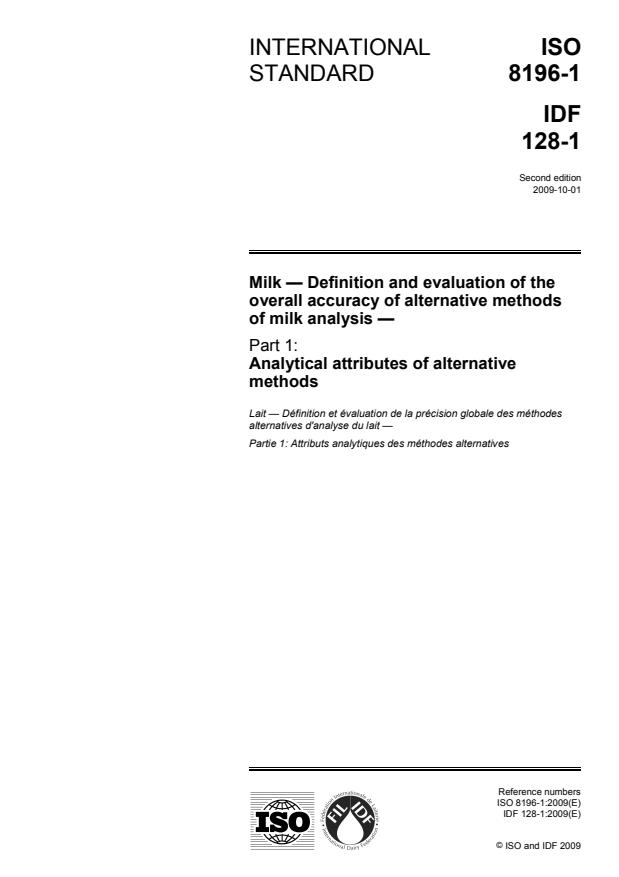
INTERNATIONAL ISO
STANDARD 8196-1
IDF
128-1
Second edition
2009-10-01
Milk — Definition and evaluation of the
overall accuracy of alternative methods
of milk analysis —
Part 1:
Analytical attributes of alternative
methods
Lait — Définition et évaluation de la précision globale des méthodes
alternatives d'analyse du lait —
Partie 1: Attributs analytiques des méthodes alternatives
Reference numbers
IDF 128-1:2009(E)
©
ISO and IDF 2009
IDF 128-1:2009(E)
PDF disclaimer
This PDF file may contain embedded typefaces. In accordance with Adobe's licensing policy, this file may be printed or viewed but
shall not be edited unless the typefaces which are embedded are licensed to and installed on the computer performing the editing. In
downloading this file, parties accept therein the responsibility of not infringing Adobe's licensing policy. Neither the ISO Central
Secretariat nor the IDF accepts any liability in this area.
Adobe is a trademark of Adobe Systems Incorporated.
Details of the software products used to create this PDF file can be found in the General Info relative to the file; the PDF-creation
parameters were optimized for printing. Every care has been taken to ensure that the file is suitable for use by ISO member bodies
and IDF national committees. In the unlikely event that a problem relating to it is found, please inform the ISO Central Secretariat at the
address given below.
© ISO and IDF 2009
All rights reserved. Unless otherwise specified, no part of this publication may be reproduced or utilized in any form or by any means,
electronic or mechanical, including photocopying and microfilm, without permission in writing from either ISO or IDF at the respective
address below.
ISO copyright office International Dairy Federation
Case postale 56 • CH-1211 Geneva 20 Diamant Building • Boulevard Auguste Reyers 80 • B-1030 Brussels
Tel. + 41 22 749 01 11 Tel. + 32 2 733 98 88
Fax + 41 22 749 09 47 Fax + 32 2 733 04 13
E-mail copyright@iso.org E-mail info@fil-idf.org
Web www.iso.org Web www.fil-idf.org
Published in Switzerland
ii © ISO and IDF 2009 – All rights reserved
IDF 128-1:2009(E)
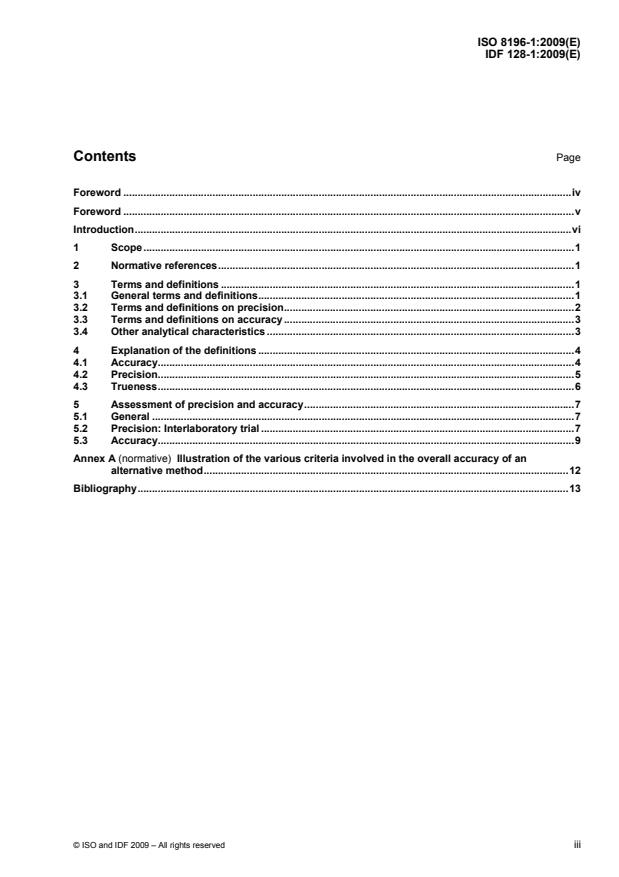
Contents Page
Foreword .iv
Foreword .v
Introduction.vi
1 Scope.1
2 Normative references.1
3 Terms and definitions .1
3.1 General terms and definitions.1
3.2 Terms and definitions on precision.2
3.3 Terms and definitions on accuracy .3
3.4 Other analytical characteristics .3
4 Explanation of the definitions .4
4.1 Accuracy.4
4.2 Precision.5
4.3 Trueness.6
5 Assessment of precision and accuracy.7
5.1 General .7
5.2 Precision: Interlaboratory trial .7
5.3 Accuracy.9
Annex A (normative) Illustration of the various criteria involved in the overall accuracy of an
alternative method.12
Bibliography.13
IDF 128-1:2009(E)
Foreword
ISO (the International Organization for Standardization) is a worldwide federation of national standards
bodies (ISO member bodies). The work of preparing International Standards is normally carried out through
ISO technical committees. Each member body interested in a subject for which a technical committee has
been established has the right to be represented on that committee. International organizations, governmental
and non-governmental, in liaison with ISO, also take part in the work. ISO collaborates closely with the
International Electrotechnical Commission (IEC) on all matters of electrotechnical standardization.
International Standards are drafted in accordance with the rules given in the ISO/IEC Directives, Part 2.
The main task of technical committees is to prepare International Standards. Draft International Standards
adopted by the technical committees are circulated to the member bodies for voting. Publication as an
International Standard requires approval by at least 75 % of the member bodies casting a vote.
Attention is drawn to the possibility that some of the elements of this document may be the subject of patent
rights. ISO shall not be held responsible for identifying any or all such patent rights.
ISO 8196-1|IDF 128-1 was prepared by Technical Committee ISO/TC 34, Food products, Subcommittee SC 5,
Milk and milk products, and the International Dairy Federation (IDF). It is being published jointly by ISO and
IDF.
This second edition of ISO 8196-1|IDF 128-1 cancels and replaces the first edition (ISO 8196-1:2000) which
has been technically revised.
ISO 8196|IDF 128 consists of the following parts, under the general title Milk — Definition and evaluation of
the overall accuracy of alternative methods of milk analysis:
⎯ Part 1: Analytical attributes of alternative methods
⎯ Part 2: Calibration and quality control in the dairy laboratory
⎯ Part 3: Protocol for the evaluation and validation of alternative quantitative methods of milk analysis
iv © ISO and IDF 2009 – All rights reserved
IDF 128-1:2009(E)
Foreword
IDF (the International Dairy Federation) is a non-profit organization representing the dairy sector worldwide.
IDF membership comprises National Committees in every member country as well as regional dairy
associations having signed a formal agreement on cooperation with IDF. All members of IDF have the right to
be represented at the IDF Standing Committees carrying out the technical work. IDF collaborates with ISO in
the development of standard methods of analysis and sampling for milk and milk products.
The main task of Standing Committees is to prepare International Standards. Draft International Standards
adopted by the Action Teams and Standing Committees are circulated to the National Committees for voting.
Publication as an International Standard requires approval by at least 50 % of IDF National Committees
casting a vote.
Attention is drawn to the possibility that some of the elements of this document may be the subject of patent
rights. IDF shall not be held responsible for identifying any or all such patent rights.
ISO 8196-1|IDF 128-1 was prepared by the International Dairy Federation (IDF) and Technical Committee
ISO/TC 34, Food products, Subcommittee SC 5, Milk and milk products. It is being published jointly by ISO
and IDF.
All work was carried out by the Joint IDF-ISO Action Team on Automated methods of the Standing Committee
on Quality assurance, statistics of analytical data and sampling under the aegis of its project leader, Mr. O.
Leray (FR).
This edition of ISO 8196-1|IDF 128-1, together with ISO 8196-2|IDF 128-2 and ISO 8196-3|IDF 128-3, cancels
and replaces IDF 128:1985, which has been technically revised.
ISO 8196|IDF 128 consists of the following parts, under the general title Milk — Definition and evaluation of
the overall accuracy of alternative methods of milk analysis:
⎯ Part 1: Analytical attributes of alternative methods
⎯ Part 2: Calibration and quality control in the dairy laboratory
⎯ Part 3: Protocol for the evaluation and validation of alternative quantitative methods of milk analysis
IDF 128-1:2009(E)
Introduction
The main purpose of this part of ISO 8196|IDF 128 is to provide definitions of the relevant performance
characteristics for quantitatively evaluating the overall accuracy of an analytical method, through the
application of proper experimental designs and recommended statistical procedures.
Performance characteristics of an analytical method can be defined as a set of quantitative and experimentally
determined values, or criteria, of fundamental importance in assessing the suitability of a method for any given
purpose. The general concepts apply to all analytical methods, but special emphasis is given to rapid physico-
chemical methods which are currently in use for compositional testing of milk.
In analytical methods where measurements result from combinations of multiple output signals of
measurement channels either in series or in parallel (e.g. methods in which multivariate mathematical models
are applied), the process of combining the primary raw information is considered as a full part of the method
itself. For the purpose of ISO 8196|IDF 128 (all parts), this process is considered as a closed device (“black
box”). As such, this process is assumed to be optimized prior to the assessments and evaluations done within
the scope of ISO 8196|IDF 128 (all parts).
ISO 8196-2|IDF 128-2 provides practical details and recommendations for the calibration of instruments and
quality control in routine dairy laboratories including checking compliance with a specification value or limit.
ISO 8196-3|IDF 128-3 is intended to complement this part of ISO 8196|IDF 128 as an alternative to the
evaluation of new methods to which this part of ISO 8196|IDF 128 cannot apply, e.g. when the organization of
interlaboratory studies is hampered by the number of new instruments available, which is too small for such a
protocol.
While this part of ISO 8196|IDF 128 and ISO 8196-3|IDF 128-3 are mainly intended for experts to assess new
methods of analysis, ISO 8196-2|IDF 128-2 aims to be a guide for routine laboratories using these methods.
ISO 8196|IDF 128 (all parts) only specifies the single linear regression model as a simplified approach to allow
users to determine equivalence of an alternative method with a reference method. However, the linear
regression approach is valid as a determination of method equivalence only in limited circumstances or if a
high correlation between the results of the reference method and the routine method is achieved. If a high
correlation is not achieved, recourse should be made to other data handling and measurement error modelling
techniques. Although these techniques are referred to, they are not specified in ISO 8196|IDF 128 (all parts).
vi © ISO and IDF 2009 – All rights reserved
INTERNATIONAL STANDARD
IDF 128-1:2009(E)
Milk — Definition and evaluation of the overall accuracy
of alternative methods of milk analysis —
Part 1:
Analytical attributes of alternative methods
1 Scope
This part of ISO 8196|IDF 128 specifies various performance characteristics that constitute and serve to
characterize the overall accuracy of an analytical method. It furthermore establishes general principles for the
design of experiments and gives guidelines for the procedures to be used to evaluate these characteristics
quantitatively.
2 Normative references
The following referenced documents are indispensable for the application of this document. For dated
references, only the edition cited applies. For undated references, the latest edition of the referenced
document (including any amendments) applies.
ISO 3534 (all parts), Statistics — Vocabulary and symbols
ISO 5725 (all parts), Accuracy (trueness and precision) of measurement methods and results
3 Terms and definitions
For the purposes of this part of ISO 8196|IDF 128, the terms and definitions given in ISO 3534 (all parts) and
ISO 5725-1 apply, together with the following.
3.1 General terms and definitions
3.1.1
true quantity value
true value of a quantity
true value
quantity value consistent with the definition of a quantity
NOTE 1 In the Error Approach to describing measurement, a true quantity value is considered unique and, in practice,
unknowable. The Uncertainty Approach is to recognize that, owing to the inherently incomplete amount of detail in the
definition of a quantity, there is not a single true quantity value but rather a set of true quantity values consistent with the
definition. However, this set of values is, in principle and in practice, unknowable. Other approaches dispense altogether
with the concept of true quantity value and rely on the concept of metrological compatibility of measurement results for
assessing their validity.
NOTE 2 In the special case of a fundamental constant, the quantity is considered to have a single true quantity value.
IDF 128-1:2009(E)
NOTE 3 When the definitional uncertainty associated with the measurand is considered to be negligible compared to
the other components of the measurement uncertainty, the measurand may be considered to have an “essentially unique”
[3]
true quantity value. This is the approach taken by ISO/IEC Guide 98-3:2008 and associated documents, where the word
“true” is considered to be redundant.
[4]
[ISO/IEC Guide 99:2007 , 2.11]
3.1.2
reference method
anchor method
method of analysis internationally recognized by experts or by agreement between the parties
[1]
NOTE 1 Adapted from ISO 21187|IDF 196:2004 , 3.2.
NOTE 2 A reference method gives the “true value” or “assigned value” of the quantity of the measurand.
3.1.3
alternative method
routine method
method of analysis allowing quantification of the status of a test sample
[1]
NOTE 1 Adapted from ISO 21187|IDF 196:2004 , 3.1.
NOTE 2 An alternative method demonstrates or estimates, for a given category of products, the same measurand as
determined using the corresponding reference method (3.1.2).
NOTE 3 The alternative method can be either an indirect method — i.e. one not measuring directly the component or
the characteristic that it is intended to quantify, but instead one or more quantities or properties which are functionally
linked to that component — or a direct method. It can have specific adaptations for user convenience (e.g. speed,
automation, miniaturization, cost) that can introduce deviation into the analytical process (e.g. incomplete component or
characteristic measurement) and thus prevent direct estimation and give different accuracy.
3.2 Terms and definitions on precision
3.2.1
precision
closeness of agreement between independent test/measurement results obtained under stipulated conditions
[ISO 3534-2:2006, 3.3.4]
3.2.2
repeatability limit
r
value less than or equal to which the absolute difference between two final values, each of them representing
a series of test results or measurement results obtained with the same method on identical test/measurement
items in the same test or measuring facility by the same operator using the same equipment within short
intervals of time, is expected to be for a specified probability of 95 %
NOTE Adapted from ISO 3534-2:2006, 3.3.6, 3.3.8, 3.3.9.
3.2.3
reproducibility limit
R
value less than or equal to which the absolute difference between two final values, each of them representing
a series of test results or measurement results obtained with the same method on identical test/measurement
items in different test or measuring facilities with different operators using different equipment, is expected to
be for a specified probability of 95 %
NOTE Adapted from ISO 3534-2:2006, 3.3.11, 3.3.13, 3.3.14.
2 © ISO and IDF 2009 – All rights reserved
IDF 128-1:2009(E)
3.3 Terms and definitions on accuracy
The terms and definitions on accuracy apply specifically to indirect alternative methods for the purpose of this
part of ISO 8196|IDF 128.
3.3.1
accuracy
closeness of agreement between a test result or measurement result and the true value (3.1.1)
NOTE 1 In practice, the accepted reference value is substituted for the true value.
NOTE 2 The term accuracy, when applied to a set of test or measurement results, involves a combination of random
components and a common systematic error or bias component.
NOTE 3 Accuracy refers to a combination of trueness (3.3.2) and precision (3.2.1).
[ISO 3534-2:2006, 3.3.1]
3.3.2
trueness
closeness of agreement between the expectation of a test result or a measurement result and a true value
(3.1.1)
NOTE 1 The measure of trueness is usually expressed in terms of bias.
NOTE 2 Trueness is sometimes referred to as “accuracy of the mean”. This usage is not recommended.
NOTE 3 In practice, the accepted reference value is substituted for the true value.
[ISO 3534-2:2006, 3.3.3]
3.3.3
exactness of calibration
closeness of agreement, at each level of the measurand, between an alternative method value and the
estimated average true value for all individual samples at the corresponding level
3.3.4
accuracy of estimate
closeness of agreement between the average test result obtained by the reference method and an alternative
method on identical materials, provided that the calibration of the alternative method is exact
NOTE Accuracy of estimate measures the part of the systematic error not due to error in calibration.
3.4 Other analytical characteristics
3.4.1
selectivity
property of a method to respond exclusively to the characteristic or analyte to be measured, or degree to
which a method can quantify that characteristic or analyte accurately in the presence of interferents
NOTE As a general principle, selectivity is sufficiently good for any interference to be ignored. Selectivity contributes
to trueness.
3.4.2
sensitivity
smallest change in concentration which can be measured by an analytical procedure
IDF 128-1:2009(E)
NOTE Sensitivity is calculated as the ratio of the variation of the method response to the variation of analyte
concentration. As this is usually arbitrary, depending on instrumental settings, it is not useful in validation. However, it may
be useful in quality assurance procedures to test whether an instrument is performing to a consistent and satisfactory
standard.
3.4.3
limit of detection
LOD
minimum amount or concentration of the analyte in a test sample which can be detected reliably but not
necessarily quantified, as demonstrated by a collaborative trial or other appropriate validation
[2]
[ISO 24276:2006 , 3.1.6]
NOTE For instrumental methods, sensitivity and limit of detection are usually determined by the sensitivity of the
detector and the signal/noise ratio.
3.4.4
limit of determination
limit of quantitation
LOQ
〈analytical procedure〉 lowest concentration or amount of the analyte in a test sample which can be
quantitatively determined with an acceptable level of precision and accuracy, as demonstrated by a
collaborative trial or other appropriate validation
[2]
[ISO 24276:2006 , 3.1.7]
4 Explanation of the definitions
4.1 Accuracy — General description
The concept applies mainly to the test result of an alternative method calibrated against the accepted value of
the reference method or standard material, or when the true value of the component concentration is known.
The accuracy is an index indicating a value of the amount of errors invol
...
NORME ISO
INTERNATIONALE 8196-1
FIL
128-1
Deuxième édition
2009-10-01
Lait — Définition et évaluation
de la précision globale des méthodes
alternatives d'analyse du lait —
Partie 1:
Attributs analytiques des méthodes
alternatives
Milk — Definition and evaluation of the overall accuracy of alternative
methods of milk analysis —
Part 1: Analytical attributes of alternative methods
Numéros de référence
FIL 128-1:2009(F)
©
ISO et FIL 2009
FIL 128-1:2009(F)
PDF – Exonération de responsabilité
Le présent fichier PDF peut contenir des polices de caractères intégrées. Conformément aux conditions de licence d'Adobe, ce fichier
peut être imprimé ou visualisé, mais ne doit pas être modifié à moins que l'ordinateur employé à cet effet ne bénéficie d'une licence
autorisant l'utilisation de ces polices et que celles-ci y soient installées. Lors du téléchargement de ce fichier, les parties concernées
acceptent de fait la responsabilité de ne pas enfreindre les conditions de licence d'Adobe. Le Secrétariat central de l'ISO et la FIL
déclinent toute responsabilité en la matière.
Adobe est une marque déposée d'Adobe Systems Incorporated.
Les détails relatifs aux produits logiciels utilisés pour la création du présent fichier PDF sont disponibles dans la rubrique General Info
du fichier; les paramètres de création PDF ont été optimisés pour l'impression. Toutes les mesures ont été prises pour garantir
l'exploitation de ce fichier par les comités membres de l'ISO et les comités nationaux de la FIL. Dans le cas peu probable où
surviendrait un problème d'utilisation, veuillez en informer le Secrétariat central de l'ISO à l'adresse donnée ci-dessous.
DOCUMENT PROTÉGÉ PAR COPYRIGHT
© ISO et FIL 2009
Droits de reproduction réservés. Sauf prescription différente, aucune partie de cette publication ne peut être reproduite ni utilisée sous
quelque forme que ce soit et par aucun procédé, électronique ou mécanique, y compris la photocopie et les microfilms, sans l'accord écrit
soit de l'ISO soit de la FIL, à l'une ou l'autre des adresses ci-après.
ISO copyright office Fédération Internationale de Laiterie
Case postale 56 • CH-1211 Geneva 20 Diamant Building • Boulevard Auguste Reyers 80 • B-1030 Bruxelles
Tel. + 41 22 749 01 11 Tel. + 32 2 733 98 88
Fax + 41 22 749 09 47 Fax + 32 2 733 04 13
E-mail copyright@iso.org E-mail info@fil-idf.org
Web www.iso.org Web www.fil-idf.org
Publié en Suisse
ii © ISO et FIL 2009 – Tous droits réservés
FIL 128-1:2009(F)
Sommaire Page
Avant-propos .iv
Avant-propos .v
Introduction.vi
1 Domaine d'application .1
2 Références normatives.1
3 Termes et définitions .1
3.1 Termes et définitions d'ordre général .1
3.2 Termes et définitions relatifs à la fidélité.2
3.3 Termes et définitions relatifs à la précision .3
3.4 Autres caractéristiques analytiques.3
4 Explication relative aux définitions .4
4.1 Précision.4
4.2 Fidélité .5
4.3 Justesse .6
5 Évaluation de la fidélité et de la précision.7
5.1 Généralités .7
5.2 Fidélité: essai interlaboratoire .7
5.3 Précision.9
Annexe A (normative) Illustration des divers critères impliqués dans la précision globale d'une
méthode alternative.12
Bibliographie.13
© ISO et FIL 2009 – Tous droits réservés iii
FIL 128-1:2009(F)
Avant-propos
L'ISO (Organisation internationale de normalisation) est une fédération mondiale d'organismes nationaux
de normalisation (comités membres de l'ISO). L'élaboration des Normes internationales est en général
confiée aux comités techniques de l'ISO. Chaque comité membre intéressé par une étude a le droit de faire
partie du comité technique créé à cet effet. Les organisations internationales, gouvernementales et non
gouvernementales, en liaison avec l'ISO participent également aux travaux. L'ISO collabore étroitement avec
la Commission électrotechnique internationale (CEI) en ce qui concerne la normalisation électrotechnique.
Les Normes internationales sont rédigées conformément aux règles données dans les Directives ISO/CEI,
Partie 2.
La tâche principale des comités techniques est d'élaborer les Normes internationales. Les projets de Normes
internationales adoptés par les comités techniques sont soumis aux comités membres pour vote. Leur
publication comme Normes internationales requiert l'approbation de 75 % au moins des comités membres
votants.
L'attention est appelée sur le fait que certains des éléments du présent document peuvent faire l'objet de
droits de propriété intellectuelle ou de droits analogues. L'ISO ne saurait être tenue pour responsable de ne
pas avoir identifié de tels droits de propriété et averti de leur existence.
L'ISO 8196-1⎪FIL 128-1 a été élaborée par le comité technique ISO/TC 34, Produits alimentaires,
sous-comité SC 5, Lait et produits laitiers, et la Fédération Internationale de Laiterie (FIL). Elle est publiée
conjointement par l’ISO et la FIL.
Cette deuxième édition de l'ISO 8196-1⎪FIL 128-1 annule et remplace la première édition (ISO 8196-1:2000),
qui a fait l'objet d'une révision technique.
L'ISO 8196⎪FIL 128 comprend les parties suivantes, présentées sous le titre général Lait — Définition et
évaluation de la précision globale des méthodes alternatives d'analyse du lait:
⎯ Partie 1: Attributs analytiques des méthodes alternatives
⎯ Partie 2: Calibrage et contrôle qualité dans les laboratoires laitiers
⎯ Partie 3: Protocole pour l'évaluation et la validation des méthodes quantitatives alternatives d'analyse du
lait
iv © ISO et FIL 2009 – Tous droits réservés
FIL 128-1:2009(F)
Avant-propos
La FIL (Fédération Internationale de Laiterie) est une organisation sans but lucratif représentant le secteur
laitier mondial. Les membres de la FIL se composent des Comités Nationaux dans chaque pays membre et
des associations laitières régionales avec lesquelles la FIL a signé des accords de coopération. Tout membre
de la FIL a le droit de faire partie des Comités permanents de la FIL auxquels sont confiés les travaux
techniques. La FIL collabore avec l'ISO pour l'élaboration de méthodes normalisées d'analyse et
d'échantillonnage normalisées pour le lait et les produits laitiers.
La tâche principale des Comités permanents est d'élaborer les Normes internationales. Les projets de
Normes internationales adoptés par les Équipes d'Action et les Comités permanents sont soumis aux Comités
Nationaux pour vote. Leur publication comme Normes internationales requiert l'approbation de 50 % au moins
des Comités Nationaux de la FIL votants.
L'attention est appelée sur le fait que certains des éléments du présent document peuvent faire l'objet de
droits de propriété intellectuelle ou de droits analogues. La FIL ne saurait être tenue pour responsable de ne
pas avoir identifié de tels droits de propriété et averti de leur existence.
L'ISO 8196-1⎪FIL 128-1 a été élaborée par la Fédération Internationale de Laiterie (FIL) et le comité
technique ISO/TC 34, Produits alimentaires, sous-comité SC 5, Lait et produits laitiers. Elle est publiée
conjointement par la FIL et l'ISO.
L'ensemble des travaux a été confié à l'Équipe d'Action mixte ISO-FIL Méthodes automatisées du comité
permanent chargé de l'Assurance de la qualité, des statistiques des résultats d'analyse et de l'échantillonnage,
sous la conduite de son chef de projet, Mr. O. Leray (FR).
La présente édition de l'ISO 8196-1⎪FIL 128-1, conjointement à l'ISO 8196-2⎪FIL 128-2 et à
l'ISO 8196-3⎪FIL 128-3, annule et remplace la FIL 128:1985, qui a fait l'objet d'une révision technique.
L'ISO 8196⎪FIL 128 comprend les parties suivantes, présentées sous le titre général Lait — Définition et
évaluation de la précision globale des méthodes alternatives d'analyse du lait:
⎯ Partie 1: Attributs analytiques des méthodes alternatives
⎯ Partie 2: Calibrage et contrôle qualité dans les laboratoires laitiers
⎯ Partie 3: Protocole pour l'évaluation et la validation des méthodes quantitatives alternatives d'analyse du
lait
© ISO et FIL 2009 – Tous droits réservés v
FIL 128-1:2009(F)
Introduction
Le principal objectif de la présente partie de l'ISO 8196 | FIL 128 est de donner les définitions des
caractéristiques de performance pertinentes pour l'évaluation quantitative de la précision globale d'une
méthode d'analyse par l'application de modèles expérimentaux appropriés et des méthodes statistiques
recommandées.
Les caractéristiques de performance d'une méthode d'analyse peuvent être définies comme une série de
valeurs ou critères quantitatifs déterminés expérimentalement ayant une importance fondamentale pour
évaluer si une méthode est adaptée à un but donné. Le concept général s'applique à toutes les méthodes
d'analyse, mais une attention particulière est portée aux méthodes physicochimiques rapides qui sont
couramment utilisées pour déterminer la composition du lait.
Dans les méthodes d'analyse où les mesurages découlent de la combinaison de plusieurs signaux de sortie
provenant de mesurages successifs ou simultanés (par exemple les méthodes mettant en œuvre des
modèles mathématiques multivariés), le processus de combinaison des données brutes primaires est
considéré comme faisant partie intégrante de la méthode. Pour les besoins de l'ISO 8196 | FIL 128 (toutes les
parties), ce processus est considéré comme un dispositif fermé («boîte noire»). En tant que tel, ce processus
est supposé être optimisé avant d'effectuer les estimations et les évaluations dans le cadre de
l'ISO 8196 | FIL 128 (toutes les parties).
L'ISO 8196-2 | FIL 128-2 donne des informations pratiques et des recommandations pour l'étalonnage des
appareils et le contrôle de la qualité dans les laboratoires laitiers, y compris la vérification de la conformité par
rapport à une valeur de spécification ou à une limite.
L'ISO 8196-3 | FIL 128-3 est complémentaire de la présente partie de l'ISO 8196 | FIL 128 et propose une
alternative pour l'évaluation des nouvelles méthodes pour lesquelles la présente partie de l'ISO 8196 | FIL 128
ne peut pas s'appliquer, par exemple lorsque l'organisation des études interlaboratoires est empêchée par un
nombre encore trop faible de nouveaux appareils disponibles pour un tel protocole.
Alors que la présente partie de l'ISO 8196 | FIL 128 et l'ISO 8196-3 | FIL 128-3 sont principalement destinées
aux spécialistes pour l'évaluation des nouvelles méthodes d'analyse, l'ISO 8196-2 | FIL 128-2 a pour objectif
de servir de guide aux laboratoires de routine utilisant ces méthodes.
L'ISO 8196 | FIL 128 (toutes les parties) spécifie uniquement le modèle de régression linéaire simple décrit en
tant qu'approche simplifiée permettant aux utilisateurs de déterminer l'équivalence d'une méthode alternative
avec une méthode de référence. Toutefois, l'approche par régression linéaire ne s'applique comme
détermination d'équivalence de méthode que dans des circonstances limitées ou lorsqu'il existe une forte
corrélation entre les résultats de la méthode de référence et la méthode de routine. En l'absence d'une forte
corrélation, il convient d'avoir recours à d'autres techniques de modélisation d'erreur de mesure et de
traitement de données. Bien qu'elles soient mentionnées dans certains articles, ces techniques ne sont pas
décrites dans l'ISO 8196 | FIL 128 (toutes les parties).
vi © ISO et FIL 2009 – Tous droits réservés
NORME INTERNATIONALE
FIL 128-1:2009(F)
Lait — Définition et évaluation de la précision globale
des méthodes alternatives d'analyse du lait —
Partie 1:
Attributs analytiques des méthodes alternatives
1 Domaine d'application
La présente partie de l'ISO 8196 | FIL 128 définit les différentes caractéristiques de performance qui
constituent et servent à caractériser la précision globale d'une méthode d'analyse. Elle décrit par ailleurs les
modèles expérimentaux et les méthodes recommandées pour évaluer quantitativement ces caractéristiques.
2 Références normatives
Les documents de référence suivants sont indispensables pour l'application du présent document. Pour les
références datées, seule l'édition citée s'applique. Pour les références non datées, la dernière édition du
document de référence s'applique (y compris les éventuels amendements).
ISO 3534 (toutes les parties), Statistique — Vocabulaire et symboles
ISO 5725 (toutes les parties), Exactitude (justesse et fidélité) des résultats et méthodes de mesure
3 Termes et définitions
Pour les besoins du présent document, les termes et définitions donnés dans l'ISO 3534 (toutes les parties) et
l'ISO 5725-1 ainsi que les suivants s'appliquent.
3.1 Termes et définitions d'ordre général
3.1.1
valeur vraie
valeur vraie d'une grandeur
valeur d'une grandeur compatible avec la définition de la grandeur
NOTE 1 Dans l'approche «erreur» de description des mesurages, la valeur vraie est considérée comme unique et, en
pratique, impossible à connaître. L'approche «incertitude» consiste à reconnaître que, par suite de la quantité
intrinsèquement incomplète de détails dans la définition d'une grandeur, il n'y a pas une seule valeur vraie mais plutôt un
ensemble de valeurs vraies compatibles avec la définition. Toutefois, cet ensemble de valeurs est, en principe et en
pratique, impossible à connaître. D'autres approches évitent complètement le concept de valeur vraie et évaluent la
validité des résultats de mesure à l'aide du concept de compatibilité de mesure.
NOTE 2 Dans le cas particulier des constantes fondamentales, on considère la grandeur comme ayant une seule
valeur vraie.
© ISO et FIL 2009 – Tous droits réservés 1
FIL 128-1:2009(F)
NOTE 3 Lorsque l'incertitude définitionnelle associée au mesurande est considérée comme négligeable par rapport aux
autres composantes de l'incertitude de mesure, on peut considérer que le mesurande a une valeur vraie par essence
[3]
unique. C'est l'approche adoptée dans l'ISO/CEI Guide 98-3:2008 , où le mot «vraie» est considéré comme redondant.
[4]
[ISO/CEI Guide 99:2007 , définition 2.11]
3.1.2
méthode de référence
méthode d'ancrage
méthode internationalement reconnue par les experts ou par accord entre les parties
[1]
NOTE 1 Adapté de l'ISO 21187 | FIL 196:2004 , définition 3.2.
NOTE 2 Une méthode de référence donne la «valeur vraie» ou la «valeur assignée» de la quantité du mesurande.
3.1.3
méthode alternative
méthode de routine
méthode d'analyse permettant de quantifier l'état d'un échantillon pour essai
[1]
NOTE 1 Adapté de l'ISO 21187 | FIL 196:2004 , définition 3.1.
NOTE 2 Une méthode alternative démontre ou estime, pour une catégorie donnée de produits, le même mesurande tel
que déterminé en utilisant la méthode de référence (3.1.2) correspondante.
NOTE 3 La méthode alternative peut être soit une méthode indirecte — c'est-à-dire qui ne mesure pas directement le
constituant ou la caractéristique devant être mesuré(e), mais une ou plusieurs grandeurs ou propriétés qui sont liées
fonctionnellement à ce constituant — soit une méthode directe. Elle peut comporter des adaptations spécifiques à la
convenance de l'utilisateur (par exemple vitesse, automatisation, miniaturisation, coût) qui sont susceptibles d'introduire
un écart dans le procédé analytique (par exemple mesurage incomplet du constituant ou de la caractéristique) et donc
empêcher une estimation directe et donner une précision différente.
3.2 Termes et définitions relatifs à la fidélité
3.2.1
fidélité
étroitesse d'accord entre des résultats d'essai/de mesure indépendants obtenus sous des conditions stipulées
[ISO 3534-2:2006, définition 3.3.4]
3.2.2
limite de répétabilité
r
valeur au-dessous de ou égale à laquelle est située, avec une probabilité spécifiée de 95 %, la valeur absolue
de la différence entre deux valeurs finales, chacune d'elle représentant une série de résultats d'essai ou
résultats de mesure obtenus par la même méthode sur un matériau d'essai identique dans le même
laboratoire, par le même opérateur, utilisant le même équipement et pendant un court intervalle de temps
NOTE Adapté de l'ISO 3534-2:2006, définitions 3.3.6, 3.3.8 et 3.3.9.
3.2.3
limite de reproductibilité
R
valeur au-dessous de ou égale à laquelle est située, avec une probabilité spécifiée de 95 %, la valeur absolue
de la différence entre deux valeurs finales, chacune d'elle représentant une série de résultats d'essai ou
résultats de mesure obtenus par la même méthode sur un matériau d'essai identique dans différents
laboratoires, avec différents opérateurs et utilisant des équipements différents
NOTE Adapté de l'ISO 3534-2:2006, définitions 3.3.11, 3.3.13 et 3.3.14.
2 © ISO et FIL 2009 – Tous droits réservés
FIL 128-1:2009(F)
3.3 Termes et définitions relatifs à la précision
Pour les besoins de la présente partie de l'ISO 8196 | FIL 128, les termes et définitions relatifs à la précision
s'appliquent particulièrement aux méthodes alternatives indirectes.
3.3.1
précision
étroitesse de l'accord entre le résultat d'essai ou résultat de mesure et la valeur vraie (3.1.1)
NOTE 1 Dans la pratique, la valeur de référence acceptée remplace la valeur vraie.
NOTE 2 Le terme «précision», appliqué à un ensemble de résultats d'essai ou de mesure, implique une combinaison
de composantes aléatoires et d'une erreur systématique commune ou d'une composante de biais.
NOTE 3 La précision fait référence à une combinaison de justesse (3.3.2) et de fidélité (3.2.1).
[ISO 3534-2:2006, définition 3.3.1]
3.3.2
justesse
étroitesse de l'accord entre l'espérance mathématique d'un résultat d'essai ou d'un résultat de mesure et une
valeur vraie (3.1.1)
NOTE 1 La mesure de la justesse est généralement exprimée en termes de biais.
NOTE 2 La justesse est également appelée «précision de la moyenne». Cet usage n'est pas recommandé.
NOTE 3 Dans la pratique, la valeur de référence remplace la valeur vraie.
[ISO 3534-2:2006, définition 3.3.3]
3.3.3
exactitude d'étalonnage
étroitesse de l'accord, à chaque niveau du mesurande, entre la valeur de la méthode alternative et la
moyenne estimée de la valeur vraie pour des échantillons individuels au niveau correspondant
3.3.4
précision d'estimation
étroitesse de l'accord entre les moyennes de résultats d'essai obtenus par la méthode de référence et la
méthode alternative sur des matériaux identiques, à condition que l'étalonnage de la méthode alternative soit
exact
NOTE La précision d'estimation mesure la partie de l'erreur systématique qui n'est pas due à l'erreur d'étalonnage.
3.4 Autres caractéristiques analytiques
3.4.1
sélectivité
propriété d'une méthode à répondre exclusivement à la caractéristique ou à l'analyte à mesurer, ou au degré
de précision avec lequel une méthode peut quantifier cette caractéristique ou cet analyte en présence
d'interférants
NOTE En principe, la sélectivité est suffisamment bonne pour pouvoir ignorer toute interférence. La sélectivité
contribue à la justesse.
3.4.2
sensibilité
plus petit changement de concentration qui peut être mesuré par une technique analytique
© ISO et FIL 2009 – Tous droits réservés 3
FIL 128-1:2009(F)
NOTE La sensibilité est mesurée par le rapport entre la variation de la réponse de la méthode et la variation de la
concentration d'analyte. Étant donné qu'elle est généralement arbitraire, selon les réglages des appareils, elle n'est pas
utile lors de la validation. Néanmoins, elle peut s'avérer utile dans les procédures d'assurance de la qualité pour vérifier si
un appareil fonctionne de manière stable et satisfaisante.
3.4.3
limite de détection
LD
quantité ou concentration minimale d'analyte présent dans un échantillon pour essai pouvant être déterminée
de manière fiable, mais pas nécessairement quantifiée, et déterminée dans le cadre d'un essai
interlaboratoires ou d'une autre forme de validation appropriée
[2]
[ISO 24276:2006 , définition 3.1.6]
NOTE Pour les méthodes instrumentales, la sensibilité et la limite de détection sont généralement déterminées par la
sensibilité du détecteur et le rapport signal/bruit.
3.4.4
limite de détermination
limite de quantification
LQ
〈mode opératoire analytique〉 plus petite quantité ou concentration d'analyte présent dans un échantillon
pour essai pouvant être déterminée quantitativement avec un niveau de précision ou d'exactitude suffisant,
et déterminée dans le cadre d'un essai interlaboratoires ou d'une autre forme de validation appropriée
[2]
[ISO 24276:2006 , définition 3.1.7]
4 Explication relative aux définitions
4.1 Précision — Description générale
Le concept s'applique principalement au résultat d'essai d'une méthode alternative éta
...
МЕЖДУНАРОДНЫЙ ISO
СТАНДАРТ 8196-1
IDF
128-1
Второе издание
2009-10-01
Молоко. Определение и оценка общей
точности альтернативных методов
анализа молока.
Часть 1.
Аналитические признаки
альтернативных методов
Milk — Definition and evaluation of the overall accuracy of alternative
methods of milk analysis —
Part 1: Analytical attributes of alternative methods
Ответственность за подготовку русской версии несёт GOST R
(Российская Федерация) в соответствии со статьёй 18.1 Устава ISO
Ссылочные номера
IDF 128-1:2009(R)
©
ISO и IDF 2009
IDF 128-1:2009(R)
Отказ от ответственности при работе в PDF
Настоящий файл PDF может содержать интегрированные шрифты. В соответствии с условиями лицензирования, принятыми
фирмой Adobe, этот файл можно распечатать или смотреть на экране, но его нельзя изменить, пока не будет получена
лицензия на установку интегрированных шрифтов в компьютере, на котором ведется редактирование. В случае загрузки
настоящего файла заинтересованные стороны принимают на себя ответственность за соблюдение лицензионных условий
фирмы Adobe. Центральный секретариат ISO не несет никакой ответственности в этом отношении.
Adobe — торговый знак Adobe Systems Incorporated.
Подробности, относящиеся к программным продуктам, использованным для создания настоящего файла PDF, можно найти в
рубрике General Info файла; параметры создания PDF оптимизированы для печати. Были приняты во внимание все меры
предосторожности с тем, чтобы обеспечить пригодность настоящего файла для использования комитетами – членами ISO. В
редких случаях возникновения проблемы, связанной со сказанным выше, просим информировать Центральный секретариат
по адресу, приведенному ниже.
ДОКУМЕНТ ЗАЩИЩЕН АВТОРСКИМ ПРАВОМ
© ISO и IDF 2009
Все права сохраняются. Если не указано иное, никакую часть настоящей публикации нельзя копировать или использовать в
какой-либо форме или каким-либо электронным или механическим способом, включая фотокопии и микрофильмы, без
предварительного письменного согласия ISO или IDF, которое должно быть получено после запроса о разрешении,
направленного по адресу, приведенному ниже.
ISO copyright office International Dairy Federation
Case postale 56 • CH-1211 Geneva 20 Diamant Building • Boulevard Auguste Reyers 80 • B-1030 Brussels
Tel. + 41 22 749 01 11 Tel. + 32 2 733 98 88
Fax + 41 22 749 09 47 Fax + 32 2 733 04 13
E-mail copyright@iso.org E-mail info@fil-idf.org
Web www.iso.org Web www.fil-idf.org
Опубликовано в Швейцарии
ii © ISO и IDF 2009 – Все права сохраняются
IDF 128-1:2009(R)
Содержание Страница
Предисловие .iv
Предисловие .v
Введение .vi
1 Область применения .1
2 Нормативные ссылки .1
3 Термины и определения .1
3.1 Общие термины и определения .1
3.2 Термины и определения по прецизионности .2
3.3 Термины и определения по точности .3
3.4 Другие аналитические характеристики.4
4 Пояснение определений .5
4.1 Точность — Общее описание.5
4.2 Прецизионность.5
4.3 Правильность.7
5 Оценка прецизионности и точности .8
5.1 Общие положения .8
5.2 Прецизионность: Межлабораторное исследование .8
5.3 Точность.10
Приложение A (нормативное) Иллюстрация различных критериев, включенных в общую
точность альтернативного метода .14
Библиография.15
© ISO и IDF 2009 – Все права сохраняются iii
IDF 128-1:2009(R)
Предисловие
Международная организация по стандартизации (ISO) является всемирной федерацией
национальных организаций по стандартизации (комитетов-членов ISO). Разработка международных
стандартов обычно осуществляется техническими комитетами ISO. Каждый комитет-член,
заинтересованный в деятельности, для которой был создан технический комитет, имеет право быть
представленным в этом комитете. Международные правительственные и неправительственные
организации, имеющие связи с ISO, также принимают участие в этой работе. ISO работает в тесном
сотрудничестве с Международной электротехнической комиссией (IEC) по всем вопросам
стандартизации в области электротехники.
Проекты международных стандартов разрабатываются в соответствии с правилами, приведенными в
Директивах ISO/IEC, Часть 2.
Основная задача технических комитетов — разработка международных стандартов. Проекты
международных стандартов, принятые техническими комитетами, рассылаются комитетам-членам на
голосование. Их опубликование в качестве международных стандартов требует одобрения не менее
75 % комитетов-членов, принимающих участие в голосовании.
Следует иметь в виду, что, возможно, некоторые элементы настоящего документа могут быть
объектом патентных прав. ISO не несет ответственности за определение некоторых или всех таких
патентных прав.
ISO 8196-1|IDF 128-1 был подготовлен Техническим комитетом ISO/TC 34, Пищевые продукты,
Подкомитетом SC 5, Молоко и молочные продукты, и Международной федерацией молочной
промышленности (IDF). Стандарт опубликован ISO совместно с IDF
Настоящее второе издание ISO 8196-1|IDF 128-1 отменяет и заменяет первое издание (ISO 8196-1:2000),
которое прошло технический пересмотр.
ISO 8196|IDF 128 состоит из следующих частей под общим заголовком Молоко. Определение и оценка
общей точности альтернативных методов анализа молока:
⎯ Часть 1. Аналитические признаки альтернативных методов
⎯ Часть 2. Калибровка и контроль качества в лаборатории по анализу молочной продукции
⎯ Часть 3. Протокол оценки и валидации альтернативных количественных методов анализа
молока
iv © ISO и IDF 2009 – Все права сохраняются
IDF 128-1:2009(R)
Предисловие
Международная федерация молочной промышленности (IDF) является всемирной федерацией
предприятий молочной отрасли, каждый член которой представлен в ней своим национальным
комитетом. Каждый национальный комитет имеет право быть представленным в постоянных
комитетах IDF, осуществляющих техническую работу. IDF сотрудничает с ISO и AOAC International по
вопросам разработки стандартных методов анализа и отбора проб молока и молочных продуктов.
Проекты международных стандартов, принятые постоянными комитетами и рабочими группами,
рассылаются национальным комитетам для голосования. Их опубликование в качестве
международных стандартов требует одобрения не менее 50 % национальных комитетов IDF,
принимающих участие в голосовании.
Следует иметь в виду, что, возможно, некоторые элементы настоящего документа могут быть
объектом патентных прав. ISO не несет ответственности за определение некоторых или всех таких
патентных прав.
ISO 8196-1|IDF 128-1 был разработан Международной федерацией молочной промышленности (IDF) и
Техническим комитетом ISO/TC 34, Пищевые продукты, Подкомитетом SC 5, Молоко и молочные
продукты. Он публикуется совместно ISO и IDF.
Вся работа была выполнена Совместной рабочей группой IDF-ISO по Автоматизированным методам
Постоянного комитета по Контролю качества, статистике данных анализа и отбору проб под
эгидой руководителя проекта, г-на O. Лерея (FR).
Настоящее издание ISO 8196-1|IDF 128-1, наряду с ISO 8196-2|IDF 128-2 и ISO 8196-3|IDF 128-3,
отменяет и заменяет IDF 128:1985, который прошел технический пересмотр.
ISO 8196|IDF 128 состоит из следующих частей под общим заголовком Молоко. Определение и оценка
общей точности альтернативных методов анализа молока:
⎯ Часть 1. Аналитические признаки альтернативных методов
⎯ Часть 2. Калибровка и контроль качества в лаборатории по анализу молочной продукции
⎯ Часть 3. Протокол оценки и валидации альтернативных количественных методов анализа
молока
© ISO и IDF 2009 – Все права сохраняются v
IDF 128-1:2009(R)
Введение
Основной задачей данной части ISO 8196|IDF 128 является определение соответствующих рабочих
характеристик для количественной оценки общей точности аналитического метода посредством
применения надлежащего планирования эксперимента и рекомендуемых статистических методик.
Рабочие характеристики аналитического метода можно определить как набор количественных и
экспериментально определенных значений или как критерии, имеющие фундаментальное значение в
оценке пригодности метода для данной задачи. Ко всем аналитическим методам применяются общие
концепции но особое ударение делается на физико-химические экспресс-методы, которые в
настоящее время используются для определения композиционного состава молока.
В аналитических методах, в которых измерения получают по комбинации выходных сигналов от
множества измерительных каналов либо последовательно, либо параллельно (например, методы, в
которых используются многовариантные математические модели), процесс соединения первичной
необработанной информации рассматривается как часть самого метода. Применительно к
ISO 8196|IDF 128 (все части), этот процесс рассматривается как «закрытый прибор» (“черный ящик”).
Предполагается, что этот процесс будет оптимизирован перед оценкой и оцениванием ,
выполняемыми в рамках международного стандарта ISO 8196|IDF 128 (все части).
В международном стандарте ISO 8196-2|IDF 128-2 представлены практические детали и рекомендации
по калибровке контрольно-измерительных приборов и контролю качества в обычных лабораториях по
анализу молочной продукции, включая проверку соответствия значению или пределу, приведенному в
спецификации.
ISO 8196-3|IDF 128-3 предназначен для дополнения данной части ISO 8196|IDF 128 как альтернатива
оценивания новых методов, к которым данную часть ISO 8196|IDF 128 применить невозможно,
например, когда организация межлабораторных исследований затрудняется количеством имеющихся
новых приборов, которых недостаточно для протокола межлабораторных испытаний.
В то время как настоящая часть ISO 8196|IDF 128 и ISO 8196-3|IDF 128-3 предназначены, главным
образом, в помощь экспертам при оценке новых методов анализа, ISO 8196-2|IDF 128-2 является
руководством для обычных лабораторий, пользующихся этими методами.
ISO 8196|IDF 128 (все части) устанавливает только одну модель линейной регрессии в качестве
упрощенного подхода, чтобы позволить пользователям определить эквивалентность альтернативного
метода стандартному методу. Тем не менее, применение линейной регрессии эффективно, поскольку
определение равноценности метода получается только в ограниченных условиях или при высокой
корреляции между результатами стандартного метода и повседневного метода. Если высокой степени
корреляции не достигается, необходимо обратиться к другой технике моделирования обработки
данных и погрешности измерений. Сами способы моделирования, хотя и широко используются, в
международном стандарте ISO 8196|IDF 128 (все части) не устанавливаются
vi © ISO и IDF 2009 – Все права сохраняются
МЕЖДУНАРОДНЫЙ СТАНДАРТ
IDF 128-1:2009
Молоко. Определение и оценка общей точности
альтернативных методов анализа молока.
Часть 1.
Аналитические признаки альтернативных методов
1 Область применения
Настоящая часть ISO 8196|IDF 128 устанавливает различные рабочие характеристики, которые задают
общую точность аналитического метода и служат ее характеризации. Здесь также устанавливаются
общие принципы планирования экспериментов и дается руководство по методикам, которые
используют для количественной оценки этих характеристик.
2 Нормативные ссылки
Следующие нормативные документы необходимы для применения настоящего международного
стандарта. Для жестких ссылок применяется только то издание, на которое дается ссылка. Для
плавающих ссылок применяется самое последнее издание нормативного ссылочного документа
(включая любые изменения).
ISO 3534 (все части), Статистика. Словарь и обозначения
ISO 5725 (все части), Точность(правильность и прецизионность) методов и результатов измерения
3 Термины и определения
Применительно к данной части ISO 8196|IDF 128 используются термины и определения, приведенные
в ISO 3534 (все части) и ISO 5725-1, а также следующие.
3.1 Общие термины и определения
3.1.1
истинное значение величины
true quantity value
true value of a quantity
истинное значение
true value
значение величины, согласующееся с ее определением
ПРИМЕЧАНИЕ 1 При подходе к описанию измерения с точки зрения погрешности истинное значение величины
считается единственным и на практике недостижимым. Подход с точки зрения неопределенности заключается в
признании, что за счет в действительности неполного объема деталей при определении величины, не существует
одного истинного значения величины, скорее существует набор истинных значений величины, согласующихся с ее
определением. Однако, этот набор значений, в принципе и на практике, непознаваемых. Другие подходы
освобождаются от концепции истинного значения величины и опираются на концепцию методологической
совместимости результатов измерения для оценки их достоверности.
© ISO и IDF 2009 – Все права сохраняются 1
IDF 128-1:2009(R)
ПРИМЕЧАНИЕ 2 В конкретном случае фундаментальной константы считается, что данная величина имеет одно
истинное значение.
ПРИМЕЧАНИЕ 3 Когда дефинициональная неопределенность, связанная с измеряемой величиной, считается
пренебрежимо малой по сравнению с неопределенностью измерения других компонентов, можно считать, что
измеряемая величина имеет “по существу единственное” истинное значение. Такой подход использует ISO/IEC
[3]
Guide 98-3:2008 и связанные с ним документы, в которых слово “истинный” считается избыточным.
[4]
[ISO/IEC Guide 99:2007 , 2.11]
3.1.2
стандартный метод
reference method
опорный метод
anchor method
метод анализа, признанный экспертами на международном уровне, или согласованный между
сторонами контракта
[1]
ПРИМЕЧАНИЕ 1 Взято из ISO 21187|IDF 196:2004 , 3.2.
ПРИМЕЧАНИЕ 2 Стандартный метод дает “истинное значение” или “присвоенное значение” величины
измеряемого параметра.
3.1.3
альтернативный метод
alternative method
распространенный метод
routine method
метод анализа, позволяющий количественно оценить статус анализируемой пробы
[1]
ПРИМЕЧАНИЕ 1 Взято из ISO 21187|IDF 196:2004 , 3.1.
ПРИМЕЧАНИЕ 2 Альтернативный метод демонстрирует или оценивает, для данной категории продукции, ту же
самую измеряемую величину, которая определяется соответствующим стандартным методом (3.1.2).
ПРИМЕЧАНИЕ 3 Альтернативный метод может быть либо непрямым методом — т.е. методом, в котором
компонент или характеристика, которую необходимо измерить, определяется не напрямую, а вместо этого
определяют один или несколько параметров или величин, которые функционально связаны с искомым
компонентом — либо прямым методом. Такой метод может иметь адаптации для удобства пользователя
(например, скорость, автоматизация, миниатюризация, стоимость), которые могут ввести отклонение в
аналитический процесс (например, неполное измерение компонента или характеристики) и, таким образом,
помешать прямому оцениванию и дать отличающуюся точность.
3.2 Термины и определения по прецизионности
3.2.1
прецизионность
precision
близость согласования между независимыми результатами испытания/измерения, полученными в
предписанных условиях
[ISO 3534-2:2006, 3.3.4]
2 © ISO и IDF 2009 – Все права сохраняются
IDF 128-1:2009(R)
3.2.2
предел повторяемости (сходимости)
repeatability limit
r
значение, которое с доверительной вероятностью 95 % не превышается абсолютной величиной
разности между результатами двух измерений (или испытаний), каждый из которых представляет
серию результатов измерений (или испытаний), полученных одним и тем же методом на идентичных
объектах испытания/измерения в одной и той же лаборатории одним и тем же оператором,
использующим одно и то же оборудование, в течение коротких интервалов времени
Примечание Взято из ISO 3534-2:2006, 3.3.6, 3.3.8, 3.3.9.
3.2.3
предел воспроизводимости
reproducibility limit
R
значение, которое с доверительной вероятностью 95 % не превышается абсолютной величиной
разности между двумя конечными значениями, каждое из которых представляет серию результатов
измерений (или испытаний), полученных одним и тем же методом на идентичных объектах
испытания/измерения в разных лабораториях разными операторами на разном оборудовании
ПРИМЕЧАНИЕ Взято из ISO 3534-2:2006, 3.3.11, 3.3.13, 3.3.14.
3.3 Термины и определения по точности
Термины и определения по точности применяются конкретно к непрямым альтернативным методам
для целей настоящей части ISO 8196|IDF 128.
3.3.1
точность
accuracy
степень близости результата испытания или измерения к истинному значению (3.1.1)
ПРИМЕЧАНИЕ 1 На практике истинное значение заменяется принятым опорным значением.
ПРИМЕЧАНИЕ 2 Термин “точность” применительно к серии результатом испытаний или измерений включает
комбинацию случайных составляющих и общую систематическую погрешность или смещение.
ПРИМЕЧАНИЕ 3 Точность относится к комбинации правильности (3.3.2) и прецизионности (3.2.1).
[ISO 3534-2:2006, 3.3.1]
3.3.2
правильность
trueness
степень близости между ожидаемым результатом испытания или измерения и истинным значением
(3.1.1)
ПРИМЕЧАНИЕ 1 Мера правильности обычно выражается в пересчете на систематическую погрешность.
ПРИМЕЧАНИЕ 2 Правильность иногда называют “точностью среднего”. Такое использование термина не
рекомендуется.
ПРИМЕЧАНИЕ 3 На практике истинное значение заменяется принятым опорным значением.
[ISO 3534-2:2006, 3.3.3]
© ISO и IDF 2009 – Все права сохраняются 3
IDF 128-1:2009(R)
3.3.3
точность калибровки
exactness of calibration
степень близости, при каждом значении измеряемой величины, между значением, полученным
альтернативным методом и оцененным средним истинным значением по всем индивидуальным
выборкам на соответствующем уровне
3.3.4
точность оценки
accuracy of estimate
степень близости между средним результатом испытания, полученным стандартным методом, и
средним результатом испытания, полученным альтернативным методом, на идентичных материалах,
при условии, что калибровка альтернативного метода является точной
ПРИМЕЧАНИЕ Точность оценки измеряется как часть систематической погрешности, вызванной не
погрешностью калибровки, а другими причинами.
3.4 Другие аналитические характеристики
3.4.1
селективность (избирательность)
selectivity
свойство метода отвечать исключительно на характеристику или анализируемый объект, или степень
точности, в которой метод может количественно оценить эту характеристику или анализируемый
объект в присутствии мешающих компонентов
ПРИМЕЧАНИЕ Как общий принцип, селективность достаточно высока, если мешающими воздействиями
(компонентами) можно пренебречь. От селективности зависит правильность.
3.4.2
чувствительность
sensitivity
минимальное изменение концентрации, которое можно измерить с помощью аналитического метода
ПРИМЕЧАНИЕ Чувствительность рассчитывают как отношение вариации отклика метода к вариации
концентрации измеряемого компонента. Поскольку это обычно произвольная величина, зависящая от настройки
прибора, она обычно не применяется при валидации. Однако ее можно использовать при обеспечении качества
для проверки работы контрольно-измерительного прибора по соответствующему и удовлетворительному
стандарту.
3.4.3
предел обнаружения (детектирования)
limit of detection
LOD
минимальное количество (или минимальная концентрация) анализируемого вещества в испытуемой
пробе, которое можно обнаружить с достаточной степенью надежности, но не обязательно
количественно, что подтверждается совместными испытаниями или другим способом валидации
[2]
[ISO 24276:2006 , 3.1.6]
ПРИМЕЧАНИЕ Для методов с применением приборов чувствительность и предел обнаружения обычно
определяются чувствительностью детектора и отношением сигнал /шум.
4 © ISO и IDF 2009 – Все права сохраняются
IDF 128-1:2009(R)
3.4.4
предел определения
limit of determination
предел количественной оценки
limit of quantitation
LOQ
〈аналитический метод〉 наименьшая концентрация или количество анализируемого вещества в
испытуемой пробе, которое можно определить количественно с приемлемым уровнем прецизионности
и точности, что подтверждается совместными испытаниями или другим способом валидации
[2]
[ISO 24276:2006 , 3.1.7]
4 Пояснение опреде
...