

ISO/TS 27265:2026
(Main)Heat-processed milk and dried milk products — Enumeration of thermoresistant spores of thermophilic bacteria
General Information
- Abstract
This document specifies methods for the enumeration of thermoresistant spores of thermophilic bacteria in heat-processed milk and dried milk products by using a colony-count technique at 55 °C after heating the sample at 106 °C or 100 °C. The applicability of this document is limited to heat-processed milk including pasteurized, ultra-high temperature (UHT) processed and sterilized milk; as well as dried whole milk, skim milk, buttermilk and whey products.
- Status
- Published
- Publication Date
- 13-May-2026
- Technical Committee
- ISO/TC 34/SC 5 - Milk and milk products
- Drafting Committee
- ISO/TC 34/SC 5 - Milk and milk products
- Current Stage
- 6060 - International Standard published
- Start Date
- 14-May-2026
- Due Date
- 29-Sep-2026
- Completion Date
- 14-May-2026
Overview
ISO/TS 27265:2026 specifies standardized methods for the enumeration of thermoresistant spores of thermophilic bacteria in heat-processed milk and dried milk products. Developed jointly by ISO and the International Dairy Federation (IDF), this technical specification outlines reliable procedures using a colony-count technique at 55 °C following heat treatment of samples at either 106 °C (30 minutes) or 100 °C (30 minutes). The standard applies to a broad range of heat-processed dairy products, including pasteurized, ultra-high temperature (UHT) processed, and sterilized milk, as well as dried whole milk, skim milk, buttermilk, and whey products. By providing harmonized analytical methods, ISO/TS 27265:2026 supports food safety and product quality across the global dairy sector.
Key Topics
- Thermoresistant Spores: Focuses on spores of thermophilic bacteria capable of surviving high-temperature treatments, which are a key factor in dairy product spoilage and potential public health risks.
- Sample Preparation: Samples undergo defined heat treatments to selectively activate and enumerate thermoresistant spore-forming bacteria.
- Colony-Count Methods: The specification includes both pour-plate and spread-plate techniques using bromocresol purple (BCP) plate count skim milk agar for improved colony visibility.
- Incubation Conditions: Standardized incubation at 55 °C for 48 hours ensures enumeration of thermophilic bacteria.
- Quality Assurance: Emphasizes laboratory best practices and quality control, including the use of control strains and validated culture media.
- Reporting and Repeatability: Detailed requirements for reporting procedures, results, and any deviations, alongside specifications for the repeatability of results.
Applications
- Dairy Quality Control: Essential for manufacturers of pasteurized, UHT, sterilized, and dried milk products to monitor and control the levels of thermophilic spores, reducing spoilage and extending shelf life.
- Regulatory Compliance: Assists dairy laboratories and quality assurance teams in meeting international and national safety and quality requirements.
- Research and Development: Provides a robust method for academic and industrial research focused on improving dairy process hygiene and safety.
- Supply Chain Risk Management: Enables food processors and suppliers to assess and manage microbiological hazards associated with thermophilic spore-formers, ensuring consistent product safety and minimizing economic loss.
- Third-Party Testing Laboratories: Offers standardized protocols ensuring comparability and reliability of test results between different laboratories worldwide.
Related Standards
- ISO 6887-1: Preparation of test samples, initial suspension, and decimal dilutions for microbiological examination of foods.
- ISO 6887-5: Specific rules for the preparation of milk and milk products for microbiological testing.
- ISO 7218: General requirements and guidance for microbiological examinations of the food chain.
- ISO 11133: Preparation, production, storage, and performance testing of culture media for food, animal feed, and water microbiology.
- ISO 707 | IDF 50: Guidance on sampling of milk and milk products.
- ISO 5725-1: General principles and definitions for accuracy (trueness and precision) of measurement methods and results.
- ISO 19036: Estimation of measurement uncertainty for quantitative determinations in the food chain.
By adhering to ISO/TS 27265:2026, dairy sector stakeholders enhance food safety, product consistency, and international trade compliance through reliable detection and enumeration of thermoresistant thermophilic bacterial spores.
Relations
- Effective Date
- 06-Jun-2022
Get Certified
Connect with accredited certification bodies for this standard

BSI Group
BSI (British Standards Institution) is the business standards company that helps organizations make excellence a habit.

Bureau Veritas
Bureau Veritas is a world leader in laboratory testing, inspection and certification services.

DNV
DNV is an independent assurance and risk management provider.
Sponsored listings
Frequently Asked Questions
ISO/TS 27265:2026 is a technical specification published by the International Organization for Standardization (ISO). Its full title is "Heat-processed milk and dried milk products — Enumeration of thermoresistant spores of thermophilic bacteria". This standard covers: This document specifies methods for the enumeration of thermoresistant spores of thermophilic bacteria in heat-processed milk and dried milk products by using a colony-count technique at 55 °C after heating the sample at 106 °C or 100 °C. The applicability of this document is limited to heat-processed milk including pasteurized, ultra-high temperature (UHT) processed and sterilized milk; as well as dried whole milk, skim milk, buttermilk and whey products.
This document specifies methods for the enumeration of thermoresistant spores of thermophilic bacteria in heat-processed milk and dried milk products by using a colony-count technique at 55 °C after heating the sample at 106 °C or 100 °C. The applicability of this document is limited to heat-processed milk including pasteurized, ultra-high temperature (UHT) processed and sterilized milk; as well as dried whole milk, skim milk, buttermilk and whey products.
ISO/TS 27265:2026 is classified under the following ICS (International Classification for Standards) categories: 67.100.10 - Milk and processed milk products. The ICS classification helps identify the subject area and facilitates finding related standards.
ISO/TS 27265:2026 has the following relationships with other standards: It is inter standard links to ISO/TS 27265:2009. Understanding these relationships helps ensure you are using the most current and applicable version of the standard.
ISO/TS 27265:2026 is available in PDF format for immediate download after purchase. The document can be added to your cart and obtained through the secure checkout process. Digital delivery ensures instant access to the complete standard document.
Standards Content (Sample)
Technical
Specification
ISO/TS 27265
IDF/RM 228
Second edition
Heat-processed milk and dried
2026-05
milk products — Enumeration
of thermoresistant spores of
thermophilic bacteria
Lait sec et produits laitiers en poudre traités thermiquement —
Dénombrement des spores thermorésistantes des bactéries
thermophiles
Reference numbers
IDF/RM 228:2026(en) © ISO and IDF 2026
IDF/RM 228:2026(en)
© ISO and IDF 2026
All rights reserved. Unless otherwise specified, or required in the context of its implementation, no part of this publication may
be reproduced or utilized otherwise in any form or by any means, electronic or mechanical, including photocopying, or posting on
the internet or an intranet, without prior written permission. Permission can be requested from either ISO at the address below
or ISO’s member body in the country of the requester.
ISO copyright office International Dairy Federation
CP 401 • Ch. de Blandonnet 8 Silver Building • Bd Auguste Reyers 70/B
CH-1214 Vernier, Geneva B-1030 Brussels
Phone: +41 22 749 01 11 Phone: +32 2 325 67 40
Fax: +32 2 325 67 41
Email: copyright@iso.org Email: info@fil-idf.org
Website: www.iso.org Website: www.fil-idf.org
Published in Switzerland
ii
IDF/RM 228:2026(en)
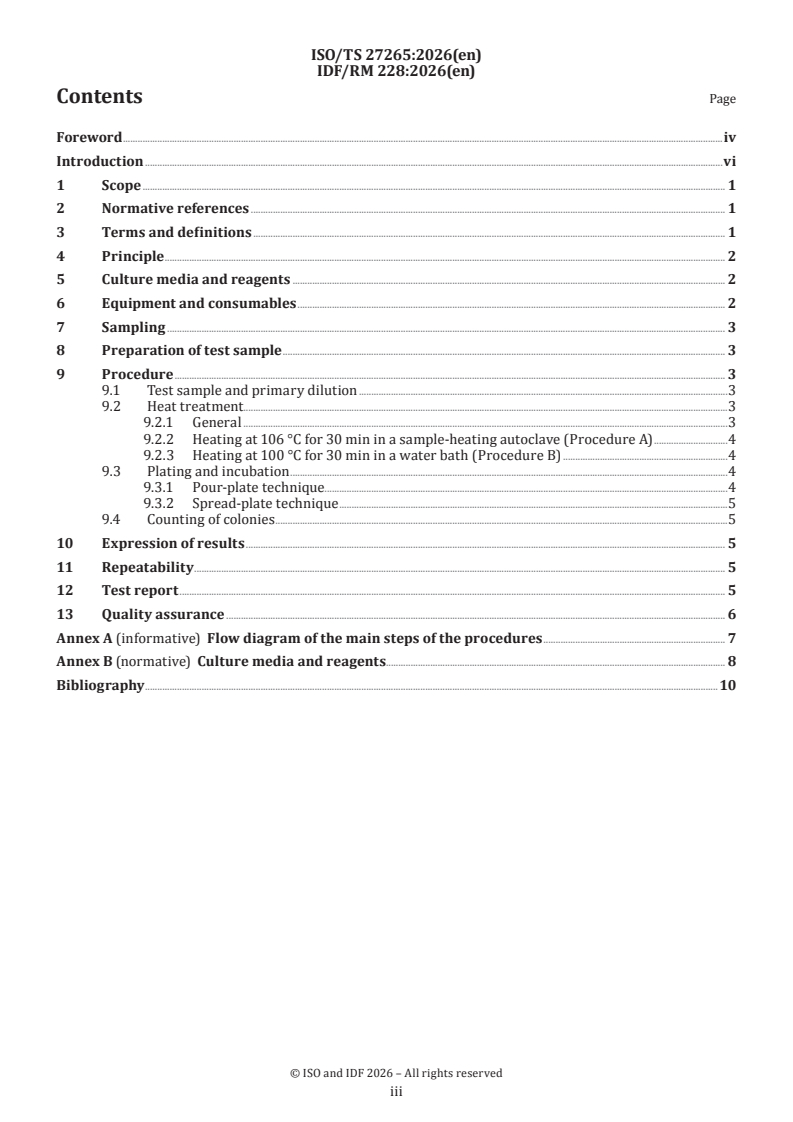
Contents Page
Foreword .iv
Introduction .vi
1 Scope . 1
2 Normative references . 1
3 Terms and definitions . 1
4 P r i nc iple . 2
5 Culture media and reagents . 2
6 Equipment and consumables . 2
7 Sampling . 3
8 Preparation of test sample . 3
9 Procedure . 3
9.1 Test sample and primary dilution .3
9.2 Heat treatment.3
9.2.1 General .3
9.2.2 Heating at 106 °C for 30 min in a sample-heating autoclave (Procedure A) .4
9.2.3 Heating at 100 °C for 30 min in a water bath (Procedure B) .4
9.3 Plating and incubation .4
9.3.1 Pour-plate technique.4
9.3.2 Spread-plate technique .5
9.4 Counting of colonies .5
10 Expression of results . 5
11 Repeatability . 5
12 Test report . 5
13 Quality assurance . 6
Annex A (informative) Flow diagram of the main steps of the procedures . 7
Annex B (normative) Culture media and reagents . 8
Bibliography .10
iii
IDF/RM 228:2026(en)
Foreword
ISO (the International Organization for Standardization) is a worldwide federation of national standards
bodies (ISO member bodies). The work of preparing International Standards is normally carried out through
ISO technical committees. Each member body interested in a subject for which a technical committee
has been established has the right to be represented on that committee. International organizations,
governmental and non-governmental, in liaison with ISO, also take part in the work. ISO collaborates closely
with the International Electrotechnical Commission (IEC) on all matters of electrotechnical standardization.
The procedures used to develop this document and those intended for its further maintenance are described
in the ISO/IEC Directives, Part 1. In particular, the different approval criteria needed for the different types
of ISO document should be noted. This document was drafted in accordance with the editorial rules of the
ISO/IEC Directives, Part 2 (see www.iso.org/directives).
ISO draws attention to the possibility that the implementation of this document may involve the use of (a)
patent(s). ISO takes no position concerning the evidence, validity or applicability of any claimed patent
rights in respect thereof. As of the date of publication of this document, ISO had not received notice of (a)
patent(s) which may be required to implement this document. However, implementers are cautioned that
this may not represent the latest information, which may be obtained from the patent database available at
www.iso.org/patents. ISO shall not be held responsible for identifying any or all such patent rights.
Any trade name used in this document is information given for the convenience of users and does not
constitute an endorsement.
For an explanation of the voluntary nature of standards, the meaning of ISO specific terms and expressions
related to conformity assessment, as well as information about ISO’s adherence to the World Trade
Organization (WTO) principles in the Technical Barriers to Trade (TBT), see www.iso.org/iso/foreword.html.
This document was prepared by Technical Committee ISO/TC 34, Food products, Subcommittee SC 5, Milk
and milk products, and the International Dairy Federation (IDF). It is being published jointly by ISO and IDF.
This second edition cancels and replaces the first edition (ISO/TS 27265 | IDF/RM 228:2009), which has
been technically revised.
The main changes are as follows:
— Addition of an alternative water bath heating procedure at 100 °C for 30 min to provide a more feasible
approach and to improve the uniformity of analysis among different laboratories.
— Annex C on modification of pressure cooker for performing the thermophilic spore test has been deleted.
Any feedback or questions on this document should be directed to the user’s national standards body. A
complete listing of these bodies can be found at www.iso.org/members.html.
iv
IDF/RM 228:2026(en)
IDF (the International Dairy Federation) is a non-profit private sector organization representing the
interests of various stakeholders in dairying at the global level. IDF members are organized in National
Committees, which are national associations composed of representatives of dairy-related national interest
groups including dairy farmers, dairy processing industry, dairy suppliers, academics and governments/
food control authorities.
ISO and IDF collaborate closely on all matters of standardization relating to methods of analysis and
sampling for milk and milk products. Since 2001, ISO and IDF jointly publish their International Standards
using the logos and reference numbers of both organizations.
IDF draws attention to the possibility that the implementation of this document may involve the use of (a)
patent(s). IDF takes no position concerning the evidence, validity or applicability of any claimed patent
rights in respect thereof. As of the date of publication of this document, IDF had not received notice of (a)
patent(s) which may be required to implement this document. However, implementers are cautioned that
this may not represent the latest information, which may be obtained from the patent database available at
www.iso.org/patents. IDF shall not be held responsible for identifying any or all such patent rights.
Any trade name used in this document is information given for the convenience of users and does not
constitute an endorsement.
This document was prepared by the IDF Standing Committee on Methods for Dairy Microbiology and
ISO Technical Committee ISO/TC 34, Food products, Subcommittee SC 5, Milk and milk products. It is being
published jointly by ISO and IDF.
The work was carried out by the IDF/ISO Action Team H28 of the Standing Committee on Methods for Dairy
Microbiology under the aegis of its project leader Haiping Li (US).
v
IDF/RM 228:2026(en)
Introduction
Bacterial spores are ubiquitous in the environment and are highly resistant to many stress factors (e.g.
heat). Thermoresistant spores can contaminate dairy products via raw milk, biofilms on equipment surfaces
(milking, transportation, and processing), ingredients, or water, etc. Survival of thermoresistant spores
primarily pose quality risks to dairy products and the public health.
Spore enumeration methods are critical for controlling possible risks and reducing economic loss in dairy
manufacturing.
The main technical changes listed in the Foreword, introduced in this document compared to ISO/TS 27265 |
IDF/RM 228:2009, are considered as minor (see ISO 17468).
These technical changes in Procedure A (see Clause 4) have a minor impact on the performance
characteristics of the method.
NOTE Procedure B (see Clause 4) was not included in the first edition of this document.
vi
Technical Specification
IDF/RM 228:2026(en)
Heat-processed milk and dried milk products — Enumeration
of thermoresistant spores of thermophilic bacteria
1 Scope
This document specifies methods for the enumeration of thermoresistant spores of thermophilic bacteria
in heat-processed milk and dried milk products by using a colony-count technique at 55 °C after heating the
sample at 106 °C or 100 °C.
The applicability of this document is limited to heat-processed milk including pasteurized, ultra-high
temperature (UHT) processed and sterilized milk; as well as dried whole milk, skim milk, buttermilk and
whey products.
2 Normative references
The following documents are referred to in the text in such a way that some or all of their content constitutes
requirements of this document. For dated references, only the edition cited applies. For undated references,
the latest edition of the referenced document (including any amendments) applies.
ISO 6887-1, Microbiology of the food chain — Preparation of test samples, initial suspension and decimal
dilutions for microbiological examination — Part 1: General rules for the preparation of the initial suspension
and decimal dilutions
ISO 6887-5, Microbiology of the food chain — Preparation of test samples, initial suspension and decimal
dilutions for microbiological examination — Part 5: Specific rules for the preparation of milk and milk products
ISO 7218, Microbiology of the food chain — General requirements and guidance for microbiological examinations
ISO 11133, Microbiology of food, animal feed and water — Preparation, production, storage and performance
testing of culture media
3 Terms and definitions
For the purposes of this document, the following terms and definitions apply.
ISO and IEC maintain terminological databases for use in standardization at the following addresses:
— ISO Online browsing platform: available at https:// www .iso .org/ obp
— IEC Electropedia: available at https:// www .electropedia .org/
3.1
thermoresistant spores of thermophilic bacteria
bacterial spores surviving a heat treatment of 106 °C for 30 min or 100 °C for 30 min and able to germinate
and form colonies aerobically at 55 °C in a non-selective medium under specific conditions
Note 1 to entry: Specific conditions are given in Clause 9.
IDF/RM 228:2026(en)
4 Principle
A specified quantity of the test sample (liquid) or an initial suspension of the test sample is heat-treated at
[5]
106 °C for 30 min or 100 °C for 30 min to destroy vegetative cells and to activate the spores. A specified
quantity of the heat-treated sample is mixed with melted non-selective bromocresol purple (BCP) pour plate
agar to prepare the poured Petri dishes. Spread plates may be prepared under the same conditions, using
decimal dilutions of the heat-treated sample. The dishes are incubated aerobically at 55 °C for 48 h.
The number of cfu of thermoresistant spores of thermophilic bacteria per gram of product is calculated from
the number of colonies on dishes chosen at dilution levels (see ISO 7218).
The thermoresistant spores of thermophilic bacteria enumerated by this method using heat treatment at
106 °C for 30 min (this is Procedure A, see 9.2.2) or 100 °C for 30 min (this is Procedure B, see 9.2.3) and
incubation of the plates at 55 °C, have the potential to survive commercial sterilization processes (e.g. UHT
or sterilized milk). Counts obtained by the two heating procedures are not equivalent, and the variations
of results due to the two different heating procedures are denoted with Procedure A and Procedure B,
respectively, in the test report (see Clause 12).
The flow diagram of the main steps of the procedures is given in Annex A.
When the method is applied at high altitude, where water boils at, for example, 95 °C, a pressure pan or oil
bath should be used to ensure a boiling temperature of 100 °C.
5 Culture media and reagents
Follow good laboratory practices in accordance with ISO 7218. The composition of the culture media and
reagents and their preparation are specified in Annex B. For performance testing of culture media, follow
the procedures in accordance with Annex B and ISO 11
...