


ISO/TS 44005
(Main)Collaborative business relationship management system — Guidance on leadership for collaborative working
Collaborative business relationship management system — Guidance on leadership for collaborative working
This International Technical Specification gives guidance for leaders at all levels within organizations, large or small, who are seeking to engage in collaborative ventures to enhance performance of relationships working across operational boundaries. This standard is applicable to the organizations that can be autonomous, geographically distributed, and heterogeneous in terms of their operating environment, culture, social capital and objectives
Système de management collaboratif des relations d'affaires — Recommandations en matière de leadership pour le travail collaboratif
General Information
- Status
- Not Published
- Technical Committee
- ISO/TC 286 - Collaborative business relationship management
- Drafting Committee
- ISO/TC 286 - Collaborative business relationship management
- Current Stage
- 6000 - International Standard under publication
- Start Date
- 03-Apr-2026
- Completion Date
- 11-Apr-2026
Overview
ISO/TS 44005:2026 offers structured guidance for leadership at all organizational levels seeking to develop effective collaborative business relationships. Published by the International Organization for Standardization (ISO), this technical specification supports leaders of both large and small organizations-whether autonomous, geographically distributed, or operating across diverse cultures and objectives. The guidance helps leaders enable successful collaborations across operational boundaries, ensuring enhanced performance and sustainable partnerships. ISO/TS 44005 aligns with the structure and intent of ISO 44001, which provides the requirements and framework for collaborative business relationship management systems.
Key Topics
- Leadership in Collaborative Ventures: Stresses the importance of leadership in creating, maintaining, and optimizing collaborative business relationships, emphasizing leadership activities at all organizational levels-not just senior management.
- Ethos of Collaboration: Highlights the need for a collaborative culture, balancing traditional leadership roles with the unique demands of working across organizations and cultures.
- Relationship Management Lifecycle: Follows the relationship life cycle from establishing context, planning, operational control, and performance assessment through to improvement, embedding leadership guidance at each stage.
- Organizational Context: Guides leaders to recognize the importance of stakeholder engagement, social capital, organizational values, and compatibility when shaping collaborative initiatives.
- Risk, Awareness, & Communication: Advises on assessing and managing risks, building operational awareness, and deploying effective communication strategies to foster engagement and trust.
- Evaluation & Improvement: Encourages continual assessment of collaborative arrangements and adaptation of leadership approaches to agree on shared objectives, address risks, and achieve mutual benefits.
Applications
ISO/TS 44005 is practical for:
- Transforming Leadership Approaches: Assists both traditional and emerging leaders in resetting leadership styles to support collaborative working, not just hierarchical control.
- Cross-Functional Operations: Equips project and program leaders in multi-organizational ventures or supply chains to tackle the complexity of integrating systems, processes, and people from diverse organizational backgrounds.
- Global & Distributed Teams: Supports distributed, virtual, or multicultural teams by encouraging adaptable leadership practices that bridge cultural and geographic differences.
- Strategic Partnering & Alliances: Provides principles to guide the integration and management of joint ventures, partnerships, strategic alliances, and outsourcing arrangements.
- Policy & Process Alignment: Helps organizations embed collaborative values and behaviors within their policies, processes, and performance frameworks, ensuring alignment with partners and stakeholders.
- Risk Management in Collaboration: Offers methods to identify, assess, and mitigate risks arising from collaborative ventures, supporting resilience and continuity.
Related Standards
- ISO 44001:2017 – Collaborative Business Relationship Management Systems: The foundational framework for implementing collaborative business relationship management.
- ISO 44002:2019 – Collaborative Business Relationship Management Guidelines: Provides further guidance on the practical implementation of ISO 44001.
- ISO/IEC Directives: Editorial and procedural guides for the drafting and maintenance of ISO standards.
Practical Value
Implementing ISO/TS 44005 enables organizations to:
- Build a culture of trust and transparency, vital for successful collaborative relationships.
- Facilitate communication and engagement across boundaries, driving innovation and sustained value creation.
- Align organizational objectives, values, and behaviors, minimizing friction in cross-boundary operations.
- Enhance strategic planning and operational effectiveness by integrating leadership at every stage of the relationship lifecycle.
- Support continual improvement and long-term success in complex, dynamic business environments.
For organizations committed to excellence in collaborative efforts, ISO/TS 44005 is an essential leadership guide for unlocking the full potential of partnerships and alliances.
Buy Documents

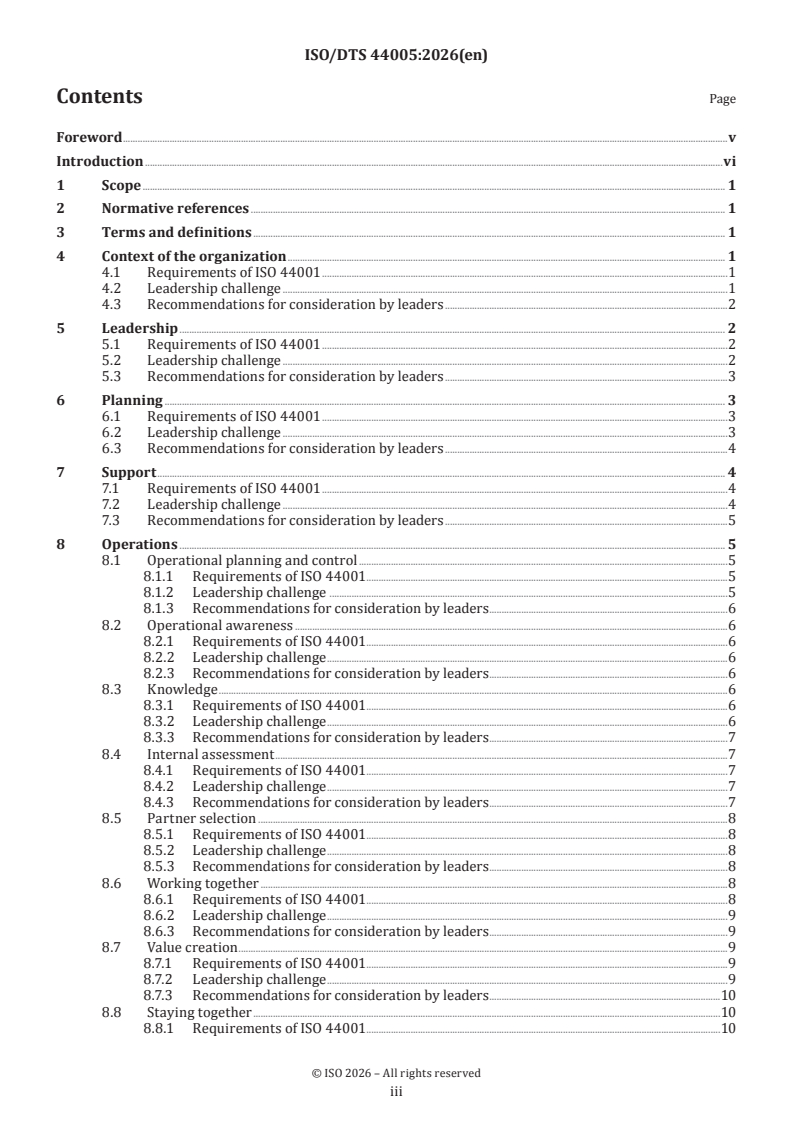

ISO/DTS 44005 - Collaborative business relationship management system — Guidance on leadership for collaborative working Released:22. 01. 2026
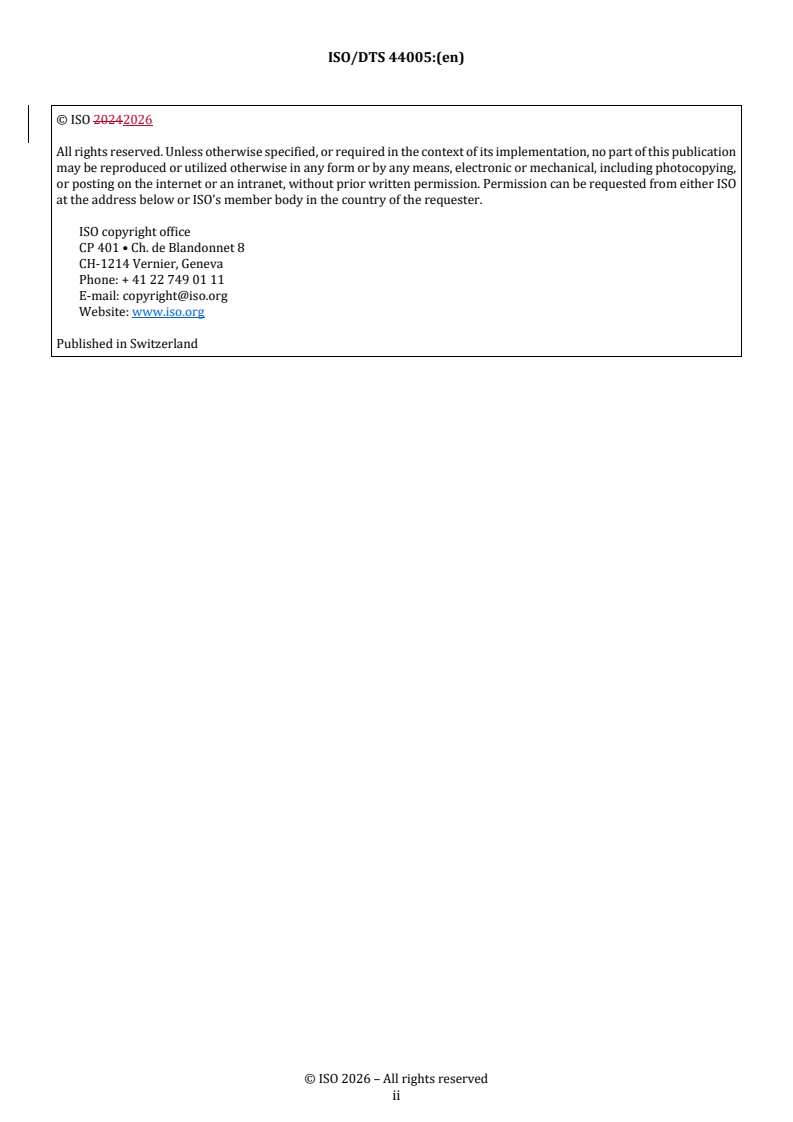
REDLINE ISO/DTS 44005 - Collaborative business relationship management system — Guidance on leadership for collaborative working Released:22. 01. 2026
Get Certified
Connect with accredited certification bodies for this standard

BSI Group
BSI (British Standards Institution) is the business standards company that helps organizations make excellence a habit.

Bureau Veritas
Bureau Veritas is a world leader in laboratory testing, inspection and certification services.

DNV
DNV is an independent assurance and risk management provider.
Sponsored listings
Frequently Asked Questions
ISO/TS 44005 is a draft published by the International Organization for Standardization (ISO). Its full title is "Collaborative business relationship management system — Guidance on leadership for collaborative working". This standard covers: This International Technical Specification gives guidance for leaders at all levels within organizations, large or small, who are seeking to engage in collaborative ventures to enhance performance of relationships working across operational boundaries. This standard is applicable to the organizations that can be autonomous, geographically distributed, and heterogeneous in terms of their operating environment, culture, social capital and objectives
This International Technical Specification gives guidance for leaders at all levels within organizations, large or small, who are seeking to engage in collaborative ventures to enhance performance of relationships working across operational boundaries. This standard is applicable to the organizations that can be autonomous, geographically distributed, and heterogeneous in terms of their operating environment, culture, social capital and objectives
ISO/TS 44005 is classified under the following ICS (International Classification for Standards) categories: 03.100.02 - Governance and ethics. The ICS classification helps identify the subject area and facilitates finding related standards.
ISO/TS 44005 is available in PDF format for immediate download after purchase. The document can be added to your cart and obtained through the secure checkout process. Digital delivery ensures instant access to the complete standard document.
Standards Content (Sample)
FINAL DRAFT
Technical
Specification
ISO/DTS 44005
ISO/TC 286
Collaborative business relationship
Secretariat: BSI
management system — Guidance
Voting begins on:
on leadership for collaborative
2026-02-05
working
Voting terminates on:
2026-04-02
RECIPIENTS OF THIS DRAFT ARE INVITED TO SUBMIT,
WITH THEIR COMMENTS, NOTIFICATION OF ANY
RELEVANT PATENT RIGHTS OF WHICH THEY ARE AWARE
AND TO PROVIDE SUPPOR TING DOCUMENTATION.
IN ADDITION TO THEIR EVALUATION AS
BEING ACCEPTABLE FOR INDUSTRIAL, TECHNO
LOGICAL, COMMERCIAL AND USER PURPOSES, DRAFT
INTERNATIONAL STANDARDS MAY ON OCCASION HAVE
TO BE CONSIDERED IN THE LIGHT OF THEIR POTENTIAL
TO BECOME STAN DARDS TO WHICH REFERENCE MAY BE
MADE IN NATIONAL REGULATIONS.
Reference number
ISO/DTS 44005:2026(en) © ISO 2026
FINAL DRAFT
ISO/DTS 44005:2026(en)
Technical
Specification
ISO/DTS 44005
ISO/TC 286
Collaborative business relationship
Secretariat: BSI
management system — Guidance
Voting begins on:
on leadership for collaborative
working
Voting terminates on:
RECIPIENTS OF THIS DRAFT ARE INVITED TO SUBMIT,
WITH THEIR COMMENTS, NOTIFICATION OF ANY
RELEVANT PATENT RIGHTS OF WHICH THEY ARE AWARE
AND TO PROVIDE SUPPOR TING DOCUMENTATION.
© ISO 2026
IN ADDITION TO THEIR EVALUATION AS
All rights reserved. Unless otherwise specified, or required in the context of its implementation, no part of this publication may
BEING ACCEPTABLE FOR INDUSTRIAL, TECHNO
LOGICAL, COMMERCIAL AND USER PURPOSES, DRAFT
be reproduced or utilized otherwise in any form or by any means, electronic or mechanical, including photocopying, or posting on
INTERNATIONAL STANDARDS MAY ON OCCASION HAVE
the internet or an intranet, without prior written permission. Permission can be requested from either ISO at the address below
TO BE CONSIDERED IN THE LIGHT OF THEIR POTENTIAL
or ISO’s member body in the country of the requester.
TO BECOME STAN DARDS TO WHICH REFERENCE MAY BE
MADE IN NATIONAL REGULATIONS.
ISO copyright office
CP 401 • Ch. de Blandonnet 8
CH-1214 Vernier, Geneva
Phone: +41 22 749 01 11
Email: copyright@iso.org
Website: www.iso.org
Published in Switzerland Reference number
ISO/DTS 44005:2026(en) © ISO 2026
ii
ISO/DTS 44005:2026(en)
Contents Page
Foreword .v
Introduction .vi
1 Scope . 1
2 Normative references . 1
3 Terms and definitions . 1
4 Context of the organization . 1
4.1 Requirements of ISO 44001 .1
4.2 Leadership challenge .1
4.3 Recommendations for consideration by leaders .2
5 Leadership . 2
5.1 Requirements of ISO 44001 .2
5.2 Leadership challenge .2
5.3 Recommendations for consideration by leaders .3
6 Planning . 3
6.1 Requirements of ISO 44001 .3
6.2 Leadership challenge .3
6.3 Recommendations for consideration by leaders .4
7 Support . 4
7.1 Requirements of ISO 44001 .4
7.2 Leadership challenge .4
7.3 Recommendations for consideration by leaders .5
8 Operations . 5
8.1 Operational planning and control .5
8.1.1 Requirements of ISO 44001 .5
8.1.2 Leadership challenge .5
8.1.3 Recommendations for consideration by leaders .6
8.2 Operational awareness .6
8.2.1 Requirements of ISO 44001 .6
8.2.2 Leadership challenge .6
8.2.3 Recommendations for consideration by leaders .6
8.3 Knowledge .6
8.3.1 Requirements of ISO 44001 .6
8.3.2 Leadership challenge .6
8.3.3 Recommendations for consideration by leaders .7
8.4 Internal assessment .7
8.4.1 Requirements of ISO 44001 .7
8.4.2 Leadership challenge .7
8.4.3 Recommendations for consideration by leaders .7
8.5 Partner selection .8
8.5.1 Requirements of ISO 44001 .8
8.5.2 Leadership challenge .8
8.5.3 Recommendations for consideration by leaders .8
8.6 Working together .8
8.6.1 Requirements of ISO 44001 .8
8.6.2 Leadership challenge .9
8.6.3 Recommendations for consideration by leaders .9
8.7 Value creation .9
8.7.1 Requirements of ISO 44001 .9
8.7.2 Leadership challenge .9
8.7.3 Recommendations for consideration by leaders .10
8.8 Staying together .10
8.8.1 Requirements of ISO 44001 .10
iii
ISO/DTS 44005:2026(en)
8.8.2 Leadership challenge .10
8.8.3 Recommendations for consideration by leaders .11
8.9 Exit strategy activation .11
8.9.1 Requirements of ISO 44001 .11
8.9.2 Leadership challenge .11
8.9.3 Recommendations for consideration by leaders .11
9 Performance .12
10 Improvement .12
Bibliography .13
iv
ISO/DTS 44005:2026(en)
Foreword
ISO (the International Organization for Standardization) is a worldwide federation of national standards
bodies (ISO member bodies). The work of preparing International Standards is normally carried out through
ISO technical committees. Each member body interested in a subject for which a technical committee
has been established has the right to be represented on that committee. International organizations,
governmental and non-governmental, in liaison with ISO, also take part in the work. ISO collaborates closely
with the International Electrotechnical Commission (IEC) on all matters of electrotechnical standardization.
The procedures used to develop this document and those intended for its further maintenance are described
in the ISO/IEC Directives, Part 1. In particular, the different approval criteria needed for the different types
of ISO document should be noted. This document was drafted in accordance with the editorial rules of the
ISO/IEC Directives, Part 2 (see www.iso.org/directives).
ISO draws attention to the possibility that the implementation of this document may involve the use of (a)
patent(s). ISO takes no position concerning the evidence, validity or applicability of any claimed patent
rights in respect thereof. As of the date of publication of this document, ISO had not received notice of (a)
patent(s) which may be required to implement this document. However, implementers are cautioned that
this may not represent the latest information, which may be obtained from the patent database available at
www.iso.org/patents. ISO shall not be held responsible for identifying any or all such patent rights.
Any trade name used in this document is information given for the convenience of users and does not
constitute an endorsement.
For an explanation of the voluntary nature of standards, the meaning of ISO specific terms and expressions
related to conformity assessment, as well as information about ISO’s adherence to the World Trade
Organization (WTO) principles in the Technical Barriers to Trade (TBT), see www.iso.org/iso/foreword.html.
This document was prepared by Technical Committee ISO/TC 286, Collaborative business relationship
management.
Any feedback or questions on this document should be directed to the user’s national standards body. A
complete listing of these bodies can be found at www.iso.org/members.html.
v
ISO/DTS 44005:2026(en)
Introduction
Dynamic leadership is a key facet of every successful business venture. In the context of managing any
partnering, alliance or collaborative programme, where the delivery process bridges organizational
boundaries, the role of the leadership is even more crucial. Developing an effective operational focus is a
challenge in most business environments, but where the traditional command and control structure needs
to embrace cross-functional operations between organizations, the coordination and direction of the
venture is even more complex, and motivation and influence become vital to success.
With respect to this document, it is important to distinguish the term “leadership” as an activity and as a
characteristic of leaders. The term “leaders” is more commonly associated with senior management who,
while having an important role in any collaborative arrangement, leadership activities cascade through in
every level in an organization or in diverse operational teams.
In the context of collaborative relationship, the role of leaders is crucial to developing and maintaining
the ethos of collaboration and establishing the environment where it can prosper. It is equally important
to understand the dynamics both internal and external when multiple organizations are merged together,
which can create tensions where operating processes and systems can overlap or interact.
A collaborative culture is both a consequence of the wider business environment within which an
organization operates and a construct of the way it is organized and operated. The external aspect is
partially beyond the control of business leaders; other than in understanding the organization’s visions
and values, its strategic objectives and direction can be selective. In understanding the desired direction
and drivers, the leadership can take steps to refocus their traditional culture and improve their ability to
function more effectively in areas where opportunities do or can exist. Understanding the cultural picture
(whether national, regional, corporate or organizational) helps build confidence to expand the degree of
interaction, with the aim of creating longer-term relationships that are mutually beneficial.
The management system standard ISO 44001 provides a framework to support and develop collaborative
business relationships, including the key requirements for maintaining relationships over time. This
document highlights and reinforces the importance of leadership and the role of leaders within each stage of
the relationship life cycle. The structure of this document therefore follows the structure of the framework.
This document uses a common approach, as follows:
— Requirements of ISO 44001: The requirements of ISO 44001 that this document addresses.
— Leadership challenge: An explanation of how this differs from traditional leadership.
— Recommendations for consideration by leaders.
vi
FINAL DRAFT Technical Specification ISO/DTS 44005:2026(en)
Collaborative business relationship management system —
Guidance on leadership for collaborative working
1 Scope
This document gives guidance for leaders operating in collaborative arrangements in alignment with the
structure of ISO 44001.
2 Normative references
The following documents are referred to in the text in such a way that some or all of their content constitutes
requirements of this document. For dated references, only the edition cited applies. For undated references,
the latest edition of the referenced document (including any amendments) applies.
ISO 44001, Collaborative business relationship management systems — Requirements and framework
3 Terms and definitions
For the purposes of this document, the terms and definitions given in ISO 44001 and the following apply.
ISO and IEC maintain terminology databases for use in standardization at the following addresses:
— ISO Online browsing platform: available at https:// www .iso .org/ obp
— IEC Electropedia: available at https:// www .electropedia .org/
3.1
the leadership
executive/senior management responsible for establishing a collaborative culture and operation of
collaborative working activities
3.2
leader
people at any level who are charged with implementing collaborative activities
3.3
leadership
style of working including actions and activities required to ensure effective collaborative working
4 Context of the organization
4.1 Requirements of ISO 44001
The requirements include elements addressing the overall context of the organization, including interested
party engagement, the scope of collaborative activities, systems and organizational values.
4.2 Leadership challenge
Relationships are key to business success, so it is unrealistic to assume that such a critical aspect can be
left to chance. It is important to understand that while organizations can try to project a persona, they are
made up of people and are thus partially dependent on their people. Relationships cannot be left to rely
on osmosis, attrition or inaction to develop the appropriate behaviours to support that ethos and culture.
ISO/DTS 44005:2026(en)
Leaders should strive to embed both structure and collaborative leadership in order to exploit the potential
benefits.
Successful leadership has always relied on an individual’s ability to articulate their vision and intent to those
charged with delivering outcomes. Charismatic leaders can inspire the people around them and under their
direction. In world of diversified, even fragmented organizations, the implications that can emerge from
outside the directly linked participants can be equally damaging. With the proliferation of communications
and technology there is the opportunity to harness these for wider reach, but there is also the potential for
negative influences to gain momentum and become major obstacles to success and reputations. As leaders
seek to drive collaborative enterprises in an integrated world, the more traditional aspects of interested
party management should be re-evaluated and developed.
4.3 Recommendations for consideration by leaders
In relation to the context of the organization, leaders should:
— raise the profile and importance of relationships across the organization;
— identify the values and principles of the organization that have the possibility of being compromised by
association;
— recognize that systems and processes do not replace people’s individual character and ambitions;
— place greater emphasis on embracing the impact of relationships to drive success;
— understand the whole interested party community and not simply the supporters and potential blockers,
as collaborative relationships can have many influencers based on diversity and culture;
— identify those that see collaborative working as an opportunity and those who can potentially have
significant reservations;
— develop strategies to facilitate understanding and engagement;
— implement a robust communications strategy and plan to ensure that engagement is sustained;
— develop high trust culture as an imperative for collaborative organizations;
— emphasis soft skills as essential for leading change and collaboration in a multi-generational workforce.
5 Leadership
5.1 Requirements of ISO 44001
The leadership requirements include validation of the commitment to collaborative working, establishment
of policies, definition of roles and responsibilities, allocation of authorities and accountability, appointment
of a senior executive responsible (SER) and effective governance.
5.2 Leadership challenge
Effective leaders should recognize that their role is to be the advocate of the collaboration within their own
organizations, which can often be in conflict with internal structures. Making the shift from a traditional
hierarchical relationship to co-creators often demands both organizational and personal realignment of
thinking and approaches. Effective leadership should operate not from a position of power but from the
ability to influence and inspire, while having an understanding of their relative power. The most successful
leadership will take its strength from being able to draw parties together and create solutions that use the
full potential to optimize performance to produce outcomes which cannot be achieved in isolation.
The role of leadership in this collaborative environment is more complex than for traditional organizations.
Not only does it have to meet the normal demands of team building and motivation, but also, in a virtual
context, this must be achieved against the variable background of time, power, distance and cultural
ISO/DTS 44005:2026(en)
diversity. This demands creative leaders with the ability to establish the visions and values that will support
a collaborative arrangement.
Leadership styles should differ, depending on circumstances: in a crisis an urgent decision-maker is
needed, in a stable state consistency of direction is required, and future development requires a visionary
perspective. This is a challenging combination to find where hierarchical structures fail to provide the
agility and flexibility needed to optimize the effectiveness of interdependent critical operations and build
environments where the benefits of collaboration can be harnessed and exploited.
5.3 Recommendations for consideration by leaders
In relation to leadership, leaders should:
— place greater emphasis on embracing the impact of relationships to drive success;
— establish the values by which the organization will govern its performance and operations; these will
likely influence any strategic developments;
— ensure these values are embedded in the organization at every level and are reflected in decision-
making and behaviours both internally and externally;
— develop a business strategy that recognizes the global implications and embraces the opportunities
which can come from adopting collaborative approaches and where external relationships can
compromise the organization’s values;
— understand their own strengths and weaknesses and how these are reflected in the leadership style
that is required to harness collaborative working;
— lead by example and consider how best to motivate those around them;
— be careful not to encourage or
...
ISO/DIS TSDTS 44005 (E)
First edition
ISO/TC 286
Secretariat: BSI
th
Date: 07 November 2026-01-21
Draft 5
Collaborative business relationship management system —
GuidelinesGuidance on leadership for collaborative working
ISO/DTS 44005:(en)
All rights reserved. Unless otherwise specified, or required in the context of its implementation, no part of this publication
may be reproduced or utilized otherwise in any form or by any means, electronic or mechanical, including photocopying,
or posting on the internet or an intranet, without prior written permission. Permission can be requested from either ISO
at the address below or ISO’s member body in the country of the requester.
ISO copyright office
CP 401 • Ch. de Blandonnet 8
CH-1214 Vernier, Geneva
Phone: + 41 22 749 01 11
E-mail: copyright@iso.org
Website: www.iso.org
Published in Switzerland
ii
ISO/DTS 44005:(en)
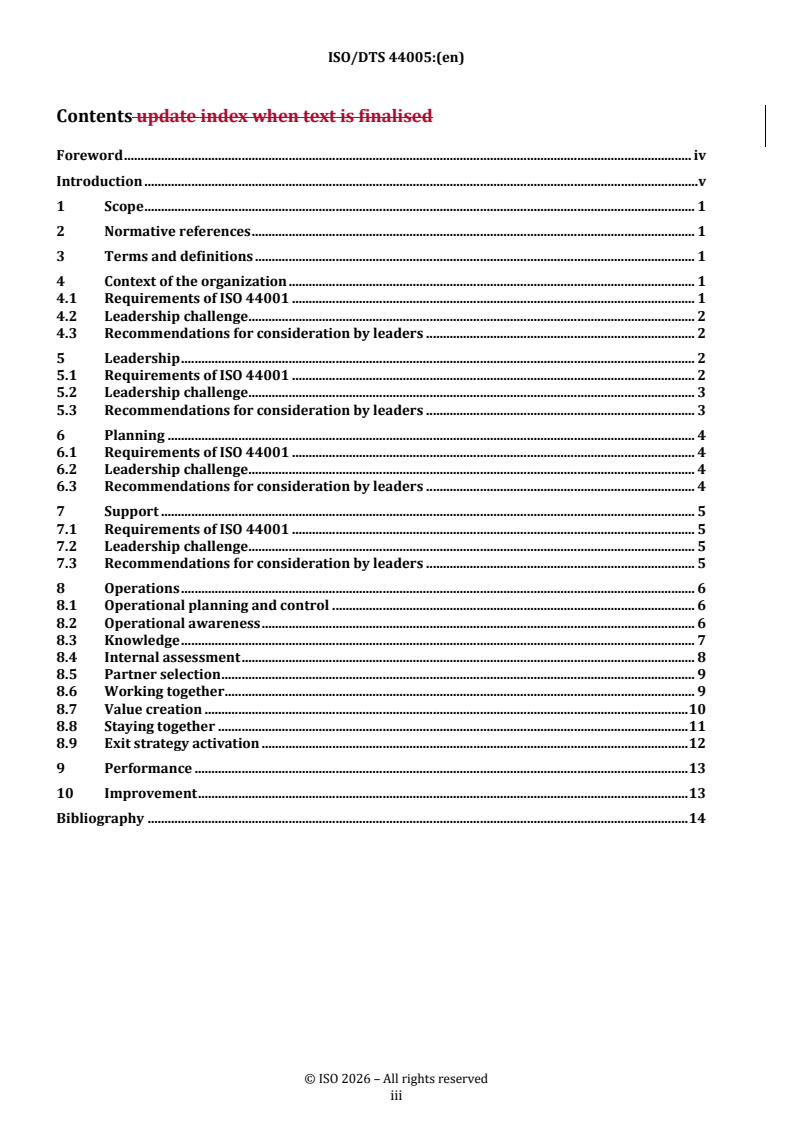
Contents update index when text is finalised
Foreword . iv
Introduction . v
1 Scope . 1
2 Normative references . 1
3 Terms and definitions . 1
4 Context of the organization . 1
4.1 Requirements of ISO 44001 . 1
4.2 Leadership challenge . 2
4.3 Recommendations for consideration by leaders . 2
5 Leadership . 2
5.1 Requirements of ISO 44001 . 2
5.2 Leadership challenge . 3
5.3 Recommendations for consideration by leaders . 3
6 Planning . 4
6.1 Requirements of ISO 44001 . 4
6.2 Leadership challenge . 4
6.3 Recommendations for consideration by leaders . 4
7 Support . 5
7.1 Requirements of ISO 44001 . 5
7.2 Leadership challenge . 5
7.3 Recommendations for consideration by leaders . 5
8 Operations . 6
8.1 Operational planning and control . 6
8.2 Operational awareness . 6
8.3 Knowledge . 7
8.4 Internal assessment . 8
8.5 Partner selection . 9
8.6 Working together . 9
8.7 Value creation . 10
8.8 Staying together . 11
8.9 Exit strategy activation . 12
9 Performance . 13
10 Improvement . 13
Bibliography . 14
iii
ISO/DTS 44005:(en)
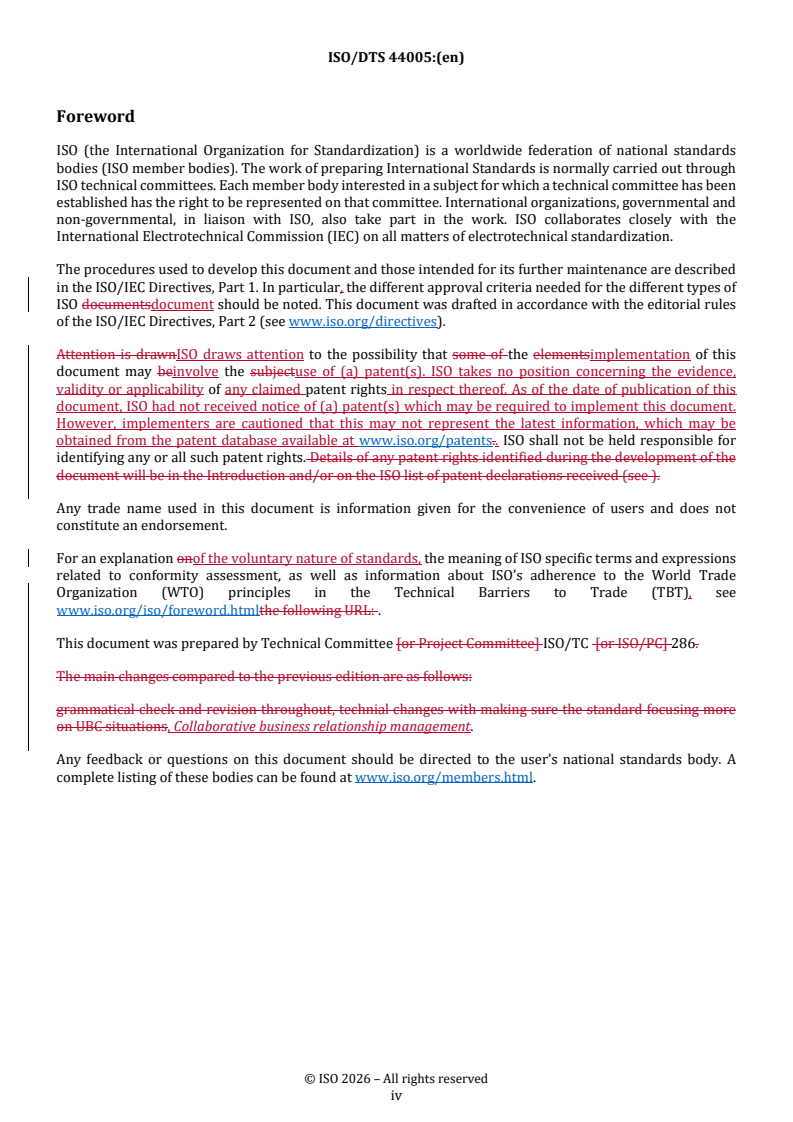
Foreword
ISO (the International Organization for Standardization) is a worldwide federation of national standards
bodies (ISO member bodies). The work of preparing International Standards is normally carried out through
ISO technical committees. Each member body interested in a subject for which a technical committee has been
established has the right to be represented on that committee. International organizations, governmental and
non-governmental, in liaison with ISO, also take part in the work. ISO collaborates closely with the
International Electrotechnical Commission (IEC) on all matters of electrotechnical standardization.
The procedures used to develop this document and those intended for its further maintenance are described
in the ISO/IEC Directives, Part 1. In particular, the different approval criteria needed for the different types of
ISO documentsdocument should be noted. This document was drafted in accordance with the editorial rules
of the ISO/IEC Directives, Part 2 (see www.iso.org/directives).
Attention is drawnISO draws attention to the possibility that some of the elementsimplementation of this
document may beinvolve the subjectuse of (a) patent(s). ISO takes no position concerning the evidence,
validity or applicability of any claimed patent rights in respect thereof. As of the date of publication of this
document, ISO had not received notice of (a) patent(s) which may be required to implement this document.
However, implementers are cautioned that this may not represent the latest information, which may be
obtained from the patent database available at www.iso.org/patents. ISO shall not be held responsible for
identifying any or all such patent rights. Details of any patent rights identified during the development of the
document will be in the Introduction and/or on the ISO list of patent declarations received (see ).
Any trade name used in this document is information given for the convenience of users and does not
constitute an endorsement.
For an explanation onof the voluntary nature of standards, the meaning of ISO specific terms and expressions
related to conformity assessment, as well as information about ISO’s adherence to the World Trade
Organization (WTO) principles in the Technical Barriers to Trade (TBT), see
www.iso.org/iso/foreword.htmlthe following URL: .
This document was prepared by Technical Committee [or Project Committee] ISO/TC [or ISO/PC] 286.
The main changes compared to the previous edition are as follows:
grammatical check and revision throughout, technial changes with making sure the standard focusing more
on UBC situations, Collaborative business relationship management.
Any feedback or questions on this document should be directed to the user’s national standards body. A
complete listing of these bodies can be found at www.iso.org/members.html.
iv
ISO/DTS 44005:(en)
Introduction
Dynamic leadership is a key facet of every successful business venture. In the context of managing any
partnering, alliance or collaborative programme, where the delivery process bridges organizational
boundaries, the role of the leadership is even more crucial. Developing an effective operational focus is a
challenge in most business environments, but where the traditional command and control structure needs to
embrace cross-functional operations between organizations, the coordination and direction of the venture is
even more complex, and motivation and influence become vital to success.
With respect to these guidelinesthis document, it is important to distinguish the term “leadership” as an
activity and as a characteristic of leaders. The term “leaders” is more commonly associated with senior
management who whilst, while having an important role in any collaborative arrangement, leadership
activities cascade through in every level in an organization or in diverse operational teams.
In the context of collaborative relationship, the role of leaders is crucial to developing and maintaining the
ethos of collaboration and establishing the environment where it can prosper. It is equally important to
understand the dynamics both internal and external when multiple organizations are merged together, which
can create tensions where operating processes and systems maycan overlap or interact.
A collaborative culture is both a consequence of the wider business environment within which an organization
operates and a construct of the way it is organized and operated. The external aspect is partially beyond the
control of business leaders; other than in understanding the organization’s visions and values, its strategic
objectives and direction can be selective. In understanding the desired direction and drivers, the leadership
can take steps to refocus their traditional culture and improve their ability to function more effectively in areas
where opportunities do or maycan exist. Understanding the cultural picture (whether national, regional,
corporate or organizational) helps build confidence to expand the degree of interaction, with the aim of
creating longer-term relationships that are mutually beneficial.
The management system standard ISO 44001:2017 provides a framework to support and develop
collaborative business relationships, including the key requirements for maintaining relationships over time.
In this guide the aim is to highlightThis document highlights and reinforcereinforces the importance of
leadership and the role of leaders within each stage of the relationship life cycle. The structure of this
document therefore follows the structure of the framework.
To avoid duplicating the detailed requirements these are briefly outlined under each primary clause number.
In navigating the standard each area has been developed withThis document uses a common approach, as
follows:
— 1. Requirements: what of ISO 44001: The requirements does the standard address;of ISO 44001 that this
document addresses.
— 2. Leadership challenge: An explanation of how does this differdiffers from traditional leadership;.
— 3. Recommendations for leaders consideration by leaders.
v
ISO/DTS 44005:(en)
Collaborative business relationship management systems—
Guidelines system — Guidance on leadership for collaborative
working
1 Scope
This document providesgives guidance for leaders operating in collaborative arrangements in alignment with
the structure of ISO 44001:2017.2. Normative references.
2 Normative references
The following documents are referred to in the text in such a way that some or all of their content constitutes
requirements of this document. For dated references, only the edition cited applies. For undated references,
the latest edition of the referenced document (including any amendments) applies.
ISO 44001:2017, Collaborative business relationship management systems — Requirements and framework
3 Terms and definitions
For the purposes of this document, the following terms and definitions apply in addition to those given in ISO
44002:2019 Collaborative business relationship management — Guidelines44001 and the following apply.
ISO and IEC maintain terminology databases for for implementation of ISO 44001use in standardization at the
following addresses:
— ISO Online browsing platform: available at https://www.iso.org/obp
— IEC Electropedia: available at https://www.electropedia.org/
3.1
the leadership
applies to executive / /senior management responsible for establishing a collaborative culture and operation
of collaborative working activities
3.2
leadersleader
applies to those people at any level thatwho are charged with implementing collaborative activities
3.3
leadership
a style of working refers toincluding actions and activities required to ensure effective collaborative working
4 Context of the organization
4.1 Requirements of ISO 44001
Incorporate thoseThe requirements include elements of the management systems standard that
addressaddressing the overall context of the organization, including stakeholderinterested party engagement,
the scope of collaborative activities, systems and organizational values.
ISO/DTS 44005:(en)
4.2 Leadership challenge
Relationships are key to business success, so it is unrealistic to assume that such a critical aspect can be left to
chance. It is important to understand that whilstwhile organizations can try to project a persona, they are
made up of people and are thus partially dependent on their people. Relationships cannot be left to rely on
osmosis or, attrition or inaction to develop the appropriate behaviours to support that ethos and culture.
Leaders should strive to embed both structure and collaborative leadership in order to exploit the potential
benefits.
Successful leadership has always relied on an individual’s ability to articulate their vision and intent to those
charged with delivering outcomes. Charismatic leaders can inspire the people around them and under their
direction. In world of diversified, even fragmented organizations, the implications that can emerge from
outside the directly linked participants can be equally damaging. With the proliferation of communications
and technology there is the opportunity to harness these for wider reach, but there is also the potential for
negative influences to gain momentum and become major obstacles to success and reputations. As leaders
seek to drive collaborative enterprises in an integrated world, the more traditional aspects of
stakeholderinterested party management need toshould be re-evaluated and developed.
4.3 Recommendations for leaders consideration by leaders
— RaiseIn relation to the context of the organization, leaders should:
— raise the profile and importance of relationships across the organization.;
— Identifyidentify the values and principles of the organizationsorganization that may behave the possibility of being
compromised by association.;
— Recogniserecognize that systems and processes do not replace people’s individual character and ambitions.;
— Placeplace greater emphasis on embracing the impact of relationships to drive success.;
— Understandunderstand the whole stakeholderinterested party community and not simply the supporters and
potential blockers, as collaborative relationships maycan have many influencers based on diversity and culture .;
— Identifyidentify those that see collaborative working as an opportunity and those who maycan potentially have
significant reservations.;
— Developdevelop strategies to facilitate understanding and engagement.;
— Implementimplement a robust communications strategy and plan to ensure that engagement is sustained. ;
— Developdevelop high trust culture as an imperative for collaborative organizations;
— Emphasisemphasis soft skills as essential for leading change and collaboration in a multi-generational workforce.
5 Leadership
5.1 Requirements of ISO 44001
The Leadershipleadership requirements encompassinclude validation of the commitment to collaborative
working, establishment of policies, definition of roles &and responsibilities, allocation of authorities &and
accountability, appointment of an Senior Executivea senior executive responsible (SER) and effective
governance.
ISO/DTS 44005:(en)
5.2 Leadership challenge
Effective leaders need to recogniseshould recognize that their role is to be the advocate of the collaboration
within their own organizations, which maycan often be in conflict with internal structures. Making the shift
from a traditional hierarchical relationship to co-creators often demands both organizational and personal
realignment of thinking and approaches. The effectiveEffective leadership should operate not from a position
of power but from the ability to influence and inspire, whilstwhile having an understanding of their relative
power. The most successful leadership will take its strength from being able to draw parties together and
create solutions that use the full potential to optimiseoptimize performance to produce outcomes which could
notcannot be achieved in isolation.
The role of leadership in this collaborative environment is more complex than for traditional organizations.
Not only does it have to meet the normal demands of team building and motivation, but also, in a virtual
context, this must be achieved against the variable background of time, power, distance and cultural diversity.
This demands creative leaders with the ability to establish the visions and values that will support a
collaborative arrangement.
Leadership styles need toshould differ, depending on circumstances: in a crisis an urgent decision-maker is
needed, in a stable state you need consistency of direction is required, and for future development it requires
a visionary perspective. This is a challenging combination to find where hierarchical structures fail to provide
the agility and flexibility needed to optimiseoptimize the effectiveness of interdependent critical operations
and build environments where the benefits of collaboration can be harnessed and exploited.
5.3 Recommendations for leaders consideration by leaders
— PlaceIn relation to leadership, leaders should:
— place greater emphasis on embracing the impact of relationships to drive success.;
— Establishestablish the values by which the organizations organization will govern its performance and operations;
these will likely influence any strategic developments.;
— Ensureensure these values are embedded in the organization at every level and are reflected in decision-making and
behaviours both internally and externally.;
— Developdevelop a business strategy that recognisesrecognizes the global implications and embraces the
opportunities which maycan come from adopting collaborative approaches and where external relationships maycan
compromise the organization’s values. ;
— Understand yourunderstand their own strengths and weaknesses and how these are reflected in the leadership style
that is required to harness collaborative working.;
— Leadlead by example and consider how best to motivate those around you.them;
— Bebe careful not to encourage or endorse opportunistic behaviours by setting targets and incentives that maycan
detract from the organization’s collaborative ethos.;
— Evaluateevaluate processes to reduce obstacles and constraints on building relationships.;
— Developdevelop a structured approach to relationship management and evaluate its impact on risk management.
ISO/DTS 44005:(en)
6 Planning
6.1 Requirements of ISO 44001
In planning collaborative activities, the management systems requirements include management of Riskrisk,
identification of collaborative opportunities, prioritization of relationships, business aims, drivers, objectives,
and benefits associated with business opportunities.
6.2 Leadership challenge
In planning for future requirements for resources, the leadership should be assessingassess where the next
shift in demand will come and how well they are positioned to address theseit. When the leadership look at
where they are today, the vulnerability of external relationships is already a consideration. As they develop
strategies, integrated hybrid thinking maycan be their next breakthrough and competitive advantage.
All levels of the value chain must be integrated to achieve overall success, but those who take the lead in the
integration process will likely take a significant lead in building sustainable alternative business models. The
challenge for the leadership is to build these considerations into their strategies and execution (market
opportunity identification, competitive advantage, supply chain collaboration, contract management, and
other aspects).
6.3 Recommendations for leaders consideration by leaders
— IdentifyIn relation to planning, leaders should:
— identify which activities are mission critical to the sustainability of the organization.;
— Evaluateevaluate the risk and commercial benefits of transferring activities to external parties.;
— Ensureensure that collaborative working approaches are built into operating systems as appropriate.;
— Identification ofidentify key relationships intoin strategic planning .;
— Ensureensure that a critical level of expertise is retained within the organization.;
— Developdevelop and maintain relationships and process compatibility to ensure continuity of operations.;
— Advocateadvocate that individual providers are appropriately linked to other partners as well as the internal
functions.;
— Ensureensure that partners have a clearly defined policy on sustainability issues which align with its the
organization’s own values.;
— Communicatecommunicate the sustainability policy to all levels of the organization and ensure compliance.;
— Ensureensure that operating processes embrace the key elements of the policy.;
— Ensureensure that relationships with partners are supportive of the organization’s policies.;
— Implementimplement processes to monitor partnerships, collaborations and strategic supplier relationships to
maintain alignment.
ISO/DTS 44005:(en)
7 Support
7.1 Requirements of ISO 44001
The requirements to support collaboration are a key consideration in terms of the leadership to ensure the
provision of resources with appropriate competencies, together with fostering collaborative behaviours,
raising awareness through effective communication, and establishing the processes and systems to support a
collaborative business relationship management plan.
7.2 Leadership challenge
Organizations should not separate the soft aspects of collaboration from the so-called “hard” aspects of
business policy and processes. It is necessary to The organization should develop the skills needed to make
collaborative approaches successful. A holistic approach that seeks to harness the benefits and focus
behaviours is necessary.should be used. It will be the forward-thinking leaders that recogniserecognize this
and support appropriate investment against which organizations can develop the right strategy and
encourage sustainable relationships that can deliver value-based performance.
Risk is a key consideration in strategic thinking. Leaders s
...
Questions, Comments and Discussion
Ask us and Technical Secretary will try to provide an answer. You can facilitate discussion about the standard in here.
Loading comments...