


ISO 8458-2
(Main)Steel wire for mechanical springs - Part 2: Patented cold-drawn non-alloy steel wire
Steel wire for mechanical springs - Part 2: Patented cold-drawn non-alloy steel wire
ISO 8458-2 specifies requirements for cold-drawn non-alloy steel wire for the manufacture of mechanical springs for static duty and dynamic duty applications, complying with the general requirements of ISO 8458-1.
Fils en acier pour ressorts mécaniques — Partie 2: Fils en acier non allié, patentés, tréfilés à froid
L'ISO 8458-2 spécifie les exigences pour les fils en acier non alliés, patentés et tréfilés à froid, utilisés pour la fabrication de ressorts mécaniques pour usages statiques et dynamiques, répondant aux exigences générales de l'ISO 8458-1.
General Information
- Status
- Not Published
- Technical Committee
- ISO/TC 17/SC 17 - Steel wire rod and wire products
- Drafting Committee
- ISO/TC 17/SC 17 - Steel wire rod and wire products
- Current Stage
- 6000 - International Standard under publication
- Start Date
- 24-Dec-2025
- Completion Date
- 10-Jan-2026
Relations
- Effective Date
- 28-Jun-2025
Overview
ISO 8458-2:2025 is an international standard published by the International Organization for Standardization (ISO) that specifies requirements for patented cold-drawn non-alloy steel wire used in the manufacture of mechanical springs. This standard applies to both static duty and dynamic duty spring applications, ensuring consistent quality and performance of steel wire products. It aligns with the general requirements outlined in ISO 8458-1 and replaces the previous edition with updated normative references and document structure for enhanced clarity.
This part 2 of ISO 8458 focuses specifically on non-alloy steel wire that has undergone a patented cold-drawing process. It defines material composition, mechanical properties, dimensional tolerances, surface finish, and testing methods to guarantee reliable spring wire properties for manufacturers and end-users.
Key Topics
Scope and Classification
ISO 8458-2 covers cold-drawn non-alloy steel wire intended for mechanical springs under static and dynamic service conditions. It classifies wire by tensile strength grades and diameter ranges, addressing low (SL), medium (SM, DM), and high tensile strength (SH, DH) variations suitable for diverse spring designs.Material Specifications
The wire material must comply with ISO 16120 standards for non-alloy steel wire rod, including ISO 16120-2 for general-purpose wire rods and ISO 16120-4 for special applications. Chemical composition ranges, including carbon, silicon, manganese, phosphorus, sulfur, and copper, are strictly controlled. Heat analysis and product testing ensure conformity.Dimensions and Supply Conditions
Wire diameter tolerances follow ISO 8458-1. The wire must be supplied as a single length from one heat with limited welds allowed only before the last patenting stage. Uniform cast quality and wire straightness criteria for cut lengths are mandated to maintain spring integrity and performance.Coating and Surface Finish
The standard allows lime, borax, or phosphate coatings applied via dry or wet drawing processes. Optional metallic coatings such as copper, zinc, or zinc/aluminium alloys can be applied based on purchaser agreements, with surface finish selection either specified or at manufacturer discretion.Mechanical and Technological Properties
Mechanical properties including tensile strength and elastic limits are specified per tensile grade. Technological performance is verified by tests like wrapping, torsion, bend, and coiling to simulate spring manufacturing processes and operational stresses.Inspection and Testing
Detailed test methodologies and inspection requirements assure product reliability. Extent of testing and sampling procedures are defined to uphold uniform standards across batches, supporting quality assurance in spring wire production.
Applications
ISO 8458-2 steel wire is critical for manufacturing mechanical springs that require high strength, fatigue resistance, and precise mechanical properties. Typical applications include:
- Automotive suspension springs
- Industrial machinery springs
- Precision springs in mechanical assemblies
- Dynamic springs subject to repetitive loading
- Static springs requiring consistent performance over time
By standardizing wire characteristics, ISO 8458-2 helps manufacturers produce springs with predictable durability and mechanical behavior, optimizing function and safety in various engineered systems.
Related Standards
- ISO 8458-1: Steel wire for mechanical springs - Part 1: General requirements - establishes foundational requirements applicable to all types of spring wire.
- ISO 16120 Series: Standards covering non-alloy steel wire rod production, including general requirements (Part 1), specific purposes (Part 2), and special applications (Part 4) - essential for raw material conformity.
- ISO/IEC Directives, Part 2: Governs the drafting and structure of ISO standards, ensuring uniform presentation and terminology.
Together, these related standards form a comprehensive framework guiding the production, testing, and application of steel wire for mechanical springs, facilitating international trade and quality consistency.
Adopting ISO 8458-2 supports manufacturers and users of patented cold-drawn non-alloy steel wire in achieving high-quality spring products tailored for both static and dynamic demands. This enhances product performance, reliability, and conformity with global market expectations.
ISO/FDIS 8458-2 - Steel wire for mechanical springs — Part 2: Patented cold-drawn non-alloy steel wire Released:10/14/2025
REDLINE ISO/FDIS 8458-2 - Steel wire for mechanical springs — Part 2: Patented cold-drawn non-alloy steel wire Released:10/14/2025
Frequently Asked Questions
ISO 8458-2 is a draft published by the International Organization for Standardization (ISO). Its full title is "Steel wire for mechanical springs - Part 2: Patented cold-drawn non-alloy steel wire". This standard covers: ISO 8458-2 specifies requirements for cold-drawn non-alloy steel wire for the manufacture of mechanical springs for static duty and dynamic duty applications, complying with the general requirements of ISO 8458-1.
ISO 8458-2 specifies requirements for cold-drawn non-alloy steel wire for the manufacture of mechanical springs for static duty and dynamic duty applications, complying with the general requirements of ISO 8458-1.
ISO 8458-2 is classified under the following ICS (International Classification for Standards) categories: 77.140.25 - Spring steels. The ICS classification helps identify the subject area and facilitates finding related standards.
ISO 8458-2 has the following relationships with other standards: It is inter standard links to ISO 8458-2:2002. Understanding these relationships helps ensure you are using the most current and applicable version of the standard.
ISO 8458-2 is available in PDF format for immediate download after purchase. The document can be added to your cart and obtained through the secure checkout process. Digital delivery ensures instant access to the complete standard document.
Standards Content (Sample)
FINAL DRAFT
International
Standard
ISO/FDIS 8458-2
ISO/TC 17/SC 17
Steel wire for mechanical springs —
Secretariat: SAC
Part 2:
Voting begins on:
Patented cold-drawn non-alloy steel
wire
Voting terminates on:
Fils en acier pour ressorts mécaniques —
Partie 2: Fils en acier non allié, patentés, tréfilés à froid
RECIPIENTS OF THIS DRAFT ARE INVITED TO SUBMIT,
WITH THEIR COMMENTS, NOTIFICATION OF ANY
RELEVANT PATENT RIGHTS OF WHICH THEY ARE AWARE
AND TO PROVIDE SUPPOR TING DOCUMENTATION.
IN ADDITION TO THEIR EVALUATION AS
BEING ACCEPTABLE FOR INDUSTRIAL, TECHNO-
LOGICAL, COMMERCIAL AND USER PURPOSES, DRAFT
INTERNATIONAL STANDARDS MAY ON OCCASION HAVE
TO BE CONSIDERED IN THE LIGHT OF THEIR POTENTIAL
TO BECOME STAN DARDS TO WHICH REFERENCE MAY BE
MADE IN NATIONAL REGULATIONS.
Reference number
ISO/FDIS 8458-2:2025(en) © ISO 2025
FINAL DRAFT
ISO/FDIS 8458-2:2025(en)
International
Standard
ISO/FDIS 8458-2
ISO/TC 17/SC 17
Steel wire for mechanical springs —
Secretariat: SAC
Part 2:
Voting begins on:
Patented cold-drawn non-alloy
steel wire
Voting terminates on:
Fils en acier pour ressorts mécaniques —
Partie 2: Fils en acier non allié, patentés, tréfilés à froid
RECIPIENTS OF THIS DRAFT ARE INVITED TO SUBMIT,
WITH THEIR COMMENTS, NOTIFICATION OF ANY
RELEVANT PATENT RIGHTS OF WHICH THEY ARE AWARE
AND TO PROVIDE SUPPOR TING DOCUMENTATION.
© ISO 2025
IN ADDITION TO THEIR EVALUATION AS
All rights reserved. Unless otherwise specified, or required in the context of its implementation, no part of this publication may
BEING ACCEPTABLE FOR INDUSTRIAL, TECHNO-
LOGICAL, COMMERCIAL AND USER PURPOSES, DRAFT
be reproduced or utilized otherwise in any form or by any means, electronic or mechanical, including photocopying, or posting on
INTERNATIONAL STANDARDS MAY ON OCCASION HAVE
the internet or an intranet, without prior written permission. Permission can be requested from either ISO at the address below
TO BE CONSIDERED IN THE LIGHT OF THEIR POTENTIAL
or ISO’s member body in the country of the requester.
TO BECOME STAN DARDS TO WHICH REFERENCE MAY BE
MADE IN NATIONAL REGULATIONS.
ISO copyright office
CP 401 • Ch. de Blandonnet 8
CH-1214 Vernier, Geneva
Phone: +41 22 749 01 11
Email: copyright@iso.org
Website: www.iso.org
Published in Switzerland Reference number
ISO/FDIS 8458-2:2025(en) © ISO 2025
ii
ISO/FDIS 8458-2:2025(en)
Contents Page
Foreword .iv
1 Scope . 1
2 Normative references . 1
3 Terms and definitions . 1
4 Classification and designation . 1
5 Dimensions and supply conditions . 2
5.1 Dimensional tolerances .2
5.2 Welds .2
5.3 Cast of the wire .2
5.4 Straightness of cut lengths .2
6 Requirements . 3
6.1 Material .3
6.1.1 General .3
6.1.2 Chemical composition .3
6.2 Coating and surface finish .3
6.3 Surface quality .4
6.4 Mechanical properties .4
6.5 Technological properties .7
6.5.1 Wrapping test .7
6.5.2 Torsion test .7
6.5.3 Bend test .8
6.5.4 Coiling test .8
7 Inspection and testing . 8
7.1 Test methods and other requirements .8
7.2 Extent of testing .8
Bibliography .10
iii
ISO/FDIS 8458-2:2025(en)
Foreword
ISO (the International Organization for Standardization) is a worldwide federation of national standards
bodies (ISO member bodies). The work of preparing International Standards is normally carried out through
ISO technical committees. Each member body interested in a subject for which a technical committee
has been established has the right to be represented on that committee. International organizations,
governmental and non-governmental, in liaison with ISO, also take part in the work. ISO collaborates closely
with the International Electrotechnical Commission (IEC) on all matters of electrotechnical standardization.
The procedures used to develop this document and those intended for its further maintenance are described
in the ISO/IEC Directives, Part 1. In particular, the different approval criteria needed for the different types
of ISO document should be noted. This document was drafted in accordance with the editorial rules of the
ISO/IEC Directives, Part 2 (see www.iso.org/directives).
ISO draws attention to the possibility that the implementation of this document may involve the use of (a)
patent(s). ISO takes no position concerning the evidence, validity or applicability of any claimed patent
rights in respect thereof. As of the date of publication of this document, ISO had not received notice of (a)
patent(s) which may be required to implement this document. However, implementers are cautioned that
this may not represent the latest information, which may be obtained from the patent database available at
www.iso.org/patents. ISO shall not be held responsible for identifying any or all such patent rights.
Any trade name used in this document is information given for the convenience of users and does not
constitute an endorsement.
For an explanation of the voluntary nature of standards, the meaning of ISO specific terms and expressions
related to conformity assessment, as well as information about ISO's adherence to the World Trade
Organization (WTO) principles in the Technical Barriers to Trade (TBT), see www.iso.org/iso/foreword.html.
This document was prepared by Technical Committee ISO/TC 17, Steel, Subcommittee SC 17, Steel wire rod
and wire products.
This third edition cancels and replaces the second edition (ISO 8458-2:2002), of which it constitutes a minor
revision.
The changes are as follows:
— the normative references have been updated;
— the structure of the document has been updated in accordance with the latest ISO/IEC Directives, Part 2.
A list of all parts in the ISO 8458 series can be found on the ISO website.
Any feedback or questions on this document should be directed to the user’s national standards body. A
complete listing of these bodies can be found at www.iso.org/members.html.
iv
FINAL DRAFT International Standard ISO/FDIS 8458-2:2025(en)
Steel wire for mechanical springs —
Part 2:
Patented cold-drawn non-alloy steel wire
1 Scope
This document specifies requirements for cold-drawn non-alloy steel wire for the manufacture of mechanical
springs for static duty and dynamic duty applications, in accordance with the general requirements of
ISO 8458-1.
2 Normative references
The following documents are referred to in the text in such a way that some or all of their content constitutes
requirements of this document. For dated references, only the edition cited applies. For undated references,
the latest edition of the referenced document (including any amendments) applies.
ISO 8458-1, Steel wire for mechanical springs — Part 1: General requirements
ISO 16120-1, Non-alloy steel wire rod for conversion to wire — Part 1: General requirements
ISO 16120-2, Non-alloy steel wire rod for conversion to wire — Part 2: Specific requirements for general purpose
wire rod
ISO 16120-4, Non-alloy steel wire rod for conversion to wire — Part 4: Specific requirements for wire rod for
special applications
3 Terms and definitions
For the purposes of this document, the terms and definitions given in ISO 8458-1 apply.
ISO and IEC maintain terminology databases for use in standardization at the following addresses:
— ISO Online browsing platform: available at https:// www .iso .org/ obp
— IEC Electropedia: available at https:// www .electropedia .org/
4 Classification and designation
The wire diameter ranges and tensile strength grades normally available for static duty and dynamic duty
are shown in Table 1.
Table 1 — Tensile strength grades and diameter range
a
Tensile strength Static duty Diameter range Dynamic duty Diameter range
Low tensile strength SL 1-10 — —
Medium tensile strength SM 0,30-20,00 DM 0,08-20,00
High tensile strength SH 0,30-20,00 DH 0,05-20,00
a
For specific applications, other tensile strength requirements may be agreed.
ISO/FDIS 8458-2:2025(en)
5 Dimensions and supply conditions
5.1 Dimensional tolerances
The dimensional tolerances on wire diameters shall be in accordance with ISO 8458-1.
5.2 Welds
The wire of a unit coil shall consist of one single length of wire originating from only one heat.
For coiled and cut lengths of wire, welds prior to the last patenting operation are allowed. All other welds
shall be removed or, if so agreed, properly marked.
5.3 Cast of the wire
4.3.1 The wire shall be uniformly cast.
4.3.2 By agreement, for sizes up to 5 mm, the cast requirements may be considered as being fulfilled if the
following statement is satisfied.
An individual ring taken from the coil and freely hung on a hook may show an axial displacement, f, at the
ends of the ring (see Figure 1).
This displacement, f, shall not exceed a value given by the following inequality [see Formula (1)]:
fD≤02,/ 4 d (1)
()
where
f is the axial displacement in millimetres;
D is the diameter of a free ring in millimetres;
d is the nominal diameter of the wire in millimetres.
Figure 1 — Cast of wire
5.4 Straightness of cut lengths
For the straightness of cut lengths, the following requirements apply.
For 500 mm test lengths – 0,5 mm maximum deviation from straightness;
ISO/FDIS 84
...
Style Definition
ISO/TC 17/SC 17 N 1379 .
Formatted: Right: 1.5 cm, Bottom: 1 cm, Gutter: 0 cm,
ISO/FDIS 8458-2(en) Section start: New page, Header distance from edge:
1.27 cm, Footer distance from edge: 1.27 cm
ISO/TC 17/SC 17
Formatted: zzCover large, Left
Formatted
...
Date: 2025-09-15
Formatted: Font: 11 pt, Not Bold, French (Switzerland)
Secretariat: SAC
Formatted: Font: 11 pt, Not Bold
Formatted: zzCover, Left
Formatted: Font: 11 pt, Not Bold
Date: 2025-10-13
Steel wire for mechanical springs —
Formatted: Regular, Font:
Part 2:
Formatted: Cover Title_A2
Patented cold-drawn non-alloy steel wire
Fils en acier pour ressorts mécaniques —
Partie 2: Fils en acier non allié, patentés, tréfilés à froid
Formatted: Cover Title_B, Space Before: 0 pt
Formatted: Footer, Left, Space Before: 0 pt, After: 0
pt, Line spacing: single
Formatted: Font: 11 pt
ISO #####-#:####(X)
Formatted: Line spacing: single
Formatted: English (United Kingdom)
Formatted: release-version, Left, Indent: Left: 0 cm,
FDIS stage
Right: 0 cm, Border: Top: (No border), Bottom: (No
border), Left: (No border), Right: (No border)
Formatted: Space Before: 0 pt, Line spacing: single
Formatted: Font: 11 pt
2 © ISO #### – All rights reserved
ISO/FDIS 8458-2:2025(en)
Formatted: Indent: Left: 0 cm, Right: 0 cm, Space
Before: 0 pt, No page break before, Adjust space
All rights reserved. Unless otherwise specified, or required in the context of its implementation, no part of this publication
between Latin and Asian text, Adjust space between
may be reproduced or utilized otherwise in any form or by any means, electronic or mechanical, including photocopying,
Asian text and numbers, Border: Top: (No border)
or posting on the internet or an intranet, without prior written permission. Permission can be requested from either ISO
at the address below or ISO’s member body in the country of the requester.
ISO copyright office
CP 401 • Ch. de Blandonnet 8
CH-1214 Vernier, Geneva
Phone: + 41 22 749 01 11
Formatted: French (Switzerland)
EmailE-mail: copyright@iso.org
Formatted: French (Switzerland)
Website: www.iso.orgwww.iso.org
Formatted: French (Switzerland)
Published in Switzerland
Formatted: English (United Kingdom)
Formatted: English (United Kingdom)
iii
ISO/FDIS 8458-2:2025(en)
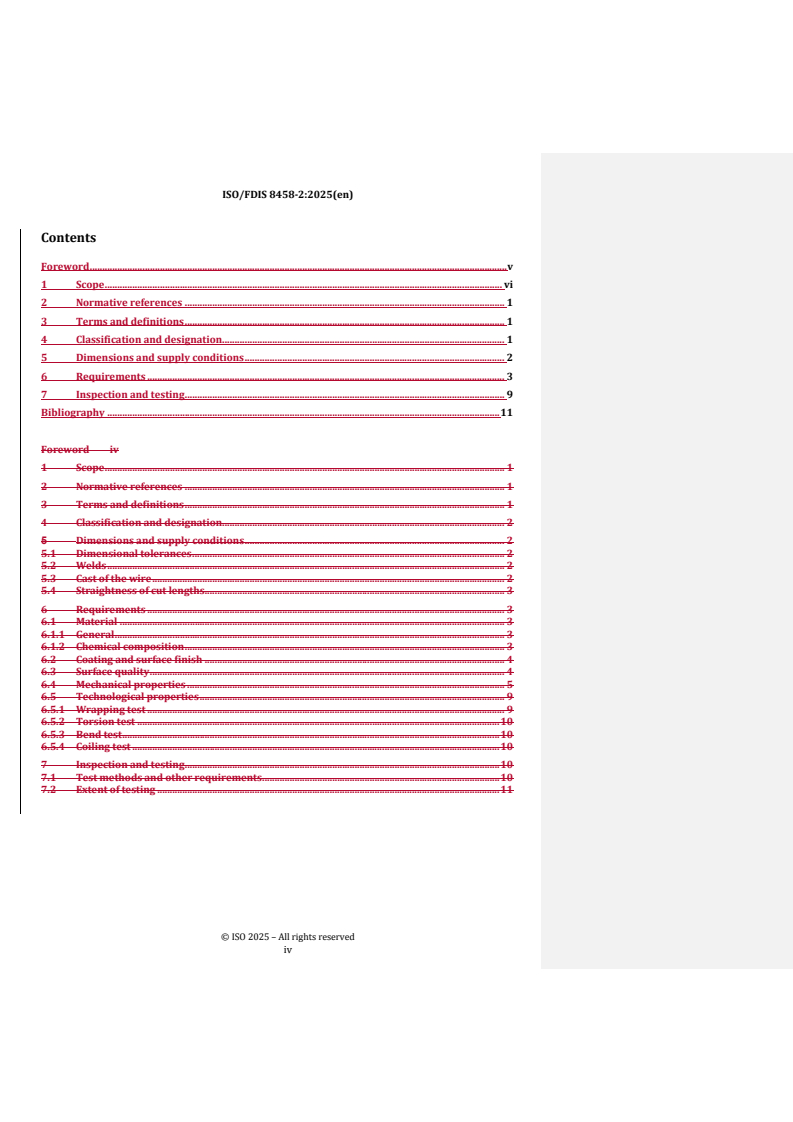
Contents
Foreword . v
1 Scope . vi
2 Normative references . 1
3 Terms and definitions . 1
4 Classification and designation. 1
5 Dimensions and supply conditions . 2
6 Requirements . 3
7 Inspection and testing . 9
Bibliography . 11
Foreword iv
1 Scope . 1
2 Normative references . 1
3 Terms and definitions . 1
4 Classification and designation. 2
5 Dimensions and supply conditions . 2
5.1 Dimensional tolerances . 2
5.2 Welds . 2
5.3 Cast of the wire . 2
5.4 Straightness of cut lengths. 3
6 Requirements . 3
6.1 Material . 3
6.1.1 General . 3
6.1.2 Chemical composition . 3
6.2 Coating and surface finish . 4
6.3 Surface quality . 4
6.4 Mechanical properties . 5
6.5 Technological properties . 9
6.5.1 Wrapping test . 9
6.5.2 Torsion test . 10
6.5.3 Bend test . 10
6.5.4 Coiling test . 10
7 Inspection and testing . 10
7.1 Test methods and other requirements . 10
7.2 Extent of testing . 11
iv
ISO/FDIS 8458-2:2025(en)
Foreword
ISO (the International Organization for Standardization) is a worldwide federation of national standards
bodies (ISO member bodies). The work of preparing International Standards is normally carried out through
ISO technical committees. Each member body interested in a subject for which a technical committee has been
established has the right to be represented on that committee. International organizations, governmental and
non-governmental, in liaison with ISO, also take part in the work. ISO collaborates closely with the
International Electrotechnical Commission (IEC) on all matters of electrotechnical standardization.
The procedures used to develop this document and those intended for its further maintenance are described
in the ISO/IEC Directives, Part 1. In particular, the different approval criteria needed for the different types of
Formatted: Font color: Auto
ISO documentsdocument should be noted. This document was drafted in accordance with the editorial rules
Formatted: Font color: Auto
of the ISO/IEC Directives, Part 2 (see www.iso.org/directives 2 (see www.iso.org/directives).
Formatted: Font color: Auto
ISO draws attention to the possibility that the implementation of this document may involve the use of (a)
patent(s). ISO takes no position concerning the evidence, validity or applicability of any claimed patent rights
in respect thereof. As of the date of publication of this document, ISO had not received notice of (a) patent(s)
which may be required to implement this document. However, implementers are cautioned that this may not
represent the latest information, which may be obtained from the patent database available at
www.iso.org/patents.www.iso.org/patents. ISO shall not be held responsible for identifying any or all such
Formatted: Font color: Auto, English (United Kingdom)
patent rights.
Any trade name used in this document is information given for the convenience of users and does not
constitute an endorsement.
For an explanation of the voluntary nature of standards, the meaning of ISO specific terms and expressions
related to conformity assessment, as well as information about ISO's adherence to the World Trade
Organization (WTO) principles in the Technical Barriers to Trade (TBT), see
www.iso.org/iso/foreword.htmlwww.iso.org/iso/foreword.html.
Formatted: Font color: Auto
This document was prepared by Technical Committee ISO/TC 17, Steel, Subcommittee SC 17, Steel wire rod
and wire products.
This third edition cancels and replaces the second edition (ISO 8458-2:2002), of which has been editorially
revisedit constitutes a minor revision.
The main changes are as follows:
Formatted: Font: Cambria
— — the normative references have been updated ;
Formatted: List Continue 1
— the structure of the document has been updated in accordance with the latest ISO/IEC
Directives,
Part 2.
Formatted: Indent: Left: 0 cm
Formatted: Font: Not Italic
ISO 8458 consistsA list of the followingall parts, under in the ISO 8458 series can be found on the general title
ISO website.
Any feedback or questions on this document should be directed to the user’s national standards body. A
complete listing of these bodies can be found at www.iso.org/members.html.
v
ISO/FDIS 8458-2(en)
Formatted: Font: 16 pt, English (United Kingdom)
Steel wire for mechanical springs: —
Formatted: Main Title 1
— Part 1: General requirements
Formatted: Font: 16 pt, English (United Kingdom)
Formatted: Main Title 2
— Part 2:
Formatted: Font: Not Italic, English (United Kingdom)
Patented cold-drawn non-alloy steel wire
Formatted: Font: Not Italic, English (United Kingdom)
— Part 3: Oil-hardened and tempered wire
vi © ISO 2025 – All rights reserved
ISO/FDIS 8458-2:2025(en)
Formatted: HeaderCentered
Formatted: Font: Bold
Steel wire for mechanical springs — Part 2: Patented cold-drawn non-
alloy steel wire
41 Scope
This document specifies requirements for cold-drawn non-alloy steel wire for the manufacture of mechanical
Formatted: Body Text
springs for static duty and dynamic duty applications, complyingin accordance with the general requirements
of ISO 8458-1.
Formatted: Font: 11 pt, Not Bold
52 Normative references
Formatted: Font color: Auto
The following documents are referred to in the text in such a way that some or all of their content constitutes
Formatted: Font color: Auto
requirements of this document. For dated references, only the edition cited applies. For undated references,
the latest edition of the referenced document (including any amendments) applies.
Formatted: Font color: Auto
Formatted: Font color: Auto
ISO 8458-1, Steel wire for mechanical springs — Part 1: General requirements
Formatted: Font color: Auto
ISO 16120-1, Non-alloy steel wire rod for conversion to wire — Part 1: General requirements
Formatted: List Continue 1, No bullets or numbering,
Don't keep with next
ISO 16120-2, Non-alloy steel wire rod for conversion to wire — Part 2: Specific requirements for general
Formatted: No underline, Font color: Auto
purpose wire rod
Field Code Changed
ISO 16120-4, Non-alloy steel wire rod for conversion to wire — Part 4: Specific requirements for wire rod for
Formatted: Font color: Auto
special applications
Formatted: No underline, Font color: Auto
63 Terms and definitions
Formatted: No page break before
Formatted: Body Text
NoFor the purposes of this document, the terms and definitions are listedgiven in this documentISO 8458-1
Formatted: Font: Not Bold
apply.
Formatted: Table header
ISO and IEC maintain terminology databases for use in standardization at the following addresses:
Formatted Table
— ISO Online browsing platform: available at https://www.iso.org/obp
Formatted: Font: Not Bold
Formatted: Font: Not Bold
— IEC Electropedia: available at https://www.electropedia.org/https://www.electropedia.org/
Formatted: Font: Not Bold
74 Classification and designation
Formatted: Font: Not Bold
Formatted: Table body
The wire diameter ranges and tensile strength grades normally available for static duty and dynamic duty are
Formatted: Table body
shown in Table 1.0.
Formatted: Table body
Table 11 — Tensile strength grades and diameter range
Formatted: Default Paragraph Font
a a
Tensile strength strength Static duty Diameter range Dynamic duty Diameter range
Formatted: Table footer
Low tensile strength SL 1-10 — —
Formatted Table
Medium tensile strength SM 0,30-20,00 DM 0,08-20,00
Formatted: Font: 9 pt
High tensile strength SH 0,30-20,00 DH 0,05-20,00 Formatted: Font: 10 pt
Formatted: Font: 10 pt
a For specific applications, other tensile strength requirements may be agreed.
Formatted: Font: 10 pt
Formatted: FooterPageNumber, Space After: 0 pt, Line
spacing: single
Formatted: Font: 11 pt
© ISO 2025 – All rights reserved
ISO/FDIS 8458-2:2025(en)
Formatted: Font: Bold
Formatted: HeaderCentered
95 Dimensions and supply conditions
Formatted: Font: Cambria, Bold
Formatted: Space Before: 12 pt
9.15.1 Dimensional tolerances
The dimensional tolerances on wire diameters shall be in accordance with ISO 8458-1.
9.25.2 Welds
The wire of a unit coil shall consist of one single length of wire originating from only one heat.
For coiled and cut lengths of wire, welds prior to the last patenting operation are allowed. All other welds shall
be removed or, if so agreed, properly marked.
9.35.3 Cast of the wire
5.3.1 4.3.1 The wire shall be uniformly cast.
Formatted: Font: Not Bold
5.3.2 4.3.2 By agreement, for sizes up to 5 mm, the cast requirements may be considered as being fulfilled
Formatted: Font: Not Bold
if the following statement is satisfied.
An individual ring taken from the coil and freely hung on a hook may show an axial displacement, f, at the ends
of the ring (see Figure 1).0).
This displacement, f, shall not exceed a value given by the following inequality: [see 0]:
Formatted: Font: (Default) Cambria, Not Expanded by /
Condensed by
𝑓≤0,2𝐷/(4√𝑑) (1)
Formatted: Font: Not Expanded by / Condensed by
where
f is the axial displacement in millimetres;
D is the diameter of a free ring in millimetres;
d is the nominal diameter of the wire in millimetres.
Formatted: Font: 10 pt
Formatted: Font: 10 pt
Formatted: Font: 10 pt
Formatted: FooterPageNumber, Space After: 0 pt, Line
spacing: single
Formatted: Font: 11 pt
2 © ISO 2025 – All rights reserved
ISO/FDIS 8458-2:2025(en)
Formatted: HeaderCentered
Formatted: Font: Bold
Figure 11 — Cast of wire
Formatted: Body Text
9.45.4 Straightness of cut lengths
Formatted: Regular Italic, Font: Cambria, Not Italic
For the straightness of cut lengths, the following requirements apply.
Formatted: Regular
Formatted: Space Before: 0 pt
For 500 mm test lengths – 0,5 mm maximum deviation from straightness;
Formatted: Regular
For 1 000 mm test lengths – 2 mm maximum deviation from straightness.
Formatted: Regular Italic, Font: Cambria, Not Italic
Formatted: Regular
NOTE 1 000 mm test lengths are recommended for wire diameter above 6 mm and 500 mm test
lengths for those below.
Formatted: Font: Not Bold
Formatted: Font: Not Bold
106 Requirements
Formatted: Font: Not Bold
10.16.1 Material
Formatted: Font: Not Bold
Formatted: Default Paragraph Font, Superscript
10.1.16.1.1 General
Formatted: Font: Not Bold
Spring wire shall be made from steel complying with ISO 16120-1.
Formatted: Font: Not Bold
For grades SL, SM and SH the steel shall comply to ISO 16120-2. Formatted: Default Paragraph Font, Superscript
Formatted: Font: Not Bold
For grades DM and DH, the steel shall comply with ISO 16120-4.
Formatted: Table header
10.1.26.1.2 Chemical composition
Formatted: Font: Not Bold
Formatted: Font: Not Bold
The steel is characterized by the heat analysis, which shall be in accordance with the values of Table 2.0. The
permissible deviation of the product analysis from the heat analysis shall be in accordance with ISO 16120-2
Formatted: Font: Not Bold
or ISO 16120-4.
Formatted: Table body
Formatted: Table body
Table 2Table 2 — Chemical composition, % (m/m) (heat analysis)
Formatted: Font: 10 pt
P S Cu
a b
Grade C Si Mn
max. max. max. Formatted: Font: 10 pt
Formatted: Font: 10 pt
SL, SM, SH 0,35-1,00 0,10-0,30 0,30-1,20 0,030 0,030 0,20
Formatted: FooterPageNumber, Space After: 0 pt, Line
DH, DM 0,45-1,00 0,10-0,30 0,30-1,20 0,020 0,025 0,12
spacing: single
Formatted: Font: 11 pt
© ISO 2025 – All rights reserved
Formatted
...
Formatted
...
ISO/FDIS 8458-2:2025(en)
Formatted
...
Formatted
...
Formatted
...
P S Cu
a b
Grade C Si Mn
Formatted
max. max. max.
...
Formatted
...
a Such a wi
...
Questions, Comments and Discussion
Ask us and Technical Secretary will try to provide an answer. You can facilitate discussion about the standard in here.
Loading comments...