

ISO 5647:2019
(Main)Paper and board — Determination of titanium dioxide content
General Information
- Abstract
This document specifies a method for determining titanium dioxide content in all kinds of paper and board, in particular coated or filled products. It comprises two procedures for the final determination of titanium, one of them relying on spectrophotometry and the other on flame atomic absorption spectrophotometry. The limits of the determination depend on the amount of sample taken (8.1). NOTE The method is designed for the determination of titanium dioxide. Titanium present in other forms, for example as a constituent of clay, will not interfere in the determination.
- Status
- Published
- Publication Date
- 08-May-2019
- Technical Committee
- ISO/TC 6 - Paper, board and pulps
- Drafting Committee
- ISO/TC 6/WG 4 - Chemical analysis
- Current Stage
- 9092 - International Standard to be revised
- Start Date
- 29-Aug-2025
- Completion Date
- 29-Aug-2026
Buy Documents




ISO 5647:2019 - Paper and board -- Determination of titanium dioxide content
ISO 5647:2019 - Paper and board — Determination of titanium dioxide content/9/2019
Overview
ISO 5647:2019 is an international standard developed by the International Organization for Standardization (ISO) that outlines a reliable method for the determination of titanium dioxide (TiO₂) content in all types of paper and board. This guidance is especially relevant for coated or filled products where precise knowledge of titanium dioxide concentration is essential for quality control, regulatory compliance, and product development. The standard specifies two validated analytical procedures: spectrophotometry and flame atomic absorption spectrophotometry, ensuring adaptability for varied laboratory capabilities and types of samples.
Key Topics
Scope and Applicability
- Covers the determination of titanium dioxide in paper and board, including coated and filled materials.
- Ensures specificity by excluding interference from other forms of titanium (e.g., in clay).
Analytical Methods
- Spectrophotometric Method: Measures absorbance at a specific wavelength (410 nm) after ashing and dissolving the paper or board sample, followed by reaction with hydrogen peroxide.
- Flame Atomic Absorption Spectrophotometry: Utilizes flame atomization and measurement at 364.3 nm, with potassium chloride as an additive to enhance measurement accuracy.
Calibration and Validation
- Both methods require the preparation of calibration graphs using standard titanium dioxide solutions for quantitative analysis.
- Offers guidance on blank reagent preparation to correct for background absorbance, ensuring data accuracy.
Safety Considerations
- Highlights the use of hazardous chemicals and gases in the process, necessitating robust safety precautions in the laboratory environment.
Reporting Requirements
- Specifies required details for test reports, including sample identification, method used, results in grams per kilogram, and any deviations from the procedure.
Applications
Quality Control in Paper and Board Manufacturing
- Filler and Coating Optimization: Accurate assessment of titanium dioxide content ensures product consistency, brightness, and opacity-key parameters in paper production.
- Regulatory Compliance: Facilitates meeting legal and safety requirements for titanium dioxide usage, particularly in food packaging or specialty papers.
- Research and Development: Supports the development of new paper and board grades with tailored optical and physical properties by enabling controlled formulation adjustments.
- Supplier Verification: Allows manufacturers to verify incoming raw materials align with specifications, reducing the risk of non-conforming batches.
Laboratory Analysis
- Enables quality assurance laboratories to choose the most suitable procedure based on available instrumentation (spectrophotometer or atomic absorption spectrometer).
- Provides a robust framework for sample handling, result validation, and data traceability.
Related Standards
- ISO 186 – Paper and board - Sampling to determine average quality
- ISO 287 – Paper and board - Determination of moisture content of a lot - Oven-drying method
- ISO 2144 – Paper, board, pulps, and cellulose nanomaterials - Determination of residue (ash content) on ignition at 900 °C
These related ISO standards provide references for sample preparation, moisture determination, and ash content measurement, supporting comprehensive paper and board analysis workflows.
Keywords: ISO 5647, titanium dioxide content determination, paper and board analysis, spectrophotometry, atomic absorption spectrophotometry, TiO₂ in paper, quality control, coated paper, filled paper, ISO standards for paper industry, laboratory testing, paper manufacturing compliance.
Relations
- Effective Date
- 16-Jun-2018
Buy Documents
ISO 5647:2019 - Paper and board -- Determination of titanium dioxide content
ISO 5647:2019 - Paper and board — Determination of titanium dioxide content/9/2019
Get Certified
Connect with accredited certification bodies for this standard

Control Union Certifications
Global certification for agriculture and sustainability.

Gozdarski inštitut Slovenije
Slovenian Forestry Institute. Forest management certification support, timber testing.
Sponsored listings
Frequently Asked Questions
ISO 5647:2019 is a standard published by the International Organization for Standardization (ISO). Its full title is "Paper and board — Determination of titanium dioxide content". This standard covers: This document specifies a method for determining titanium dioxide content in all kinds of paper and board, in particular coated or filled products. It comprises two procedures for the final determination of titanium, one of them relying on spectrophotometry and the other on flame atomic absorption spectrophotometry. The limits of the determination depend on the amount of sample taken (8.1). NOTE The method is designed for the determination of titanium dioxide. Titanium present in other forms, for example as a constituent of clay, will not interfere in the determination.
This document specifies a method for determining titanium dioxide content in all kinds of paper and board, in particular coated or filled products. It comprises two procedures for the final determination of titanium, one of them relying on spectrophotometry and the other on flame atomic absorption spectrophotometry. The limits of the determination depend on the amount of sample taken (8.1). NOTE The method is designed for the determination of titanium dioxide. Titanium present in other forms, for example as a constituent of clay, will not interfere in the determination.
ISO 5647:2019 is classified under the following ICS (International Classification for Standards) categories: 85.060 - Paper and board. The ICS classification helps identify the subject area and facilitates finding related standards.
ISO 5647:2019 has the following relationships with other standards: It is inter standard links to ISO 5647:1990. Understanding these relationships helps ensure you are using the most current and applicable version of the standard.
ISO 5647:2019 is available in PDF format for immediate download after purchase. The document can be added to your cart and obtained through the secure checkout process. Digital delivery ensures instant access to the complete standard document.
Standards Content (Sample)
SLOVENSKI STANDARD
01-november-2020
Papir, karton in lepenka - Določanje vsebnosti titanovega dioksida
Paper and board -- Determination of titanium dioxide content
Papier et carton -- Détermination de la teneur en dioxyde de titane
Ta slovenski standard je istoveten z: ISO 5647:2019
ICS:
85.060 Papir, karton in lepenka Paper and board
2003-01.Slovenski inštitut za standardizacijo. Razmnoževanje celote ali delov tega standarda ni dovoljeno.
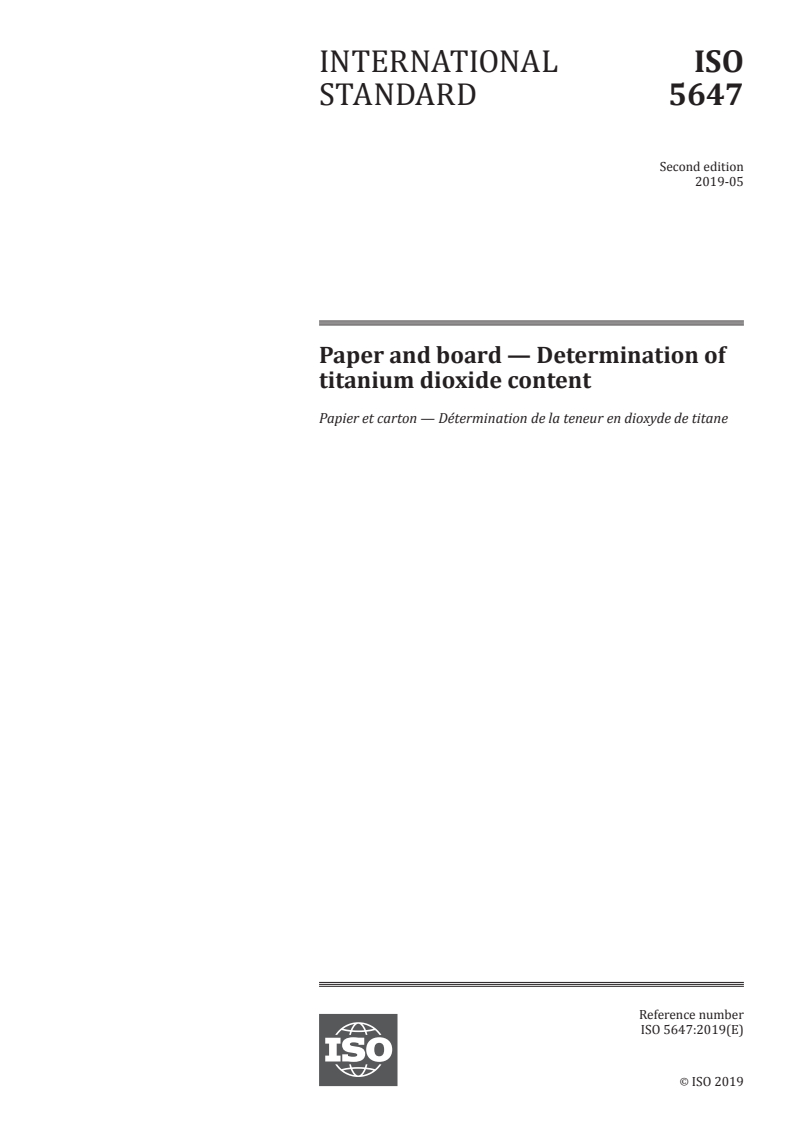
INTERNATIONAL ISO
STANDARD 5647
Second edition
2019-05
Paper and board — Determination of
titanium dioxide content
Papier et carton — Détermination de la teneur en dioxyde de titane
Reference number
©
ISO 2019
© ISO 2019
All rights reserved. Unless otherwise specified, or required in the context of its implementation, no part of this publication may
be reproduced or utilized otherwise in any form or by any means, electronic or mechanical, including photocopying, or posting
on the internet or an intranet, without prior written permission. Permission can be requested from either ISO at the address
below or ISO’s member body in the country of the requester.
ISO copyright office
CP 401 • Ch. de Blandonnet 8
CH-1214 Vernier, Geneva
Phone: +41 22 749 01 11
Fax: +41 22 749 09 47
Email: copyright@iso.org
Website: www.iso.org
Published in Switzerland
ii © ISO 2019 – All rights reserved
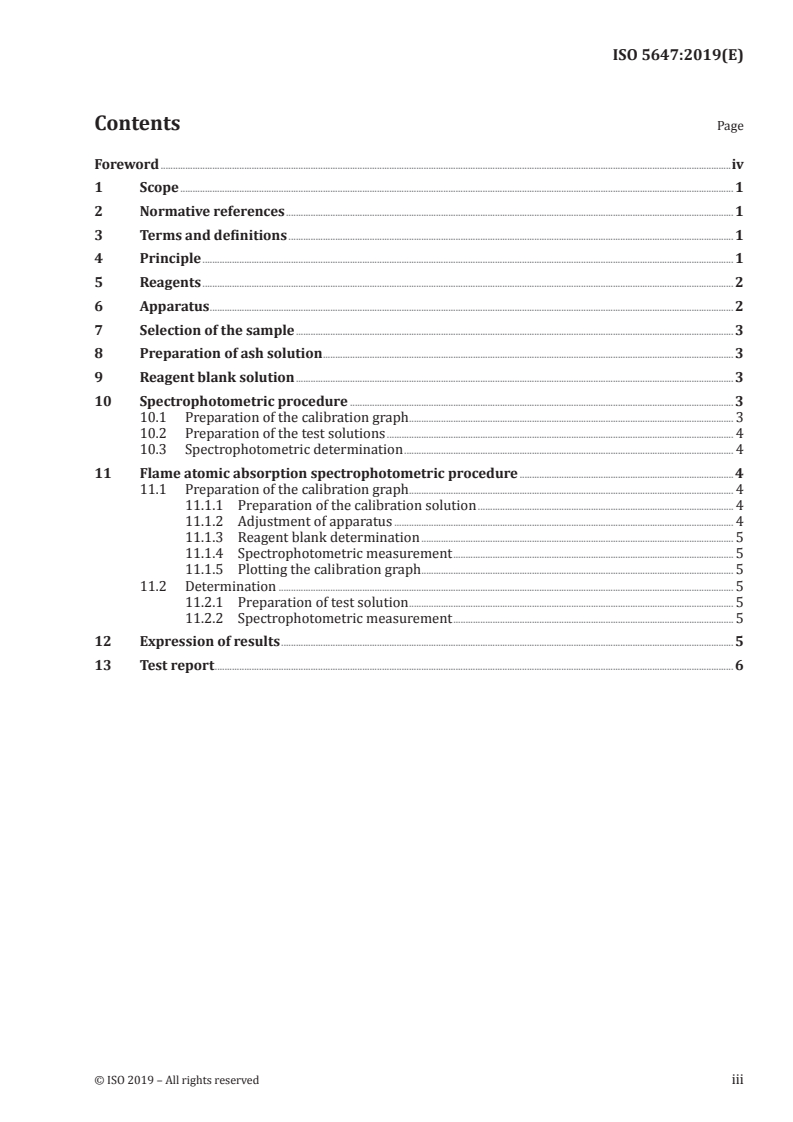
Contents Page
Foreword .iv
1 Scope . 1
2 Normative references . 1
3 Terms and definitions . 1
4 Principle . 1
5 Reagents . 2
6 Apparatus . 2
7 Selection of the sample . 3
8 Preparation of ash solution . 3
9 Reagent blank solution . 3
10 Spectrophotometric procedure . 3
10.1 Preparation of the calibration graph . 3
10.2 Preparation of the test solutions . 4
10.3 Spectrophotometric determination . 4
11 Flame atomic absorption spectrophotometric procedure . 4
11.1 Preparation of the calibration graph . 4
11.1.1 Preparation of the calibration solution . 4
11.1.2 Adjustment of apparatus . 4
11.1.3 Reagent blank determination . 5
11.1.4 Spectrophotometric measurement . 5
11.1.5 Plotting the calibration graph . 5
11.2 Determination . 5
11.2.1 Preparation of test solution . 5
11.2.2 Spectrophotometric measurement . 5
12 Expression of results . 5
13 Test report . 6
Foreword
ISO (the International Organization for Standardization) is a worldwide federation of national standards
bodies (ISO member bodies). The work of preparing International Standards is normally carried out
through ISO technical committees. Each member body interested in a subject for which a technical
committee has been established has the right to be represented on that committee. International
organizations, governmental and non-governmental, in liaison with ISO, also take part in the work.
ISO collaborates closely with the International Electrotechnical Commission (IEC) on all matters of
electrotechnical standardization.
The procedures used to develop this document and those intended for its further maintenance are
described in the ISO/IEC Directives, Part 1. In particular, the different approval criteria needed for the
different types of ISO documents should be noted. This document was drafted in accordance with the
editorial rules of the ISO/IEC Directives, Part 2 (see www .iso .org/directives).
Attention is drawn to the possibility that some of the elements of this document may be the subject of
patent rights. ISO shall not be held responsible for identifying any or all such patent rights. Details of
any patent rights identified during the development of the document will be in the Introduction and/or
on the ISO list of patent declarations received (see www .iso .org/patents).
Any trade name used in this document is information given for the convenience of users and does not
constitute an endorsement.
For an explanation of the voluntary nature of standards, the meaning of ISO specific terms and
expressions related to conformity assessment, as well as information about ISO's adherence to
the World Trade Organization (WTO) principles in the Technical Barriers to Trade (TBT), see
www .iso .org/iso/foreword .html.
This document was prepared by Technical Committee ISO/TC 6, Paper, Board and Pulps.
This second edition cancels and replaces the first edition (ISO 5647:1990), of which it constitutes a
minor revision. The changes compared to the previous edition are as follows:
— Clause 4: The option of using Inductively Coupled Plasma/Atomic Emission Spectrometry (ICP/AES)
has been added.
Any feedback or questions on this document should be directed to the user’s national standards body. A
complete listing of these bodies can be found at www .iso .org/members .html.
iv © ISO 2019 – All rights reserved
INTERNATIONAL STANDARD ISO 5647:2019(E)
Paper and board — Determination of titanium dioxide
content
WARNING — The method specified in this document involves the use of some hazardous
chemicals and of gases that can form explosive mixtures with air. Care shall be taken to ensure
that the relevant safety precautions are observed.
1 Scope
This document specifies a method for determining titanium dioxide content in all kinds of paper and
board, in particular coated or filled products. It comprises two procedures for the final determination
of titanium, one of them relying on spectrophotometry and the other on flame atomic absorption
spectrophotometry. The limits of the determination depend on the amount of sample taken (8.1).
NOTE The method is designed for the determination of titanium dioxide. Titanium present in other forms,
for example as a constituent of clay, will not interfere in the determination.
2 Normative references
The following documents are referred to in the text in such a way that some or all of their content
constitutes requirements of this document. For dated references, only the edition cited applies. For
undated references, the latest edition of the referenced document (including any amendments) applies.
ISO 186, Paper and board — Sampling to determine average quality
ISO 287, Paper and board — Determination of moisture content of a lot — Oven-drying method
ISO 2144, Paper, board, pulps and cellulose nanomaterials — Determination of residue (ash content) on
ignition at 900 °C
3 Terms and definitions
For the purposes of this document, the following terms and definitions apply.
ISO and IEC maintain terminological databases for use in standardization at the following addresses:
— ISO Online browsing platform: available at https: //www .iso .org/obp
— IEC Electropedia: available at http: //www .electropedia .org/
3.1
titanium dioxide content
titanium dioxide content of paper or board (expressed on an oven-dry basis), determined after ashing
the sample and dissolving the ash by the method specified in this document
4 Principle
Titanium dioxide is determined by ashing the sample and dissolution of the ash in sulphuric acid
and ammonium sulphate. Determination of the titanium by spectrophotometry, applying hydrogen
peroxide, or by flame atomic absorption spectrophotometry, adding potassium chloride.
The determination of titanium, after ashing the sample and dissolution of the ash, can also be done by
ICP/AES (Inductivel
...
INTERNATIONAL ISO
STANDARD 5647
Second edition
2019-05
Paper and board — Determination of
titanium dioxide content
Papier et carton — Détermination de la teneur en dioxyde de titane
Reference number
©
ISO 2019
© ISO 2019
All rights reserved. Unless otherwise specified, or required in the context of its implementation, no part of this publication may
be reproduced or utilized otherwise in any form or by any means, electronic or mechanical, including photocopying, or posting
on the internet or an intranet, without prior written permission. Permission can be requested from either ISO at the address
below or ISO’s member body in the country of the requester.
ISO copyright office
CP 401 • Ch. de Blandonnet 8
CH-1214 Vernier, Geneva
Phone: +41 22 749 01 11
Fax: +41 22 749 09 47
Email: copyright@iso.org
Website: www.iso.org
Published in Switzerland
ii © ISO 2019 – All rights reserved
Contents Page
Foreword .iv
1 Scope . 1
2 Normative references . 1
3 Terms and definitions . 1
4 Principle . 1
5 Reagents . 2
6 Apparatus . 2
7 Selection of the sample . 3
8 Preparation of ash solution . 3
9 Reagent blank solution . 3
10 Spectrophotometric procedure . 3
10.1 Preparation of the calibration graph . 3
10.2 Preparation of the test solutions . 4
10.3 Spectrophotometric determination . 4
11 Flame atomic absorption spectrophotometric procedure . 4
11.1 Preparation of the calibration graph . 4
11.1.1 Preparation of the calibration solution . 4
11.1.2 Adjustment of apparatus . 4
11.1.3 Reagent blank determination . 5
11.1.4 Spectrophotometric measurement . 5
11.1.5 Plotting the calibration graph . 5
11.2 Determination . 5
11.2.1 Preparation of test solution . 5
11.2.2 Spectrophotometric measurement . 5
12 Expression of results . 5
13 Test report . 6
Foreword
ISO (the International Organization for Standardization) is a worldwide federation of national standards
bodies (ISO member bodies). The work of preparing International Standards is normally carried out
through ISO technical committees. Each member body interested in a subject for which a technical
committee has been established has the right to be represented on that committee. International
organizations, governmental and non-governmental, in liaison with ISO, also take part in the work.
ISO collaborates closely with the International Electrotechnical Commission (IEC) on all matters of
electrotechnical standardization.
The procedures used to develop this document and those intended for its further maintenance are
described in the ISO/IEC Directives, Part 1. In particular, the different approval criteria needed for the
different types of ISO documents should be noted. This document was drafted in accordance with the
editorial rules of the ISO/IEC Directives, Part 2 (see www .iso .org/directives).
Attention is drawn to the possibility that some of the elements of this document may be the subject of
patent rights. ISO shall not be held responsible for identifying any or all such patent rights. Details of
any patent rights identified during the development of the document will be in the Introduction and/or
on the ISO list of patent declarations received (see www .iso .org/patents).
Any trade name used in this document is information given for the convenience of users and does not
constitute an endorsement.
For an explanation of the voluntary nature of standards, the meaning of ISO specific terms and
expressions related to conformity assessment, as well as information about ISO's adherence to
the World Trade Organization (WTO) principles in the Technical Barriers to Trade (TBT), see
www .iso .org/iso/foreword .html.
This document was prepared by Technical Committee ISO/TC 6, Paper, Board and Pulps.
This second edition cancels and replaces the first edition (ISO 5647:1990), of which it constitutes a
minor revision. The changes compared to the previous edition are as follows:
— Clause 4: The option of using Inductively Coupled Plasma/Atomic Emission Spectrometry (ICP/AES)
has been added.
Any feedback or questions on this document should be directed to the user’s national standards body. A
complete listing of these bodies can be found at www .iso .org/members .html.
iv © ISO 2019 – All rights reserved
INTERNATIONAL STANDARD ISO 5647:2019(E)
Paper and board — Determination of titanium dioxide
content
WARNING — The method specified in this document involves the use of some hazardous
chemicals and of gases that can form explosive mixtures with air. Care shall be taken to ensure
that the relevant safety precautions are observed.
1 Scope
This document specifies a method for determining titanium dioxide content in all kinds of paper and
board, in particular coated or filled products. It comprises two procedures for the final determination
of titanium, one of them relying on spectrophotometry and the other on flame atomic absorption
spectrophotometry. The limits of the determination depend on the amount of sample taken (8.1).
NOTE The method is designed for the determination of titanium dioxide. Titanium present in other forms,
for example as a constituent of clay, will not interfere in the determination.
2 Normative references
The following documents are referred to in the text in such a way that some or all of their content
constitutes requirements of this document. For dated references, only the edition cited applies. For
undated references, the latest edition of the referenced document (including any amendments) applies.
ISO 186, Paper and board — Sampling to determine average quality
ISO 287, Paper and board — Determination of moisture content of a lot — Oven-drying method
ISO 2144, Paper, board, pulps and cellulose nanomaterials — Determination of residue (ash content) on
ignition at 900 °C
3 Terms and definitions
For the purposes of this document, the following terms and definitions apply.
ISO and IEC maintain terminological databases for use in standardization at the following addresses:
— ISO Online browsing platform: available at https: //www .iso .org/obp
— IEC Electropedia: available at http: //www .electropedia .org/
3.1
titanium dioxide content
titanium dioxide content of paper or board (expressed on an oven-dry basis), determined after ashing
the sample and dissolving the ash by the method specified in this document
4 Principle
Titanium dioxide is determined by ashing the sample and dissolution of the ash in sulphuric acid
and ammonium sulphate. Determination of the titanium by spectrophotometry, applying hydrogen
peroxide, or by flame atomic absorption spectrophotometry, adding potassium chloride.
The determination of titanium, after ashing the sample and dissolution of the ash, can also be done by
ICP/AES (Inductively Coupled Plasma/Atomic Emission Spectrometry) provided that the results have
been validated.
5 Reagents
During the analysis, unless otherwise stated, use only reagents of recognized analytical grade and only
distilled water or water of equivalent purity (5.1).
5.1 Dist
...
INTERNATIONAL ISO
STANDARD 5647
Second edition
2019-05
Paper and board — Determination of
titanium dioxide content
Papier et carton — Détermination de la teneur en dioxyde de titane
Reference number
©
ISO 2019
© ISO 2019
All rights reserved. Unless otherwise specified, or required in the context of its implementation, no part of this publication may
be reproduced or utilized otherwise in any form or by any means, electronic or mechanical, including photocopying, or posting
on the internet or an intranet, without prior written permission. Permission can be requested from either ISO at the address
below or ISO’s member body in the country of the requester.
ISO copyright office
CP 401 • Ch. de Blandonnet 8
CH-1214 Vernier, Geneva
Phone: +41 22 749 01 11
Fax: +41 22 749 09 47
Email: copyright@iso.org
Website: www.iso.org
Published in Switzerland
ii © ISO 2019 – All rights reserved
Contents Page
Foreword .iv
1 Scope . 1
2 Normative references . 1
3 Terms and definitions . 1
4 Principle . 1
5 Reagents . 2
6 Apparatus . 2
7 Selection of the sample . 3
8 Preparation of ash solution . 3
9 Reagent blank solution . 3
10 Spectrophotometric procedure . 3
10.1 Preparation of the calibration graph . 3
10.2 Preparation of the test solutions . 4
10.3 Spectrophotometric determination . 4
11 Flame atomic absorption spectrophotometric procedure . 4
11.1 Preparation of the calibration graph . 4
11.1.1 Preparation of the calibration solution . 4
11.1.2 Adjustment of apparatus . 4
11.1.3 Reagent blank determination . 5
11.1.4 Spectrophotometric measurement . 5
11.1.5 Plotting the calibration graph . 5
11.2 Determination . 5
11.2.1 Preparation of test solution . 5
11.2.2 Spectrophotometric measurement . 5
12 Expression of results . 5
13 Test report . 6
Foreword
ISO (the International Organization for Standardization) is a worldwide federation of national standards
bodies (ISO member bodies). The work of preparing International Standards is normally carried out
through ISO technical committees. Each member body interested in a subject for which a technical
committee has been established has the right to be represented on that committee. International
organizations, governmental and non-governmental, in liaison with ISO, also take part in the work.
ISO collaborates closely with the International Electrotechnical Commission (IEC) on all matters of
electrotechnical standardization.
The procedures used to develop this document and those intended for its further maintenance are
described in the ISO/IEC Directives, Part 1. In particular, the different approval criteria needed for the
different types of ISO documents should be noted. This document was drafted in accordance with the
editorial rules of the ISO/IEC Directives, Part 2 (see www .iso .org/directives).
Attention is drawn to the possibility that some of the elements of this document may be the subject of
patent rights. ISO shall not be held responsible for identifying any or all such patent rights. Details of
any patent rights identified during the development of the document will be in the Introduction and/or
on the ISO list of patent declarations received (see www .iso .org/patents).
Any trade name used in this document is information given for the convenience of users and does not
constitute an endorsement.
For an explanation of the voluntary nature of standards, the meaning of ISO specific terms and
expressions related to conformity assessment, as well as information about ISO's adherence to
the World Trade Organization (WTO) principles in the Technical Barriers to Trade (TBT), see
www .iso .org/iso/foreword .html.
This document was prepared by Technical Committee ISO/TC 6, Paper, Board and Pulps.
This second edition cancels and replaces the first edition (ISO 5647:1990), of which it constitutes a
minor revision. The changes compared to the previous edition are as follows:
— Clause 4: The option of using Inductively Coupled Plasma/Atomic Emission Spectrometry (ICP/AES)
has been added.
Any feedback or questions on this document should be directed to the user’s national standards body. A
complete listing of these bodies can be found at www .iso .org/members .html.
iv © ISO 2019 – All rights reserved
INTERNATIONAL STANDARD ISO 5647:2019(E)
Paper and board — Determination of titanium dioxide
content
WARNING — The method specified in this document involves the use of some hazardous
chemicals and of gases that can form explosive mixtures with air. Care shall be taken to ensure
that the relevant safety precautions are observed.
1 Scope
This document specifies a method for determining titanium dioxide content in all kinds of paper and
board, in particular coated or filled products. It comprises two procedures for the final determination
of titanium, one of them relying on spectrophotometry and the other on flame atomic absorption
spectrophotometry. The limits of the determination depend on the amount of sample taken (8.1).
NOTE The method is designed for the determination of titanium dioxide. Titanium present in other forms,
for example as a constituent of clay, will not interfere in the determination.
2 Normative references
The following documents are referred to in the text in such a way that some or all of their content
constitutes requirements of this document. For dated references, only the edition cited applies. For
undated references, the latest edition of the referenced document (including any amendments) applies.
ISO 186, Paper and board — Sampling to determine average quality
ISO 287, Paper and board — Determination of moisture content of a lot — Oven-drying method
ISO 2144, Paper, board, pulps and cellulose nanomaterials — Determination of residue (ash content) on
ignition at 900 °C
3 Terms and definitions
For the purposes of this document, the following terms and definitions apply.
ISO and IEC maintain terminological databases for use in standardization at the following addresses:
— ISO Online browsing platform: available at https: //www .iso .org/obp
— IEC Electropedia: available at http: //www .electropedia .org/
3.1
titanium dioxide content
titanium dioxide content of paper or board (expressed on an oven-dry basis), determined after ashing
the sample and dissolving the ash by the method specified in this document
4 Principle
Titanium dioxide is determined by ashing the sample and dissolution of the ash in sulphuric acid
and ammonium sulphate. Determination of the titanium by spectrophotometry, applying hydrogen
peroxide, or by flame atomic absorption spectrophotometry, adding potassium chloride.
The determination of titanium, after ashing the sample and dissolution of the ash, can also be done by
ICP/AES (Inductively Coupled Plasma/Atomic Emission Spectrometry) provided that the results have
been validated.
5 Reagents
During the analysis, unless otherwise stated, use only reagents of recognized analytical grade and only
distilled water or water of equivalent purity (5.1).
5.1 Dist
...