

ISO 18722-1:2026
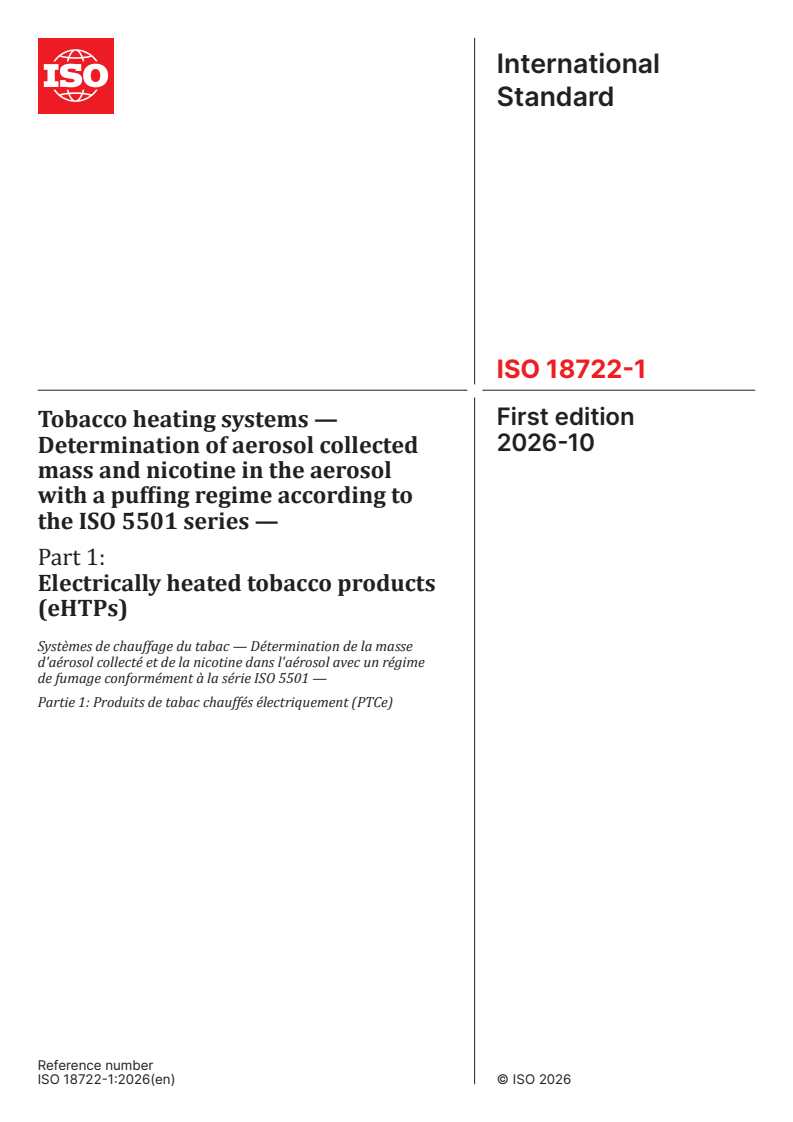
(Main)Tobacco heating systems — Determination of aerosol collected mass and nicotine in the aerosol with a puffing regime according to the ISO 5501 series — Part 1: Electrically heated tobacco products (eHTPs)
- Abstract
This document specifies an analytical method with a puffing regime according to ISO 5501-1 to determine aerosol collected mass (ACM) and nicotine in the aerosol from electrically heated tobacco products, in combination with a specific tobacco heating device (THD).
- Status
- Published
- Publication Date
- 27-Oct-2026
- Technical Committee
- ISO/TC 126 - Tobacco and tobacco products
- Drafting Committee
- ISO/TC 126 - Tobacco and tobacco products
- Current Stage
- 6060 - International Standard published
- Start Date
- 28-Oct-2026
- Completion Date
- 28-Oct-2026
Buy Documents


ISO 18722-1:2026 - Tobacco heating systems — Determination of aerosol collected mass and nicotine in the aerosol with a puffing regime according to the ISO 5501 series — Part 1: Electrically heated tobacco products (eHTPs)
ISO 18722-1 is an ISO standard published by ISO for testing electrically heated tobacco products (eHTPs). It specifies an analytical method to determine aerosol collected mass (ACM) and nicotine in trapped aerosol using a puffing regime according to ISO 5501-1 and gas chromatography with flame ionization detection (GC-FID). The document is used by laboratories and product teams that need comparable aerosol measurements for eHTPs used with a specific tobacco heating device (THD).
What does ISO 18722-1 specify?
ISO 18722-1 specifies a laboratory method for measuring ACM and nicotine in aerosol from eHTPs in combination with a specific THD. The method uses the ISO 5501-1 puffing regime, gravimetric ACM determination, and GC-FID analysis of nicotine after extraction.
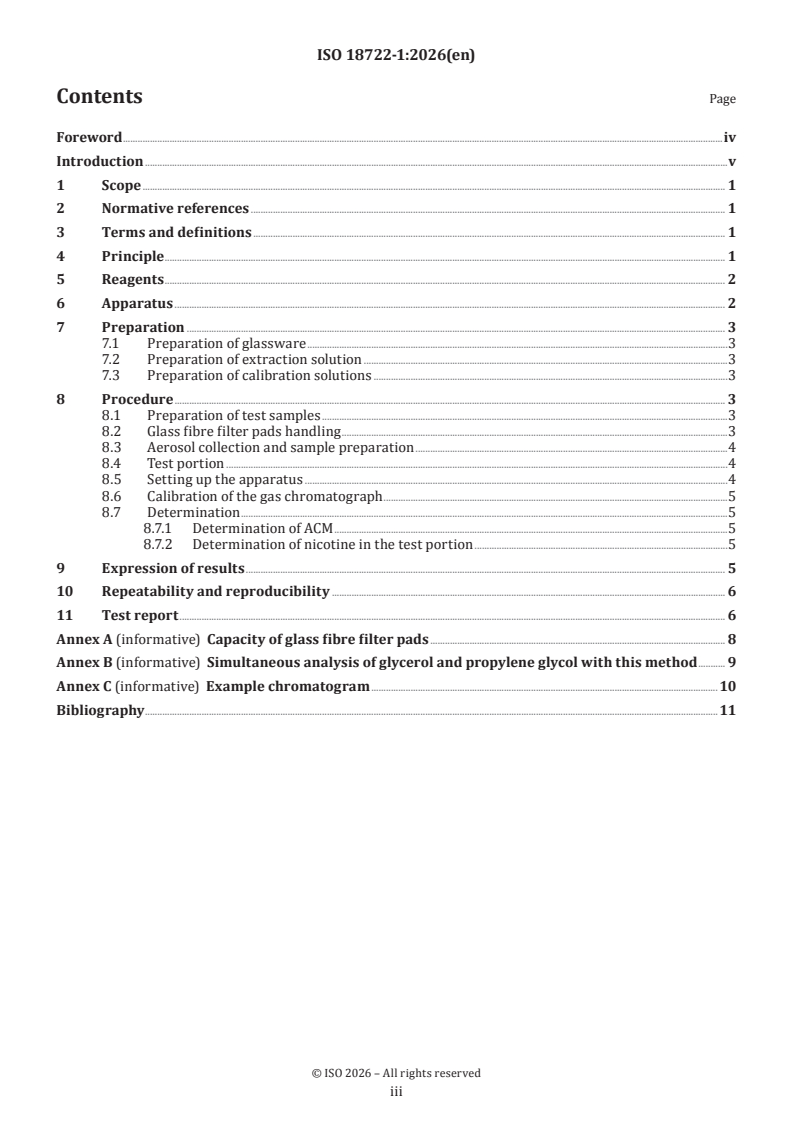
The document is organized into clauses 1 to 11 and three informative annexes.
| Annex | What it covers |
|---|---|
| Annex A | Capacity of glass fibre filter pads |
| Annex B | Simultaneous analysis of glycerol and propylene glycol with this method |
| Annex C | Example chromatogram |
The scope is narrow and practical: it is about analytical measurement of trapped aerosol from electrically heated products, not about human exposure or health risk. The introduction also notes that machine puffing data are useful for design and regulatory purposes, but they are not direct measures of human exposure.
What are the key requirements of ISO 18722-1?
ISO 18722-1 sets out a sequence for conditioning, collecting, extracting and analyzing aerosol so that ACM and nicotine can be reported in a consistent way. The main practical point is that the same puffing regime, sample handling and calibration approach should be used throughout a study.
Sample preparation and aerosol collection
eHTPs are conditioned and handled according to ISO 5501-1, while THDs are charged, stored and cleaned according to the manufacturer’s instructions or the study protocol. Glass fibre filter pads are conditioned in the ISO 3402 atmosphere for at least 24 h before weighing, and contamination from handling has to be avoided.
Aerosol is collected onto glass fibre filter pads in accordance with ISO 5501-1. The document typically uses two to five eHTPs per replicate and warns not to exceed filter pad capacity, because overloading can affect the capture of ACM and nicotine.
ACM determination and extraction
ISO 18722-1 determines ACM gravimetrically by weighing the filter holder before and after aerosol collection to the nearest 0.1 mg. In practice, this gives the mass of collected material without needing to identify each component individually.
After collection, the pad is extracted with propane-2-ol containing an internal standard. The extraction volume depends on pad size, and the extract is shaken for at least 30 min, then analyzed as soon as possible. This matters because extraction quality and extract stability directly affect the nicotine result.
GC-FID calibration and nicotine measurement
The nicotine measurement uses a gas chromatograph with flame ionization detection. ISO 18722-1 requires at least five calibration solutions spanning the expected test range, and the nicotine response is calibrated against the internal standard by linear regression.
The document also calls for resolution of nicotine, the internal standard and other aerosol components, and it recommends checking the calibration during the sequence. In practice, this means the laboratory has to verify that the chromatograph is separating the peaks cleanly and that the calibration remains valid throughout the run.
Reporting and precision
Results are expressed as nicotine per consumable or per puff, depending on the study design. Clause 10 summarizes repeatability and reproducibility data from a CORESTA proficiency study, supported by ISO 5725-2 statistics, which helps users judge how much variation to expect between laboratories.
The test report has to identify the sample, the ISO 18722-1 edition used, the nicotine and ACM results, any operating conditions not specified in the document, any circumstance affecting the result, and the test date.
What terms does ISO 18722-1 define?
- THS - Tobacco heating system, the combination of a tobacco heating device and a heated tobacco product used together to produce a nicotine-containing aerosol without combustion.
- THD - Tobacco heating device, the device that heats the product.
- HTP - Heated tobacco product, a tobacco substrate designed to be heated, not combusted, by a separate source.
- eHTP - Electrically heated tobacco product, the product type covered by this part of ISO 18722.
- ACM - Aerosol collected mass, the mass collected on the aerosol trapping system during operation of a tobacco heating system.
- GC-FID - Gas chromatography with flame ionization detection, the analytical technique used here to measure nicotine in the extract.
- Internal standard - A reference compound added to the extraction solution so nicotine can be quantified by ratio rather than by raw detector response alone.
Who uses ISO 18722-1?
ISO 18722-1 is used by analytical laboratories, tobacco product manufacturers, and regulatory or conformity assessment laboratories that measure eHTP aerosol. Product development teams use it to compare designs, devices and operating conditions, while quality and buyer teams use it to specify a test method for supplier or contract-lab work.
The document is also relevant where nicotine yields in aerosol need to be compared in a repeatable way. The introduction makes clear that the results are intended for design, testing and regulatory purposes, not as direct measures of human exposure or risk.
Which standards are used with ISO 18722-1?
- ISO 3402 - sets the atmosphere for conditioning and testing the filter pads used in the method.
- ISO 5501-1 - provides the definitions and standard conditions for aerosol generation and collection, including the puffing regime used here.
- ISO 6080 - supplies the vocabulary for tobacco heating systems and related terms.
- ISO 5725-2 - provides the statistical basis referenced for the repeatability and reproducibility study in Clause 10.
What does the ISO 18722-1 document contain?
ISO 18722-1 contains a complete analytical workflow, from reagents and apparatus through sample preparation, aerosol collection, extraction, GC-FID calibration and calculation of results. It includes an example chromatogram in Annex C and practical guidance on filter pad capacity in Annex A.
The document also gives a precision summary based on a CORESTA proficiency study, with tables for nicotine and ACM. Annex B extends the method to simultaneous analysis of glycerol and propylene glycol, which is useful when laboratories want to measure more than nicotine from the same extract.
Buy Documents
ISO 18722-1:2026 - Tobacco heating systems — Determination of aerosol collected mass and nicotine in the aerosol with a puffing regime according to the ISO 5501 series — Part 1: Electrically heated tobacco products (eHTPs)
Get Certified
Connect with accredited certification bodies for this standard

Control Union Certifications
Global certification for agriculture and sustainability.

ECOCERT
Organic and sustainability certification.

FSC International
Forest Stewardship Council certification.
Sponsored listings
Frequently Asked Questions
ISO 18722-1:2026 is a standard published by the International Organization for Standardization (ISO). Its full title is "Tobacco heating systems — Determination of aerosol collected mass and nicotine in the aerosol with a puffing regime according to the ISO 5501 series — Part 1: Electrically heated tobacco products (eHTPs)". This standard covers: This document specifies an analytical method with a puffing regime according to ISO 5501-1 to determine aerosol collected mass (ACM) and nicotine in the aerosol from electrically heated tobacco products, in combination with a specific tobacco heating device (THD).
This document specifies an analytical method with a puffing regime according to ISO 5501-1 to determine aerosol collected mass (ACM) and nicotine in the aerosol from electrically heated tobacco products, in combination with a specific tobacco heating device (THD).
ISO 18722-1:2026 is classified under the following ICS (International Classification for Standards) categories: 65.160 - Tobacco, tobacco products and related equipment. The ICS classification helps identify the subject area and facilitates finding related standards.
ISO 18722-1:2026 is available in PDF format for immediate download after purchase. The document can be added to your cart and obtained through the secure checkout process. Digital delivery ensures instant access to the complete standard document.
Standards Content (Sample)
International
Standard
ISO 18722-1
First edition
Tobacco heating systems —
2026-10
Determination of aerosol collected
mass and nicotine in the aerosol
with a puffing regime according to
the ISO 5501 series —
Part 1:
Electrically heated tobacco products
(eHTPs)
Systèmes de chauffage du tabac — Détermination de la masse
d'aérosol collecté et de la nicotine dans l'aérosol avec un régime
de fumage conformément à la série ISO 5501 —
Partie 1: Produits de tabac chauffés électriquement (PTCe)
Reference number
© ISO 2026
All rights reserved.
This ISO publication is protected by copyright and is owned by ISO and/or its licensors.
The content of this ISO publication is provided under licence, not sold. Use is subject to the applicable licence terms issued by ISO,
an ISO member body, or an authorized third-party distributor.
Except as required for implementation or expressly permitted by a separate licence, no part of this ISO publication may be
reproduced, distributed, modified, used, or made available in any form or by any means – electronic or mechanical, including
photocopying, scanning, recording, or posting on internal or external digital platforms.
Any use beyond the scope of the granted rights is prohibited and may result in legal action.
ISO copyright office
CP 401 • CH-1214 Vernier, Geneva
Phone: +41 22 749 01 11
Email: copyright@iso.org
Website: www.iso.org
Published in Switzerland
ii
Contents Page
Foreword .iv
Introduction .v
1 Scope . 1
2 Normative references . 1
3 Terms and definitions . 1
4 Principle . 1
5 Reagents . 2
6 Apparatus . 2
7 Preparation . 3
7.1 Preparation of glassware .3
7.2 Preparation of extraction solution .3
7.3 Preparation of calibration solutions .3
8 Procedure . 3
8.1 Preparation of test samples .3
8.2 Glass fibre filter pads handling .3
8.3 Aerosol collection and sample preparation .4
8.4 Test portion .4
8.5 Setting up the apparatus .4
8.6 Calibration of the gas chromatograph .5
8.7 Determination .5
8.7.1 Determination of ACM .5
8.7.2 Determination of nicotine in the test portion .5
9 Expression of results . 5
10 Repeatability and reproducibility . 6
11 Test report . 6
Annex A (informative) Capacity of glass fibre filter pads . 8
Annex B (informative) Simultaneous analysis of glycerol and propylene glycol with this method . 9
Annex C (informative) Example chromatogram . 10
Bibliography .11
iii
Foreword
ISO (the International Organization for Standardization) is a worldwide federation of national standards
bodies (ISO member bodies). The work of preparing International Standards is normally carried out through
ISO technical committees. Each member body interested in a subject for which a technical committee
has been established has the right to be represented on that committee. International organizations,
governmental and non-governmental, in liaison with ISO, also take part in the work. ISO collaborates closely
with the International Electrotechnical Commission (IEC) on all matters of electrotechnical standardization.
The procedures used to develop this document and those intended for its further maintenance are described
in the ISO/IEC Directives, Part 1. In particular, the different approval criteria needed for the different types
of ISO documents should be noted. This document was drafted in accordance with the editorial rules of the
ISO/IEC Directives, Part 2 (see www.iso.org/directives).
ISO draws attention to the possibility that the implementation of this document may involve the use of (a)
patent(s). ISO takes no position concerning the evidence, validity or applicability of any claimed patent
rights in respect thereof. As of the date of publication of this document, ISO had not received notice of (a)
patent(s) which may be required to implement this document. However, implementers are cautioned that
this may not represent the latest information, which may be obtained from the patent database available at
www.iso.org/patents. ISO shall not be held responsible for identifying any or all such patent rights.
Any trade name used in this document is information given for the convenience of users and does not
constitute an endorsement.
For an explanation of the voluntary nature of standards, the meaning of ISO specific terms and expressions
related to conformity assessment, as well as information about ISO's adherence to the World Trade
Organization (WTO) principles in the Technical Barriers to Trade (TBT), see www.iso.org/iso/foreword.html.
This document was prepared by Technical Committee ISO/TC 126, Tobacco and tobacco products.
A list of all parts in the ISO 18722 series can be found on the ISO website.
Any feedback or questions on this document should be directed to the user’s national standards body. A
complete listing of these bodies can be found at www.iso.org/members.html.
iv
Introduction
A tobacco heating system (THS) is a specific combination of a tobacco heating device (THD) and a heated
tobacco product (HTP) used together and designed to produce a nicotine-containing aerosol without
combustion of the tobacco substrate. An HTP is a product containing a tobacco substrate that is designed to
be heated and not combusted by a separate source to produce a nicotine-containing aerosol.
With the emerging development and commercialization of HTPs, there are a number of different approaches
to heating the HTP, categorized as electrically, aerosol and carbon HTPs (eHTP, aHTP and cHTP respectively),
[1]
as described in ISO 6080 . Carbon heated tobacco products (cHTPs) have not been commercially available
as of 2022.
In some countries, the regulation of HTPs requires nicotine yields in aerosol. Therefore, there is a necessity
to have an international standard in place to get reliable/comparable data on nicotine in the aerosol from
THSs, with a specific HTP. Technical investigation of HTPs requires determining aerosol collected mass
(ACM) in combination with a specific THD.
This document was developed for the determination of ACM with a gravimetric method, and nicotine
yields in trapped eHTP aerosol utilizing gas chromatography coupled with a flame ionization detector. This
[2]
document is based on the CORESTA recommended method (CRM) 107 , which was written on the basis of
[3]
the results obtained in an interlaboratory study conducted in 2021 involving 17 laboratories .
No machine puffing regime can represent all human puffing behaviour.
— It is recommended that eHTP also be tested under conditions of a different intensity of machine puffing
than those specified in this document.
— Machine puffing testing is useful to characterize eHTP emissions for design and regulatory purposes, but
communication of machine measurements to users can result in misunderstandings about differences in
exposure and risk across brands.
— Aerosol emission data from machine measurements may be used as inputs for product hazard
assessment, but they are not intended to be nor are they valid as measures of human exposure or risks.
Communicating differences between products in machine measurements as differences in exposure or
risk is a misuse of testing using ISO standards.
WARNING — Regulation and standardization are independent from each other, and standardization
does not pre-empt regulation.
v
International Standard ISO 18722-1:2026(en)
Tobacco heating systems — Determination of aerosol
collected mass and nicotine in the aerosol with a puffing
regime according to the ISO 5501 series —
Part 1:
Electrically heated tobacco products (eHTPs)
1 Scope
[4]
This document specifies an analytical method with a puffing regime according to ISO 5501-1 to determine
aerosol collected mass (ACM) and nicotine in the aerosol from electrically heated tobacco products, in
combination with a specific tobacco heating device (THD).
2 Normative references
The following documents are referred to in the text in such a way that some or all of their content constitutes
requirements of this document. For dated references, only the edition cited applies. For undated references,
the latest edition of the referenced document (including any amendments) applies.
ISO 3402, Tobacco and tobacco products — Atmosphere for conditioning and testing
ISO 5501-1, Tobacco heating systems — Definitions and standard conditions for aerosol generation and
collection — Part 1: Electrically heated tobacco products (eHTPs)
ISO 6080, Tobacco heating systems — Vocabulary
3 Terms and definitions
For the purposes of this document, the terms and definitions given in ISO 6080 and the following apply.
ISO and IEC maintain terminology databases for use in standardization at the following addresses:
— ISO Online browsing platform: available at https:// www .iso .org/ obp
— IEC Electropedia: available at https:// www .electropedia .org/
3.1
aerosol collected mass
ACM
mass of aerosol collected on an aerosol trapping system from the operation of a tobacco heating system
(THS) by a routine analytical puffing machine
[5]
Note 1 to entry: See ISO 4387 for total particulate matter (TPM).
[6]
[SOURCE: ISO 5501-3:2024 , 3.15]
4 Principle
Aerosol shall be generated and collected as described in ISO 5501-1. The ACM is determined gravimetrically.
The collected matter is then extracted with propane-2-ol solution containing internal standard (7.2). The
nicotine content of an aliquot of the solution is determined by gas chromatography with flame ionization
detection (GC-FID) and quantitated by internal standard calibration. Results are expressed as the weight of
nicotine collected per consumable, or per puff as warranted.
5 Reagents
Use only reagents of recognized analytical grade.
1)
5.1 Carrier gas, helium (CAS RN® 7440-59-7), nitrogen (CAS RN® 7727-37-9), or hydrogen (CAS RN®
1333-74-0) of high purity.
5.2 Auxiliary gases, air and hydrogen (CAS RN® 1333-74-0) for flame, and nitrogen (CAS RN® 7727-37-
9) as make-up gas, of high purity for the flame ionization detector.
5.3 Propane-2-ol (CAS RN® 67-63-0), with maximum water content of 1,0 mg/ml, used with internal
standard(s) to prepare the extraction solution.
NOTE Propane-2-ol is hygroscopic and can absorb water over time if not stored in a sealed container/bottle.
5.4 Internal standards, quinaldine (CAS RN® 91-63-4), n-heptadecane (CAS RN® 629-78-7) or
n-octadecane (CAS RN® 593-45-3) of purity not less than 99 %.
Other appropriate internal standards may be u
...