

ISO/TR 25088:2026
(Main)Guidance for the application of low-carbon technologies in steel plants
General Information
- Abstract
This document provides an overview of low-carbon technologies for the entire production process of the iron and steel industry, sets application in sintering, pelletizing, coking, ironmaking, steelmaking, continuous casting, rolling and other production processes. NOTE Low-carbon technologies in the iron and steel industry are constantly evolving. This document describes processes in different stages of maturity. There is heterogeneity in the decarbonization pathways among the steel enterprises. Therefore, not all low-carbon technologies covered in this document are equally applicable to all steel plants. Low-carbon technologies in the iron and steel industry are not limited to those listed in this document. This document will be revised as appropriate as technologies evolve.
- Status
- Published
- Publication Date
- 22-Jan-2026
- Technical Committee
- SC 21 - ISO/TC 17/SC 21
- Drafting Committee
- SC 21 - ISO/TC 17/SC 21
- Current Stage
- 6060 - International Standard published
- Start Date
- 23-Jan-2026
- Due Date
- 25-Jan-2027
- Completion Date
- 23-Jan-2026


Overview
ISO/TR 25088:2026 – Guidance for the application of low-carbon technologies in steel plants is an internationally recognized technical report developed by ISO to support the iron and steel industry in achieving lower carbon emissions. This comprehensive document outlines a classification framework and provides detailed guidance on the application of a wide range of low-carbon technologies across the full spectrum of steelmaking processes. These processes include sintering, pelletizing, coking, ironmaking, steelmaking, continuous casting, rolling, and other associated production stages.
The aim of ISO/TR 25088:2026 is to provide the iron and steel sector with up-to-date, practical information on the selection, implementation, and integration of low-carbon technologies in diverse production environments. Recognizing the evolving nature of decarbonization pathways, this standard addresses both mature and emerging low-carbon solutions, acknowledging the diversity of technical and economic situations in steel enterprises worldwide.
Key Topics
Technology Classification: The standard groups low-carbon technologies into four primary categories:
- Smelting process breakthroughs
- Process optimization and innovation
- Resource recycling
- Carbon dioxide (CO₂) capture and utilization (CCU)
Smelting Process Breakthroughs: Encourages transformative innovations that move beyond traditional blast furnace methods. Emphasizes hydrogen-rich and direct reduction ironmaking, as well as advancements in electric arc furnace technology powered by low-carbon electricity.
Process Optimization and Innovation: Focuses on improving existing processes through energy efficiency, raw material composition, equipment upgrades, and maximizing renewable energy integration. Examples include near net shape rolling and thermo-mechanical processing.
Resource Recycling: Addresses technological approaches for the efficient reuse of solid, liquid, and gaseous by-products, promoting circular economy practices. Technologies include high scrap ratio smelting, slag reuse, and heat recovery.
CO₂ Capture and Utilization: Explores techniques to capture and repurpose CO₂ emissions, such as CO₂ mineralization, injection into basic oxygen furnaces, and chemical co-production strategies to create value-added products.
Applications
ISO/TR 25088:2026 is highly relevant for all stakeholders in the steel industry looking to accelerate their decarbonization efforts and meet global climate change targets. Key applications include:
- Steel Plant Operators: Provides clear guidance on integrating low-carbon technologies into new or existing production lines, from initial assessment to practical implementation.
- Project Managers and Engineers: Supports technology selection and project planning by classifying technologies according to maturity, technical feasibility, and applicability.
- Policy Makers and Regulators: Offers a neutral, authoritative reference for establishing or assessing compliance frameworks and incentives for low-carbon development in heavy industry.
- Supply Chain Partners: Helps suppliers of equipment and raw materials align offerings with industry needs and emerging best practices for sustainable metal production.
- Research and Academia: Serves as a basis for further innovation, pilot studies, and industry collaboration on low-carbon process improvements.
Related Standards
Steel producers and stakeholders should also be aware of related ISO standards that complement ISO/TR 25088:2026 in the context of low-carbon steel production and environmental management:
- ISO 14404: Calculation method of carbon dioxide emission intensity from iron and steel production.
- ISO 14001: Environmental management systems – Requirements with guidance for use.
- ISO 50001: Energy management systems – Requirements with guidance for use.
Practical Value
Adopting ISO/TR 25088:2026 helps steel plants:
- Identify the most suitable and effective low-carbon technologies for their unique conditions.
- Systematically reduce carbon footprints across entire production chains.
- Stay competitive by aligning with international best practices in sustainable steel production.
- Enhance efficiency, reduce costs, and improve product quality through advanced technology integration.
ISO/TR 25088:2026 is an essential reference for achieving green and low-carbon development in the global iron and steel industry. Its comprehensive, structured guidance supports the sector’s transition toward a more sustainable, climate-resilient future.
Get Certified
Connect with accredited certification bodies for this standard

Element Materials Technology
Materials testing and product certification.

Inštitut za kovinske materiale in tehnologije
Institute of Metals and Technology. Materials testing, metallurgical analysis, NDT.
Sponsored listings
Frequently Asked Questions
ISO/TR 25088:2026 is a technical report published by the International Organization for Standardization (ISO). Its full title is "Guidance for the application of low-carbon technologies in steel plants". This standard covers: This document provides an overview of low-carbon technologies for the entire production process of the iron and steel industry, sets application in sintering, pelletizing, coking, ironmaking, steelmaking, continuous casting, rolling and other production processes. NOTE Low-carbon technologies in the iron and steel industry are constantly evolving. This document describes processes in different stages of maturity. There is heterogeneity in the decarbonization pathways among the steel enterprises. Therefore, not all low-carbon technologies covered in this document are equally applicable to all steel plants. Low-carbon technologies in the iron and steel industry are not limited to those listed in this document. This document will be revised as appropriate as technologies evolve.
This document provides an overview of low-carbon technologies for the entire production process of the iron and steel industry, sets application in sintering, pelletizing, coking, ironmaking, steelmaking, continuous casting, rolling and other production processes. NOTE Low-carbon technologies in the iron and steel industry are constantly evolving. This document describes processes in different stages of maturity. There is heterogeneity in the decarbonization pathways among the steel enterprises. Therefore, not all low-carbon technologies covered in this document are equally applicable to all steel plants. Low-carbon technologies in the iron and steel industry are not limited to those listed in this document. This document will be revised as appropriate as technologies evolve.
ISO/TR 25088:2026 is classified under the following ICS (International Classification for Standards) categories: 77.180 - Equipment for the metallurgical industry. The ICS classification helps identify the subject area and facilitates finding related standards.
ISO/TR 25088:2026 is available in PDF format for immediate download after purchase. The document can be added to your cart and obtained through the secure checkout process. Digital delivery ensures instant access to the complete standard document.
Standards Content (Sample)
Technical
Report
ISO/TR 25088
First edition
Guidance for the application of low-
2026-01
carbon technologies in steel plants
Lignes directrices pour l'application des technologies à faible
teneur en carbone dans les usines sidérurgiques
Reference number
© ISO 2026
All rights reserved. Unless otherwise specified, or required in the context of its implementation, no part of this publication may
be reproduced or utilized otherwise in any form or by any means, electronic or mechanical, including photocopying, or posting on
the internet or an intranet, without prior written permission. Permission can be requested from either ISO at the address below
or ISO’s member body in the country of the requester.
ISO copyright office
CP 401 • Ch. de Blandonnet 8
CH-1214 Vernier, Geneva
Phone: +41 22 749 01 11
Email: copyright@iso.org
Website: www.iso.org
Published in Switzerland
ii
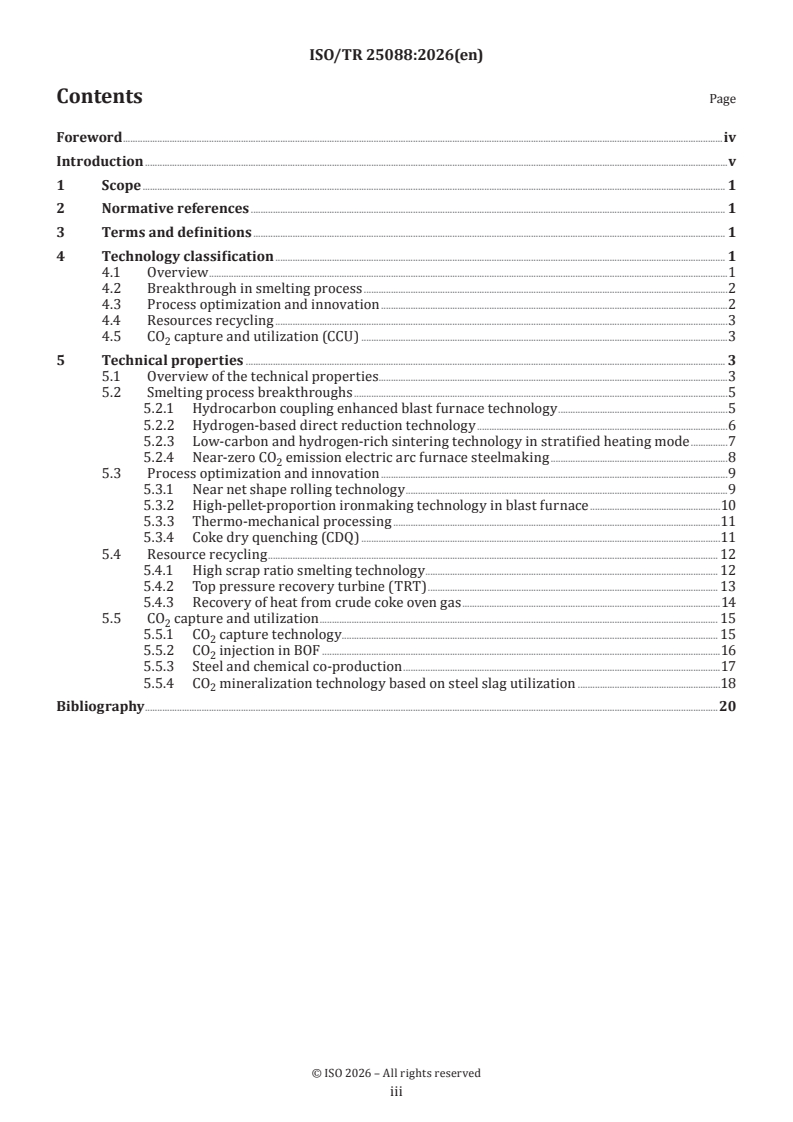
Contents Page
Foreword .iv
Introduction .v
1 Scope . 1
2 Normative references . 1
3 Terms and definitions . 1
4 Technology classification . 1
4.1 Overview .1
4.2 Breakthrough in smelting process .2
4.3 Process optimization and innovation .2
4.4 Resources recycling .3
4.5 CO capture and utilization (CCU) .3
5 Technical properties . 3
5.1 Overview of the technical properties.3
5.2 Smelting process breakthroughs .5
5.2.1 Hydrocarbon coupling enhanced blast furnace technology .5
5.2.2 Hydrogen-based direct reduction technology .6
5.2.3 Low-carbon and hydrogen-rich sintering technology in stratified heating mode .7
5.2.4 Near-zero CO emission electric arc furnace steelmaking .8
5.3 Process optimization and innovation .9
5.3.1 Near net shape rolling technology .9
5.3.2 High-pellet-proportion ironmaking technology in blast furnace .10
5.3.3 Thermo-mechanical processing .11
5.3.4 Coke dry quenching (CDQ) .11
5.4 Resource recycling . 12
5.4.1 High scrap ratio smelting technology . 12
5.4.2 Top pressure recovery turbine (TRT) . 13
5.4.3 Recovery of heat from crude coke oven gas .14
5.5 CO capture and utilization . 15
5.5.1 CO capture technology . . . 15
5.5.2 CO injection in BOF .16
5.5.3 Steel and chemical co-production .17
5.5.4 CO mineralization technology based on steel slag utilization .18
Bibliography .20
iii
Foreword
ISO (the International Organization for Standardization) is a worldwide federation of national standards
bodies (ISO member bodies). The work of preparing International Standards is normally carried out through
ISO technical committees. Each member body interested in a subject for which a technical committee
has been established has the right to be represented on that committee. International organizations,
governmental and non-governmental, in liaison with ISO, also take part in the work. ISO collaborates closely
with the International Electrotechnical Commission (IEC) on all matters of electrotechnical standardization.
The procedures used to develop this document and those intended for its further maintenance are described
in the ISO/IEC Directives, Part 1. In particular, the different approval criteria needed for the different types
of ISO document should be noted. This document was drafted in accordance with the editorial rules of the
ISO/IEC Directives, Part 2 (see www.iso.org/directives).
ISO draws attention to the possibility that the implementation of this document may involve the use of (a)
patent(s). ISO takes no position concerning the evidence, validity or applicability of any claimed patent
rights in respect thereof. As of the date of publication of this document, ISO had not received notice of (a)
patent(s) which may be required to implement this document. However, implementers are cautioned that
this may not represent the latest information, which may be obtained from the patent database available at
www.iso.org/patents. ISO shall not be held responsible for identifying any or all such patent rights.
Any trade name used in this document is information given for the convenience of users and does not
constitute an endorsement.
For an explanation of the voluntary nature of standards, the meaning of ISO specific terms and expressions
related to conformity assessment, as well as information about ISO's adherence to the World Trade
Organization (WTO) principles in the Technical Barriers to Trade (TBT), see www.iso.org/iso/foreword.html.
This document was prepared by Technical Committee ISO/TC 17, Steel, Subcommittee SC 21, Environment
related to climate change in the iron and steel industry.
Any feedback or questions on this document should be directed to the user’s national standards body. A
complete listing of these bodies can be found at www.iso.org/members.html.
iv
Introduction
With the intensification of global actions to address climate change, the iron and steel industry is
facing unprecedented pressure and challenges. It needs to achieve low-carbon transformation through
technological innovation and industrial upgrading.
Currently, several leading steel enterprises around the world have formulated low-carbon development
roadmaps, but the majority of steel companies are still in the exploratory phase. The application of low-
carbon technologies is a key pathway for the green transformation of the steel industry. In recent years,
a large number of low-carbon technologies have emerged within the industry. However, how to identify
which low-carbon technologies have significant carbon reduction effects and whether they are suitable for
enterprise application remains an urgent issue to be resolved.
Low-carbon technologies include, but are not limited to, energy efficiency improvements, the use of
alternative energy sources, carbon capture and utilization technologies, and the promotion of circular
economy models. Nevertheless, due to the lack of unified guidelines, there are differences in the selection
and application of low-carbon technologies among countries and enterprises, which not only affects the
efficiency of technology promotion but also increases the transformation costs for enterprises.
This document is formulated for the purpose of promoting the low-carbon development of the global iron
and steel industry, establishing and improving the low-carbon technology system, and driving technological
progress of the iron and steel industry.
This document stands in the global perspective, based on the current technology development and
application status, to sort out the low-carbon technology of the iron and steel industry. It encompasses
processes such as sintering, pelletizing, coking, ironmaking, steelmaking, continuous casting, rolling
and other auxiliary processes. Moreover, this document puts forward the specific technology application
guidance from the aspects of smelting process breakthroughs, resource recycling, process optimization and
innovation, and CO capture and utilization, etc. which can be used as the reference technical information
for the low-carbon development of the iron and steel industry.
Smelting process breakthroughs mainly focus on the transformative innovation in key technologies which
deviates from the constraints of traditional processes and equipment, including low-carbon blast furnace
ironmaking technology, hydrogen-based direct reduction technology, etc. Resource recycling technologies
provide the way to utilize secondary resources such as solid, liquid, and gas phase wastes generated from
the iron and steel production process by efficient recycling. Process optimization and innovation introduces
the way and technologies for innovating steel manufacturing processes and improving process efficiency by
adjusting and optimizing the process and the proportion of raw material structure and energy consumption
based on traditional processes and equipment. CO capture and utilization gives the method and application
of separating CO from the emission sources of steel manufacturing and reducing CO emissions into the
2 2
atmosphere through effective solidification, or resource utilization.
This document will help steel enterprises choose low-carbon technologies that are suitable for their own
conditions and future development trends. It will promote the global application of advanced green and low-
carbon technologies and hold significant importance for the green and low-carbon development of the global
steel industry. Due to the continuous innovation in technology, this document will also undergo regular
revisions to provide the most up-to-date guidance.
It is expected that economic aspects are taken into account for the respective technology.
v
Technical Report ISO/TR 25088:2026(en)
Guidance for the application of low-carbon technologies in
steel plants
1 Scope
This document provides an overview of low-carbon technologies for the entire production process of the iron
and steel industry, sets application in sintering, pelletizing, coking, ironmaking, steelmaking, continuous
casting, rolling and other production processes.
NOTE Low-carbon technologies in the iron and steel industry are constantly evolving. This document describes
processes in different stages of maturity. There is heterogeneity in the decarbonization pathways among the steel
enterprises. Therefore, not all low-carbon technologies covered in this document are equally applicable to all steel
plants. Low-carbon technologies in the iron and steel industry are not limited to those listed in this document. This
document will be revised as appropriate as technologies evolve.
2 Normative references
There are no normative references in this document.
3 Terms and definitions
For the purposes of this document, the following terms and definitions apply.
ISO and IEC maintain terminology databases for use in standardization at the following addresses:
— ISO Online browsing platform: available at https:// www .iso .org/ obp
— IEC Electropedia: available at https:// www .electropedia .org/
3.1
low-carbon technology
technologies that reduce net greenhouse gas emissions excluding virtual emission reductions using carbon
credits when applied
Note 1 to entry: Low-carbon technologies include Best Available Technologies (BAT), described in national/regional
BAT documents, as well as innovative technologies.
3.2
low-carbon electricity
electricity generated from low-carbon energy sources (including but not limited to solar energy, wind
power, biomass energy, geothermal energy, hydropower, nuclear power) with significantly lower emissions
of greenhouse gases than fossil fuel-based generation
Note 1 to entry: The term "fossil free electricity" is often used for the same type of electricity.
4 Technology classification
4.1 Overview
The classification of technologies includes four main categories: smelting process breakthroughs, resource
recycling, process optimization and innovation, and CO capture and utilization.
Smelting process breakthroughs mainly focus on the transformative innovation in key technologies which
deviates from the constraints of traditional processes and equipment, including low-carbon blast furnace
ironmaking technology, hydrogen-based direct reduction technology, etc.
Resource recycling technologies provide the way to utilize secondary resources such as solid, liquid, and gas
phase wastes generated from the iron and steel production process by efficient recycling.
Process optimization and innovation introduce the way and technologies for innovating steel manufacturing
processes and improving process efficiency by adjusting and optimizing the process, the raw materials and
their proportions, and the energy mix based on traditional processes and equipment.
CO capture and utilization gives the method and application of separating CO from the emission sources
2 2
of steel manufacturing and reducing CO emissions into the atmosphere through effective solidification, or
resource utilization.
When giving properties of the low-carbon technologies, including technical sophistication, feasibility,
technology maturity, and application conditions, this proposal is based on existing research and application
situations. It is expected that such characteristics will evolve over time, and this document will require
updates accordingly.
4.2 Breakthrough in smelting process
The breakthrough in smelting process deviates from the constraints of traditional process equipment, with
the goal of significantly reducing fossil carbon, and seek transformative innovation in key technologies,
achieving a breakthrough in the original smelting process towards low-carbon smelting. Breakthroughs in
smelting process focus on:
— developing melting reduction technologies, such as plasma smelting to achieve low-carbon smelting,
focusing on the research and promotion of blast furnace hydrogen-rich and gas de-carbonization cycles,
hydrogen-rich direct reduction, and biomass smelting;
— exploring new technologies for direct reduction of hydrogen-rich gas or pure hydrogen in iron-making
and establish a new DRI-EAF/SAF process route; paying attention to the reduction of carbon emissions
from steelmaking itself, continuing to develop the high-efficiency multi-energy supply technology based
on low-carbon electricity, the low-carbon clean melting technology of all scrap, DRI less slag steelmaking
and biomass carbon slag foaming technology, etc., and forming a new process of Near-zero CO emission
electric arc furnace steelmaking to achieve near-zero carbon melting process. Any new electrical melting
process is optimized to minimize electrical net perturbations;
— actively tracking new smelting processes such as alkaline solution electrolysis and molten oxide
electrolysis that replace carbon with low-carbon electricity, completely breaking through the process
route of iron-making and steel-making, and achieving low-carbon smelting.
4.3 Process optimization and innovation
Process optimization and innovation is based on existing processes and equipment, by optimizing the
proportion of raw materials and energy, the process of steel production, innovating the steel manufacturing
process, improving the efficiency of the process, and significantly reducing CO emissions. Process
optimization and innovation focus on:
— optimizing traditional process flow and reduce process energy consumption, such as low-carbon smelting
technology for optimizing the proportion of raw materials and fuels, intelligent control technology for
electric furnace steel-making, etc., to achieve carbon reduction;
— actively layout and increasing the substitution of fossil energy by renewable and clean energy sources
such as solar energy, wind energy, achieving a combination of self-generation, and self-supply with
enterprises, and continuously increasing the proportion of non-fossil energy use in production processes,
such as heating, smelting, and transportation;
— breaking traditional process flow, adopting technologies such as near net shape fully continuous rolling
(such as ESP), endless rolling, TMCP temperature controlled rolling, etc., further breaking through
core rolling technologies such as homogenization solidification and efficient rolling forming, achieving
simplicity and compactness of iron and steel casting and rolling, reducing repeated heating and forming.
4.4 Resources recycling
Resource recycling refers to the efficient reuse of solid waste, wastewater, flue gas and other resources
generated in the steel production process, through the recycling in steel or other related industries, to
achieve maximum resource value and promote pollution and carbon reduction in the iron and steel industry
and the entire society. Resource recycling focus on:
— centring on steel production, involving the orderly coordination and integration of multiple industrial
chains, including steel, petrochemicals, building materials, and chemical industries;
— strengthening the research, promotion, and application of technologies for the recycling and utilizing
recyclable resources like scrap, slag, and other solid wastes. Through technological innovations in scrap
identification, sorting, and processing, and in steel slag separation, modification, stabilization, processing
and reuse, improve and stabilize the quality and performance of products derived from metallurgical
solid waste utilization;
— establishing a comprehensive treatment and recycling technology framework for the entire process of
wastewater resources, cascade the utilization of water resources, and strengthen the efficient recycling
of wastewater;
— combining with ultra-low emission transformation, strengthening the efficient recycling and utilization
of by-products from flue gas treatment, and vigorously promote the comprehensive recycling and
utilization of waste gas resources generated by various furnaces and processes in iron and steel
production.
4.5 CO capture and utilization (CCU)
CO capture and utilization is the separation of CO from the emission sources of steel manufacturing,
2 2
solidification, or resource utilization, becoming a crucial element in achieving carbon neutrality in the iron
and steel industry. CCU focus on:
— the technologies and processes for enriching, separating, and extracting CO from various emission
sources in steel manufacturing under the premise of low cost and high efficiency;
— technologies for CO utilization in the steel production process, bio-fermentation for ethanol production
in the chemical industry, chemical catalysis for methanol production, mineralization fixation for building
materials in the building materials industry.
5 Technical properties
5.1 Overview of the technical properties
Currently applied low-carbon technologies are classified into four main categories and are shown in Table 1,
which also lists the main properties such as technology maturity, technical feasibility, etc.
Table 1 — Main properties of low-carbon technologies
Procedure of iron and steel Challenges and
Term Classification
industry constraints
Hydrocarbon coupling Insufficient hy-
Smelting process break-
enhanced blast furnace Ironmaking drogen-rich gas
throughs
b
technology resources
Insufficient hy-
Hydrogen-based direct Smelting process break-
Ironmaking drogen-rich gas
b
reduction technology throughs
resources
Low-carbon and hydro-
Insufficient hy-
gen-rich sintering technol- Smelting process break-
Sintering drogen-rich gas
ogy in stratified heating throughs
resources
a
mode
Near-zero CO emission
Smelting process break- Insufficient scrap
electric arc furnace steel- Steel making
throughs resources
a
making
Near net shape rolling Process optimization and Product structure
Rolling
a
technology innovation and market demand
High-pellet-proportion iron-
Process optimization and Stable supply of
making technology of blast Ironmaking
innovation high-grade iron ore
a
furnace
Thermal bending Process optimization and Product structure
Rolling
a
technology innovation and market demand
Process optimization and
a
Coke dry quenching (CDQ) Cokemaking —
innovation
High scrap ratio smelting Insufficient scrap
Steel making Resource recycling
b
for BOF resources
Top pressure recovery
Ironmaking Resource recycling —
a
turbine (TRT)
Recovery of heat from crude
Cokemaking Resource recycling —
a
coke oven gas
Procedures and facilities
b
CO capture technology which generates CO CO capture and utilization Excessive costs
2 2 2
such as blast furnace, lime kiln
a
CO injection in BOF Steel making CO capture and utilization —
2 2
Steel and chemical co-pro-
Auxiliary CO capture and utilization Market demand
b 2
duction
CO mineralization tech-
nology based on steel slag Steel making CO capture and utilization Production cost
b
utilization
a
Established, broad application
b
Emerging, few isolated applications
c
R&D, under development, has not left the lab scale
NOTE For CO emissions calculating method, see ISO 14404.
5.2 Smelting process breakthroughs
5.2.1 Hydrocarbon coupling enhanced blast furnace technology
5.2.1.1 Technical process
Figure 1 — Flow chart of low-carbon blast furnace
5.2.1.2 Technical principle
Hydrocarbon coupling enhanced blast furnace technology uses hydrogen-rich gas and carbon monoxide-rich
gas as gas sources. After dedusting, purification, pressurization, decarbonization and heating, it is piped in
from the blast furnace tuyere area blowing device to achieve low solid carbon consumption. The blowing
gas is blown into the blast furnace from the tuyere after pressure regulation by a compressor, and the high
concentration of H and CO in the blowing medium undergoes a reduction reaction with the iron ore in the
blast furnace with a high reduction rate, which in turn promotes indirect reduction. The heat absorption of
the hydrogen reduction process is much smaller than the reduction of heat consumption due to the reduction
of direct reduction, and the heat demand of the blast furnace is reduced on the whole, which promotes the
decrease of solid fuel consumption and realizes the carbon reduction of the blast furnace.
5.2.1.3 Technological advancement and feasibility
This technology contains three key technologies:
1) blast furnace production control technology under the condition of hydrogen-rich blast blowing;
2) equipment development of hydrocarbon coupled blowing technology system for blast furnace;
3) key technologies of hydrocarbon coupled blowing intelligent regulation and control technology.
All of them have achieved breakthroughs and innovations in engineering application, obtained reliable data
support, and realized the engineering application of complete production flow and production process,
therefore, the technology is feasible.
5.2.1.4 Conditions of technical applicability
It is applicable to new, reconstructed and expanded blast furnace high-efficiency reduction of hydrocarbon
projects, including blast furnace hydrogen-rich blowing (such as coke oven gas, natural gas, coalbed
methane, shale gas, petrochemical hydrogen-rich waste gas), blast furnace CO-rich gas blowing, blast
furnace hydrocarbon coupling gas blowing, and furnace top gas recycling process.
5.2.2 Hydrogen-based direct reduction technology
5.2.2.1 Technical process
Figure 2 — Process flow of hydrogen-based shaft furnace
Hydrogen-based direct reduction technology belongs to the non-blast furnace ironmaking process, which
is different from the blast furnace ironmaking. It adopts CO-rich or H -rich or pure H or polyhydrocarbon
2 2
gas (to be reformed into CO or H ) or other gases as the reductant, and uses pellet or/and lump ore as the
raw material, and produces the product as direct reduced iron (DRI), which is in the form of solid granules,
mainly as the raw material used in the electric furnaces for steelmaking.
5.2.2.2 Technical principle
The basic principle is the gas-solid phase reaction between H , CO and iron oxides, which is characterized
by mature technology, fast reaction speed, high productivity and good product quality. Its representative
technology is mainly based on hydrogen-based shaft furnace process.
5.2.2.3 Technological advancement and feasibility
Based on the current status quo of the global steel process (especially in developing countries), the process
of steel production will gradually change from the traditional carbon-based long process to the innovative
hydrogen-based and low-carbon electricity short process to achieve the goal of carbon neutrality. Coal-
based methods such as tunnel kiln and rotary kiln are mainly used, with backward production process, high
energy consumption and unstable product quality. From the point of view of single furnace capacity, energy
consumption and CO emission of the production unit, hydrogen-based shaft furnace has greater advantages
compared with coal-based method direct reduction process, which is more suitable for the production of
direct reduced iron for large-scale steelmaking.
5.2.2.4 Conditions of technical applicability
It is mainly applicable to iron and steel smelting scenarios with methane-rich gas (natural gas, coke oven
gas, shale gas, coal bed methane, etc.) and hydrogen as the main reductant.
5.2.3 Low-carbon and hydrogen-rich sintering technology in stratified heating mode
5.2.3.1 Technical process
Figure 3 — Process flow of low-carbon and hydrogen-rich sintering technology in stratified heating
mode
5.2.3.2 Technical principle
The low-carbon and hydrogen-rich sintering technology in stratified heating mode aims at solving the
difficulties including unreasonable material layer heating, poor temperature control during the sintering
condensation mineralization, incomplete fuel combustion, etc. in the existing sintering process. Instead of
singularly heating by coke powder combustion, it proposed a new heating method driven by synergistic
combustion of gas fuel and solid fuel. The hydrogen-rich gas fuel is fed into the material layer with its
amount varying piecewise along the direction of the trolley. By replacing the solid fuel with gas fuel, the
heat supply at the vertical height of the material layer would be finely controlled, which would dramatically
reduce energy consumption. In addition, the replacement of carbon with hydrogen for reduction has
significantly reduced the carbon consumption. Besides, by broadening the combustion zone and delaying
the condensation temperature speed, the amount of returned minerals in the process has been significantly
reduced. The above improvements of three aspects have completed technology upgrade of sintering low-
ca
...