

ISO 18173:2026
(Main)Non-destructive testing — General terms and definitions
- Abstract
This document defines general technical terms used in many non-destructive testing disciplines.
- Status
- Published
- Publication Date
- 08-Jun-2026
- Technical Committee
- ISO/TC 135 - Non-destructive testing
- Drafting Committee
- ISO/TC 135 - Non-destructive testing
- Current Stage
- 6060 - International Standard published
- Start Date
- 09-Jun-2026
- Due Date
- 02-Feb-2026
- Completion Date
- 09-Jun-2026
ISO 18173:2026 is an ISO International Standard for non-destructive testing (NDT). It defines general technical terms used across many NDT disciplines, so readers can use the same language for inspection, interpretation, evaluation, and reporting.
What does ISO 18173:2026 specify?
ISO 18173:2026 specifies general technical terms and definitions for NDT. It is organized into three clauses: Scope, Normative references, and Terms and definitions.
The scope is broad on purpose. The document covers vocabulary used in many NDT disciplines, rather than a single test method, so it helps align wording across different methods, standards, codes, and specifications.
What are the key requirements of ISO 18173:2026?
ISO 18173:2026 is a terminology standard, so its main content is the controlled meaning of NDT terms. In practice, that matters because the same words are used when writing procedures, judging indications, setting acceptance thresholds, and documenting results.
Core evaluation language
- Acceptance criteria and acceptance level define the basis for deciding whether a test object is acceptable. In practice, these terms matter when a buyer, inspector, or quality manager needs a clear pass/fail basis.
- Evaluation, relevant indication, non-relevant indication, and false indication separate signals that need action from signals that do not. This helps avoid rejecting a part for a signal that is not tied to a meaningful discontinuity.
- Indication is the signal or representation produced by an NDT method. In practice, it is the starting point for deciding whether further interpretation or evaluation is needed.
Defects, flaws, and discontinuities
- Discontinuity, imperfection, flaw, and defect are distinguished from one another. The document treats a flaw as an imperfection or unintentional discontinuity that can be detected by NDT, while a defect is a flaw or group of flaws that fails the specified acceptance criteria.
- This distinction matters because not every indication becomes a rejectable defect. The terminology supports a controlled decision path from detection to acceptance.
Methods, procedures, and techniques
- NDT method means a discipline applying a physical principle, and NDT technique means a specific way of using that method. For users, this helps separate the general method from the exact way it is applied.
- NDT procedure is the written description of the essential parameters and precautions to be followed. In practice, this is the document people use to run the work consistently and in line with standards, codes, or specifications.
Equipment response and traceability
- Calibration, standardization, and reference block describe how instruments are checked or adjusted against known references. This matters because repeatable response is needed before results can be trusted.
- The standard also defines recording as a stored presentation of test results and instrument settings. That supports traceability in quality systems and reporting.
Performance of the test
- Detection sensitivity, detection threshold, resolution, signal-to-noise ratio, and sizing describe how well an NDT method can find and characterize flaws. In practice, these terms are used when judging whether a method can detect small discontinuities and how much detail it can reliably separate.
- Noise is the unwanted signal that can interfere with the test or its results. Recognizing noise matters because it can mask real indications or create uncertainty.
What terms does ISO 18173:2026 define?
- NDT - Non-destructive testing: development and application of methods that do not impair future usefulness and serviceability.
- Acceptance criteria - The rules used to decide whether a test object is acceptable.
- Flaw - An imperfection or unintentional discontinuity that can be detected by NDT and is not necessarily rejectable.
- Indication - The signal or representation produced in the format allowed by the NDT method.
- Reference block - A known material piece used to set, check, assess, or quantify equipment response.
- Standardization - Adjustment of an NDT instrument using an appropriate reference block to obtain a known and reproducible response.
- Signal-to-noise ratio - The ratio of the signal from a discontinuity to the nearby average noise.
Who uses ISO 18173:2026?
ISO 18173:2026 is used by people who write, read, or apply NDT procedures and specifications. That includes NDT practitioners, procedure writers, inspectors, and quality personnel who need shared meanings for terms such as indication, evaluation, flaw, and acceptance criteria.
It is also useful in commerce and industry when the same terminology has to work across different NDT disciplines. The document supports standardization work, training, reporting, and discussions between users, suppliers, and testing organizations.
What changed in ISO 18173:2026 from the previous edition?
ISO 18173:2026 is the first edition and cancels and replaces the first edition of ISO/TS 18173:2005. The foreword states that the terms and definitions have been technically revised and harmonized with ISO/TS 18173:2005, EN 1330-2:1998, and ASTM E1316-13c.
What does the ISO 18173:2026 document contain?
ISO 18173:2026 contains a short front matter section, a foreword, an introduction, and Clause 3 with the terms and definitions. Clause 3 provides the vocabulary used to describe evaluation, detection, interpretation, recording, calibration, standardization, and related NDT activities.
The document is a terminology reference rather than a test method or a procedure standard. Its practical value is in giving users a common language for specifications, procedures, training materials, and inspection records.
The foreword also identifies ISO/TC 135, Non-destructive testing, as the technical committee responsible for the document.
Relations
- Effective Date
- 06-Jun-2022
Get Certified
Connect with accredited certification bodies for this standard

IMP NDT d.o.o.
Non-destructive testing services. Radiography, ultrasonic, magnetic particle, penetrant, visual inspection.
Inštitut za kovinske materiale in tehnologije
Institute of Metals and Technology. Materials testing, metallurgical analysis, NDT.
Q Techna d.o.o.
NDT and quality assurance specialist. 30+ years experience. NDT personnel certification per ISO 9712, nuclear and thermal power plant inspections, QA/
Sponsored listings
Frequently Asked Questions
ISO 18173:2026 is a standard published by the International Organization for Standardization (ISO). Its full title is "Non-destructive testing — General terms and definitions". This standard covers: This document defines general technical terms used in many non-destructive testing disciplines.
This document defines general technical terms used in many non-destructive testing disciplines.
ISO 18173:2026 is classified under the following ICS (International Classification for Standards) categories: 01.040.19 - Testing (Vocabularies); 19.100 - Non-destructive testing. The ICS classification helps identify the subject area and facilitates finding related standards.
ISO 18173:2026 has the following relationships with other standards: It is inter standard links to ISO/TS 18173:2005. Understanding these relationships helps ensure you are using the most current and applicable version of the standard.
ISO 18173:2026 is available in PDF format for immediate download after purchase. The document can be added to your cart and obtained through the secure checkout process. Digital delivery ensures instant access to the complete standard document.
Standards Content (Sample)
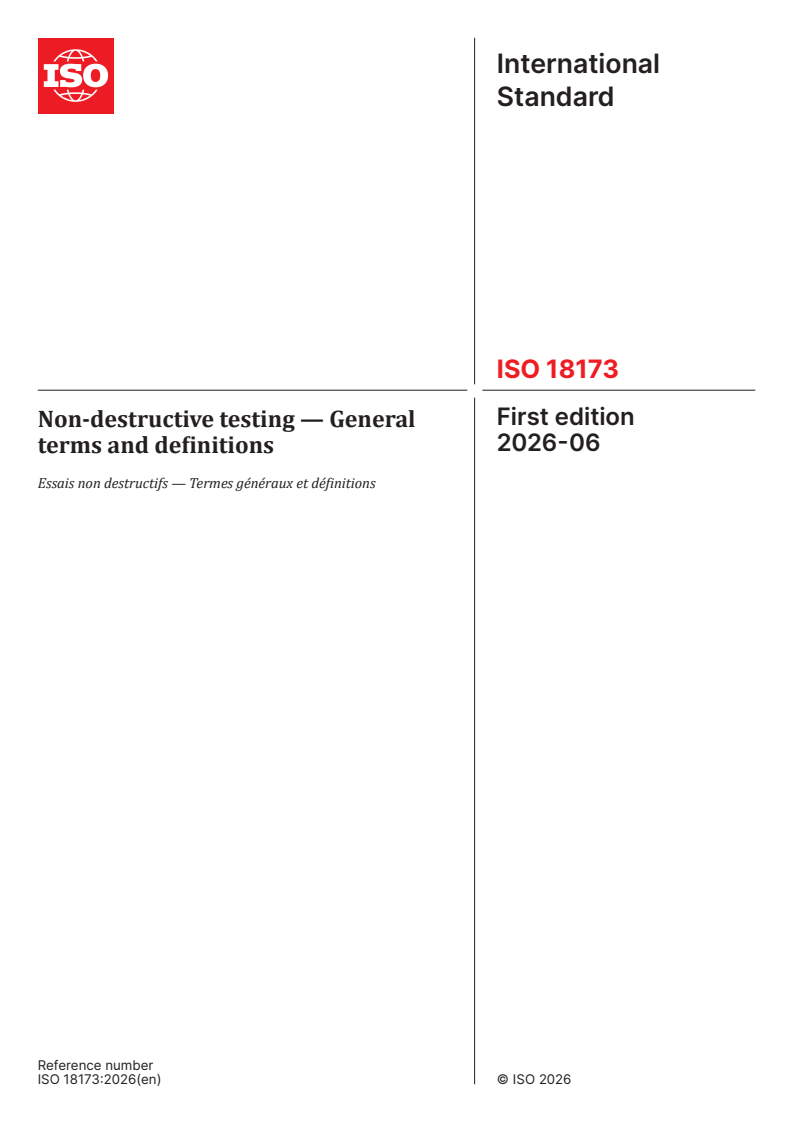
International
Standard
ISO 18173
First edition
Non-destructive testing — General
2026-06
terms and definitions
Essais non destructifs — Termes généraux et définitions
Reference number
© ISO 2026
All rights reserved. Unless otherwise specified, or required in the context of its implementation, no part of this publication may
be reproduced or utilized otherwise in any form or by any means, electronic or mechanical, including photocopying, or posting on
the internet or an intranet, without prior written permission. Permission can be requested from either ISO at the address below
or ISO’s member body in the country of the requester.
ISO copyright office
CP 401 • Ch. de Blandonnet 8
CH-1214 Vernier, Geneva
Phone: +41 22 749 01 11
Email: copyright@iso.org
Website: www.iso.org
Published in Switzerland
ii
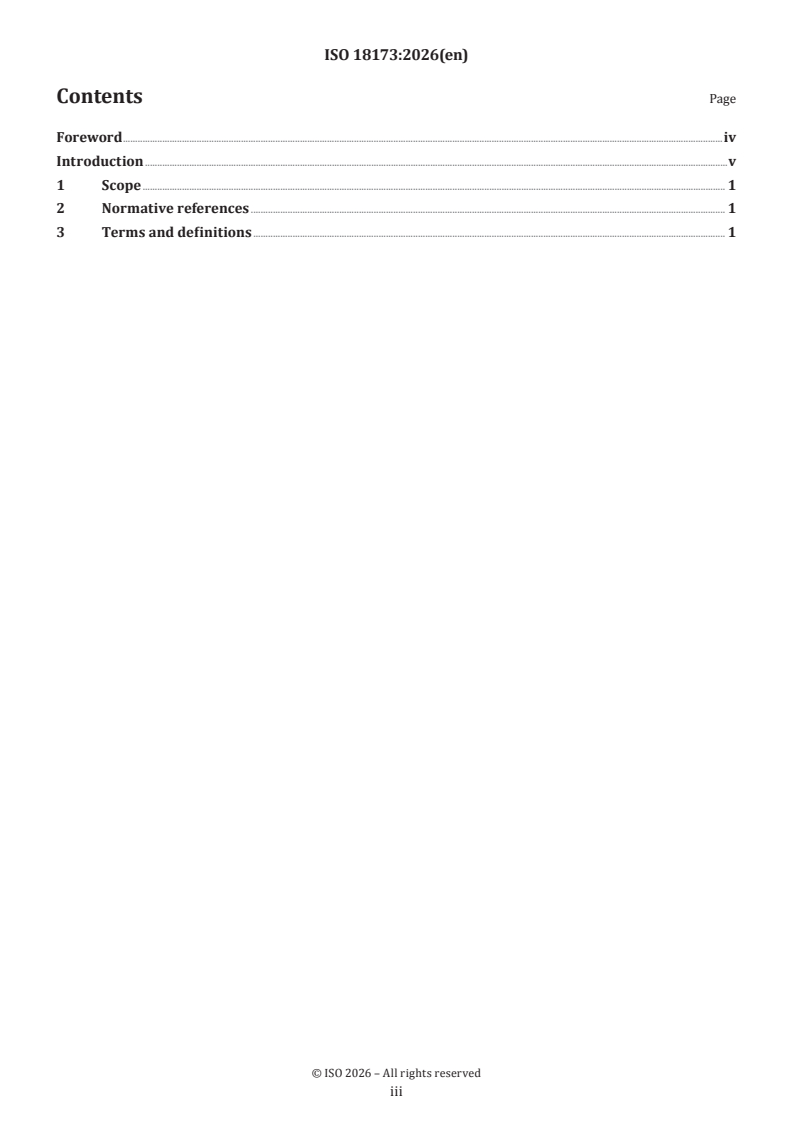
Contents Page
Foreword .iv
Introduction .v
1 Scope . 1
2 Normative references . 1
3 Terms and definitions . 1
iii
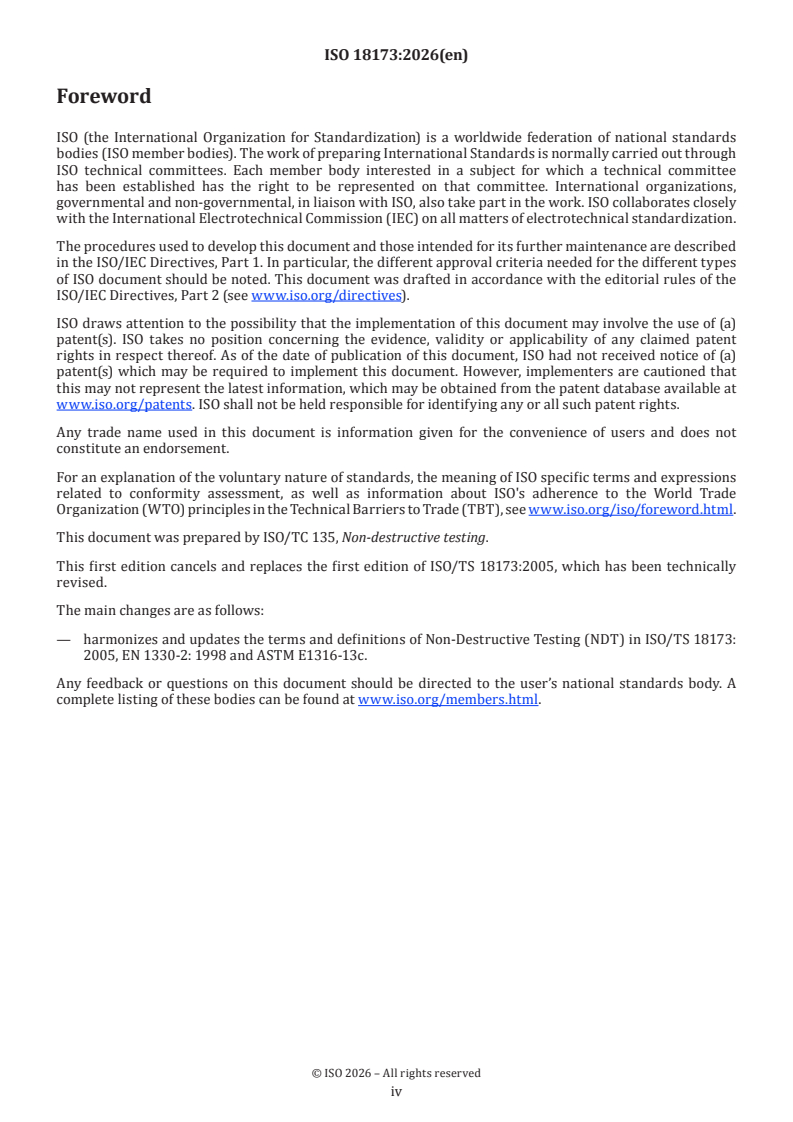
Foreword
ISO (the International Organization for Standardization) is a worldwide federation of national standards
bodies (ISO member bodies). The work of preparing International Standards is normally carried out through
ISO technical committees. Each member body interested in a subject for which a technical committee
has been established has the right to be represented on that committee. International organizations,
governmental and non-governmental, in liaison with ISO, also take part in the work. ISO collaborates closely
with the International Electrotechnical Commission (IEC) on all matters of electrotechnical standardization.
The procedures used to develop this document and those intended for its further maintenance are described
in the ISO/IEC Directives, Part 1. In particular, the different approval criteria needed for the different types
of ISO document should be noted. This document was drafted in accordance with the editorial rules of the
ISO/IEC Directives, Part 2 (see www.iso.org/directives).
ISO draws attention to the possibility that the implementation of this document may involve the use of (a)
patent(s). ISO takes no position concerning the evidence, validity or applicability of any claimed patent
rights in respect thereof. As of the date of publication of this document, ISO had not received notice of (a)
patent(s) which may be required to implement this document. However, implementers are cautioned that
this may not represent the latest information, which may be obtained from the patent database available at
www.iso.org/patents. ISO shall not be held responsible for identifying any or all such patent rights.
Any trade name used in this document is information given for the convenience of users and does not
constitute an endorsement.
For an explanation of the voluntary nature of standards, the meaning of ISO specific terms and expressions
related to conformity assessment, as well as information about ISO's adherence to the World Trade
Organization (WTO) principles in the Technical Barriers to Trade (TBT), see www.iso.org/iso/foreword.html.
This document was prepared by ISO/TC 135, Non-destructive testing.
This first edition cancels and replaces the first edition of ISO/TS 18173:2005, which has been technically
revised.
The main changes are as follows:
— harmonizes and updates the terms and definitions of Non-Destructive Testing (NDT) in ISO/TS 18173:
2005, EN 1330-2: 1998 and ASTM E1316-13c.
Any feedback or questions on this document should be directed to the user’s national standards body. A
complete listing of these bodies can be found at www.iso.org/members.html.
iv
Introduction
This document defines the general technical terms that are used in many non-destructive testing disciplines.
These terms are not usually defined in the standards pertaining to individual non-destructive test
methods. Thus, the terms and definitions in this document serve to establish a common basis for further
standardization and general use in the field of non-destructive testing and thereby provide for enhanced
understanding in commerce and industry.
v
International Standard ISO 18173:2026(en)
Non-destructive testing — General terms and definitions
1 Sc
...