

ISO 23949:2023
(Main)Plastics — Application of spread of flame test to plastic pipes
General Information
- Abstract
This document specifies test methods for assessing the flame spread of plastic pipes including fiberglass reinforced plastic (FRP) pipes. This document is applicable to plastic pipes including FRP pipes for use in ships, air crafts and vehicles.
- Status
- Published
- Publication Date
- 17-Apr-2023
- Technical Committee
- ISO/TC 61/SC 4 - Burning behaviour
- Drafting Committee
- ISO/TC 61/SC 4/WG 9 - Composites and semi-finished products
- Current Stage
- 6060 - International Standard published
- Start Date
- 18-Apr-2023
- Due Date
- 21-Jul-2023
- Completion Date
- 18-Apr-2023
Overview
ISO 23949:2023 - Plastics - Application of spread of flame test to plastic pipes - specifies how to assess surface flame spread for plastic pipes, including fiberglass reinforced plastic (FRP) pipes, primarily for use in ships, aircraft and vehicles. The standard adapts the lateral spread test of ISO 5658-2:2006 to pipe geometries and provides detailed specimen preparation, conditioning, test procedures and reporting requirements to ensure repeatable reaction-to-fire results.
Key topics and technical requirements
- Test principle: Uses the ISO 5658-2 lateral spread-of-flame method with additional pipe-specific protocols (radiant heat flux exposure, time-to-ignition, lateral spread and extinguishment observations).
- Specimen preparation:
- Pipe sections cut to 800 mm length.
- For rigid pipes: lateral cutting rules depending on inner diameter (e.g., curvature height ≤ 5 mm if ID > 10 mm; split into two parts if 5 mm < ID ≤ 10 mm; full section used if ID ≤ 5 mm).
- Wall thickness: test at full thickness if ≤ 40 mm; reduce unexposed face to 40 mm if > 40 mm (record original thickness).
- Assembly: place sections side-by-side on a non-combustible backing board (155 mm × 800 mm, 20 mm thick, nominal density 900 ± 100 kg/m³) and secure with thin metal wires or wire mesh where deformation can occur.
- Number of specimens: At least six specimens unless agreed otherwise.
- Conditioning: Constant mass at (23 ± 2) °C and (50 ± 5) % RH; constant mass defined by two weighings 24 h apart differing by ≤ 0.1% or 0.1 g.
- Test execution: Use ISO 5658-2 apparatus and calibration; account for possible large fume/gas production for thick-walled pipes and ensure adequate exhaust.
- Results and calculations: Derive average heat for sustained burning (Qsb) and critical heat flux at extinguishment (CFE) per ISO 5658-2.
- Reporting: Include time to reach standard 50 mm positions, observations, derived characteristics (Q and C), specimen description, test conditions, number of specimens, ignition time and limitations.
Applications and practical value
- Ensures consistent, repeatable assessment of flame spread on plastic and FRP piping used in maritime, aviation, automotive and land-based installations.
- Supports product development, material selection and compliance evidence for designers, shipbuilders, aircraft and vehicle manufacturers, and fire safety engineers.
- Useful for manufacturers and testing laboratories seeking standardized methods to demonstrate fire performance of pipe systems and to inform risk assessments and regulatory submissions.
Who should use this standard
- Pipe and composite (FRP) manufacturers
- Accredited fire testing laboratories
- Maritime, aviation and automotive OEMs and suppliers
- Fire safety engineers, certification bodies and regulators
Related standards
- ISO 5658-2:2006 - Reaction-to-fire tests - Spread of flame - Part 2 (lateral spread)
- ISO 13943 - Fire safety - Vocabulary
- IMO guidelines on use of plastic pipes (referenced in the introduction)
Keywords: ISO 23949:2023, spread of flame test, plastic pipes, FRP pipes, ISO 5658-2, flame spread, reaction-to-fire, pipe fire testing, maritime fire safety.
Get Certified
Connect with accredited certification bodies for this standard

DIN CERTCO
DIN Group product certification.
CIS Institut d.o.o.
Personal Protective Equipment (PPE) certification body. Notified Body NB-2890 for EU Regulation 2016/425 PPE.
Institut za varilstvo d.o.o. (Welding Institute)
Slovenia's leading welding institute since 1952. ISO 3834, EN 1090, pressure equipment certification, NDT personnel, welder qualification. Only IIW Au
Sponsored listings
Frequently Asked Questions
ISO 23949:2023 is a standard published by the International Organization for Standardization (ISO). Its full title is "Plastics — Application of spread of flame test to plastic pipes". This standard covers: This document specifies test methods for assessing the flame spread of plastic pipes including fiberglass reinforced plastic (FRP) pipes. This document is applicable to plastic pipes including FRP pipes for use in ships, air crafts and vehicles.
This document specifies test methods for assessing the flame spread of plastic pipes including fiberglass reinforced plastic (FRP) pipes. This document is applicable to plastic pipes including FRP pipes for use in ships, air crafts and vehicles.
ISO 23949:2023 is classified under the following ICS (International Classification for Standards) categories: 13.220.40 - Ignitability and burning behaviour of materials and products; 23.040.20 - Plastics pipes; 83.080.01 - Plastics in general. The ICS classification helps identify the subject area and facilitates finding related standards.
ISO 23949:2023 is available in PDF format for immediate download after purchase. The document can be added to your cart and obtained through the secure checkout process. Digital delivery ensures instant access to the complete standard document.
Standards Content (Sample)
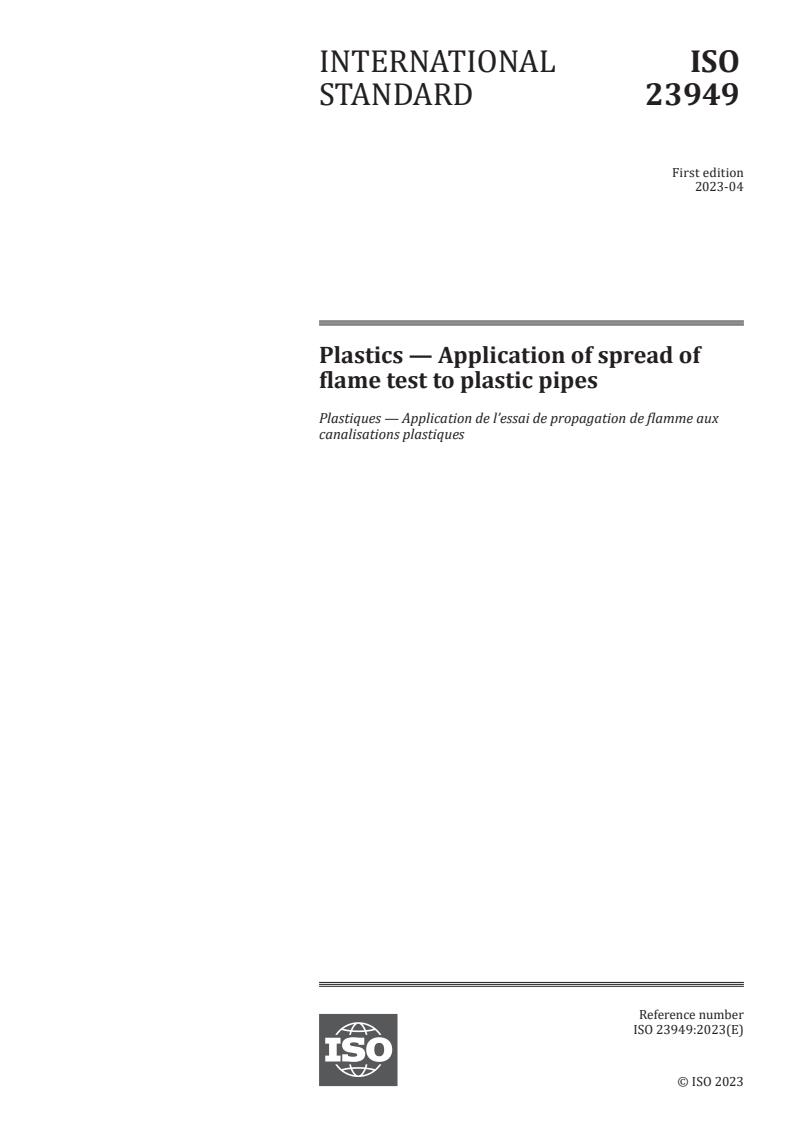
INTERNATIONAL ISO
STANDARD 23949
First edition
2023-04
Plastics — Application of spread of
flame test to plastic pipes
Plastiques — Application de l’essai de propagation de flamme aux
canalisations plastiques
Reference number
© ISO 2023
All rights reserved. Unless otherwise specified, or required in the context of its implementation, no part of this publication may
be reproduced or utilized otherwise in any form or by any means, electronic or mechanical, including photocopying, or posting on
the internet or an intranet, without prior written permission. Permission can be requested from either ISO at the address below
or ISO’s member body in the country of the requester.
ISO copyright office
CP 401 • Ch. de Blandonnet 8
CH-1214 Vernier, Geneva
Phone: +41 22 749 01 11
Email: copyright@iso.org
Website: www.iso.org
Published in Switzerland
ii
Contents Page
Foreword .iv
Introduction .v
1 Scope . 1
2 Normative references . 1
3 Terms and definitions . 1
4 Principle . 1
5 Test apparatus .1
6 Test specimen . 2
6.1 General . 2
6.2 Number of test specimens . 2
6.3 Thickness of the test specimen . 2
6.4 Rigid pipes . 2
6.5 Flexible pipes . 4
7 Conditioning of specimens . 4
8 Test procedures . 4
8.1 General . 4
8.2 Additional test procedures for pipes . 4
9 Calculation of the test results . 5
10 Precision of the test .5
11 Test report . 5
Annex A (informative) Example of the test results on plastic pipes . 7
Bibliography .10
iii
Foreword
ISO (the International Organization for Standardization) is a worldwide federation of national standards
bodies (ISO member bodies). The work of preparing International Standards is normally carried out
through ISO technical committees. Each member body interested in a subject for which a technical
committee has been established has the right to be represented on that committee. International
organizations, governmental and non-governmental, in liaison with ISO, also take part in the work.
ISO collaborates closely with the International Electrotechnical Commission (IEC) on all matters of
electrotechnical standardization.
The procedures used to develop this document and those intended for its further maintenance are
described in the ISO/IEC Directives, Part 1. In particular, the different approval criteria needed for the
different types of ISO document should be noted. This document was drafted in accordance with the
editorial rules of the ISO/IEC Directives, Part 2 (see www.iso.org/directives).
ISO draws attention to the possibility that the implementation of this document may involve the use
of (a) patent(s). ISO takes no position concerning the evidence, validity or applicability of any claimed
patent rights in respect thereof. As of the date of publication of this document, ISO had not received
notice of (a) patent(s) which may be required to implement this document. However, implementers are
cautioned that this may not represent the latest information, which may be obtained from the patent
database available at www.iso.org/patents. ISO shall not be held responsible for identifying any or all
such patent rights.
Any trade name used in this document is information given for the convenience of users and does not
constitute an endorsement.
For an explanation of the voluntary nature of standards, the meaning of ISO specific terms and
expressions related to conformity assessment, as well as information about ISO's adherence to
the World Trade Organization (WTO) principles in the Technical Barriers to Trade (TBT), see
www.iso.org/iso/foreword.html.
This document was prepared by Technical Committee ISO/TC 61 Plastics, Subcommittee SC 4, Burning
behaviour.
Any feedback or questions on this document should be directed to the user’s national standards body. A
complete listing of these bodies can be found at www.iso.org/members.html.
iv
Introduction
Plastic pipes and fiberglass reinforced plastic (FRP) pipes exhibit corrosion resistance against water
including sea water and liquid chemicals. These pipes have been used on ships in various applications,
such as piping supplying fresh water, sanitary and drain piping, sea-water piping and liquid cargo
piping.
The International Maritime Organization (IMO) adopted guidelines on use of plastic pipes (see
Reference [1]). These guidelines contain requirements on the fire performance of plastic pipes and of
FRP pipes to be used on-board ships. These guidelines also contain brief explanation of test procedures
applicable to flame spread for plastics pipes and FRP pipes. However, the details provided regarding
these fire tests are very short and are insufficient to conduct these tests in a uniform manner.
This document was developed based on the IMO Guidelines, ISO 5658-2:2006, Annex E and the NATO
[2]
Reaction-to-fire tests for materials surface spread of flame (see AFAP – 4 Edition 3 ). It provides
detailed descriptions of the test methods for assessing the flame spread of plastic pipes and FRP pipes.
This document is applicable, on a voluntary basis, to plastic pipes and to FRP pipes for use in ships, air
crafts, vehicles, building and land-based structures.
v
INTERNATIONAL STANDARD ISO 23949:2023(E)
Plastics — Application of spread of flame test to plastic
pipes
1 Scope
This document specifies test methods for assessing the flame spread of plastic pipes including fiberglass
reinforced plastic (FRP) pipes. This document is applicable to plastic pipes including FRP pipes for use
in ships, air crafts and vehicles.
2 Normative references
The following documents are referred to in the text in such a way that some or all of their content
constitutes requirements of this document. For dated references, only the edition cited applies. For
undated references, the latest edition of the referenced document (including any amendments) applies.
ISO 5658-2:2006, Reaction to fire tests — Spread of flame — Part 2: Lateral spread on building and
transport products in vertical configuration
ISO 13943, Fire safety — Vocabulary
3 Terms and definitions
For the purposes of this document, the terms and definitions given in ISO 5658-2, ISO 13943 apply.
ISO and IEC maintain terminological databases for use in standardization at the following addresses:
— ISO Online browsing platform: available at https:// www .iso .org/ obp
— IEC Electropedia: available at https:// www .electropedia .org/
4 Principle
The test procedure in this document uses the test method given in ISO 5658-2 to evaluate the surface
spread of flame characteristics of test specimens. Additional test protocols and procedures for testing
plastic pipes are also specified in this document.
The test specimen is constructed in such a way that plastic pipes are cut to a length of 800 mm. The
length of cut pipes are further cut laterally. The cut pipe sections are placed side by side on a non-
combustible backing board, with dimensions of 155 mm wide and 800 mm long. The test specimens are
secured by means of narrow metal wires. The test specimen is exposed to a graded radiant heat flux
field, as specified in ISO 5658-2.
Data on critical heat flux at extinguishment and average heat for sustained burning are derived from
observations of time to ignition, lateral spread and extinguishment of flame along the surface of the
test specimen which is exposed such that the surface is vertical and the longer edge in horizontal.
...