

ISO 21886:2026
(Main)Space systems — Configuration management
- Abstract
This document defines the contents, methods and requirements of configuration management for space projects, and the responsibilities and authorities of related parties. It is intended to be used in conjunction with ISO 14300-1:2023, Clause 10. This document is applicable to the configuration management of space projects from the mission analysis phase to the disposal phase.
- Status
- Published
- Publication Date
- 01-Sep-2026
- Technical Committee
- ISO/TC 20/SC 14 - Space systems and operations
- Drafting Committee
- ISO/TC 20/SC 14/WG 5 - Space System Program Management and Quality
- Current Stage
- 6060 - International Standard published - 60 Publication
- Start Date
- 02-Sep-2026
- Due Date
- 25-Feb-2027
- Completion Date
- 25-Feb-2027
ISO 21886:2026 is an International Standard published by ISO for space systems configuration management. It specifies the contents, methods and responsibilities for controlling configuration across space projects, from mission analysis through disposal, and it is intended to be used with ISO 14300-1:2023, Clause 10.
It is written for suppliers, customers and project teams that need a controlled record of requirements, design, changes, verification and audits. In practice, it tells them what to plan, what to identify, what to approve, and how to keep the product configuration traceable.
What does ISO 21886:2026 specify?
ISO 21886:2026 specifies the configuration management framework for space projects and organizes it into planning, identification, control, status accounting, verification, audit and configuration control board activities. It applies across the life cycle of a space project, from mission analysis to disposal.
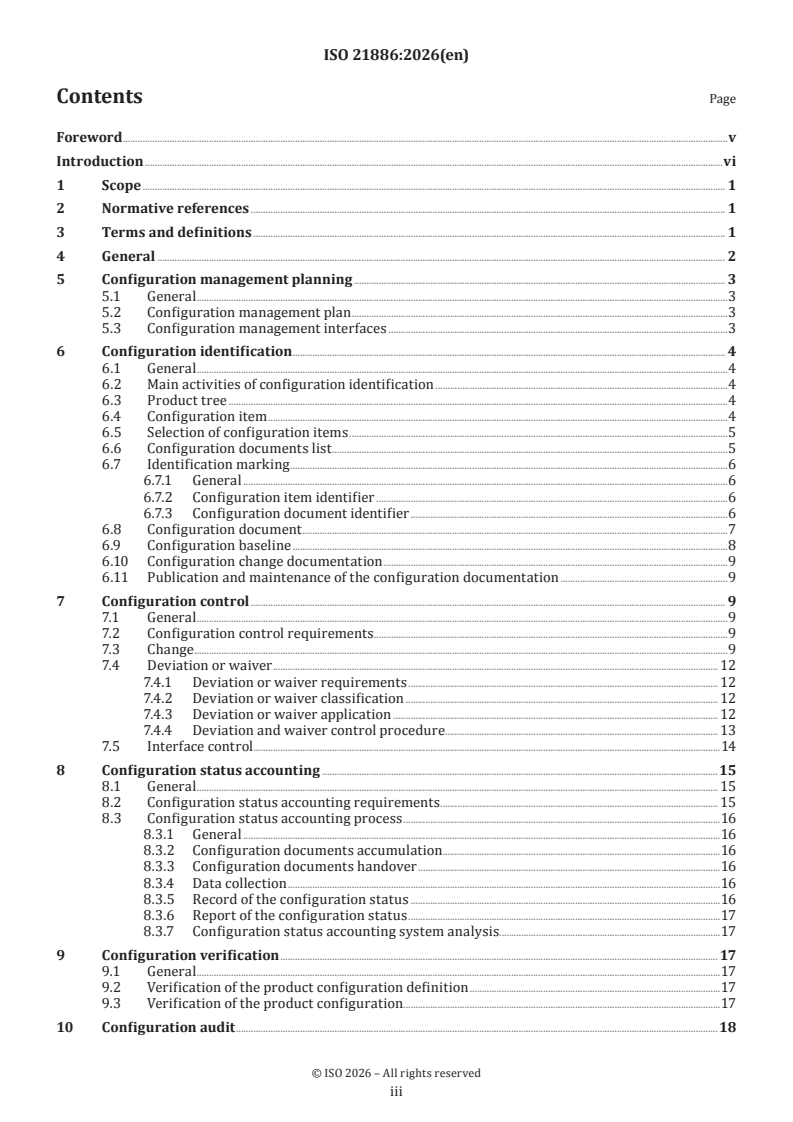
The document is structured into 11 clauses and 3 informative annexes. The annexes support planning, the link with information and documentation management, and configuration status accounting reports.
| Annex | What it covers |
|---|---|
| Annex A | Structure and content of a configuration management plan |
| Annex B | Configuration management and its link with information or documentation management |
| Annex C | Configuration status accounting reports |
What are the key requirements of ISO 21886:2026?
ISO 21886:2026 requires configuration management to be planned, controlled and updated throughout the product life cycle. It also requires the customer and supplier to define responsibilities, approve the right documents, and keep the configuration of the delivered product traceable to its requirements.
Planning and organization
- Clause 4 requires configuration management to be applied throughout the life cycle and improved as the project develops. In practice, this means CM is not a one-time document set-up task - it is maintained from early project work to disposal.
- Clause 4.2 requires a configuration control board (CCB) made up of representatives from the relevant disciplines, with decision-making authority. This matters because changes must be judged by people who understand technical, contractual and program effects.
- Clause 4.3 requires each supplier to prepare a configuration management (CM) plan and submit it to the customer for approval when required. The plan has to cover objectives, responsibilities and phase-by-phase requirements.
Configuration identification and baselines
- Clause 6 requires the project to build a product tree, select configuration items, define identifiers and prepare a configuration documents list. This gives the project a controlled structure for knowing exactly what is being managed.
- Clause 6.5 emphasizes early selection of configuration items, with upper-level items chosen early and lower-level items selected as the life cycle begins. In practice, that means the team should not wait until late design or production to decide what is under configuration control.
- Clause 6.8 and 6.9 require configuration documents and baselines to grow from functional to development to product definition, with clear precedence if the documents conflict. This helps teams control requirements drift and know which approved definition governs the work.
Change, deviation, waiver and interface control
- Clause 7 starts configuration control at the functional baseline and keeps it running for the whole life cycle. All changes, deviations and waivers must be described, justified, assessed and implemented in control.
- Clause 7.3 separates changes into class 1 and class 2. Class 1 changes go to the CCB, while class 2 changes are handled under internal control. For the reader, this means major impacts must be escalated, while smaller changes can be handled within the supplier’s own process.
- Clause 7.4 treats deviations and waivers separately and distinguishes major from minor cases. Major cases involve safety, reliability, interfaces, critical physical characteristics and similar effects, so they need stronger review and, in some cases, customer approval.
- Clause 7.5 makes interface control part of configuration control. This is important because space projects rely on many linked items, and a change to one item can affect function, fit or compatibility elsewhere.
Status accounting, verification and audit
- Clause 8 requires configuration status accounting to record approved documents, changes, deviations, waivers and audit results. This gives management visibility of what is approved, what has changed and what still needs action.
- Clause 9 requires verification of the configuration definition at SRR, PDR and CDR, and verification of the product configuration by comparing as-designed and as-built states. The document uses ADCL and ABCL to support that comparison.
- Clause 10 requires functional configuration audit and physical configuration audit. These audits check that the product matches its approved documents, that changes were properly incorporated, and that the final item matches the required functional and physical definition.
- Clause 11 defines the CCB as the authority that reviews change necessity, evaluates effects, and advises on approval of changes, deviations and waivers. This is the decision point that keeps configuration control consistent across the project.
What terms does ISO 21886:2026 define?
- Configuration - the combined functional and physical characteristics of a product or service as defined in configuration documents.
- Configuration management (CM) - the activity of keeping consistent records of a product’s status and changes against its design and operational requirements.
- Configuration item - a hardware, software, material, service, or part of one of these, selected to be managed as a single entity.
- Configuration document - a document that defines the requirements for a configuration item’s function, design, build, production and verification.
- Configuration baseline - an approved set of requirements and design data at a project milestone that becomes the reference point for later work.
- Change control - the activity of controlling changes, deviations and waivers after a baseline has been approved.
- Configuration control board (CCB) - the decision-making body that reviews configuration status and approves or rejects changes, deviations and waivers.
- As-designed configuration list (ADCL) and as-built configuration list (ABCL) - lists used in configuration verification to compare the intended definition with the delivered item.
Who uses ISO 21886:2026?
ISO 21886:2026 is used by space project organizations, suppliers, customers, manufacturers and sub-suppliers that need a controlled configuration process. It is especially relevant to configuration managers, project managers, engineering, product assurance, manufacturing, and information or documentation management teams.
These users apply it when they define configuration items, build baselines, process changes, record status, perform audits, and verify that the product matches its approved definition. It is also useful for CCB members who must review technical and contractual effects before approving major changes, deviations or waivers.
What changed in ISO 21886:2026 from the previous edition?
ISO 21886:2026 is the second edition and cancels and replaces ISO 21886:2019. The main change stated in the document is a revision of the descriptions of class 2 in 7.3.1.3 to ensure consistency.
Which standards are used with ISO 21886:2026?
- ISO 14300-1:2023 - named in the scope as the companion document, and used with this standard in Clause 10 of ISO 14300-1.
- ISO 10007 - provides quality management guidelines for configuration management.
- ISO 10795 - provides vocabulary for space systems programme management and quality.
- ISO 21351 - used in Clause 6.8.3 for functional and technical specifications.
- ISO 27026 - used in Clause 6.2 for breakdown of project management structures.
What does the ISO 21886:2026 document contain?
ISO 21886:2026 contains the planning rules, identification methods, control procedures, accounting process, verification steps and audit requirements needed to run configuration management on a space project. It also sets out how to build and maintain the CM plan, how to name configuration items and documents, and how to classify and process changes, deviations and waivers.
Annex A gives the recommended structure and content of a configuration management plan, including general information, policies, identification, change control, status accounting and audit. Annex B shows the relationship between configuration management and information or documentation management. Annex C lists the usual content of configuration status accounting reports, including document indexes, deviation and waiver lists, change proposal status, and review item discrepancies.
The body of the standard also describes practical working documents such as the product tree, configuration documents list, configuration change documentation, ADCL and ABCL, and audit meeting minutes. That makes the document useful for day-to-day control work, project reviews, supplier coordination and final acceptance activities.
Relations
- Effective Date
- 01-Mar-2025
Get Certified
Connect with accredited certification bodies for this standard

BUREAU VERITAS Certification Germany
Bureau Veritas certification in Germany.

Element Materials Technology
Materials testing and product certification.

AQMS Ltd.
AQMS provides ISO certification to SMEs across the UK.
Sponsored listings
Frequently Asked Questions
ISO 21886:2026 is a standard published by the International Organization for Standardization (ISO). Its full title is "Space systems — Configuration management". This standard covers: This document defines the contents, methods and requirements of configuration management for space projects, and the responsibilities and authorities of related parties. It is intended to be used in conjunction with ISO 14300-1:2023, Clause 10. This document is applicable to the configuration management of space projects from the mission analysis phase to the disposal phase.
This document defines the contents, methods and requirements of configuration management for space projects, and the responsibilities and authorities of related parties. It is intended to be used in conjunction with ISO 14300-1:2023, Clause 10. This document is applicable to the configuration management of space projects from the mission analysis phase to the disposal phase.
ISO 21886:2026 is classified under the following ICS (International Classification for Standards) categories: 49.140 - Space systems and operations. The ICS classification helps identify the subject area and facilitates finding related standards.
ISO 21886:2026 has the following relationships with other standards: It is inter standard links to ISO 21886:2019. Understanding these relationships helps ensure you are using the most current and applicable version of the standard.
ISO 21886:2026 is available in PDF format for immediate download after purchase. The document can be added to your cart and obtained through the secure checkout process. Digital delivery ensures instant access to the complete standard document.
Standards Content (Sample)
Contents
- Introduction
- 1 Scope
- 2 Normative references
- 3 Terms and definitions
- 3.1 configuration
- 3.1.1 functional characteristic
- 3.1.2 physical characteristic
- 3.2 configuration management
- 3.3 configuration item
- 3.4 configuration document
- 3.5 configuration baseline
- 3.6 change control
- 3.7 change
- 4 General
- 4.4 Configuration management interfaces with engineering, product assurance, manufacturing and
- 5 Configuration management planning
- 5.1 General
- 5.2 Configuration management plan
- 5.3 Configuration management interfaces
- 6 Configuration identification
- 6.1 General
- 6.2 Main activities of configuration identification
- 6.3 Product tree
- 6.4 Configuration item
- 6.5 Selection of configuration items
- 6.6 Configuration documents list
- 6.7 Identification marking
- 6.8 Configuration document
- 6.9 Configuration baseline
- 6.10 Configuration change documentation
- 6.11 Publication and maintenance of the configuration documentation
- 7 Configuration control
- 7.1 General
- 7.2 Configuration control requirements
- 7.3 Change
- 7.4 Deviation or waiver
- 7.5 Interface control
- 8 Configuration status accounting
- 8.1 General
- 8.2 Configuration status accounting requirements
- 8.3 Configuration status accounting process
- 9 Configuration verification
- 9.1 General
- 9.2 Verification of the product configuration definition
- 9.3 Verification of the product configuration
- 10 Configuration audit
- 10.1 General
- 10.2 Configuration audit requirements
- 10.3 Configuration audit team
- 10.4 Responsibilities of the supplier and the customer
- 10.5 Meeting minutes
- 10.6 Functional configuration audit
- 10.7 Physical configuration audit
- 10.8 Others
- 11 Configuration control board
- Annex A
- Annex B
- Annex C
- Bibliography
Introduction
The space system is a complex system that requires configuration management to ensure its success. Configuration management establishes and maintains a consistent record of a product's functional and physical characteristics in relation to its design and operational requirements. This process enables personnel to be aware, at any time, of the technical description of a product through approved documentation, as well as the operational capabilities and limitations of each product.
International Standard ISO 21886:2026(en) Space systems — Configuration management
1 Scope
This document defines the contents, methods and requirements of configuration management for space projects, and the responsibilities and authorities of related parties. It is intended to be used in conjunction with ISO 14300-1:2023, Clause 10.
This document is applicable to the configuration management of space projects from the mission analysis phase to the disposal phase.
2 Normative references
The following documents are referred to in the text in such a way that some or all of their content constitutes requirements of this document. For dated references, only the edition cited applies. For undated references, the latest edition of the referenced document (including any amendments) applies:
ISO 14300-1, Space systems — Programme management — Part 1: Structuring of a project ISO 10007, Quality management — Guidelines for configuration management ISO 10795, Space systems — Programme management and quality — Vocabulary
3 Terms and definitions
For the purposes of this document, the terms and definitions given in ISO 14300-1, ISO 10007, ISO 10795 and the following apply.
ISO and IEC maintain terminology databases for use in standardization at the following addresses:
- ISO Online browsing platform: available at https:// www .iso .org/ obp
- IEC Electropedia: available at https:// www .electropedia .org/
3.1 configuration
interrelated functional characteristics (3.1.1) and physical characteristics (3.1.2) of a product or service defined in configuration document (3.4)
3.1.1 functional characteristic
performance parameter and design constraint to be realized or required, including operational and logistic parameters and their respective tolerances Note 1 to entry: Functional characteristics include all performance parameters such as range, speed, lethality, reliability, maintainability and safety.
3.1.2 physical characteristic
quantitative and qualitative expression of a product and its tolerance EXAMPLE Mechanical, electrical, chemical or biological characteristic.
ISO 21886:2026(en)
3.2 configuration management
activity for establishing and maintaining consistent records of the status of and changes (3.7) to the performance parameters of a product and its functional and physical attributes compared to the product design and operational requirements Note 1 to entry: Configuration management is applied throughout the entire life of the product (i.e. development, production, deployment, operation and disposal).
3.3 configuration item
aggregation of hardware, software, processed materials, services or any of its discrete portions, that is designated for configuration management (3.2) and treated as a single entity in the configuration management process Note 1 to entry: A configuration item can contain other configuration item(s).
3.4 configuration document
document that defines the requirements for the function, design, build, production and verification for a configuration item (3.3) Note 1 to entry: For space systems, configuration documents can include documents relating to the operation and disposal of the configuration item.
3.5 configuration baseline
approved status of requirements and design of a product at a project key milestone that serves as the reference for activities throughout the life cycle of the product
3.6 change control
activity for controlling the changes (3.7), deviations or waivers to the product after the formal approval of its configuration baseline (3.5)
3.7 change
official numerically issued alterations to a document or any portion thereof, usually brought about by changed conditions or more complete information
4 General
4.1 Configuration management establishes and maintains a consistent record of product functional and physical characteristics compared to its design and operational requirements. It shall be applied throughout the product’s life cycle and improved as the project develops. 4.2 Establish the configuration control board (CCB) consisting of representatives of related fields based on the complexity of the configuration item and its position in the project breakdown structure. The CCB consists of permanent representatives of all program or project disciplines necessary for reviewing and evaluating changes. The members of the CCB are with the decision-making authority. 4.3 Each supplier shall develop a configuration management (CM) plan responding to the customer’s configuration management requirements. The CM plan shall specify the objectives, missions, responsibilities and requirements of each phase during the entire life cycle and make necessary revisions according to the specific circumstances as the project develops.
4.4 Configuration management interfaces with engineering, product assurance, manufacturing and
production. It contributes to the programme or project organization and execution schedule by identifying all constraints related to the business agreement provisions.
ISO 21886:2026(en)
5 Configuration management planning
5.1 General
Configuration management planning is aimed at specific configuration items. Effective configuration management planning coordinates configuration management activities in a specific context over the product life cycle, which shall be performed during the project’s initial phase. Configuration management planning shall:
a) ensure the configuration management process can comprehensively and accurately record and control the evolution of product configuration; b) ensure the participating personnel know the correct configuration documents of a product at any time; c) ensure the configuration documents used are complete, correct, controlled and approved; d) ensure the traceability of the configuration evolution; e) ensure the consistency of internal and external interfaces of a product; f) ensure the consistency of the configuration of the inspected product and requirements of the technical documents.
5.2 Configuration management plan
5.2.1 The configuration management plan is a document that outlines the organization’s responsibilities, procedures, resources and methods for implementing configuration management. The result of this planning process is the configuration management plan itself. The configuration management plan prepared by the supplier shall be submitted to the customer for approval in response to a requirement from customer. 5.2.2 For a configuration item, the configuration management plan shall:
a) meet the requirements of the contract; b) establish the overall objective and phase objectives for the implementation of configuration management; c) specify the responsibilities and authorities for the implementation of configuration management; d) establish the procedure and means to implement configuration management; e) conform to the configuration requirements defined by the customer; f) clarify the interface control requirements; g) ensure that the process of the configuration management is under control. 5.2.3 Annex A provides the structure and basic contents of the configuration management plan.
5.3 Configuration management interfaces
Configuration management is an integral part of project management. Configuration management processes shall interface with engineering management, product assurance, product manufacturing and information or documentation management. The contractual provision and schedule shall also be considered when defining and phasing of configuration management activities.
ISO 21886:2026(en)
6 Configuration identification
6.1 General
Configuration identification incrementally establishes and releases controlled documentation to identify a product’s configuration characteristics until they are fully defined concerning its intended functional and physical characteristics. Configuration identification establishes and maintains a documentation basis for configuration control, status accounting, verification and audit, and it is the basis for the configuration management implementation. The management of the configuration documents shall be incorporated into the information or documentation management process; and the relationship is detailed in Annex B.
6.2 Main activities of configuration identification
Main activities of configuration identification are:
a) selecting configuration items based on the project breakdown structure and product tree; processes and requirements of project breakdown structures are performed according to ISO 27026; b) determining configuration documents produced at different phases (including internal and external interface documents) and form the preliminary configuration documents list; c) specifying identifiers for configuration items and configuration documents; d) producing configuration documents based on the approved configuration documents list; e) establishing the configuration baseline; f) documenting the configuration change information and provide its identifier.
6.3 Product tree
6.3.1 The supplier shall break down the task of the project, starting from the functional requirements and following certain logic and requirements defined by level 1 customer. Based on the project breakdown structure, the supplier shall determine the project structure levels and the corresponding work and complete the respective product trees in accordance with each product’s functional requirements. 6.3.2 The product tree, based on the approved final function, breaks down the system into successive levels and defines the top-down architecture framework of a product, such as system level, subsystem level, unit level.
6.3.3 The supplier shall ensure that the product tree can comprehensively describe the product’s
successive breakdown, compositions and positions and the necessary configuration items to deliver the product function.
6.3.4 The product tree is established based on historical information or knowledge gained through the project and shall be updated under configuration control.
6.4 Configuration item
6.4.1 Configuration items are selected based on the project breakdown structure and product tree. Configuration items correspond to the structure of product tree and are identified at various levels of the product tree.
6.4.2 Configuration items fall into two categories: developed configuration item and non-developed configuration item. A developed configuration item is subject to development and fully or partially designed for the programme or project. In contrast, a non-developed configuration item is a standardized or off-
ISO 21886:2026(en) the-shelf product not explicitly developed for the programme or project. Both categories shall be managed according to configuration management requirements.
6.5 Selection of configuration items
6.5.1 Select configuration items as early as possible. Configuration items of upper levels (system and subsystem level) shall be selected at the early definition phase; configuration items of lower levels (unit level) shall be selected at the initial stage of its life cycle. 6.5.2 The number of configuration items selected shall consider the management effect, cost, risks, including safety and security, and development time, etc., to maximize the organization’s project control capacity.
6.5.3 The organization shall determine configuration items according to certain selection criteria. The selected configuration items usually are:
a) items whose functional and physical characteristics can be separately managed; b) items of system level, subsystem level or developed cross-unit and cross-sector; c) items that have critical characteristics from a safety, risk and mission success point of view; d) items that incorporate new design, technology or methods; e) items interfacing with other items; f) items designated for separate procurement; g) items that are critical for use and security.
6.5.4 For configuration items controlled by the customer and their related baseline review, the customer and supplier shall consult mutually to determine the principles defined in the configuration management plan.
6.5.5 A list of confirmed configuration items shall be submitted to the customer for approval. The list shall indicate the structure (system, subsystem and unit), names and identifiers of the configuration items. 6.5.6 Review and update configuration items as the project develops.
6.6 Configuration documents list
6.6.1 Each supplier shall determine the configuration documents related to design, manufacturing, testing, operation, maintenance, storage, etc. (including internal and external interface documents) to be prepared during the entire life cycle of the product. The configuration documents list shall be improved and updated with the progress of configuration identification activities. 6.6.2 The configuration documents list shall include:
a) document title and identifier; b) type of document; c) phases during the life cycle; d) expected release time (determined by the phases and supplier’s schedule); e) preparation company and document status; f) classification (open, classified), etc.
ISO 21886:2026(en) 6.6.3 The configuration documents list prepared by the supplier shall be submitted to the customer for approval.
6.7 Identification marking
6.7.1 General
For confirmed configuration items, their identification marking mainly includes configuration item identifiers and configuration document identifiers.
6.7.2 Configuration item identifier
6.7.2.1 The configuration item identifier is a code to indicate the item (product) designation and type. It shall be produced by the customer, supplier or related parties according to its sources and breakdown structure (such as system, subsystem, unit).
6.7.2.2 A configuration item identifier shall be unique. A configuration item identifier shall include:
a) model identifier; b) serial number; c) configuration item identifier; d) manufacturer identifier; e) product name, etc.
6.7.2.3 Identifiers for standard products and off-the-shelf products shall conform to relevant standards and requirements.
6.7.3 Configuration document identifier
6.7.3.1 Configuration document identifier is a code to indicate the entity described and the document type. The supplier usually produces it according to internal regulations. 6.7.3.2 A configuration document identifier shall be unique.
NOTE To prevent using the same identifier for different products (items), it is common practice to prefix the identifier with an enterprise identifier.
6.7.3.3 A configuration document identifier usually includes the name of the publisher, document
identifier, phase identifier, status identifier, document change or revision identifier, etc., and it shall be marked at certain positions of technical documents (such as the title bar):
a) name of the publisher: name or name abbreviation of the document publisher; b) document identifier: document number consists of product identifier, entity code, code and document category number, where:
1) product (item) identifier is the symbol specified to distinguish different products; 2) entity code is the code specified to distinguish the technical documents for different types of products, generally including the model product code, design serial number, etc.; 3) code is the code specified by specific rules and based on the hierarchal relation or technical characteristics of products; 4) document category number is the code specified to distinguish the different types of documents;
ISO 21886:2026(en) 5) enterprise code is the code specified by supplier to distinguish different suppliers; 6) documents describing the same configuration item shall be numbered consecutively; c) phase identifier: to identify the phase where the formed document is located in the product′s entire life cycle; see ISO 14300-1 for phase division; d) status identifier: to indicate the status of entity, such as M for model satellite, F for mission satellite; e) document change implementation identifier: the implementation document change identifier includes the change to the number of implementation document and the shift in the marks.
6.8 Configuration document
6.8.1 The organization shall prepare a complete set of configuration documents according to the
configuration documents list required by each phase during the life cycle. 6.8.2 During the project’s development, document each configuration item’s functional characteristics, physical characteristics, interfaces, changes and other information and assign them unique identifiers. 6.8.3 The information of a configuration item is usually described in the following documents:
a) specification: a document defining requirements, including functional specification and technical specification (such as the system specification, development specification, product specification, process specification, material specification), functional specification and technical specification are prepared in accordance with ISO 21351; b) drawing: a document showing the product structure, composition, shape and other information using either graphics or the specified symbols, including drawings and diagrams; c) list: a document describing the composition and quantity of products or documents using tables or lists, including summary lists, supporting lists and complete-set document list, etc.; d) procedure and manual: a document specifying the approaches and requirements for carry out an activity or a procedure, such as the operation procedure, operation and maintenance manual. 6.8.4 The realization of objectives during project development is usually defined by three types of configuration documents: functional configuration document, development configuration document and product configuration document.
6.8.4.1 The functional configuration document defines the customer’s mission demand, specifying
the overall functional requirements, mission requirements, interface requirements, design constraints, acceptance and operation requirements. It is usually expressed as either a functional specification or system specification, or both.
The functional configuration document usually includes the following:
a) mission definition; b) performance, risk, requirements and objective; c) functional and physical characteristics of the main system or sub-system; d) internal and external interface requirements; e) design criteria, conditions and operation constraints; f) test and reliability requirements; g) organization, cost, schedule, etc.
ISO 21886:2026(en) 6.8.4.2 The development configuration document defines functional requirements, mission requirements, interface requirements, design constraints, acceptance and operation requirements for compositions and items assigned from an upper-level configuration item. The development configuration document is usually expressed as a development specification.
The development configuration document usually includes:
a) requirements of functional characteristics of the system, sub-system or unit; b) major physical characteristics of the system, sub-system or unit; c) internal and external interface requirements of the system, sub-system or unit; d) requirements for all tests or reviews necessary to verify the design; e) design criteria, design constraints, etc.
...