

ISO 23312:2026
(Main)Space systems — Detailed space debris mitigation requirements for spacecraft
- Abstract
This document defines detailed space debris mitigation requirements and recommendations for the design and operation of unmanned spacecraft in Earth orbit. This document defines detailed requirements that are applicable to: avoiding the intentional release of space debris into Earth orbit during normal operations; avoiding break-ups in Earth orbit; disposal of a spacecraft after the end of mission; estimating the mass of the remaining usable propellant; developing and maintaining the space debris mitigation plan. NOTE This document does not cover nuclear power sources on spacecraft.
- Status
- Published
- Publication Date
- 04-Oct-2026
- Technical Committee
- ISO/TC 20/SC 14 - Space systems and operations
- Drafting Committee
- ISO/TC 20/SC 14/WG 7 - Orbital Debris Working Group
- Current Stage
- 6060 - International Standard published
- Start Date
- 05-Oct-2026
- Due Date
- 05-Feb-2027
- Completion Date
- 05-Oct-2026
ISO 23312:2026 is an International Standard from ISO for detailed space debris mitigation requirements and recommendations for unmanned spacecraft in Earth orbit. It tells spacecraft designers, operators and acquiring organizations how to implement the top-level debris mitigation requirements in ISO 24113 in day-to-day design, operations, disposal and planning work.
What does ISO 23312:2026 specify?
ISO 23312:2026 specifies detailed space debris mitigation requirements and recommendations for the design and operation of unmanned spacecraft in Earth orbit. It focuses on preventing debris release during normal operations, avoiding break-ups, disposing of the spacecraft after end of mission, estimating remaining usable propellant, and maintaining a space debris mitigation plan (SDMP).
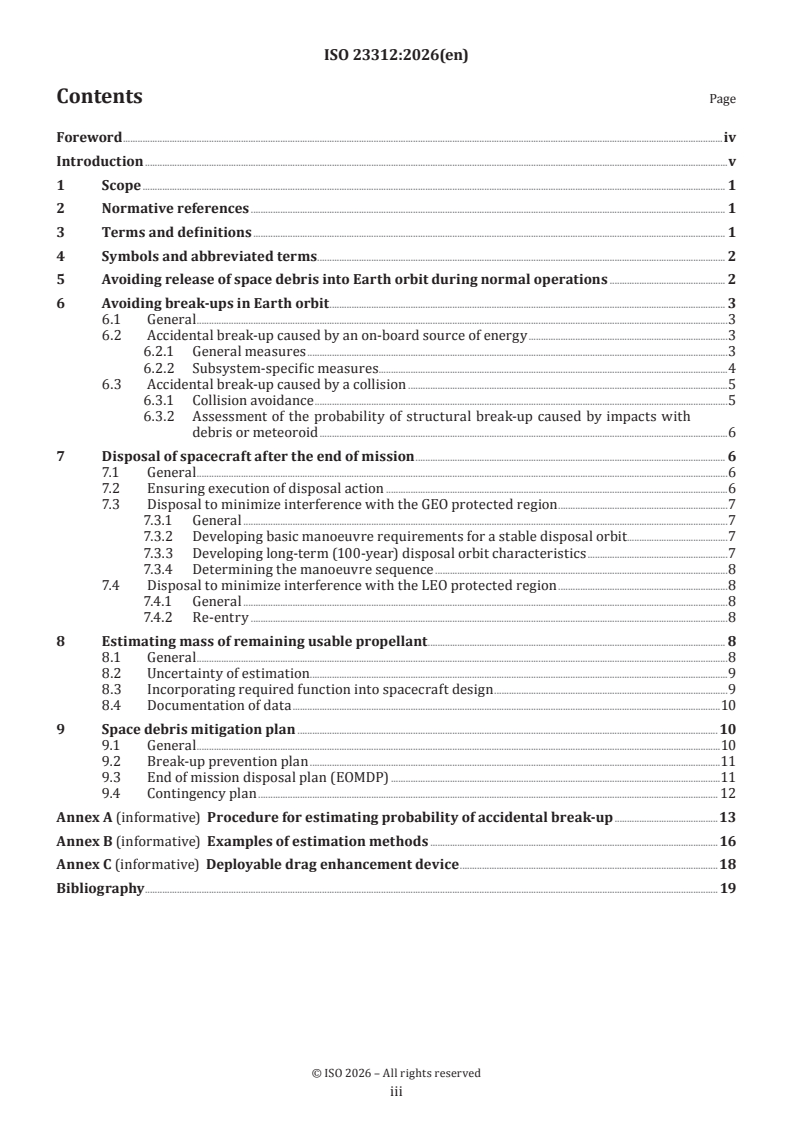
The document is organized into nine clauses and three informative annexes:
| Annex | What it covers |
|---|---|
| Annex A | Procedure for estimating probability of accidental break-up |
| Annex B | Examples of estimation methods and key parameters for propellant gauging |
| Annex C | Deployable drag enhancement device |
ISO 23312:2026 also notes that nuclear power sources on spacecraft are outside its scope.
What are the key requirements of ISO 23312:2026?
ISO 23312:2026 turns the high-level debris mitigation goals of ISO 24113 into practical spacecraft design, test and operations measures. The main message is that the spacecraft must be designed, monitored and disposed of so that stored energy, orbital collisions and leftover propellant do not create new debris.
Avoid releasing debris in normal operation
Clause 5 requires spacecraft appendages used for normal operation to be designed so they are not released. It also says that any part essential to mission objectives should not create a safety risk or worsen the space environment if it is released. Materials such as paint, multilayer insulation (MLI) and other surface materials should be chosen and processed to avoid flaking.
For tethered spacecraft, extra measures are required to limit collision risk and avoid severing from a single impact. In practice, this means the design team must look for any item that could become a fragment and prove that it will stay attached or remain benign.
Prevent break-ups from stored energy
Clause 6 requires the probability of accidental break-up to be assessed and reduced for all stored-energy sources. The spacecraft design must allow energy sources to be depleted or permanently deactivated when no longer needed, and the design review must confirm that reliability and quality controls are adequate.
Clause 6 also requires operational monitoring of systems that could generate debris. At a minimum, pressure and temperature in engines, tanks and pressure vessels, battery temperature and voltage, and orbit and attitude control failure indicators should be monitored from the ground when applicable. Passivation procedures must be updated before disposal and then carried out at the end of operation, unless a controlled re-entry is being performed.
Subsystem-specific measures cover batteries, propulsion, pressurized systems, rotating hardware and other energy sources. For example, residual propellant and pressurized fluids should be consumed or vented as far as possible before end of life, rotating parts should be allowed to spin down, and any unavoidable fragments from other devices should be contained within the device. For a buyer or reviewer, this section is where the detailed evidence for debris-risk control should appear.
Manage collision and impact risk
Clause 6 also requires periodic conjunction assessment against trackable orbital objects and collision-avoidance manoeuvres when risk exceeds the threshold set by the approving agent. The spacecraft design must also assess the probability of structural break-up caused by impacts with debris or meteoroids before end of life.
This matters because collision avoidance affects both safety and propellant budgeting. The document links collision risk assessment to disposal planning, so expected avoidance manoeuvres feed into the propellant needed for end-of-life actions.
Plan disposal before end of mission
Clause 7 requires disposal to be planned so that interference with protected orbital regions is minimized. The document asks for a probability of successful disposal to be determined during design, for needed systems and propellant to remain available throughout the mission, and for the remaining usable propellant to be estimated and monitored with uncertainty.
For geostationary Earth orbit (GEO), the document requires disposal orbit selection that keeps the spacecraft outside the protected region for at least 100 years. It gives two ways to establish a stable disposal orbit and, where long-term analysis is used, calls for a high-precision propagator including Earth gravity harmonics, lunisolar attraction and solar radiation pressure. For low Earth orbit (LEO), the plan must select a disposal option in the required priority order and may consider drag enhancement devices.
If re-entry is chosen, casualty risk must be assessed. If that risk is too high, the plan must use disposal options that reduce it.
Estimate and control remaining usable propellant
Clause 8 requires the mass of remaining usable propellant to be estimated from the design phase onward. The spacecraft team must calculate the minimum ΔV needed for the targeted disposal orbit, retain the fuel needed for that manoeuvre, and choose an estimation method early in design.
The uncertainty must cover all significant error sources and be expressed as an equivalent propellant mass. The document also requires the estimate hardware, software and data handling functions to be built into the spacecraft design, verified in testing, and documented in the spacecraft handbook. For operations, this means propellant accounting is not a one-time calculation - it must be tracked and defended with data.
Maintain the SDMP
Clause 9 requires the SDMP to involve the spacecraft provider, operator and acquiring organization in each review. Detailed disposal planning should begin early enough to allow proper preparation, and a post-end-of-life implementation report must be submitted to the approving agent.
The SDMP must include a break-up prevention plan, an end of mission disposal plan (EOMDP) and a contingency plan. Those plans need to identify stored-energy sources, chosen disposal method, manoeuvre timing, depletion steps, notification needs and fallback actions if disposal systems fail.
What terms does ISO 23312:2026 define?
- Acquiring organization - the organization that plans and manages the development and acquisition contracts for the space system, including design and operations responsibilities.
- Book-keeping method - a propellant gauging method that estimates consumption from flow rates and burn duration.
- Disposal orbit - the orbit a spacecraft occupies after its disposal actions are complete.
- PVT method - a pressure, volume, temperature (PVT) method that estimates remaining fluid quantity from pressure and temperature in a known volume.
- Remaining usable propellant - propellant still available for attitude and orbit control manoeuvres, excluding residuals and uncertainty.
- SDMP - the space debris mitigation plan that ties together prevention, disposal and contingency actions.
- EOMDP - the end of mission disposal plan that documents the disposal orbit, manoeuvres, propellant needs and supporting analysis.
Who uses ISO 23312:2026?
ISO 23312:2026 is used by spacecraft providers, operators, acquiring organizations and the engineers who design, test and approve spacecraft for Earth orbit. It is especially relevant to systems, propulsion, attitude control, thermal control, mission operations and mission assurance teams.
In practice, users apply it when they review debris-generating failure modes, choose propellant gauging methods, prepare conjunction and disposal plans, write passivation procedures, and assemble the evidence needed for approval and mission handover.
What changed in ISO 23312:2026 from the previous edition?
ISO 23312:2026 is the second edition and it cancels and replaces ISO 23312:2022. The foreword states that the main change is a revision of the reference to ISO 24113.
Which standards are used with ISO 23312:2026?
ISO 23312:2026 cites ISO 24113 as its main companion standard. ISO 24113 provides the top-level space debris mitigation requirements that ISO 23312:2026 details for spacecraft design and operations.
The cited edition, ISO 24113:2023, is used throughout the document for specific probability levels, disposal criteria and orbital-region requirements. ISO 23312:2026 builds on that framework rather than replacing it.
What does the ISO 23312:2026 document contain?
ISO 23312:2026 contains detailed clauses on release prevention, break-up prevention, collision avoidance, disposal after end of mission, propellant estimation and SDMP content. It also includes an informative procedure for accidental break-up probability, examples of propellant gauging methods, and recommendations for deployable drag enhancement devices.
Annex A gives a fault-tree based workflow for assessing break-up probability. Annex B provides example methods such as PVT, thermal knocking, gas injection, liquid leveling, book-keeping and flowmeter approaches, plus the key parameters to document for each. Annex C gives practical recommendations for drag enhancement devices, including safe deployment, stability and debris-impact considerations.
Relations
- Revises
ISO 23312:2022 - Space systems — Detailed space debris mitigation requirements for spacecraft - Effective Date
- 09-Aug-2025
Get Certified
Connect with accredited certification bodies for this standard

BUREAU VERITAS Certification Germany
Bureau Veritas certification in Germany.

Element Materials Technology
Materials testing and product certification.

AQMS Ltd.
AQMS provides ISO certification to SMEs across the UK.
Sponsored listings
Frequently Asked Questions
ISO 23312:2026 is a standard published by the International Organization for Standardization (ISO). Its full title is "Space systems — Detailed space debris mitigation requirements for spacecraft". This standard covers: This document defines detailed space debris mitigation requirements and recommendations for the design and operation of unmanned spacecraft in Earth orbit. This document defines detailed requirements that are applicable to: avoiding the intentional release of space debris into Earth orbit during normal operations; avoiding break-ups in Earth orbit; disposal of a spacecraft after the end of mission; estimating the mass of the remaining usable propellant; developing and maintaining the space debris mitigation plan. NOTE This document does not cover nuclear power sources on spacecraft.
This document defines detailed space debris mitigation requirements and recommendations for the design and operation of unmanned spacecraft in Earth orbit. This document defines detailed requirements that are applicable to: avoiding the intentional release of space debris into Earth orbit during normal operations; avoiding break-ups in Earth orbit; disposal of a spacecraft after the end of mission; estimating the mass of the remaining usable propellant; developing and maintaining the space debris mitigation plan. NOTE This document does not cover nuclear power sources on spacecraft.
ISO 23312:2026 is classified under the following ICS (International Classification for Standards) categories: 49.140 - Space systems and operations. The ICS classification helps identify the subject area and facilitates finding related standards.
ISO 23312:2026 has the following relationships with other standards: It is inter standard links to ISO 23312:2022. Understanding these relationships helps ensure you are using the most current and applicable version of the standard.
ISO 23312:2026 is available in PDF format for immediate download after purchase. The document can be added to your cart and obtained through the secure checkout process. Digital delivery ensures instant access to the complete standard document.
Standards Content (Sample)
International
Standard
ISO 23312
Second edition
Space systems — Detailed space
2026-10
debris mitigation requirements for
spacecraft
Systèmes spatiaux — exigences détaillées pour la diminution des
debris spatiaux relatifs aux satellites
Reference number
© ISO 2026
All rights reserved.
This ISO publication is protected by copyright and is owned by ISO and/or its licensors.
The content of this ISO publication is provided under licence, not sold. Use is subject to the applicable licence terms issued by ISO,
an ISO member body, or an authorized third-party distributor.
Except as required for implementation or expressly permitted by a separate licence, no part of this ISO publication may be
reproduced, distributed, modified, used, or made available in any form or by any means – electronic or mechanical, including
photocopying, scanning, recording, or posting on internal or external digital platforms.
Any use beyond the scope of the granted rights is prohibited and may result in legal action.
ISO copyright office
CP 401 • CH-1214 Vernier, Geneva
Phone: +41 22 749 01 11
Email: copyright@iso.org
Website: www.iso.org
Published in Switzerland
ii
Contents Page
Foreword .iv
Introduction .v
1 Scope . 1
2 Normative references . 1
3 Terms and definitions . 1
4 Symbols and abbreviated terms. 2
5 Avoiding release of space debris into Earth orbit during normal operations . 2
6 Avoiding break-ups in Earth orbit . 3
6.1 General .3
6.2 Accidental break-up caused by an on-board source of energy .3
6.2.1 General measures .3
6.2.2 Subsystem-specific measures.4
6.3 Accidental break-up caused by a collision .5
6.3.1 Collision avoidance .5
6.3.2 Assessment of the probability of structural break-up caused by impacts with
debris or meteoroid .6
7 Disposal of spacecraft after the end of mission . 6
7.1 General .6
7.2 Ensuring execution of disposal action .6
7.3 Disposal to minimize interference with the GEO protected region .7
7.3.1 General .7
7.3.2 Developing basic manoeuvre requirements for a stable disposal orbit .7
7.3.3 Developing long-term (100-year) disposal orbit characteristics .7
7.3.4 Determining the manoeuvre sequence .8
7.4 Disposal to minimize interference with the LEO protected region .8
7.4.1 General .8
7.4.2 Re-entry .8
8 Estimating mass of remaining usable propellant . 8
8.1 General .8
8.2 Uncertainty of estimation.9
8.3 Incorporating required function into spacecraft design .9
8.4 Documentation of data .10
9 Space debris mitigation plan . 10
9.1 General .10
9.2 Break-up prevention plan .11
9.3 End of mission disposal plan (EOMDP) .11
9.4 Contingency plan . 12
Annex A (informative) Procedure for estimating probability of accidental break-up .13
Annex B (informative) Examples of estimation methods .16
Annex C (informative) Deployable drag enhancement device .18
Bibliography . 19
iii
Foreword
ISO (the International Organization for Standardization) is a worldwide federation of national standards
bodies (ISO member bodies). The work of preparing International Standards is normally carried out through
ISO technical committees. Each member body interested in a subject for which a technical committee
has been established has the right to be represented on that committee. International organizations,
governmental and non-governmental, in liaison with ISO, also take part in the work. ISO collaborates closely
with the International Electrotechnical Commission (IEC) on all matters of electrotechnical standardization.
The procedures used to develop this document and those intended for its further maintenance are described
in the ISO/IEC Directives, Part 1. In particular, the different approval criteria needed for the different types
of ISO documents should be noted. This document was drafted in accordance with the editorial rules of the
ISO/IEC Directives, Part 2 (see www.iso.org/directives).
Attention is drawn to the possibility that some of the elements of this document may be the subject of patent
rights. ISO shall not be held responsible for identifying any or all such patent rights. Details of any patent
rights identified during the development of the document will be in the Introduction and/or on the ISO list of
patent declarations received (see www.iso.org/patents).
Any trade name used in this document is information given for the convenience of users and does not
constitute an endorsement.
For an explanation of the voluntary nature of standards, the meaning of ISO specific terms and expressions
related to conformity assessment, as well as information about ISO's adherence to the World Trade
Organization (WTO) principles in the Technical Barriers to Trade (TBT), see www.iso.org/iso/foreword.html.
This document was prepared by Technical Committee ISO/TC 20, Aircraft and space vehicles, Subcommittee
SC 14, Space systems and operations.
This second edition cancels and replaces the first edition (ISO 23312:2022), of which it constitutes a minor
revision. The main change is as follows:
— revision of the reference to ISO 24113.
Any feedback or questions on this document should be directed to the user’s national standards body. A
complete listing of these bodies can be found at www.iso.org/members.html.
iv
Introduction
This document is developed to incorporate the content of ISO 16127, ISO 16164, ISO 23339, ISO 26872 and
other detailed requirements relevant to spacecraft related debris mitigation, corresponding to ISO 24113.
The purpose of this document is to enable conformance with those high-level space debris mitigation
requirements in ISO 24113 that are relevant to spacecraft.
This document acts as one of the supporting technical standards for space debris mitigation, to provide
implementation requirements and details for the top-level requirements in ISO 24113.
v
International Standard ISO 23312:2026(en)
Space systems — Detailed space debris mitigation
requirements for spacecraft
1 Scope
This document defines detailed space debris mitigation requirements and recommendations for the design
and operation of unmanned spacecraft in Earth orbit.
This document defines detailed requirements that are applicable to:
a) avoiding the intentional release of space debris into Earth orbit during normal operations;
b) avoiding break-ups in Earth orbit;
c) disposal of a spacecraft after the end of mission;
d) estimating the mass of the remaining usable propellant;
e) developing and maintaining the space debris mitigation plan.
NOTE This document does not cover nuclear power sources on spacecraft.
2 Normative references
The following documents are referred to in the text in such a way that some or all of their content constitutes
requirements of this document. For dated references, only the edition cited applies. For undated references,
the latest edition of the referenced document (including any amendments) applies.
ISO 24113, Space systems — Space debris mitigation requirements
ISO 24113:2023, Space systems — Space debris mitigation requirements
3 Terms and definitions
For the purposes of this document, the terms and definitions given in ISO 24113 and the following apply.
ISO and IEC maintain terminology databases for use in standardization at the following addresses:
— ISO Online browsing platform: available at https:// www .iso .org/ obp
— IEC Electropedia: available at https:// www .electropedia .org/
3.1
acquiring organization
organization that plans and manages the development and acquisition contracts for the space system
Note 1 to entry: The responsibilities of the acquiring organization include the engineering and technical aspects of the
space system’s design and operations.
3.2
book-keeping method
method for determining fluid consumption by monitoring flow rates and the duration of propellant
expenditure periods
3.3
disposal orbit
orbit in which a spacecraft resides following the completion of its disposal actions
3.4
PVT method
method for determining the remaining fluid quantity by estimating the mass of gas by deriving density in a
known volume from pressure and temperature measurements
3.5
remaining usable propellant
propellant that remains in the propellant system and that is effective for attitude and orbit control
manoeuvres excluding residuals and uncertainty
4 Symbols and abbreviated terms
ΔV delta velocity or total velocity change
EOL end of life
EOMDP end of mission disposal plan
GEO geostationary Earth orbit
LEO low Earth orbit
ṁ mass flow rate
MLI multilayer insulation
PVT pressure, volume, temperature
SDMP space debris mitigation plan
t time
5 Avoiding release of space debris into Earth orbit during normal operations
ISO 24113 specifies that a spacecraft shall be designed so as not to release space debris into Earth orbit
during normal operations. To satisfy this requirement, as a minimum, the following measures shall be taken
into account.
a) Any appendage related to spacecraft normal operations shall be designed not to be released.
NOTE 1 Appendages include items such as apogee kick propulsion devices, fasteners of holding and deployment
mechanisms, caps, hoods, heat insulation enclosures, springs, explosive bolts and related fragments.
b) Releasing parts essential for mission objectives should not pose a risk to the safety of operating
spacecraft and deteriorate the space environment.
c) Paint, MLI and surface materials that are exposed to the space environment, should be selected and
processes applied properly, to avoid flaking off from the spacecraft.
NOTE 2 The following ISO documents can help to ensure conformance:
[1]
1) ISO 16691 , Thermal control coatings for spacecraft — General requirements.
[2]
2) ISO 23129 , Space systems — Thermal control coatings for spacecraft — Atomic oxygen protective coating on
polyimide film.
[3]
3) ISO 23230 , Space systems — Paint materials — Processes, procedures, requirements.
d) Programs using tethers shall take extra measures to limit the collision risk with resident space objects,
and not to be severed with a single impact of debris or meteoroid.
NOTE 3 A potential measure for a tethered system is to apply multi-strand tether, to retract the tether in the
disposal phase.
6 Avoiding break-ups in Earth orbit
6.1 General
[4]
ISO 24113 specifies requirements to avoid the accidental break-up of a spacecraft in Earth orbit both
before and after its end of life. 6.2 and 6.3 provide detailed measures to help satisfy these requirements.
6.2 Accidental break-up caused by an on-board source of energy
6.2.1 General measures
6.2.1.1 Spacecraft design
The spacecraft design measures to prevent accidental break-ups caused by on-board source of energy are as
follows.
a) The calculations to determine the probability of accidental break-up while in orbit until its end of life
shall be performed and assessed with probability levels defined in ISO 24113:2023, 7.2.2.1.
NOTE 1 Annex A provides an example of an acceptable detailed evaluation approach.
b) Measures shall be designed to ensure that all on-board sources of stored energy can be depleted or
made safe and permanently deactivated once they are no longer required for the mission operation.
NOTE 2 Source can be residual propellants, batteries, high-pressure vessels, self-destructive devices,
flywheels, and momentum wheels.
c) The design of the on-board sources of stored energy shall take into account the following influences:
1) the environmental extremes expected to be encountered during the normal operations;
2) mechanical degradation during the normal operations;
3) chemical decomposition;
4) the effect of potential failure modes of the spacecraft during the mission; and
5) what effect they have on the ability to passivate the spacecraft.
d) The robustness of the design shall be confirmed during the design review process, to ensure that
adequate reliability and quality control has been performed to inhibit any failure that can lead to a
break-up event with a probability worse than specified in ISO 24113.
e) The first issue of passivation procedures shall be established prior to the end of the design phase.
6.2.1.2 Spacecraft operations
The spacecraft in-orbit operation measures to prevent accidental break-ups caused by on-board source of
energy are as follows.
a) For the operations of the spacecraft, procedures shall be defined to allow monitoring of the relevant
parameters of each subsystem, which has been identified as a potential source of space debris
generation, in order to detect malfunctions.
b) The following items, as a minimum, shall be monitored from the ground, if applicable:
1) pressure and temperature in the engines, tanks, pressure vessels;
2) parameters (temperature and voltage) of batteries to detect failures;
3) parameters to detect failure modes of the orbit and attitude control system.
c) Prior to the disposal phase, the passivation procedures shall be updated to take into account any failures
that have occurred during the mission and that affect the ability to passivate the spacecraft.
d) At the time when spacecraft operation is concluded either purposefully or due to malfunction and
disposal manoeuvres have been finished, passivation shall be performed.
NOTE If a controlled re-entry is to be performed, then passivation is not necessary.
e) In the event of in-orbit malfunctions which can lead to break-up or the loss of operating function, a
contingency plan to prevent debris generation should have been studied and, where appropriate,
implemented.
6.2.2 Subsystem-specific measures
6.2.2.1 Electrical systems
The specific measures for electrical systems are as follows.
a) The performance of batteries shall be monitored and assessed in accordance with standardized
procedures to assure the safety of the mission and post-mission disposal.
NOTE 1 Standardized procedure for health assessment of lithium-ion batteries can be found in ISO/CD TR 20891
[5]
.
b) Batteries and/or electrical systems shall be designed and manufactured, both structurally and
electrically, to prevent break-ups during all orbital life.
c) Pressure increase in battery cells and assemblies, potentially leading to a break-up, shall be prevented.
NOTE 2 This can be done by mechanical measures for some types of batteries as far as it doesn’t decrease the
reliability.
d) At the end of operations, take measures to prevent re-charging to batteries, and discharge the stored
electric energy with assuring to keep necessary electric energy for following disposal action.
6.2.2.2 Propulsion systems
The specific measures for propulsion systems are as follows.
a) Pressure vessels, such as tanks and high-pressure gas bottles, shall be designed to avoid accidental
break-up caused by stored energy sources.
[6] [7]
NOTE ISO 14623 and ISO 24638 contain requirements relating to the design of pressure vessels.
b) For a bipropellant propulsion system, especially with hypergolic propellants, tanks and lines should be
designed so that any single-point failure does not cause the unplanned mixture or combustion of the
propellants.
c) Before end of life, as part of the disposal phase, the spacecraft shall have consumed or vented residual
liquid propellants and pressurized fluids, such as cold gas, liquefied gas, and propellant for the fluid-
based electric propulsion systems, which are potential sources of break-ups. Any residual liquid
propellants and pressurized fluids can be a source of break-ups also for spacecraft drifting outside
protected regions after end of life and should be consumed or vented to the maximum extent as possible
before end of life.
d) End of venting shall be monitored (or confirmed), if appropriate, by proper means, such as on-board
pressure sensors, fluid gauging systems, thermal sensing, attitude sensing, or any other demonstrable
means.
e) If it is not possible to vent, a sufficient safety margin to ensure no break-ups under expected post-
disposal environmental conditions shall be adopted.
f) The venting system and process shall be designed not to be prevented by the frozen propellants.
g) The venting process should be defined to take into account any potential effects on the spacecraft’s
attitude or orbit and any ground visibility issues.
h) Solid rocket motors shall only be actuated in the case that there have been no sensor indications of
motor degradation due to mission-induced damage or due to adverse environmental conditions.
i) Solid motor should not be allowed if it generates slags in the GEO and LEO protected regions.
6.2.2.3 Pressurized systems such as heat pipes/fluid loops
All pressurized systems which are typically not designed to be vented, such as heat pipes/fluid loops, shall
be designed and qualified with safety margins that prevent break-up of the spacecraft when considering
thermal effects in orbit.
NOTE Specific venting operations for this kind of pressurized systems are not required in the disposal phase.
6.2.2.4 Rotating hardware
The specific measures for rotating hardware are as follows.
a) All rotating devices, for example flywheels, reaction wheels, and momentum wheels, shall be designed so
that failure of the rotating part does not cause the break-up of the spacecraft under nominal mechanical
environmental conditions.
b) All rotating parts shall be allowed to de-spin, or stopped by termination of the power supply, at the end
of life.
6.2.2.5 Other devices
The specific measures for other devices are as follows.
a) Any other energy sources, such as pyrotechnically operated devices, shall be designed so that they do
not cause unacceptable risk of break-up and generate fragments.
b) Where this is unavoidable, the fragments shall be self-contained within the device which is affected by
break-up.
6.3 Accidental break-up caused by a collision
6.3.1 Collision avoidance
The spacecraft shall be designed and operated properly to prevent collision with trackable orbital objects
before its end of life.
a) During the mission operation, the conjunction assessment shall be conducted periodically against
potentially approaching objects based on the reliable orbit data.
b) Exchange of orbital parameters should be encouraged among spacecraft operators or space agencies,
to precisely check the close approach distance, and then determine an optimal avoidance manoeuvre
strategy for operators.
c) The probability of collision with approaching trackable orbital objects shall be assessed during
operation.
[8]
NOTE ISO/TR 16158 can be used to estimate the probability of collision.
d) If the risk of collision is above the threshold set by an approving agent, then the collision avoidance
manoeuvre (and/or returning manoeuvre) shall be planned and conducted appropriately, to reduce the
collision risk below the corresponding risk threshold.
6.3.2 Assessment of the probability of structural break-up caused by impacts with debris or
meteoroid
It is required to assess the probability of structural break-ups of spacecraft caused by impacts with debris
or meteoroid before its end of life.
a) The vulnerability of spacecraft against impact of space debris or meteoroid shall be assessed during the
design phase.
b) If the risk of structural break-up caused by impacts with debris is above the threshold set by an
approving agent, then the special design measures should be considered to minimize this risk.
[9] [10]
NOTE 1 ISO 11227 and ISO 16126 provide guidance for analysing the impact risk from small debris impacts
and improving the design of spacecraft.
NOTE 2 The probability of successful collision avoidance, induced from the experience and authorized by approving
agent, can be incorporated into this assessment.
NOTE 3 The estimated probability of collision with trackable object will provide information of the expected number
of collision avoidance during operation and contribute on the planning of propellant allocation for 7.2, list item c).
7 Disposal of spacecraft after the end of mission
7.1 General
ISO 24113 specifies requirements for the disposal of a spacecraft after the end of mission so as to minimize
interference with the protected regions. 7.2 to 7.4 provide detailed measures to help satisfy these
requirements.
NOTE Measures to prevent break-up, as a part of disposal action, are given in 6.2.
7.2 Ensuring execution of disposal action
The measures to ensure execution of disposal action are as follows.
a) The probability of successful disposal should be determined during the design phase, and decide to
terminate the operation taking into account the events that have occurred during the operating phase.
NOTE 1 In the case of highly eccentric orbits, considering the uncertainty in estimation of orbital lifetime, the
amount of propellant for disposal is designed to ensure conformance to the 25-year rule with a probability of
more than 0,9. This is excluded from the probability of successful disposal of 0,9.
NOTE 2 Where possible, put in place well-organized systematic surveillance procedures, pre-planned
emergency actions, adequate procedures for determining the extension of the lifespan taking into account
deterioration or decommissioning, etc. The method to assess this probability can be determined by the approving
agent.
b) The availability of items concerning to the specific criteria shall be ensured throughout the designated
(or planned) mission life.
NOTE 3 Examples are estimated amounts of propellant remaining, redundancy remaining, status of electrical
power, status of systems critical to successful disposal, and time required to execute each disposal action.
...