


ISO 12494:2017
(Main)Atmospheric icing of structures
Atmospheric icing of structures
ISO 12494:2017 describes the general principles of determining ice load on structures of the types listed in this clause. In cases where a certain structure is not directly covered by this or another standard or recommendation, designers can use the intentions of this document. However, it is the user's responsibility to carefully consider the applicability of this document to the structure in question. The practical use of all data in this document is based upon certain knowledge of the site of the structure. Information about the degree of "normal" icing amounts (= ice classes) for the site in question is used. For many areas, however, no information is available. Even in such cases, this document can be useful because local meteorologists or other experienced persons should be able to, on the safe side, estimate a proper ice class. Using such an estimate in the structural design will result in a much safer structure than designing without any considerations for problems due to ice. CAUTION It is extremely important to design for some ice instead of no ice, and then the question of whether the amount of ice was correct is of less importance. In particular, the action of wind can be increased considerably due to both increased exposed area and increased drag coefficient. ISO 12494:2017 is intended for use in determining ice mass and wind load on the iced structure for the following types of structure: - masts; - towers; - antennas and antenna structures; - cables, stays, guy ropes, etc.; - rope ways (cable railways); - structures for ski-lifts; - buildings or parts of them exposed to potential icing; - towers for special types of construction such as transmission lines, wind turbines, etc. Atmospheric icing on electrical overhead lines is covered by IEC (International Electrotechnical Commission) standards. This document is intended to be used in conjunction with ISO 2394. NOTE Some typical types of structure are mentioned, but other types can also be considered by designers by thinking in terms of which type of structure is sensitive to unforeseen ice, and act thereafter. Also, in many cases, only parts of structures are to be designed for ice loads because they are more vulnerable to unforeseen ice than is the whole structure. Even if electrical overhead lines are covered by IEC standards, designers can use this document for the mast structures to overhead lines (which are not covered by IEC standards) if they so wish.
Charges sur les structures dues à la glace
General Information
- Status
- Published
- Publication Date
- 29-Mar-2017
- Technical Committee
- ISO/TC 98/SC 3 - Loads, forces and other actions
- Drafting Committee
- ISO/TC 98/SC 3 - Loads, forces and other actions
- Current Stage
- 9093 - International Standard confirmed
- Start Date
- 05-Oct-2022
- Completion Date
- 12-Feb-2026
Relations
- Effective Date
- 09-Feb-2026
- Effective Date
- 10-Dec-2016
Overview
ISO 12494:2017 - Atmospheric icing of structures provides principles for assessing ice accretion and the resulting loads on exposed structures. It guides designers and engineers in determining ice mass, wind actions on iced structures, and related effects (static, dynamic and falling ice). The standard emphasizes site-specific knowledge - especially the use of ice classes - and recommends designing for some ice rather than none to improve safety and resilience.
Key topics
- Scope and applicability: Intended for masts, towers, antennas, cables and stays, ropeways, ski-lift structures, buildings or parts exposed to icing, and special towers (e.g., wind turbines, transmission-line towers). Electrical overhead line icing is covered by IEC standards, but ISO 12494 can be used for associated mast structures.
- Icing types and fundamentals: Definitions and characteristics of glaze, wet snow, rime, and other icing types; topographic and height-related variations affecting accretion.
- Ice classes (IC): Use of site-based ice classes to represent “normal” icing amounts; guidance on estimating ice class where measurements are unavailable.
- Load effects: Static ice loads, increased wind load on iced members (increased exposed area and drag coefficient), dynamic effects, unbalanced ice loading on guys, and falling ice hazards.
- Wind action & drag coefficients: Treatment of single members and lattice structures, including angle of incidence and design implications.
- Annexes (informative): Formulae, standard measurement practices, theoretical icing models, climatic estimation of ice classes, and practical usage hints.
Practical applications
ISO 12494:2017 is used to:
- Determine ice mass and combined ice-plus-wind loads for structural design and safety checks.
- Inform retrofits, site selection, and maintenance planning where atmospheric icing is a risk.
- Support decisions where no local icing data exist by providing methodologies to estimate ice classes (consultation with meteorologists or local experts recommended).
- Evaluate parts of structures most vulnerable to icing (e.g., antenna elements, guy ropes, rotor blades).
Who uses it:
- Structural and civil engineers, design offices and consultancies
- Wind-turbine and telecom tower designers
- Utilities, ropeway and ski-lift engineers
- Infrastructure owners, asset managers, and meteorologists
Related standards
- Use in conjunction with ISO 2394 (general principles on reliability of structures).
- For electrical overhead lines, consult relevant IEC standards (ISO 12494 can still inform design of non-electrical support structures).
ISO 12494:2017 helps ensure safer, more resilient designs by integrating atmospheric icing considerations into structural engineering practice.


Get Certified
Connect with accredited certification bodies for this standard

ICC Evaluation Service
Building products evaluation and certification.

QAI Laboratories
Building and construction product testing and certification.

Aboma Certification B.V.
Specialized in construction, metal, and transport sectors.
Sponsored listings
Frequently Asked Questions
ISO 12494:2017 is a standard published by the International Organization for Standardization (ISO). Its full title is "Atmospheric icing of structures". This standard covers: ISO 12494:2017 describes the general principles of determining ice load on structures of the types listed in this clause. In cases where a certain structure is not directly covered by this or another standard or recommendation, designers can use the intentions of this document. However, it is the user's responsibility to carefully consider the applicability of this document to the structure in question. The practical use of all data in this document is based upon certain knowledge of the site of the structure. Information about the degree of "normal" icing amounts (= ice classes) for the site in question is used. For many areas, however, no information is available. Even in such cases, this document can be useful because local meteorologists or other experienced persons should be able to, on the safe side, estimate a proper ice class. Using such an estimate in the structural design will result in a much safer structure than designing without any considerations for problems due to ice. CAUTION It is extremely important to design for some ice instead of no ice, and then the question of whether the amount of ice was correct is of less importance. In particular, the action of wind can be increased considerably due to both increased exposed area and increased drag coefficient. ISO 12494:2017 is intended for use in determining ice mass and wind load on the iced structure for the following types of structure: - masts; - towers; - antennas and antenna structures; - cables, stays, guy ropes, etc.; - rope ways (cable railways); - structures for ski-lifts; - buildings or parts of them exposed to potential icing; - towers for special types of construction such as transmission lines, wind turbines, etc. Atmospheric icing on electrical overhead lines is covered by IEC (International Electrotechnical Commission) standards. This document is intended to be used in conjunction with ISO 2394. NOTE Some typical types of structure are mentioned, but other types can also be considered by designers by thinking in terms of which type of structure is sensitive to unforeseen ice, and act thereafter. Also, in many cases, only parts of structures are to be designed for ice loads because they are more vulnerable to unforeseen ice than is the whole structure. Even if electrical overhead lines are covered by IEC standards, designers can use this document for the mast structures to overhead lines (which are not covered by IEC standards) if they so wish.
ISO 12494:2017 describes the general principles of determining ice load on structures of the types listed in this clause. In cases where a certain structure is not directly covered by this or another standard or recommendation, designers can use the intentions of this document. However, it is the user's responsibility to carefully consider the applicability of this document to the structure in question. The practical use of all data in this document is based upon certain knowledge of the site of the structure. Information about the degree of "normal" icing amounts (= ice classes) for the site in question is used. For many areas, however, no information is available. Even in such cases, this document can be useful because local meteorologists or other experienced persons should be able to, on the safe side, estimate a proper ice class. Using such an estimate in the structural design will result in a much safer structure than designing without any considerations for problems due to ice. CAUTION It is extremely important to design for some ice instead of no ice, and then the question of whether the amount of ice was correct is of less importance. In particular, the action of wind can be increased considerably due to both increased exposed area and increased drag coefficient. ISO 12494:2017 is intended for use in determining ice mass and wind load on the iced structure for the following types of structure: - masts; - towers; - antennas and antenna structures; - cables, stays, guy ropes, etc.; - rope ways (cable railways); - structures for ski-lifts; - buildings or parts of them exposed to potential icing; - towers for special types of construction such as transmission lines, wind turbines, etc. Atmospheric icing on electrical overhead lines is covered by IEC (International Electrotechnical Commission) standards. This document is intended to be used in conjunction with ISO 2394. NOTE Some typical types of structure are mentioned, but other types can also be considered by designers by thinking in terms of which type of structure is sensitive to unforeseen ice, and act thereafter. Also, in many cases, only parts of structures are to be designed for ice loads because they are more vulnerable to unforeseen ice than is the whole structure. Even if electrical overhead lines are covered by IEC standards, designers can use this document for the mast structures to overhead lines (which are not covered by IEC standards) if they so wish.
ISO 12494:2017 is classified under the following ICS (International Classification for Standards) categories: 91.080.01 - Structures of buildings in general. The ICS classification helps identify the subject area and facilitates finding related standards.
ISO 12494:2017 has the following relationships with other standards: It is inter standard links to EN ISO 35106:2019, ISO 12494:2001. Understanding these relationships helps ensure you are using the most current and applicable version of the standard.
ISO 12494:2017 is available in PDF format for immediate download after purchase. The document can be added to your cart and obtained through the secure checkout process. Digital delivery ensures instant access to the complete standard document.
Standards Content (Sample)
INTERNATIONAL ISO
STANDARD 12494
Second edition
2017-03
Atmospheric icing of structures
Charges sur les structures dues à la glace
Reference number
©
ISO 2017
© ISO 2017, Published in Switzerland
All rights reserved. Unless otherwise specified, no part of this publication may be reproduced or utilized otherwise in any form
or by any means, electronic or mechanical, including photocopying, or posting on the internet or an intranet, without prior
written permission. Permission can be requested from either ISO at the address below or ISO’s member body in the country of
the requester.
ISO copyright office
Ch. de Blandonnet 8 • CP 401
CH-1214 Vernier, Geneva, Switzerland
Tel. +41 22 749 01 11
Fax +41 22 749 09 47
copyright@iso.org
www.iso.org
ii © ISO 2017 – All rights reserved
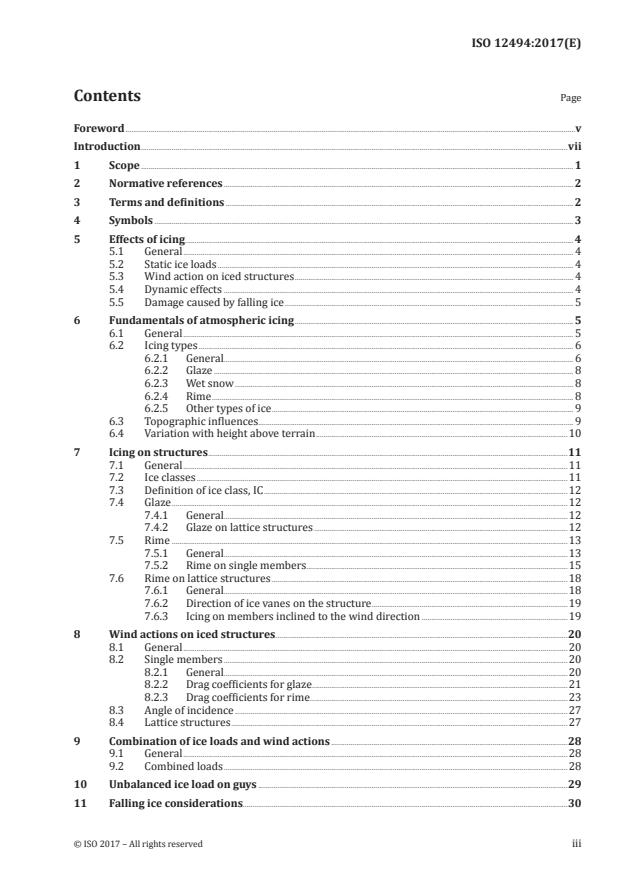
Contents Page
Foreword .v
Introduction .vii
1 Scope . 1
2 Normative references . 2
3 Terms and definitions . 2
4 Symbols . 3
5 Effects of icing . 4
5.1 General . 4
5.2 Static ice loads . 4
5.3 Wind action on iced structures . 4
5.4 Dynamic effects . 4
5.5 Damage caused by falling ice . 5
6 Fundamentals of atmospheric icing . 5
6.1 General . 5
6.2 Icing types . 6
6.2.1 General. 6
6.2.2 Glaze . 8
6.2.3 Wet snow . 8
6.2.4 Rime . 8
6.2.5 Other types of ice . 9
6.3 Topographic influences . 9
6.4 Variation with height above terrain .10
7 Icing on structures .11
7.1 General .11
7.2 Ice classes .11
7.3 Definition of ice class, IC .12
7.4 Glaze .12
7.4.1 General.12
7.4.2 Glaze on lattice structures .12
7.5 Rime .13
7.5.1 General.13
7.5.2 Rime on single members.15
7.6 Rime on lattice structures .18
7.6.1 General.18
7.6.2 Direction of ice vanes on the structure .19
7.6.3 Icing on members inclined to the wind direction .19
8 Wind actions on iced structures .20
8.1 General .20
8.2 Single members .20
8.2.1 General.20
8.2.2 Drag coefficients for glaze .21
8.2.3 Drag coefficients for rime .23
8.3 Angle of incidence .27
8.4 Lattice structures .27
9 Combination of ice loads and wind actions .28
9.1 General .28
9.2 Combined loads .28
10 Unbalanced ice load on guys .29
11 Falling ice considerations .30
Annex A (informative) Formulae used in this document.32
Annex B (informative) Standard measurements for ice actions .35
Annex C (informative) Theoretical modelling of icing .39
Annex D (informative) Climatic estimation of ice classes based on weather data .50
Annex E (informative) Hints on using this document .53
Bibliography .57
iv © ISO 2017 – All rights reserved
Foreword
ISO (the International Organization for Standardization) is a worldwide federation of national standards
bodies (ISO member bodies). The work of preparing International Standards is normally carried out
through ISO technical committees. Each member body interested in a subject for which a technical
committee has been established has the right to be represented on that committee. International
organizations, governmental and non-governmental, in liaison with ISO, also take part in the work.
ISO collaborates closely with the International Electrotechnical Commission (IEC) on all matters of
electrotechnical standardization.
The procedures used to develop this document and those intended for its further maintenance are
described in the ISO/IEC Directives, Part 1. In particular the different approval criteria needed for the
different types of ISO documents should be noted. This document was drafted in accordance with the
editorial rules of the ISO/IEC Directives, Part 2 (see www. iso. org/d irectives).
Attention is drawn to the possibility that some of the elements of this document may be the subject of
patent rights. ISO shall not be held responsible for identifying any or all such patent rights. Details of
any patent rights identified during the development of the document will be in the Introduction and/or
on the ISO list of patent declarations received (see www. iso. org/p atents).
Any trade name used in this document is information given for the convenience of users and does not
constitute an endorsement.
For an explanation on the voluntary nature of standards, the meaning of ISO specific terms and expressions
related to conformity assessment, as well as information about ISO’s adherence to the World Trade
Organization (WTO) principles in the Technical Barriers to Trade (TBT) see the following URL:
ww w .iso. org/iso / foreword. html.
The committee responsible for this document is ISO/TC 98, Bases for design of structures, Subcommittee
SC 3, Loads, forces and other actions.
This second edition cancels and replaces the first edition (ISO 12494:2001), of which it constitutes a
minor revision. The changes made are the following:
— 8.1, line 2, replaced “ISO 4355” by “ISO 4354”;
— 8.3, Figure 7, revised the right figure;
— 9.1, line 2 ,9.2, line 2 to 4, replaced “exceedence” by “exceedance”;
— 9.2, line 11, replaced “to day’s” by “today’s”;
— Clause 10, line 15, replaced “5.3” by “5.4”;
— A.2, Table 3, line 1, replaced “the glaze mass” by “the mass of the ice, glaze or rime”;
— A.2, Table 3, line 2, replaced “the glaze thickness” by “the thickness of the ice, glaze or rime”;
— A.2, Table 3, line 4, replaced “the glaze density” by “the density of the ice, glaze or rime”;
— A.2, Table 3, line 4, replaced “r” by “γ”;
— A.2, Table 3, line 1 to 4, moved before Table 3,
— B.3.2, c), replaced “see Table 2 and 2.3” by “see Table 1 in 6.2.1”;
— B.3.3, line 5, replaced “definitions 3.1 and 3.2” by “definitions B.3.1 and B.3.2”;
— B.3.3, line 6, replaced “Table 4 or 5” by “Table 3 or 4”;
-3 -3
— C.3, paragraph 6, line 4, replaced “0,7 cm ” by “0,7 g cm ”;
— E.4, b), line1, replaced “ICGx” by “ICRx”.
Annexes A to E of this document are for information only.
vi © ISO 2017 – All rights reserved
Introduction
This document describes ice actions and can be used in the design of certain types of structures.
It should be used in conjunction with ISO 2394 and also in conjunction with relevant CEN standards.
This document differs in some aspects from other International Standards, because the topic is poorly
known and available information is inadequate. Therefore, it contains more explanations than usual, as
well as supplementary descriptions and recommendations in the annexes.
Designers might find that they have better information on some specific topics than those available
from this document. This may be true, especially in the future. They should, however, be very careful
not to use only parts of this document partly, but only as a whole.
The main purpose of this document is to encourage designers to think about the possibility of ice
accretions on a structure and to act thereafter.
As more information about the nature of atmospheric icing becomes available during the coming years,
the need for updating this document is expected to be more urgent than usual.
Guidance is given as a NOTE, after the text for which it is a supplement. It is distinguished from the
text by being in smaller typeface. This guidance includes some information and values which might be
useful during practical design work, and which represents results that are not certain enough for this
document, but may be useful in many cases until better information becomes available in the future.
Designers are therefore welcome to use information from the guidance notes, but they should be aware
of the intention of the use and also forthcoming results of new investigations and/or measurements.
INTERNATIONAL STANDARD ISO 12494:2017(E)
Atmospheric icing of structures
1 Scope
This document describes the general principles of determining ice load on structures of the types listed
in this clause.
In cases where a certain structure is not directly covered by this or another standard or recommendation,
designers can use the intentions of this document. However, it is the user’s responsibility to carefully
consider the applicability of this document to the structure in question.
The practical use of all data in this document is based upon certain knowledge of the site of the
structure. Information about the degree of “normal” icing amounts (= ice classes) for the site in question
is used. For many areas, however, no information is available.
Even in such cases, this document can be useful because local meteorologists or other experienced
persons should be able to, on the safe side, estimate a proper ice class. Using such an estimate in the
structural design will result in a much safer structure than designing without any considerations for
problems due to ice.
CAUTION — It is extremely important to design for some ice instead of no ice, and then the
question of whether the amount of ice was correct is of less importance. In particular, the action
of wind can be increased considerably due to both increased exposed area and increased drag
coefficient.
This document is intended for use in determining ice mass and wind load on the iced structure for the
following types of structure:
— masts;
— towers;
— antennas and antenna structures;
— cables, stays, guy ropes, etc.;
— rope ways (cable railways);
— structures for ski-lifts;
— buildings or parts of them exposed to potential icing;
— towers for special types of construction such as transmission lines, wind turbines, etc.
Atmospheric icing on electrical overhead lines is covered by IEC (International Electrotechnical
Commission) standards.
This document is intended to be used in conjunction with ISO 2394.
NOTE Some typical types of structure are mentioned, but other types can also be considered by designers
by thinking in terms of which type of structure is sensitive to unforeseen ice, and act thereafter.
Also, in many cases, only parts of structures are to be designed for ice loads because they are more
vulnerable to unforeseen ice than is the whole structure.
Even if electrical overhead lines are covered by IEC standards, designers can use this document for the
mast structures to overhead lines (which are not covered by IEC standards) if they so wish.
2 Normative references
The following documents are referred to in the text in such a way that some or all of their content
constitutes requirements of this document. For dated references, only the edition cited applies. For
undated references, the latest edition of the referenced document (including any amendments) applies.
ISO 2394:2015, General principles on reliability for structures
3 Terms and definitions
For the purposes of this document, the following terms and definitions apply.
ISO and IEC maintain terminological databases for use in standardization at the following addresses:
— IEC Electropedia: available at http:// www .electropedia .org/
— ISO Online browsing platform: available at http:// www .iso .org/ obp
3.1
accretion
process of building up ice on the surface of an object, resulting in the different types of icing on
structures
3.2
drag coefficient
shape factor for an object to be used for the calculation of wind forces in the along-wind direction
3.3
glaze
clear, high-density ice
3.4
ice action
effect of accreted ice on a structure, both as gravity load (= self-weight of ice) and as wind action on the
iced structure
3.5
ice class
IC
classification of the characteristic ice load that is expected to occur within a mean return period of 50
years on a reference ice collector situated in a particular location
3.6
in-cloud icing
icing due to super-cooled water droplets in a cloud or fog
3.7
precipitation icing
icing due to either
a) freezing rain or drizzle, or
b) accumulation of wet snow
3.8
return period
average number of years in which a stated action statistically is exceeded once
Note 1 to entry: A long return period means low transgression intensity (occurring rarely) and a short return
period means high transgression intensity (occurring often).
2 © ISO 2017 – All rights reserved
3.9
rime
white ice with in-trapped air
4 Symbols
C drag coefficient of an iced object 1
i
C drag coefficient for large objects (width >0,3 m) 1
0,3
C drag coefficient of an object without ice 1
D diameter of accreted ice or total width of object including ice mm
F wind force N/m
w
H height above terrain m
k factor for velocity pressure from wind action 1
K height factor 1
h
L length of ice vane measured in windward direction mm
m mass of accreted ice per meter unit length kg/m
m ice mass for ice on large objects kg
W
T return period year
t ice thickness mm
t air temperature °C
a
W width of object (excluding ice) perpendicular to wind direction mm
α angle of incidence between wind direction and the objects longitudinal axis °
γ density of ice kg/m
θ angle of wind incidence in a vertical plane °
τ
exposed panel area
solidity ratio:
total panel area within outside boundariies
increased value of τ caused by icing to be used in calculations 1
¢
τ
ϕ factor of combination 1
5 Effects of icing
5.1 General
The general effects of icing are the increased vertical loads on the iced structure and increased wind
drag caused by the increased wind-exposed area. The latter can lead to more severe wind loads than
without icing.
NOTE Clause 5 describes the way the ice loads act on a structure, and this can enable designers to understand
the background and to use this document, even in cases which are not mentioned here.
5.2 Static ice loads
Different types of structure are more or less sensitive to varying aspects concerning ice action, and
some examples on this are as follows.
a) Tensioned steel ropes, cables and guys, etc., are generally very sensitive to ice action, consequently
tension forces in such elements can increase considerably in an iced condition.
b) Slender lattice structures, especially guyed masts, are sensitive to the increased axial compression
forces from accreted ice on the structure.
c) Antennas and antenna structures can easily be overloaded by accreted ice, if this has not been
foreseen. In particular, small fastening details are weak when increased load is added on top of
other actions, because the ice may easily double the normal load.
d) “Sagging of ice” on non-structural elements can be harmful. Non-structural elements such as
antennas and cables, may be exposed to unexpected ice load because the ice sags downwards
and covers or presses on the elements. The ice action on these elements can then be substantially
greater than the ice load normally accreted on them.
e) The load of accreted ice can easily deform or damage envelope elements (claddings, etc.), and
damage also might occur if the ice has not fallen off before forces have grown too great.
5.3 Wind action on iced structures
Structures such as masts and towers, together with tensioned steel ropes, cables, mast guys, etc., are
sensitive to increased wind drag caused by icing.
Wind action on iced structures may be calculated based on the same principles as the action on the ice-
free structure. However, both the dimensions of the structural members and their drag coefficients are
subject to changes. Therefore, the main purpose of this document is to specify proper values for
— dimensions and weight of accreted ice,
— shapes of accreted ice, and
— drag coefficients of accreted ice.
5.4 Dynamic effects
A significant factor influencing the dynamic behaviour of a structure is its natural frequencies.
Normally, the natural frequencies of a structure are decreased considerably if the structure is heavily
iced. This is important in connection with dynamic investigations because the lower frequencies
normally are the critical ones.
In addition, the change in cross-sectional shape due to the accreted ice may require dynamic
investigations to be made. For example, the eccentric cross-sectional shape of ice on a cable or guy can
4 © ISO 2017 – All rights reserved
cause aerodynamic instability resulting in heavy oscillations (e.g. galloping). Also, fully iced mast or
tower sections can introduce vortex shedding, resulting in cross wind vibrations.
Shedding of ice from a structure can cause severe dynamic effects and stresses in the structure,
depending on the type of structure and the amount and properties of the ice. Such dynamic effects
should be investigated if the structure in question is sensitive to those actions. For a guyed mast,
the shedding of ice from heavily iced guys may introduce severe dynamic vibrations and should be
considered (see Clause 10).
NOTE This phenomenon has caused total collapses of very tall, guyed masts.
5.5 Damage caused by falling ice
When a structure is iced, this ice will sooner or later fall from the structure. The shedding of ice can be
total or (most often) partial.
Experience shows that ice shedding typically occurs during increasing temperatures. Normally,
accreted ice does not melt from the structure, but breaks because of small deflections, vibrations, etc.
and falls off in fragments.
It is extremely difficult to avoid such falling ice, so this should be considered during design and when
choosing the site for the structure.
Damage can occur to structural or non-structural elements (antennas, etc.) when ice from higher
parts fall and hit lower elements in the structure. The height of falling ice is an important factor when
evaluating risks of damage, because a greater height means greater dynamic forces from the ice. A
method of avoiding or reducing damage from falling ice is the use of shielding structures.
NOTE See also 5.2 d) about “sagging of ice” and Clause 10 about unbalanced ice on guys, and Clause 11 on
considerations on ice falling from a structure.
6 Fundamentals of atmospheric icing
6.1 General
The expression “atmospheric icing” comprises all processes where drifting or falling water droplets,
rain, drizzle or wet snow in the atmosphere freeze or stick to any object exposed to the weather.
The accretion processes and resulting types of ice are described in this clause. The more theoretical
explanation of the processes is given in Annexes C and D.
NOTE Unlike other meteorological parameters such as temperature, precipitation, wind and snow depths,
there is generally very limited data available about ice accretions.
The wide variety of local topography, climate and icing conditions make it difficult to standardize
actions from ice accretions.
Therefore, local (national) work has to be done, and such work should be based upon this document
(see Annex B). It is urgent to be able to undertake comparisons between collected data and to exchange
experiences, because this will be a way to improve knowledge and data necessary for a future
comprehensive International Standard for atmospheric icing.
Detailed information about icing frequency, intensity, etc. should be collected.
The following methods may do this.
— A: collecting existing experiences.
— B: icing modelling based on known meteorological data.
— C: direct measurements of ice for many years.
Method A is a good starting one, because it makes it possible to obtain quickly information of
considerable value. However, it will be necessary to have different types of structures established on
proper areas, to be able to collect sufficiently broad information on ice frequencies and intensities.
Therefore, experienced people in those fields should be consulted, e.g. telecommunication and power
transmission companies, meteorological services and the like with in-service experience. The method
can be recommended as the first thing to do, while awaiting results from Method C.
Method B usually demands some additional information or assumptions about the parameters.
The principles of icing modelling are presented in Annexes C and D.
For Method C, standardized measuring devices shall be operating in the areas representative of the
planned site or at the actual construction site.
It is important that measurements follow standardized procedure, and such a procedure is described in
Annex B.
Measurements should be taken for a sufficient long period to form a reliable basis for extreme value
analysis. The length of the period could be from a few years to several decades, depending on the
conditions.
However, shorter series can be of valuable help and can also be connected to longer records of
meteorological data, either statistically or (better) physically, in combination with theoretical models.
6.2 Icing types
6.2.1 General
Atmospheric icing is traditionally classified according to two different formation processes:
a) precipitation icing;
b) in-cloud icing.
However, a classification may be based on other parameters, see Tables 1 and 2.
The physical properties and the appearance of the accreted ice will vary widely according to the
variation in meteorological conditions during the ice growth.
Besides the properties mentioned in Table 1, other parameters, such as compressive strength (yield
and crushing), shear strength, etc., may be used to describe the nature of accreted ice.
The maximum amount of accreted ice will depend on several factors, the most important being
humidity, temperature and the duration of the ice accretion.
A main preconditions for significant ice accretion are the dimensions of the object exposed and its
orientation to the direction of the icing wind. This is explained in more detail in Clause 7.
6 © ISO 2017 – All rights reserved
Table 1 — Typical properties of accreted atmospheric ice
Type of ice Density Adhesion and General appearance
cohesion
3 Colour Shape
kg/m
Glaze 900 strong transparent evenly distributed/icicles
Wet snow 300 to 600 weak (forming) white evenly distributed/eccentric
strong (frozen)
Hard rime 600 to 900 strong opaque eccentric, pointing windward
Soft rime 200 to 600 low to medium white eccentric, pointing windward
NOTE 1 In practice, accretions formed of layers of different types of ice (mentioned in Table 1) can also occur,
but from an engineering point of view the types of ice do not need to be described in more detail. Table 2 gives a
schematic outline of the major meteorological parameters controlling ice accretion.
A cloud or fog consists of small water droplets or ice crystals. Even if the temperature is below the
freezing point of water, the water droplets may remain in the water state. Such super-cooled droplets
freeze immediately on impact with objects in the airflow.
Table 2 — Meteorological parameters controlling atmospheric ice accretion
Type of ice Air Wind speed Droplet size Water content in air Typical storm
temperature duration
m/s
°C
Precipitation icing
Glaze (freezing −10 < t < 0 any large medium hours
a
rain or drizzle)
Wet snow 0 < t < + 3 any flakes very high hours
a
In-cloud icing
Glaze see Figure 1 see Figure 1 medium high hours
Hard rime see Figure 1 see Figure 1 medium medium days
Soft rime see Figure 1 see Figure 1 small low days
NOTE 2 When the flux of water droplets towards the object is less than the freezing rate, each droplet freezes
before the next droplet impinges on the same spot, and the ice growth is said to be dry.
When the water flux increases, the ice growth will tend to be wet, because the droplets do not have the
necessary time to freeze, before the next one impinges.
In general, dry icing results in different types of rime (containing air bubbles), while wet icing always
forms glaze (solid and clear).
Figure 1 gives an indication of the parameters controlling the major types of ice formation.
The density of accreted ice varies widely from low (soft rime) over medium (hard rime) to high (glaze).
NOTE The curves shift to the left with increasing liquid water content and with decreasing object size.
Figure 1 — Type of accreted ice as a function of wind speed and air temperature
6.2.2 Glaze
Glaze is the type of precipitation ice having the highest density. Glaze is caused by freezing rain, freezing
drizzle or wet in-cloud icing, and normally causes smooth evenly distributed ice accretion.
Glaze may result also in formation of icicles; in this case, the resulting shape can be rather asymmetric.
Glaze can be accreted on objects anywhere when rain or drizzle occurs at temperatures below
freezing point.
NOTE Freezing rain or drizzle occurs when warm air aloft melts snow crystals and forms rain drops, which
afterwards fall through a freezing air layer near the ground. Such temperature inversions can occur in connection
with warm fronts, or in valleys where cold air can be trapped below warmer air aloft.
The surface temperature of accreting ice is near freezing point, and therefore liquid water, due to wind
and gravity, can flow around the object and freeze also on the leeward side.
The accretion rate for glaze mainly varies with the following:
— rate of precipitation;
— wind speed;
— air temperature.
6.2.3 Wet snow
Wet snow is able to adhere to the surface of an object because of the occurrence of free water in the
partly melted snow crystals. Wet snow accretion therefore occurs when the air temperature is just
above the freezing point.
If decreasing temperature follows wet snow accretion, the snow will freeze. The density and adhesive
strength vary widely with, among other things, the fraction of melted water and the wind speed.
6.2.4 Rime
Rime is the most common type of in-cloud icing and often forms vanes on the windward side of linear,
non-rotatable objects, i.e. objects which will not rotate around the longitudinal axis due to eccentrical
loading by ice.
8 © ISO 2017 – All rights reserved
During significant icing on small, linear objects, the cross section of the rime vane is nearby triangular
with the top angle pointing windward but, as the width (diameter) of the object increases, the ice vane
changes its form (see Clause 7).
Evenly distributed ice can also be formed by in-cloud icing when the object is a (nearly) horizontal
“string” (linear shape) which is rotatable around its axis. The accreted ice on the windward side of the
“string” will force it to rotate when the weight of ice is sufficient. This mechanism may continue as long
as the ice accretion is going on. It results in an ice accretion more or less cylindrical around the string.
NOTE The liquid water content of the air becomes so small at temperatures below about −20 °C that
practically no in-cloud icing occurs.
The most severe rime icing occurs on freely exposed mountains (coastal or inland), or where mountain
valleys force moist air through passes, and consequently both lifts the air and increases the wind speed
over the pass.
The accretion rate for rime mainly varies with the following:
— dimensions of the object exposed;
— wind speed;
— liquid water content in the air;
— drop size distribution;
— air temperature.
6.2.5 Other types of ice
Hoar frost, which is due to direct phase transition from water vapour into ice, is common at low
temperatures. Hoar frost is of low density and strength, and normally does not result in significant load
on structures.
6.3 Topographic influences
Regional and local topography modifies the vertical motions of the air masses and hence also the cloud
structures precipitation intensity and, by these, the icing conditions.
The influence of terrain is generally different for in-cloud icing than for precipitation icing. In general,
topography may be the basis for defining icing zones. Most often a detailed description is necessary
concerning the following:
— distance from the coast (to windward/leeward);
— elevation above sea level;
— local topography (plains, valleys);
— mountain sides facing maritime climates (to windward);
— high level areas sheltered by higher mountains;
— high mountains situated on high level areas.
The most severe icing often occurs in mountain areas, where conditions can result in a combination of
in-cloud and precipitation icing, where precipitation icing will normally be of the wet snow type.
NOTE When the wind is blowing from the sea, the mountains force the moist air upwards. This leads to
condensation of water vapour and droplet growth on the windward side of the mountains due to cooling of the
lifted, moist air.
On the leeward side of the mountains, the cloudy air will descend and the water droplets (or ice crystals)
will evaporate, resulting in dissolution of the clouds.
In a mountain area, a local face of a cliff only about 50 m in height can give a significant reduction of in-
cloud icing on the leeward vicinity of the cliff.
Additional lifting of the air by higher mountains, situated further inland, will cause new condensation
and formation of clouds. But in this case, the passing of the coastal mountains has already reduced the
liquid water content into the air. Therefore, the resulting icing at inland heights usually is less severe
than the icing at the coastal heights.
In valleys, where cold air can be “trapped”, severe icing due to precipitation is more frequent in the
valley bottoms than on the surrounding hillsides.
6.4 Variation with height above terrain
Ice mass on a structure may vary strongly with height of the element above terrain, but so far a simple
model for the distribution of ice with height has not been found.
In some cases, ice may not be observed close to ground level, but at higher levels the ice load can be
significant, and also the reverse situation may be found.
If heavy ice accretions appear probable, further meteorological studies on the particular site are
recommended.
NOTE Figure 2 shows a typical multiplying factor for ice masses at higher levels above terrain (not above sea
level). The factor can be applied for all types of ice, if site-specific data are not available, but reality can in some
cases be more complicated than Figure 2 shows.
The height effect can be expressed also by specifying different ice classes for different levels of a high
structure, e.g. mast, towers, ski-lifts, etc.
0,01H
NOTE Height factor: K = e . See Formula (A.3).
h
Figure 2 — Typical variation of ice masses with the height above terrain
10 © ISO 2017 – All rights reserved
7 Icing on structures
7.1 General
This clause contains principles of the procedure for determining characteristic ice actions and their
effects on structures.
It is necessary to have accreted ice dimensions and masses to be able to determine ice actions.
The meteorological parameters, together with the physical properties of ice and icing duration,
determine the size and weight of accreted ice on a given object.
Shapes of the accreted ice are primarily controlled by the amount and type of ice accreted and the size,
shape and orientation of the exposed object.
Icing types specified below are separated into “glaze” (G) and “rime” (R). Wet snow should be treated
as rime.
NOTE Under the same meteorological conditions, the ice accretion rate will vary with the dimensions, shape
and orientation of the exposed object to the wind.
The most severe ice accretion will occur on an object which is placed in a plane, perpendicular to the
wind direction, and with small cross-sectional dimensions. For example, ice accretes more rapidly on a
thin wire than on a thick one. However, if the icing duration is long enough, the accreted ice dimensions
of the two objects will be almost similar.
Therefore, specific objects such as cables, mast guys, antenna elements, lattice structures and the
like can be exposed to much higher ice accretion rates than objects of greater diameter and of a solid
structural type.
For the same reasons, on bigger objects the accreted ice normally will be concentrated on rims, sharp
edges, etc.
There will be almost no ice accreted on a “one-dimensional” object (e.g. a wire) orientated parallel to
the wind direction.
7.2 Ice classes
To be able to express the expected amount of accreted ice at a certain site, the term “ice class” (IC) is
introduced.
IC is the parameter to be used by designers to determine how severe the ice accretion is expected to be
at a particular site.
Meteorologists may provide information about the IC, and for a certain site, icing severity is defined by a
certain ice class, which in general terms tells how much ice can be expected as defined for dimensioning
purposes.
Data for ice classes in this clause are used as recommendations, based on which all ice actions may be
determined for engineering use. These ice classes cover the possible variation of accreted ice for most
sites, but not all sites (ref. IC G6 and R10 in Tables 3 and 4 should be used for extreme ice accretions).
NOTE Measurements and/or model studies are necessary to obtain the information needed for a specific
site, unless experience can supply the same information.
The ice class may vary within rather short distances in a specific area. Measuring should be carried out
where ice accretion is expected to be most severe, or at the precise building site (see Annex B).
7.3 Definition of ice class, IC
ICs are defined by a characteristic value, the 50 years return period of the ice accretion on the reference
collector. This reference collector is a 30 mm diameter cylinder of a length not less than 0,5 m, placed
10 m above terrain and slowly rotating around its own axis (see Annex B and B.3).
ICs can be determined based upon
— meteorological and/or topographical data together with use of an ice accretion model, or
— ice masses (weight) per metre structural length, measured on site.
This means that a proper IC can be stipulated for certain sites, if one of the above-mentioned sets of
information is available.
ICs are defined for both glaze and rime, because the characteristics for these differ. ICG is for glaze
deposits and ICR for rime deposits (wet snow is here treated as rime).
The mass of ice is always calculated as the cross-sectional area of accreted ice (outside the cross-
sectional area of the object inside the ice), multiplied by the density of the accreted ice.
7.4 Glaze
7.4.1 General
ICGs are defined as a certain ice thickness on the reference ice collector. Table 3 shows the ice thickness
and mass for each ice class for glaze, ICG, while Figure 3 shows the stipulated accretion model for glaze.
Table 3 — Ice classes for glaze (ICG) (density of ice = 900 kg/m )
Ice class Ice
...
Questions, Comments and Discussion
Ask us and Technical Secretary will try to provide an answer. You can facilitate discussion about the standard in here.
Loading comments...