

ISO 11173:1994
(Main)Thermoplastics pipes — Determination of resistance to external blows — Staircase method
General Information
- Abstract
Specifies a method for determining the resistance to external blows of thermoplastic pipes of circular cross-section (staircase method). Applicable to isolated batches of pipe to be tested at 0 °C.
- Status
- Published
- Publication Date
- 30-Nov-1994
- Current Stage
- 9093 - International Standard confirmed
- Start Date
- 21-Sep-2022
- Completion Date
- 29-Aug-2026
Buy Documents
ISO 11173:1994 - Thermoplastics pipes — Determination of resistance to external blows — Staircase method Released:12/1/1994
ISO 11173:1994 - Tubes en matieres thermoplastiques — Détermination de la résistance aux chocs extérieurs — Méthode en escalier Released:12/1/1994
Overview
ISO 11173:1994 specifies a standardized testing method known as the staircase method for evaluating the resistance of thermoplastic pipes to external blows. This international standard applies specifically to thermoplastic pipes with circular cross-sections and is intended for isolated production batches tested at 0 °C. It provides a reliable, repeatable procedure to determine the impact resistance, essential for assuring the durability and safety of plastic piping systems used in various industries.
Key Topics
Scope and Application
The standard is designed for thermoplastic pipes of circular cross-section and focuses on their capacity to withstand external impact forces. Testing is conducted at a controlled temperature of 0 °C, with recommendations for lower-temperature testing (e.g., -20 °C) if required.Test Principle
The staircase method involves subjecting pipe specimens-cut to length and randomly selected-to single, controlled impacts by a free-falling weighted striker (percuteur). The drop height is adjusted incrementally based on whether the specimen fails or passes, providing a clear quantitative measure of impact resistance.Equipment and Specimen Preparation
- A vertical drop test machine with a guided weighted striker having specific hemispherical or segmental ends, depending on mass.
- Specimens are sections of pipe approximately 200 mm long, with ends cut perpendicularly and free of defects.
- Support fixtures include rigid V-blocks positioned to simulate realistic impact conditions.
- Conditioning of specimens at 0 °C or specified temperatures for reproducibility.
Testing Procedure
- Starting with a preliminary test to estimate failure height (Hs0), the main test involves increasing or decreasing drop heights by fixed increments based on specimen failure results.
- The test continues until enough data points are collected to statistically determine the height at which 50% of specimens fail under impact.
- Detailed criteria for defining failure include visible cracks, breaks or fissures on the inner face of the pipe.
Results and Reporting
The output is the height at 50% failure probability (Hs0), representing the pipe’s resistance to external impact at 0 °C. The report must include pipe identification, test conditions, specimen count, failure criteria, equipment details, and environmental factors affecting results.
Applications
Quality Control
Manufacturers of thermoplastic pipes use ISO 11173 to verify product consistency and robustness for batch acceptance before release to market.Product Development
R&D teams utilize this method during material selection and pipe design to improve impact resistance based on quantitative testing.Regulatory Compliance
Ensures that thermoplastic piping systems meet specific impact resistance thresholds mandated by building codes, safety standards, or client specifications.Performance Verification
Helps confirm that pipes used in harsh environments-where mechanical impact risks exist-maintain integrity, reducing leaks and failures.Comparative Testing
Allows benchmarking of different thermoplastic formulations, wall thicknesses, or pipe designs under uniform testing conditions.
Related Standards
ISO 6603-1:1985 – Plastics - Determination of multiaxial impact behavior of rigid plastics - Part 1: Falling dart impact test, which complements ISO 11173 by describing test techniques for plastics under impact.
ISO/TC 138 series – Covers broader terminology, testing, and specifications related to plastic tubes, fittings, and valves used for fluid transport.
Product-specific ISO standards often reference ISO 11173 for external impact resistance requirements.
Keywords: ISO 11173, thermoplastic pipes, impact resistance test, staircase method, external blow resistance, pipe testing at 0°C, plastic pipe standards, thermoplastic pipe durability, standardized pipe testing, ISO standards for pipes, plastic impact testing.
Relations
- Effective Date
- 25-Aug-2026
- Effective Date
- 25-Aug-2026
- Effective Date
- 25-Aug-2026
- Effective Date
- 03-Jun-2026
Buy Documents
ISO 11173:1994 - Thermoplastics pipes — Determination of resistance to external blows — Staircase method Released:12/1/1994
ISO 11173:1994 - Tubes en matieres thermoplastiques — Détermination de la résistance aux chocs extérieurs — Méthode en escalier Released:12/1/1994
Get Certified
Connect with accredited certification bodies for this standard

Institut za varilstvo d.o.o. (Welding Institute)
Slovenia's leading welding institute since 1952. ISO 3834, EN 1090, pressure equipment certification, NDT personnel, welder qualification. Only IIW Au
Sponsored listings
Frequently Asked Questions
ISO 11173:1994 is a standard published by the International Organization for Standardization (ISO). Its full title is "Thermoplastics pipes — Determination of resistance to external blows — Staircase method". This standard covers: Specifies a method for determining the resistance to external blows of thermoplastic pipes of circular cross-section (staircase method). Applicable to isolated batches of pipe to be tested at 0 °C.
Specifies a method for determining the resistance to external blows of thermoplastic pipes of circular cross-section (staircase method). Applicable to isolated batches of pipe to be tested at 0 °C.
ISO 11173:1994 is classified under the following ICS (International Classification for Standards) categories: 23.040.20 - Plastics pipes. The ICS classification helps identify the subject area and facilitates finding related standards.
ISO 11173:1994 has the following relationships with other standards: It is inter standard links to EN 1453-1:2017, EN 1329-1:2014+A1:2018, EN 14758-1:2012, EN 1329-1:2014. Understanding these relationships helps ensure you are using the most current and applicable version of the standard.
ISO 11173:1994 is available in PDF format for immediate download after purchase. The document can be added to your cart and obtained through the secure checkout process. Digital delivery ensures instant access to the complete standard document.
Standards Content (Sample)
INTERNATIONAL
ISO
STANDARD
First edition
1994-12-01
Thermoplastics pipes - Determination of
resistance to external blows - Staircase
method
Tubes en matieres thermoplastiques -
D&ermination de Ia r&is tance aux
chocs ext&ieurs -
Methode en escalier
Reference number
Foreword
ISO (the International Organization for Standardization) is a worldwide
federation of national Standards bodies (ISO member bodies). The work of
preparing International Standards is normally carried out through ISO
technical committees. Esch member body interested in a subject for which
a technical committee has been established has the right to be
represented on that committee. International organizations, governmental
and non-governmental, in liaison with ISO, also take part in the work. ISO
collaborates closely with the International Electrotechnical Commission
(IEC) on all matters of electrotechnical standardization.
Draft International Standards adopted by the technical committees are
circulated to the member bodies for voting. Publication as an International
Standard requires approval by at least 75 % of the member bodies casting
a vote.
International Standard ISO 11173 was prepared by Technical Committee
lSO/TC 138, Plastics pipes, fittings and valves for the transport of fluids,
Subcommittee SC 5, Genera/ properties of pipes, fittings and va/ves of
plastic materials and their accessories - Test methods and basic
specifica tions.
0 ISO 1994
All rights reserved. Unless otherwise specified, no part of this publication may be reproduced
or utilized in any form or by any means, electronie or mechanicaf, rncluding photocopying and
microfilm, without permrssion in writing from the publisher.
International Organization for Standardization
CH-1 211 Geneve 20 l Switzerland
Case postale 56 l
Printed in Switzerland
ii
INTERNATIONAL STANDARD o ISO ISO 11173:1994(E)
Thermoplastics pipes - Determination of resistance to
external blows - Staircase method
1 Scope 3.2 failure: Unless otherwise specified in the
product Standard, shattering or any Crack or Split on
This International Standard specifies a method for
the inside of the pipe that was caused by the impact
determining the resistance to external blows of ther-
and that tan be seen by the naked eye (lighting
moplastic pipes of circular Cross-section; it is called
devices may be used to assist in examining the
the staircase method.
specimens).
This method is applicable to isolated batches of pipe
Indentation of the test piece or a crease on the
to be tested at 0 “C.
surface shall not be considered a failure.
NOTE 1 If testing below 0 “C is necessary, the tempera-
ture of - 20 “C is recommended.
4 Principle
2 Normative reference Test pieces, comprising tut lengths of Pipe, are each
subjected to a Single blow by a falling striker of
specified mass and shape dropped from one of a
The following Standard contains provisions which,
sequence of different heights onto a random Position
through reference in this text, constitute provisions of
around the circumference of the Pipe.
this International Standard. At the time of publication,
the edition indicated was valid. All Standards are
If a test piece fails, the drop height for the next blow
subject to revision, and Parties to agreements based
is decreased by a predetermined amount. If a test
on this International Standard are encouraged to
piece does not fail, the drop height for the next blow
investigate the possibility of applying the most recent
is increased accordingly. If sufficient test pieces are
edition of the Standard indicated below. Members of
used, the Hs0 value of a batch, or a production run
IEC and ISO maintain registers of currently valid
from an extruder, tan be calculated.
International Standards.
The severity of this test method tan be adjusted by
ISO 6603-1 :1985, Plastics - Determination of multi-
changing the mass of the striker and/or the test
axial impact behaviour of rigid plastics - Part 7:
temperature.
Falling dart method.
3 Definitions
5 Apparatus
For the purposes of this International Standard, the
following definitions apply.
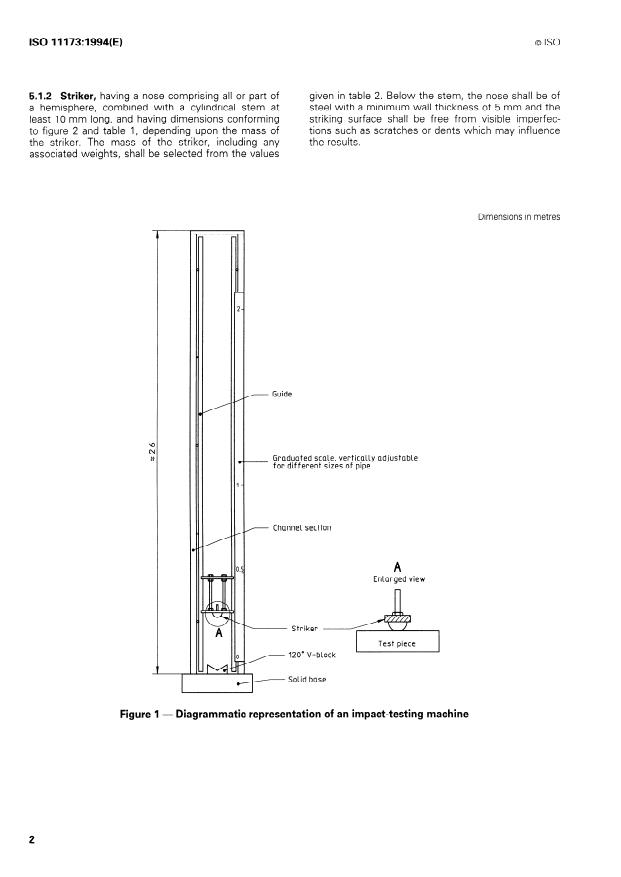
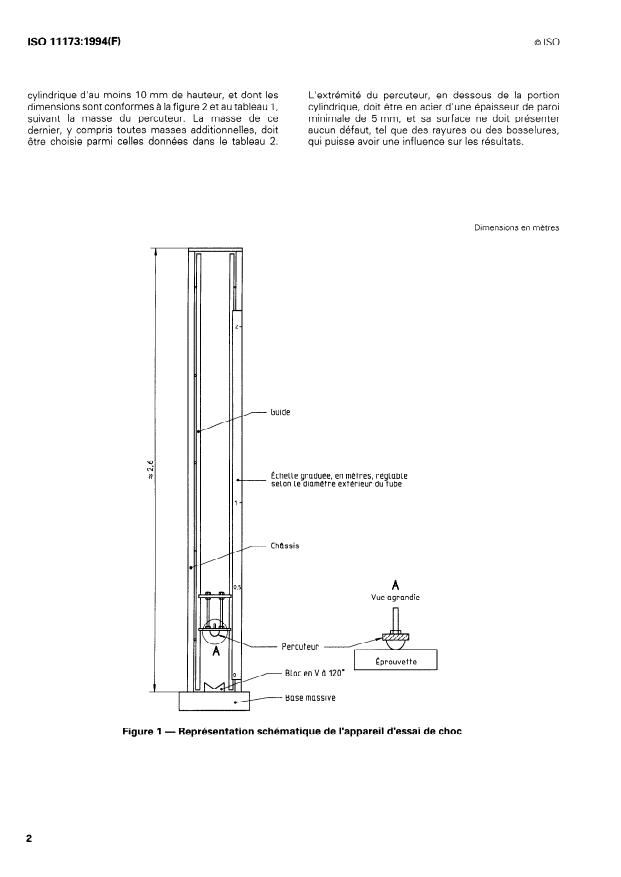
5.1 Falling-weight testing machine, incorporating
the following basic components (see figure 1).
3.1 drop height for 50 % failure, I&: Height of fall
of a striker of specified mass, which provokes failure
51.1 Main frame, with guide rails or a guiding tube
of 50 % of test pieces from samples of pipe taken to
rigidly fixed in the vertical position, to accommodate a
represent a batch.
striker (5.12) and release it to fall vertically and freely.
When calibrated, the Speed of the striker at the
NOTE 2 In practice, test pieces are drawn at random from
moment of impact shall be not less than 95 % of the
the batch and the result is only an estimate of the Hs0 for
theoretical Speed.
that batch.
0 ISO
given in table 2. Below the Stern, the nose shall be of
5.12 Striker, having a nose comprising all or part of
steel with a minimum wall thickness of 5 mm and the
a hemisphere, combined with a cylindrical stem at
striking surface shall be free from visible imperfec-
least 10 mm long, and having dimensions conforming
tions such as scratches or dents which may influence
to figure 2 and table 1, depending upon the mass of
the results.
the striker. The mass of the striker, including any
associated weights, shall be selected from the values
Dimensions in metres
- Guide
Graduated scale, vertically adjustable
for different sizes of pipe
/- ChanneL section
A
Enlarged view
triker
Test piece
A
Lack
0” V-b
Figure 1 - Diagrammatic representation of an impact-testing machine
0 ISO
Dimensions in millimetres
Rs
I
I
.
.-
#
E
+Lj 41
a) Type d25 (for strikers of mass 0,s kg and 0,8 kg)
b) Type d90 (for strikers of mass equal to or greater than Ikg)
Figure 2 - Noses of the strikers (see table 1)
Strikers with 0,5 kg and 0,8 kg mass shall have a type Table 2 - Recommended masses of stri kers
Masses in kilograms
d25 nose. Strikers with greater masses shall have a
type d90 nose.
Ot5
116 410 IO,0
018 zo 510
12,5
Table 1 - Dimensions for the nose of the striker
LO
2,5 6,3 16,O
Dimensions in millimetres
1,25
3,2 80
TYPe 4 d 4 a”
NOTE - The permissible tolerante on the mass of a
*l
striker shall be rf 0,5 %.
d25
50 25 free free
d90
50 90 free free
51.3 Rigid test support, consisting of a 120” For pipes with smooth inside and outside surfaces,
V-block at least 200 mm long, positioned so that the the wall thickness of the pipe to be tested shall be the
vertical projection of the Point of impact of the falling total wall through the pipe section.
striker is within 25 mm of the axis of the V-block (see
figure 1).
For pipes which are corrugated or ribbed externally,
the wall thickness is the thickest wall of the pipe
F
...
NORME
ISO
INTERNATIONALE
Première édition
1994-l 2-01
Tubes en matières thermoplastiques -
Détermination de la résistance aux chocs
extérieurs - Méthode en escalier
Thermoplastics pipes - Determina tion of resis tance to extemal blows -
Staircase method
Numéro de référence
ISO II 173:1994(F)
Avant-propos
L’ISO (Organisation internationale de normalisation) est une fédération
mondiale d’organismes nationaux de normalisation (comités membres de
I’ISO). L’élaboration des Normes internationales est en général confiée aux
comités techniques de I’ISO. Chaque comité membre intéressé par une
étude a le droit de faire partie du comité technique créé à cet effet. Les
organisations internationales, gouvernementales et non gouverne-
mentales, en liaison avec I’ISO participent également aux travaux. L’ISO
collabore étroitement avec la Commission électrotechnique internationale
(CEI) en ce qui concerne la normalisation électrotechnique.
Les projets de Normes internationales adoptés par les comités techniques
sont soumis aux comités membres pour vote. Leur publication comme
Normes internationales requiert l’approbation de 75 % au moins des
comités membres votants.
La Norme internationale ISO 11173 a été élaborée par le comité technique
lSO/TC 138, Tubes, raccords et robinetterie en matières plastiques pour le
transport des fluides, sous-comité SC 5, Propriétés générales des tubes,
raccords et robinetteries en matières plastiques et leurs accessoires.
Méthodes d’essais et spécifications de base.
0 ISO 1994
Droits de reproduction réservés. Sauf prescription différente, aucune partie de cette publica-
tion ne peut être reproduite ni utilisée sous quelque forme que ce soit et par aucun procédé,
électronique ou mécanique, y compris la photocopie et les microfilms, sans l’accord écrit de
l’éditeur.
Organisation internationale de normalisation
Case postale 56 l Cl-l-l 211 Genève 20 l Suisse
Imprimé en Suisse
ii
NORME INTERNATIONALE o ISO ISO 11173:1994(F)
Détermination
Tubes en matières thermoplastiques -
de la résistance aux chocs extérieurs - Méthode de l’escalier
3.2 défaillance: Le fait qu’un tube se brise en éclats,
1 Domaine d’application
se fende ou se fissure sur sa face interne, sous
La présente Norme internationale prescrit une métho-
l’action d’un choc, et d’une manière visible à I’œil nu (il
de pour la détermination de la résistance aux chocs
est possible d’utiliser une lampe pour faciliter I’exa-
extérieurs des tubes en matières thermoplastiques de
men des éprouvettes), sauf dans le cas d’une spécifi-
section circulaire; méthode dite de l’escalier.
cation particulière de la norme de produit.
Cette méthode est applicable à des lots isolés de
Une empreinte en creux ou une pliure des éprouvet-
tubes essayés à 0 “C.
tes n’est pas considérée comme une défaillance.
NOTE 1 S’il est nécessaire d’effectuer des essais en des-
sous de 0 OC, la température de - 20 “C est recommandée.
4 Principe
Soumission d’éprouvettes, constituées par des por-
tions de tube, à un choc unique provoqué par la chute
2 Référence normative
d’un percuteur, de masse spécifiée et de forme don-
née, à partir d’une hauteur ou d’une série de hauteurs
La norme suivante contient des dispositions qui, par
sur un point au hasard le long de la circonférence du
suite de la référence qui en est faite, constitue des
tube.
dispositions valables pour la présente Norme interna-
tionale. Au moment de la publication, l’édition indi-
Si une éprouvette se rompt, la hauteur de chute du
quée était en vigueur. Toute norme est sujette à révi-
choc suivant est diminuée d’une quantité prédéter-
sion et les parties prenantes des accords fondés sur
minée. Si une éprouvette ne se rompt pas, la hauteur
la présente Norme internationale sont invitées à
de chute du choc suivant est augmentée. Si un nom-
rechercher la possibilité d’appliquer l’édition la plus
bre suffisant d’éprouvettes est utilisé, la valeur HsO
récente de la norme indiquée ci-après. Les membres
d’un lot, ou de la production d’une extrudeuse, peut
de la CEI et de I’ISO possèdent le registre des
être calculée.
Normes internationales en vigueur à un moment
donné.
La sévérité de cette méthode d’essai peut être
ajustée par une modification de la masse du percuteur
ISO 6603-I :1985, Plastiques - Détermination du
et/ou de la température d’essai.
comportement des plastiques rigides sous un choc
m ultiaxial - Partie 1: Essai par chute de projectile.
5 Appareillage
3 Définitions
5.1 Machine d’essai de chute de masse, compor-
Pour les besoins de la présente Norme internationale,
tant les éléments de base suivants (voir figure 1).
les définitions suivantes s’appliquent.
5.1.1 Bâti, avec des rails de guidage ou un tube de
3.1 hauteur à 50 % de défaillance par choc, HSO:
guidage fixés de manière rigide en position verticale,
Hauteur de chute d’un percuteur de masse spécifiée,
permettant au percuteur (5.1.2) auquel il est destiné
qui provoque la défaillance de 50 % des éprouvettes
de tomber verticalement et librement. Après étalon-
prélevées dans un échantillon de tubes représentatif
nage, la vitesse du percuteur au moment du choc doit
d’un lot.
être au moins égale a 95 % de la vitesse théorique.
NOTE 2 En pratique, les éprouvettes sont prélevées au
5.12 Percuteur, dont l’extrémité est un hémisphère
hasard dans le lot, et le résultat est seulement une estima-
tion du HsO de ce lot. ou un segment d’hémisphère associé à une portion
0 ISO
cylindrique d’au moins 10 mm de hauteur, et dont les L’extrémité du percuteur, en dessous de la portion
dimensions sont conformes à la figure 2 et au tableau 1, cylindrique, doit être en acier d’une épaisseur de paroi
suivant la masse du percuteur. La masse de ce minimale de 5 mm, et sa surface ne doit présenter
dernier, y compris toutes masses additionnelles, doit aucun défaut, tel que des rayures ou des bosselures,
qui puisse avoir une influence sur les résultats.
être choisie parmi celles données dans le tableau 2.
Dimensions en mètres
,----- Guide
Echelle graduée, en mètres, réglable
selon Le diamètre exterieur du tube
,----- Chassis
A
Vue agrandie
------- Percuteur
Éprouvette
/- Bloc en V h 120”
------ Base massive
Figure 1 - Représentation schématique de l’appareil d’essai de choc
0 ISO
Dimensions en millimètres
a) Type d25 (pour les masses de 0,s kg et 0,8 kg)
QY
--
,’
/
c
.-
E
b) Type d90 (pour Les masses de 1 kg et plus)
Figure 2 - Extrémités des percuteurs (voir tableau 1)
Tableau 2 - Masses recommandées des
Les percuteurs de masses 0,5 kg et 0,8 kg doivent
percuteurs
avoir une extrémité du type d25. Ceux d’une masse
supérieure doivent avoir une extrémité du type d90.
Masses en kilogrammes
Tableau l- Dimensions de l’extrémité du
015 18 4,O
10,o
percuteur
018 2,o 510 12,5
Dimensions en millimètres
l,O 2,5 6,3 16,O
1,25 32 80
d a”
Rs 4
TYPe
+l
L’écart admissible de la masse du percuteur
NOTE -
r I
doit être de f 0,5 %.
d25 50 25 libre libre
50 90 libre libre
d90
5.1.3 Support d’éprouvette rigide, constitué par un Pour les tubes à surfaces interne et externe lisses,
bloc en V à 120°, de longueur minimale 200 mm, l’épaisseur de paroi du tube à essayer doit être toute
placé de telle sorte que le point d’impact de la masse l’épaisseur de la paroi de la section droite d( tube.
soit à 2,5 mm près de l’axe du V (voir figure 1).
...