

ISO/IEC PRF 19770-5
(Main)Information technology — IT asset management — Part 5: Vocabulary
General Information
- Abstract
ISO/IEC 19770-5:2015 provides a) an overview of the ISO/IEC 19770 family of standards, b) an introduction to IT asset management (ITAM) and software asset management (SAM), c) a brief description of the foundation principles and approaches on which SAM is based, and d) consistent terms and definitions for use throughout the ISO/IEC 19770 family of standards. ISO/IEC 19770-5:2015 is applicable to all types of organization (e.g. commercial enterprises, government agencies, and non-profit organizations).
- Status
- Not Published
- Technical Committee
- ISO/IEC JTC 1/SC 7 - Software and systems engineering
- Drafting Committee
- ISO/IEC JTC 1/SC 7 - Software and systems engineering
- Current Stage
- 5020 - FDIS ballot initiated: 2 months. Proof sent to secretariat
- Start Date
- 22-Sep-2026
- Completion Date
- 26-Sep-2026
Buy Documents
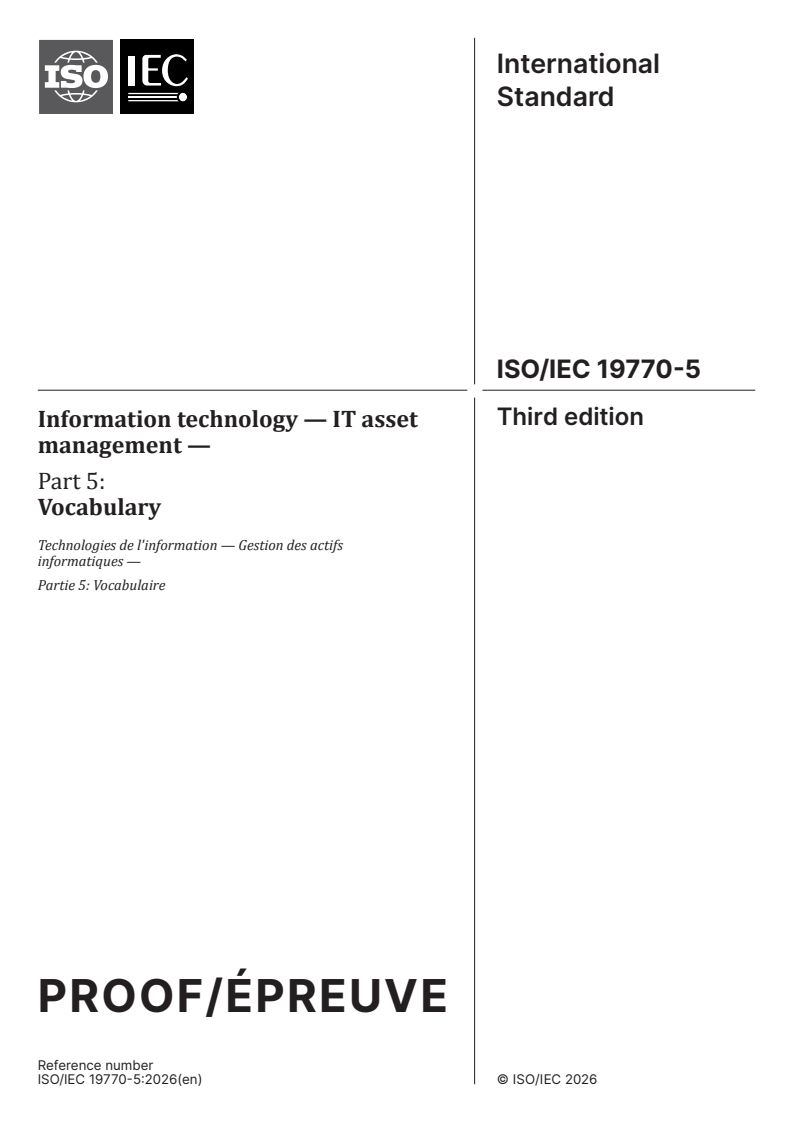
ISO/IEC PRF 19770-5 - Information technology — IT asset management — Part 5: Vocabulary

REDLINE ISO/IEC PRF 19770-5 - Information technology — IT asset management — Part 5: Vocabulary
Overview
ISO/IEC PRF 19770-5 is the vocabulary part of the ISO/IEC 19770 family for IT asset management (ITAM). It provides consistent terms and definitions that support clear communication across the full series, including software asset management (SAM) and related ITAM practices.
This standard is useful for organizations that need a common language for managing IT assets, improving governance, and aligning teams around shared terminology. It applies to all types of organizations, including commercial enterprises, government agencies, and non-profit organizations.
As a vocabulary standard, ISO/IEC 19770-5 helps reduce ambiguity in documentation, policies, and operational processes. It also supports users of the broader ISO/IEC 19770 series by making the terminology easier to understand and apply in practical IT asset management programs.
Key Topics
The standard covers terms that are central to the IT asset management lifecycle, including:
- IT asset management (ITAM) and software asset management (SAM)
- IT assets, hardware, software, digital assets, and related services
- Asset portfolios, configuration items, and management systems
- Entitlements, licenses, and licensing-related concepts
- Information structures used to identify and manage IT assets
- Documentation, data, and conformity terms used in ITAM governance
It also provides an overview of the ISO/IEC 19770 family and introduces the foundation principles and approaches on which SAM is based. This makes it a practical reference for organizations developing or improving ITAM policies, asset inventories, and compliance processes.
The terminology supports better understanding of topics such as:
- Asset value and risk
- Inventory and reconciliation
- License management and entitlement allocation
- IT asset lifecycle planning
- Automation and interoperability in ITAM tools
Applications
ISO/IEC PRF 19770-5 is valuable in a wide range of IT asset management applications, especially where consistent terminology improves communication and process quality.
Common uses include:
- Building and maintaining an ITAM program
- Defining internal policies and procedures
- Supporting software compliance and license management
- Improving collaboration between IT, procurement, legal, and governance teams
- Training staff on standard ITAM and SAM terminology
- Aligning documentation across tools, reports, and management systems
For organizations adopting ITAM frameworks, the vocabulary standard helps ensure that stakeholders interpret terms such as asset, entitlement, configuration item, and information structure in a consistent way. This is especially important when coordinating across departments or using multiple software asset management tools.
Related Standards
ISO/IEC PRF 19770-5 is part of the broader ISO/IEC 19770 series, which addresses different aspects of IT asset management.
Related standards and references may include:
- ISO/IEC 19770 series - the main family of ITAM standards
- Standards covering software identification, license management, and management system concepts
- Other ISO and IEC terminology resources used to support standardization and interoperability
Together, these standards help organizations strengthen IT asset governance, improve operational efficiency, and build a more structured approach to managing technology assets across their lifecycle.
Relations
- Effective Date
- 26-Aug-2023
Buy Documents
ISO/IEC PRF 19770-5 - Information technology — IT asset management — Part 5: Vocabulary
REDLINE ISO/IEC PRF 19770-5 - Information technology — IT asset management — Part 5: Vocabulary
Get Certified
Connect with accredited certification bodies for this standard

BSI Group
BSI (British Standards Institution) is the business standards company that helps organizations make excellence a habit.

NYCE
Mexican standards and certification body.
Sponsored listings
Frequently Asked Questions
ISO/IEC PRF 19770-5 is a draft published by the International Organization for Standardization (ISO). Its full title is "Information technology — IT asset management — Part 5: Vocabulary". This standard covers: ISO/IEC 19770-5:2015 provides a) an overview of the ISO/IEC 19770 family of standards, b) an introduction to IT asset management (ITAM) and software asset management (SAM), c) a brief description of the foundation principles and approaches on which SAM is based, and d) consistent terms and definitions for use throughout the ISO/IEC 19770 family of standards. ISO/IEC 19770-5:2015 is applicable to all types of organization (e.g. commercial enterprises, government agencies, and non-profit organizations).
ISO/IEC 19770-5:2015 provides a) an overview of the ISO/IEC 19770 family of standards, b) an introduction to IT asset management (ITAM) and software asset management (SAM), c) a brief description of the foundation principles and approaches on which SAM is based, and d) consistent terms and definitions for use throughout the ISO/IEC 19770 family of standards. ISO/IEC 19770-5:2015 is applicable to all types of organization (e.g. commercial enterprises, government agencies, and non-profit organizations).
ISO/IEC PRF 19770-5 is classified under the following ICS (International Classification for Standards) categories: 01.040.35 - Information technology (Vocabularies); 35.020 - Information technology (IT) in general. The ICS classification helps identify the subject area and facilitates finding related standards.
ISO/IEC PRF 19770-5 has the following relationships with other standards: It is inter standard links to ISO/IEC 19770-5:2015. Understanding these relationships helps ensure you are using the most current and applicable version of the standard.
ISO/IEC PRF 19770-5 is available in PDF format for immediate download after purchase. The document can be added to your cart and obtained through the secure checkout process. Digital delivery ensures instant access to the complete standard document.
Standards Content (Sample)
International
Standard
ISO/IEC 19770-5
Third edition
Information technology — IT asset
management —
Part 5:
Vocabulary
Technologies de l'information — Gestion des actifs
informatiques —
Partie 5: Vocabulaire
PROOF/ÉPREUVE
Reference number
ISO/IEC 19770-5:2026(en) © ISO/IEC 2026
ISO/IEC 19770-5:2026(en)
© ISO/IEC 2026
All rights reserved.
This ISO publication is protected by copyright and is owned by ISO and/or its licensors.
The content of this ISO publication is provided under licence, not sold. Use is subject to the applicable licence terms issued by ISO,
an ISO member body, or an authorized third-party distributor.
Except as required for implementation or expressly permitted by a separate licence, no part of this ISO publication may be
reproduced, distributed, modified, used, or made available in any form or by any means – electronic or mechanical, including
photocopying, scanning, recording, or posting on internal or external digital platforms.
Any use beyond the scope of the granted rights is prohibited and may result in legal action.
ISO copyright office
CP 401 • CH-1214 Vernier, Geneva
Phone: +41 22 749 01 11
Email: copyright@iso.org
Website: www.iso.org
Published in Switzerland
PROOF/ÉPREUVE
© ISO/IEC 2026 – All rights reserved
ii
ISO/IEC 19770-5:2026(en)
Contents Page
Foreword .iv
Introduction .v
1 Scope . 1
2 Normative references . 1
3 Terms and definitions . 1
Bibliography .16
Index . 17
PROOF/ÉPREUVE
© ISO/IEC 2026 – All rights reserved
iii
ISO/IEC 19770-5:2026(en)
Foreword
ISO (the International Organization for Standardization) and IEC (the International Electrotechnical
Commission) form the specialized system for worldwide standardization. National bodies that are
members of ISO or IEC participate in the development of International Standards through technical
committees established by the respective organization to deal with particular fields of technical activity.
ISO and IEC technical committees collaborate in fields of mutual interest. Other international organizations,
governmental and non-governmental, in liaison with ISO and IEC, also take part in the work.
The procedures used to develop this document and those intended for its further maintenance are described
in the ISO/IEC Directives, Part 1. In particular, the different approval criteria needed for the different types
of document should be noted. This document was drafted in accordance with the editorial rules of the ISO/
IEC Directives, Part 2 (see www.iso.org/directives or www.iec.ch/members_experts/refdocs).
ISO and IEC draw attention to the possibility that the implementation of this document may involve the
use of (a) patent(s). ISO and IEC take no position concerning the evidence, validity or applicability of any
claimed patent rights in respect thereof. As of the date of publication of this document, ISO and IEC had not
received notice of (a) patent(s) which may be required to implement this document. However, implementers
are cautioned that this may not represent the latest information, which may be obtained from the patent
database available at www.iso.org/patents and https://patents.iec.ch. ISO and IEC shall not be held
responsible for identifying any or all such patent rights.
Any trade name used in this document is information given for the convenience of users and does not
constitute an endorsement.
For an explanation of the voluntary nature of standards, the meaning of ISO specific terms and expressions
related to conformity assessment, as well as information about ISO's adherence to the World Trade
Organization (WTO) principles in the Technical Barriers to Trade (TBT) see www.iso.org/iso/foreword.html.
In the IEC, see www.iec.ch/understanding-standards.
This document was prepared by Joint Technical Committee ISO/IEC JTC1, Information technology,
Subcommittee SC 7, Software and systems engineering.
This third edition cancels and replaces the second edition (ISO/IEC 19770-5:2015), which has been
technically revised.
The main changes are as follows:
— The document changed to a vocabulary document.
— Latest terms and definitions are added from ISO/IEC 1977- series.
A list of all parts in the ISO/IEC 19770 series can be found on the ISO and IEC websites.
Any feedback or questions on this document should be directed to the user’s national standards
body. A complete listing of these bodies can be found at www.iso.org/members.html and
www.iec.ch/national-committees.
PROOF/ÉPREUVE
© ISO/IEC 2026 – All rights reserved
iv
ISO/IEC 19770-5:2026(en)
Introduction
The ISO/IEC 19770 series for IT asset management (ITAM) addresses all dimensions (processes, technology,
people, information, governance and external parties) for managing IT assets, including software,
hardware, virtual assets, cloud-based assets and asset services. Because IT is an essential enabler for almost
all activities in today's world, the ISO/IEC 19770 series integrates tightly into all of the IT functions. For
example, from a process perspective, the ISO/IEC 19770 series can be used with all management system
standards because IT and IT management are essential components of any modern management system.
From a technology perspective, the ISO/IEC 19770 series for information structures not only provides for
data interoperability of IT asset management data but also provides the basis for many related benefits
such as more effective security in the use of IT assets. The ISO/IEC 19770 series for information structures
also facilitates significant automation of IT functionality, such as improved authentication of IT assets and
linking to national vulnerability databases for more automated exposure identification and mitigation.
This document is targeted both at the general audience wishing to understand the ISO/IEC 19770 series, and
more specifically, at users of the ISO/IEC 19770 series. While there is no specific prerequisite to read this
document, it is helpful to the user in understanding the terms used in the other parts.
PROOF/ÉPREUVE
© ISO/IEC 2026 – All rights reserved
v
International Standard ISO/IEC 19770-5:2026(en)
Information technology — IT asset management —
Part 5:
Vocabulary
1 Scope
This document defines the terms common to the ISO/IEC 19770 series.
This document is applicable to all types of organizations (e.g. commercial enterprises, government agencies
and non-profit organizations).
2 Normative references
There are no normative references in this document.
3 Terms and definitions
ISO and IEC maintain terminology databases for use in standardization at the following addresses:
— ISO Online browsing platform: available at https:// www .iso .org/ obp
— IEC Electropedia: available at https:// www .electropedia .org/
3.1
allocation of an entitlement
process (3.69) of assigning some or all of a given entitlement (3.83) to a subsidiary or other associated
organizational unit
Note 1 to entry: The entitlement schema (3.27) enables the recording of entitlement allocations.
3.2
asset
item, thing or entity that has potential or actual value to an organization (3.57)
Note 1 to entry: Value can be tangible or intangible, financial or non-financial, and includes consideration of risks
(3.76) and liabilities. It can be positive or negative at different stages of the asset life.
Note 2 to entry: Physical assets usually refer to equipment, inventory and properties. Physical assets are the opposite
of intangible assets, which are non-physical assets such as leases, brands, digital assets (3.21), use rights (3.75),
licenses, intellectual property rights, reputation or agreements.
Note 3 to entry: A grouping of assets referred to as an asset system can also be considered as an asset.
3.3
asset type
grouping of assets (3.2) having common characteristics that distinguish those assets as a group or class
EXAMPLE Physical assets, information (3.35) assets, intangible assets, critical assets (3.17), enabling assets,
linear assets, information and communications technology (ICT) assets, infrastructure assets, and moveable assets.
PROOF/ÉPREUVE
© ISO/IEC 2026 – All rights reserved
ISO/IEC 19770-5:2026(en)
3.4
audit
independent examination of a work product or set of work products to assess compliance with specifications,
standards, contractual agreements, or other criteria
Note 1 to entry: An audit can be an internal audit (first party) or an external audit (second party or third party), and it
can be a combined audit (combining two or more disciplines).
[SOURCE: ISO/IEC/IEEE 12207:2017, 3.1.10, modified — Note 1 to entry has been added.]
3.5
baseline
formally approved version (3.107) of a configuration item (3.10), regardless of media, formally designated
and fixed at a specific time during the configuration item’s life cycle
[SOURCE: ISO/IEC/IEEE 12207:2017, 3.1.11]
3.6
bundle
grouping of products which is the result of a marketing or licensing strategy to sell entitlements to multiple
products as one purchased item
Note 1 to entry: A bundle can be referred to as a “suite” if the products are closely related and typically integrated
(such as an office suite containing a spreadsheet, word processor, presentation and other related items).
Note 2 to entry: Bundles can also refer to software (3.78) titles that are less closely related such as a game, a virus
scanner and a utility “bundled” together with a new computer, or to groups of entitlements, such as multiple
entitlements for a backup software product (3.93).
3.7
capability
measure of capacity and ability of a system, person or organization (3.57) to achieve its objectives (3.56)
3.8
competence
ability to apply knowledge and skills to achieve intended results
3.9
computing device
functional unit that can perform substantial computations, including numerous arithmetic operations and
logic operations, with or without human intervention
Note 1 to entry: A computing device can consist of a standalone unit or several interconnected units. It can also be a
device that provides a specific set of functions, such as a phone or a personal organizer, or more general functions such
as a laptop or desktop computer.
3.10
configuration item
CI
item or aggregation of hardware (3.30), software (3.78), or both, that is designated for configuration
management and treated as a single entity in the configuration management process (3.69)
[SOURCE: ISO/IEC/IEEE 12207:2017, 3.1.15, modified — The abbreviated term has been added; EXAMPLE
has been removed.]
PROOF/ÉPREUVE
© ISO/IEC 2026 – All rights reserved
ISO/IEC 19770-5:2026(en)
3.11
configuration management database
CMDB
database containing all the relevant details of each configuration item (3.10) and details of the important
relationships between them
Note 1 to entry: Aligning service management with SAM (3.80) can be enabled with CIs (3.10) that cover all software
(3.78) within the scope of SAM, i.e. controlled or licensed software usage (3.94) fully mapped to CIs and so accountable
through all the service management processes using CIs.
3.12
conformity
fulfilment of a requirement (3.72)
3.13
consolidation of an entitlement
process (3.69) of combining two or more software entitlements (3.83) into a single, unified software
entitlement
Note 1 to entry: Software entitlements can be consolidated to simplify understanding of the current position or as
the result of a licensor negotiation. The entitlement schema (3.27) enables the recording of software entitlement
consolidations.
3.14
continual improvement
recurring activity to enhance performance (3.61)
3.15
corporate board or equivalent body
person or group of people who assumes legal responsibility for conducting or controlling an organization
(3.57) at the highest level
3.16
corrective action
action to eliminate the cause of a nonconformity (3.55) and to prevent recurrence
Note 1 to entry: In the case of other undesirable outcomes, action is necessary to minimize or eliminate the causes and
to reduce the impact or prevent recurrence. Such actions fall outside the concept of corrective action, in the sense of
this definition.
3.17
critical asset
asset (3.2) having the potential to significantly impact the achievement of the organization’s objectives (3.56)
Note 1 to entry: Assets can be safety-critical, environment-critical or performance-critical and can relate to legal,
regulatory or statutory requirements (3.72).
Note 2 to entry: Critical assets can refer to those assets necessary to provide services to critical customers (3.18).
Note 3 to entry: Asset systems can be distinguished as being critical in a similar manner to individual assets.
3.18
customer
organization (3.57) or person that receives a product or service
[SOURCE: ISO/IEC/IEEE 12207:2017, 3.1.16, modified — EXAMPLE and note 1 to entry have been removed.]
PROOF/ÉPREUVE
© ISO/IEC 2026 – All rights reserved
ISO/IEC 19770-5:2026(en)
3.19
data
representation of facts, concepts or instructions in a manner suitable for communication, interpretation or
processing by humans or by automatic means
Note 1 to entry: In the context of IT asset management systems (3.43), data is captured, measured or recorded
representation of information (3.35) before it is analyzed, interpreted or processed. Data relates to objects such as
facts, events, things, processes (3.69) or ideas, including concepts that within a certain context have a particular
meaning related to IT assets (3.40).
3.20
definitive software library
DSL
secure storage environment, formed of physical media, or of one or more electronic software (3.78)
repositories, capable of controlling and protecting definitive authorized versions (3.107) of all software
configuration items (3.10) and gold originals of all software controlled by SAM (3.80)
3.21
digital asset
IT asset (3.40) expressed electronically in a digital format
3.22
digital information content asset
digital asset (3.21) with information (3.35) content
EXAMPLE Documents, audio, video, graphics, databases, free-standing dictionaries; often licensed.
Note 1 to entry: ITAM (3.44) can include management of these assets (3.2) as whole entities, for example, for license
compliance, but excludes management of the content.
3.23
documented information
information (3.35) required to be controlled and maintained by an organization (3.57) and the medium on
which it is contained
Note 1 to entry: Documented information can be in any format and media and from any source.
[SOURCE: ISO 55000:2024, 3.3.12, modified — Note 2 to entry has been removed.]
3.24
downgrade right
right (3.75) granted to receive, install, and/or use an installation of a previous version (3.107) of software
(3.78) rather than the currently granted entitlement (3.83)
3.25
effectiveness
extent to which planned activities are realized and planned results achieved
3.26
end user
person or persons who will ultimately be using the IT asset (3.40) for its intended purpose
3.27
entitlement schema
Ent
software entitlement schema
information structure (3.36) containing a digital encapsulation of a licensing transaction and its associated
software entitlement (3.83) information (3.35)
Note 1 to entry: A single transaction does not necessarily encapsulate a full (or effective) software entitlement. An
effective software entitlement can involve multiple licensing transactions, of a full license and then of upgrades and/
or maintenance transactions, transitions and subscriptions.
PROOF/ÉPREUVE
© ISO/IEC 2026 – All rights reserved
ISO/IEC 19770-5:2026(en)
3.28
XML
extensible markup language
license-free and platform-independent markup language that carries rules for generating text formats that
contain structured data (3.19)
3.29
globally unique identifier
GUID
16-byte string of characters that is generated in a manner that gives a high probability that the string is
unique in any context
Note 1 to entry: Other globally unique identifier algorithms can be used in some situations. In general, alternative
algorithms use uniform resource identifier (URI) (3.104) based structures, so the id owner’s registration identifier
(regid) (3.70) is included in the identifier.
3.30
hardware
physical equipment used to process, store, or transmit computer programs or data (3.19)
3.31
hardware asset management
HAM
coordinated activity of an organization to realize value from hardware (3.30) assets (3.2)
Note 1 to entry: Hardware asset management is a specialization and sub discipline of IT asset management (3.44)
focused specifically on hardware assets. The management of hardware assets can also involve the management of
non-hardware assets.
3.32
hardware identification tag
HWID tag
HWID
information structure (3.36) containing a digital description of a hardware (3.30) component and its
associated information (3.35)
3.33
hardware maintenance
process (3.69) of retaining a hardware (3.30) system or component in, or restoring it to, a state in which it
can perform its required functions
[SOURCE: ISO/IEC/IEEE 24765:2017, 3.2318, definition 2, modified — The term has been changed from
"maintenance" to "hardware maintenance".]
3.34
incident
anomalous or unexpected event, set of events, condition, or situation at any time during the life cycle of an
IT asset (3.40)
[SOURCE: ISO/IEC/IEEE 12207:2017, 3.1.23, modified — "a project, product, service, or system" has been
replaced by "an IT asset".]
3.35
information
knowledge concerning objects, such as facts, events, things, processes (3.69), or ideas, including concepts,
that within a certain context has a particular meaning
Note 1 to entry: In the context of IT asset management systems (3.43), information can be recorded digitally or
physically (e.g. on paper).
[SOURCE: ISO/IEC 2382:2015, 2121271, modified — The original notes to entry have been replaced by a new
one.]
PROOF/ÉPREUVE
© ISO/IEC 2026 – All rights reserved
ISO/IEC 19770-5:2026(en)
3.36
information structure
structure that provides information (3.35) about an IT asset (3.40) in order to facilitate its management
Note 1 to entry: Information structure is a generic reference to all information structures defined within the
ISO/IEC 19770 series.
EXAMPLE The software (3.78) identification structure is named a SWID tag (3.86).
3.37
information structure creator
info struct creator
entity that establishes an information structure (3.36)
Note 1 to entry: The information structure creator can be the same as, or different than, the creator of the IT asset
(3.40).
3.38
information structure ID
globally unique value for each information structure (3.36)
3.39
information technology
IT
development, maintenance, and use of technology to acquire, process, store and distribute digital information
(3.35)
3.40
IT asset
item, thing or entity that can be used to acquire, process, store and distribute digital information (3.35) and
has potential or actual value to an organization (3.57)
Note 1 to entry: IT assets include: software (3.78); media (physical and digital); physical equipment along with virtual
platforms (3.63) and instances; licenses (including proof of license); contracts; and ITAM system (3.43) management
assets (including ITAM systems and tools, and the metadata needed to manage all IT assets).
Note 2 to entry: Services to meet IT asset management (3.44)requirements (3.72), typically externally supplied, can also
be considered IT assets, such as 'software-as-a-service', hardware (3.30) maintenance, software support, and training.
Note 3 to entry: Digital information content assets (3.22) are files or other entities with information content, but they
are not considered software, for example, collections of standards in digital form, media collections, and credit agency
rating information. Such assets can be licensed, and therefore can benefit from being managed using the discipline of
IT asset management.
Note 4 to entry: The collective set of IT assets is also referred to as the IT infrastructure (3.46).
3.41
IT asset life cycle
stages involved in the management of an IT asset (3.40) from creation or acquisition to end of life
Note 1 to entry: End of life can be based on a specific criterion, for example, financial, function, performance and
available support stages involved in the management of an asset (3.2).
3.42
IT asset management plan
documented information (3.23) that specifies the activities, resources and timescales required for an
individual IT asset (3.40), or grouping of IT assets, to achieve the organization’s IT asset management
(3.44) objectives (3.56)
Note 1 to entry: The grouping of assets (3.2) can be by asset type (3.3), asset class, asset system or IT asset portfolio
(3.45).
Note 2 to entry: An IT asset management plan is derived from the strategic IT asset management plan.
PROOF/ÉPREUVE
© ISO/IEC 2026 – All rights reserved
ISO/IEC 19770-5:2026(en)
Note 3 to entry: An IT asset management plan can be contained in, or may be a subsidiary plan of, the strategic IT asset
management plan.
3.43
IT asset management system
ITAMS
ITAM system
management system (3.53) for IT asset management (3.44) whose function is to establish the IT asset (3.40)
management policy (3.64) and IT asset management objectives (3.56)
Note 1 to entry: The asset management system is a subset of asset management.
3.44
IT asset management
ITAM
coordinated activity of an organization (3.57) to realize value from IT assets (3.40)
3.45
IT asset portfolio
IT assets (3.40) that are within the scope of the IT asset management system (3.43)
Note 1 to entry: A portfolio is typically establ
...
Style Definition
...
Style Definition
...
Style Definition
...
Style Definition
...
Style Definition
...
ISO/IEC DISPRF 19770-5:2024(en)
Style Definition
...
ISO JTC1 /SC7 /WG21/IEC JTC 1/SC 7
Style Definition
...
Style Definition
...
Secretariat: BIS
Style Definition
...
Date: 2025-01-032026-09-22
Style Definition
...
Style Definition
...
Style Definition
...
Style Definition
...
Style Definition
...
Style Definition
...
Information technology — IT asset management — —
Style Definition
...
Style Definition
...
Style Definition
...
Style Definition
...
Style Definition
...
Part 5:
Style Definition
...
Vocabulary Style Definition
...
Style Definition
...
Style Definition
...
Style Definition
...
Style Definition
...
Style Definition
...
Style Definition
...
Style Definition
...
Style Definition
...
Style Definition
...
Style Definition
...
Style Definition
...
Style Definition
...
Style Definition
...
Style Definition
...
Style Definition
...
Style Definition
...
Style Definition
...
Style Definition
...
Style Definition
...
Style Definition
...
Style Definition
...
Style Definition
...
Style Definition
...
Style Definition
...
Style Definition
...
Style Definition
...
Style Definition
...
Style Definition
...
Style Definition
...
Style Definition
...
Style Definition
...
Style Definition
...
Style Definition
...
Style Definition
...
Style Definition
...
Style Definition
© Technologies de l'information — Gestion des actifs informatiques —
Partie 5: Vocabulaire
FDIS stage
Formatted: Font: 11 pt, Bold
Formatted: Font: 11 pt, Bold
Formatted: Font: 11 pt, Bold
© ISO/IEC 2024 2026
Formatted: HeaderCentered, Space After: 0 pt, Line
spacing: single
All rights reserved. Unless otherwise specified,
This ISO publication is protected by copyright and is owned by ISO and/or its licensors. Formatted: Default Paragraph Font, French (France)
The content of this ISO publication is provided under licence, not sold. Use is subject to the applicable licence terms issued
Formatted: French (France)
by ISO, an ISO member body, or an authorized third-party distributor.
Formatted: Indent: Left: 0 cm, Right: 0 cm, Space
Except as required in the context of its for implementation or expressly permitted by a separate licence, no part of this
Before: 0 pt, No page break before, Adjust space
ISO publication may be reproduced or utilized otherwise, distributed, modified, used, or made available in any form or
between Latin and Asian text, Adjust space between
by any means, – electronic or mechanical, including photocopying, scanning, recording, or posting on internal or external
Asian text and numbers
digital platforms.
Any use beyond the internet or an intranet, without prior written permission. Permission can be requested from either
Formatted: Right: 1.5 cm, Bottom: 1 cm, Gutter: 0 cm,
ISO at the address below or ISO’s member body in the countryscope of the requestergranted rights is prohibited and may
Header distance from edge: 1.27 cm, Footer distance
result in legal action.
from edge: 0.5 cm
Formatted: Indent: Left: 0 cm, Right: 0 cm, Adjust
ISO copyright office
space between Latin and Asian text, Adjust space
between Asian text and numbers
CP 401 • Ch. de Blandonnet 8
CH-1214 Vernier, Geneva
Formatted: zzCopyright address, Indent: Left: 0 cm,
Phone: + 41 22 749 01 11
First line: 0 cm, Right: 0 cm, Adjust space between
Email: copyright@iso.org
Latin and Asian text, Adjust space between Asian text
Website: www.iso.orgwww.iso.org
and numbers
Published in Switzerland
Formatted: Font: 10 pt
Formatted: Font: 10 pt
Formatted: Font: 11 pt
ii © ISO 2024 /IEC 2026 – All rights reserved
ii
ISO/IEC DISPRF 19770-5:20242026(en)
Formatted: Font: 11 pt
Formatted: Font: 11 pt
Formatted: Font: 11 pt
Contents
Formatted: HeaderCentered, Left, Space After: 0 pt,
Line spacing: single, Tab stops: Not at 0.71 cm
Foreword . iv
Formatted: Adjust space between Latin and Asian text,
Introduction . v
Adjust space between Asian text and numbers
1 Scope . 1
2 Normative references . 1
3 Terms and definitions . 1
Bibliography . 18
Index 19
Foreword . v
Introduction . vi
1 Scope . 1
2 Normative references . 1
3 Terms and definitions . 1
Formatted: Font: 10 pt
Formatted: Font: 10 pt
Formatted: FooterCentered, Left, Space Before: 0 pt,
Tab stops: Not at 17.2 cm
Formatted: Font: 11 pt
© ISO/IEC 20242026 – All rights reserved
iii
Formatted: Font: 11 pt, Bold
Formatted: Font: 11 pt, Bold
Formatted: Font: 11 pt, Bold
Foreword
Formatted: HeaderCentered, Space After: 0 pt, Line
spacing: single
ISO (the International Organization for Standardization) and IEC (the International Electrotechnical
Commission) form the specialized system for worldwide standardization. National bodies that are members
of ISO or IEC participate in the development of International Standards through technical committees
established by the respective organization to deal with particular fields of technical activity. ISO and IEC
technical committees collaborate in fields of mutual interest. Other international organizations, governmental
and non-governmental, in liaison with ISO and IEC, also take part in the work.
The procedures used to develop this document and those intended for its further maintenance are described
in the ISO/IEC Directives, Part 1. In particular, the different approval criteria needed for the different types of
document should be noted. This document was drafted in accordance with the editorial rules of the ISO/IEC
Directives, Part 2 (see www.iso.org/directiveswww.iso.org/directives or
www.iec.ch/members_experts/refdocswww.iec.ch/members_experts/refdocs).
ISO and IEC draw attention to the possibility that the implementation of this document may involve the use of
(a) patent(s). ISO and IEC take no position concerning the evidence, validity or applicability of any claimed
patent rights in respect thereof. As of the date of publication of this document, ISO and IEC had not received
notice of (a) patent(s) which may be required to implement this document. However, implementers are
cautioned that this may not represent the latest information, which may be obtained from the patent database
available at www.iso.org/patents and https://patents.iec.ch.www.iso.org/patents and https://patents.iec.ch.
ISO and IEC shall not be held responsible for identifying any or all such patent rights.
Any trade name used in this document is information given for the convenience of users and does not
constitute an endorsement.
For an explanation of the voluntary nature of standards, the meaning of ISO specific terms and expressions
related to conformity assessment, as well as information about ISO's adherence to the World Trade
Organization (WTO) principles in the Technical Barriers to Trade (TBT) see
www.iso.org/iso/foreword.html.www.iso.org/iso/foreword.html. In the IEC, see www.iec.ch/understanding-
standardswww.iec.ch/understanding-standards.
This document was prepared by Joint Technical Committee ISO/IEC JTC1, Information technology,
Formatted: Default Paragraph Font
Subcommittee SC 7, Software and systems engineering.
Formatted: Default Paragraph Font
Formatted: Adjust space between Latin and Asian text,
This third edition cancels and replaces the second edition (ISO/IEC 19770-5:2015), which has been technically
Adjust space between Asian text and numbers
revised.
Formatted: Default Paragraph Font
The main changes are as follows:
Formatted: Default Paragraph Font
— — The document changed to a Vocabularyvocabulary document. Formatted: Default Paragraph Font
Formatted: Default Paragraph Font
— — Latest Termsterms and definitions are added from ISO/IEC 1977- series .
Formatted: Font: Cambria
A list of all parts in the ISO/IEC 19770 series can be found on the ISO and IEC websites.
Any feedback or questions on this document should be directed to the user’s national standards body. A
complete listing of these bodies can be found at www.iso.org/members.htmlwww.iso.org/members.html and
www.iec.ch/national-committeeswww.iec.ch/national-committees.
Formatted: Font: 10 pt
Formatted: Font: 10 pt
Formatted: Font: 11 pt
iv © ISO 2024 /IEC 2026 – All rights reserved
iv
ISO/IEC DISPRF 19770-5:20242026(en)
Formatted: Font: 11 pt
Formatted: Font: 11 pt
Formatted: Font: 11 pt
Introduction
Formatted: HeaderCentered, Left, Space After: 0 pt,
Line spacing: single, Tab stops: Not at 0.71 cm
Formatted: Adjust space between Latin and Asian text,
Adjust space between Asian text and numbers
The ISO/IEC 19770 series for IT asset management (ITAM) addresses all dimensions (processes, technology,
Formatted: Default Paragraph Font
people, information, governance and external parties) for managing IT assets, including software, hardware,
virtual assets, cloud-based assets and asset services. Because IT is an essential enabler for almost all activities
Formatted: Default Paragraph Font
in today's world, the ISO/IEC 19770 series integrates tightly into all of the IT functions. For example, from a
Formatted: Adjust space between Latin and Asian text,
process perspective, the ISO/IEC 19770 series can be used with all management system standards because IT
Adjust space between Asian text and numbers
and IT management are essential components of any modern management system. From a technology
Formatted: Default Paragraph Font
perspective, the ISO/IEC 19770 series for information structures not only provides for data interoperability
of IT asset management data but also provides the basis for many related benefits such as more effective
Formatted: Default Paragraph Font
security in the use of IT assets. The ISO/IEC 19770 series for information structures also facilitates significant
Formatted: Default Paragraph Font
automation of IT functionality, such as improved authentication of IT assets and linking to national
Formatted: Default Paragraph Font
vulnerability databases for more automated exposure identification and mitigation.
Formatted: Default Paragraph Font
Formatted: Default Paragraph Font
This document is targeted both at the general audience wishing to understand the ISO/IEC 19770 series, and
Formatted: Default Paragraph Font
more specifically, at users of the ISO/IEC 19770 series. While there is no specific prerequisite to read this
Formatted: Default Paragraph Font
document, it is helpful to the user in understanding the terms used in the other parts.
Formatted: English (United Kingdom)
Formatted: Adjust space between Latin and Asian text,
Adjust space between Asian text and numbers
Formatted: Font: 10 pt
Formatted: Font: 10 pt
Formatted: FooterCentered, Left, Space Before: 0 pt,
Tab stops: Not at 17.2 cm
Formatted: Font: 11 pt
© ISO/IEC 20242026 – All rights reserved
v
DRAFT International Standard ISO/IEC DIS 19770-5:2024(en)
Formatted: Main Title 1, Space After: 0 pt, Adjust
Information technology — IT asset management — Overview and
space between Latin and Asian text, Adjust space
vocabulary —
between Asian text and numbers
Formatted: Right: 1.5 cm, Bottom: 1 cm, Gutter: 0 cm,
Part 5:
Section start: New page, Header distance from edge:
Vocabulary
1.27 cm, Footer distance from edge: 0.5 cm
1 Scope
This document defines the terms common to the ISO/IEC 19770 series.
Formatted: Body Text, Adjust space between Latin and
Asian text, Adjust space between Asian text and
This document is applicable to all types of organizations (e.g. commercial enterprises, government agencies
numbers, Tab stops: Not at 0.7 cm + 1.4 cm + 2.1 cm
and non-profit organizations).
+ 2.8 cm + 3.5 cm + 4.2 cm + 4.9 cm + 5.6 cm + 6.3
cm + 7 cm
2 Normative references
Formatted: Adjust space between Latin and Asian text,
Adjust space between Asian text and numbers
There are no normative references in this document.
Formatted: Body Text
3 Terms and definitions
ISO and IEC maintain terminology databases for use in standardization at the following addresses:
— — ISO Online browsing platform: available at https://www.iso.org/obphttps://www.iso.org/obp
— — IEC Electropedia: available at https://www.electropedia.org/https://www.electropedia.org/
3.1 3.1
allocation of an entitlement
process (3.69)(3.69) of assigning some or all of a given entitlement (3.83)(3.83) to a subsidiary or other
associated organizational unit
Note 1 to entry: The entitlement schema (3.27)(3.27) enables the recording of entitlement allocations.
3.2 3.2
asset
item, thing or entity that has potential or actual value to an organization (3.57)(3.57)
Note 1 to entry: Value can be tangible or intangible, financial or non-financial, and includes consideration of risks
(3.76)(3.76) and liabilities. It can be positive or negative at different stages of the asset life.
Note 2 to entry: Physical assets usually refer to equipment, inventory and properties. Physical assets are the opposite
of intangible assets, which are non-physical assets such as leases, brands, digital assets (3.21),(3.21), use rights
(3.75),(3.75), licenses, intellectual property rights, reputation or agreements.
Note 3 to entry: A grouping of assets referred to as an asset system can also be considered as an asset.
3.3 3.3
asset type
grouping of assets (3.2)(3.2) having common characteristics that distinguish those assets as a group or class
Formatted: Font: 11 pt
© ISO/IEC 2024 – All rights reserved
Formatted: Font: 11 pt, Bold
Formatted: Font: 11 pt, Bold
Formatted: Font: 11 pt, Bold
EXAMPLE: Physical assets, information (3.35)(3.35) assets, intangible assets, critical assets (3.17),(3.17), enabling
Formatted: HeaderCentered, Space After: 0 pt, Line
assets, linear assets, information and communications technology (ICT) assets, infrastructure assets, and moveable
spacing: single
assets.
3.4 3.4
audit
independent examination of a work product or set of work products to assess compliance with specifications,
standards, contractual agreements, or other criteria
Note 1 to entry: An audit can be an internal audit (first party) or an external audit (second party or third party), and it
Formatted: Adjust space between Latin and Asian text,
can be a combined audit (combining two or more disciplines).
Adjust space between Asian text and numbers, Tab
stops: Not at 0.7 cm + 1.4 cm + 2.1 cm + 2.8 cm +
[SOURCE: ISO/IEC/IEEE 12207:2017, 3.1.10, modified — Note 1 to entry has been added.]
3.5 cm + 4.2 cm + 4.9 cm + 5.6 cm + 6.3 cm + 7 cm
Formatted: Default Paragraph Font
3.5 3.5
Formatted: Default Paragraph Font
baseline
formally approved version (3.107)(3.107) of a configuration item (3.10),(3.10), regardless of media, formally
Formatted: Default Paragraph Font
designated and fixed at a specific time during the configuration item’s life cycle
Formatted: Adjust space between Latin and Asian text,
Adjust space between Asian text and numbers
[SOURCE: ISO/IEC/IEEE 12207:2017, 3.1.11]
Formatted: Default Paragraph Font
3.6 3.6
Formatted: Default Paragraph Font
bundle
Formatted: Default Paragraph Font
grouping of products which is the result of a marketing or licensing strategy to sell entitlements to multiple
products as one purchased item
Note 1 to entry: A bundle can be referred to as a “suite” if the products are closely related and typically integrated (such
Formatted: Adjust space between Latin and Asian text,
as an office suite containing a spreadsheet, word processor, presentation and other related items).
Adjust space between Asian text and numbers, Tab
stops: Not at 0.7 cm + 1.4 cm + 2.1 cm + 2.8 cm +
Note 2 to entry: Bundles can also refer to software (3.78)(3.78) titles that are less closely related such as a game, a virus
3.5 cm + 4.2 cm + 4.9 cm + 5.6 cm + 6.3 cm + 7 cm
scanner and a utility “bundled” together with a new computer, or to groups of entitlements, such as multiple entitlements
for a backup software product (3.93).(3.93).
3.7 3.7
capability
measure of capacity and ability of a system, person or organization (3.57)(3.57) to achieve its objectives
(3.56)(3.56)
3.8 3.8
competence
ability to apply knowledge and skills to achieve intended results
3.9 3.9
computing device
functional unit that can perform substantial computations, including numerous arithmetic operations and
logic operations, with or without human intervention
Note 1 to entry: A computing device can consist of a standalone unit or several interconnected units. It can also be a
Formatted: Adjust space between Latin and Asian text,
device that provides a specific set of functions, such as a phone or a personal organizer, or more general functions such
Adjust space between Asian text and numbers, Tab
as a laptop or desktop computer.
stops: Not at 0.7 cm + 1.4 cm + 2.1 cm + 2.8 cm +
3.5 cm + 4.2 cm + 4.9 cm + 5.6 cm + 6.3 cm + 7 cm
Formatted: Font: 10 pt
Formatted: Font: 10 pt
Formatted: Font: 11 pt
2 © ISO 2024 /IEC 2026 – All rights reserved
ISO/IEC DISPRF 19770-5:20242026(en)
Formatted: Font: 11 pt
Formatted: Font: 11 pt
Formatted: Font: 11 pt
3.10 3.10
Formatted: HeaderCentered, Left, Space After: 0 pt,
configuration item
Line spacing: single, Tab stops: Not at 0.71 cm
CI
item or aggregation of hardware (3.30),(3.30), software (3.78),(3.78), or both, that is designated for
configuration management and treated as a single entity in the configuration management process
(3.69)(3.69)
[SOURCE: ISO/IEC/IEEE 12207:2017, 3.1.15, modified — The abbreviated term has been added; EXAMPLE
Formatted: Default Paragraph Font
has been removed.]
Formatted: Default Paragraph Font
Formatted: Default Paragraph Font
3.11 3.11
configuration management database
Formatted: English (United Kingdom)
CMDB
database containing all the relevant details of each configuration item (3.10)(3.10) and details of the important
relationships between them
Note 1 to entry: Aligning service management with SAM (3.80)(3.80) can be enabled with CIs (3.10)(3.10) that cover
all software (3.78)(3.78) within the scope of SAM, i.e. controlled or licensed software usage (3.94)(3.94) fully mapped to
CIs and so accountable through all the service management processes using CIs.
3.12 3.12
conformity
fulfilment of a requirement (3.72)(3.72)
3.13 3.13
consolidation of an entitlement
process (3.69)(3.69) of combining two or more software entitlements (3.83)(3.83) into a single, unified
software entitlement
Note 1 to entry: Software entitlements can be consolidated to simplify understanding of the current position or as the
result of a licensor negotiation. The entitlement schema (3.27)(3.27) enables the recording of software entitlement
consolidations.
3.14 3.14
continual improvement
recurring activity to enhance performance (3.61)(3.61)
3.15 3.15
corporate board or equivalent body
person or group of people who assumes legal responsibility for conducting or controlling an organization
(3.57)(3.57) at the highest level
3.16 3.16
corrective action
action to eliminate the cause of a nonconformity (3.55)(3.55) and to prevent recurrence
Note 1 to entry: In the case of other undesirable outcomes, action is necessary to minimize or eliminate the causes and
Formatted: Adjust space between Latin and Asian text,
to reduce the impact or prevent recurrence. Such actions fall outside the concept of corrective action, in the sense of this
Adjust space between Asian text and numbers, Tab
definition.
stops: Not at 0.7 cm + 1.4 cm + 2.1 cm + 2.8 cm +
3.5 cm + 4.2 cm + 4.9 cm + 5.6 cm + 6.3 cm + 7 cm
3.17 3.17
Formatted: Font: 10 pt
critical asset
asset (3.2)(3.2) having the potential to significantly impact the achievement of the organization’s objectives Formatted: Font: 10 pt
(3.56)(3.56)
Formatted: FooterCentered, Left, Space Before: 0 pt,
Line spacing: single, Tab stops: Not at 17.2 cm
Formatted: Font: 11 pt
© ISO/IEC 20242026 – All rights reserved
Formatted: Font: 11 pt, Bold
Formatted: Font: 11 pt, Bold
Formatted: Font: 11 pt, Bold
Note 1 to entry: Assets can be safety-critical, environment-critical or performance-critical and can relate to legal,
Formatted: HeaderCentered, Space After: 0 pt, Line
regulatory or statutory requirements (3.72).(3.72).
spacing: single
Note 2 to entry: Critical assets can refer to those assets necessary to provide services to critical customers (3.18).(3.18).
Note 3 to entry: Asset systems can be distinguished as being critical in a similar manner to individual assets.
3.18 3.18
customer
organization (3.57)(3.57) or person that receives a product or service
[SOURCE: ISO/IEC/IEEE 12207:2017, 3.1.16, modified — EXAMPLE and note 1 to entry have been removed.]
Formatted: Default Paragraph Font
Formatted: Default Paragraph Font
3.19 3.19
data Formatted: Default Paragraph Font
representation of facts, concepts or instructions in a manner suitable for communication, interpretation or
processing by humans or by automatic means
Note 1 to entry: In the context of IT asset management systems (3.43),(3.43), data is captured, measured or recorded
representation of information (3.35)(3.35) before it is analyzed, interpreted or processed. Data relates to objects such as
facts, events, things, processes (3.69)(3.69) or ideas, including concepts that within a certain context have a particular
meaning related to IT assets (3.40).(3.40).
3.20 3.20
definitive software library
DSL
secure storage environment, formed of physical media, or of one or more electronic software (3.78)(3.78)
repositories, capable of controlling and protecting definitive authorized versions (3.107)(3.107) of all software
configuration items (3.10)(3.10) and gold originals of all software controlled by SAM (3.80)(3.80)
3.21 3.21
digital asset
Formatted: Dutch (Netherlands)
IT asset (3.40)(3.40) expressed electronically in a digital format
Formatted: Dutch (Netherlands)
Formatted: Dutch (Netherlands)
3.22 3.22
digital information content asset
Formatted: Dutch (Netherlands)
digital asset (3.21)(3.21) with information (3.35)(3.35) content
Formatted: Adjust space between Latin and Asian text,
Adjust space between Asian text and numbers, Tab
EXAMPLE: Documents, audio, video, graphics, databases, free-standing dictionaries; often licensed.
stops: Not at 0.7 cm + 1.4 cm + 2.1 cm + 2.8 cm +
3.5 cm + 4.2 cm + 4.9 cm + 5.6 cm + 6.3 cm + 7 cm
Note 1 to entry: ITAM (3.44)(3.44) can include management of these assets (3.2)(3.2) as whole entities, for example,
for license compliance, but excludes management of the content.
Formatted: Adjust space between Latin and Asian text,
Adjust space between Asian text and numbers, Tab
3.23 3.23
stops: Not at 0.7 cm + 1.4 cm + 2.1 cm + 2.8 cm +
documented information
3.5 cm + 4.2 cm + 4.9 cm + 5.6 cm + 6.3 cm + 7 cm
information (3.35)(3.35) required to be controlled and maintained by an organization (3.57)(3.57) and the
Formatted: Default Paragraph Font
medium on which it is contained
Formatted: Default Paragraph Font
Note 1 to entry: Documented information can be in any format and media and from any source.
Formatted: Default Paragraph Font
Formatted: Default Paragraph Font
[SOURCE: ISO 55000:2024, 3.3.12, modified — Note 2 to entry has been removed.]
Formatted: Adjust space between Latin and Asian text,
3.24 3.24 Adjust space between Asian text and numbers
downgrade right
Formatted: Font: 10 pt
right (3.75)(3.75) granted to receive, install, and/or use an installation of a previous version (3.107)(3.107) of
Formatted: Font: 10 pt
software (3.78)(3.78) rather than the currently granted entitlement (3.83)(3.83)
Formatted: Font: 11 pt
4 © ISO 2024 /IEC 2026 – All rights reserved
ISO/IEC DISPRF 19770-5:20242026(en)
Formatted: Font: 11 pt
Formatted: Font: 11 pt
Formatted: Font: 11 pt
3.25 3.25
Formatted: HeaderCentered, Left, Space After: 0 pt,
effectiveness
Line spacing: single, Tab stops: Not at 0.71 cm
extent to which planned activities are realized and planned results achieved
3.26 3.26
end user
person or persons who will ultimately be using the IT asset (3.40)(3.40) for its intended purpose
3.27 3.27
entitlement schema
Ent
software entitlement schema
Formatted: Regular, Font: Bold
information structure (3.36)(3.36) containing a digital encapsulation of a licensing transaction and its
Formatted: Font: Bold
associated software entitlement (3.83) (3.83) information (3.35)(3.35)
Note 1 to entry: A single transaction does not necessarily encapsulate a full (or effective) software entitlement. An
Formatted: Adjust space between Latin and Asian text,
effective software entitlement can involve multiple licensing transactions, of a full license and then of upgrades and/or
Adjust space between Asian text and numbers, Tab
maintenance transactions, transitions and subscriptions.
stops: Not at 0.7 cm + 1.4 cm + 2.1 cm + 2.8 cm +
3.5 cm + 4.2 cm + 4.9 cm + 5.6 cm + 6.3 cm + 7 cm
3.28 3.28
XML
extensible markup language
Formatted: Regular, Font: Bold
license-free and platform-independent markup language that carries rules for generating text formats that
Formatted: Font: Bold
contain structured data (3.19)(3.19)
3.29
3.29 GUID
globally unique identifier
Formatted: Font: Bold
GUID
16-byte string of characters that is generated in a manner that gives a high probability that the string is unique
Formatted: Adjust space between Latin and Asian text,
in any context
Adjust space between Asian text and numbers
Note 1 to entry: Other globally unique identifier algorithms can be used in some situations. In general, alternative
algorithms use uniform resource identifier (URI) (3.104)(3.104) based structures, so the id owner’s registration identifier
(regid) (3.70)(3.70) is included in the identifier.
3.30 3.30
hardware
physical equipment used to process, store, or transmit computer programs or data (3.19)(3.19)
3.31 3.31
hardware asset management
HAM
coordinated activity of an organization to realize value from hardware (3.30) assets (3.2)(3.30) assets (3.2)
Note 1 to entry: Hardware asset management is a specialization and sub discipline of IT asset management (3.44)(3.44)
focused specifically on hardware assets. The management of hardware assets can also involve the management of non-
hardware assets.
3.32 3.32
hardware identification tag
Formatted: Font: 10 pt
HWID tag
Formatted: Font: 10 pt
HWID
information structure (3.36)(3.36) containing a digital description of a hardware (3.30)(3.30) component and Formatted: FooterCentered, Left, Space Before: 0 pt,
Line spacing: single, Tab stops: Not at 17.2 cm
its associated information (3.35)(3.35)
Formatted: Font: 11 pt
© ISO/IEC 20242026 – All rights reserved
Formatted: Font: 11 pt, Bold
Formatted: Font: 11 pt, Bold
Formatted: Font: 11 pt, Bold
3.33 3.33
Formatted: HeaderCentered, Space After: 0 pt, Line
hardware maintenance
spacing: single
process (3.69)(3.69) of retaining a hardware (3.30)(3.30) system or component in, or restoring it to, a state in
which it can perform its required functions
[SOURCE: ISO/IEC/IEEE 24765:2017, 3.2318, definition 2, modified — The term has been changed from
Formatted: Default Paragraph Font
"maintenance" to "hardware maintenance".]
Formatted: Default Paragraph Font
3.34 3.34 Formatted: Default Paragraph Font
incident
Formatted: Default Paragraph Font
anomalous or unexpected event, set of events, condition, or situation at any time during the life cycle of an IT
asset (3.40)(3.40)
[SOURCE: ISO/IEC/IEEE 12207:2017, 3.1.23, modified — "a project, product, service, or system" has been
Formatted: Default Paragraph Font
replaced by "an IT asset".]
Formatted: Default Paragraph Font
Formatted: Default Paragraph Font
3.35 3.35
information
Formatted: Default Paragraph Font
knowledge concerning objects, such as facts, events, things, processes (3.69),(3.69), or ideas, including
concepts, that within a certain context has a particular meaning
Note 1 to entry: In the context of IT asset management systems (3.43),(3.43), information can be recorded digitally or
physically (e.g. on paper).
[SOURCE: ISO/IEC 2382:2015, 2121271, modified — The original notes to entry have been replaced by a new
Formatted: Default Paragraph Font
one.]
Formatted: Default Paragraph Font
Formatted: Default Paragraph Font
3.36 3.36
information structure
Formatted: Adjust space between Latin and Asian text,
structure that provides information (3.35)(3.35) about an IT asset (3.40)(3.40) in order to facilitate its
Adjust space between Asian text and numbers
management
Note 1 to entry: Information structure is a generic reference to all information structures defined within the
Formatted: Adjust space between Latin and Asian text,
ISO/IEC 19770 series.
Adjust space between Asian text and numbers, Tab
stops: Not at 0.7 cm + 1.4 cm + 2.1 cm + 2.8 cm +
EXAMPLE: The software (3.78)(3.78) identification structure is named a SWID tag (3.86).(3.86).
3.5 cm + 4.2 cm + 4.9 cm + 5.6 cm + 6.3 cm + 7 cm
3.37 3.37
information structure creator
info struct creator
entity that establishes an information structure (3.36)(3.36)
Note 1 to entry: The information structure creator can be the same as, or different than, the creator of the IT asset
(3.40).(3.40).
3.38 3.38
information structure ID
globally unique value for each information structure (3.36)(3.36)
3.39 3.39
information technology
IT
development, maintenance, and use of technology to acquire, process, store and distribute digital information
Formatted: Font: 10 pt
(3.35)(3.35)
Formatted: Font: 10 pt
Formatted: Font: 11 pt
6 © ISO 2024 /IEC 2026 – All rights reserved
ISO/IEC DISPRF 19770-5:20242026(en)
Formatted: Font: 11 pt
Formatted: Font: 11 pt
Formatted: Font: 11 pt
3.40 3.40
Formatted: HeaderCentered, Left, Space After: 0 pt,
IT asset
Line spacing: single, Tab stops: Not at 0.71 cm
item, thing or entity that can be used to acquire, process, store and distribute digital information (3.35)(3.35)
and has potential or actual value to an organization (3.57)(3.57)
Note 1 to entry: IT assets include: software (3.78);(3.78); media (physical and digital); physical equipment along with
virtual platforms (3.63)(3.63) and instances; licenses (including proof of license); contracts; and ITAM system
(3.43)(3.43) management assets (including ITAM systems and tools, and the metadata needed to manage all IT assets).
Note 2 to entry: Services to meet IT asset management (3.44) (3.44)requirements (3.72),(3.72), typically externally
supplied, can also be considered IT assets, such as 'software-as-a-service', hardware (3.30)(3.30) maintenance, software
support, and training.
Note 3 to entry: Digital information content assets (3.22)(3.22) are files or other entities with information content, but
they are not considered software, for example, collections of standards in digital form, media collections, and credit
agency rating information. Such assets can be licensed, and therefore can benefit from being managed using the discipline
of IT asset management.
Note 4 to entry: The collective set of IT assets is also referred to as the IT infrastructure (3.46).(3.46).
3.41 3.41
IT asset life cycle
stages involved in the management of an IT asset (3.40)(3.40) from creation or acquisition to end of life
Note 1 to entry: End of life can be based on a specific criterion, for example, financial, function, performance and
available support stages involved in the management of an asset (3.2).(3.2).
3.42 3.42
IT asset management plan
documented information (3.23)(3.23) that specifies the activities, resources and timescales required for an
individual IT asset (3.40),(3.40), or grouping of IT assets, to achieve the organization’s IT asset management
(3.44) (3.44) objectives (3.56)(3.56)
Note 1 to entry: The grouping of assets (3.2)(3.2) can be by asset type (3.3),(3.3), asset class, asset system or IT asset
portfolio (3.45).(3.45).
Note 2 to entry: An IT asset management plan is derived from the strategic IT asset management plan.
Note 3 to entry: An IT asset management plan can be contained in, or may be a subsidiary plan of, the strategic IT asset
management plan.
3.43 3.43
IT asset management system
ITAMS
ITAM system
management system (3.53)(3.53) for IT asset management (3.44)(3.44) whose function is to establish the IT
asset (3.40)(3.40) management policy (3.64)(3.64) and IT asset management objectives (3.56)(3.56)
Formatted: Adjust space between Latin and Asian text,
Note 1 to entry: The asset management system is a subset of asset management.
Adjust space between Asian text and numbers, Tab
stops: Not at 0.7 cm + 1.4 cm + 2.1 cm + 2.8 cm +
3.44 3.44
3.5 cm + 4.2 cm + 4.9 cm + 5.6 cm + 6.3 cm + 7 cm
IT asset management
Formatted: Font: 10 pt
ITAM
Formatted: Font: 10 pt
coordinated activity of an organization (3.57)(3.57) to realize value from IT assets (3.40)(3.40)
Formatted: FooterCentered, Left, Space Before: 0 pt,
Line spacing: single, Tab stops: Not at 17.2 cm
Formatted: Font: 11 pt
© ISO/IEC 20242026 – All rights reserved
Formatted: Font: 11 pt, Bold
Formatted: Font: 11 pt, Bold
Formatted: Font: 11 pt, Bold
3.45 3.45
Formatted: HeaderCentered, Space After: 0 pt, Line
IT asset portfolio
spacing: single
IT assets (3.40)(3.40) that are within the scope of the IT asset management system (3.43)(3.43)
Note 1 to entry: A portfolio is typically established and assigned for managerial control purposes. Portfolios for IT
hardware (3.30)(3.30) can be defined by category (e.g. servers, PCs, mobile devices). Software (3.78)(3.78) portfolios can
be defined by software creator (3.81),(3.81), or by platform (3.63)(3.63) (e.g. PC, server, mainframe), or by category
including cloud services. An IT asset management system can encompass multiple IT asset portfolios.
3.46 3.46
IT infrastructure
combined set of IT assets (3.40)(3.40) for developing, maintaining, and using IT services or applications
3.47 3.47
information technology asset management owner
ITAM owner
individual at a senior organization-wide level who is identified as being responsible for ITAM (3.44)(3.44)
3.48 3.48
ITAM practitioner
information technology asset management practitioner
Formatted: Regular, Font: Bold
individual involved in the practice or role of managing IT assets (3.40)(3.40)
Formatted: Font: Bold
Note 1 to entry: An ITAM practitioner is often involved in the collection or reconciliation of IT asset inventory.
Formatted: Adjust space between Latin and Asian text,
Adjust space between Asian text and numbers, Tab
3.49 3.49
stops: Not at 0.7 cm + 1.4 cm + 2.1 cm + 2.8 cm +
information technology asset management programme scope
3.5 cm + 4.2 cm + 4.9 cm + 5.6 cm + 6.3 cm + 7 cm
ITAM programme scope
clear statement listing of all parts of the organization (3.57)(3.57) and types of IT assets (3.40)(3.40) covered
by an ITAM (3.44)(3.44) program
3.50 3.50
information technology asset management tool
ITAM tool
software (3.78)(3.78) used to assist in and automate parts of the process (3.69)(3.69) of management of IT
assets (3.40)(3.40)
3.51 3.51
level of service
relative quality of service performance (3.61),(3.61), usually specified in an agreement and measured with
regard to service characteristics
Note 1 to entry: The characteristics for level of IT service can include attributes such as customer (3.18)(3.18)
satisfaction, reliability, availability, responsiveness and cost.
3.52 3.52
license model
class of licenses with common characteristics
Formatted: Example, Adjust space between Latin and
Asian text, Adjust space between Asian text and
EXAMPLE: Per processor, per core, per user, per device.
numbers, Tab stops: Not at 0.7 cm + 1.4 cm + 2.1 cm
+ 2.8 cm + 3.5 cm + 4.2 cm + 4.9 cm + 5.6 cm + 6.3
3.53 3.53
cm + 7 cm
management system
Formatted: Font: 10 pt
set of interrelated or interacting elements of an organization (3.57)(3.57) to establish policies and objectives
(3.56)(3.56) and processes (3.69)(3.69) to achieve those objectives
Formatted: Font: 10 pt
Formatted: Font: 11 pt
8 © ISO 2024 /IEC 2026 – All rights reserved
ISO/IEC DISPRF 19770-5:20242026(en)
Formatted: Font: 11 pt
Formatted: Font: 11 pt
Formatted: Font: 11 pt
Note 1 to entry: A management system can address a single discipline or several disciplines.
Formatted: HeaderCentered, Left, Space After: 0 pt,
Line spacing: single, Tab stops: Not at 0.71 cm
Note 2 to entry: The system elements include the organization’s structure, roles and responsibilities, planning, and
operation, etc.
Formatted: Adjust space between Latin and Asian text,
Adjust space between Asian text and numbers, Tab
Note 3 to entry: The scope of a management system can include the whole of the organization, specific and identified
stops: Not at 0.7 cm + 1.4 cm + 2.1 cm + 2.8 cm +
functions of the organization, specific and identified sections of the organization, or one or more functions across a group
3.5 cm + 4.2 cm + 4.9 cm + 5.6 cm + 6.3 cm + 7 cm
of organizations.
3.54 3.54
monitoring
determining the status of a system, a process (3.69)(3.69) or an activity
Note 1 to entry: To determine the status, there can be a need to check, supervise or critically observe.
Formatted: Adjust space between Latin and Asian text,
Adjust space between Asian text and numbers, Tab
Note 2 to entry: For the purposes of asset management, monitoring also refers to determining the status of an asset
stops: Not at 0.7 cm + 1.4 cm + 2.1 cm + 2.8 cm +
(3.2).(3.2). This is typically referred to as “condition monitoring” or “performance monitoring”.
3.5 cm + 4.2 cm + 4.9 cm + 5.6 cm + 6.3 cm + 7 cm
[SOURCE: ISO 55000:2024, 3.3.25]
Formatted: Default Paragraph Font
Formatted: Default Paragraph Font
3.55 3.55
Formatted: Default Paragraph Font
nonconformity
non-fulfilment of a requirement (3.72)(3.72)
Formatted: Adjust space between Latin and Asian text,
Adjust space between Asian text and numbers
Note 1 to entry: Nonconformity can be any deviation from asset management system (3.53)(3.53) requirements, or
from relevant work standards, practices, procedures, legal requirements, etc.
3.56 3.56
objective
result to be achieved
Note 1 to entry: Some objectives are ongoing; some are achieved once met. Objectives can have different aspects (such
as financial, health and safety, and environmental goals) and can apply at different levels [such as strategic, organization-
wide, project, product and process (3.69)].(3.69)].
3.57 3.57
organization
person or group of people that has its own functions with responsibilities, authorities and relationships to
achieve its objectives (3.56)(3.56)
3.58 3.58
OEM
original equipment manufacturer
Formatted: Regular, Font: Bold
company that builds a product designed for end-users such as a printer or laptop
3.59 3.59
outsource
make an arrangement where an external organization (3.57)(3.57) performs part of an organization’s
Formatted: Font: Italic
(3.57)(3.57) function or process (3.69)(3.69)
3.60 3.60 Formatted: English (United Kingdom)
patch
Formatted: Font: 10 pt
modification made directly to an object program without reassembling or recompiling from the source
Formatted: Font: 10 pt
program
Formatted: FooterCentered, Left, Space Before: 0 pt,
Line spacing: single, Tab stops: Not at 17.2 cm
[SOURCE: ISO/IEC/IEEE 24765:2017, 3.2832, definition 1]
Formatted: Font: 11 pt
© ISO/IEC 20242026 – All rights reserved
Formatted: Font: 11 pt, Bold
Formatted: Font: 11 pt, Bold
Formatted: Font: 11 pt, Bold
3.61 3.61
Formatted: HeaderCentered, Space After: 0 pt, Line
performance
spacing: single
measurable result
Note 1 to entry: Performance can relate either to quantitative or qualitative findings. Performance can relate to the
management of activities, processes (3.69),(3.69), products (including services), systems or organizations.
Note 2 to entry: For the purposes of asset management, performance can relate to assets (3.2)(3.2) in their ability to
fulfil requirements (3.72)(3.72) or objectives (3.56).(3.56).
3.62 3.62
perpetual license
license for a software entitlement (3.83)(3.83) granted without an end date or fixed duration
Note 1 to entry: The alternative to a perpetual license is a subscription-based license (3.97).(3.97).
3.63 3.63
platform
type of computer or hardware (3.30)(3.30) device and/or associated operating system, or a virtual
environment, on which software (3.78)(3.78) can be installed or run
Note 1 to entry: A platform is distinct from the unique instances of that platform, which are typically referred to as
Formatted: Adjust space between Latin and Asian text,
devices or instances.
Adjust space between Asian text and numbers, Tab
stops: Not at 0.7 cm + 1.4 cm + 2.1 cm + 2.8 cm +
3.64 3.64
3.5 cm + 4.2 cm + 4.9 cm + 5.6 cm + 6.3 cm + 7 cm
policy
intentions and direction of an organization (3.57),(3.57), as formally expressed by its top management
(3.101)(3.101)
3.65 3.65
predictive action
action to monitor the condition of an asset (3.2)(3.2) and predict the need for preventive action (3.66),(3.66),
corrective action (3.16)(3.16) or perfective action
Note 1 to entry: Predictive action is also commonly referred to as either “condition monitoring” or “performance
Formatted: Adjust space between Latin and Asian text,
monitoring”.
Adjust space between Asian text and numbers, Tab
stops: Not at 0.7 cm + 1.4 cm + 2.1 cm + 2.8 cm +
[
3.5 cm + 4.2 cm + 4.9 cm + 5.6 cm + 6.3 cm + 7 cm
3.66 3.66
preventive action
action to eliminate the cause of a potential nonconformity (3.55)(3.55) or other undesirable potential situation
Note 1 to entry: There can be more than one cause for a potential nonconformity.
Formatted: Adjust space between Latin and Asian text,
Adjust space between Asian text and numbers, Tab
Note 2 to entry: Preventive action is taken to
...