

ISO 16119-2:2013
(Main)Agricultural and forestry machinery — Environmental requirements for sprayers — Part 2: Horizontal boom sprayers
General Information
- Abstract
ISO 16119-2:2013 specifies requirements and the means for their verification for the design and performance of horizontal boom sprayers, as defined in 3.1, with regard to minimizing the potential risk of environmental contamination during use, including misuse foreseeable by the manufacturer. It is intended to be used with ISO 16119-1, which gives general requirements common to all the sprayer types covered by ISO 16119. It does not cover safety aspects (see ISO 4254-6). ISO 16119-2:2013 is not applicable to sprayers manufactured before the date of its publication.
- Status
- Published
- Publication Date
- 25-Feb-2013
- Technical Committee
- ISO/TC 23/SC 6 - Equipment for crop protection
- Drafting Committee
- ISO/TC 23/SC 6 - Equipment for crop protection
- Current Stage
- 9092 - International Standard to be revised
- Start Date
- 20-Sep-2024
- Completion Date
- 29-Aug-2026
Buy Documents

ISO 16119-2:2013 - Agricultural and forestry machinery — Environmental requirements for sprayers — Part 2: Horizontal boom sprayers Released:3/9/2017
ISO 16119-2:2013 - Matériel agricole et forestier — Exigences environnementales pour les pulvérisateurs — Partie 2: Pulvérisateurs a rampe horizontale Released:3/9/2017
Overview
ISO 16119-2:2013 - Agricultural and forestry machinery - Environmental requirements for sprayers - Part 2: Horizontal boom sprayers specifies environmental design and verification requirements for horizontal boom and similar low‑crop sprayers. Intended to be used together with ISO 16119-1 (general requirements), this part focuses on reducing environmental contamination during normal use and foreseeable misuse. It does not cover machine safety (see ISO 4254-6) and is not applicable to sprayers manufactured before its publication.
Key topics and technical requirements
The standard sets measurable requirements and references established test methods (e.g., ISO 5682 series). Major technical topics include:
Spray tank design
- Inner/outer surface roughness limit: Rz ≤ 100 µm (ISO 4287/4288).
- Filling devices designed to avoid return to supply; filling hole sizes per ISO 9357.
- Strainers: mesh size < 2 mm, minimum depths specified by tank capacity.
- Filling capacity: for tanks ≥ 100 L, strainer-equipped filling must allow ≥ 100 L/min; smaller tanks must be fillable within 1 minute.
- Mixing/agitation to ensure concentration uniformity (allowed deviation ±15% per ISO 5682-2).
- Residual volume limit: total residual ≤ 0.5% of nominal tank volume + 2 L per metre of boom (ISO 13440).
- Tank emptying devices and guarded outlets to enable complete drainage without environmental contamination.
Hoses, lines and valves
- Hoses must respect manufacturer bending radii and be free of deformations; pressure lines need quick-acting shut-off valves.
Spray boom
- Working section width limits and independent section use; boom height adjustment ranges (minimum ranges given, e.g., at least 1.0 m, and 1.2 m for crops >1.0 m).
- Ability to adjust nozzle-to-target distance (down to 0.5 m in most cases).
- Measures to prevent spraying on the sprayer itself.
Nozzles, filters and measuring systems
- Requirements for nozzle selection, distribution and drift control; filtration and measuring systems to support accurate application rates.
Marking and documentation
- Marking and instruction handbook requirements to support correct use and environmental protection.
Practical applications and users
ISO 16119-2:2013 is used by:
- Agricultural machinery manufacturers and design engineers for compliant sprayer design.
- Test laboratories and certification bodies for type testing and verification.
- Procurement specialists and farm managers specifying low‑drift, environmentally compliant sprayers.
- Regulators and compliance teams aligning equipment with environmental protection requirements.
Benefits include reduced off‑target contamination, clearer procurement specifications, and documented verification methods for environmental performance.
Related standards
Key related documents referenced in ISO 16119-2 include:
- ISO 16119-1 (General)
- ISO 4254-6 (Safety - Sprayers)
- ISO 5682-1 / -2 / -3 (Sprayer test methods)
- ISO 9357, ISO 13440, ISO 4102, ISO 4287/4288, ISO 21278 series
Keywords: ISO 16119-2:2013, horizontal boom sprayers, environmental requirements, sprayer design, spray tank, nozzle drift control, agricultural machinery standards.
Relations
- Effective Date
- 12-Feb-2026
Buy Documents
ISO 16119-2:2013 - Agricultural and forestry machinery — Environmental requirements for sprayers — Part 2: Horizontal boom sprayers Released:3/9/2017
ISO 16119-2:2013 - Matériel agricole et forestier — Exigences environnementales pour les pulvérisateurs — Partie 2: Pulvérisateurs a rampe horizontale Released:3/9/2017
Get Certified
Connect with accredited certification bodies for this standard

Control Union Certifications
Global certification for agriculture and sustainability.

ECOCERT
Organic and sustainability certification.

FSC International
Forest Stewardship Council certification.
Sponsored listings
Frequently Asked Questions
ISO 16119-2:2013 is a standard published by the International Organization for Standardization (ISO). Its full title is "Agricultural and forestry machinery — Environmental requirements for sprayers — Part 2: Horizontal boom sprayers". This standard covers: ISO 16119-2:2013 specifies requirements and the means for their verification for the design and performance of horizontal boom sprayers, as defined in 3.1, with regard to minimizing the potential risk of environmental contamination during use, including misuse foreseeable by the manufacturer. It is intended to be used with ISO 16119-1, which gives general requirements common to all the sprayer types covered by ISO 16119. It does not cover safety aspects (see ISO 4254-6). ISO 16119-2:2013 is not applicable to sprayers manufactured before the date of its publication.
ISO 16119-2:2013 specifies requirements and the means for their verification for the design and performance of horizontal boom sprayers, as defined in 3.1, with regard to minimizing the potential risk of environmental contamination during use, including misuse foreseeable by the manufacturer. It is intended to be used with ISO 16119-1, which gives general requirements common to all the sprayer types covered by ISO 16119. It does not cover safety aspects (see ISO 4254-6). ISO 16119-2:2013 is not applicable to sprayers manufactured before the date of its publication.
ISO 16119-2:2013 is classified under the following ICS (International Classification for Standards) categories: 65.060.40 - Plant care equipment. The ICS classification helps identify the subject area and facilitates finding related standards.
ISO 16119-2:2013 has the following relationships with other standards: It is inter standard links to EN ISO 16119-2:2013. Understanding these relationships helps ensure you are using the most current and applicable version of the standard.
ISO 16119-2:2013 is available in PDF format for immediate download after purchase. The document can be added to your cart and obtained through the secure checkout process. Digital delivery ensures instant access to the complete standard document.
Standards Content (Sample)
INTERNATIONAL ISO
STANDARD 16119-2
First edition
2013-03-01
Corrected version
2017-03
Agricultural and forestry
machinery — Environmental
requirements for sprayers —
Part 2:
Horizontal boom sprayers
Matériel agricole et forestier — Exigences environnementales pour les
pulvérisateurs —
Partie 2: Pulvérisateurs à rampe horizontale
Reference number
©
ISO 2013
© ISO 2013, Published in Switzerland
All rights reserved. Unless otherwise specified, no part of this publication may be reproduced or utilized otherwise in any form
or by any means, electronic or mechanical, including photocopying, or posting on the internet or an intranet, without prior
written permission. Permission can be requested from either ISO at the address below or ISO’s member body in the country of
the requester.
ISO copyright office
Ch. de Blandonnet 8 • CP 401
CH-1214 Vernier, Geneva, Switzerland
Tel. +41 22 749 01 11
Fax +41 22 749 09 47
copyright@iso.org
www.iso.org
ii © ISO 2013 – All rights reserved
Contents Page
Foreword .iv
Introduction .v
1 Scope . 1
2 Normative references . 1
3 Terms and definitions . 2
4 List of significant hazards . 2
5 Requirements . 3
5.1 General . 3
5.1.1 Spray tank . 3
5.1.2 Lines (hoses and pipes) . 5
5.1.3 Spray boom . 5
5.1.4 Filter . 7
5.1.5 Nozzles . 7
5.1.6 Measuring systems. 8
5.1.7 Provisions for connecting test equipment . 8
5.2 Volume/hectare adjustment system . 8
5.2.1 General. 8
5.2.2 Measurements . 8
5.3 Distribution and control of spray drift . 9
5.3.1 Distribution . 9
5.3.2 Control of spray drift .10
5.4 Cleaning .10
5.4.1 Water tank .10
5.4.2 Cleaning systems .10
5.5 Cleaning devices .10
5.6 Additional requirements for band sprayers .11
5.6.1 General.11
5.6.2 Nozzles .11
5.6.3 Distribution .11
5.7 Additional requirements for spray guns and lances .11
6 Verification .12
7 Marking .12
8 Instruction handbook .12
Bibliography .14
Foreword
ISO (the International Organization for Standardization) is a worldwide federation of national standards
bodies (ISO member bodies). The work of preparing International Standards is normally carried out
through ISO technical committees. Each member body interested in a subject for which a technical
committee has been established has the right to be represented on that committee. International
organizations, governmental and non-governmental, in liaison with ISO, also take part in the work.
ISO collaborates closely with the International Electrotechnical Commission (IEC) on all matters of
electrotechnical standardization.
The procedures used to develop this document and those intended for its further maintenance are
described in the ISO/IEC Directives, Part 1. In particular the different approval criteria needed for the
different types of ISO documents should be noted. This document was drafted in accordance with the
editorial rules of the ISO/IEC Directives, Part 2 (see www .iso .org/ directives).
Attention is drawn to the possibility that some of the elements of this document may be the subject of
patent rights. ISO shall not be held responsible for identifying any or all such patent rights. Details of
any patent rights identified during the development of the document will be in the Introduction and/or
on the ISO list of patent declarations received (see www .iso .org/ patents).
Any trade name used in this document is information given for the convenience of users and does not
constitute an endorsement.
For an explanation on the voluntary nature of standards, on the meaning of ISO specific terms and
expressions related to conformity assessment, as well as information about ISO’s adherence to the
World Trade Organization (WTO) principles in the Technical Barriers to Trade (TBT) see the following
URL: w w w . i s o .org/ iso/ foreword .html
This document was prepared by the European Committee for Standardization (CEN) Technical
Committee CEN/TC 144, Tractors and machinery for agriculture and forestry, in collaboration with
ISO Technical Committee TC 23, Tractors and machinery for agriculture and forestry, Subcommittee SC 6,
Equipment for crop protection, in accordance with the Agreement on technical cooperation between
ISO and CEN (Vienna Agreement).
This corrected version of ISO 16119-2:2013 incorporates the following corrections:
— ISO 22401 has been added to Clause 2;
— ISO 22369-3 has been replaced by ISO 22401 in the last paragraph of 5.3.2;
— ISO 22401 has been added to the last column of Table 3, row 5.3.2;
— ISO 22369-3 has been removed from the Bibliography.
A list of all parts in the ISO 16119 series can be found on the ISO website.
iv © ISO 2013 – All rights reserved
Introduction
The requirements of this part of ISO 16119 are based on the test methods given in ISO 5682-2:1997,
which were primarily developed for hydraulic sprayers. For other types of sprayers, other test methods
and/or test criteria may be needed and may be the subject of future investigation and a revision of this
part of ISO 16119.
This document is a type C standard as stated in ISO 12100.
The machinery concerned and the extent to which hazards, hazardous situations and hazardous events
are covered are indicated in the scope of this document.
When provisions of this type C standard are different from those which are stated in type A or B
standards, the provisions of this type C standard take precedence over the provisions of the other
standards, for machines that have been designed and built according to the provisions of this type C
standard.
INTERNATIONAL STANDARD ISO 16119-2:2013(E)
Agricultural and forestry machinery — Environmental
requirements for sprayers —
Part 2:
Horizontal boom sprayers
1 Scope
This part of ISO 16119 specifies requirements and the means for their verification for the design and
performance of horizontal boom sprayers, as defined in 3.1, with regard to minimizing the potential
risk of environmental contamination during use, including misuse foreseeable by the manufacturer.
It is intended to be used with ISO 16119-1, which gives general requirements common to all the sprayer
types covered by ISO 16119. When requirements of this part of ISO 16119 are different from those
which are stated in ISO 16119-1, the requirements of this part of ISO 16119 take precedence over the
requirements of ISO 16119-1 for machines within the scope of this part of ISO 16119. It does not cover
safety aspects (see ISO 4254-6).
This part of ISO 16119 is not applicable to sprayers manufactured before the date of its publication.
2 Normative references
The following documents, in whole or in part, are normatively referenced in this document and are
indispensable for its application. For dated references, only the edition cited applies. For undated
references, the latest edition of the referenced document (including any amendments) applies.
ISO 4102, Equipment for crop protection — Sprayers — Connection threading
ISO 4254-6:2009, Agricultural machinery — Safety — Part 6: Sprayers and liquid fertilizer distributors
ISO 4288, Geometrical Product Specifications (GPS) — Surface texture: Profile method — Rules and
procedures for the assessment of surface texture
ISO 5681, Equipment for crop protection — Vocabulary
ISO 5682-1, Equipment for crop protection — Spraying equipment — Part 1: Test methods for sprayer nozzles
ISO 5682-2:1997, Equipment for crop protection — Spraying equipment — Part 2: Test methods for
hydraulic sprayers
ISO 5682-3:1996, Equipment for crop protection — Spraying equipment — Part 3: Test method for
volume/hectare adjustment systems of agricultural hydraulic pressure sprayers
ISO 9357, Equipment for crop protection — Agricultural sprayers — Tank nominal volume and filling hole
diameter
ISO 13440:1996, Equipment for crop protection — Agricultural sprayers — Determination of the volume of
total residual
ISO 16119-1:2013, Agricultural and forestry machinery — Environmental requirements for sprayers —
Part 1: General
ISO 21278-1, Equipment for crop protection — Induction hoppers — Part 1: Test methods
ISO 21278-2, Equipment for crop protection — Induction hoppers — Part 2: General requirements and
performance limits
ISO 22368-1, Crop protection equipment — Test methods for the evaluation of cleaning systems — Part 1:
Internal cleaning of complete sprayers
ISO 22368-3, Crop protection equipment — Test methods for the evaluation of cleaning systems — Part 3:
Internal cleaning of tank
ISO 22369-2:2010, Crop protection equipment — Drift classification of spraying equipment — Part 2:
Classification of field crop sprayers by field measurements
ISO 22401, Equipment for crop protection — Method for measurement of potential spray drift from
horizontal boom sprayers by the use of a test bench
ISO 22856, Equipment for crop protection — Methods for the laboratory measurement of spray drift —
Wind tunnels
ISO 22866, Equipment for crop protection — Methods for field measurement of spray drift
3 Terms and definitions
For the purposes of this document, the terms and definitions given in ISO 5681 and the following apply.
3.1
horizontal boom sprayer
machine for spraying plant protection products, along a boom or in bands, with a spray generally
directed downwards onto/into the target
3.2
plant protection product container
collective name for plant protection product packaging
EXAMPLE Can, bottle, bag, sack, box.
3.3
cleaning device
device for cleaning the insides of empty plant protection product containers
Note 1 to entry: The device may be an integral part of the sprayer or an independent installation (e.g. stationary
equipment).
4 List of significant hazards
Table 1 specifies the significant hazards, the significant hazardous situations and significant hazardous
event(s) covered by this part of ISO 16119 that have been identified by risk assessment as being relevant
for this type of machine with regard to environmental contamination, and which require specific action
by the designer or manufacturer to eliminate or to reduce environmental contamination.
Attention is drawn to the necessity to verify that the environmental requirements specified in both
ISO 16119-1 and this part of ISO 16119 apply to each significant hazard presented by a given machine
and to validate that the risk assessment is complete.
2 © ISO 2013 – All rights reserved
Table 1 — List of significant hazards
Hazardous situation/ Clause/subclause of this
Hazard
event part of ISO 16119
4.1 Spillages Filling 5.1.1.2; 8
Induction of plant protec- 5.1.1.2; 8
tion product
4.2 Contamination of the water supply Filling 5.1.1.2
4.3 Leakages Transport and application 5.1.1.2; 5.1.2
Contact with obstacles 5.1.3.3; 5.1.5
4.4 Overfilling Filling 5.1.1.2; 5.1.1.4; 8
4.5 Dispersal of spray mixture residues or Drainage 5.1.1.3.1; 5.1.1.4; 8
plant protection products
Cleaning and rinsing 5.1.1.1; 5.4; 5.5; 8
4.6 Accidental leakages Accidental opening of 5.1.1.3.2
tank outlet
4.7 Over-dosing Heterogeneous mixing 5.1.1.5; 8
Overlapping 5.1.3.1
Sprayer adjustment/control 5.1.1.4; 5.1.2; 5.1.6; 5.2;
5.7; 8
Sprayer maintenance/
service 5.1.7; 7; 8
Unintended deposition 5.3.1; 5.1.3.2; 5.6.3
4.8 Unintended spraying outside the target area Deposition outside the 5.1.3.1; 5.6.1; 5.6.2
target area
5.1.2; 5.7
Spraying stop control
4.9 Drift Spraying 5.1.3.2; 5.3.2; 7; 8
4.10 Dispersal of spray mixture Intervention on the spray- 5.1.4; 7; 8
er during application or
service
4.11 Dripping Spraying stop control 5.1.5
5 Requirements
5.1 General
5.1.1 Spray tank
5.1.1.1 Surfaces
The depth of roughness, Rz, (see ISO 4287) of the inner and outer walls of the tank shall be such that
Rz ≤ 100 μm, measured according to ISO 4288.
5.1.1.2 Filling
Filling devices shall be designed to avoid any return of liquid from the tank to the filling supply.
The filling hole diameter shall comply with ISO 9357. The opening lid shall seal sufficiently to prevent
leakage/spillage when closed.
The total tank volume shall be at least 5 % more than its nominal volume, to prevent spillage as a result
of overfilling. Tanks with a nominal volume greater than 200 l shall have a nominal volume which is a
multiple of 100 l.
Strainers shall have a minimum depth, d, as given in Table 2 and measured according to Figure 1.
Strainers shall be installed in filling openings and shall have a mesh size less than 2 mm. Any gaps
between the tank filling hole and the strainer shall not exceed 2 mm (see Figure 1).
The filling capacity of the tank with strainer when filled with water shall be at least 100 l/min for tanks
with a nominal volume of 100 l or more. For tanks with a nominal volume of less than 100 l, it shall be
possible to fill the tank within 1 min.
Induction hoppers shall comply with ISO 21278-2.
Table 2 — Minimum depth of strainers
a
Nominal tank capacity Minimum depth
C d
l mm
C ≤ 150 60
150 < C ≤ 400 100
400 < C ≤ 600 150
C > 600 250
a
Measured from the upper edge of the strainer down to its bottom.
Dimensions in millimetres
Key
d minimum depth
Figure 1 — Determination of the depth of the strainer and width of gap(s)
4 © ISO 2013 – All rights reserved
5.1.1.3 Emptying
5.1.1.3.1 Residual volume
The volume of total residual as defined in ISO 13440:1996, 2.1 shall not exceed 0,5 % of the nominal
tank volume plus 2 l/m of the boom.
The volume of total residual shall be determined in accordance with ISO 13440.
5.1.1.3.2 Tank emptying device
An emptying device in accordance with ISO 4254-6:2009, 5.4.3 shall allow the complete emptying of
the residual in the tank when the sprayer is in a horizontal position. Complete emptying of the residual
is considered to have been achieved when there are no visible puddles at the bottom of the tank after
5 min drainage.
It shall be possible to collect the liquid at the outlet without contaminating the environment or
equipment parts, e.g. stays.
The tank outlet shall be guarded against accidental opening.
5.1.1.4 Tank contents indicator(s)
The indication of contents shall corr
...
NORME ISO
INTERNATIONALE 16119-2
Première édition
2013-03-01
Version corrigée
2017-03
Matériel agricole et forestier —
Exigences environnementales pour les
pulvérisateurs —
Partie 2:
Pulvérisateurs à rampe horizontale
Agricultural and forestry machinery — Environmental requirements
for sprayers —
Part 2: Horizontal boom sprayers
Numéro de référence
©
ISO 2013
DOCUMENT PROTÉGÉ PAR COPYRIGHT
© ISO 2013, Publié en Suisse
Droits de reproduction réservés. Sauf indication contraire, aucune partie de cette publication ne peut être reproduite ni utilisée
sous quelque forme que ce soit et par aucun procédé, électronique ou mécanique, y compris la photocopie, l’affichage sur
l’internet ou sur un Intranet, sans autorisation écrite préalable. Les demandes d’autorisation peuvent être adressées à l’ISO à
l’adresse ci-après ou au comité membre de l’ISO dans le pays du demandeur.
ISO copyright office
Ch. de Blandonnet 8 • CP 401
CH-1214 Vernier, Geneva, Switzerland
Tel. +41 22 749 01 11
Fax +41 22 749 09 47
copyright@iso.org
www.iso.org
ii © ISO 2013 – Tous droits réservés
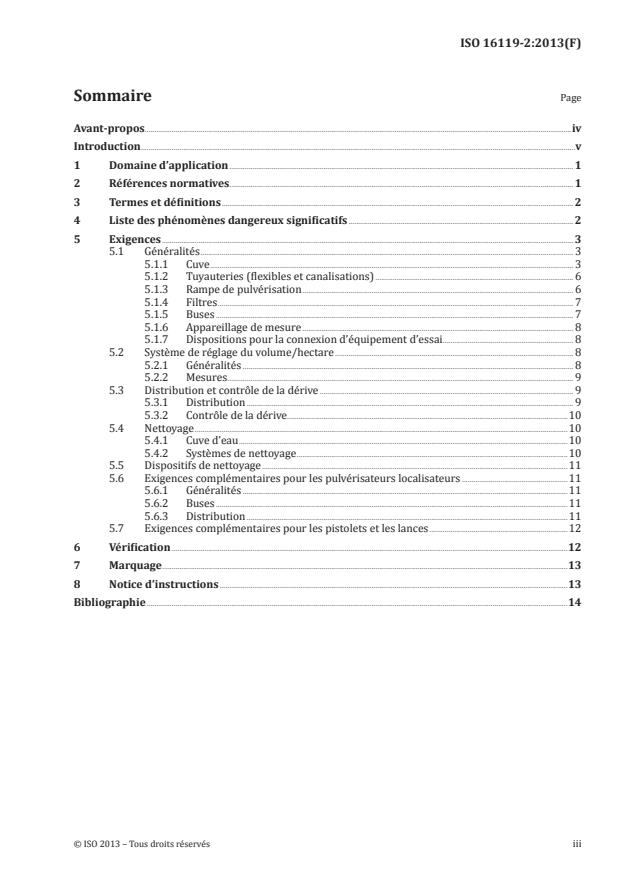
Sommaire Page
Avant-propos .iv
Introduction .v
1 Domaine d’application . 1
2 Références normatives . 1
3 Termes et définitions . 2
4 Liste des phénomènes dangereux significatifs . 2
5 Exigences . 3
5.1 Généralités . 3
5.1.1 Cuve . 3
5.1.2 Tuyauteries (flexibles et canalisations) . 6
5.1.3 Rampe de pulvérisation . 6
5.1.4 Filtres . 7
5.1.5 Buses . 7
5.1.6 Appareillage de mesure . 8
5.1.7 Dispositions pour la connexion d’équipement d’essai . 8
5.2 Système de réglage du volume/hectare . 8
5.2.1 Généralités . 8
5.2.2 Mesures . 9
5.3 Distribution et contrôle de la dérive . 9
5.3.1 Distribution . 9
5.3.2 Contrôle de la dérive . .10
5.4 Nettoyage .10
5.4.1 Cuve d’eau .10
5.4.2 Systèmes de nettoyage .10
5.5 Dispositifs de nettoyage .11
5.6 Exigences complémentaires pour les pulvérisateurs localisateurs .11
5.6.1 Généralités .11
5.6.2 Buses .11
5.6.3 Distribution .11
5.7 Exigences complémentaires pour les pistolets et les lances .12
6 Vérification .12
7 Marquage .13
8 Notice d’instructions .13
Bibliographie .14
Avant-propos
L’ISO (Organisation internationale de normalisation) est une fédération mondiale d’organismes
nationaux de normalisation (comités membres de l’ISO). L’élaboration des Normes internationales est
en général confiée aux comités techniques de l’ISO. Chaque comité membre intéressé par une étude
a le droit de faire partie du comité technique créé à cet effet. Les organisations internationales,
gouvernementales et non gouvernementales, en liaison avec l’ISO participent également aux travaux.
L’ISO collabore étroitement avec la Commission électrotechnique internationale (IEC) en ce qui
concerne la normalisation électrotechnique.
Les procédures utilisées pour élaborer le présent document et celles destinées à sa mise à jour sont
décrites dans les Directives ISO/IEC, Partie 1. Il convient, en particulier de prendre note des différents
critères d’approbation requis pour les différents types de documents ISO. Le présent document a été
rédigé conformément aux règles de rédaction données dans les Directives ISO/IEC, Partie 2 (voir www
.iso .org/ directives).
L’attention est appelée sur le fait que certains des éléments du présent document peuvent faire l’objet de
droits de propriété intellectuelle ou de droits analogues. L’ISO ne saurait être tenue pour responsable
de ne pas avoir identifié de tels droits de propriété et averti de leur existence. Les détails concernant
les références aux droits de propriété intellectuelle ou autres droits analogues identifiés lors de
l’élaboration du document sont indiqués dans l’Introduction et/ou dans la liste des déclarations de
brevets reçues par l’ISO (voir www .iso .org/ brevets).
Les appellations commerciales éventuellement mentionnées dans le présent document sont données
pour information, par souci de commodité, à l’intention des utilisateurs et ne sauraient constituer un
engagement.
Pour une explication de la nature volontaire des normes, la signification des termes et expressions
spécifiques de l’ISO liés à l’évaluation de la conformité, ou pour toute information au sujet de l’adhésion
de l’ISO aux principes de l’Organisation mondiale du commerce (OMC) concernant les obstacles
techniques au commerce (OTC), voir le lien suivant: w w w . i s o .org/ iso/ fr/ avant -propos .html
L’ISO 16119-2 a été élaborée par le comité technique CEN/TC 144, Tracteurs et matériels agricoles et
forestiers, du Comité européen de normalisation (CEN) en collaboration avec le comité technique
ISO/TC 23, Tracteurs et matériels agricoles et forestiers, sous-comité SC 6, Matériel de protection des
cultures, conformément à l’Accord de coopération technique entre l’ISO et le CEN (Accord de Vienne).
La présente version corrigée de l’ISO 16119-2:2013 inclut les corrections suivantes :
— la norme ISO 22401 a été ajoutée à l’article 2 ;
— la norme ISO 22369-3 a été remplacée par l’ISO 22401 dans la dernière alignée de 5.3.2 ;
— la norme ISO 22401 a été ajoutée à la dernière colonne du Tableau 3, ligne 5.3.2 ;
— la norme ISO 22369-3 a été enlevée de la Bibliographie.
Une liste de toutes les parties de la norme ISO 16119 se trouve sur le site web de l’ISO.
iv © ISO 2013 – Tous droits réservés
Introduction
Les exigences données dans la présente partie de l’ISO 16119 sont basées sur les méthodes d’essai
données dans l’ISO 5682-2:1997, initialement développées pour les pulvérisateurs à jet porté. Pour
les autres types de pulvérisateurs, d’autres méthodes d’essais et/ou critères d’essai peuvent être
nécessaires. Cela fera l’objet de recherches futures et d’une possible révision de la présente partie de
l’ISO 16119
Le présent document est une norme de type C comme indiqué dans l’ISO 12100.
Les machines concernées et l’étendue des phénomènes dangereux, des situations dangereuses et des
événements dangereux couverts sont indiquées dans le domaine d’application du présent document.
Lorsque des exigences de la présente norme de type C sont différentes de celles mentionnées dans les
normes de type A ou B, les exigences de la présente norme de type C prennent le pas sur celles des
autres normes, pour les machines conçues et fabriquées conformément aux exigences de la présente
norme de type C.
NORME INTERNATIONALE ISO 16119-2:2013(F)
Matériel agricole et forestier — Exigences
environnementales pour les pulvérisateurs —
Partie 2:
Pulvérisateurs à rampe horizontale
1 Domaine d’application
La présente partie de l’ISO 16119 spécifie les exigences et les méthodes de vérification correspondantes
pour la conception et les performances des pulvérisateurs à rampe horizontale, tels que définis en 3.1,
avec l’objectif de réduire les risques de contamination de l’environnement durant leur utilisation, y
compris lors d’une mauvaise utilisation raisonnablement prévisible par le fabricant.
Elle est prévue pour être utilisée conjointement avec l’ISO 16119-1, qui donne les exigences générales
applicables à tous les types de pulvérisateurs couverts par l’ISO 16119. Lorsque les exigences de la
présente partie diffèrent de celles énoncées dans l’ISO 16119-1, les exigences de la présente partie de
l’ISO 16119 prennent le pas sur celles de l’ISO 16119-1 pour les machines faisant partie du domaine
d’application de la présente partie de l’ISO 16119. La présente partie de l’ISO 16119 ne couvre pas les
aspects de sécurité (voir l’ISO 4254-6).
La présente partie de l’ISO 16119 n’est pas applicable aux pulvérisateurs qui sont fabriqués avant sa
date de publication.
2 Références normatives
Les documents suivants, en totalité ou en partie, sont référencés de manière normative dans le présent
document et sont indispensables pour son application. Pour les références datées, seule l’édition citée
s’applique. Pour les références non datées, la dernière édition du document de référence s’applique (y
compris les éventuels amendements).
ISO 4102, Matériel de traitement agropharmaceutique — Pulvérisateurs — Filetages de raccordement
ISO 4254-6:2009, Matériel agricole — Sécurité — Partie 6: Pulvérisateurs et distributeurs d’engrais
liquides
ISO 4288, Spécification géométrique des produits (GPS) — État de surface: Méthode du profil — Règles et
procédures pour l’évaluation de l’état de surface
ISO 5681, Matériel de traitement phytopharmaceutique — Vocabulaire
ISO 5682-1, Matériel de protection des cultures — Équipement de pulvérisation — Partie 1: Méthodes
d’essai des buses de pulvérisation
ISO 5682-2:1997, Matériel de protection des cultures — Équipement de pulvérisation — Partie 2: Méthodes
d’essai des pulvérisateurs à jet projeté
ISO 5682-3:1996, Matériel de protection des cultures — Équipement de pulvérisation — Partie 3: Méthode
d’essai des systèmes de régulation du volume/hectare des pulvérisateurs agricoles à jet projeté
ISO 9357, Matériel de traitement agropharmaceutique — Pulvérisateurs agricoles — Volume nominal du
réservoir et diamètre du trou de remplissage
ISO 13440:1996, Matériel de protection des cultures — Pulvérisateurs agricoles — Détermination du
volume du résidu total
ISO 16119-1:2013, Matériel agricole et forestier — Exigences environnementales pour les pulvérisateurs —
Partie 1: Généralités
ISO 21278-1, Matériel de protection des cultures — Incorporateurs — Partie 1: Méthodes d’essai
ISO 21278-2, Matériel de protection des cultures — Incorporateurs — Partie 2: Exigences générales et
limites de performance
ISO 22368-1, Matériel de protection des cultures — Méthodes d’essai pour l’évaluation des systèmes de
nettoyage — Partie 1: Nettoyage interne de la totalité du pulvérisateur
ISO 22368-3, Matériel de protection des cultures — Méthodes d’essai pour l’évaluation des systèmes de
nettoyage — Partie 3: Nettoyage interne du réservoir
ISO 22369-2:2010, Matériel de protection des cultures — Classification de la dérive des matériels de
pulvérisation — Partie 2: Classification des pulvérisateurs à rampes par mesurage au champ
ISO 22401, Matériel de protection des cultures — Méthode de mesurage de la dérive potentielle des
pulvérisateurs à rampe horizontale au moyen d’un banc d’essai
ISO 22856, Matériel de protection des cultures — Méthodes de mesurage en laboratoire de la dérive du
jet — Souffleries
ISO 22866, Matériel de protection des cultures — Mesurage de la dérive du jet au champ
3 Termes et définitions
Pour les besoins du présent document, les termes et définitions donnés dans l’ISO 5681 ainsi que les
suivants s’appliquent.
3.1
pulvérisateur à rampe horizontale
machine conçue pour l’application de produits phytosanitaires, le long d’une rampe ou en bandes, un jet
de liquide étant généralement dirigé vers le bas sur/dans la cible
3.2
bidon de produits phytosanitaires
terme général pour le conditionnement des produits phytosanitaires
EXEMPLE Bidon, bouteille, pochette, sac, boîte.
3.3
dispositif de nettoyage
dispositif pour le nettoyage intérieur des bidons de produits phytosanitaires vides
Note 1 à l’article: Le dispositif peut faire partie intégrante du pulvérisateur ou être un équipement indépendant
(équipement fixe par exemple).
4 Liste des phénomènes dangereux significatifs
Le Tableau 1 spécifie les phénomènes dangereux significatifs, ainsi que les situations et événements
dangereux pertinents couverts par la présente partie de l’ISO 16119, qui ont été identifiés par
appréciation du risque comme étant significatifs pour ce type de machines en ce qui concerne le
risque d’une contamination de l’environnement et qui exigent une action spécifique du fabricant ou du
concepteur pour éliminer ou réduire le risque.
L’attention est attirée sur la nécessité de vérifier que les exigences de sécurité spécifiées dans la
présente partie de l’ISO 16119 s’appliquent à chaque phénomène dangereux significatif présenté par
une machine donnée et de valider le fait que l’appréciation du risque a été effectuée.
2 © ISO 2013 – Tous droits réservés
Tableau 1 — Liste des phénomènes dangereux significatifs
Article/paragraphe de
Situation ou événement
Phénomène dangereux la présente partie de
dangereux
l’ISO 16119
4.1 Déversements Remplissage 5.1.1.2; 8
Incorporation du produit 5.1.1.2; 8
phytosanitaire
4.2 Contamination de la source d’alimenta- Remplissage 5.1.1.2
tion en eau
4.3 Fuites Transport et application 5.1.1.2; 5.1.2
Contact avec des obstacles 5.1.3.3; 5.1.5
4.4 Débordement Remplissage 5.1.1.2; 5.1.1.4; 8
4.5 Dispersion des résidus de la bouillie ou des Vidange 5.1.1.3.1; 5.1.1.4; 8
produits phytosanitaires
Nettoyage et rinçage 5.1.1.1; 5.4; 5.5; 8
4.6 Fuites accidentelles Ouverture accidentelle de 5.1.1.3.2
la sortie du réservoir
4.7 Surdosage Bouillie hétérogène 5.1.1.5; 8
Recouvrement 5.1.3.1
Réglage/contrôle du pulvé- 5.1.1.4; 5.1.2; 5.1.6; 5.2;
risateur 5.7; 8
Maintenance/entretien du 5.1.7; 7; 8
pulvérisateur
5.3.1; 5.1.3.2; 5.6.3
Dépôt imprévu
4.8 Pulvérisation involontaire en dehors de la Dépôt hors de la zone cible 5.1.3.1; 5.6.1; 5.6.2
cible
Commande d’arrêt de la 5.1.2; 5.7
pulvérisation
4.9 Dérive Pulvérisation 5.1.3.2; 5.3.2; 7; 8
4.10 Dispersion de la bouillie Intervention sur le pulvéri- 5.1.4; 7; 8
sateur pendant l’entretien
ou l’application
4.11 Égouttement Commande d’arrêt de la 5.1.5
pulvérisation
5 Exigences
5.1 Généralités
5.1.1 Cuve
5.1.1.1 Surfaces
La valeur de rugosité, Rz (voir l’ISO 4287), des parois internes et externes de la cuve doit être telle que
Rz ≤ 100 µm, lorsqu’elle est mesurée conformément à l’ISO 4288.
5.1.1.2 Remplissage
Les dispositifs de remplissage doivent être conçus de manière à éviter tout retour de liquide de la cuve
vers la source d’alimentation.
Le diamètre de l’orifice de remplissage doit être conforme à l’ISO 9357. Le couvercle de l’ouverture doit
être suffisamment étanche de manière à éviter les fuites/débordements lorsqu’il est fermé.
Le volume total de la cuve doit dépasser d’au moins 5 % son volume nominal pour empêcher tout
déversement résultant d’un débordement lors du remplissage. Le volume nominal des cuves ayant un
volume nominal supérieur à 200 l doit être un multiple de 100 l.
La profondeur minimale des tamis, d, mesurée conformément à la Figure 1, doit correspondre aux
valeurs du Tableau 2.
Des tamis dont la dimension des mailles doit être inférieure à 2 mm doivent être montés dans les
ouvertures de remplissage. Le ou les espaces entre l’orifice de remplissage de la cuve et le tamis ne
doivent pas dépasser 2 mm (voir Figure 1).
La capacité de remplissage de la cuve avec le tamis, lorsqu’on la remplit d’eau, doit être au moins de
100 l/min pour les cuves ayant un volume nominal de 100 l ou plus. Pour les cuves ayant un volume
nominal inférieur à 100 l, il doit être possible de remplir la cuve en 1 min.
L’incorporateur doit répondre aux exigences de l’ISO 21278-2.
Tableau 2 — Profondeur minimale des tamis
a
Capacité nominale de la cuve Profondeur minimale
C d
l mm
C ≤ 150 60
150 < C ≤ 400 100
400 < C ≤ 600 150
C > 600 250
a
Mesurée entre le bord supérieur et le fond du tamis.
5.1.1.3 Vidange
5.1.1.3.1 Volume du résidu
Le volume du résidu total, tel que défini dans l’ISO 13440:1996, 2.1, ne doit pas excéder 0,5 % du volume
nominal de la cuve plus 2 l/m de rampe.
Le volume du résidu total doit être déterminé conformément à l’ISO 13440.
5.1.1.3.2 Dispositif de vidange de la cuve
Un dispositif de vidange conforme à l’ISO 4254-6:2009, 5.4.3, doit permettre la vidange complète des
résidus dans la cuve lorsque le pulvérisateur est en position horizontale. Une vidange complète des
résidus est considérée comme obtenue si aucune flaque n’est visible au fond de la cuve au bout de 5 min
de vidange.
Il doit être possible de recueillir le liquide à la sortie sans contaminer l’environnement ou des parties de
l’équipement, les supports par exemple.
L’orifice de sortie de la cuve doit être protégé contre toute ouverture intempestive.
4 © ISO 2013 – Tous droits réservés
Dimensions en millimètres
Légende
d profondeur minimale
Figure 1 — Détermination de la profondeur du tamis et de la largeur des espaces
5.1.1.4 Indicateur(s) du contenu de la cuve
L’indication du contenu de la cuve doit être conforme à l’ISO 9357. Elle doit être durable et bien lisible
depuis le poste de conduite et depuis le lieu de remplissage. La rotation de la tête et du haut du corps est
acceptable.
Les t
...