

ISO 17652-2:2003
(Main)Welding — Test for shop primers in relation to welding and allied processes — Part 2: Welding properties of shop primers
General Information
- Abstract
ISO 17652-2:2003 describes tests for assessing the influence of shop primers on the weldability. The following tests are detailed. Rating test This screening test provides a method of assessing the relative weldability of a shop primer of a specified thickness by making a standard weld and subsequently evaluating the severity of the resulting porosity. Rating tests are suitable for declaration by suppliers of the influence of particular shop primers and similar purposes. Weldability test This test describes a method for evaluating the weldability of welding consumables and shop primer combinations, using various arc welding processes. A standard size fillet is produced that enables comparison to be made. An overall assessment of the quality of the resultant weld is made. Weldability tests may be more closely related to actual conditions during production.
- Status
- Published
- Publication Date
- 27-May-2003
- Technical Committee
- ISO/TC 44/SC 10 - Quality management in the field of welding
- Drafting Committee
- ISO/TC 44/SC 10 - Quality management in the field of welding
- Current Stage
- 9093 - International Standard confirmed
- Start Date
- 03-Sep-2024
- Completion Date
- 29-Aug-2026
Buy Documents
ISO 17652-2:2003 - Welding — Test for shop primers in relation to welding and allied processes — Part 2: Welding properties of shop primers Released:5/28/2003
ISO 17652-2:2003 - Soudage — Essai sur peintures primaires en relation avec le soudage et les techniques connexes — Partie 2: Propriétés relatives au soudage des peintures primaires Released:5/28/2003
Overview - ISO 17652-2:2003 (Welding properties of shop primers)
ISO 17652-2:2003 specifies laboratory tests to assess how shop primers influence weldability and the formation of weld porosity. It is Part 2 of the ISO 17652 series and focuses on two reproducible test methods - the Rating test (screening) and the Weldability test (detailed assessment) - for use with common arc welding processes and welding consumables.
Key topics and technical requirements
- Two test methods
- Rating test: a screening procedure using a standard MAG (arc welding process 135) weld to compare relative weldability of primers by measuring porosity severity.
- Weldability test: produces a standard fillet weld to evaluate combinations of shop primer and welding consumables under conditions closer to production.
- Specimen preparation
- Rating test uses 10 specimens per primer (e.g., bright drawn steel plates 20 × 80 × 200 mm and 12 × 50 × 200 mm).
- Coating thickness must be uniform and as supplied; specimens are normally dried for at least 10 days at >10 °C and <40 °C with ≥50% relative humidity unless otherwise reported.
- Welding parameters (prescribed for rating test)
- MAG process (ISO 4063 process 135), shielding gas CO2 (C1), wire electrode G3Si1, 1.2 mm diameter, positive electrode polarity.
- Example prescribed settings include specified current, voltage and travel speed with ±5% tolerances, gas flow and stick-out; details are in the standard.
- Porosity evaluation
- Welds are broken (three-point loading) at ~150–250 °C to reveal pores.
- Pores smaller than 0.5 mm are ignored; examine a 100 mm length (excluding ends).
- Record number of pores >0.5 mm, total pore area (mm²), and mean pore area per pore.
- Reporting
- Mandatory test report items include primer ID, coating thickness, welding procedure, consumables, surface condition, porosity data and other test conditions.
Applications and users
- Who uses it
- Coating and primer manufacturers for product declarations.
- Welding engineers, fabricators and quality assurance labs assessing primer suitability for welded structures.
- Procurement and inspection teams validating primer/welding consumable combinations for production.
- Practical value
- Predicts relative tendency for porosity when welding over shop primers.
- Helps select primers and welding procedures to minimize weld defects and rework.
- Provides reproducible data for supplier claims and process approvals.
Related standards
- ISO 17652 series: Part 1 (General requirements), Part 3 (Thermal cutting), Part 4 (Emission of fumes and gases).
- Normative references cited: EN 439 (shielding gases), EN 440 (wire electrodes), EN 10025 (structural steels), EN ISO 2808, EN ISO 6947, and welding procedure specification standards.
Keywords: ISO 17652-2, shop primers, weldability, rating test, weldability test, porosity, MAG welding, fillet weld, welding consumables, testing procedure.
Relations
- Effective Date
- 12-Feb-2026
- Effective Date
- 28-Feb-2023
Buy Documents
ISO 17652-2:2003 - Welding — Test for shop primers in relation to welding and allied processes — Part 2: Welding properties of shop primers Released:5/28/2003
ISO 17652-2:2003 - Soudage — Essai sur peintures primaires en relation avec le soudage et les techniques connexes — Partie 2: Propriétés relatives au soudage des peintures primaires Released:5/28/2003
Get Certified
Connect with accredited certification bodies for this standard

DVS-ZERT GmbH
German welding certification society.
CARES (UK Certification Authority for Reinforcing Steels)
UK certification for reinforcing steels and construction.
EWF/IIW (European/International Welding Federation)
International welding personnel certification.
Sponsored listings
Frequently Asked Questions
ISO 17652-2:2003 is a standard published by the International Organization for Standardization (ISO). Its full title is "Welding — Test for shop primers in relation to welding and allied processes — Part 2: Welding properties of shop primers". This standard covers: ISO 17652-2:2003 describes tests for assessing the influence of shop primers on the weldability. The following tests are detailed. Rating test This screening test provides a method of assessing the relative weldability of a shop primer of a specified thickness by making a standard weld and subsequently evaluating the severity of the resulting porosity. Rating tests are suitable for declaration by suppliers of the influence of particular shop primers and similar purposes. Weldability test This test describes a method for evaluating the weldability of welding consumables and shop primer combinations, using various arc welding processes. A standard size fillet is produced that enables comparison to be made. An overall assessment of the quality of the resultant weld is made. Weldability tests may be more closely related to actual conditions during production.
ISO 17652-2:2003 describes tests for assessing the influence of shop primers on the weldability. The following tests are detailed. Rating test This screening test provides a method of assessing the relative weldability of a shop primer of a specified thickness by making a standard weld and subsequently evaluating the severity of the resulting porosity. Rating tests are suitable for declaration by suppliers of the influence of particular shop primers and similar purposes. Weldability test This test describes a method for evaluating the weldability of welding consumables and shop primer combinations, using various arc welding processes. A standard size fillet is produced that enables comparison to be made. An overall assessment of the quality of the resultant weld is made. Weldability tests may be more closely related to actual conditions during production.
ISO 17652-2:2003 is classified under the following ICS (International Classification for Standards) categories: 25.160.10 - Welding processes. The ICS classification helps identify the subject area and facilitates finding related standards.
ISO 17652-2:2003 has the following relationships with other standards: It is inter standard links to EN ISO 17652-2:2003, ISO 6480:1980. Understanding these relationships helps ensure you are using the most current and applicable version of the standard.
ISO 17652-2:2003 is available in PDF format for immediate download after purchase. The document can be added to your cart and obtained through the secure checkout process. Digital delivery ensures instant access to the complete standard document.
Standards Content (Sample)
INTERNATIONAL ISO
STANDARD 17652-2
First edition
2003-05-15
Welding — Test for shop primers in
relation to welding and allied
processes —
Part 2:
Welding properties of shop primers
Soudage — Essai sur peintures primaires en relation avec le soudage
et les techniques connexes —
Partie 2: Propriétés relatives au soudage des peintures primaires
Reference number
©
ISO 2003
PDF disclaimer
This PDF file may contain embedded typefaces. In accordance with Adobe's licensing policy, this file may be printed or viewed but
shall not be edited unless the typefaces which are embedded are licensed to and installed on the computer performing the editing. In
downloading this file, parties accept therein the responsibility of not infringing Adobe's licensing policy. The ISO Central Secretariat
accepts no liability in this area.
Adobe is a trademark of Adobe Systems Incorporated.
Details of the software products used to create this PDF file can be found in the General Info relative to the file; the PDF-creation
parameters were optimized for printing. Every care has been taken to ensure that the file is suitable for use by ISO member bodies. In
the unlikely event that a problem relating to it is found, please inform the Central Secretariat at the address given below.
© ISO 2003
All rights reserved. Unless otherwise specified, no part of this publication may be reproduced or utilized in any form or by any means,
electronic or mechanical, including photocopying and microfilm, without permission in writing from either ISO at the address below or
ISO's member body in the country of the requester.
ISO copyright office
Case postale 56 • CH-1211 Geneva 20
Tel. + 41 22 749 01 11
Fax + 41 22 749 09 47
E-mail copyright@iso.org
Web www.iso.org
Published in Switzerland
ii © ISO 2003 – All rights reserved
Foreword
ISO (the International Organization for Standardization) is a worldwide federation of national standards bodies
(ISO member bodies). The work of preparing International Standards is normally carried out through ISO
technical committees. Each member body interested in a subject for which a technical committee has been
established has the right to be represented on that committee. International organizations, governmental and
non-governmental, in liaison with ISO, also take part in the work. ISO collaborates closely with the
International Electrotechnical Commission (IEC) on all matters of electrotechnical standardization.
International Standards are drafted in accordance with the rules given in the ISO/IEC Directives, Part 2.
The main task of technical committees is to prepare International Standards. Draft International Standards
adopted by the technical committees are circulated to the member bodies for voting. Publication as an
International Standard requires approval by at least 75 % of the member bodies casting a vote.
Attention is drawn to the possibility that some of the elements of this document may be the subject of patent
rights. ISO shall not be held responsible for identifying any or all such patent rights.
ISO 17652-2 was prepared by the European Committee for Standardization (CEN) in collaboration with
Technical Committee ISO/TC 44, Welding and allied processes, Subcommittee SC 10, Unification of
requirements in the field of metal welding, in accordance with the Agreement on technical cooperation
between ISO and CEN (Vienna Agreement).
Throughout the text of this document, read ".this European Standard." to mean ".this International
Standard.".
ISO 17652 consists of the following parts, under the general title Welding — Test for shop primers in relation
to welding and allied processes:
— Part 1: General requirements
— Part 2: Welding properties of shop primers
— Part 3: Thermal cutting
— Part 4: Emission of fumes and gases
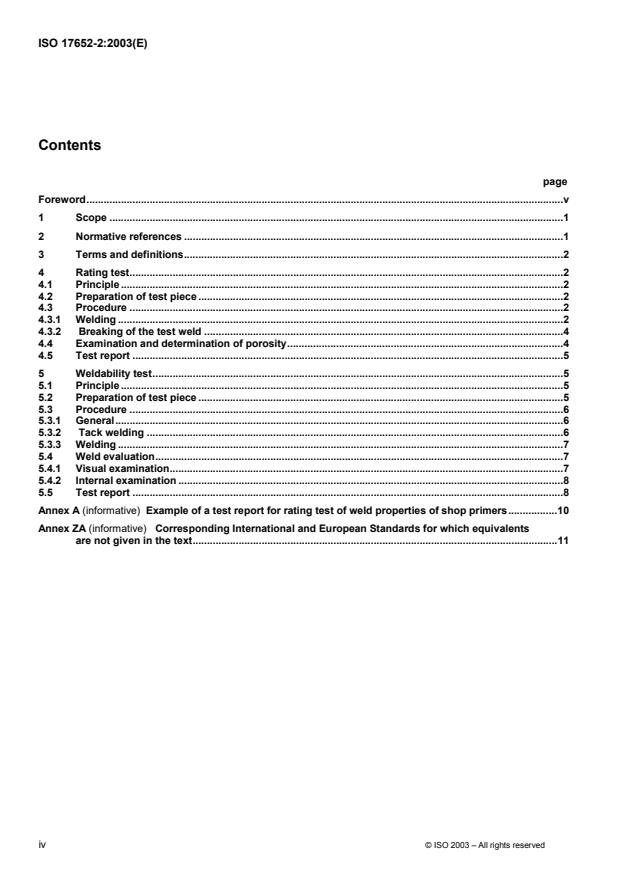
Contents
page
Foreword.v
1 Scope .1
2 Normative references .1
3 Terms and definitions.2
4 Rating test.2
4.1 Principle .2
4.2 Preparation of test piece .2
4.3 Procedure .2
4.3.1 Welding .2
4.3.2 Breaking of the test weld .4
4.4 Examination and determination of porosity.4
4.5 Test report .5
5 Weldability test.5
5.1 Principle .5
5.2 Preparation of test piece .5
5.3 Procedure .6
5.3.1 General.6
5.3.2 Tack welding .6
5.3.3 Welding .7
5.4 Weld evaluation.7
5.4.1 Visual examination.7
5.4.2 Internal examination .8
5.5 Test report .8
Annex A (informative) Example of a test report for rating test of weld properties of shop primers.10
Annex ZA (informative) Corresponding International and European Standards for which equivalents
are not given in the text.11
iv © ISO 2003 – All rights reserved
Foreword
This document (EN ISO 17652-2:2003) has been prepared by Technical Committee CEN/TC 121 "Welding", the
secretariat of which is held by DS, in collaboration with Technical Committee ISO/TC 44 “Welding and allied
processes”.
This European Standard shall be given the status of a national standard, either by publication of an identical text or
by endorsement, at the latest by November 2003, and conflicting national standards shall be withdrawn at the latest
by November 2003.
EN ISO 17652 consists of the following parts, under the general title: Welding – Test for shop primers in relation to
welding and allied processes:
- Part 1: General requirements
- Part 2: Welding properties of shop primers
- Part 3: Thermal cutting
- Part 4: Emission of fumes and gases
Annexes A and ZA are informative.
According to the CEN/CENELEC Internal Regulations, the national standards organizations of the following
countries are bound to implement this European Standard: Austria, Belgium, Czech Republic, Denmark, Finland,
France, Germany, Greece, Hungary, Iceland, Ireland, Italy, Luxembourg, Malta, Netherlands, Norway, Portugal,
Slovakia, Spain, Sweden, Switzerland and the United Kingdom.
1 Scope
This part of this European Standard describes tests for assessing the influence of shop primers on the weldability.
The following tests are detailed:
a) Rating test
This screening test provides a method of assessing the relative weldability of a shop primer of a specified thickness
by making a standard weld and subsequently evaluating the severity of the resulting porosity. Rating tests are
suitable for declaration by suppliers of the influence of particular shop primers and similar purposes;
b) Weldability test
This test describes a method for evaluating the weldability of welding consumables and shop primer combinations,
using various arc welding processes. A standard size fillet is produced that enables comparison to be made. An
overall assessment of the quality of the resultant weld is made. Weldability tests may be more closely related to
actual conditions during production.
For precaution for protection of health, safety and environment during testing, see EN ISO 17652-1.
2 Normative references
This European Standard incorporates by dated or undated reference, provisions from other publications. These
normative references are cited at the appropriate places in the text, and the publications are listed hereafter. For
dated references, subsequent amendments to or revisions of any of these publications apply to this European
Standard only when incorporated in it by amendment or revision. For undated references the latest edition of the
publication referred to applies (including amendments).
EN 439, Welding consumables - Shielding gases for arc welding and cutting.
EN 440, Welding consumables - Wire electrodes and deposits for gas shielded metal arc welding of non alloy and
fine grain steels - Classification.
EN 10025:1990, Hot rolled products of non-alloy structural steels Technical delivery conditions.
EN 10238, Automatically blast-cleaned and automatically prefabricated primed structural steel products.
EN 10278, Dimensions and tolerances of bright steel products.
EN ISO 4063, Welding and allied processes Nomenclature of processes and reference numbers (ISO
4063:1998).
Welds - Working positions - Definitions of angles of slope and rotation (ISO 6947:1993).
EN ISO 6947,
EN ISO 2808, Paints and varnishes - Determination of film thickness (ISO 2808:1999).
EN ISO 8501-1:2001, Preparation of steel substrates before application of paints and related products - Visual
assessment of surface cleanliness - Part 1: Rust grades and preparation grades of uncoated steel substrates and of
steel substrates after overall removal of previous coatings (ISO 8501-1:1988).
prEN ISO 15609-1:2000, Specification and approval of welding procedures for metallic materials - Welding
procedure specification - Part 1: Arc welding (ISO/DIS 15609-1:2000).
EN ISO 17652-1:2003, Welding - Test for shop primers in relation to welding and allied processes - Part 1: General
requirements (ISO 17652-1:2003).
3 Terms and definitions
For the purposes of this European Standard, the terms and definitions in EN ISO 17652-1:2003 apply.
4 Rating test
4.1 Principle
This test provides a method of assessing the relative weldability of shop primers of a specified thickness by making
a standard weld over a range of shop primers and subsequently evaluat
...
NORME ISO
INTERNATIONALE 17652-2
Première édition
2003-05-15
Soudage — Essai sur peintures primaires
en relation avec le soudage et les
techniques connexes —
Partie 2:
Propriétés relatives au soudage des
peintures primaires
Welding — Test for shop primers in relation to welding and allied
processes —
Part 2: Welding properties of shop primers
Numéro de référence
©
ISO 2003
PDF – Exonération de responsabilité
Le présent fichier PDF peut contenir des polices de caractères intégrées. Conformément aux conditions de licence d'Adobe, ce fichier
peut être imprimé ou visualisé, mais ne doit pas être modifié à moins que l'ordinateur employé à cet effet ne bénéficie d'une licence
autorisant l'utilisation de ces polices et que celles-ci y soient installées. Lors du téléchargement de ce fichier, les parties concernées
acceptent de fait la responsabilité de ne pas enfreindre les conditions de licence d'Adobe. Le Secrétariat central de l'ISO décline toute
responsabilité en la matière.
Adobe est une marque déposée d'Adobe Systems Incorporated.
Les détails relatifs aux produits logiciels utilisés pour la création du présent fichier PDF sont disponibles dans la rubrique General Info
du fichier; les paramètres de création PDF ont été optimisés pour l'impression. Toutes les mesures ont été prises pour garantir
l'exploitation de ce fichier par les comités membres de l'ISO. Dans le cas peu probable où surviendrait un problème d'utilisation,
veuillez en informer le Secrétariat central à l'adresse donnée ci-dessous.
© ISO 2003
Droits de reproduction réservés. Sauf prescription différente, aucune partie de cette publication ne peut être reproduite ni utilisée sous
quelque forme que ce soit et par aucun procédé, électronique ou mécanique, y compris la photocopie et les microfilms, sans l'accord écrit
de l'ISO à l’adresse ci-après ou du comité membre de l'ISO dans le pays du demandeur.
ISO copyright office
Case postale 56 • CH-1211 Geneva 20
Tel. + 41 22 749 01 11
Fax. + 41 22 749 09 47
E-mail copyright@iso.org
Web www.iso.org
Publié en Suisse
ii © ISO 2003 – Tous droits réservés
Avant-propos
L'ISO (Organisation internationale de normalisation) est une fédération mondiale d'organismes nationaux de
normalisation (comités membres de l'ISO). L'élaboration des Normes internationales est en général confiée
aux comités techniques de l'ISO. Chaque comité membre intéressé par une étude a le droit de faire partie du
comité technique créé à cet effet. Les organisations internationales, gouvernementales et non
gouvernementales, en liaison avec l'ISO participent également aux travaux. L'ISO collabore étroitement avec
la Commission électrotechnique internationale (CEI) en ce qui concerne la normalisation électrotechnique.
Les Normes internationales sont rédigées conformément aux règles données dans les Directives ISO/CEI,
Partie 2.
La tâche principale des comités techniques est d'élaborer les Normes internationales. Les projets de Normes
internationales adoptés par les comités techniques sont soumis aux comités membres pour vote. Leur
publication comme Normes internationales requiert l'approbation de 75 % au moins des comités membres
votants.
L'attention est appelée sur le fait que certains des éléments du présent document peuvent faire l'objet de
droits de propriété intellectuelle ou de droits analogues. L'ISO ne saurait être tenue pour responsable de ne
pas avoir identifié de tels droits de propriété et averti de leur existence.
L'ISO 17652-2 a été élaborée par le Comité européen de normalisation (CEN) en collaboration avec le comité
technique ISO/TC 44, Soudage et techniques connexes, sous-comité SC 10, Unification des prescriptions
dans la technique du soudage des métaux, conformément à l'Accord de coopération technique entre l'ISO et
le CEN (Accord de Vienne).
Tout au long du texte du présent document, lire «… la présente Norme européenne …» avec le sens de
«… la présente Norme internationale …».
L'ISO 17652 comprend les parties suivantes, présentées sous le titre général Soudage — Essai sur peintures
primaires en relation avec le soudage et les techniques connexes:
— Partie 1: Exigences générales
— Partie 2: Propriétés relatives au soudage des peintures primaires
— Partie 3: Coupage thermique
— Partie 4: Émission des fumées et des gaz
Sommaire Page
Avant-propos.v
1 Domaine d'application.1
2 Références normatives.1
3 Termes et définitions.2
4 Essai de classement.2
4.1 Principes .2
4.2 Préparation de la pièce d'essai.2
4.3 Mode opératoire .3
4.3.1 Soudage .3
4.3.2 Rupture de la soudure d’essai.4
4.4 Examen et détermination de la porosité .5
4.5 Rapport d’essai .6
5 Essai de soudabilité .6
5.1 Principe .6
5.2 Préparation de la pièce d'essai.7
5.3 Mode opératoire .7
5.3.1 Généralités.7
5.3.2 Soudures de pointage .8
5.3.3 Soudage .9
5.4 Évaluation de la soudure .9
5.4.1 Contrôle visuel .9
5.4.2 Examen interne.9
5.5 Rapport d'essai .11
Annexe A (informative) Exemple d’un rapport d’essai pour un essai de classement des propriétés
relatives au soudage des peintures primaires.12
Annexe ZA (informative) Normes internationales et européennes correspondantes pour lesquelles
aucune équivalence n’est donnée dans le texte .13
iv © ISO 2003 – Tous droits réservés
Avant-propos
Le présent document (EN ISO 17652-2:2003) a été élaboré par le Comité Technique CEN/TC 121 “Soudage”, dont
le secrétariat est tenu par DS, en collaboration avec le Comité Technique ISO/TC 44 “Soudage et techniques
connexes ”.
Cette Norme européenne devra recevoir le statut de norme nationale, soit par publication d'un texte identique, soit
par entérinement, au plus tard en novembre 2003, et toutes les normes nationales en contradiction devront être
retirées au plus tard en novembre 2003.
L’EN ISO 17652 comporte les parties suivantes, sous le titre général : Soudage — Essai sur peintures primaires en
relation avec le soudage et les techniques connexes :
¾ Partie 1 : Exigences générales
¾ Partie 2 : Propriétés relatives au soudage des peintures primaires
¾ Partie 3 : Coupage thermique
¾ Partie 4 : Émission des fumées et des gaz
Les Annexes A et ZA sont informatives.
Selon le Règlement Intérieur du CEN/CENELEC, les instituts de normalisation nationaux des pays suivants sont
tenus de mettre cette Norme européenne en application : Allemagne, Autriche, Belgique, Danemark, Espagne,
Finlande, France, Grèce, Hongrie, Irlande, Islande, Italie, Luxembourg, Malte, Norvège, Pays-Bas, Portugal,
République Tchèque, Royaume-Uni, Slovaquie, Suède et Suisse.
1 Domaine d'application
La présente partie de la présente Norme européenne décrit des essais pour évaluer l'influence des peintures
primaires sur la soudabilité. Les essais suivants sont décrits :
a) Essai de classement
Cet essai de sélection constitue une méthode pour évaluer la soudabilité relative d’une peinture primaire ayant une
épaisseur spécifiée en exécutant une soudure normalisée puis en évaluant l’importance de la porosité qui en
résulte. Les essais de classement conviennent bien pour la déclaration faite par les fournisseurs sur l'influence de
peintures primaires données et dans des buts similaires ;
b) Essai de soudabilité
Cet essai décrit une méthode pour évaluer la soudabilité de combinaisons de produits consommables de soudage
et de peintures primaires en utilisant différents procédés de soudage à l'arc. Une soudure d'angle de dimensions
normalisées est réalisée à des fins de comparaison. Une évaluation globale de la qualité de la soudure produite est
effectuée. Les essais de soudabilité peuvent être adaptés plus précisément aux conditions réelles en production.
Pour les précautions à prendre pour la protection de l’hygiène, de la sécurité et de l’environnement lors des essais,
voir l’EN ISO 17652-1.
2 Références normatives
Cette Norme européenne comporte par référence datée ou non datée des dispositions d'autres publications. Ces
références normatives sont citées aux endroits appropriés dans le texte et les publications sont énumérées
ci-après. Pour les références datées, les amendements ou révisions ultérieurs de l'une quelconque de ces
publications ne s'appliquent à cette Norme européenne que s'ils y ont été incorporés par amendement ou révision.
Pour les références non datées, la dernière édition de la publication à laquelle il est fait référence s'applique (y
compris les amendements).
EN 439, Produits consommables pour le soudage — Gaz de protection pour le soudage et le coupage à l'arc.
EN 440, Produits consommables pour le soudage — Fils électrodes et dépôts pour le soudage à l'arc sous gaz des
aciers non alliés et des aciers à grain fin — Classification.
EN 10025:1990, Produits laminés à chaud en aciers de construction non alliés — Conditions techniques de
livraison.
EN 10238, Produits en aciers de construction grenaillés et prépeints par traitement automatique.
EN 10278, Dimensions et tolérances des produits en acier transformé à froid.
EN ISO 4063, Soudage et techniques connexes — Nomenclature et numérotation des procédés (ISO 4063:1998).
EN ISO 6947, Soudures — Positions de travail — Définitions des angles d'inclinaison et de rotation
(ISO 6947:1993).
EN ISO 2808, Peintures et vernis — Détermination de l'épaisseur du feuil (ISO 2808:1999).
EN ISO 8501-1:2001, Préparation des subjectiles d’acier avant application de peintures et de produits assimilés —
Évaluation visuelle de la propreté d’un subjectile — Partie 1 : Degrés de rouille et degrés de préparation des
subjectiles d’acier non recouverts et des subjectiles d’acier après décapage sur toute la surface des revêtements
précédents (ISO 8501-1:1988).
prEN ISO 15609-1:2000, Descriptif et qualification d'un mode opératoire de soudage pour les matériaux
métalliques — Descriptif d'un mode opératoire de soudage — Partie 1 : Soudage à l'arc (ISO/DIS 15609-1:2000).
EN ISO 17652-1:2003, Soudage — Essai sur peintures primaires en relation avec le soudage et les techniques
connexes — Partie 1 : Exigences générales (ISO 17652-1:2003).
3 Termes et définitions
Pour les besoins de la présente Norme européenne, les termes et définitions donnés dans l’EN ISO 17652-1:2003
s'appliquent.
4 Essai de classement
4.1 Principes
Cet essai constitue une méthode pour évaluer la soudabilité relative de peintures primaires ayant une épaisseur
spécifiée en exécutant une soudure normalisée sur une gamme de peintures primaires puis en évaluant
l’importance de la porosité qui en résulte. Un seul mode opératoire de soudage est prescrit, en utilisant le
soudage MAG (procédé 135 conformément à l’EN ISO 4063).
La configuration du joint et un accostage précis sont conçus pour provoquer des niveaux de porosité significatifs
pour des raisons de différentiation et de reproductibilité.
La norme ne spécifie pas les limites d'acceptabilité car elles dépendent des applications pratiques. Il est prévu que
dans les applications pratiques, les niveaux de porosité soient inférieurs aux niveaux mesurés durant l’essai.
4.2 Préparation de la pièce d'essai
Dix pièces d'essai doivent être préparées pour chaque peinture primaire. Chaque pièce doit être constituée de
deux tôles laminées en acier doux brillant conformément à l’EN 10278.
Les dimensions des pièces d’essai sont les suivantes :
¾ 20 mm x 80 mm x 200 mm ;
¾ 12 mm x 50 mm x 200 mm.
Les pièces doivent avoir des surfaces lisses, planes, non endommagées et toute bavure sur les bords doit être
élimin
...