


ISO 6916-2:2024
(Main)Flexible cellular polymeric materials — Sponge and expanded cellular rubber products — Part 2: Specification for mouldings and extrusions
Flexible cellular polymeric materials — Sponge and expanded cellular rubber products — Part 2: Specification for mouldings and extrusions
This document classifies flexible cellular rubber products known as sponge and expanded rubber. The base material used in their manufacture may be natural rubber, reclaimed rubber, synthetic rubber or rubber-like material, either alone or in combination. Thermoplastic rubbers are not included. This document does not apply to latex foam rubbers or shoe soling. This document covers vulcanized cellular rubber products that are manufactured by a moulding or continuous vulcanization process, i.e. hot air, microwave, infra-red, liquid curing medium (LCM), shearing-head vulcanization or a combination of two or more of these methods. Sheeting materials are covered by ISO 6916-1. In the case of conflict between the provisions of this document and those of the detailed specification or test method for a particular product, the latter takes precedence. Reference to the methods specifically states the desired test or tests.
Polymères alvéolaires souples — Caoutchoucs alvéolaires mousses et souples — Partie 2: Spécification pour les moulages et les extrusions
General Information
- Status
- Published
- Publication Date
- 25-Apr-2024
- Technical Committee
- ISO/TC 45/SC 4 - Products (other than hoses)
- Drafting Committee
- ISO/TC 45/SC 4 - Products (other than hoses)
- Current Stage
- 6060 - International Standard published
- Start Date
- 26-Apr-2024
- Due Date
- 01-Nov-2024
- Completion Date
- 26-Apr-2024
Relations
- Effective Date
- 06-Jun-2022
Overview
ISO 6916-2:2024 is the International Standard that specifies classification and requirements for flexible cellular polymeric materials described as sponge and expanded cellular rubber products manufactured as mouldings and extrusions. It covers vulcanized cellular rubber made from natural, reclaimed or synthetic rubber (thermoplastic rubbers, latex foam rubbers and shoe soling are excluded). Manufacturing processes covered include moulding and continuous vulcanization methods such as hot‑air, microwave, infra‑red, liquid curing medium (LCM) and shearing‑head vulcanization.
Key topics and technical requirements
- Classification system: products are classified by Type (Type 1 open‑cell, Type 2 closed‑cell, Type 3 self‑skinned), Class (A–D based on base polymer and oil/temperature resistance), Grade (0–6 based on firmness) and optional suffixes indicating additional properties or test conditions.
- Firmness (grades): grades are defined by compression deflection ranges (e.g., Grade 0: 2.5–15.0 kPa; Grade 1: 15.1–35.0 kPa; up to Grade 6: 200.1–300.0 kPa).
- Physical property requirements: tables specify baseline requirements for different type/class/grade combinations, including density, compression behavior and other performance limits.
- Test methods and annexes: normative test procedures are provided (Annexes A–G) covering temperature resistance, compression deflection, oil resistance, compression set, water absorption, fluid resistance and low‑temperature resistance.
- Quality controls: rules for sampling, inspection and rejection, storage before testing, dimensional tolerances for mouldings/extrusions, and packaging/marking.
- Priority rule: specific product test methods or detailed specifications take precedence if conflicts arise.
Practical applications and users
ISO 6916-2 is used by:
- Manufacturers and compounders of sponge and expanded rubber mouldings/extrusions for consistent product specification and quality control.
- Design engineers and specifiers selecting seals, gaskets, cushioning, vibration‑damping and weather‑sealing components requiring defined firmness, oil or temperature resistance.
- Test laboratories and quality inspectors performing compression, oil resistance, low‑temperature and dimensional tests in accordance with the standard.
- Procurement professionals and certifiers who require standardized material performance for industrial, automotive, construction and other applications.
Related standards
- ISO 6916-1 (sheeting materials)
- Referenced test standards used in ISO 6916-2: ISO 188, ISO 815-1, ISO 1431-1, ISO 1817, ISO 1923, ISO 3865, ISO 5893
Keywords: ISO 6916-2, sponge rubber, expanded cellular rubber, mouldings and extrusions, compression deflection, oil resistance, dimensional tolerances, vulcanized cellular rubber, continuous vulcanization.
Get Certified
Connect with accredited certification bodies for this standard

Smithers Quality Assessments
US management systems and product certification.

DIN CERTCO
DIN Group product certification.
Sponsored listings
Frequently Asked Questions
ISO 6916-2:2024 is a standard published by the International Organization for Standardization (ISO). Its full title is "Flexible cellular polymeric materials — Sponge and expanded cellular rubber products — Part 2: Specification for mouldings and extrusions". This standard covers: This document classifies flexible cellular rubber products known as sponge and expanded rubber. The base material used in their manufacture may be natural rubber, reclaimed rubber, synthetic rubber or rubber-like material, either alone or in combination. Thermoplastic rubbers are not included. This document does not apply to latex foam rubbers or shoe soling. This document covers vulcanized cellular rubber products that are manufactured by a moulding or continuous vulcanization process, i.e. hot air, microwave, infra-red, liquid curing medium (LCM), shearing-head vulcanization or a combination of two or more of these methods. Sheeting materials are covered by ISO 6916-1. In the case of conflict between the provisions of this document and those of the detailed specification or test method for a particular product, the latter takes precedence. Reference to the methods specifically states the desired test or tests.
This document classifies flexible cellular rubber products known as sponge and expanded rubber. The base material used in their manufacture may be natural rubber, reclaimed rubber, synthetic rubber or rubber-like material, either alone or in combination. Thermoplastic rubbers are not included. This document does not apply to latex foam rubbers or shoe soling. This document covers vulcanized cellular rubber products that are manufactured by a moulding or continuous vulcanization process, i.e. hot air, microwave, infra-red, liquid curing medium (LCM), shearing-head vulcanization or a combination of two or more of these methods. Sheeting materials are covered by ISO 6916-1. In the case of conflict between the provisions of this document and those of the detailed specification or test method for a particular product, the latter takes precedence. Reference to the methods specifically states the desired test or tests.
ISO 6916-2:2024 is classified under the following ICS (International Classification for Standards) categories: 83.100 - Cellular materials. The ICS classification helps identify the subject area and facilitates finding related standards.
ISO 6916-2:2024 has the following relationships with other standards: It is inter standard links to ISO 6916-2:2001. Understanding these relationships helps ensure you are using the most current and applicable version of the standard.
ISO 6916-2:2024 is available in PDF format for immediate download after purchase. The document can be added to your cart and obtained through the secure checkout process. Digital delivery ensures instant access to the complete standard document.
Standards Content (Sample)
International
Standard
ISO 6916-2
Second edition
Flexible cellular polymeric
2024-04
materials — Sponge and expanded
cellular rubber products —
Part 2:
Specification for mouldings and
extrusions
Polymères alvéolaires souples — Caoutchoucs alvéolaires
mousses et souples —
Partie 2: Spécification pour les moulages et les extrusions
Reference number
© ISO 2024
All rights reserved. Unless otherwise specified, or required in the context of its implementation, no part of this publication may
be reproduced or utilized otherwise in any form or by any means, electronic or mechanical, including photocopying, or posting on
the internet or an intranet, without prior written permission. Permission can be requested from either ISO at the address below
or ISO’s member body in the country of the requester.
ISO copyright office
CP 401 • Ch. de Blandonnet 8
CH-1214 Vernier, Geneva
Phone: +41 22 749 01 11
Email: copyright@iso.org
Website: www.iso.org
Published in Switzerland
ii
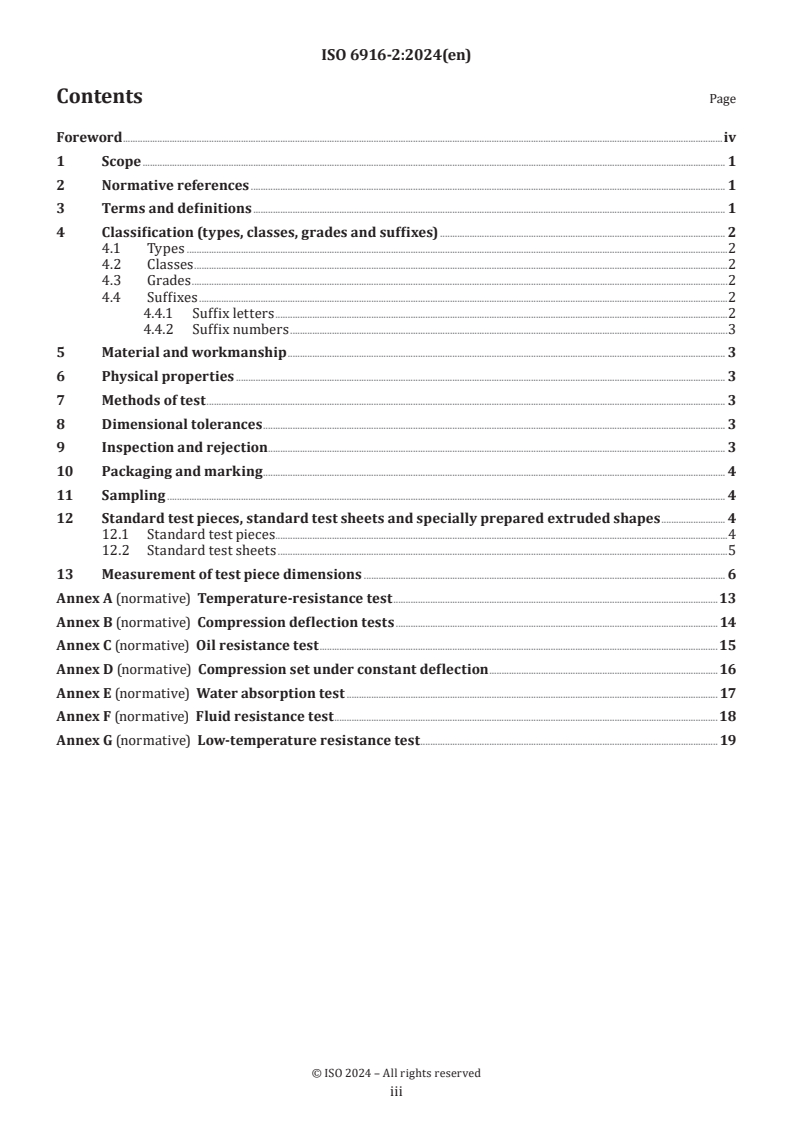
Contents Page
Foreword .iv
1 Scope . 1
2 Normative references . 1
3 Terms and definitions . 1
4 Classification (types, classes, grades and suffixes) . 2
4.1 Types .2
4.2 Classes .2
4.3 Grades .2
4.4 Suffixes .2
4.4.1 Suffix letters .2
4.4.2 Suffix numbers .3
5 Material and workmanship . 3
6 Physical properties . 3
7 Methods of test . 3
8 Dimensional tolerances . 3
9 Inspection and rejection . 3
10 Packaging and marking . 4
11 Sampling . 4
12 Standard test pieces, standard test sheets and specially prepared extruded shapes . 4
12.1 Standard test pieces .4
12.2 Standard test sheets .5
13 Measurement of test piece dimensions . 6
Annex A (normative) Temperature-resistance test .13
Annex B (normative) Compression deflection tests . 14
Annex C (normative) Oil resistance test .15
Annex D (normative) Compression set under constant deflection .16
Annex E (normative) Water absorption test . 17
Annex F (normative) Fluid resistance test .18
Annex G (normative) Low-temperature resistance test . 19
iii
Foreword
ISO (the International Organization for Standardization) is a worldwide federation of national standards
bodies (ISO member bodies). The work of preparing International Standards is normally carried out through
ISO technical committees. Each member body interested in a subject for which a technical committee
has been established has the right to be represented on that committee. International organizations,
governmental and non-governmental, in liaison with ISO, also take part in the work. ISO collaborates closely
with the International Electrotechnical Commission (IEC) on all matters of electrotechnical standardization.
The procedures used to develop this document and those intended for its further maintenance are described
in the ISO/IEC Directives, Part 1. In particular, the different approval criteria needed for the different types
of ISO document should be noted. This document was drafted in accordance with the editorial rules of the
ISO/IEC Directives, Part 2 (see www.iso.org/directives).
ISO draws attention to the possibility that the implementation of this document may involve the use of (a)
patent(s). ISO takes no position concerning the evidence, validity or applicability of any claimed patent
rights in respect thereof. As of the date of publication of this document, ISO had not received notice of (a)
patent(s) which may be required to implement this document. However, implementers are cautioned that
this may not represent the latest information, which may be obtained from the patent database available at
www.iso.org/patents. ISO shall not be held responsible for identifying any or all such patent rights.
Any trade name used in this document is information given for the convenience of users and does not
constitute an endorsement.
For an explanation of the voluntary nature of standards, the meaning of ISO specific terms and expressions
related to conformity assessment, as well as information about ISO's adherence to the World Trade
Organization (WTO) principles in the Technical Barriers to Trade (TBT), see www.iso.org/iso/foreword.html.
This document was prepared by Technical Committee ISO/TC 45, Rubber and rubber products, Subcommittee
SC 4, Products (other than hoses).
This second edition cancels and replaces the first edition (ISO 6916-2:2001), which has been technically
revised.
The main changes are as follows:
— editorial changes throughout the document.
A list of all parts in the ISO 6916 series can be found on the ISO website.
Any feedback or questions on this document should be directed to the user’s national standards body. A
complete listing of these bodies can be found at www.iso.org/members.html.
iv
International Standard ISO 6916-2:2024(en)
Flexible cellular polymeric materials — Sponge and expanded
cellular rubber products —
Part 2:
Specification for mouldings and extrusions
WARNING — Persons using this document should be familiar with normal laboratory practice. This
document does not purport to address all of the safety problems, if any, associated with its use. It
is the responsibility of the user to establish appropriate safety and health practices and to ensure
compliance with any national regulatory conditions.
1 Scope
This document classifies flexible cellular rubber products known as sponge and expanded rubber. The base
material used in their manufacture may be natural rubber, reclaimed rubber, synthetic rubber or rubber-
like material, either alone or in combination. Thermoplastic rubbers are not included. This document does
not apply to latex foam rubbers or shoe soling.
This document covers vulcanized cellular rubber products that are manufactured by a moulding or
continuous vulcanization process, i.e. hot air, microwave, infra-red, liquid curing medium (LCM), shearing-
head vulcanization or a combination of two or more of these methods. Sheeting materials are covered by
ISO 6916-1.
In the case of conflict between the provisions of this document and those of the detailed specification or test
method for a particular product, the latter takes precedence. Reference to the methods specifically states
the desired test or tests.
2 Normative references
The following documents are referred to in the text in such a way that some or all of their content constitutes
requirements of this document. For dated references, only the edition cited applies. For undated references,
the latest edition of the referenced document (including any amendments) applies.
ISO 188, Rubber, vulcanized and thermoplastic — Accelerated ageing and heat resistance tests
ISO 815-1, Rubber, vulcanized or thermoplastic — Determination of compression set — Part 1: At ambient or
elevated temperatures
ISO 1431-1, Rubber, vulcanized or thermoplastic — Resistance to ozone cracking — Part 1: Static strain test
ISO 1817, Rubber, vulcanized — Determination of the effect of liquids
ISO 1923, Cellular plastics and rubbers — Determination of linear dimensions
ISO 3865, Rubber, vulcanized or thermoplastic — Methods of test for staining in contact with organic material
ISO 5893, Rubber and plastics test equipment — Tensile, flexural and compression types (constant rate of
traverse) — Specification
3 Terms and definitions
No terms and definitions are listed in this document.
ISO and IEC maintain terminology databases for use in standardization at the following addresses:
— ISO Online browsing platform: available at https:// www .iso .org/ obp
— IEC Electropedia: available at https:// www .electropedia .org/
4 Classification (types, classes, grades and suffixes)
4.1 Types
Three types are specified, as follows:
— Type 1: open-cell rubber;
— Type 2: closed-cell rubber;
— Type 3: self-skinned cellular rubber.
4.2 Classes
Each type is divided into four classes designated by the letters A, B, C and D (for example type 1B), as follows:
— Class A: cellular rubbers made from natural rubber, where specific resistance to the action of petroleum-
based oils is not required;
— Class B: cellular rubbers having specific requirements for oil resistance with low swell;
— Class C: cellular rubbers having specific requirements for oil resistance with medium swell;
— Class D: cellular rubbers made from synthetic rubber or rubber-like materials, either alone or in
combination, having specific requirements for both low- and high-temperature resistance (–75 °C to
+250 °C), but where specific resistance to the action of petroleum-based oils is not required.
4.3 Grades
Each class is divided into seven different grades based on a specific range of firmness as expressed by
compression deflection determined as described in Annex B. Grades are designated by a digit (0 to 6), with
the softer grades being identified with the lower numbers and the harder grades with the higher numbers:
— Grade 0: for type 1 cellular rubbers only, a compression deflection range of 2,5 kPa to 15,0 kPa;
— Grade 1: a compression deflection range of 15,1 kPa to 35,0 kPa;
— Grade 2: a compression deflection range of 35,1 kPa to 65,0 kPa;
— Grade 3: a compression deflection range of 65,1 kPa to 95,0 kPa;
— Grade 4: a compression deflection range of 95,1 kPa to 125,0 kPa;
— Grade 5: a compression deflection range of 125,1 kPa to 200,0 kPa;
— Grade 6: a compression deflection range of 200,1 kPa to 300,0 kPa.
4.4 Suffixes
4.4.1 Suffix letters
Suffix letters may be added singly or in combination after any grade number to indicate additional
requirements beyond those specified in Tables 1 to 3 as basic requirements. The significance of the approved
suffix letters is shown in Table 4.
4.4.2 Suffix numbers
Each suffix letter should preferably be followed by a suffix number. The suffix number indicates the
particular test conditions. The test duration is part of the method and is taken from the listing in Table 5.
NOTE Regarding products meeting requirements defined to the suffix number level, national health and safety
regulations can apply.
5 Material and workmanship
5.1 Cellular rubbers produced to this document shall be manufactured from natural rubber, synthetic
rubber, reclaimed rubber or rubber-like material, together with added compounding ingredients of such
nature and quality that the product complies with the requirements of this document.
5.2 In permitting choice in the use of materials, it is not intended to imply that the resulting different
rubber materials are equivalent in respect of all physical properties. Any special characteristics other
than those specified in this document that may be desired for a specific application shall be detailed in
the particular product specification. All materials and workmanship shall be in accordance with good
commercial practice, and the resulting cellular rubbers shall be free from defects affecting serviceability.
6 Physical properties
The various types, classes and grades of cellular rubber shall conform to the physical-property requirements
given in Tables 1 to 3, together with any additional requirements indicated by any suffix letter as described
in Table 4 and any suffix number given in the designation as described in 4.4.
7 Methods of test
7.1 Unless specifically stated otherwise, all tests shall be carried out in accordance with the methods
specified in Annexes A to G.
7.2 Test pieces shall not be tested for at least 72 h after manufacture. Prior to testing, the test pieces shall
be stored for at least 16 h at either (23 ± 2) °C and (50 ± 5) % relative humidity or (27 ± 2) °C and (65 ± 5) %
relative humidity. This period may form the latter part of the period following manufacture.
8 Dimensional tolerances
The tolerances allowable on the dimensions of cellular rubber in moulded and extruded form shall be as
specified in Table 6.
9 Inspection and rejection
9.1 All tests and inspections shall be made at the place of manufacture prior to shipment, unless otherwise
specified. The manufacturer shall afford the inspector all reasonable facilities for tests and inspections.
9.2 The purchaser may carry out the tests and inspections governing acceptance or rejection of the
material at his own laboratory or elsewhere. Such tests and inspections shall be made not later than 15 days
after receipt of the material.
9.3 All test pieces prepared as specified in Clause 12 shall be visually inspected to determine compliance
with the material, workmanship and colour requirements.
9.4 Any material that fails one or more of the test requirements may be re-tested. For this purpose, two
additional tests shall be made for the requirement for which failure occurred. Failure of either of the re-tests
shall be cause for final rejection.
9.5 Rejected material shall be disposed of as directed by the manufacturer.
10 Packaging and marking
The material shall be properly and adequately packaged. Each package or container shall be legibly marked
with the name of the material, the name or trademark of the manufacturer, and any required purchaser's
designations.
11 Sampling
11.1 When possible, the complete finished product shall be used for the tests specified. Representative
samples of the lot being examined shall be selected at random as required.
11.2 When it is necessary or advisable to obtain test pieces from the article, as in those cases where the
finished product is not required or suitable for testing, the method of cutting and the exact position from
which test pieces are to be taken shall be specified. The apparent density and the state of cure may vary in
different parts of the finished product, especially if the article is of complicated shape or of varying thickness,
and these factors will affect the physical properties of the test pieces. Also, the apparent density is affected
by the number of cut surfaces as opposed to the number of skin-covered surfaces on the test piece.
11.3 When the finished product does not lend itself to testing or to the preparation of test pieces because of
its complicated shape, its small size, the presence of metal or fabric inserts, the presence of surface skins, a
tendency to adhere to metal, or for other reasons, standard test sheets shall be prepared. When differences
in test values arise due to the difficulty in obtaining suitable test pieces from the finished product,
manufacturer and purchaser may agree on acceptable deviations. This can be done by comparing results
obtained with standard test pieces and those obtained on actual products.
12 Standard test pieces, standard test sheets and specially prepared extruded shapes
12.1 Standard test pieces
+00, 4 +00, 4
Standard test pieces shall be discs, cut out with a die, either ()30 mm or ()19 mm in diameter and
0 0
+05,
at least ()6 mm thick. The test pieces may be cut out with a revolving die using a soap solution as a
lubricant. If a lubricant is used, the test pieces shall be thoroughly dried before proceeding with testing. In
some cases, it may be necessary to freeze the cellular rubber to obtain parallel cut edges. When cut from
standard test sheets, the test pieces shall be cut from the central area as shown in Figure 1. The exact
dimensions of the test pieces shall be measured as specified in Clause 13. Plied-up test pieces may be used as
indicated in the test methods for compression deflection and compression set.
Where available material widths are too small to allow standard test pieces to be cut, then smaller-diameter
discs may be used. Test results obtained on smaller discs cannot be the same as on standard test pieces.
Dimensions in millimetres
Key
1 nine holes, diameter 30 mm, with centres spaced 33,3 mm apart
Figure 1 — Locations from which standard test pieces are to be cut when preparing them from
standard test sheets or commercial sheets
12.2 Standard test sheets
12.2.1 Standard test sheets for all types of cellular rubber shall be (150 ± 5) mm square and (12,5 ± 0,5) mm
in thickness, made from the same compound and having the same apparent density and state of cure as the
product they represent. In all cases, the surface skin shall be left intact on both top and bottom faces of the
test sheet. Standard test sheets shall be prepared either by cutting them from commercial sheets of the
specified thickness or as described in 12.2.2 or 12.2.3.
12.2.2 When specially prepared standard test sheets of sponge rubber are required, they shall be made
using the frame shown in Figure 2 together with top and bottom plates each approximately 12,5 mm in
thickness. The frame and plates shall be made of aluminium or steel. The compound shall be cut into squares
slightly smaller than the frame cavities. The thickness shall be such as to give the required apparent density
when the material is blown during cure to fill the moulding cavities. The squares of compound shall be
dusted with talc and the excess brushed off to avoid pitting. They shall then be placed in the frame, and fabric
sheeting shall be applied on the top and bottom between the frame and the plates to allow venting of gases
produced during curing. This fabric shall be a commercial sheet with a mass per unit area of approximately
135 g/m and having approximately 2,75 ends/mm and 2,36 picks/mm. The sheets shall be vulcanized in
a platen press under conditions of time and temperature chosen to produce the same state of cure in the
standard sheets as in the finished products that they represent.
12.2.3 Where specially prepared standard test sheets of expanded rubber are required, such test sheets
shall be prepared to have approximately the same density and shall be vulcanized under conditions of time
and temperature chosen to produce the same state of cure as in the finished products that they represent.
...
Questions, Comments and Discussion
Ask us and Technical Secretary will try to provide an answer. You can facilitate discussion about the standard in here.
Loading comments...