

ISO 17225-7:2021
(Main)Solid biofuels — Fuel specifications and classes — Part 7: Graded non-woody briquettes
General Information
- Abstract
This document determines the fuel quality classes and specifications of graded non-woody briquettes. This document covers only non-woody briquettes produced from the following raw materials (see ISO 17225‑1:2021, Table 1): — 2 Herbaceous biomass — 3 Fruit biomass — 4 Aquatic biomass — 5 Biomass blends and mixtures NOTE 1 Herbaceous biomass originates from plants that have a non-woody stem and which die back at the end of the growing season. It includes grains or seeds crops from food production or processing industry and their by-products such as cereals. NOTE 2 Blends and mixtures include blends and mixtures from the main origin-based solid biofuel groups woody biomass, herbaceous biomass, fruit biomass and aquatic biomass. Blends are intentionally mixed biofuels, whereas mixtures are unintentionally mixed biofuels. The origin of the blend and mixture is to be described using ISO 17225‑1:2021, Table 1. If solid biofuel blend or mixture contains chemically treated material it shall be stated. NOTE 3 Thermally treated biomass briquettes (e.g. torrefied briquettes) are not included in the scope of this document
- Status
- Published
- Publication Date
- 04-Jul-2021
- Technical Committee
- ISO/TC 238 - Solid biofuels
- Drafting Committee
- ISO/TC 238/WG 2 - Fuel specifications and classes
- Current Stage
- 9020 - International Standard under periodical review
- Start Date
- 15-Jul-2026
- Completion Date
- 15-Jul-2026
Buy Documents

ISO 17225-7:2021 - Solid biofuels -- Fuel specifications and classes
ISO 17225-7:2021 - Solid biofuels — Fuel specifications and classes — Part 7: Graded non-woody briquettes/5/2021


ISO 17225-7:2021 - Biocombustibles solides -- Classes et spécifications des combustibles
ISO 17225-7:2021 - Biocombustibles solides — Classes et spécifications des combustibles — Partie 7: Classes de briquettes d'origine agricole/5/2021
Overview
ISO 17225-7:2021 - Solid biofuels - Fuel specifications and classes - Part 7: Graded non-woody briquettes defines fuel quality classes and technical specifications for non-woody briquettes made from herbaceous, fruit, aquatic biomass or their blends. It supports consistent trade, safe use and communication between producers, buyers and appliance manufacturers. Thermally treated briquettes (e.g. torrefied) are excluded.
Keywords: ISO 17225-7, non-woody briquettes, solid biofuels, fuel specifications, biomass briquettes, biofuel standards.
Key topics and requirements
The standard specifies classification, declaration and test methods for graded non-woody briquettes. Major technical requirements include:
- Covered raw materials: herbaceous biomass, fruit biomass, aquatic biomass, and biomass blends/mixtures (see ISO 17225‑1 for origin codes).
- Fuel quality classes: A1, A2 and B (A1 recommended for residential use; blending with woody biomass is recommended to reach A1 limits).
- Physical and chemical limits (selected, dry or as‑received units as stated in the standard):
- Moisture: A1/A2 ≤ 12% (wet basis); B ≤ 15%.
- Ash (dry basis): A1 ≤ 3%; A2 ≤ 6%; B ≤ 10%.
- Particle density (as received): A1/A2 ≥ 0.9 g/cm3; B ≥ 0.6 g/cm3.
- Net calorific value: ≥ 14.5 MJ/kg (≈4.0 kWh/kg).
- Nitrogen (dry): A1/A2 ≤ 1.5%; B ≤ 2.0%.
- Sulfur (dry): A1/A2 ≤ 0.20%; B ≤ 0.30%.
- Chlorine (dry): A1 ≤ 0.10%; A2 ≤ 0.20%; B ≤ 0.30%.
- Heavy metals (dry basis): limits for As, Cd, Cr, Cu, Pb, Hg, Ni, Zn are specified (e.g., As ≤ 1.0 mg/kg for A1/A2, ≤ 1.5 mg/kg for B; Hg ≤ 0.1 mg/kg).
- Additives: maximum 5% (mass) and type/amount must be stated (pressing aids, inhibitors, starch, oils etc.).
- Dimensions & shape: briquette geometry (diameter, length, width, height) must be declared.
- Informative properties: ash melting behaviour (SST, DT, HT, FT) and surface area should be stated where relevant because non-woody fuels often produce low‑melting, corrosive ashes.
Practical applications and users
ISO 17225-7 is intended for:
- Fuel producers and suppliers declaring product quality.
- Appliance manufacturers (stoves, boilers, room heaters) that require clear fuel specs for design and warranty.
- Heating system installers, facility managers and specifiers selecting briquettes for residential, small commercial, public building and industrial applications.
- Regulators and procurement teams ensuring safe combustion results and reduced corrosion, fouling or emissions.
Practical guidance in the standard emphasizes appropriate sampling, analysis and documentation so users can manage risks associated with high ash, chlorine and alkali contents typical of non-woody biomass.
Related standards
- ISO 17225-1:2021 (General requirements and origin codes)
- Sampling & analysis: ISO 18135, ISO 21945, ISO 14780, ISO 18134-1/2, ISO 18122, ISO 18125, ISO 16948, ISO 16968, ISO 16994, ISO 18847
Using ISO 17225-7 together with ISO 17225-1 and the referenced test standards ensures consistent, market-ready specifications for non-woody biomass briquettes.
Relations
- Effective Date
- 12-Feb-2026
- Effective Date
- 16-Jun-2018
Buy Documents
ISO 17225-7:2021 - Solid biofuels -- Fuel specifications and classes
ISO 17225-7:2021 - Solid biofuels — Fuel specifications and classes — Part 7: Graded non-woody briquettes/5/2021
ISO 17225-7:2021 - Biocombustibles solides -- Classes et spécifications des combustibles
ISO 17225-7:2021 - Biocombustibles solides — Classes et spécifications des combustibles — Partie 7: Classes de briquettes d'origine agricole/5/2021
Get Certified
Connect with accredited certification bodies for this standard

DNV
DNV is an independent assurance and risk management provider.

Lloyd's Register
Lloyd's Register is a global professional services organisation specialising in engineering and technology.
DNV Energy Systems
Energy and renewable energy certification.
Sponsored listings
Frequently Asked Questions
ISO 17225-7:2021 is a standard published by the International Organization for Standardization (ISO). Its full title is "Solid biofuels — Fuel specifications and classes — Part 7: Graded non-woody briquettes". This standard covers: This document determines the fuel quality classes and specifications of graded non-woody briquettes. This document covers only non-woody briquettes produced from the following raw materials (see ISO 17225‑1:2021, Table 1): — 2 Herbaceous biomass — 3 Fruit biomass — 4 Aquatic biomass — 5 Biomass blends and mixtures NOTE 1 Herbaceous biomass originates from plants that have a non-woody stem and which die back at the end of the growing season. It includes grains or seeds crops from food production or processing industry and their by-products such as cereals. NOTE 2 Blends and mixtures include blends and mixtures from the main origin-based solid biofuel groups woody biomass, herbaceous biomass, fruit biomass and aquatic biomass. Blends are intentionally mixed biofuels, whereas mixtures are unintentionally mixed biofuels. The origin of the blend and mixture is to be described using ISO 17225‑1:2021, Table 1. If solid biofuel blend or mixture contains chemically treated material it shall be stated. NOTE 3 Thermally treated biomass briquettes (e.g. torrefied briquettes) are not included in the scope of this document
This document determines the fuel quality classes and specifications of graded non-woody briquettes. This document covers only non-woody briquettes produced from the following raw materials (see ISO 17225‑1:2021, Table 1): — 2 Herbaceous biomass — 3 Fruit biomass — 4 Aquatic biomass — 5 Biomass blends and mixtures NOTE 1 Herbaceous biomass originates from plants that have a non-woody stem and which die back at the end of the growing season. It includes grains or seeds crops from food production or processing industry and their by-products such as cereals. NOTE 2 Blends and mixtures include blends and mixtures from the main origin-based solid biofuel groups woody biomass, herbaceous biomass, fruit biomass and aquatic biomass. Blends are intentionally mixed biofuels, whereas mixtures are unintentionally mixed biofuels. The origin of the blend and mixture is to be described using ISO 17225‑1:2021, Table 1. If solid biofuel blend or mixture contains chemically treated material it shall be stated. NOTE 3 Thermally treated biomass briquettes (e.g. torrefied briquettes) are not included in the scope of this document
ISO 17225-7:2021 is classified under the following ICS (International Classification for Standards) categories: 27.190 - Biological sources and alternative sources of energy; 75.160.40 - Biofuels. The ICS classification helps identify the subject area and facilitates finding related standards.
ISO 17225-7:2021 has the following relationships with other standards: It is inter standard links to EN ISO 17225-7:2021, ISO 17225-7:2014. Understanding these relationships helps ensure you are using the most current and applicable version of the standard.
ISO 17225-7:2021 is available in PDF format for immediate download after purchase. The document can be added to your cart and obtained through the secure checkout process. Digital delivery ensures instant access to the complete standard document.
Standards Content (Sample)
INTERNATIONAL ISO
STANDARD 17225-7
Second edition
2021-07
Solid biofuels — Fuel specifications
and classes —
Part 7:
Graded non-woody briquettes
Biocombustibles solides — Classes et spécifications des
combustibles —
Partie 7: Classes de briquettes d'origine agricole
Reference number
©
ISO 2021
© ISO 2021
All rights reserved. Unless otherwise specified, or required in the context of its implementation, no part of this publication may
be reproduced or utilized otherwise in any form or by any means, electronic or mechanical, including photocopying, or posting
on the internet or an intranet, without prior written permission. Permission can be requested from either ISO at the address
below or ISO’s member body in the country of the requester.
ISO copyright office
CP 401 • Ch. de Blandonnet 8
CH-1214 Vernier, Geneva
Phone: +41 22 749 01 11
Email: copyright@iso.org
Website: www.iso.org
Published in Switzerland
ii © ISO 2021 – All rights reserved
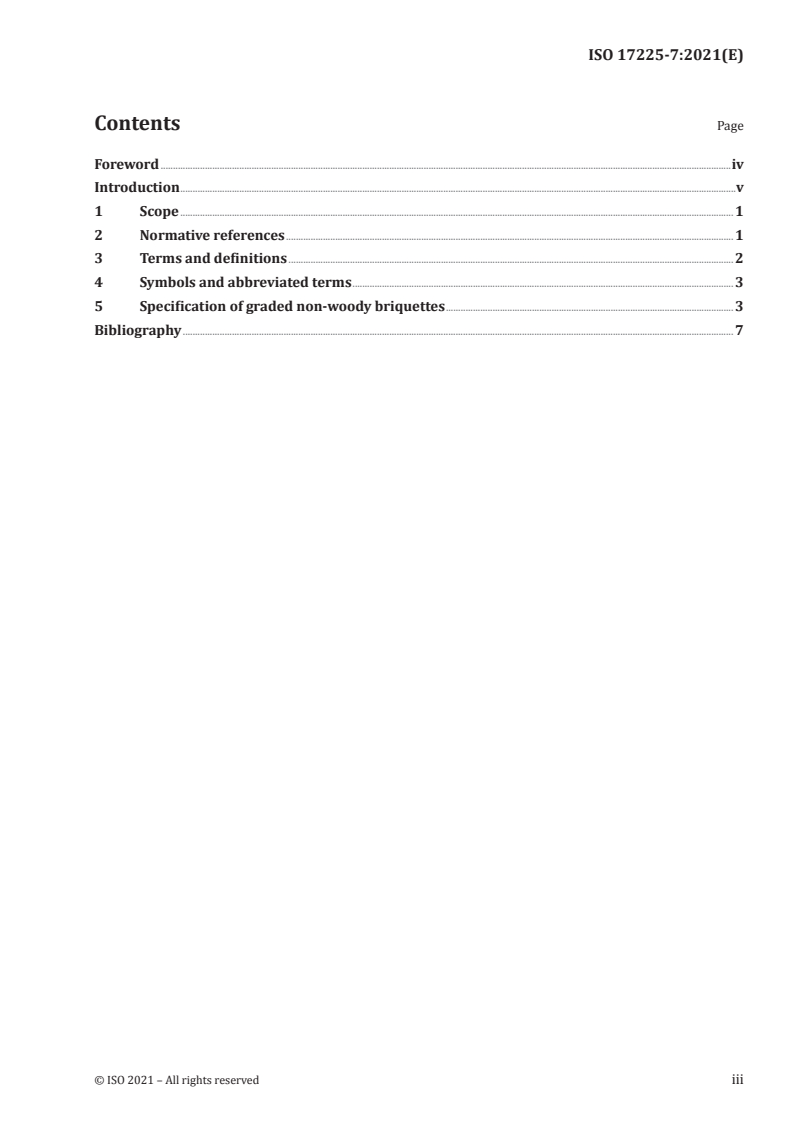
Contents Page
Foreword .iv
Introduction .v
1 Scope . 1
2 Normative references . 1
3 Terms and definitions . 2
4 Symbols and abbreviated terms . 3
5 Specification of graded non-woody briquettes . 3
Bibliography . 7
Foreword
ISO (the International Organization for Standardization) is a worldwide federation of national standards
bodies (ISO member bodies). The work of preparing International Standards is normally carried out
through ISO technical committees. Each member body interested in a subject for which a technical
committee has been established has the right to be represented on that committee. International
organizations, governmental and non-governmental, in liaison with ISO, also take part in the work.
ISO collaborates closely with the International Electrotechnical Commission (IEC) on all matters of
electrotechnical standardization.
The procedures used to develop this document and those intended for its further maintenance are
described in the ISO/IEC Directives, Part 1. In particular, the different approval criteria needed for the
different types of ISO documents should be noted. This document was drafted in accordance with the
editorial rules of the ISO/IEC Directives, Part 2 (see www .iso .org/ directives).
Attention is drawn to the possibility that some of the elements of this document may be the subject of
patent rights. ISO shall not be held responsible for identifying any or all such patent rights. Details of
any patent rights identified during the development of the document will be in the Introduction and/or
on the ISO list of patent declarations received (see www .iso .org/ patents).
Any trade name used in this document is information given for the convenience of users and does not
constitute an endorsement.
For an explanation of the voluntary nature of standards, the meaning of ISO specific terms and
expressions related to conformity assessment, as well as information about ISO's adherence to the
World Trade Organization (WTO) principles in the Technical Barriers to Trade (TBT), see www .iso .org/
iso/ foreword .html.
This document was prepared by Technical Committee ISO/TC 238, Solid biofuels.
This second edition cancels and replaces the first edition (ISO 17225-7:2014), which has been technically
revised. The main changes compared to the previous edition are as follows:
— Figure 1 changed;
— Class A is split into two classes, A1 and A2;
— Chlorine value changed in Class A2;
— Arsenic value changed in Class B;
— Ash melting behaviour added as an informative property.
A list of all parts in the ISO 17225 series can be found on the ISO website.
Any feedback or questions on this document should be directed to the user’s national standards body. A
complete listing of these bodies can be found at www .iso .org/ members .html.
iv © ISO 2021 – All rights reserved
Introduction
The objective of the ISO 17225 series is to provide unambiguous and clear classification principles for
solid biofuels; to serve as a tool to enable efficient trading of biofuels; to enable good understanding
between seller and buyer as well as a tool for communication with equipment manufacturers. It will
also facilitate authority permission procedures and reporting.
This document supports the use of graded non-woody briquettes in specially designed appliances for
residential, small commercial and public building applications and industrial use.
The residential, small commercial and public building appliances require higher quality fuel for the
following reasons:
— Small-scale equipment does not usually have advanced controls and flue gas cleaning;
— Appliances are not generally managed by professional heating engineers;
— Appliances are often located in residential and populated districts.
Non-woody briquettes have high ash, chlorine (Cl), nitrogen (N), sulfur (S) and major element contents,
so non-woody briquettes are recommended to be used in appliances, which are specially designed or
adjusted for this kind of briquettes.
In general, non-woody biomass materials have higher content of ash forming elements and produces
ashes with lower melting temperature compared to most woody biomass. Be aware that different
growing and soil conditions of the herbaceous or fruit biomass may influence the fuel ash composition
differently depending on growth and soil conditions This may result in fouling, slagging and corrosion
inside boilers. These problems are especially related to materials that have high content of potassium
(K) and silicate (Si) and low content of calcium (Ca). The content of chlorine (Cl), phosphorous (P) and
potassium (K) in the material may form chlorides and phosphates and other chemical compounds
resulting in high hydrochloric emissions and chemically active ash causing corrosion. Special attention
should be paid to the risk of corrosion in small and medium scale boilers and flue gas systems. Blending
with woody biomass can improve the combustion characteristics.
NOTE 1 Briquettes produced according to this document can be used in stoves, fireplaces, cookers,
,[1]
roomheaters and multifired sauna stoves, which are tested according to European standards EN 13229
[2] [3] [4] [5] [6]
EN 12815, EN 12809, EN 13240, EN 15250 and EN 15821, and boilers systems tested according to
[7]
EN 303–5 .
NOTE 2 For individual contracts ISO 17225-1 can be used.
Although this document may be obtained separately, it requires a general understanding of the
standards based on and supporting ISO 17225-1. It is recommended to obtain and use ISO 17225-1 in
conjunction with this document.
INTERNATIONAL STANDARD ISO 17225-7:2021(E)
Solid biofuels — Fuel specifications and classes —
Part 7:
Graded non-woody briquettes
1 Scope
This document determines the fuel quality classes and specifications of graded non-woody briquettes.
This document covers only non-woody briquettes produced from the following raw materials (see
ISO 17225-1:2021, Table 1):
— 2 Herbaceous biomass
— 3 Fruit biomass
— 4 Aquatic biomass
— 5 Biomass blends and mixtures
NOTE 1 Herbaceous biomass originates from plants that have a non-woody stem and which die back at the end
of the growing season. It includes grains or seeds crops from food production or processing industry and their
by-products such as cereals.
NOTE 2 Blends and mixtures include blends and mixtures from the main origin-based solid biofuel groups
woody biomass, herbaceous biomass, fruit biomass and aquatic biomass.
Blends are intentionally mixed biofuels, whereas mixtures are unintentionally mixed biofuels. The
origin of the blend and mixture is to be described using ISO 17225-1:2021, Table 1.
If solid biofuel blend or mixture contains chemically treated material it shall be stated.
NOTE 3 Thermally treated biomass briquettes (e.g. torrefied briquettes) are not included in the scope of this
document.
2 Normative references
The following documents, in whole or in part, are normatively referenced in this document and are
indispensable for its application. For dated references, only the edition cited applies. For undated
references, the latest edition of the referenced document (including any amendments) applies.
ISO 14780, Solid biofuels — Sample preparation
ISO 16559, Solid biofuels — Terminology, definitions and descriptions
ISO 16948, Solid biofuels — Determination of total content of carbon, hydrogen and nitrogen
ISO 16968, Solid biofuels — Determination of minor elements
ISO 16994, Solid biofuels — Determination of total content of sulfur and chlorine
ISO 17225-1:2021, Solid biofuels — Part 1 — General requirements
ISO 18122, Solid biofuels — Determination of ash content
ISO 18125, Solid biofuels — Determination of calorific value
...
INTERNATIONAL ISO
STANDARD 17225-7
Second edition
2021-07
Solid biofuels — Fuel specifications
and classes —
Part 7:
Graded non-woody briquettes
Biocombustibles solides — Classes et spécifications des
combustibles —
Partie 7: Classes de briquettes d'origine agricole
Reference number
©
ISO 2021
© ISO 2021
All rights reserved. Unless otherwise specified, or required in the context of its implementation, no part of this publication may
be reproduced or utilized otherwise in any form or by any means, electronic or mechanical, including photocopying, or posting
on the internet or an intranet, without prior written permission. Permission can be requested from either ISO at the address
below or ISO’s member body in the country of the requester.
ISO copyright office
CP 401 • Ch. de Blandonnet 8
CH-1214 Vernier, Geneva
Phone: +41 22 749 01 11
Email: copyright@iso.org
Website: www.iso.org
Published in Switzerland
ii © ISO 2021 – All rights reserved
Contents Page
Foreword .iv
Introduction .v
1 Scope . 1
2 Normative references . 1
3 Terms and definitions . 2
4 Symbols and abbreviated terms . 3
5 Specification of graded non-woody briquettes . 3
Bibliography . 7
Foreword
ISO (the International Organization for Standardization) is a worldwide federation of national standards
bodies (ISO member bodies). The work of preparing International Standards is normally carried out
through ISO technical committees. Each member body interested in a subject for which a technical
committee has been established has the right to be represented on that committee. International
organizations, governmental and non-governmental, in liaison with ISO, also take part in the work.
ISO collaborates closely with the International Electrotechnical Commission (IEC) on all matters of
electrotechnical standardization.
The procedures used to develop this document and those intended for its further maintenance are
described in the ISO/IEC Directives, Part 1. In particular, the different approval criteria needed for the
different types of ISO documents should be noted. This document was drafted in accordance with the
editorial rules of the ISO/IEC Directives, Part 2 (see www .iso .org/ directives).
Attention is drawn to the possibility that some of the elements of this document may be the subject of
patent rights. ISO shall not be held responsible for identifying any or all such patent rights. Details of
any patent rights identified during the development of the document will be in the Introduction and/or
on the ISO list of patent declarations received (see www .iso .org/ patents).
Any trade name used in this document is information given for the convenience of users and does not
constitute an endorsement.
For an explanation of the voluntary nature of standards, the meaning of ISO specific terms and
expressions related to conformity assessment, as well as information about ISO's adherence to the
World Trade Organization (WTO) principles in the Technical Barriers to Trade (TBT), see www .iso .org/
iso/ foreword .html.
This document was prepared by Technical Committee ISO/TC 238, Solid biofuels.
This second edition cancels and replaces the first edition (ISO 17225-7:2014), which has been technically
revised. The main changes compared to the previous edition are as follows:
— Figure 1 changed;
— Class A is split into two classes, A1 and A2;
— Chlorine value changed in Class A2;
— Arsenic value changed in Class B;
— Ash melting behaviour added as an informative property.
A list of all parts in the ISO 17225 series can be found on the ISO website.
Any feedback or questions on this document should be directed to the user’s national standards body. A
complete listing of these bodies can be found at www .iso .org/ members .html.
iv © ISO 2021 – All rights reserved
Introduction
The objective of the ISO 17225 series is to provide unambiguous and clear classification principles for
solid biofuels; to serve as a tool to enable efficient trading of biofuels; to enable good understanding
between seller and buyer as well as a tool for communication with equipment manufacturers. It will
also facilitate authority permission procedures and reporting.
This document supports the use of graded non-woody briquettes in specially designed appliances for
residential, small commercial and public building applications and industrial use.
The residential, small commercial and public building appliances require higher quality fuel for the
following reasons:
— Small-scale equipment does not usually have advanced controls and flue gas cleaning;
— Appliances are not generally managed by professional heating engineers;
— Appliances are often located in residential and populated districts.
Non-woody briquettes have high ash, chlorine (Cl), nitrogen (N), sulfur (S) and major element contents,
so non-woody briquettes are recommended to be used in appliances, which are specially designed or
adjusted for this kind of briquettes.
In general, non-woody biomass materials have higher content of ash forming elements and produces
ashes with lower melting temperature compared to most woody biomass. Be aware that different
growing and soil conditions of the herbaceous or fruit biomass may influence the fuel ash composition
differently depending on growth and soil conditions This may result in fouling, slagging and corrosion
inside boilers. These problems are especially related to materials that have high content of potassium
(K) and silicate (Si) and low content of calcium (Ca). The content of chlorine (Cl), phosphorous (P) and
potassium (K) in the material may form chlorides and phosphates and other chemical compounds
resulting in high hydrochloric emissions and chemically active ash causing corrosion. Special attention
should be paid to the risk of corrosion in small and medium scale boilers and flue gas systems. Blending
with woody biomass can improve the combustion characteristics.
NOTE 1 Briquettes produced according to this document can be used in stoves, fireplaces, cookers,
,[1]
roomheaters and multifired sauna stoves, which are tested according to European standards EN 13229
[2] [3] [4] [5] [6]
EN 12815, EN 12809, EN 13240, EN 15250 and EN 15821, and boilers systems tested according to
[7]
EN 303–5 .
NOTE 2 For individual contracts ISO 17225-1 can be used.
Although this document may be obtained separately, it requires a general understanding of the
standards based on and supporting ISO 17225-1. It is recommended to obtain and use ISO 17225-1 in
conjunction with this document.
INTERNATIONAL STANDARD ISO 17225-7:2021(E)
Solid biofuels — Fuel specifications and classes —
Part 7:
Graded non-woody briquettes
1 Scope
This document determines the fuel quality classes and specifications of graded non-woody briquettes.
This document covers only non-woody briquettes produced from the following raw materials (see
ISO 17225-1:2021, Table 1):
— 2 Herbaceous biomass
— 3 Fruit biomass
— 4 Aquatic biomass
— 5 Biomass blends and mixtures
NOTE 1 Herbaceous biomass originates from plants that have a non-woody stem and which die back at the end
of the growing season. It includes grains or seeds crops from food production or processing industry and their
by-products such as cereals.
NOTE 2 Blends and mixtures include blends and mixtures from the main origin-based solid biofuel groups
woody biomass, herbaceous biomass, fruit biomass and aquatic biomass.
Blends are intentionally mixed biofuels, whereas mixtures are unintentionally mixed biofuels. The
origin of the blend and mixture is to be described using ISO 17225-1:2021, Table 1.
If solid biofuel blend or mixture contains chemically treated material it shall be stated.
NOTE 3 Thermally treated biomass briquettes (e.g. torrefied briquettes) are not included in the scope of this
document.
2 Normative references
The following documents, in whole or in part, are normatively referenced in this document and are
indispensable for its application. For dated references, only the edition cited applies. For undated
references, the latest edition of the referenced document (including any amendments) applies.
ISO 14780, Solid biofuels — Sample preparation
ISO 16559, Solid biofuels — Terminology, definitions and descriptions
ISO 16948, Solid biofuels — Determination of total content of carbon, hydrogen and nitrogen
ISO 16968, Solid biofuels — Determination of minor elements
ISO 16994, Solid biofuels — Determination of total content of sulfur and chlorine
ISO 17225-1:2021, Solid biofuels — Part 1 — General requirements
ISO 18122, Solid biofuels — Determination of ash content
ISO 18125, Solid biofuels — Determination of calorific value
...
NORME ISO
INTERNATIONALE 17225-7
Deuxième édition
2021-07
Biocombustibles solides — Classes et
spécifications des combustibles —
Partie 7:
Classes de briquettes d'origine
agricole
Solid biofuels — Fuel specifications and classes —
Part 7: Graded non-woody briquettes
Numéro de référence
©
ISO 2021
DOCUMENT PROTÉGÉ PAR COPYRIGHT
© ISO 2021
Tous droits réservés. Sauf prescription différente ou nécessité dans le contexte de sa mise en œuvre, aucune partie de cette
publication ne peut être reproduite ni utilisée sous quelque forme que ce soit et par aucun procédé, électronique ou mécanique,
y compris la photocopie, ou la diffusion sur l’internet ou sur un intranet, sans autorisation écrite préalable. Une autorisation peut
être demandée à l’ISO à l’adresse ci-après ou au comité membre de l’ISO dans le pays du demandeur.
ISO copyright office
Case postale 401 • Ch. de Blandonnet 8
CH-1214 Vernier, Genève
Tél.: +41 22 749 01 11
E-mail: copyright@iso.org
Web: www.iso.org
Publié en Suisse
ii © ISO 2021 – Tous droits réservés
Sommaire Page
Avant-propos .iv
Introduction .v
1 Domaine d'application . 1
2 Références normatives . 1
3 Termes et définitions . 2
4 Symboles et abréviations . 3
5 Spécification des classes des briquettes d'origine agricole . 3
Bibliographie . 7
Avant-propos
L'ISO (Organisation internationale de normalisation) est une fédération mondiale d'organismes
nationaux de normalisation (comités membres de l'ISO). L'élaboration des Normes internationales est
en général confiée aux comités techniques de l'ISO. Chaque comité membre intéressé par une étude
a le droit de faire partie du comité technique créé à cet effet. Les organisations internationales,
gouvernementales et non gouvernementales, en liaison avec l'ISO participent également aux travaux.
L'ISO collabore étroitement avec la Commission électrotechnique internationale (IEC) en ce qui
concerne la normalisation électrotechnique.
Les procédures utilisées pour élaborer le présent document et celles destinées à sa mise à jour sont
décrites dans les Directives ISO/IEC, Partie 1. Il convient, en particulier de prendre note des différents
critères d'approbation requis pour les différents types de documents ISO. Le présent document a été
rédigé conformément aux règles de rédaction données dans les Directives ISO/IEC, Partie 2 (voir www
.iso .org/ directives).
L'attention est attirée sur le fait que certains des éléments du présent document peuvent faire l'objet de
droits de propriété intellectuelle ou de droits analogues. L'ISO ne saurait être tenue pour responsable
de ne pas avoir identifié de tels droits de propriété et averti de leur existence. Les détails concernant
les références aux droits de propriété intellectuelle ou autres droits analogues identifiés lors de
l'élaboration du document sont indiqués dans l'Introduction et/ou dans la liste des déclarations de
brevets reçues par l'ISO (voir www .iso .org/ brevets).
Les appellations commerciales éventuellement mentionnées dans le présent document sont données
pour information, par souci de commodité, à l'intention des utilisateurs et ne sauraient constituer un
engagement.
Pour une explication de la nature volontaire des normes, la signification des termes et expressions
spécifiques de l'ISO liés à l'évaluation de la conformité, ou pour toute information au sujet de l'adhésion
de l'ISO aux principes de l'Organisation mondiale du commerce (OMC) concernant les obstacles
techniques au commerce (OTC), voir le lien suivant: www .iso .org/ iso/ fr/ avant -propos.
Le présent document a été élaboré par le comité technique ISO/238, Biocombustibles solides.
Cette deuxième édition annule et remplace la première édition (ISO 17225-7:2014), qui a fait l'objet d'une
révision technique. Les principales modifications par rapport à l'édition précédente sont les suivantes:
— modification de la Figure 1;
— division de la classe A en deux classes, A1 et A2;
— modification des valeurs du chlore dans la classe A2;
— modification des valeurs de l'arsenic dans la classe B;
— ajout du comportement de fusibilité des cendres en tant que propriété informative.
Une liste de toutes les parties de la série ISO 17225 se trouve sur le site web de l'ISO.
Il convient que l'utilisateur adresse tout retour d'information ou toute question concernant le présent
document à l'organisme national de normalisation de son pays. Une liste exhaustive desdits organismes
se trouve à l'adresse www .iso .org/ fr/ members .html.
iv © ISO 2021 – Tous droits réservés
Introduction
L'objectif de la série de normes ISO 17225 est de fournir des principes clairs et univoques de
classification des biocombustibles solides, de servir d'outil pour permettre des échanges commerciaux
efficaces et une bonne compréhension entre vendeur et acheteur, ainsi que de moyen de communication
avec les fabricants de matériel. Elle facilite également les procédures d'autorisation administrative et
l'établissement de rapports.
Le présent document couvre l'utilisation de classes de briquettes d'origine agricole dans les appareils
spécialement conçus pour les habitations, les petits commerces et les bâtiments publics, ainsi que dans
les applications industrielles.
Les appareils utilisés dans les habitations, les petits commerces et les bâtiments publics nécessitent un
combustible de haute qualité pour les raisons suivantes:
— les équipements à petite échelle ne disposent habituellement pas de commandes sophistiquées ni
d'épurateurs de fumées;
— en général, ils ne sont pas gérés par un spécialiste du chauffage;
— ils sont souvent situés dans des zones résidentielles et habitées.
Les briquettes d'origine agricole possèdent une haute teneur en cendres, en chlore (Cl), en azote (N), en
soufre (S) et en éléments majeurs, ainsi il est recommandé d'utiliser des briquettes d'origine agricole
dans des appareils spécialement conçus et ajustés pour ce type de briquettes.
En général, les matériaux de biomasse d'origine agricole ont une plus grande teneur en éléments
formant des cendres et produisent des cendres avec une température de fusion plus faible comparée
à la plupart des matériaux de biomasse ligneuse. À noter que la biomasse herbacée ou fruitière peut
influer de manière différente sur la composition des cendres du combustible, selon les conditions de
croissance ou l'état du sol. Cela peut provoquer un encrassement, une formation de mâchefer et une
corrosion dans les chaudières. Ces problèmes sont particulièrement associés aux matériaux ayant
une haute teneur en potassium (K) et en silicate (Si) et une faible teneur en calcium (Ca). La teneur en
chlore (Cl), en phosphore (P) et en potassium (K) dans le matériau peut former des chlorures et des
phosphates ainsi que d'autres composés chimiques conduisant à des émissions d'acide chlorhydrique
élevées et des cendres chimiquement actives générant de la corrosion. Il convient de veiller au risque de
corrosion dans les chaudières de petite et moyenne échelles ainsi que dans les systèmes d'évacuation
de gaz. L'assortiment avec de la biomasse ligneuse peut améliorer les caractéristiques de combustion.
NOTE 1 Les briquettes produites conformément au présent document peuvent être utilisées dans des poêles,
des cheminées, des cuisinières, des calorifères et dans des poêles de saunas polycombustibles qui sont soumis à
[1] [2] [3] [4] [5] [6]
essai conformément à l'EN 13229 , l'EN 12815 , l'EN 12809 , l'EN 13240 , l'EN 15250 et l'EN 15821 , et
[7]
dans les chaudières qui sont soumises à essai selon l'EN 303–5 .
NOTE 2 Pour des contrats individuels, l'ISO 17225-1 peut être utilisée.
Bien que le présent document puisse être obtenu séparément, il nécessite une compréhension globale
des normes basées sur l'ISO 17225-1 et de celles qui la complètent. Il est recommandé de se procurer
l'ISO 17225-1 et de l'utiliser conjointement au présent document.
NORME INTERNATIONALE ISO 17225-7:2021(F)
Biocombustibles solides — Classes et spécifications des
combustibles —
Partie 7:
Classes de briquettes d'origine agricole
1 Domaine d'application
Le présent document détermine les classes et spécifications de qualité du combustible pour les
briquettes d'origine agricole. Le présent document couvre uniquement les briquettes d'origine agricole
produites à partir des matières premières suivantes (voir ISO 17225-1:2021, Tableau 1):
— 2 Biomasse herbacée;
— 3 Biomasse fruitière;
— 4 Biomasse aquatique;
— 5 Assortiments et mélanges de biomasses.
NOTE 1 La biomasse herbacée provient de plantes à tiges non ligneuses et qui se fanent à la fin de la saison
de croissance. Cela comprend la culture de graines ou de semences issues de l'industrie de production ou de
transformation alimentaire et leurs co-produits tels que les céréales.
NOTE 2 Le groupe Assortiments et mélanges comprend les assortiments et mélanges issus des principaux
groupes de biocombustibles solides provenant des biomasses ligneuse, herbacée, fruitière et aquatique.
Les assortiments résultent du mélange intentionnel de différents biocombustibles, tandis que les
mélanges résultent d'une association non intentionnelle de différents biocombustibles. L'origine de
l'assortiment et du mélange doit être décrite à l'aide du Tableau 1 de l'ISO 17225-1:2021.
Si l'assortiment ou le mélange de biocombustibles solides contient des matériaux traités chimiquement,
cela doit être mentionné.
NOTE 3 Les briquettes de biomasse traitée thermiquement (par exemple, briquettes torréfiées) ne sont pas
comprises dans le domaine d'application du présent document.
2 Références normatives
Les documents suivants sont cités dans le texte de sorte qu'ils constituent, pour tout ou partie de leur
contenu, des exigences du présent document. Pour les références datées, seule l'édition citée s'applique.
Pour les références non datées, la dernière édition du document de référence s'applique (y compris les
éventuels amendements).
ISO 14780, Biocombustibles solides — Préparation des échantillons
ISO 16559, Biocombustibles solides — Terminologie, définitions et descriptions
ISO 16948, Biocombustibles solides — Détermination de la teneur totale en carbone, hydrogène et azote
ISO 16968, Biocombustib
...
NORME ISO
INTERNATIONALE 17225-7
Deuxième édition
2021-07
Biocombustibles solides — Classes et
spécifications des combustibles —
Partie 7:
Classes de briquettes d'origine
agricole
Solid biofuels — Fuel specifications and classes —
Part 7: Graded non-woody briquettes
Numéro de référence
©
ISO 2021
DOCUMENT PROTÉGÉ PAR COPYRIGHT
© ISO 2021
Tous droits réservés. Sauf prescription différente ou nécessité dans le contexte de sa mise en œuvre, aucune partie de cette
publication ne peut être reproduite ni utilisée sous quelque forme que ce soit et par aucun procédé, électronique ou mécanique,
y compris la photocopie, ou la diffusion sur l’internet ou sur un intranet, sans autorisation écrite préalable. Une autorisation peut
être demandée à l’ISO à l’adresse ci-après ou au comité membre de l’ISO dans le pays du demandeur.
ISO copyright office
Case postale 401 • Ch. de Blandonnet 8
CH-1214 Vernier, Genève
Tél.: +41 22 749 01 11
E-mail: copyright@iso.org
Web: www.iso.org
Publié en Suisse
ii © ISO 2021 – Tous droits réservés
Sommaire Page
Avant-propos .iv
Introduction .v
1 Domaine d'application . 1
2 Références normatives . 1
3 Termes et définitions . 2
4 Symboles et abréviations . 3
5 Spécification des classes des briquettes d'origine agricole . 3
Bibliographie . 7
Avant-propos
L'ISO (Organisation internationale de normalisation) est une fédération mondiale d'organismes
nationaux de normalisation (comités membres de l'ISO). L'élaboration des Normes internationales est
en général confiée aux comités techniques de l'ISO. Chaque comité membre intéressé par une étude
a le droit de faire partie du comité technique créé à cet effet. Les organisations internationales,
gouvernementales et non gouvernementales, en liaison avec l'ISO participent également aux travaux.
L'ISO collabore étroitement avec la Commission électrotechnique internationale (IEC) en ce qui
concerne la normalisation électrotechnique.
Les procédures utilisées pour élaborer le présent document et celles destinées à sa mise à jour sont
décrites dans les Directives ISO/IEC, Partie 1. Il convient, en particulier de prendre note des différents
critères d'approbation requis pour les différents types de documents ISO. Le présent document a été
rédigé conformément aux règles de rédaction données dans les Directives ISO/IEC, Partie 2 (voir www
.iso .org/ directives).
L'attention est attirée sur le fait que certains des éléments du présent document peuvent faire l'objet de
droits de propriété intellectuelle ou de droits analogues. L'ISO ne saurait être tenue pour responsable
de ne pas avoir identifié de tels droits de propriété et averti de leur existence. Les détails concernant
les références aux droits de propriété intellectuelle ou autres droits analogues identifiés lors de
l'élaboration du document sont indiqués dans l'Introduction et/ou dans la liste des déclarations de
brevets reçues par l'ISO (voir www .iso .org/ brevets).
Les appellations commerciales éventuellement mentionnées dans le présent document sont données
pour information, par souci de commodité, à l'intention des utilisateurs et ne sauraient constituer un
engagement.
Pour une explication de la nature volontaire des normes, la signification des termes et expressions
spécifiques de l'ISO liés à l'évaluation de la conformité, ou pour toute information au sujet de l'adhésion
de l'ISO aux principes de l'Organisation mondiale du commerce (OMC) concernant les obstacles
techniques au commerce (OTC), voir le lien suivant: www .iso .org/ iso/ fr/ avant -propos.
Le présent document a été élaboré par le comité technique ISO/238, Biocombustibles solides.
Cette deuxième édition annule et remplace la première édition (ISO 17225-7:2014), qui a fait l'objet d'une
révision technique. Les principales modifications par rapport à l'édition précédente sont les suivantes:
— modification de la Figure 1;
— division de la classe A en deux classes, A1 et A2;
— modification des valeurs du chlore dans la classe A2;
— modification des valeurs de l'arsenic dans la classe B;
— ajout du comportement de fusibilité des cendres en tant que propriété informative.
Une liste de toutes les parties de la série ISO 17225 se trouve sur le site web de l'ISO.
Il convient que l'utilisateur adresse tout retour d'information ou toute question concernant le présent
document à l'organisme national de normalisation de son pays. Une liste exhaustive desdits organismes
se trouve à l'adresse www .iso .org/ fr/ members .html.
iv © ISO 2021 – Tous droits réservés
Introduction
L'objectif de la série de normes ISO 17225 est de fournir des principes clairs et univoques de
classification des biocombustibles solides, de servir d'outil pour permettre des échanges commerciaux
efficaces et une bonne compréhension entre vendeur et acheteur, ainsi que de moyen de communication
avec les fabricants de matériel. Elle facilite également les procédures d'autorisation administrative et
l'établissement de rapports.
Le présent document couvre l'utilisation de classes de briquettes d'origine agricole dans les appareils
spécialement conçus pour les habitations, les petits commerces et les bâtiments publics, ainsi que dans
les applications industrielles.
Les appareils utilisés dans les habitations, les petits commerces et les bâtiments publics nécessitent un
combustible de haute qualité pour les raisons suivantes:
— les équipements à petite échelle ne disposent habituellement pas de commandes sophistiquées ni
d'épurateurs de fumées;
— en général, ils ne sont pas gérés par un spécialiste du chauffage;
— ils sont souvent situés dans des zones résidentielles et habitées.
Les briquettes d'origine agricole possèdent une haute teneur en cendres, en chlore (Cl), en azote (N), en
soufre (S) et en éléments majeurs, ainsi il est recommandé d'utiliser des briquettes d'origine agricole
dans des appareils spécialement conçus et ajustés pour ce type de briquettes.
En général, les matériaux de biomasse d'origine agricole ont une plus grande teneur en éléments
formant des cendres et produisent des cendres avec une température de fusion plus faible comparée
à la plupart des matériaux de biomasse ligneuse. À noter que la biomasse herbacée ou fruitière peut
influer de manière différente sur la composition des cendres du combustible, selon les conditions de
croissance ou l'état du sol. Cela peut provoquer un encrassement, une formation de mâchefer et une
corrosion dans les chaudières. Ces problèmes sont particulièrement associés aux matériaux ayant
une haute teneur en potassium (K) et en silicate (Si) et une faible teneur en calcium (Ca). La teneur en
chlore (Cl), en phosphore (P) et en potassium (K) dans le matériau peut former des chlorures et des
phosphates ainsi que d'autres composés chimiques conduisant à des émissions d'acide chlorhydrique
élevées et des cendres chimiquement actives générant de la corrosion. Il convient de veiller au risque de
corrosion dans les chaudières de petite et moyenne échelles ainsi que dans les systèmes d'évacuation
de gaz. L'assortiment avec de la biomasse ligneuse peut améliorer les caractéristiques de combustion.
NOTE 1 Les briquettes produites conformément au présent document peuvent être utilisées dans des poêles,
des cheminées, des cuisinières, des calorifères et dans des poêles de saunas polycombustibles qui sont soumis à
[1] [2] [3] [4] [5] [6]
essai conformément à l'EN 13229 , l'EN 12815 , l'EN 12809 , l'EN 13240 , l'EN 15250 et l'EN 15821 , et
[7]
dans les chaudières qui sont soumises à essai selon l'EN 303–5 .
NOTE 2 Pour des contrats individuels, l'ISO 17225-1 peut être utilisée.
Bien que le présent document puisse être obtenu séparément, il nécessite une compréhension globale
des normes basées sur l'ISO 17225-1 et de celles qui la complètent. Il est recommandé de se procurer
l'ISO 17225-1 et de l'utiliser conjointement au présent document.
NORME INTERNATIONALE ISO 17225-7:2021(F)
Biocombustibles solides — Classes et spécifications des
combustibles —
Partie 7:
Classes de briquettes d'origine agricole
1 Domaine d'application
Le présent document détermine les classes et spécifications de qualité du combustible pour les
briquettes d'origine agricole. Le présent document couvre uniquement les briquettes d'origine agricole
produites à partir des matières premières suivantes (voir ISO 17225-1:2021, Tableau 1):
— 2 Biomasse herbacée;
— 3 Biomasse fruitière;
— 4 Biomasse aquatique;
— 5 Assortiments et mélanges de biomasses.
NOTE 1 La biomasse herbacée provient de plantes à tiges non ligneuses et qui se fanent à la fin de la saison
de croissance. Cela comprend la culture de graines ou de semences issues de l'industrie de production ou de
transformation alimentaire et leurs co-produits tels que les céréales.
NOTE 2 Le groupe Assortiments et mélanges comprend les assortiments et mélanges issus des principaux
groupes de biocombustibles solides provenant des biomasses ligneuse, herbacée, fruitière et aquatique.
Les assortiments résultent du mélange intentionnel de différents biocombustibles, tandis que les
mélanges résultent d'une association non intentionnelle de différents biocombustibles. L'origine de
l'assortiment et du mélange doit être décrite à l'aide du Tableau 1 de l'ISO 17225-1:2021.
Si l'assortiment ou le mélange de biocombustibles solides contient des matériaux traités chimiquement,
cela doit être mentionné.
NOTE 3 Les briquettes de biomasse traitée thermiquement (par exemple, briquettes torréfiées) ne sont pas
comprises dans le domaine d'application du présent document.
2 Références normatives
Les documents suivants sont cités dans le texte de sorte qu'ils constituent, pour tout ou partie de leur
contenu, des exigences du présent document. Pour les références datées, seule l'édition citée s'applique.
Pour les références non datées, la dernière édition du document de référence s'applique (y compris les
éventuels amendements).
ISO 14780, Biocombustibles solides — Préparation des échantillons
ISO 16559, Biocombustibles solides — Terminologie, définitions et descriptions
ISO 16948, Biocombustibles solides — Détermination de la teneur totale en carbone, hydrogène et azote
ISO 16968, Biocombustib
...