


ISO 18264:2016
(Main)Textile slings — Lifting slings for general purpose lifting operations made from fibre ropes — High modulus polyethylene (HMPE)
Textile slings — Lifting slings for general purpose lifting operations made from fibre ropes — High modulus polyethylene (HMPE)
ISO 18264:2016 specifies the requirements related to safety, including methods of rating and testing eye-and-eye and endless sling constructions used as single (1) leg, two (2) leg, three (3) leg or four (4) leg lifting configurations (with and without fittings).These sling constructions are made of 8-strand braided ropes (type L), 12-strand braided ropes (type T), covered rope constructions (type C) according to ISO 10325. Alternatively, other laid and braided rope constructions deviating from ISO 10325, but tested according to ISO 2307, may be used. This International Standard is applicable to rope constructions made of High Modulus Polyethylene [HMPE, also referred to as Ultra High Molecular Weight Polyethylene (UHMWPE)] fibre having a minimum reference number of 12 and a maximum reference number of 72, even though there is no direct link between rope reference numbers and the type of lifting operations, either general-purpose or special lifting operations. Parts of the braided load bearing constructions in such slings, or the whole sling, can be enclosed in a protective cover/jacket/sleeve. The protective cover/jacket/sleeve is designed to be non-load bearing as it is intended only for protection and containment of the load bearing core. The fibre rope slings covered by this International Standard are intended for general-purpose lifting operations only, i.e. when used for lifting objects, materials or goods which require no deviations from the requirements, safety factors, also referred to as design factors, or work load limits specified. Lifting operations not covered by this International Standard would include the lifting of persons, potentially dangerous materials such as molten metal and acids, glass sheets, fissile materials, nuclear reactors and special lifting operations. ISO 18264:2016 deals with the technical requirements to minimize the hazards listed in Clause 4 which can arise during the use of fibre rope slings when carried out in accordance with the instructions and specification given by the manufacturer, its authorized representative or qualified and/or competent person.
Élingues textiles — Élingues de levage pour opérations de levage pour usage général en cordages en fibres — Polyéthylène à haut module (HMPE)
ISO 18264:2016 spécifie les exigences relatives à la sécurité, y compris les méthodes de classification et d'essai des fabrications d'élingues à deux boucles et sans fin utilisées pour des configurations de levage à un seul (1) brin, deux (2) brins, trois (3) brins ou quatre (4) brins (avec ou sans accessoires). Ces fabrications d'élingues sont réalisées en cordages tressés à 8 torons (type L), en cordages tressés à 12 torons (type T), fabrication de cordage avec couverture (type C) conformément à l'ISO 10325. Sinon, d'autres fabrication de cordages toronnés ou tressés autres que ceux de l'ISO 10325, mais soumis à l'essai conformément à l'ISO 2307, peuvent être utilisés. La présente Norme internationale est applicable à tous les cordages fabriqués en fibre de polyéthylène à haut module [HMPE, aussi appelé polyéthylène de masse molaire très élevée (UHMWPE)] ayant un numéro de référence minimum de 12 et un numéro de référence maximum de 72, même s'il n'existe pas de lien direct entre les numéros de référence des cordages et le type d'opérations de levage, ni les opérations de levage d'usage général ou spéciales. Les parties des fabrications porteuses tressées de telles élingues, ou l'ensemble de l'élingue, peuvent être contenues dans une couverture/gaine/enveloppe de protection. La couverture/gaine/enveloppe de protection est conçue pour ne pas être porteuse car elle est destinée uniquement à protéger et contenir l'âme portante. Les élingues en cordages en fibres couvertes par la présente Norme internationale sont destinées uniquement à des opérations de levage d'usage général, c'est-à-dire quand elles sont utilisées pour le levage d'objets, de matériaux ou de marchandises qui ne nécessitent aucun écart par rapport aux exigences, aux facteurs de sécurité, aussi appelés facteurs de conception, ou limites spécifiées de charge de travail. Les opérations de levage non couvertes par la présente Norme internationale devraient inclure le levage de personnes, de matériaux potentiellement dangereux tels que le métal fondu et les acides, les feuilles de verre, les matières fissiles, les réacteurs nucléaires et les opérations de levage spéciales. ISO 18264:2016 traite des exigences techniques visant à réduire au minimum les phénomènes dangereux listés à l'Article 4 qui peuvent survenir pendant l'utilisation des élingues en cordages en fibres conformément aux instructions et aux spécifications données par le fabricant, son mandataire ou une personne qualifiée et/ou compétente.
General Information
- Status
- Withdrawn
- Publication Date
- 09-Oct-2016
- Technical Committee
- ISO/TC 38 - Textiles
- Drafting Committee
- ISO/TC 38/WG 21 - Ropes, cordage, slings and netting
- Current Stage
- 9599 - Withdrawal of International Standard
- Start Date
- 08-Dec-2022
- Completion Date
- 14-Feb-2026
Relations
- Effective Date
- 11-Dec-2021
Buy Documents


ISO 18264:2016 - Textile slings -- Lifting slings for general purpose lifting operations made from fibre ropes -- High modulus polyethylene (HMPE)

ISO 18264:2016 - Élingues textiles -- Élingues de levage pour opérations de levage pour usage général en cordages en fibres -- Polyéthylene a haut module (HMPE)
Get Certified
Connect with accredited certification bodies for this standard

Control Union Certifications
Global certification for agriculture and sustainability.

Bureau Veritas Bangladesh
Bureau Veritas certification services in Bangladesh.

ECOCERT France
Leader in organic and sustainability certification worldwide.
Sponsored listings
Frequently Asked Questions
ISO 18264:2016 is a standard published by the International Organization for Standardization (ISO). Its full title is "Textile slings — Lifting slings for general purpose lifting operations made from fibre ropes — High modulus polyethylene (HMPE)". This standard covers: ISO 18264:2016 specifies the requirements related to safety, including methods of rating and testing eye-and-eye and endless sling constructions used as single (1) leg, two (2) leg, three (3) leg or four (4) leg lifting configurations (with and without fittings).These sling constructions are made of 8-strand braided ropes (type L), 12-strand braided ropes (type T), covered rope constructions (type C) according to ISO 10325. Alternatively, other laid and braided rope constructions deviating from ISO 10325, but tested according to ISO 2307, may be used. This International Standard is applicable to rope constructions made of High Modulus Polyethylene [HMPE, also referred to as Ultra High Molecular Weight Polyethylene (UHMWPE)] fibre having a minimum reference number of 12 and a maximum reference number of 72, even though there is no direct link between rope reference numbers and the type of lifting operations, either general-purpose or special lifting operations. Parts of the braided load bearing constructions in such slings, or the whole sling, can be enclosed in a protective cover/jacket/sleeve. The protective cover/jacket/sleeve is designed to be non-load bearing as it is intended only for protection and containment of the load bearing core. The fibre rope slings covered by this International Standard are intended for general-purpose lifting operations only, i.e. when used for lifting objects, materials or goods which require no deviations from the requirements, safety factors, also referred to as design factors, or work load limits specified. Lifting operations not covered by this International Standard would include the lifting of persons, potentially dangerous materials such as molten metal and acids, glass sheets, fissile materials, nuclear reactors and special lifting operations. ISO 18264:2016 deals with the technical requirements to minimize the hazards listed in Clause 4 which can arise during the use of fibre rope slings when carried out in accordance with the instructions and specification given by the manufacturer, its authorized representative or qualified and/or competent person.
ISO 18264:2016 specifies the requirements related to safety, including methods of rating and testing eye-and-eye and endless sling constructions used as single (1) leg, two (2) leg, three (3) leg or four (4) leg lifting configurations (with and without fittings).These sling constructions are made of 8-strand braided ropes (type L), 12-strand braided ropes (type T), covered rope constructions (type C) according to ISO 10325. Alternatively, other laid and braided rope constructions deviating from ISO 10325, but tested according to ISO 2307, may be used. This International Standard is applicable to rope constructions made of High Modulus Polyethylene [HMPE, also referred to as Ultra High Molecular Weight Polyethylene (UHMWPE)] fibre having a minimum reference number of 12 and a maximum reference number of 72, even though there is no direct link between rope reference numbers and the type of lifting operations, either general-purpose or special lifting operations. Parts of the braided load bearing constructions in such slings, or the whole sling, can be enclosed in a protective cover/jacket/sleeve. The protective cover/jacket/sleeve is designed to be non-load bearing as it is intended only for protection and containment of the load bearing core. The fibre rope slings covered by this International Standard are intended for general-purpose lifting operations only, i.e. when used for lifting objects, materials or goods which require no deviations from the requirements, safety factors, also referred to as design factors, or work load limits specified. Lifting operations not covered by this International Standard would include the lifting of persons, potentially dangerous materials such as molten metal and acids, glass sheets, fissile materials, nuclear reactors and special lifting operations. ISO 18264:2016 deals with the technical requirements to minimize the hazards listed in Clause 4 which can arise during the use of fibre rope slings when carried out in accordance with the instructions and specification given by the manufacturer, its authorized representative or qualified and/or competent person.
ISO 18264:2016 is classified under the following ICS (International Classification for Standards) categories: 59.080.01 - Textiles in general. The ICS classification helps identify the subject area and facilitates finding related standards.
ISO 18264:2016 has the following relationships with other standards: It is inter standard links to ISO 18264:2022. Understanding these relationships helps ensure you are using the most current and applicable version of the standard.
ISO 18264:2016 is available in PDF format for immediate download after purchase. The document can be added to your cart and obtained through the secure checkout process. Digital delivery ensures instant access to the complete standard document.
Standards Content (Sample)
INTERNATIONAL ISO
STANDARD 18264
First edition
2016-10-15
Textile slings — Lifting slings for
general purpose lifting operations
made from fibre ropes — High
modulus polyethylene (HMPE)
Élingues textiles — Élingues de levage pour opérations de levage
pour usage général en cordages en fibres — Polyéthylène à haut
module (HMPE)
Reference number
©
ISO 2016
© ISO 2016, Published in Switzerland
All rights reserved. Unless otherwise specified, no part of this publication may be reproduced or utilized otherwise in any form
or by any means, electronic or mechanical, including photocopying, or posting on the internet or an intranet, without prior
written permission. Permission can be requested from either ISO at the address below or ISO’s member body in the country of
the requester.
ISO copyright office
Ch. de Blandonnet 8 • CP 401
CH-1214 Vernier, Geneva, Switzerland
Tel. +41 22 749 01 11
Fax +41 22 749 09 47
copyright@iso.org
www.iso.org
ii © ISO 2016 – All rights reserved
Contents Page
Foreword .v
Introduction .vi
1 Scope . 1
2 Normative references . 1
3 Terms and definitions . 2
4 Hazards . 8
5 Sling materials and components . 9
5.1 Fibre ropes . 9
5.2 Coatings .10
5.3 Cover (sleeves, jackets) .10
5.4 Mechanical components .10
5.5 Other materials and components .10
6 Sling constructions, fabrication and lifting configurations. .10
6.1 Sling constructions .10
6.2 Fabrication .11
6.2.1 Splicing .11
6.2.2 Considerations for connecting hardware and fittings .12
6.2.3 Other requirements for mechanical components .13
6.3 Lifting configurations .13
6.4 Design factor .14
6.5 Working load limit .15
6.5.1 Calculation of the working load limit of a lifting configuration (WLL ).15
LC
6.5.2 Calculation of the working load limit of a lifting configuration (WLL ) as
LC
a consequence of bending losses .17
6.6 Effective work length .18
6.7 Traceability code .18
7 Sling verification .18
7.1 General .18
7.2 Qualification of personnel .19
7.3 Type test for verification of sling constructions .19
7.3.1 General.19
7.3.2 Methodology .19
7.3.3 Basic procedure for type testing/verification of MBF .20
7.3.4 Extended procedure for type testing/verification of MBF .22
7.3.5 Type test to verify the interaction of a sling construction with fittings .22
7.4 Manufacturing tests .23
7.4.1 Visual examination .23
7.4.2 Determination of the effective work length of sling legs.23
7.4.3 Proof testing requirements .23
7.4.4 Breaking force tests .24
7.5 Type and manufacturing testing in case of modifications to sling constructions .24
7.6 Visual examination .24
8 Sling marking .25
8.1 General .25
8.2 Labelling .25
8.2.1 Information.25
8.2.2 Label colour .25
9 Manufacturer’s certificate .26
10 Instructions for selection, use, inspection and maintenance .26
Annex A (normative) Instructions for selection, use, inspection and maintenance to be
provided by the sling manufacturer or its authorized representative with the HMPE
fibre rope slings .27
Annex B (informative) Suggested content of information to be provided by the
manufacturer or its authorized representative with the HMPE fibre rope sling assembly 29
Bibliography .35
iv © ISO 2016 – All rights reserved
Foreword
ISO (the International Organization for Standardization) is a worldwide federation of national standards
bodies (ISO member bodies). The work of preparing International Standards is normally carried out
through ISO technical committees. Each member body interested in a subject for which a technical
committee has been established has the right to be represented on that committee. International
organizations, governmental and non-governmental, in liaison with ISO, also take part in the work.
ISO collaborates closely with the International Electrotechnical Commission (IEC) on all matters of
electrotechnical standardization.
The procedures used to develop this document and those intended for its further maintenance are
described in the ISO/IEC Directives, Part 1. In particular the different approval criteria needed for the
different types of ISO documents should be noted. This document was drafted in accordance with the
editorial rules of the ISO/IEC Directives, Part 2 (see www.iso.org/directives).
Attention is drawn to the possibility that some of the elements of this document may be the subject of
patent rights. ISO shall not be held responsible for identifying any or all such patent rights. Details of
any patent rights identified during the development of the document will be in the Introduction and/or
on the ISO list of patent declarations received (see www.iso.org/patents).
Any trade name used in this document is information given for the convenience of users and does not
constitute an endorsement.
For an explanation on the meaning of ISO specific terms and expressions related to conformity assessment,
as well as information about ISO’s adherence to the World Trade Organization (WTO) principles in the
Technical Barriers to Trade (TBT) see the following URL: www.iso.org/iso/foreword.html.
The committee responsible for this document is ISO/TC 38, Textiles.
Introduction
This International Standard has been prepared to be a standard providing one means of complying
with the essential safety requirements.
vi © ISO 2016 – All rights reserved
INTERNATIONAL STANDARD ISO 18264:2016(E)
Textile slings — Lifting slings for general purpose lifting
operations made from fibre ropes — High modulus
polyethylene (HMPE)
1 Scope
This International Standard specifies the requirements related to safety, including methods of rating
and testing eye-and-eye and endless sling constructions used as single (1) leg, two (2) leg, three (3) leg
or four (4) leg lifting configurations (with and without fittings).These sling constructions are made of
8-strand braided ropes (type L), 12-strand braided ropes (type T), covered rope constructions (type
C) according to ISO 10325. Alternatively, other laid and braided rope constructions deviating from
ISO 10325, but tested according to ISO 2307, may be used. This International Standard is applicable to
rope constructions made of High Modulus Polyethylene [HMPE, also referred to as Ultra High Molecular
Weight Polyethylene (UHMWPE)] fibre having a minimum reference number of 12 and a maximum
reference number of 72, even though there is no direct link between rope reference numbers and the
type of lifting operations, either general-purpose or special lifting operations.
Parts of the braided load bearing constructions in such slings, or the whole sling, can be enclosed in a
protective cover/jacket/sleeve. The protective cover/jacket/sleeve is designed to be non-load bearing
as it is intended only for protection and containment of the load bearing core.
The fibre rope slings covered by this International Standard are intended for general-purpose lifting
operations only, i.e. when used for lifting objects, materials or goods which require no deviations from
the requirements, safety factors, also referred to as design factors, or work load limits specified.
Lifting operations not covered by this International Standard would include the lifting of persons,
potentially dangerous materials such as molten metal and acids, glass sheets, fissile materials, nuclear
reactors and special lifting operations.
This International Standard deals with the technical requirements to minimize the hazards listed in
Clause 4 which can arise during the use of fibre rope slings when carried out in accordance with the
instructions and specification given by the manufacturer, its authorized representative or qualified
and/or competent person.
2 Normative references
The following documents, in whole or in part, are normatively referenced in this document and are
indispensable for its application. For dated references, only the edition cited applies. For undated
references, the latest edition of the referenced document (including any amendments) applies.
ISO 1968, Fibre ropes and cordage — Vocabulary
ISO 2076, Textiles — Man-made fibres — Generic names
ISO 2262, General purpose thimbles for use with steel wire ropes — Specification
ISO 2307, Fibre ropes — Determination of certain physical and mechanical properties
ISO 2415, Forged shackles for general lifting purposes — Dee shackles and bow shackles
ISO 7500-1, Metallic materials — Calibration and verification of static uniaxial testing machines — Part 1:
Tension/compression testing machines — Calibration and verification of the force-measuring system
ISO 7597, Forged steel lifting hooks with latch, grade 8
ISO 8539, Forged steel lifting components for use with Grade 8 chain
ISO 10325, Fibre ropes — High modulus polyethylene — 8-strand braided ropes, 12-strand braided ropes
and covered ropes
ISO 12100:2010, Safety of machinery — General principles for design — Risk assessment and risk reduction
ISO 12480-1, Cranes — Safe use — Part 1: General
ISO 16798, Links of Grade 8 for use with slings
3 Terms and definitions
For the purposes of this document, the terms and definitions given in ISO 1968 and the following apply.
3.1
abnormal operating conditions
environmental conditions that are unfavourable, harmful or detrimental to or for the operation of
sling assemblies, such as excessively high ambient temperature, exposure to chemicals, dust laden
atmospheres and hazardous locations
3.2
abrasion
mechanical wearing of a surface resulting from frictional contact with other materials and objects
3.3
angle of choke
α
CHOKE
angle formed in a sling body as it passes through the choking eye or fittings
Note 1 to entry: See Figure 1 and Figure 4.
Key
1 α
CHOKE
Figure 1 — Example of angle of choke
3.4
angle of loading
horizontal angle
α
angle formed by the sling leg with the horizontal line
Note 1 to entry: See Figure 2.
2 © ISO 2016 – All rights reserved
Key
β vertical angle
α angle of loading
Figure 2 — Example of angle of loading
3.5
competent person
designated person, suitably trained and qualified by knowledge and practical experience, and with the
necessary instructions to enable the required tests and examination to be carried out
3.6
design factor
DF
ratio of the maximum load and the rated load of the sling construction (3.26)
Note 1 to entry: Also referred to as safety factor (SF) as defined in ISO 1968.
Note 2 to entry: Fittings may have different design factors from that of the fibre rope to which they are connected.
Note 3 to entry: This term has the same meaning as the term ”working coefficient” or “safety factor” used in the
EU Machinery Directive
3.7
effective work length
EWL
L
EW
actual finished length of the fibre rope sling construction, inclusive of fittings, from bearing point to
bearing point
Note 1 to entry: See nominal length (3.20).
3.8
general-purpose lifting operation
operation also referred to as routine lifts or lifting operation and, as opposed to special lifting operation,
[6]
can be identified and described as the one which
— is covered by a job risk assessment (JRA) (3.14),
— may not require a new lift plan (LP) (3.16),
— is operation/lift for which a lift plan (LP) can be generic, but should still be reviewed prior to the
operation,
— is known, repetitive operation/lift, familiar to the qualified and/or competent person (3.5) or
lifting team,
— is repetitive lift which is covered by a previously prepared JRA and LP, however, this should be
reviewed by a qualified and/or competent person,
— is where the identified lifting team is trained in the use of the specific lifting equipment/devices and
familiar with its opportunities and limitations and competent to complete the entire operation,
— is where qualified and/or competent person or lifting team has performed their roles previously,
— is where all personnel involved is familiar with the written JRA and LP for the operation being
conducted, and
— is where the LP is verified as the current issue before the operation
3.9
basket hitch
method of rigging a sling in which the sling is passed around the load and both loop eyes and end fittings
are attached to the lifting device
Note 1 to entry: See Figure 3.
Figure 3 — Example of basket hitch
3.10
choker hitch
method rigging a sling in which the sling passed around the load, then through one loop eye, end fitting,
or other device, with the other loop eye or end fitting attached to the lifting device
Note 1 to entry: This hitch (3.11) can be done with a sliding choker hook or similar device (see Figure 4).
4 © ISO 2016 – All rights reserved
Figure 4 — Example of choker hitch
3.11
hitch
method of rigging (attaching) one or several slings temporarily to a load, or object, for the purpose
of lifting
3.12
vertical hitch
method of rigging a sling in which the load is attached to the loop eye or end fitting at one end of the
sling and the loop eye or end fitting at the other end is attached to the lifting device
Note 1 to entry: Any hitch (3.11) less than 5° from the vertical (β in Figure 2) may be considered a vertical hitch
(see Figure 5).
Figure 5 — Example of vertical hitch
3.13
intermediate master link
link used to connect one or two legs of a sling to a master link (3.17)
Note 1 to entry: Intermediate links can be assembled with a master link to form a permanent master link.
3.14
job risk assessment
JRA
process where
— health and safety hazards are identified,
— the risks associated with the hazards are analyzed and evaluated, and
— appropriate ways to eliminate or control these hazards are determined
Note 1 to entry: In practical terms, a risk assessment is a thorough look at your workplace to identify those
things, situations, processes, etc. that may cause harm, particularly to people. After identification is made, the
user of the slings evaluates how likely and severe the risk is, and then decides what measures should be in place
to effectively prevent or control the harm from happening. The result of this process is documented by the user
of the slings in the form of a job risk assessment (JRA).
3.15
lifting configuration
special condition (lifting mode) to which a sling assembly (3.24) is subject when being attached
simultaneously to a suspended load and to a lifting mechanism
Note 1 to entry: The lifting configuration is characterized by the number of sling legs in the lifting assembly, the
angle of loading (3.4) under which they spread and in which the sling assembly is connected to the suspended
load. As part of the rigging arrangement additional hardware, such as, e.g. (intermediate) master links, shackles
and spreader bars, may be used.
3.16
lift plan
LP
documented plan of the proposed lifting operation covering aspects such as the following:
— characterization the load in terms of dimensions, weight and center of gravity;
— characterization of the task in terms of lifting, rotation, speeds and travel directions;
— evaluation of the hazards to determine consequences resulting from collision, upset or dropping the
suspended load;
— determination of how to rig the load using good rigging practices and ensuring the use of proper
rigging techniques during the lift;
— ensuring that the attachment points and suspended load can withstand the forces created by the
rigging gear attachment;
— selecting equipment and rigging based on the type, category of lift and minimum capacity of lifting
equipment (hoist, crane, slings, lifting fixture, etc.) and on the identified load, task and hazards;
— ensuring that sling angles are considered when determining forces on rigging equipment and the
suspended load
3.17
master link
link forming the upper terminal of a sling or intermediate master link (3.13) by means of which the sling
is attached to the hook of a crane or other lifting machine
3.18
multi-leg sling
sling assembly (3.24) composed of multiple (two, three or four) and identical legs with the top ends
gathered in a fitting that goes over the lifting hook
Note 1 to entry: Also called bridle sling.
EXAMPLE Examples are given in Figures 9 to 11.
6 © ISO 2016 – All rights reserved
3.19
nominal diameter
d
ROPE
specified diameter of the rope which is usually used as the reference number for a given product
3.20
nominal length
L
specified length of the sling leg, inclusive of fittings, from bearing point to bearing point
Note 1 to entry: See Figures 6 and 7.
3.21
proof force
F
p
force applied as a test to a finished sling construction (3.26), as specified in proof test (3.22)
Note 1 to entry: Also referred to as “proof load”.
3.22
proof test
non-destructive force (or load) test made to a predefined proof force (3.21) (or load) of a sling
construction (3.26)
3.23
rated force
F
R
maximum allowable tension of a sling construction (3.26)
Note 1 to entry: Also referred to as rated load.
Note 2 to entry: Expressed in kN.
3.24
sling assembly
one or more sling leg(s)/sling constructions (3.26) combined with rigging hardware (such as, e.g. links,
shackles, thimbles) to be used as part of a rigging arrangement for the purpose of lifting a load
3.25
sling body
fibre rope used as load bearing part to create a sling assembly (3.24)
3.26
sling construction
eye-and-eye (see Figure 6) or endless construction (see Figure 7) of a fibre rope used to create a sling
assembly (3.24)
Note 1 to entry: Also referred to as sling leg.
3.27
sling manufacturer
person or company assembling or fabricating sling components into their final form
Note 1 to entry: The rope and sling manufacturer are not necessarily identical entities.
3.28
soft eye
eye made by forming the end of the fibre rope into a loop and by splicing the free end to the standing part.
3.29
special lifting operations
operations which do not meet all criteria for general-purpose lifting operations (3.8) and are lifting
[10]
operations where
— a job risk assessment (JRA) (3.14) is required to identify and mitigate the risks and a completed lift
plan (LP) (3.16) is required, and
— a new specific lift plan (LP) is required based on a risk assessment
Note 1 to entry: Also referred to as non-routine lifts or engineered lifting operations.
3.30
splice
loop, or eye, formed in the end of a rope or the connection of two ends to create an endless connection
by tucking the ends of the strands back into the main body of the fibre rope in a prescribed manner
3.31
working load limit of the lifting configuration
WLL
LC
maximum allowable total suspended mass a lifting configuration (3.15) is authorized to sustain in
general-purpose lifting operations (3.8)
Note 1 to entry: Expressed in t.
4 Hazards
The accident release of a suspended load or release of a suspended load due to failure of a component
puts at risk, either directly or indirectly, the safety or health of those persons within the danger zone.
In order to provide the necessary strength and durability of lifting accessories, this International
Standard specifies requirements for the design, manufacture, testing, use and maintenance to ensure
the specified levels of performance are met.
Endurance/durability has not been identified as a risk when properly designed and manufactured fibre
rope slings, comprising high tenacity HMPE fibre, having the specified levels of performance, given in
this International Standard, are properly used and inspected for general-purpose lifting operations.
Since failure can be caused by overloading or incorrect selection of the working load limit (WLL) and
specification of lifting accessory, this International Standard also gives the requirements for marking
and the manufacturer’s certificate.
Aspects of selection and safe use associated with good practice are given in Annex A and Annex B.
Table 1 lists those hazards, as derived from ISO 12100:2010, in so far as they are dealt with in this
International Standard that require action to reduce those hazards identified as being specific and
significant for fibre rope slings made of HMPE fibre rope.
It is known that HMPE fibres are susceptible to creep, like most synthetic fibres, that under certain
conditions can lead to creep rupture. Under constant loading HMPE fibres and ropes show an
irreversible deformation (creep) behaviour that is strongly dependent upon load and temperature,
[10]
as well as the type of HMPE fibre. Different HMPE fibres display different creep behaviour under
identical conditions.
Depending on the conditions the slings are intended to be used, the sling user shall consult the sling
manufacturer in order to select the appropriate design.
8 © ISO 2016 – All rights reserved
Table 1 — Type or group of hazards and associated hazard mitigation requirements
Type or group of Examples of hazards Hazard mitigation
hazards and relevant requirements in
subclause(s) of relevant
b) Potential
ISO 12100:2010; derived (sub)clause(s)
a) Origin
consequences
from Table B.1 of this International
Standard
Human error/
behaviour, education
and training,
Mechanical hazards:
documentation, Being run over,
6.1, 6.2.1, 6.2.2.1,
planning, cutting parts, crushing, cutting,
6.2.2.2, 6.2.3 a) and b), 5, 6, 7, 8, 9, 10,
falling objects, abrasion, puncture,
6.2.6, 6.3.1, 6.3.2, 6.3.3, Annexes A and B.
instability, rough tilting, overloading,
6.3.4.3, 6.3.5.5, 6.4.1,
surfaces, sharp edges, falling, …
6.4.2, 6.4.3, 6.4.4, 6.4.5
shock loading, incorrect or
missing sling marking,
handling, …
Human error/
Thermal hazards: behaviour, education
6.1, 6.2.2.2, 6.2.3, and training,
Melting, burn, falling, … Annex B
6.2.6, 6.3.2.1, 6.3.4.5, documentation,
6.4.5.1 a), b), d) and e) planning, radiation of
heat sources, vibration, …
Human error/
Hazards associated with behaviour, education
the environment in and training,
which the machine is documentation, Cutting, abrasion,
4, 5, 9, 10, Annex B
used: planning, dust, puncture, falling, …
6.1, 6.2.6, 6.3.2.1, pollution, chemical
6.4.5.1 a) and b) components,
temperature, handling, …
Combination of
Combination of hazards: Combination of 5, 6, 7, 8, 9, 10,
consequences
All the above origins mentioned above Annexes A and B
mentioned above
a A single origin of a hazard can have several potential consequences.
b For each type of hazard or group of hazards, some potential consequences can be related to several origins of hazard.
5 Sling materials and components
5.1 Fibre ropes
Fibre rope materials covered by this International Standard for the use of sling assemblies are a High
Modulus Polyethylene (HMPE) fibres as defined in ISO 2076.
The HMPE rope constructions covered by this International Standard are the following:
— 8-strand braided ropes (type L), 12-strand braided ropes (type T) and covered rope constructions
(type C) manufactured and tested in accordance with ISO 2307 and ISO 10325;
— laid and braided rope constructions deviating from ISO 10325, manufactured and tested in
accordance with ISO 2307.
5.2 Coatings
Finishes and coatings shall not impair the performance of the sling construction.
NOTE 1 A fibre finish is typically applied to the base fibre after creation of the individual filaments, but before
winding of the roving or during twisting or assembly. A coating may be applied during rope or sling production,
or afterwards on the finished sling in a separate step.
NOTE 2 Coatings may be applied to improve performance in the following four principal areas:
— structural improvement such as, but not limited to, strength (variability), shape stiffness, environmental
protection (e.g. chemicals) and cover slippage;
— splice optimization (such as friction);
— abrasion/fatigue (such as, but not limited to, tension and bending fatigue);
— functional additives (such as, but not limited to, colour, UV resistance, flame retardance and adhesion
promotion).
NOTE 3 Different parts of the sling construction may require different frictional properties and coating
characteristics.
5.3 Cover (sleeves, jackets)
When fitted to sling leg(s), covers, partly or fully enclosing the fibre rope, shall provide
appropriate protection against abrasion and cutting during storage, handling and use of the sling
construction/assembly during the lifting operation.
The edges of cover shall be finished in such a way that they can neither unravel nor impair the
performance of the load bearing core of the sling.
NOTE The type of fibre material(s) used in cover depends on performance requirements and potential risks
(abrasion, cutting, puncture, exposure to chemicals, etc.) to be mitigated.
5.4 Mechanical components
Mechanical components, such as thimbles, shackles, pins, fittings and (master) links, used as parts
of a fibre rope sling construction shall be selected such that they are compatible to the fibre rope
sling construction, they meet the requirements and they do not impair the performance of the sling
construction (see 6.2.3).
5.5 Other materials and components
Materials and components other than those listed in 5.4 may be employed. When such materials are
employed, the sling manufacturer, its authorized representative or a qualified and/or competent person
shall provide supportive data to minimize hazards and prove that these sling assemblies comply with
all other requirements of this International Standard.
6 Sling constructions, fabrication and lifting configurations.
6.1 Sling constructions
An eye-and-eye construction shall be formed from a single piece of fibre rope and shall have eyes, with
or without thimbles and fittings, spliced at each end. Figure 6 shows three typical examples of such
construction.
10 © ISO 2016 – All rights reserved
Key
L nominal length of the sling
Figure 6 — Sling construction — Typical eye-and-eye constructions
An endless construction shall preferably be formed from a single piece of fibre rope and shall have the
ends joined together by a splice. Figure 7 shows a typical example of an endless construction.
Key
L nominal length of the sling
Figure 7 — Sling construction — Typical endless construction
The fabrication of the sling construction, including deviations from the manufacturing methods, shall
be verified and documented by the sling manufacturer in accordance with this International Standard.
Sling constructions, used in a multi-leg sling assembly, shall be constructed so that all corresponding
components are identical in respect of rope construction, size, material and fittings/links.
6.2 Fabrication
6.2.1 Splicing
Splicing is the commonly used method of fabricating eye-and-eye or endless sling construction. All
splices shall be made by a trained and competent splicer and in accordance with the documented
splicing instructions provided by the sling manufacturer, its authorized representative or a competent
person. Samples of these splices shall have been previously created in accordance with the application
requirements and successfully verified by the testing in accordance with Clause 7.
In addition, the following shall be observed:
— in a typical eye-and-eye construction, no other splices than the splices required to create an eye
shall be permitted;
— endless sling construction shall preferably have only a single splice;
— where the protruding parts of the strands in a splice are contained, e.g. by binding, gluing, tapering,
etc., to improve the appearance of the finished splice, such finishing shall not affect the performance
of the splice;
— eye-and-eye sling constructions shall have a minimum undisturbed length of the rope of 10 times the
rope reference number between the end of the splices; deviations shall be verified and documented
in accordance with Clause 7 in this International Standard;
— knots, clips or clamps shall not be used to fabricate slings;
— if thimbles do not have ears to prevent rotation, they shall be lashed to the rope. Thimbles shall be
used in the slings whenever required and installed in a manner that will prevent the thimble from
rotating inside the eye or falling out of the eye.
Splice methodology for any sling construction is to be defined and documented by the sling
manufacturer.
6.2.2 Considerations for connecting hardware and fittings
6.2.2.1 Eye-and-eye sling constructions
As a design rule, the minimum internal length (L ) of a soft eye for an eye-and-eye sling construction,
EYE
measured with a steel tape or rule graduated in increments of 1 mm, is given below. Deviations shall be
documented and verified in accordance with Clause 7.
Figure 8 — Soft eye dimensions
Design rules:
D
— /d ≥ 2; besides, it shall never be <1.
HW ROPE
— L /D ≥ 3, alternatively, α ≤ 20°.
EYE HW ROPE
where
D
is the diameter of the hardware (pin, bollard, shackle, trunnion or fitting) being used
HW
during type testing and use;
d is the fibre rope reference number;
ROPE
L is the length of the eye;
EYE
α is the angle between two legs of the eye.
ROPE
12 © ISO 2016 – All rights reserved
6.2.2.2 Endless sling constructions
D
The recommended /d for and endless construction is preferably equal to 3 and never less
HW ROPE
than 1. Deviations shall be documented and verified in accordance with Clause 7 in this International
Standard.
6.2.3 Other requirements for mechanical components
Mechanical components used as parts of a sling construction and/or sling assembly shall be selected to
meet the following requirements:
a) suitability of mechanical or socketed fittings shall be verified by a competent person;
b) the material shall be compatible with the mechanical and environmental requirements imposed
on and by the sling construction and/or sling assembly. Master link shall be in accordance with
ISO 16798. Other rigging hardware, when employed, shall be forged and shall meet the general
requirements in accordance with ISO 8539.
c) eye hooks shall be in accordance with ISO 7597 and shackles, according to ISO 2415.
d) thimbles shall comply with ISO 2262 or other applicable national standard.
The diameter, width and roughness of the bearing surface of the fitting/link can (severely) affect the
strength of the sling construction and assembly. Thus, thimble, or hard, eyes are recommended.
The natural flattening width, also referred to as the actual inside width, of the rope shall be equal to, or
preferably less than, the effective inside width of the mechanical component.
6.3 Lifting configurations
For general-purpose lifting operations, eye-and-eye and endless sling constructions are used as
— single leg lifting configuration, or
— multi-leg lifting configuration
A two leg lifting configuration shall comprise two identical sling legs being connected to a master link
or crane hook. Figure 9 shows a typical two leg lifting configuration.
Figure 9 — Typical two (2) leg lifting configuration
Three-leg lifting configuration shall be produced as per Figure 10 in the same way, but two legs shall be
attached to one intermediate link and one leg to the other.
Figure 10 — Typical three (3) leg lifting configuration
A four leg lifting configuration shall comprise of four identical sling legs. Each pair of sling legs is
connected to an intermediate link. The two intermediate links shall be attached to a master link or
crane hook. Figure 11 shows a typical four-leg lifting configuration.
Figure 11 — Typical four (4) leg lifting configuration
NOTE In case the effective work length of the sling assemblies in a multi-leg configuration are not identical,
the lifting operation is perceived as a special lifting operation.
6.4 Design factor
The design factor (DF) shall comply with the minimum requirements for the region in which the sling
constructions are put in use as shown in Table 2.
14 © ISO 2016 – All rights reserved
Table 2 — Regional design factors (DF) of fibre rope sling constructions
Region Min. DF Reference
[5]
European Union 7 Machinery Directive 2006/42/EC
[9]
United States 5 ASME B30.9 2010
[7]
Japan 6 JIS B8818
Other regions Design factor shall comply with respective regional
requirements
6.5 Working load limit
6.5.1 Calculation of the working load limit of a lifting configuration (WLL )
LC
The working load limit of a sling construction depends on the following factors:
a) the rope strength (depending on linear density and construction parameters);
b) the design factor (see 6.4);
c) the type of hitch (see Table 3);
d) the angle of loading (see Figure 2);
e) the diameter of curvature over which the sling is used (6.2.2).
The rated force (F ) and the working load limit (WLL ) of a lifting configuration shall be calculated
R LC
according to Formulae (1) and (2).
F = BS /DF (1)
R SC
WLL = (F /g) · M (2)
LC R
where
F is the rated force, expressed in kN;
R
BS is the spliced break strength of a sling construction, expressed in kN;
SC
WLL is the work load limit of the lifting configuration, expressed in t;
LC
g is the acceleration of gravity (9,81 m/s );
M is the mode factor (see ISO 1968).
Table 3 — Mode factors (=M) for eye-and-eye and endless sling constructions
Sling leg
Vertical
Configuration of sling leg(s)
Eye-and-eye sling Endless sling
angle (ß)
construction construction
Single-leg
(vertical hitch 0° 1,0 1,0
or straight pull)
Basket hitch 0° 2,0 2,0
Two-leg bridle (including
angle of loading <90° in
0° 2,0 2,0
case of basket hitch)
30° 1,7 1,7
45° 1,4 1,4
60° 1,0 1,0
Multiple-leg
Three- and four-leg bridle
45° 1,4 1,4
M shall be determined by the sling manufacturer or its
Choker hitch
authorized representative in accordance with Clause 7.
Angles of loading (α; see Figure 2) less than 30° shall not be used except when recommended by the
sling manufacturer, its authorized representative or a qualified and/or competent person.
Angle of choke (α ; see Figure 1) shall preferably bigger than 120°.
CHOKE
NOTE Mode factors are based on identical WLL and L of each sling construction in a multi-leg sling
EW
assembly;
The values as given in Table 3, excluding choker hitch as lifting configuration, are based on minimum
D /d in accordance with 6.2.2.
HW ROPE
The mode factors for lifting configuration made up by sling assemblies of endless sling constructions
shall be based on symmetrical positioning of the splice in accordance with Clause 7.
Mode factors for configurations deviating from the configurations mentioned in Table 3 shall be
determined by the sling manufacturer.
Other configurations not covered by this subclause shall be rated in accordance with the
recommendation by the sling manufacturer or a qualified and/or competent person, and shall conform
to all other provisions in this International Standard.
16 © ISO 2016 – All rights reserved
6.5.2 Calculation of the working load limit of a lifting configuration (WLL ) as a consequence
LC
of bending losses
6.5.2.1 Eye-and-eye construction utilized in vertical hitch or multi-leg assembly
When using an eye-and-eye construction in a vertical hitch (i.e. straight pull) or a multi-leg assembly
(not meaning a basket hitch; see Figures 9 to 11), it is not necessary to account for bending loss in case
the D /d is at least equal to one in accordance with 6.2.2.1.
HW ROPE
6.5.2.2 Eye-and-eye and endless construction utilized in basket hitch
When using an endless construction or an eye-and-eye construction in basket hitch configuration (e.g.
bent over bow of a shackle or crane hook), the D /d shall be preferably equal to 3 and never less
HW ROPE
than 1. In case the D
...
NORME ISO
INTERNATIONALE 18264
Première édition
2016-10-15
Élingues textiles — Élingues de levage
pour opérations de levage pour usage
général en cordages en fibres —
Polyéthylène à haut module (HMPE)
Textile slings — Lifting slings for general purpose lifting operations
made from fibre ropes — High modulus polyethylene (HMPE)
Numéro de référence
©
ISO 2016
DOCUMENT PROTÉGÉ PAR COPYRIGHT
© ISO 2016, Publié en Suisse
Droits de reproduction réservés. Sauf indication contraire, aucune partie de cette publication ne peut être reproduite ni utilisée
sous quelque forme que ce soit et par aucun procédé, électronique ou mécanique, y compris la photocopie, l’affichage sur
l’internet ou sur un Intranet, sans autorisation écrite préalable. Les demandes d’autorisation peuvent être adressées à l’ISO à
l’adresse ci-après ou au comité membre de l’ISO dans le pays du demandeur.
ISO copyright office
Ch. de Blandonnet 8 • CP 401
CH-1214 Vernier, Geneva, Switzerland
Tel. +41 22 749 01 11
Fax +41 22 749 09 47
copyright@iso.org
www.iso.org
ii © ISO 2016 – Tous droits réservés
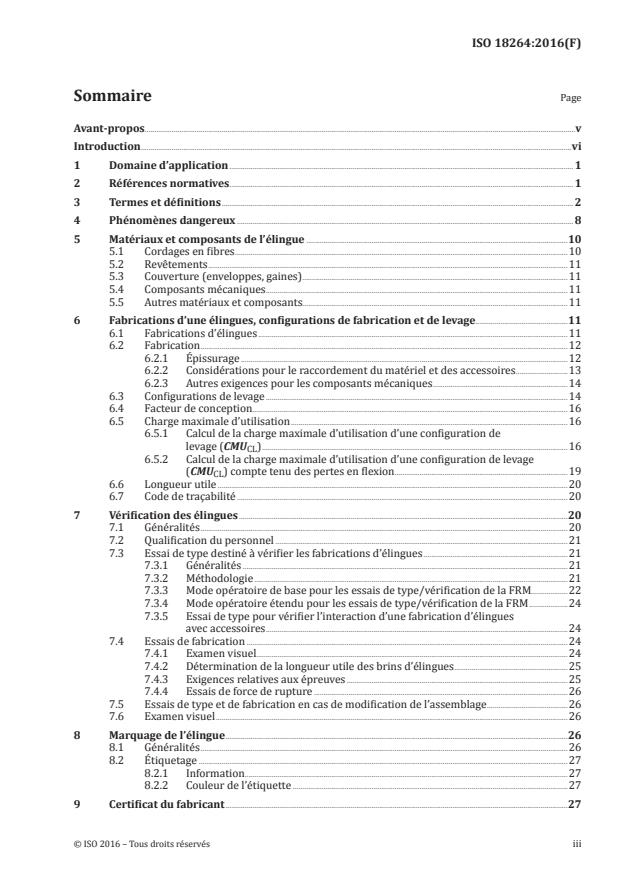
Sommaire Page
Avant-propos .v
Introduction .vi
1 Domaine d’application . 1
2 Références normatives . 1
3 Termes et définitions . 2
4 Phénomènes dangereux . 8
5 Matériaux et composants de l’élingue .10
5.1 Cordages en fibres .10
5.2 Revêtements .11
5.3 Couverture (enveloppes, gaines) .11
5.4 Composants mécaniques .11
5.5 Autres matériaux et composants.11
6 Fabrications d’une élingues, configurations de fabrication et de levage.11
6.1 Fabrications d’élingues .11
6.2 Fabrication .12
6.2.1 Épissurage .12
6.2.2 Considérations pour le raccordement du matériel et des accessoires .13
6.2.3 Autres exigences pour les composants mécaniques .14
6.3 Configurations de levage .14
6.4 Facteur de conception .16
6.5 Charge maximale d’utilisation .16
6.5.1 Calcul de la charge maximale d’utilisation d’une configuration de
levage (CMU ) .16
CL
6.5.2 Calcul de la charge maximale d’utilisation d’une configuration de levage
(CMU ) compte tenu des pertes en flexion .19
CL
6.6 Longueur utile .20
6.7 Code de traçabilité .20
7 Vérification des élingues .20
7.1 Généralités .20
7.2 Qualification du personnel .21
7.3 Essai de type destiné à vérifier les fabrications d’élingues .21
7.3.1 Généralités .21
7.3.2 Méthodologie .21
7.3.3 Mode opératoire de base pour les essais de type/vérification de la FRM.22
7.3.4 Mode opératoire étendu pour les essais de type/vérification de la FRM .24
7.3.5 Essai de type pour vérifier l’interaction d’une fabrication d’élingues
avec accessoires .24
7.4 Essais de fabrication .24
7.4.1 Examen visuel.24
7.4.2 Détermination de la longueur utile des brins d’élingues .25
7.4.3 Exigences relatives aux épreuves .25
7.4.4 Essais de force de rupture .26
7.5 Essais de type et de fabrication en cas de modification de l’assemblage .26
7.6 Examen visuel .26
8 Marquage de l’élingue .26
8.1 Généralités .26
8.2 Étiquetage .27
8.2.1 Information.27
8.2.2 Couleur de l’étiquette .27
9 Certificat du fabricant .27
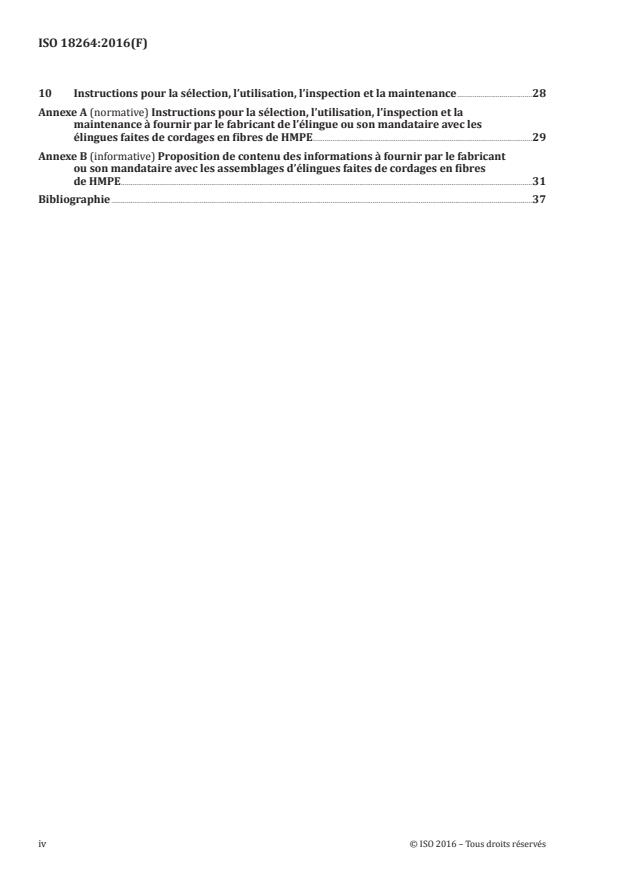
10 Instructions pour la sélection, l’utilisation, l’inspection et la maintenance .28
Annexe A (normative) Instructions pour la sélection, l’utilisation, l’inspection et la
maintenance à fournir par le fabricant de l’élingue ou son mandataire avec les
élingues faites de cordages en fibres de HMPE .29
Annexe B (informative) Proposition de contenu des informations à fournir par le fabricant
ou son mandataire avec les assemblages d’élingues faites de cordages en fibres
de HMPE .31
Bibliographie .37
iv © ISO 2016 – Tous droits réservés
Avant-propos
L’ISO (Organisation internationale de normalisation) est une fédération mondiale d’organismes
nationaux de normalisation (comités membres de l’ISO). L’élaboration des Normes internationales est
en général confiée aux comités techniques de l’ISO. Chaque comité membre intéressé par une étude
a le droit de faire partie du comité technique créé à cet effet. Les organisations internationales,
gouvernementales et non gouvernementales, en liaison avec l’ISO participent également aux travaux.
L’ISO collabore étroitement avec la Commission électrotechnique internationale (IEC) en ce qui
concerne la normalisation électrotechnique.
Les procédures utilisées pour élaborer le présent document et celles destinées à sa mise à jour sont
décrites dans les Directives ISO/IEC, Partie 1. Il convient, en particulier de prendre note des différents
critères d’approbation requis pour les différents types de documents ISO. Le présent document a été
rédigé conformément aux règles de rédaction données dans les Directives ISO/IEC, Partie 2 (voir www.
iso.org/directives).
L’attention est appelée sur le fait que certains des éléments du présent document peuvent faire l’objet de
droits de propriété intellectuelle ou de droits analogues. L’ISO ne saurait être tenue pour responsable
de ne pas avoir identifié de tels droits de propriété et averti de leur existence. Les détails concernant
les références aux droits de propriété intellectuelle ou autres droits analogues identifiés lors de
l’élaboration du document sont indiqués dans l’Introduction et/ou dans la liste des déclarations de
brevets reçues par l’ISO (voir www.iso.org/brevets).
Les appellations commerciales éventuellement mentionnées dans le présent document sont données
pour information, par souci de commodité, à l’intention des utilisateurs et ne sauraient constituer un
engagement.
Pour une explication de la signification des termes et expressions spécifiques de l’ISO liés à l’évaluation
de la conformité, ou pour toute information au sujet de l’adhésion de l’ISO aux principes de l’Organisation
mondiale du commerce (OMC) concernant les obstacles techniques au commerce (OTC), voir le lien
suivant: www.iso.org/iso/fr/avant-propos.html
Le comité chargé de l’élaboration du présent document est l’ISO/TC 38, Textiles.
Introduction
La présente Norme internationale a été élaborée pour être une norme fournissant un moyen de se
conformer aux exigences essentielles de sécurité.
vi © ISO 2016 – Tous droits réservés
NORME INTERNATIONALE ISO 18264:2016(F)
Élingues textiles — Élingues de levage pour opérations
de levage pour usage général en cordages en fibres —
Polyéthylène à haut module (HMPE)
1 Domaine d’application
La présente Norme internationale spécifie les exigences relatives à la sécurité, y compris les méthodes
de classification et d’essai des fabrications d’élingues à deux boucles et sans fin utilisées pour des
configurations de levage à un seul (1) brin, deux (2) brins, trois (3) brins ou quatre (4) brins (avec ou
sans accessoires). Ces fabrications d’élingues sont réalisées en cordages tressés à 8 torons (type L), en
cordages tressés à 12 torons (type T), fabrication de cordage avec couverture (type C) conformément à
l’ISO 10325. Sinon, d’autres fabrication de cordages toronnés ou tressés autres que ceux de l’ISO 10325,
mais soumis à l’essai conformément à l’ISO 2307, peuvent être utilisés. La présente Norme internationale
est applicable à tous les cordages fabriqués en fibre de polyéthylène à haut module [HMPE, aussi appelé
polyéthylène de masse molaire très élevée (UHMWPE)] ayant un numéro de référence minimum de 12
et un numéro de référence maximum de 72, même s’il n’existe pas de lien direct entre les numéros de
référence des cordages et le type d’opérations de levage, ni les opérations de levage d’usage général ou
spéciales.
Les parties des fabrications porteuses tressées de telles élingues, ou l’ensemble de l’élingue, peuvent
être contenues dans une couverture/gaine/enveloppe de protection. La couverture/gaine/enveloppe de
protection est conçue pour ne pas être porteuse car elle est destinée uniquement à protéger et contenir
l’âme portante.
Les élingues en cordages en fibres couvertes par la présente Norme internationale sont destinées
uniquement à des opérations de levage d’usage général, c’est-à-dire quand elles sont utilisées pour
le levage d’objets, de matériaux ou de marchandises qui ne nécessitent aucun écart par rapport aux
exigences, aux facteurs de sécurité, aussi appelés facteurs de conception, ou limites spécifiées de charge
de travail.
Les opérations de levage non couvertes par la présente Norme internationale devraient inclure le levage
de personnes, de matériaux potentiellement dangereux tels que le métal fondu et les acides, les feuilles
de verre, les matières fissiles, les réacteurs nucléaires et les opérations de levage spéciales.
La présente Norme internationale traite des exigences techniques visant à réduire au minimum les
phénomènes dangereux listés à l’Article 4 qui peuvent survenir pendant l’utilisation des élingues en
cordages en fibres conformément aux instructions et aux spécifications données par le fabricant, son
mandataire ou une personne qualifiée et/ou compétente.
2 Références normatives
Les documents suivants, en tout ou partie, sont référencés de façon normative dans le présent document
et sont indispensables à son application. Pour les références datées, seule l’édition citée s’applique.
Pour les références non datées, la dernière édition du document de référence s’applique (y compris les
éventuels amendements).
ISO 1968, Cordages en fibres et articles de corderie — Vocabulaire
ISO 2076, Textiles — Fibres chimiques — Noms génériques
ISO 2262, Cosses d’usages courants destinées à être utilisées avec des câbles en acier — Spécifications
ISO 2307, Cordages en fibres — Détermination de certaines caractéristiques physiques et mécaniques
ISO 2415, Manilles forgées pour levage — Manilles droites et manilles lyres
ISO 7500-1, Matériaux métalliques — Étalonnage et vérification des machines pour essais statiques
uniaxiaux — Partie 1: Machines d’essai de traction/compression — Étalonnage et vérification du système
de mesure de force
ISO 7597, Crochets de levage forgés en acier avec loquet, classe 8
ISO 8539, Accessoires de levage en acier forgé pour utilisation avec des chaînes de Classe 8
ISO 10325, Cordages en fibres — Polyéthylène à haut module — Cordages 8 torons, cordages 12 torons et
cordages avec couverture
ISO 12100:2010, Sécurité des machines — Principes généraux de conception — Appréciation du risque et
réduction du risque
ISO 12480-1, Appareils de levage à charge suspendue — Sécurité d’emploi — Partie 1: Généralités
ISO 16798, Mailles de classe 8 pour utilisation avec élingues
3 Termes et définitions
Pour les besoins du présent document, les termes et définitions donnés dans l’ISO 1968 ainsi que les
suivants s’appliquent.
3.1
conditions d’utilisation anormales
conditions environnementales qui sont défavorables, nocives ou préjudiciables au ou pour le
fonctionnement des assemblages d’élingues, telles qu’une température ambiante excessivement élevée,
une exposition aux produits chimiques, des atmosphères chargées de poussières et des emplacements
dangereux
3.2
abrasion
usure mécanique d’une surface résultant d’un contact par frottement avec d’autres matériaux et objets
3.3
angle de la bague
α
BAGUE
angle formé dans le corps d’une élingue qui passe à travers le nœud de la bague ou des accessoires
Note 1 à l’article: Voir la Figure 1 et la Figure 4.
Légende
1 α
BAGUE
Figure 1 — Exemple d’angle de la bague
2 © ISO 2016 – Tous droits réservés
3.4
angle de chargement
angle horizontal
α
angle formé par le brin d’élingue et la ligne horizontale
Note 1 à l’article: Voir la Figure 2.
Légende
β angle verticale
α angle de chargement
Figure 2 — Exemple d’angle de chargement
3.5
personne compétente
personne désignée, correctement formée et qualifiée par ses connaissances et son expérience pratique
et ayant reçu les instructions nécessaires pour lui permettre de réaliser les essais et examens requis
3.6
facteur de conception
FC
rapport de la charge maximale et la charge nominale de la fabrication d’élingues (3.26)
Note 1 à l’article: Aussi appelé facteur de sécurité (FS) comme défini dans l’ISO 1968.
Note 2 à l’article: Les accessoires peuvent avoir des facteurs de conception différents de ceux du cordage auquel
ils sont reliés.
Note 3 à l’article: Ce terme a la même signification que le terme «coefficient d’utilisation» ou «facteur de sécurité»
utilisé dans la Directive Machines UE.
3.7
longueur utile
L
U
longueur finie réelle de la fabrication d’élingue en cordage en fibre, accessoires compris, de point
porteur à point porteur
Note 1 à l’article: Voir longueur nominale (3.20).
3.8
opération de levage d’usage général
opération aussi appelée levages courants ou opérations de levage courantes et, par opposition à
[6]
l’opération de levage spéciale, peut être identifiée et décrite comme étant celle qui
— est couverte par une évaluation du risque d’une activité (ERA) (3.14),
— peut ne pas nécessiter un nouveau plan de levage (PL) (3.16),
— est l’opération/le levage pour lequel (laquelle) un plan de levage (PL) peut être générique, mais qu’il
convient de toujours revoir avant l’opération,
— est une opération/un levage répétitif(ve) connu(e), familier(familière) pour la personne compétente
(3.5) et/ou qualifiée ou l’équipe de levage,
— est un levage répétitif qui est couvert par une ERA et un PL préparés au préalable, qu’il convient
cependant de revoir par une personne compétente et/ou qualifiée,
— pour laquelle l’équipe de levage identifiée est formée à l’utilisation des dispositifs/équipements de
levage spécifiques et familiarisée à leurs avantages et limites et compétente pour réaliser l’opération
dans son intégralité,
— pour laquelle la personne qualifiée et/ou compétente ou l’équipe de levage a assumé ce rôle
précédemment,
— pour lesquelles l’ensemble du personnel impliqué est familier avec l’ERA et le PL rédigés pour
l’opération en cours de réalisation, et
— pour laquelle le PL est vérifié en tant que document actuel avant l’opération
3.9
élingage en panier
méthode de gréement d’une élingue dans laquelle l’élingue est passée autour de la charge et les deux
boucles et accessoires d’extrémité sont attachées au dispositif de levage
Note 1 à l’article: Voir la Figure 3.
Figure 3 — Exemple d’élingage en panier
4 © ISO 2016 – Tous droits réservés
3.10
élingage en nœud coulant
méthode de gréement d’une élingue dans laquelle l’élingue est passée autour de la charge, puis à travers
une boucle, un accessoire d’extrémité, ou autre dispositif, l’autre boucle ou accessoire d’extrémité étant
attaché au dispositif de levage
Note 1 à l’article: Cet élingage (3.11) peut être réalisé avec un crochet coulissant ou un dispositif similaire (voir la
Figure 4).
Figure 4 — Exemple d’élingage en nœud coulant
3.11
élingage
méthode de gréement (attachement) d’une ou plusieurs élingues temporairement à une charge ou un
objet à des fins de levage
3.12
élingage vertical
méthode de gréement d’une élingue dans laquelle la charge est attachée à la boucle ou accessoire
d’extrémité à une extrémité de l’élingue et la boucle ou accessoire d’extrémité à l’autre extrémité est
attachée au dispositif de levage
Note 1 à l’article: N’importe quel élingage (3.11) de moins de 5° par rapport à la verticale (β à la Figure 2) peut
être considéré comme un élingage vertical (voir la Figure 5).
Figure 5 — Exemple d’élingage vertical
3.13
maille de tête intermédiaire
maille utilisée pour connecter un ou deux brins d’une élingue à une maille de tête (3.17)
Note 1 à l’article: Les mailles intermédiaires peuvent être assemblées avec une maille de tête pour former une
maille de tête permanente.
3.14
évaluation du risque d’une activité
ERA
processus au cours duquel:
— les phénomènes dangereux pour la santé et la sécurité sont identifiés,
— les risques associés aux phénomènes dangereux sont analysés et évalués, et
— les moyens appropriés pour éliminer ou maîtriser ces phénomènes dangereux sont déterminés
Note 1 à l’article: En termes pratiques, une évaluation du risque est un examen complet sur le lieu de travail
visant à identifier ces éléments, situations, processus, etc. susceptibles d’être préjudiciables, notamment pour
les personnes. Une fois l’identification réalisée, l’utilisateur des élingues évalue la probabilité et la gravité du
risque, puis décide des mesures qu’il convient de mettre en place pour empêcher ou maîtriser de façon efficace la
survenue d’un tel préjudice. Le résultat de ce processus est documenté par l’utilisateur des élingues sous forme
d’évaluation du risque d’une activité (ERA).
3.15
configuration de levage
condition spéciale (mode de levage) à laquelle un assemblage d’élingues (3.24) est soumis lorsqu’il est
attaché simultanément à une charge suspendue et à un mécanisme de levage
Note 1 à l’article: La configuration de levage est caractérisée par le nombre de brins d’élingue dans l’assemblage
de levage, l’angle de chargement (3.4) sous lequel ils se propagent et dans lequel l’assemblage de levage est relié à
la charge suspendue. Dans le cadre du matériel supplémentaire de disposition de gréement, tels que, par exemple
des mailles de tête (intermédiaires), des manilles et barres d’écartement, peuvent être utilisés.
3.16
plan de levage
PL
plan documenté de l’opération de levage envisagée couvrant des aspects tels que les suivants:
— caractérisation de la charge en termes de dimensions, de poids et de centre de gravité;
— caractérisation de la tâche en termes de levage, de rotation, de vitesse et de directions de déplacement;
— évaluation des phénomènes dangereux afin de déterminer les conséquences résultant de la collision,
du renversement ou de la chute de la charge suspendue;
— détermination du mode de gréement de la charge au moyen de bonnes pratiques de gréement et en
s’assurant de l’utilisation de techniques de gréement appropriées pendant le levage;
— assurance que les points d’attache et la charge suspendue peuvent supporter les efforts créés par la
fixation du matériel de gréement;
— sélection de l’équipement et du gréement en fonction du type, de la catégorie de levage et de la
capacité minimale de l’équipement de levage (palan, grue, élingues, installation de levage, etc.) et de
la charge, la tâche et les phénomènes dangereux identifiés;
— assurance que les angles des élingues sont pris en considération lors de la détermination des efforts
sur l’équipement de gréement et la charge suspendue
6 © ISO 2016 – Tous droits réservés
3.17
maille de tête
maille constituant la borne supérieure d’une élingue ou d’une maille de tête intermédiaire (3.13) aux
moyens de laquelle l’élingue est fixée au crochet d’une grue ou autre appareil de levage
3.18
élingues multibrins
assemblage d’élingues (3.24) comprenant plusieurs (deux, trois ou quatre) brins identiques dont les
extrémités supérieures sont assemblées par un accessoire qui se place sur le crochet de levage
Note 1 à l’article: Aussi appelé élingue à bride
EXEMPLE Des exemples sont donnés dans les Figures 9 à 11.
3.19
diamètre nominal
d
CORDAGE
diamètre spécifié du cordage qui est généralement utilisé comme numéro de référence d’un produit donné
3.20
longueur nominale
L
N
longueur spécifiée du brin de l’élingue, accessoires compris, de point porteur à point porteur
Note 1 à l’article: Voir les Figures 6 et 7.
3.21
force d’épreuve
F
p
force appliquée à titre d’essai à un assemblage d’élingues (3.26) finie, telle que spécifiée dans
l’épreuve (3.22)
Note 1 à l’article: Aussi appelée «charge d’épreuve».
3.22
épreuve
essai de force (ou charge) non destructif réalisé à une force d’épreuve (3.21) (ou charge) prédéfinie d’une
fabrication d’élingues (3.26)
3.23
force nominale
F
N
tension maximale admissible d’un assemblage d’élingues (3.26)
Note 1 à l’article: Aussi appelée charge nominale.
Note 2 à l’article: Exprimée en kN.
3.24
assemblage d’élingues
un ou plusieurs brins d’élingue/fabrication d’élingues (3.26) combiné(s) à un matériel de gréement (tels
que, par exemple, mailles, manilles, cosses) à utiliser dans le cadre de disposition de gréement dans le
but de soulever une charge
3.25
corps d’élingue
cordage en fibres utilisé en tant qu’élément porteur pour créer un assemblage d’élingues (3.24)
3.26
fabrication d’élingues
fabrication à deux boucles (voir la Figure 6) ou sans fin (voir la Figure 7) d’un cordage en fibres utilisé
pour créer un assemblage d’élingues (3.24)
Note 1 à l’article: Aussi appelée brin d’élingue.
3.27
fabricant d’élingue
personne ou entreprise procédant à l’assemblage ou à la fabrication des composants d’une élingue dans
leur forme finale
Note 1 à l’article: Le fabricant de l’élingue et du cordage ne sont pas nécessairement des entités identiques.
3.28
boucle souple
boucle réalisée en repliant l’extrémité du cordage en fibres dans une boucle et en épissant l’extrémité
du brin mort dans le brin vif
3.29
opérations de levage spéciales
opération qui ne satisfont pas à tous les critères relatifs aux opérations de levage d’usage général (3.8) et
[10]
qui sont des opérations de levage où
— une évaluation du risque de l’activité (ERA) (3.14) est requise afin d’identifier et de limiter les risques,
et un plan de levage (PL) (3.16) complet est requis, et
— un nouveau plan de levage (PL) spécifique est requis sur la base d’une évaluation du risque
Note 1 à l’article: Aussi appelé levages non courants ou opérations de levage mécanisées.
3.30
épissure
boucle, ou nœud, formé(e) à l’extrémité d’un cordage en fibres ou connexion de deux extrémité pour
créer une connexion sans fin en faisant repasser l’extrémité des torons dans le corps principal du
cordage en fibres suivant une méthode spécifiée
3.31
charge maximale d’utilisation de la configuration de levage
CMU
CL
masse totale suspendue maximale admissible qu’une configuration de levage (3.15) est autorisée à
supporter dans le cadre d’opérations de levage d’usage général (3.8)
Note 1 à l’article: Exprimée en t.
4 Phénomènes dangereux
La libération accidentelle d’une charge suspendue, ou la libération d’une charge suspendue due à la
défaillance d’un composant met en danger, directement ou indirectement, la sécurité ou la santé des
personnes présentes dans la zone dangereuse. Afin de fournir la résistance et la durabilité nécessaires
des accessoires de levage, la présente Norme internationale spécifie les exigences relatives à la
conception, à la fabrication, aux essais, à l’utilisation et à la maintenance, pour s’assurer que les niveaux
de performance spécifiés sont satisfaits.
La fatigue/durabilité n’a pas été identifiée comme étant un risque lorsque les élingues en cordages en
fibres, correctement conçues et fabriquées, constituées de fibre de HMPE haute ténacité et ayant les
niveaux de performance spécifiés, donnés dans la présente Norme internationale, sont correctement
utilisées et inspectées pour des opérations de levage d’usage général.
8 © ISO 2016 – Tous droits réservés
La rupture pouvant avoir pour origine une surcharge ou une sélection incorrecte de la limite de charge
d’utilisation (CMU) et des spécifications des accessoires de levage, la présente Norme internationale
fixe également les exigences relatives au marquage et au certificat du fabricant.
Les aspects relatifs à la sélection et à la sécurité d’utilisation associés aux bonnes pratiques sont donnés
dans l’Annexe A et l’Annexe B.
Le Tableau 1 liste ces phénomènes dangereux, obtenus à partir de l’ISO 12100:2010, dans la mesure où
ils sont traités par la présente Norme internationale qui nécessitent des mesures permettant de réduire
ces phénomènes dangereux identifiés comme spécifiques et significatifs pour les élingues en cordages
en fibre de HMPE.
Il est connu que les fibres de HMPE sont sujettes au fluage, comme la plupart des fibres synthétiques,
ce qui, sous certaines conditions, peut entraîner une rupture par fluage. Sous une charge constante,
les fibres et cordages en HMPE ont un comportement de déformation (fluage) irréversible qui dépend
[10]
fortement de la charge et de la température, ainsi que du type de fibre de HMPE. Les différentes
fibres de HMPE affichent différents comportements de fluage dans des conditions identiques.
En fonction des conditions dans lesquelles les élingues sont destinées à être utilisées, l’utilisateur de
l’élingue doit consulter le fabricant de l’élingue afin de sélectionner la conception appropriée.
Tableau 1 — Type ou groupe de phénomènes dangereux et exigences associées relatives à leur
limitation
Exemples de phénomènes dangereux Exigences relatives à la
Type ou groupe de limitation des phé-
phénomènes dange- nomènes dangereux
reux et paragraphe(s) dans le(s) article(s)/
b) Conséquences
correspondant(s) de paragraphe(s)
a) Origine
potentielles
l’ISO 12100:2010; établi approprié(s) corres-
à partir du Tableau B.1 pondants de la présente
Norme internationale
Erreur/comportement hu-
Phénomènes dangereux
main, éducation et formation,
mécaniques:
documentation, planification,
Renversement, écrase-
parties coupantes, chute
6.1, 6.2.1, 6.2.2.1, 6.2.2.2,
ment, coupure, abrasion, 5, 6, 7, 8, 9, 10, An-
d’objets, instabilité, surfaces
6.2.3 a) et b), 6.2.6, 6.3.1,
perforation, bascule- nexes A et B
rugueuses, angles vifs, choc à
6.3.2, 6.3.3, 6.3.4.3,
ment, surcharge, chute.
la mise en charge, marquage
6.3.5.5, 6.4.1, 6.4.2, 6.4.3,
de l’élingue incorrect ou
6.4.4, 6.4.5
absent, manutention.
Phénomènes dangereux
Erreur/comportement hu-
thermiques:
main, éducation et formation,
documentation, planification, Fonte, brûlure, chute… Annexe B
6.1, 6.2.2.2, 6.2.3, 6.2.6,
rayonnement de sources ther-
6.3.2.1, 6.3.4.5, 6.4.5.1 a),
miques, vibrations.
b), d) et e)
Phénomènes dangereux
Erreur/comportement hu-
liés à l’environnement
main, éducation et formation,
dans lequel la machine
documentation, planification, Coupure, abrasion, per-
4, 5, 9, 10, Annexe B
est utilisée:
poussière, pollution, compo- foration, chute.
sants chimiques, température,
6.1, 6.2.6, 6.3.2.1, 6.4.5.1
manutention.
a) et b)
Combinaison de phéno-
Combinaison des consé-
mènes dangereux:
Combinaison des origines 5, 6, 7, 8, 9, 10, An-
quences mentionnées
mentionnées ci-dessus nexes A et B
Ensemble des éléments
ci-dessus
ci-dessus
a
Une seule origine d’un phénomène dangereux peut avoir plusieurs conséquences potentielles.
b
Pour chaque type de phénomène dangereux ou groupe de phénomènes dangereux, certaines conséquences potentielles
peuvent être reliées à plusieurs origines de phénomène dangereux.
5 Matériaux et composants de l’élingue
5.1 Cordages en fibres
Les matériaux des cordages en fibre couverts par la présente Norme internationale pour une utilisation
des assemblages d’élingues sont les fibres de polyéthylène à haut module (HMPE) telles que définies
dans l’ISO 2076.
Les fabrications de cordages en HMPE couvertes dans la présente Norme internationale sont les
suivants:
— les cordages tressés à 8 torons (type L), les cordages tressés à 12 torons (type T) et les fabrications
de cordages avec couverture (type C) fabriqués et soumis à essai conformément à l’ISO 2307 et à
l’ISO 10325;
— les fabrications de cordages toronnés et tressés autres que ceux de l’ISO 10325, fabriqués et soumis
à essai conformément à l’ISO 2307.
10 © ISO 2016 – Tous droits réservés
5.2 Revêtements
Les finitions et revêtements ne doivent pas nuire aux performances de la fabrication de l’élingue.
NOTE 1 Un ensimage de fibre est généralement appliqué à la fibre de base après création des filaments
individuels, mais avant l’enroulage des mèches ou pendant la torsion ou l’assemblage. Un revêtement peut être
appliqué pendant la production du cordage ou de l’élingue, ou par la suite sur l’élingue finie au cours d’une
autre étape.
NOTE 2 Des revêtements peuvent être appliqués afin d’améliorer les performances dans les quatre domaines
principaux suivants:
— amélioration structurelle telles que, entre autres, résistance (variabilité), rigidité de la forme, protection
environnementale (chimiques par exemple) et glissement de la couverture;
— optimisation des épissures (frottement par exemple);
— abrasion/fatigue (par exemple, entre autres, fatigue en traction et en flexion);
— additifs fonctionnels (tels que, entre autres, couleur, résistance aux UV, ignifugation et promotion de
l’adhérence).
NOTE 3 Les différentes parties de la fabrication d’élingues peuvent nécessiter différentes propriétés de
frottement et caractéristiques de revêtement.
5.3 Couverture (enveloppes, gaines)
Lorsque le ou les brin(s) en sont pourvues, les couvertures enveloppant en partie ou en totalité le
cordage en fibres doivent offrir une protection appropriée contre l’abrasion et les coupures pendant le
stockage, la manutention et l’utilisation de la fabrication/l’assemblage des élingues lors de l’opération
de levage.
Les bords de la couverture doivent être finis de sorte qu’ils ne puissent pas s’effilocher ni nuire aux
performances de l’âme portante de l’élingue.
NOTE Le type de matériau(x) des fibres utilisé(s) dans la couverture dépend des exigences de performance
et des risques potentiels (abrasion, coupure, perforation, exposition à des produits chimiques, etc.) à limiter.
5.4 Composants mécaniques
Les composants mécaniques, tels que les cosses, manilles, axes, accessoires et mailles (de tête), utilisés
comme partie intégrante d’une fabrication d’élingues en cordage de fibres doivent être sélectionnés de
manière à être compatibles avec la fabrication d’élingues en cordage de fibres, à satisfaire aux exigences
et à ne pas nuire aux performances de la fabrication d’élingues (voir 6.2.3).
5.5 Autres matériaux et composants
Des matériaux et composants autres que ceux répertoriés en 5.4 peuvent être employés. Lorsque de
tels matériaux sont employés, le fabricant de l’élingue, son mandataire ou une personne qualifiée et/ou
compétente doit fournir des données justificatives afin de réduire le plus possible les phénomènes
dangereux et de démontrer que ces assemblages d’élingues sont conformes à toutes les autres exigences
de la présente Norme internationale.
6 Fabrications d’une élingues, configurations de fabrication et de levage
6.1 Fabrications d’élingues
Une fabrication à deux boucles doit être formé à partir d’une seule longueur de cordage en fibres et
doit posséder des boucles épissées à chaque extrémité, avec ou sans cosses et accessoires. La Figure 6
illustre trois exemples types de ce type de fabrication.
Légende
L longueur nominale de l’élingue
N
Figure 6 — Fabrication d’élingues — Fabrications type à deux boucles
Une fabrication sans fin doit être formée de préférence à partir d’une seule longueur de cordage en
fibres et doit avoir les extrémités jointes ensemble par une épissure. La Figure 7 illustre un exemple
type de fabrication sans fin.
Légende
L longueur nominale de l’élingue
N
Figure 7 — Fabrication d’élingues — Fabrication type à deux boucles
La fabrication de l’assemblage d’élingues, y compris les écarts par rapport aux méthodes de fabrication,
doivent être vérifiées et documentées par le fabricant de l’élingue conformément à la présente Norme
internationale.
Les fabrications d’élingues, utilisés dans les assemblages d’élingues multibrins, doivent être fabriqués
de sorte que tous les composants correspondants soient identiques en termes de fabrication du cordage,
de taille, de matériau et d’accessoires/mailles.
6.2 Fabrication
6.2.1 Épissurage
L’épissurage est la méthode couramment utilisée dans la fabrication d’élingues à deux boucles ou sans
fin. Toutes les épissures doivent être effectuées par un épisseur formé et compétent conformément aux
instructions d’épissurage documentées fournies par le fabricant de l’élingue, son mandataire ou une
personne compétente. Des échantillons de ces épissures doivent être au préalable créés conformément
aux exigences de l’application et ayant satisfait aux essais conformément à l’Article 7.
12 © ISO 2016 – Tous droits réservés
D’autre part, les points suivants doivent être observés:
— dans une fabrication type à deux boucles, aucune épissure autre que celles requises pour former une
boucle ne doit être autorisée;
— la fabrication d’élingues sans fin doit de préférence ne posséder qu’une seule épissure;
— lorsque les parties saillantes des torons dans une épissure sont retenues, par exemple par
entrelacement, collage, effilement, etc., pour améliorer aspect de l’épissure finie, une telle finition
ne doit pas affecter la performance de l’épissure;
— la fabrication d’élingues à deux boucles doivent avoir une longueur de cordage minimale au repos
égale à dix 10 fois le numéro de référence du cordage entre l’extrémité des épissures; les écarts
doivent être vérifiés et documentés conformément à l’Article 7 de la présente Norme internationale;
— des nœuds, colliers ou brides ne doivent pas être utilisés pour fabriquer des élingues;
— si les cosses n’ont pas de pattes pour empêcher la rotation, elles doivent être saisies sur le cordage.
Des cosses doivent être utilisées dans les élingues chaque fois que nécessaire, et installées de
manière à empêcher la cosse de tourner à l’intérieur de la boucle ou de tomber de la boucle.
La méthodologie d’épissurage pour n’importe quelle fabrication d’élingues doit être définie et
documentée par le fabricant de l’élingue.
6.2.2 Considérations pour le raccordement du matériel et des accessoires
6.2.2.1 Fabrications d’élingue à deux boucles
En conception, la longueur intérieure minimale (L ) d’une boucle souple pour une fabrication
BOUCLE
d’élingues à deux boucles, mesurée à l’aide d’un ruban ou d’une règle d’acier gradués au millimètre, est
donnée ci-dessous. Les écarts doivent être documentés et vérifiés conformément à l’Article 7.
Figure 8 — Dimensions d’une boucle souple
Règles de conception:
— D /d ≥ 2; sans jamais être < 1;
MAT CORDAGE
— L /D ≥ 3, ou α ≤ 20°;
BOUCLE MAT CORDAGE
où
D est le diamètre du matériel (axe, manille, tourillon ou accessoire) utilisé pendant les essais
MAT
de type et l’utilisation
d est le numéro de référence du cordage en fibres;
CORDAGE
L est la longueur de la boucle;
BOUCLE
α est l’angle entre deux brins de la boucle.
CORDAGE
6.2.2.2 Fabrications d’élingues sans fin
Le rapport recommandé D /d pour une fabrication d’élingues sans fin est de préférence
MAT CORDAGE
égal à 3 sans jamais être inférieur à 1. Les écarts doivent être documentés et vérifiés conformément à
l’Article 7 de la présente Norme internationale.
6.2.3 Autres exigences pour les composants mécaniques
Les composants mécaniques utilisés comme parties intégrantes d’une fabrication d’élingues et/ou d’un
assemblage d’élingues doivent être sélectionnés de façon à satisfaire aux exigences suivantes:
a) le caractère approprié des accessoires mécaniques ou emboîtés doit être vérifié par une personne
compétente;
b) le matériau doit être compatible avec les exigences mécaniques et environnementales imposées sur
et par la fabrication d’élingues et/ou l’assemblage d’élingues. La maille de tête doit être conforme à
l’ISO 16798. Les autres matériels de gréement, lorsqu’ils sont utilisés, doivent être forgés et doivent
remplir les exigences générales conformément à l’ISO 8539;
c) les crochets fermés doivent être conformes à l’ISO 7597, et les manilles conformes à l’ISO 2415;
d) les cosses doivent être conformes à l’ISO 2262 ou une autre norme nationale applicable.
Le diamètre, la largeur et la rugosité de la surface portante de l’accessoire/maille peuvent (gravement)
affecter la résistance de la fabrication ou l’assemblage de l’élingue. Ainsi, une cosse, ou des boucles
renforcées, sont recommandées.
La largeur naturelle d’aplatissement, aussi appelée largeur intérieure réelle, du cordage doit être égale,
ou de préférence inférieure, à la largeur intérieure utile du composant mécanique.
6.3 Configurations de levage
Dans le cadre des opérations de levage d’usage général, les fabrications d’él
...
Questions, Comments and Discussion
Ask us and Technical Secretary will try to provide an answer. You can facilitate discussion about the standard in here.
Loading comments...