

SIST EN 15947-5:2022
(Main)Pyrotechnic articles - Fireworks, Categories F1, F2 and F3 - Part 5: Requirements for construction and performance
General Information
- Abstract
This document specifies requirements for construction and performance of firework and primary packs and selection packs. It is applicable to firework of the categories F1, F2 and F3 as defined by Article 6 Paragraph (1) clause (a) subclause (i) to (iii) of Directive 2013/29/EU.
This document is not applicable for fireworks containing detonative explosives other than black powder or flash composition or pyrotechnic composition that includes any of the following substances:
- arsenic or arsenic compounds;
- hexachlorobenzene;
- lead or lead compounds;
- mixtures containing a mass fraction of chlorates greater than 80 %;
- mixtures of chlorates with metals;
- mixtures of chlorates with red phosphorus (except when used in Christmas crackers, party poppers or snaps);
- mixtures of chlorates with potassium hexacyanoferrate (II);
- mixtures of chlorates with sulphur (these mixtures are allowed for friction heads only);
- mixtures of chlorates with sulphides;
- mercury compounds;
- nitrocellulose with a mass fraction of nitrogen of more than 12,6 %.
- picrates or picric acid;
- potassium chlorate with a mass fraction of bromates greater than 0,15 %;
- sulphur with an acidity, expressed in mass fraction of sulphuric acid, greater than 0,002 %;
- white phosphorus;
- zirconium with a particle size of less than 40 µm.
This document does not apply to fireworks intended to be kept or used at temperatures below −20 °C or above 50 °C.
- Status
- Published
- Public Enquiry End Date
- 01-Nov-2018
- Publication Date
- 19-Oct-2022
- Technical Committee
- IEKS - Explosives
- Current Stage
- 6060 - National Implementation/Publication (Adopted Project)
- Start Date
- 12-Oct-2022
- Due Date
- 17-Dec-2022
- Completion Date
- 20-Oct-2022

Overview
EN 15947-5:2022 - published by CEN - defines requirements for construction and performance of consumer fireworks (pyrotechnic articles) in categories F1, F2 and F3 as defined by Directive 2013/29/EU. The standard applies to individual fireworks and to primary packs and selection packs, and specifies type testing and batch testing procedures to verify safety, functioning and conformity with EU requirements. It supersedes EN 15947-5:2015 and was approved in October 2022.
Key topics and technical requirements
- Scope and applicability: Covers F1–F3 consumer fireworks; excludes articles containing detonative explosives other than black powder or flash compositions and those containing certain hazardous substances (see list below). Not applicable for intended use/storage temperatures below −20 °C or above 50 °C.
- Prohibited or restricted substances: The standard excludes pyrotechnic compositions containing:
- arsenic/arsenic compounds, hexachlorobenzene, lead/lead compounds
- mercury compounds, picrates/picric acid, white phosphorus
- nitrocellulose with nitrogen > 12.6 %
- mixtures with high chlorate content or chlorates combined with metals, red phosphorus, potassium hexacyanoferrate(II), sulphur (except friction heads), sulphides
- potassium chlorate with bromates > 0.15 %, sulphur with acidity > 0.002 %, zirconium < 40 µm particle size
- Construction requirements: Materials, dimensions (e.g., mini rockets), end-closure breakability, and permitted elements in batteries/combination fireworks are specified and verified by visual and type/batch testing.
- Means of initiation: Permitted initiators, protection, attachment and resistance to abrasion are detailed; requirements apply for type and batch tests.
- Performance testing: Procedures assess stability, angle and height of flight, principal effects, sound pressure, burning/incandescent matter, debris projection, extinguishing, and specific checks before/during/after functioning tests.
- Testing regime: Type testing and batch testing protocols are defined; sampling references ISO 2859-1 (AQL schemes). Labelling checks and certain measurement relaxations (e.g., batch sound measurement not required if type test values < 90 dB(A) at safety distance) are included.
- New additions (2022): New types such as “report rocket” (F3) and “senko-hanabi” (F1), requirements for hand‑held Bengal flame and bangers with preliminary effects, and other editorial/technical updates.
Applications and users
EN 15947-5:2022 is essential for:
- Fireworks manufacturers - design, material selection, product validation and CE conformity.
- Test laboratories and QC teams - performing type tests, batch inspection and sampling.
- Regulatory bodies and notified bodies - conformity assessment under Directive 2013/29/EU.
- Importers/Distributors and retailers - verifying pack compliance (primary/selection packs) and safe market placement.
- Product safety managers - integrating construction/performance limits into risk assessments.
Related standards
- EN 15947-1:2022 - Terminology
- EN 15947-2:2022 - Categories and types of firework
- EN 15947-3:2022 - Minimum labelling requirements
- EN 15947-4:2022 - Test methods
- ISO 2859-1:1999 - Sampling procedures (AQL)
Keywords: EN 15947-5:2022, pyrotechnic articles, fireworks F1 F2 F3, construction and performance, CEN, Directive 2013/29/EU, type testing, batch testing, primary pack, selection pack.
Relations
- Effective Date
- 12-Oct-2022
- Effective Date
- 29-Apr-2026
- Effective Date
- 29-Apr-2026
- Effective Date
- 09-Feb-2026
- Effective Date
- 28-Jan-2026
- Effective Date
- 28-Jan-2026
- Effective Date
- 28-Jan-2026
- Refers
SIST EN 16362:2014 - Railway applications - Ground based services - Water restocking equipment - Effective Date
- 28-Jan-2026
- Effective Date
- 28-Jan-2026
- Effective Date
- 28-Jan-2026
- Effective Date
- 28-Jan-2026
- Effective Date
- 29-Apr-2026
- Effective Date
- 01-Oct-2018
Get Certified
Connect with accredited certification bodies for this standard

ECOCERT
Organic and sustainability certification.

Eurofins Food Testing Global
Global leader in food, environment, and pharmaceutical product testing.

Intertek Bangladesh
Intertek certification and testing services in Bangladesh.
Sponsored listings
Frequently Asked Questions
SIST EN 15947-5:2022 is a standard published by the Slovenian Institute for Standardization (SIST). Its full title is "Pyrotechnic articles - Fireworks, Categories F1, F2 and F3 - Part 5: Requirements for construction and performance". This standard covers: This document specifies requirements for construction and performance of firework and primary packs and selection packs. It is applicable to firework of the categories F1, F2 and F3 as defined by Article 6 Paragraph (1) clause (a) subclause (i) to (iii) of Directive 2013/29/EU. This document is not applicable for fireworks containing detonative explosives other than black powder or flash composition or pyrotechnic composition that includes any of the following substances: - arsenic or arsenic compounds; - hexachlorobenzene; - lead or lead compounds; - mixtures containing a mass fraction of chlorates greater than 80 %; - mixtures of chlorates with metals; - mixtures of chlorates with red phosphorus (except when used in Christmas crackers, party poppers or snaps); - mixtures of chlorates with potassium hexacyanoferrate (II); - mixtures of chlorates with sulphur (these mixtures are allowed for friction heads only); - mixtures of chlorates with sulphides; - mercury compounds; - nitrocellulose with a mass fraction of nitrogen of more than 12,6 %. - picrates or picric acid; - potassium chlorate with a mass fraction of bromates greater than 0,15 %; - sulphur with an acidity, expressed in mass fraction of sulphuric acid, greater than 0,002 %; - white phosphorus; - zirconium with a particle size of less than 40 µm. This document does not apply to fireworks intended to be kept or used at temperatures below −20 °C or above 50 °C.
This document specifies requirements for construction and performance of firework and primary packs and selection packs. It is applicable to firework of the categories F1, F2 and F3 as defined by Article 6 Paragraph (1) clause (a) subclause (i) to (iii) of Directive 2013/29/EU. This document is not applicable for fireworks containing detonative explosives other than black powder or flash composition or pyrotechnic composition that includes any of the following substances: - arsenic or arsenic compounds; - hexachlorobenzene; - lead or lead compounds; - mixtures containing a mass fraction of chlorates greater than 80 %; - mixtures of chlorates with metals; - mixtures of chlorates with red phosphorus (except when used in Christmas crackers, party poppers or snaps); - mixtures of chlorates with potassium hexacyanoferrate (II); - mixtures of chlorates with sulphur (these mixtures are allowed for friction heads only); - mixtures of chlorates with sulphides; - mercury compounds; - nitrocellulose with a mass fraction of nitrogen of more than 12,6 %. - picrates or picric acid; - potassium chlorate with a mass fraction of bromates greater than 0,15 %; - sulphur with an acidity, expressed in mass fraction of sulphuric acid, greater than 0,002 %; - white phosphorus; - zirconium with a particle size of less than 40 µm. This document does not apply to fireworks intended to be kept or used at temperatures below −20 °C or above 50 °C.
SIST EN 15947-5:2022 is classified under the following ICS (International Classification for Standards) categories: 71.100.30 - Explosives. Pyrotechnics and fireworks. The ICS classification helps identify the subject area and facilitates finding related standards.
SIST EN 15947-5:2022 has the following relationships with other standards: It is inter standard links to SIST EN 15947-5:2016, SIST ISO 2859-1:2003/C1:2003, SIST ISO 2859-1:2003, SIST ISO 2859-1:2003/Amd 1:2020, SIST EN 196-1:1995, SIST EN 15947-1:2022, SIST EN 15947-3:2022, SIST EN 16362:2014, SIST EN 15947-4:2022, SIST EN 15947-2:2022, SIST EN 15947-4:2010, oSIST prEN 15947:2026, SIST EN 15947-5:2016. Understanding these relationships helps ensure you are using the most current and applicable version of the standard.
SIST EN 15947-5:2022 is associated with the following European legislation: EU Directives/Regulations: 2013/29/EU; Standardization Mandates: M/504, M/583. When a standard is cited in the Official Journal of the European Union, products manufactured in conformity with it benefit from a presumption of conformity with the essential requirements of the corresponding EU directive or regulation.
SIST EN 15947-5:2022 is available in PDF format for immediate download after purchase. The document can be added to your cart and obtained through the secure checkout process. Digital delivery ensures instant access to the complete standard document.
Standards Content (Sample)
SLOVENSKI STANDARD
01-december-2022
Nadomešča:
SIST EN 15947-5:2016
Pirotehnični izdelki - Ognjemetni izdelki, kategorije F1, F2 in F3 - 5. del: Zahteve za
izdelavo in delovanje
Pyrotechnic articles - Fireworks, Categories F1, F2 and F3 - Part 5: Requirements for
construction and performance
Pyrotechnische Gegenstände - Feuerwerkskörper, Kategorien F1, F2 und F3 - Teil 5:
Anforderungen an Konstruktion und Funktion
Articles pyrotechniques - Artifices de divertissement, Catégories F1, F2 et F3 - Partie 5 :
Exigences de construction et de performances
Ta slovenski standard je istoveten z: EN 15947-5:2022
ICS:
71.100.30 Eksplozivi. Pirotehnika in Explosives. Pyrotechnics and
ognjemeti fireworks
2003-01.Slovenski inštitut za standardizacijo. Razmnoževanje celote ali delov tega standarda ni dovoljeno.
EN 15947-5
EUROPEAN STANDARD
NORME EUROPÉENNE
October 2022
EUROPÄISCHE NORM
ICS 71.100.30 Supersedes EN 15947-5:2015
English Version
Pyrotechnic articles - Fireworks, Categories F1, F2 and F3 -
Part 5: Requirements for construction and performance
Articles pyrotechniques - Artifices de divertissement, Pyrotechnische Gegenstände - Feuerwerkskörper,
Catégories F1, F2 et F3 - Partie 5 : Exigences de Kategorien F1, F2 und F3 - Teil 5: Anforderungen an
construction et de performances Konstruktion und Funktion
This European Standard was approved by CEN on 8 August 2022.
CEN members are bound to comply with the CEN/CENELEC Internal Regulations which stipulate the conditions for giving this
European Standard the status of a national standard without any alteration. Up-to-date lists and bibliographical references
concerning such national standards may be obtained on application to the CEN-CENELEC Management Centre or to any CEN
member.
This European Standard exists in three official versions (English, French, German). A version in any other language made by
translation under the responsibility of a CEN member into its own language and notified to the CEN-CENELEC Management
Centre has the same status as the official versions.
CEN members are the national standards bodies of Austria, Belgium, Bulgaria, Croatia, Cyprus, Czech Republic, Denmark, Estonia,
Finland, France, Germany, Greece, Hungary, Iceland, Ireland, Italy, Latvia, Lithuania, Luxembourg, Malta, Netherlands, Norway,
Poland, Portugal, Republic of North Macedonia, Romania, Serbia, Slovakia, Slovenia, Spain, Sweden, Switzerland, Türkiye and
United Kingdom.
EUROPEAN COMMITTEE FOR STANDARDIZATION
COMITÉ EUROPÉEN DE NORMALISATION
EUROPÄISCHES KOMITEE FÜR NORMUNG
CEN-CENELEC Management Centre: Rue de la Science 23, B-1040 Brussels
© 2022 CEN All rights of exploitation in any form and by any means reserved Ref. No. EN 15947-5:2022 E
worldwide for CEN national Members.
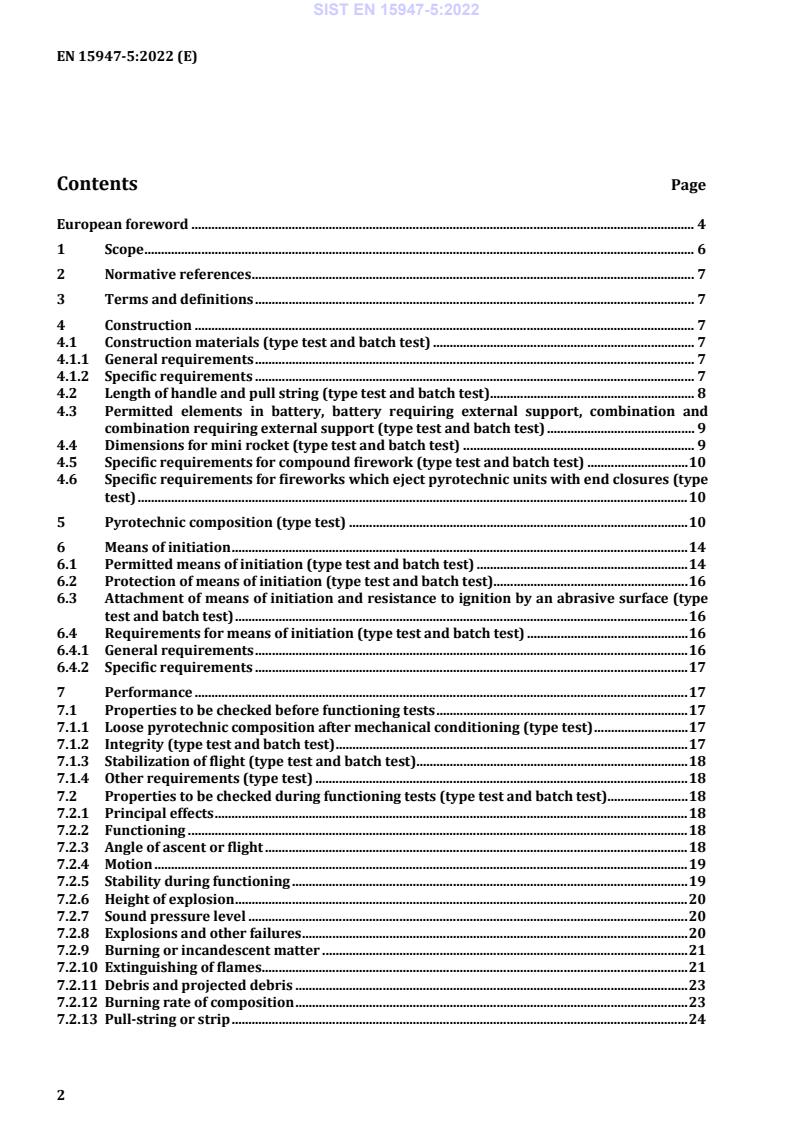
Contents Page
European foreword . 4
1 Scope . 6
2 Normative references . 7
3 Terms and definitions . 7
4 Construction . 7
4.1 Construction materials (type test and batch test) . 7
4.1.1 General requirements . 7
4.1.2 Specific requirements . 7
4.2 Length of handle and pull string (type test and batch test) . 8
4.3 Permitted elements in battery, battery requiring external support, combination and
combination requiring external support (type test and batch test) . 9
4.4 Dimensions for mini rocket (type test and batch test) . 9
4.5 Specific requirements for compound firework (type test and batch test) . 10
4.6 Specific requirements for fireworks which eject pyrotechnic units with end closures (type
test) . 10
5 Pyrotechnic composition (type test) . 10
6 Means of initiation . 14
6.1 Permitted means of initiation (type test and batch test) . 14
6.2 Protection of means of initiation (type test and batch test). 16
6.3 Attachment of means of initiation and resistance to ignition by an abrasive surface (type
test and batch test) . 16
6.4 Requirements for means of initiation (type test and batch test) . 16
6.4.1 General requirements . 16
6.4.2 Specific requirements . 17
7 Performance . 17
7.1 Properties to be checked before functioning tests . 17
7.1.1 Loose pyrotechnic composition after mechanical conditioning (type test) . 17
7.1.2 Integrity (type test and batch test) . 17
7.1.3 Stabilization of flight (type test and batch test). 18
7.1.4 Other requirements (type test) . 18
7.2 Properties to be checked during functioning tests (type test and batch test) . 18
7.2.1 Principal effects . 18
7.2.2 Functioning . 18
7.2.3 Angle of ascent or flight . 18
7.2.4 Motion . 19
7.2.5 Stability during functioning . 19
7.2.6 Height of explosion . 20
7.2.7 Sound pressure level . 20
7.2.8 Explosions and other failures . 20
7.2.9 Burning or incandescent matter . 21
7.2.10 Extinguishing of flames . 21
7.2.11 Debris and projected debris . 23
7.2.12 Burning rate of composition . 23
7.2.13 Pull-string or strip . 24
7.3 Properties to be checked after functioning tests (type test and batch test) . 24
7.3.1 Droop . 24
7.3.2 Plastics body . 24
7.3.3 Tube containing the propellant charge for rocket and report rocket . 24
8 Primary pack or selection pack (type test and batch test) . 24
9 Type testing . 24
9.1 General . 24
9.2 Specific requirements for primary packs to be examined. 26
10 Batch testing . 26
10.1 General . 26
10.2 Sampling plans. 26
10.3 Unit of product . 26
10.4 Nonconformities . 27
10.5 Acceptance or rejection of a batch . 29
10.5.1 Nonconforming units . 29
10.5.2 Critical nonconforming units . 29
10.5.3 Major nonconforming units . 29
10.5.4 Minor nonconforming units . 29
10.5.5 Fireworks supplied in primary packs or selection packs . 29
Annex ZA (informative) Relationship between this European Standard and the essential safety
requirements of Directive 2013/29/EU aimed to be covered . 30
European foreword
This document (EN 15947-5:2022) has been prepared by Technical Committee CEN/TC 212 “Pyrotechnic
articles”, the secretariat of which is held by NEN.
This European Standard shall be given the status of a national standard, either by publication of an
identical text or by endorsement, at the latest by April 2023, and conflicting national standards shall be
withdrawn at the latest by December 2023.
Attention is drawn to the possibility that some of the elements of this document may be the subject of
patent rights. CEN shall not be held responsible for identifying any or all such patent rights.
This document supersedes EN 15947-5:2015.
In comparison with the previous edition EN 15947-5:2015, the following essential technical
modifications have been made:
— new fireworks types “report rocket” in F3 and “senko-hanabi” in F1 added with corresponding
requirements;
— requirements for hand-held Bengal flame and Banger with preliminary effect have been added;
— procedure to check the labelling during type testing has been revised;
— measuring of sound pressure level during batch testing is not required, if the measured values during
type testing were less than 90 dB (AI) at the respective safety distance;
— for fireworks with whistle elements no plastic tubes shall be ejected from the article during
functioning;
— deletion of the requirements regarding “Integrity after function” (earlier 7.3.4);
— type testing was revised;
— requirements on elements in battery, battery requiring external support, combination and
combination requiring external support has been revised;
— requirement for end closures breakability has been added;
— the requirement to use a non-metallic base plate to fix the individual fireworks for a compound
firework has been removed;
— requirement removed for mounted wheels in category F3 (ex 6.4.2).
This document has been prepared under a Standardization Request (M/583) concerning pyrotechnic
articles given to CEN by the European Commission and the European Free Trade Association, and
supports Essential Safety requirements of Directive 2013/29/EU.
For relationship with Directive 2013/29/EU, see informative Annex ZA, which is an integral part of this
document.
This document is one of the series of standards as listed below:
— EN 15947-1, Pyrotechnic articles — Fireworks, Categories F1, F2 and F3 — Part 1: Terminology
— EN 15947-2, Pyrotechnic articles — Fireworks, Categories F1, F2 and F3 — Part 2: Categories and types
of firework
— EN 15947-3, Pyrotechnic articles — Fireworks, Categories F1, F2 and F3 — Part 3: Minimum labelling
requirements
— EN 15947-4, Pyrotechnic articles — Fireworks, Categories F1, F2 and F3 — Part 4: Test methods
— EN 15947-5, Pyrotechnic articles — Fireworks, Categories F1, F2 and F3 — Part 5: Requirements for
construction and performance
Any feedback and questions on this document should be directed to the users’ national standards body.
A complete listing of these bodies can be found on the CEN website.
According to the CEN-CENELEC Internal Regulations, the national standards organisations of the
following countries are bound to implement this European Standard: Austria, Belgium, Bulgaria, Croatia,
Cyprus, Czech Republic, Denmark, Estonia, Finland, France, Germany, Greece, Hungary, Iceland, Ireland,
Italy, Latvia, Lithuania, Luxembourg, Malta, Netherlands, Norway, Poland, Portugal, Republic of North
Macedonia, Romania, Serbia, Slovakia, Slovenia, Spain, Sweden, Switzerland, Türkiye and the United
Kingdom.
1 Scope
This document specifies requirements for construction and performance of firework and primary packs
and selection packs. It is applicable to firework of the categories F1, F2 and F3 as defined by Article 6
Paragraph (1) clause (a) subclause (i) to (iii) of Directive 2013/29/EU.
This document is not applicable for fireworks containing detonative explosives other than black powder
or flash composition or pyrotechnic composition that includes any of the following substances:
— arsenic or arsenic compounds;
— hexachlorobenzene;
— lead or lead compounds;
— mixtures containing a mass fraction of chlorates greater than 80 %;
— mixtures of chlorates with metals;
— mixtures of chlorates with red phosphorus (except when used in Christmas crackers, party poppers
or snaps);
— mixtures of chlorates with potassium hexacyanoferrate (II);
— mixtures of chlorates with sulphur (these mixtures are allowed for friction heads only);
— mixtures of chlorates with sulphides;
— mercury compounds;
— nitrocellulose with a mass fraction of nitrogen of more than 12,6 %;
— picrates or picric acid;
— potassium chlorate with a mass fraction of bromates greater than 0,15 %;
— sulphur with an acidity, expressed in mass fraction of sulphuric acid, greater than 0,002 %;
— white phosphorus;
— zirconium with a particle size of less than 40 µm.
This document does not apply to fireworks intended to be kept or used at temperatures below −20 °C or
above 50 °C.
2 Normative references
The following documents are referred to in the text in such a way that some or all of their content
constitutes requirements of this document. For dated references, only the edition cited applies. For
undated references, the latest edition of the referenced document (including any amendments) applies.
EN 15947-1:2022, Pyrotechnic articles — Fireworks, Categories F1, F2 and F3 — Part 1: Terminology
EN 15947-2:2022, Pyrotechnic articles — Fireworks, Categories F1, F2 and F3 — Part 2: Categories and
types of firework
EN 15947-3:2022, Pyrotechnic articles — Fireworks, Categories F1, F2 and F3 — Part 3: Minimum labelling
requirements
EN 15947-4:2022, Pyrotechnic articles — Fireworks, Categories F1, F2 and F3 — Part 4: Test methods
ISO 2859-1:1999, Sampling procedures for inspection by attributes — Part 1: Sampling schemes indexed
by acceptance quality limit (AQL) for lot-by-lot inspection
3 Terms and definitions
For the purposes of this document, the terms and definitions given in EN 15947-1:2022 apply.
ISO and IEC maintain terminological databases for use in standardization at the following addresses:
— IEC Electropedia: available at https://www.electropedia.org/
— ISO Online browsing platform: available at https://www.iso.org/obp/ui
4 Construction
4.1 Construction materials (type test and batch test)
4.1.1 General requirements
Conformity to the following requirements shall be verified by visual examination according with
EN 15947-4:2022, 6.13, except the last sentence of the second hyphen.
— The body of the firework case, except rocket motors containing only propellant charge, shall be made
of paper, cardboard or plastic. The base (end closures) shall be made of non-metallic material. For
fixing purposes, wood, staples, nails, aluminium coated foil or binding wires may be used.
— For articles fitted with a friction head: the primary pack shall be fitted with a striking surface. The
striking surface on the primary pack shall be covered or the primary pack shall be sealed. The striking
surface shall be resistant enough to allow ignition of all the fireworks included within the primary
pack when tested in accordance with EN 15947-4:2022, 6.16.
— Any part of a firework that acts as handle shall not contain any pyrotechnic composition.
4.1.2 Specific requirements
Conformity to the following requirements shall be verified by visual examination according with
EN 15947-4:2022, 6.13.
As impacted by ISO 2859-1:1999/Cor.1:2001 and ISO 2859-1:1999/Amd.1:2011.
— For banger and flash banger: additionally to 4.1.1 cardboard wrapped in string is permitted as
construction material.
— For Bengal match and Bengal stick: the stick shall be made of wood.
— For Christmas cracker and snap: the overlapping strips shall be made of cardboard, paper or string.
— For hand-held sparkler and non-hand-held sparkler: a metal stick is permitted as construction
material.
— For jumping cracker: the firework case shall be made of paper only.
— For mini rocket: the tube containing the propellant charge and the effect charge shall be made of
cardboard or, when no report charge is present, plastic.
— For novelty match: the stick shall be made of cardboard or wood.
— For party popper: the shape shall not resemble a gun.
— For rocket and report rocket: the tube containing the propellant charge shall be made of cardboard,
plastic or sheathed aluminium.
— For Roman candle and shot tube: the case, if any, of the pyrotechnic unit, shall be made of paper,
cardboard or plastics.
— For senko-hanabi: natural straw is permitted as construction material.
— For spinner: the aerofoils, if any, shall be made of cardboard or plastics.
— For throwdown: the body shall be made of tissue paper or foil.
Conformity to the following requirement shall be verified by determination of diameter according to
EN 15947-4:2022, 6.1.5:
— For Roman candle: the inside diameter of the tube shall not exceed 30 mm.
— For shot tube: the inside diameter of the tube shall not exceed 30 mm (category F2) or 50 mm
(category F3).
Conformity to the following requirement shall be verified by determination of tube angle according to
EN 15947-4:2022, 6.18:
For battery, battery requiring external support, combination and combination requiring external
support: the angle of tubes of mines, Roman candles or shot tubes shall not exceed 30° to the vertical.
Conformity to the following requirement shall be verified by conformity to drawings and part lists
according to EN 15947-4:2022, 6.2.2 and visual examination according to EN 15947-4:2022, 6.13:
— For battery, battery requiring external support, combination and combination requiring external
support: Any technical appliances as an integral part of the firework allowing ignition transmission
to other fireworks are not allowed. Reserve fuse is not considered a technical appliance.
4.2 Length of handle and pull string (type test and batch test)
Conformity to the following requirements shall be verified by the test method described in
EN 15947-4:2022, 6.1.1.
— For Bengal match: the uncoated end of a Bengal match which acts as the handle shall have a length
of at least 40 % of the total length of the Bengal match with a minimum of 20 mm.
— For Bengal stick: the uncoated end of a Bengal stick which acts as the handle shall have a minimum
length of 75 mm.
— For hand-held fountain and hand-held Bengal flame: the end of the firework case which acts as a
handle, or if it is a separate component, shall have a minimum length of 40 mm. If the handle is an
integral part of the body, the handle section shall be marked in a contrasting colour.
— For hand-held sparkler: a category F1 hand-held sparkler shall have a minimum handle length of
75 mm; a category F2 hand-held sparkler shall have a minimum handle length of 75 mm when the
total length does not exceed 450 mm and 150 mm when the total length is more than 450 mm.
— For novelty match: the uncoated end of a novelty match which acts as the handle shall have a
minimum length of 20 mm.
— For senko-hanabi: the handle shall have a minimum length of 80 mm.
Conformity to the following requirements shall be verified by the method described in EN 15947-4:2022,
6.1.4.
— For Christmas cracker and snap: the total length of the pull-strip or –string shall be at least 50 mm.
— For party popper: the length of the pull-string shall be at least 75 mm.
4.3 Permitted elements in battery, battery requiring external support, combination and
combination requiring external support (type test and batch test)
Conformity to the following requirements shall be verified by the individual applicable test method
described in EN 15947-4:2022, Clause 6.
Elements in a category F2 battery, battery requiring external support, combination and combination
requiring external support shall be of category F1 or F2. Elements in a category F3 battery, battery
requiring external support, combination and combination requiring external support shall be of category
F1, F2 or F3.
Elements in a battery, battery requiring external support, combination and combination requiring
external support shall comply with the requirements of 4.1, 4.2, 4.4, 4.6 and Clause 5 applicable to the
type and the category of the elements.
4.4 Dimensions for mini rocket (type test and batch test)
When tested in accordance with EN 15947-4:2022, 6.1.5 and 6.1.3, mini rockets shall have the following
dimensions:
— outer diameter of tube: maximum 10 mm;
— length of tube: maximum 60 mm;
— total length: minimum 250 mm, maximum 350 mm.
4.5 Specific requirements for compound firework (type test and batch test)
Compound firework may only consist of the following pyrotechnic articles:
— fireworks of categories F1, F2 and F3 for which an EU-type examination certificate (Module B) has
been issued and
— pyrotechnic cords and fuses of category P1 only, which were CE marked.
NOTE 1 Usually pyrotechnic cords and fuses cannot be labelled on account of the nature and size of the
pyrotechnic article.
Elements which are designed to ensure the stability of the firework during its functioning as single
articles may be omitted, when the firework is fixed on a base plate.
NOTE 2 Such elements can include for example loose attachment bases, metal fixings (loops)/spikes to be
inserted in the ground, foldable bases and packaging with fixing functions.
The category of a compound firework shall be determined by the highest category amongst the individual
fireworks in the compound firework or the category according to the net explosive content (NEC) limits
for compound firework given in Table 1, whichever is the highest.
A base plate is required for compound fireworks. When tested in accordance with EN 15947-4:2022, 6.13
all fireworks which are required to remain upright during functioning according to 7.2.5 shall remain
fixed to the base plate during functioning of the compound firework.
When tested in accordance with EN 15947-4:2022, 6.13, every single article in a compound firework shall
be oriented as individually type tested.
When tested in accordance with EN 15947-4:2022, 6.13, compound fireworks shall be supplied in a
primary pack.
When tested in accordance with EN 15947-4:2022, 6.13, the locations where the initial fuses and/or
pyrotechnic cords and fuses are connected with each other within compound fireworks shall be securely
covered and not be exposed or directly accessible.
4.6 Specific requirements for fireworks which eject pyrotechnic units with end closures
(type test)
End closures of pyrotechnic units having a diameter larger than 20 mm and weighing more than 8,0 g,
which are designed to be ejected from a tube or a launcher and to burst in the air, shall be breakable and
no fragments shall weigh more than 8,0 g when tested in accordance with EN 15947-4:2022, 6.1.8.
5 Pyrotechnic composition (type test)
When tested in accordance with EN 15947-4:2022, 6.2.2 and 6.2.3, the NECs shall comply with Table 1.
For report and/or bursting charges with a composition other than black powder, nitrate/metal-based
compositions or perchlorate/metal-based compositions the same upper limits as for perchlorate/metal-
based compositions apply.
Table 1 — Pyrotechnic composition
Firework type Category NEC
aerial wheel F3 Not more than 160 g, shall not contain more than eight pyrotechnic units. A
pyrotechnic unit shall have a NEC of not more than 20 g. Each report charge, if
any, shall have a NEC of not more than 10 g of black powder or 4,0 g of
nitrate/metal-based report charge or 2,0 g of perchlorate/metal-based report
charge.
banger F2 In case of no preliminary effect, not more than 6,0 g black powder. In case of
preliminary effect not more than 3,0 g black powder and 4,5 g other effects (in
case of whistle unit, not more than 1,0 g and only one unit).
F3 In case of no preliminary effect, not more than 10 g black powder. In case of
preliminary effect not more than 5,0 black powder and 7,5 g other effects (in
case of whistle unit, not more than 2,0 g and only one unit).
battery, F2 Each element shall have a NEC of not more than the limit for F2 firework of the
same type.
battery requiring
external support, A battery or battery requiring external support of fountains shall have a NEC of
not more than 600 g.
combination and
A combination or combination requiring external support containing fountains,
combination
shall have NEC of not more than 600 g of which not more than 500 g shall be
requiring
contained in elements other than fountains.
external support
Any other battery or battery requiring external support shall have a NEC of not
more than 500 g.
Any other combination or combination requiring external support shall have a
NEC of not more than 500 g.
Bangers used in batteries, batteries requiring external support, combinations
or combinations requiring external support shall have a total NEC of not more
than 100 g.
Flash bangers used in batteries, batteries requiring external support,
combinations or combinations requiring external support shall have a total
NEC of not more than 25 g.
F3 Each element shall have a NEC of not more than the limit for F3 firework of the
same type.
A battery or battery requiring external support of fountains shall have a NEC of
not more than 3 000 g.
A combination or combination requiring external support containing fountains,
shall have a NEC of not more than 3 000 g of which not more than 1 000 g shall
be contained in elements other than fountains.
Any other battery or battery requiring external support shall have a NEC of not
more than 1 000 g.
Any other combination or combination requiring external support shall have a
NEC of not more than 1 000 g.
Bangers used in batteries, batteries requiring external support, combinations
or combinations requiring external support shall have a total NEC of not more
than 1 000 g.
Flash bangers used in batteries, batteries requiring external support,
combinations or combinations requiring external support shall have a total
NEC of not more than 250 g.
Firework type Category NEC
Bengal flame F1 Not more than 20 g.
F2 Not more than 250 g.
F3 Not more than 1 000 g.
Bengal match F1 Not more than 3,0 g.
Bengal stick F1 Not more than 7,5 g.
F2 Not more than 50 g.
Christmas F1 Not more than 16 mg report charge based on potassium chlorate and red
phosphorous, or not more than 1,6 mg silver fulminate as report charge.
cracker
combination See batteries, batteries requiring external support, combinations and
combinations requiring external support.
compound F2 Not more than 2 000 g; the respective NEC limits of the included fireworks types
firework apply independently.
F3 Not more than 4 000 g; the respective NEC limits of the included fireworks types
apply independently.
crackling F1 Not more than 3,0 g.
granule
F2 Not more than 15 g.
double banger F2 Not more than 10 g black powder.
flash banger F2 In case of no preliminary effect, not more than 1,0 g for nitrate/metal-based
report charge or not more than 0,5 g for perchlorate/metal-based report charge.
In case of preliminary effect not more than 0,6 g nitrate/metal-based report
charge or not more than 0,3 g perchlorate/metal-based report charge and 4,5 g
other effects (in case of whistle unit, not more than 2,0 g and only one unit).
F3 In case of no preliminary effect, not more than 10 g for nitrate/metal-based
report composition charge or not more than 5,0 g for perchlorate/metal-based
report composition charge. In case of preliminary effect not more than 5,0 g
nitrate/metal-based report charge or not more than 2,5 g perchlorate/metal-
based report charge and 7,5 g other effects (in case of whistle unit, not more than
2,0 g and only one unit).
flash pellet F1 Not more than 2,0 g.
F2 Not more than 30 g.
fountain F1 Not more than 7,5 g, no whistle unit (for indoor use: pyrotechnic composition
that is based on nitrocellulose, with no additional oxidizing substances).
F2 Not more than 250 g, each whistle unit, if any, not more than 5,0 g.
F3 Not more than 1 000 g, each whistle unit, if any, not more than 20 g.
ground mover F2 Not more than 25 g, each pyrotechnic unit not more than 3,0 g, no report charge.
ground spinner F1 Not more than, 5,0 g.
F2 Not more than 25 g and each pyrotechnic unit not more than 8,0 g.
hand-held F1 Not more than 7,5 g.
sparkler
F2 Not more than 50 g.
jumping cracker F2 Not more than 10 g black powder.
Firework type Category NEC
jumping ground F2 Not more than 25 g, each pyrotechnic unit not more than 5,0 g.
spinner
mine F2 Not more than 50 g; shall not contain more than five pyrotechnic units
containing report charge and each of these pyrotechnic units shall not contain
more than 5,0 g of black powder or 2,0 g of nitrate/metal-based composition or
1,0 g of perchlorate/metal-based composition.
Not more than 8,0 g nitrocellulose only for mines with non-pyrotechnic objects.
F3 Not more than 200 g; shall not contain more than 25 pyrotechnic units
containing report charge and each of these pyrotechnic units shall not contain
more than 5,0 g of black powder or 2,0 g of nitrate/metal-based composition or
1,0 g of perchlorate/metal-based composition.
Not more than 32 g nitrocellulose only for mines with non-pyrotechnic objects.
mini rocket F2 Not more than 1,5 g, not more than 0,13 g report charge.
non-hand-held F1 Not more than 7,5 g.
sparkler
F2 Not more than 50 g.
novelty match F1 Not more than 50 mg; shall only contain one report charge, if any; the report
charge shall have a NEC of not more than 2,5 mg silver fulminate.
party popper F1 Not more than 16 mg of pyrotechnic composition that is based on potassium
chlorate and red phosphorous.
report rocket F3 In case of report rockets with a single report: Not more than 200 g; report charge
shall be not more than 100 g of black powder or 40 g of nitrate/metal-based
composition or 20 g of perchlorate/metal-based composition.
In case of report rockets with multiple reports: Not more than 125 g; report
charge not more than 50 g; each pyrotechnic unit shall not contain more than
4,5 g of report charge. Bursting charge shall be not more than 35 g of black
powder.
rocket F2 Not more than 75 g; report and bursting charge, if any, shall be not more than
10 g of black powder or 4,0 g of nitrate/metal-based composition or 2,0 g of
perchlorate/metal-based composition.
F3 Not more than 200 g; report and bursting charge, if any, shall be not more than
50 g of black powder or 20 g of nitrate/metal-based composition or 10 g of
perchlorate/metal-based composition.
Roman candle F2 Not more than 50 g; each pyrotechnic unit not more than 10 g; shall not contain
more than five pyrotechnic units containing report charge and each of these
pyrotechnic units not more than 10 g of black powder or 4,0 g nitrate/metal-
based composition or 2,0 g perchlorate/metal-based composition.
F3 Not more than 250 g; each pyrotechnic unit not more than 50 g; shall not contain
more than 10 pyrotechnic units containing report charge and each of these
pyrotechnic units not more than 20 g of black powder or 8,0 g of nitrate/metal-
based composition or 4,0 g of perchlorate/metal-based composition.
senko-hanabi F1 Not more than 0,5 g.
serpent F1 Not more than 3,0 g.
Firework type Category NEC
Not more than 25 g; mass of the report and bursting charge in the pyrotechnic
shot tube F2
unit: not more than 10 g of black powder or 4,0 g of nitrate/metal-based
composition or 2,0 g of perchlorate/metal-based composition.
F3 Not more than 40 g; mass of the report and bursting charge in the pyrotechnic
unit: not more than 20 g of black powder or 8,0 g of nitrate/metal-based
composition or 4,0 g of perchlorate/metal-based composition.
snap F1 Not more than 16 mg report composition based on potassium chlorate and red
phosphorous, or not more than 1,6 mg silver fulminate as report charge.
spinner F2 Not more than 30 g.
table bomb F1 Not more than 2,0 g nitrocellulose.
throwdown F1 Not more than 2,5 mg silver fulminate.
wheel F2 Not more than 100 g; each whistle unit, if any, not more than 5,0 g.
F3 Not more than 900 g; each single unit not more than 150 g; each whistle unit, if
any, not more than 20 g.
6 Means of initiation
6.1 Permitted means of initiation (type test and batch test)
When tested in accordance with EN 15947-4:2022, 6.13, conformity to the following requirements in
Table 2 shall be verified.
Table 2 — Permitted means of initiation (type test and batch test)
No means of
Ignition Sealing Friction
Firework type Protruding fuse
initiation
head paper head
aerial wheel + – – – –
banger + + – + –
battery + – – – –
battery requiring + – – – –
external support
Bengal flame + + + – –
Bengal match – – – + –
Bengal stick – – – – +
Christmas cracker – – – – +
combination + – – – –
combination + – – – –
requiring external
support
compound firework + – – – –
crackling granule + – – – –
double banger + – – – –
No means of
Ignition Sealing Friction
Firework type Protruding fuse
initiation
head paper head
flash banger + – – – –
flash pellet + + – – +
fountain (indoor use) + + + – +
fountain (outdoor + + + + –
use)
ground mover + + – – –
ground spinner + – – – –
hand-held sparkler – + – – +
jumping cracker + + – + –
jumping ground + – – – –
spinner
mine + + – – –
mini rocket + – – – –
non-hand-held – + – – +
sparkler
novelty match – – – + –
party popper – – – – +
report rocket + - - - –
rocket + – – – –
Roman candle + – – – –
senko-hanabi – – + – +
serpent + + – – +
shot tube + – – – –
snap – – – – +
spinner + – – – –
table bomb + – – – –
throwdown – – – – +
wheel + – – – –
NOTE For types given in the column ”No means of initiation” refer to EN 15947-3:2022, Table A.1 for initiation
of functioning.
+: permitted.
–: not permitted.
Batteries, batteries requiring external support, combinations and combinations requiring external
support shall be fitted with one initial fuse and may be fitted with one reserve fuse, both meeting the
requirements given in 6.4.1.
Compound fireworks shall be fitted with one initial fuse and may be fitted with a maximum of three
reserve fuses, all meeting the requirements given in 6.4.1.
6.2 Protection of means of initiation (type test and batch test)
Conformity to the following requirements shall be verified by visual examination according with
EN 15947-4:2022, 6.13:
— the initial fuse and the reserve fuse, if any, shall be protected by a fuse cover, a primary pack or a
selection pack;
— the use of a primary pack is mandatory for Bengal match, friction ignited banger, friction ignited
outdoor fountain, hand-held sparkler, non-hand-held sparkler, novelty match, senko-hanabi and
throwdown;
— the use of a primary or selection pack is mandatory for Bengal stick, Christmas cracker, flash pellet,
jumping cracker, mini rocket, party popper, serpent, snap and spinner;
— throwdowns shall be embedded in sawdust;
— there shall be no exposed instantaneous fuse in any firework, verified by conformity to drawings and
part lists according with EN 15947-4:2022, 6.2.2, except in the following types provided any
pyrotechnic composition is covered (using tape or similar):
— batteries and batteries requiring external support containing elements of type fountain or
Bengal flame or flash banger or banger;
— combinations and combinations requiring external support containing elements of type fountain
or Bengal flame or flash banger or banger;
— wheel.
6.3 Attachment of means of initiation and resistance to ignition by an abrasive surface
(type test and batch test)
The initial and reserve fuse(s) of the firework shall not be detached within 10 s when tested in accordance
with EN 15947-4:2022, 6.1.6. The friction head shall not ignite when tested in accordance with
EN 15947-4:2022, 6.1.7.
6.4 Requirements for means of initiation (type test and batch test)
6.4.1 General requirements
Conformity to the following requirements shall be verified unless other specific requirements according
with 6.4.2 apply.
When tested in accordance with EN 15947-4:2022, 6.13, means of initiation shall be visible or shall be
indicated by labelling or instructions. When tested in accordance with EN 15947-4:2022, 6.6.2.1, the
initial fuse and reserve fuse shall ignite within 10 s and the ignition shall be visible, or the friction head
shall ignite and the ignition shall be visible.
When tested in accordance with EN 15947-4:2022, 6.6.2.2, for category F1 and F2 fireworks, the duration
of the initial fuse and reserve fuse burning shall be 3,0 s to 8,0 s and for category F3 fireworks 5,0 s to
13,0 s.
For fireworks fitted with a friction head: when tested in accordance with EN 15947-4:2022, 6.1.7, the
friction head shall not ignite.
6.4.2 Specific requirements
For indoor fountain of category F1: when tested in accordance with EN 15947-4:2022, 6.6.2.1, the
fountain shall ignite within 5,0 s.
For Roman candle, banger and flash banger: when tested in accordance with EN 15947-4:2022, 6.6.2.3,
the period of invisible burning occurring after the preliminary effect, if any, shall not exceed 5,0 s
(category F2) or 10,0 s (category F3).
For spinner and jumping ground spinner: the point of ignition shall be visible from the top of the article,
when tested in accordance with EN 15947-4:2022, 6.13.
Hand-held sparkler and non-hand-held sparkler shall ignite within 15 s when tested in accordance with
EN 15947-4:2022, 6.6.2.1.
For compound firework: the delay time between the functioning of subsequent fireworks included in the
compound firework shall not exceed 15 s when measured in accordance with EN 15947-4:2022, 6.6.2.4.
7 Performance
7.1 Properties to be checked before functioning tests
7.1.1 Loose pyrotechnic composition after mechanical conditioning (type test)
When tested in accordance with EN 15947-4:2022, 6.14, the mass of loose pyrotechnic composition shall
not exceed 100 mg for each item tested except for Christmas crackers and snaps it shall not exceed 1,0 mg.
7.1.2 Integrity (type test and batch test)
7.1.2.1 General requirements
Conformity to the following requirement shall be verified by visual examination in accordance with
EN 15947-4:2022, 6.13 and by conformity to drawings and part lists in accordance with
EN 15947-4:2022, 6.2.2.
— There shall b
...