

SIST EN 676:2020
(Main)Forced draught burners for gaseous fuels
General Information
- Abstract
This European Standard specifies the terminology, the general requirements for the construction and operation of forced draught gas burners and also the provision of control and safety devices, and the test procedure for these burners.
This European Standard is applicable to:
- automatic gas burners with a combustion air fan (hereinafter called "burners") and gas line components, intended for use in appliances of different types, and that are operated with gaseous fuels;
- pre mixed burners and nozzle mixed burners;
- single burners with a single combustion chamber;
- single fuel and dual fuel burners when operating only on gas;
- the gas function of dual-fuel burners designed to operate simultaneously on gaseous and liquid fuels, which, for the latter, the requirements of EN 267 also apply.
This European Standard deals with all significant machine hazards, hazardous situations and events relevant to burners, when they are used as intended and under conditions of misuse which are reasonably foreseeable, see Annex J.
This European Standard specifies the requirements to ensure the safety during commissioning, start-up, operation, shut-down and maintenance.
This European Standard does not apply to burners specifically designed for use in industrial processes carried out on industrial premises.
This European Standard deals also with the additional requirements for the burners in the scope with pressurised parts and /or firing pressurised bodies, see Annex K.
This European Standard deals also with forced draught burners intended to be used with biogenous gaseous fuels, mixtures with line-conveyed gas and special gaseous fuels.
This European Standard deals also with burners and their equipment to increase the total appliance efficiency, see Annex M.
- Status
- Published
- Public Enquiry End Date
- 02-Mar-2017
- Publication Date
- 09-Mar-2020
- Technical Committee
- PLN - Gas appliances for domestic use
- Current Stage
- 6060 - National Implementation/Publication (Adopted Project)
- Start Date
- 05-Feb-2020
- Due Date
- 11-Apr-2020
- Completion Date
- 10-Mar-2020



Overview
SIST EN 676:2020 - Forced draught burners for gaseous fuels is the European standard that defines terminology, construction and operational requirements, safety provisions, control and safety devices, and test procedures for forced draught gas burners. It applies to automatic gas burners equipped with a combustion air fan (forced draught), including pre-mixed and nozzle-mixed designs, single burners with a single combustion chamber, and single- or dual-fuel burners when operating on gas. The standard addresses safe commissioning, start-up, operation, shut-down and maintenance, and includes provisions for burners using biogenous and special gaseous fuels.
Key topics and technical requirements
- Scope and applicability: Covers automatic forced draught burners intended for appliances (not burners designed specifically for industrial process plants on industrial premises).
- Terminology and definitions: Comprehensive glossary covering gas types, burner operation modes, test rig and combustion chamber definitions.
- Constructional requirements: Design, materials, mounting, accessibility for maintenance, soundness and connections.
- Equipment requirements: Motors, fans, adjustable air dampers, gas line components, electrical safety and EMC aspects.
- Control and safety devices: Requirements for sequencing, ignition, flame detection, safety times and lock-out/reset behavior.
- Functional and operational tests: Test procedures for start-up, pre‑purge, ignition, heat input determination, flame stability and limits of safe operation.
- Combustion emissions and measurement: Methods and conversions for CO and NOx measurement (Annex A) and test gas specifications (Annex C).
- Special provisions: Additional requirements for pressurised parts and firing pressurised bodies (Annex K), use with biogenous gases, and means to improve appliance efficiency (Annex M).
- Marking, documentation and packaging: Data plate, installation/maintenance instructions and labelling requirements.
Practical applications and who uses this standard
SIST EN 676:2020 is used by:
- Burner and boiler manufacturers to design and certify forced draught gas burners compliant with European safety and performance expectations.
- Test laboratories and certification bodies to perform standardized functional, combustion and safety tests.
- HVAC and mechanical engineers, installers and maintenance technicians for correct installation, commissioning and safe maintenance practices.
- Regulatory authorities and compliance teams verifying conformity with safety, emissions and labelling requirements.
- Product designers working with biogas or mixed gaseous fuels who need guidance on safe burner operation and testing.
Related standards
- EN 267 (referenced for dual-fuel burners when operating on liquid fuels)
- SIST EN 676:2020 supersedes earlier editions (e.g., EN 676:2003+A2:2008)
Keywords: forced draught burners, gaseous fuels, SIST EN 676:2020, gas burners standard, burner safety, combustion emissions, test procedures, premixed burners, nozzle mixed burners.
Relations
- Effective Date
- 01-Apr-2020
- Effective Date
- 01-Apr-2020
- Effective Date
- 25-Aug-2026
- Effective Date
- 09-Feb-2026
- Effective Date
- 09-Feb-2026
- Effective Date
- 09-Feb-2026
- Effective Date
- 09-Feb-2026
- Effective Date
- 09-Feb-2026
- Effective Date
- 09-Feb-2026
- Effective Date
- 09-Feb-2026
- Effective Date
- 09-Feb-2026
- Effective Date
- 09-Feb-2026
- Effective Date
- 28-Jan-2026
- Effective Date
- 28-Jan-2026
- Effective Date
- 28-Jan-2026
Get Certified
Connect with accredited certification bodies for this standard

DNV
DNV is an independent assurance and risk management provider.

Lloyd's Register
Lloyd's Register is a global professional services organisation specialising in engineering and technology.
DNV Energy Systems
Energy and renewable energy certification.
Sponsored listings
Frequently Asked Questions
SIST EN 676:2020 is a standard published by the Slovenian Institute for Standardization (SIST). Its full title is "Forced draught burners for gaseous fuels". This standard covers: This European Standard specifies the terminology, the general requirements for the construction and operation of forced draught gas burners and also the provision of control and safety devices, and the test procedure for these burners. This European Standard is applicable to: - automatic gas burners with a combustion air fan (hereinafter called "burners") and gas line components, intended for use in appliances of different types, and that are operated with gaseous fuels; - pre mixed burners and nozzle mixed burners; - single burners with a single combustion chamber; - single fuel and dual fuel burners when operating only on gas; - the gas function of dual-fuel burners designed to operate simultaneously on gaseous and liquid fuels, which, for the latter, the requirements of EN 267 also apply. This European Standard deals with all significant machine hazards, hazardous situations and events relevant to burners, when they are used as intended and under conditions of misuse which are reasonably foreseeable, see Annex J. This European Standard specifies the requirements to ensure the safety during commissioning, start-up, operation, shut-down and maintenance. This European Standard does not apply to burners specifically designed for use in industrial processes carried out on industrial premises. This European Standard deals also with the additional requirements for the burners in the scope with pressurised parts and /or firing pressurised bodies, see Annex K. This European Standard deals also with forced draught burners intended to be used with biogenous gaseous fuels, mixtures with line-conveyed gas and special gaseous fuels. This European Standard deals also with burners and their equipment to increase the total appliance efficiency, see Annex M.
This European Standard specifies the terminology, the general requirements for the construction and operation of forced draught gas burners and also the provision of control and safety devices, and the test procedure for these burners. This European Standard is applicable to: - automatic gas burners with a combustion air fan (hereinafter called "burners") and gas line components, intended for use in appliances of different types, and that are operated with gaseous fuels; - pre mixed burners and nozzle mixed burners; - single burners with a single combustion chamber; - single fuel and dual fuel burners when operating only on gas; - the gas function of dual-fuel burners designed to operate simultaneously on gaseous and liquid fuels, which, for the latter, the requirements of EN 267 also apply. This European Standard deals with all significant machine hazards, hazardous situations and events relevant to burners, when they are used as intended and under conditions of misuse which are reasonably foreseeable, see Annex J. This European Standard specifies the requirements to ensure the safety during commissioning, start-up, operation, shut-down and maintenance. This European Standard does not apply to burners specifically designed for use in industrial processes carried out on industrial premises. This European Standard deals also with the additional requirements for the burners in the scope with pressurised parts and /or firing pressurised bodies, see Annex K. This European Standard deals also with forced draught burners intended to be used with biogenous gaseous fuels, mixtures with line-conveyed gas and special gaseous fuels. This European Standard deals also with burners and their equipment to increase the total appliance efficiency, see Annex M.
SIST EN 676:2020 is classified under the following ICS (International Classification for Standards) categories: 27.060.20 - Gas fuel burners. The ICS classification helps identify the subject area and facilitates finding related standards.
SIST EN 676:2020 has the following relationships with other standards: It is inter standard links to SIST EN 676:2004+A2:2008/AC:2009, SIST EN 676:2004+A2:2008, SIST ISO 7-1:1995, SIST EN 60529:1997/A2:2014, SIST EN 61310-1:2008, SIST EN 60335-2-102:2016, SIST EN 60529:1997, SIST EN 60529:1997/A1:2000, SIST EN 60204-1:2006, SIST EN 62061:2005, SIST EN 60730-1:2012, SIST EN 50156-1:2015, SIST EN 1092-3:2004, SIST EN 1854:2010, SIST EN ISO 9606-4:1999. Understanding these relationships helps ensure you are using the most current and applicable version of the standard.
SIST EN 676:2020 is associated with the following European legislation: EU Directives/Regulations: 2006/42/EC, 2009/142/EC, 2014/68/EU, 2016/426, 813/2013, 97/23/EC; Standardization Mandates: M/071, M/396, M/535, M/BC/CEN/89/6. When a standard is cited in the Official Journal of the European Union, products manufactured in conformity with it benefit from a presumption of conformity with the essential requirements of the corresponding EU directive or regulation.
SIST EN 676:2020 is available in PDF format for immediate download after purchase. The document can be added to your cart and obtained through the secure checkout process. Digital delivery ensures instant access to the complete standard document.
Standards Content (Sample)
SLOVENSKI STANDARD
01-april-2020
Nadomešča:
SIST EN 676:2004+A2:2008
SIST EN 676:2004+A2:2008/AC:2009
Plinski ventilatorski gorilniki
Forced draught burners for gaseous fuels
Gebläsebrenner für gasförmige Brennstoffe
Brûleurs à air soufflé pour combustibles gazeux
Ta slovenski standard je istoveten z: EN 676:2020
ICS:
27.060.20 Plinski gorilniki Gas fuel burners
2003-01.Slovenski inštitut za standardizacijo. Razmnoževanje celote ali delov tega standarda ni dovoljeno.
EN 676
EUROPEAN STANDARD
NORME EUROPÉENNE
January 2020
EUROPÄISCHE NORM
ICS 27.060.20 Supersedes EN 676:2003+A2:2008
English Version
Forced draught burners for gaseous fuels
Brûleurs à air soufflé pour combustibles gazeux Gebläsebrenner für gasförmige Brennstoffe
This European Standard was approved by CEN on 9 October 2019.
CEN members are bound to comply with the CEN/CENELEC Internal Regulations which stipulate the conditions for giving this
European Standard the status of a national standard without any alteration. Up-to-date lists and bibliographical references
concerning such national standards may be obtained on application to the CEN-CENELEC Management Centre or to any CEN
member.
This European Standard exists in three official versions (English, French, German). A version in any other language made by
translation under the responsibility of a CEN member into its own language and notified to the CEN-CENELEC Management
Centre has the same status as the official versions.
CEN members are the national standards bodies of Austria, Belgium, Bulgaria, Croatia, Cyprus, Czech Republic, Denmark, Estonia,
Finland, France, Germany, Greece, Hungary, Iceland, Ireland, Italy, Latvia, Lithuania, Luxembourg, Malta, Netherlands, Norway,
Poland, Portugal, Republic of North Macedonia, Romania, Serbia, Slovakia, Slovenia, Spain, Sweden, Switzerland, Turkey and
United Kingdom.
EUROPEAN COMMITTEE FOR STANDARDIZATION
COMITÉ EUROPÉEN DE NORMALISATION
EUROPÄISCHES KOMITEE FÜR NORMUNG
CEN-CENELEC Management Centre: Rue de la Science 23, B-1040 Brussels
© 2020 CEN All rights of exploitation in any form and by any means reserved Ref. No. EN 676:2020 E
worldwide for CEN national Members.
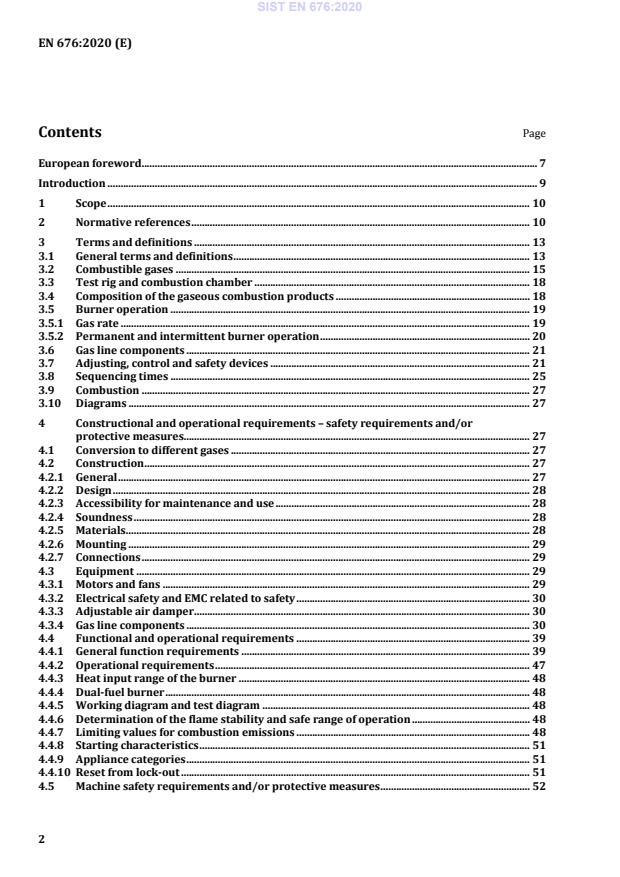
Contents Page
European foreword . 7
Introduction . 9
1 Scope . 10
2 Normative references . 10
3 Terms and definitions . 13
3.1 General terms and definitions . 13
3.2 Combustible gases . 15
3.3 Test rig and combustion chamber . 18
3.4 Composition of the gaseous combustion products . 18
3.5 Burner operation . 19
3.5.1 Gas rate . 19
3.5.2 Permanent and intermittent burner operation . 20
3.6 Gas line components . 21
3.7 Adjusting, control and safety devices . 21
3.8 Sequencing times . 25
3.9 Combustion . 27
3.10 Diagrams . 27
4 Constructional and operational requirements – safety requirements and/or
protective measures. 27
4.1 Conversion to different gases . 27
4.2 Construction . 27
4.2.1 General . 27
4.2.2 Design . 28
4.2.3 Accessibility for maintenance and use . 28
4.2.4 Soundness . 28
4.2.5 Materials . 28
4.2.6 Mounting . 29
4.2.7 Connections . 29
4.3 Equipment . 29
4.3.1 Motors and fans . 29
4.3.2 Electrical safety and EMC related to safety . 30
4.3.3 Adjustable air damper . 30
4.3.4 Gas line components . 30
4.4 Functional and operational requirements . 39
4.4.1 General function requirements . 39
4.4.2 Operational requirements . 47
4.4.3 Heat input range of the burner . 48
4.4.4 Dual-fuel burner . 48
4.4.5 Working diagram and test diagram . 48
4.4.6 Determination of the flame stability and safe range of operation . 48
4.4.7 Limiting values for combustion emissions . 48
4.4.8 Starting characteristics . 51
4.4.9 Appliance categories . 51
4.4.10 Reset from lock-out . 51
4.5 Machine safety requirements and/or protective measures . 52
5 Test methods . 52
5.1 General . 52
5.1.1 Test gases for forced draught burners . 52
5.1.2 Test pressures . 52
5.1.3 Test rig . 53
5.1.4 Types of test . 62
5.2 Functional tests . 62
5.2.1 General . 62
5.2.2 Start-up . 62
5.2.3 Pre-purge . 62
5.2.4 Start-up heat input . 62
5.2.5 Ignition . 62
5.2.6 Safety times . 63
5.3 Operation . 63
5.3.1 External soundness . 63
5.3.2 Resistance of the burner to over-heating . 64
5.3.3 Temperature of the control and safety devices . 64
5.3.4 Ignition — flame stability . 64
5.3.5 Operation — flame stability . 66
5.3.6 Auxiliary electricity consumption (ErP) . 67
5.3.7 Sound power level L (ErP) . 67
WA
5.4 Tests to be carried out on the working and test diagrams . 67
5.4.1 Tests at point 1 . 67
5.4.2 Tests at point Hp1 . 68
5.4.3 Tests at points 2, 5 (single, multi-stage and modulating burners) and 6 (multi-stage
and modulating burners) . 68
5.4.4 Tests at points Hp2 (single, multi-stage and modulating burners) and Hp6 (multi-
stage and modulating burners) . 69
5.4.5 Tests at point 3 . 69
5.4.6 Tests at point 4 . 69
5.4.7 Tests at first stage points or minimum heat input. 70
5.4.8 Summary . 70
5.5 Combustion . 71
5.6 Start-up . 72
5.7 Obtaining the heat input . 72
5.7.1 Determination of heat input at reference conditions . 72
5.7.2 Determination of heat input at ambient conditions . 74
5.8 Electrical safety . 74
5.9 Verification of safety and /or protective measures . 75
6 Marking, labelling and packaging . 75
6.1 General . 75
6.2 Data plate . 75
6.3 Other marking . 76
6.4 Instructions for installation, adjustment, maintenance and operation. 76
6.5 Packaging . 78
6.6 Marking on the packaging . 78
Annex A (normative) Determination of combustion characteristics — Carbon monoxide
and nitrogen oxides, conversion and corrections. 79
A.1 CO content (Q ), calculation from ml/m into mg/kWh . 79
CO
A.2 NO content (Q ), calculation from ml/m into mg/kWh . 80
x NO
X
A.3 Correction for the influence of combustion air temperature and humidity on NO
x
emissions Q . 81
NOx
A.4 NO mean value for evaluating the NO classes . 81
x x
A.5 CO content f . 82
2 CO
3 3
A.6 Other conversion factors for emissions, calculated from ml/m into mg/m at 3 % O
reference flue gas conditions . 82
Annex B (informative) Examples of control box sequencing . 84
Annex C (informative) Test gases . 85
C.1 General . 85
C.2 Conditions for preparation of the test gases . 85
C.3 Practical application of the test gases . 86
Annex D (informative) Gas connections conditions in common use in the various countries . 89
Annex E (informative) Tests . 91
E.1 Supplementary testing . 91
E.2 Drawing review . 91
E.3 Individual test and inspection . 91
E.4 Test report . 92
Annex F (informative) Use of alternative gas lines and test documentation . 93
F.1 Use of alternative gas lines . 93
F.2 Test documentation . 93
Annex G (informative) Void . 94
Annex H (informative) Check of the air proving device . 95
Annex I (informative) Additional recommendations for specific applications . 96
I.1 General . 96
I.2 Pre-heating of the combustion air . 96
I.3 Continuous working of the air ventilator . 96
I.4 Variable excess of combustion air . 96
I.5 Burner with start gas flame . 96
I.6 Air filtering . 97
Annex J (normative) Machine Directive (2006/42/CE) related hazards – safety
)
requirements and/or protective measures . 98
J.1 General . 98
J.2 List of significant hazards . 98
J.3 Safety requirements and /or protective measures . 98
J.4 Verification of machine safety requirements and/or protective measures . 102
J.5 Information for use . 102
Annex K (normative) Additional requirements for burners with pressurized parts and
burners firing pressurized bodies as defined in Pressure Equipment Directive (PED)
2014/68/EU . 103
K.1 General . 103
K.2 Pressurized parts . 103
K.3 Electrical safety and gas line components . 104
K.4 Gas pressure regulator . 104
K.5 High gas pressure over load protection device. 104
K.6 Automatic safety shut-off valve . 105
K.7 Air proving device . 105
K.8 Automatic burner control system . 105
K.9 Means for draining and venting. 105
K.10 General functions requirements . 106
K.11 External safety limiter . 106
K.12 Design according to Annex L in conjunction with EN 60204-1. 107
K.13 Consideration: safety life cycle . 108
K.14 Tests of pressurized parts . 109
K.15 Other marking . 110
K.16 Instructions for installation, adjustment, maintenance and operation. 110
Annex L (normative) Electrical requirements – modifications to EN 60204-1:2006 . 112
L.1 Scope. 112
L.2 Normative references . 112
L.3 Terms and definitions . 112
L.4 General requirements . 113
L.5 Incoming supply conductor terminations and devices for disconnecting and
switching off . 116
L.6 Protection against electric shock . 116
L.7 Protection of equipment . 116
L.8 Equipotential bonding . 116
L.9 Control circuits and control functions . 116
L.10 Operator interface and machine-mounted control devices . 126
L.11 Electrical equipment (Controlgear: location, mounting, and enclosures) . 126
L.12 Conductors and cables . 127
L.13 Wiring practices . 127
L.14 Electric motors and associated equipment . 127
L.15 Accessories and lighting . 127
L.16 Marking, warning signs and reference designations . 127
L.17 Technical documentation . 127
L.18 Verification . 128
Annex M (informative) Burner equipped to increase the efficiency . 129
Annex N (informative) Electrical interfaces for burners . 130
Annex O (informative) Environmental checklist EN 676 . 135
Annex P (informative) Guide for the applicability of the different standards on electrical
safety . 137
Annex Q (informative) Verification procedures for market surveillance purposes (ErP) . 139
Q.1 General . 139
Q.2 Minimization of the influence of the measurement procedure. 139
Q.3 Verification of the declared parameters . 139
Annex R (informative) Impact of the variations of the gas quality in EU gas grids to gas
burners . 140
Annex S (informative) A-Deviations . 142
Annex ZA (informative) Relationship between this European Standard and the essential
requirements of Directive 2009/142/EC (GAD) aimed to be covered . 143
Annex ZB (informative) Relationship between this European Standard and the ecodesign
requirements of Commission Regulation (EU) No 813/2013 aimed to be covered . 146
Bibliography . 147
European foreword
This document (EN 676:2020) has been prepared by Technical Committee CEN/TC 131 “Gas burners
using fans”, the secretariat of which is held by DIN.
This European Standard shall be given the status of a national standard, either by publication of an
identical text or by endorsement, at the latest by July 2020 and conflicting national standards shall be
withdrawn at the latest by January 2023.
Attention is drawn to the possibility that some of the elements of this document may be the subject of
patent rights. CEN shall not be held responsible for identifying any or all such patent rights.
This document will supersede EN 676:2003+A2:2008.
This document has been prepared under a mandate given to CEN by the European Commission and the
European Free Trade Association, and supports essential requirements of EU Directive(s).
For relationship with EU Directive(s), see informative Annexes ZA and ZB, which are an integral part
of this document.
Compared to EN 676:2003 and its amendments A1 and A2 the following fundamental changes have
been made:
a) based on ISO 22967 where different to EN 676 such as:
1) update of definitions;
2) test rig < 2,4 MW and > 2,4 MW;
3) electrical interfaces for burners;
b) modification:
4) replacement of EN 50156-1 by EN 60204-1 to include international available requirements for
the electrical safety of machines; see Annex L with editorial allocation in Annex K;
5) Annex J is adapted to the new EN ISO 12100 which is substituting EN 292 which is currently
referenced to in Table J.1;
6) normative formulation of Annex A 'Combustion characteristics';
c) new functions / requirements:
7) remote reset;
8) environmental aspects (environmental checklist);
9) increase of burner efficiency;
10) terminology for burner load control;
11) implementing new requirements to comply with the 2013/813 (ErP);
12) requiring of a risk assessment as required by EU Directives 2014/35/EU for LVD and EU
Regulation 2016/426 for GAR.
According to the CEN-CENELEC Internal Regulations, the national standards organisations of the
following countries are bound to implement this European Standard: Austria, Belgium, Bulgaria,
Croatia, Cyprus, Czech Republic, Denmark, Estonia, Finland, France, Germany, Greece, Hungary, Iceland,
Ireland, Italy, Latvia, Lithuania, Luxembourg, Malta, Netherlands, Norway, Poland, Portugal, Republic of
North Macedonia, Romania, Serbia, Slovakia, Slovenia, Spain, Sweden, Switzerland, Turkey and the
United Kingdom.
Introduction
This document is primarily intended for forced draught gas burners having a combustion air fan,
operated with gaseous fuels, and intended to be marketed as a complete assembly.
EN 437 sets out a system of classification of appliances into categories defined according to the gases
and pressures for which they are designed.
Such a system of classification, when applied to forced draught burners, can lead to difficulties in
defining the precise category to which a particular burner should be allocated. For example many
burners are designed to operate on a wide range of fuel gases with little or no modification other than
adjustment of air supply.
The technical committee responsible for the standard decided that the following appliance categories
for forced draught burners should apply:
— single categories: I for natural gas and I for liquefied petroleum gas;
2R 3R
— dual category: II for natural and liquefied petroleum gas.
2R /3R
All the burners of this standard marked with these categories are commissioned on site and the
measured values are recorded in a commissioning report.
However it should be noted that the Gas Appliance Directive requires the specification of the type of gas
and the supply pressure used as well as the burner category.
Forced draught gas burners according to this document are often used in industrial applications. The
safety principles are the same as for forced draught gas burners used for household/commercial
applications. Industrial forced draught gas burners however should operate safely in their industrial
environment and the risks involved can differ from those for household applications. These industrial
forced draught gas burners can be characterized by the ability to withstand industrial environmental
influences, like moisture, high temperature, electrical and magnetic phenomena, vibrations, etc.
Principal requirements for installation and construction of gas burners used in industrial thermal
processes are covered by EN 746-2 Industrial thermoprocessing equipment — Safety requirements for
combustion and fuel handling systems.
Special requirements for forced draught burners for industrial premises will carry a prefix, “Industrial
application”.
Further information and application limitation for EN 676 forced draught burners which are used for
industrial application are given in informative Annex I.
This document is a type C standard as stated in EN ISO 12100.
The machinery concerned and the extent to which hazards, hazardous situations and hazardous events
are covered are indicated in the scope of this document.
When provisions of this type C standard are different from those which are stated in type A or B
standards, the provisions of this type C standard take precedence over the provisions of the other
standard, for machines that have been designed and built according to the provisions of this type C
standard.
1 Scope
This document specifies the terminology, the general requirements for the construction and operation
of forced draught gas burners and also the provision of control and safety devices, and the test
procedure for these burners.
This document is applicable to:
— automatic gas burners with a combustion air fan (hereinafter called “burners”) and gas line
components, intended for use in appliances of different types, and that are operated with gaseous
fuels;
— pre-mixed burners and nozzle mixed burners;
— single burners with a single combustion chamber;
— single-fuel and dual-fuel burners when operating only on gas;
— the gas function of dual-fuel burners designed to operate simultaneously on gaseous and liquid
fuels, which, for the latter, the requirements of EN 267 also apply.
This document deals with all significant machine hazards, hazardous situations and events relevant to
burners, when they are used as intended and under conditions of misuse which are reasonably
foreseeable, see Annex J.
This document specifies the requirements to ensure the safety during commissioning, start-up,
operation, shut-down and maintenance.
This document does not apply to burners specifically designed for use in industrial processes carried
out on industrial premises.
This document deals also with the additional requirements for the burners in the scope with
pressurized parts and /or firing pressurized bodies, see Annex K.
This document deals also with forced draught burners intended to be used with biogenous gaseous
fuels, mixtures with line-conveyed gas and special gaseous fuels.
This document deals also with burners and their equipment to increase the total appliance efficiency,
see Annex M.
2 Normative references
The following documents are referred to in the text in such a way that some or all of their content
constitutes requirements of this document. For dated references, only the edition cited applies. For
undated references, the latest edition of the referenced document (including any amendments) applies.
EN 88-1:2011+A1:2016, Pressure regulators and associated safety devices for gas appliances — Part 1:
Pressure regulators for inlet pressures up to and including 50 kPa
EN 88-2:2007, Pressure regulators and associated safety devices for gas appliances — Part 2: Pressure
regulators for inlet pressures above 500 mbar up to and including 5 bar
EN 126:2012, Multifunctional controls for gas burning appliances
EN 161:2011+A3:2013, Automatic shut-off valves for gas burners and gas appliances
EN 267, Forced draught burners for liquid fuels
EN 298:2012, Automatic burner control systems for burners and appliances burning gaseous or liquid
fuels
EN 334:2005+A1:2009, Gas pressure regulators for inlet pressures up to 100 bar
EN ISO 14120:2015, Safety of machinery — Guards — General requirements for the design and
construction of fixed and movable guards (ISO 14120:2015)
EN 1092-1:2007+A1:2013, Flanges and their joints — Circular flanges for pipes, valves, fittings and
accessories, PN designated — Part 1: Steel flanges
EN 1092-2:1997, Flanges and their joints — Circular flanges for pipes, valves, fittings and accessories, PN
designated — Part 2: Cast iron flanges
EN 1092-3:2003, Flanges and their joints — Circular flanges for pipes, valves, fittings and accessories, PN
designated — Part 3: Copper alloy flanges
EN 1643:2014, Safety and control devices for gas burners and gas burning appliances — Valve proving
systems for automatic shut-off valves
EN 1854:2010, Pressure sensing devices for gas burners and gas burning appliances
EN 10204:2004, Metallic products — Types of inspection documents
EN 10216-1:2013, Seamless steel tubes for pressure purposes — Technical delivery conditions — Part 1:
Non-alloy steel tubes with specified room temperature properties
EN 10217-1:2002+A1:2005, Welded steel tubes for pressure purposes — Technical delivery conditions —
Part 1: Non-alloy steel tubes with specified room temperature properties
EN 10220:2002, Seamless and welded steel tubes — Dimensions and masses per unit length
EN 12067-2:2004, Gas/air ratio controls for gas burners and gas burning appliances — Part 2: Electronic
types
EN 12516-3:2002, Valves — Shell design strength — Part 3: Experimental method
EN 13611:2015, Safety and control devices for burners and appliances burning gaseous and/or liquid fuels
— General requirements
EN 15036-1:2006, Heating boilers — Test regulations for airborne noise emissions from heat generators -
Part 1: Airborne noise emissions from heat generators
EN 50156-1:2015, Electrical equipment for furnaces and ancillary equipment — Part 1: Requirements for
application design and installation
EN 60204-1:2006, Safety of machinery — Electrical equipment of machines — Part 1: General
requirements (IEC 60204-1:2005, modified))
EN 60335-2-102:2016, Household and similar electrical appliances — Safety — Part 2-102: Particular
requirements for gas, oil and solid-fuel burning appliances having electrical connections
EN 60529:1991, Degrees of protection provided by enclosures (IP Code) (IEC 60529:1989)
EN 60529:1991/A1:2000, Degrees of protection provided by enclosures (IP Code) (IEC 60529/A1:1999)
EN 60529:1991/A2:2013, Degrees of protection provided by enclosures (IP Code) (IEC 60529/A2:2013)
EN 60730-1:2011, Automatic electrical controls for household and similar use — Part 1: General
requirements
EN 61310-1, Safety of machinery — Indication, marking and actuation — Part 1: Requirements for visual,
acoustic and tactile signals
EN 62061:2011, Safety of machinery — Functional safety of safety-related electrical, electronic and
programmable electronic control systems
EN ISO 228-1:2003, Pipe threads where pressure-tight joints are not made on the threads — Part 1:
Dimensions, tolerances and designation (ISO 228-1:2000)
EN ISO 3166-1, Codes for the representation of names of countries and their subdivisions — Part 1:
Country codes (ISO 3166-1:2013)
EN ISO 3183:2012, Petroleum and natural gas industries — Steel pipe for pipeline transportation systems
(ISO 3183:2012)
EN ISO 4871, Acoustics — Declaration and verification of noise emission values of machinery and
equipment (ISO 4871:1996)
EN ISO 9606-1:2013, Qualification testing of welders — Fusion welding — Part 1: Steels (ISO 9606-1:2012
including Cor 1:2012)
EN ISO 9606-2:2004, Qualification test of welders — Fusion welding — Part 2: Aluminium and aluminium
alloys (ISO 9606-2:2004)
EN ISO 9606-3, Approval testing of welders — Fusion welding — Part 3: Copper and copper alloys (ISO
9606-3:1999)
EN ISO 9606-4, Approval testing of welders — Fusion welding — Part 4: Nickel and nickel alloys (ISO
9606-4:1999)
EN ISO 9606-5:2000, Approval testing of welders — Fusion welding — Part 5: Titanium and titanium
alloys, zirconium and zirconium alloys (ISO 9606-5:2000)
EN ISO 12100:2010, Safety of machinery — General principles for design — Risk assessment and risk
reduction (ISO 12100:2010)
EN ISO 13849-1:2015, Safety of machinery — Safety-related parts of control systems — Part 1: General
principles for design (ISO 13849-1:2015)
EN ISO 13857, Safety of machinery — Safety distances to prevent hazard zones being reached by upper
and lower limbs (ISO 13857:2008)
EN ISO 14119:2013, Safety of machinery — Interlocking devices associated with guards — Principles for
design and selection (ISO 14119:2013)
EN ISO 15609-1:2004, Specification and qualification of welding procedures for metallic materials -
Welding procedure specification — Part 1: Arc welding (ISO 15609-1:2004)
EN ISO 15609-2:2001, Specification and qualification of welding procedures for metallic materials —
Welding procedure specification — Part 2: Gas welding (ISO 15609-2:2001)
EN ISO 15609-3:2004, Specification and qualification of welding procedures for metallic materials —
Welding procedures specification — Part 3: Electron beam welding (ISO 15609-3:2004)
EN ISO 15609-4:2009, Specification and qualification of welding procedures for metallic materials —
Welding procedure specification — Part 4: Laser beam welding (ISO 15609-4:2009)
EN ISO 15609-5:2011, Specification and qualification of welding procedures for metallic materi
...