

SIST EN 4057-307:2009
(Main)Aerospace series - Cable ties for harnesses - Test methods - Part 307: Resistance to ultra violet radiation
- Abstract
This standard determines test methods for the resistance of cable ties for harnesses to the exposure to ultra violet radiation.
- Status
- Published
- Publication Date
- 13-Apr-2009
- Technical Committee
- I13 - Imaginarni 13
- Current Stage
- 6060 - National Implementation/Publication (Adopted Project)
- Start Date
- 06-Apr-2009
- Due Date
- 11-Jun-2009
- Completion Date
- 14-Apr-2009

SIST EN 4057-307:2009 is the Slovenian adoption of the European standard EN 4057-307 for aerospace cable ties used on harnesses. It sets out a test method for checking how those cable ties withstand exposure to ultra violet radiation, so manufacturers and test laboratories can compare aged and unaged parts in a repeatable way.
What does SIST EN 4057-307:2009 specify?
SIST EN 4057-307:2009 specifies a test method, not a product design requirement, for cable ties for harnesses exposed to ultra violet radiation. It is aimed at verifying resistance after ageing, while the acceptance limit itself is left to the product standard.
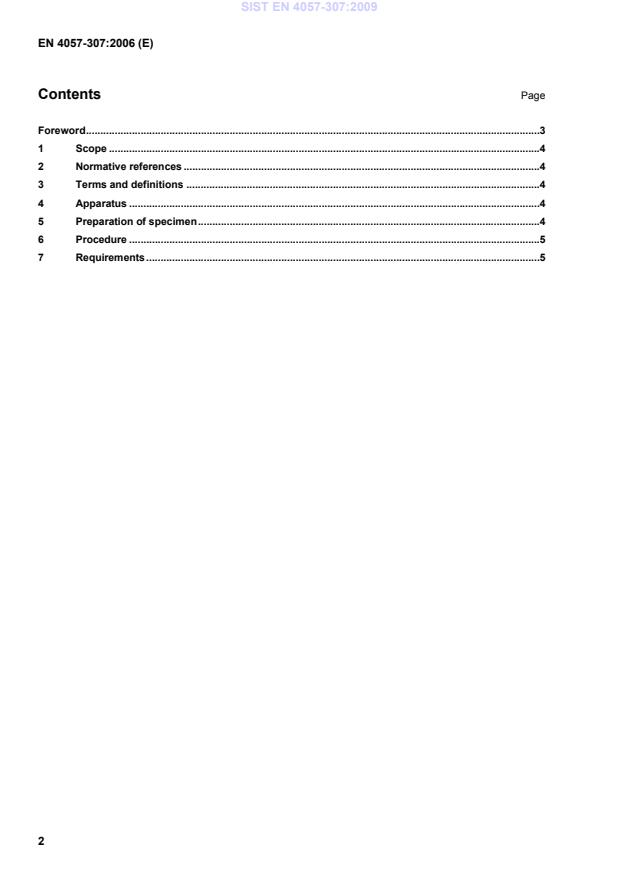
The document is organized into seven clauses after the foreword:
- Scope
- Normative references
- Terms and definitions
- Apparatus
- Preparation of specimen
- Procedure
- Requirements
Clause 7 is important in practice because it makes clear that the allowable change in performance is not fixed here. That means users must check the relevant product standard when deciding pass or fail.
What are the key requirements of SIST EN 4057-307:2009?
SIST EN 4057-307:2009 builds the test around controlled UV exposure, defined specimen preparation, and a tensile comparison between aged and unaged samples. The key point for users is that the method measures change in elongation at break after ageing.
Apparatus and reference test equipment
Clause 4 requires the apparatus specified in ASTM G53-88, Clause 6, using UV B tubes. In practice, the lab needs the correct exposure chamber and lamp type, because the radiation source is part of the test severity.
Specimen preparation
Clause 5 calls for test pieces cut from the parallel portion of the cable tie, with a minimum length of 75 mm. A minimum of 20 specimens must be prepared, with half mounted for exposure and the remainder retained for later use. This ensures there are enough samples to compare aged and unaged groups.
Flexible specimens may be attached to an aluminium or other non-corrosive, heat-conductive backing panel to provide rigidity. That matters because the specimen must stay properly positioned during exposure.
UV exposure cycle
Clause 6 uses a repeating cycle of 8 h at (55 ± 3) °C under UV, followed by 4 h at (40 ± 3) °C during the humidity period. The specimens are exposed for 1 000 h. In practice, this is the ageing phase that simulates long-term radiation and moisture exposure.
Conditioning after exposure
After cycling, both exposed and unexposed specimens are conditioned for 24 h in a chamber at the specified temperature with relative humidity of (50 ± 5) %. They are then stored in an airtight container and tested within 1 h. This limits further environmental effects before measurement.
Tensile test and calculation
Clause 6 requires a tensile test machine capable of measuring elongation to an accuracy of 1 %, with a gauge length of (25 ± 1) mm and a jaw separation speed of (25 ± 2.5) mm/min. Seven aged and seven unaged specimens are pulled, the highest and lowest elongation values are discarded, and the average elongation at break is calculated for each group. The percent change between the two averages is then determined.
Acceptance criterion
Clause 7 states that the maximum change in average elongation at break between aged and unaged groups is specified in the product standard. For buyers and quality managers, that means this document provides the test method, while the governing acceptance limit comes from the product specification.
What terms does SIST EN 4057-307:2009 define?
Clause 3 points users to the definitions in EN 4056-001. The following terms are central to reading the method:
- Cable ties for harnesses - fastening elements used on harnesses to secure bundles of cables.
- Ultra violet radiation - the UV exposure used to age the specimens in the chamber.
- Specimen - the prepared test piece cut from the cable tie for exposure and tensile testing.
- Elongation at break - the elongation measured when the specimen fails in the tensile test.
- Gauge length - the defined distance between grips used during tensile testing.
- UV B tubes - the lamp type required for the exposure apparatus.
- Product standard - the document that sets the allowable change in performance for the specific cable tie product.
Who uses SIST EN 4057-307:2009?
SIST EN 4057-307:2009 is used by aerospace cable tie manufacturers, test laboratories, and quality teams working on harness components. It is also relevant to buyers and approval teams who need a defined UV ageing test for incoming qualification or product validation.
In practice, users apply it when they must:
- prepare specimens for environmental ageing
- run UV and humidity cycling
- measure elongation at break after ageing
- compare aged and unaged results
- set or check product-standard acceptance limits
What changed in SIST EN 4057-307:2009 from the previous edition?
SIST EN 4057-307:2009 is identical to EN 4057-307:2006.
Which standards are used with SIST EN 4057-307:2009?
- EN 4056-001 - provides the technical specification for aerospace cable ties for harnesses and supplies the terms and definitions used in this test method.
- ASTM G53-88 - provides the referenced practice for operating the light and water-exposure apparatus, and Clause 6 of that practice is used for the test equipment.
What does the SIST EN 4057-307:2009 document contain?
SIST EN 4057-307:2009 contains a defined UV ageing method for cable ties for harnesses, plus the sample preparation and tensile comparison needed to judge the effect of exposure. It specifies the apparatus, the specimen dimensions and count, the exposure cycle, post-exposure conditioning, and the tensile test settings.
The procedure section shows how to mount the specimens, how to handle empty rack spaces, and how to calculate the change in elongation at break from aged and unaged groups. The requirements section then links the measured change to the limit set by the product standard.
Relations
- Effective Date
- 28-Jan-2026
- Effective Date
- 28-Jan-2026
- Effective Date
- 28-Jan-2026
- Effective Date
- 28-Jan-2026
- Effective Date
- 28-Jan-2026
- Effective Date
- 28-Jan-2026
- Effective Date
- 28-Jan-2026
- Effective Date
- 28-Jan-2026
Get Certified
Connect with accredited certification bodies for this standard

BUREAU VERITAS Certification Germany
Bureau Veritas certification in Germany.

Element Materials Technology
Materials testing and product certification.

AQMS Ltd.
AQMS provides ISO certification to SMEs across the UK.
Sponsored listings
Frequently Asked Questions
SIST EN 4057-307:2009 is a standard published by the Slovenian Institute for Standardization (SIST). Its full title is "Aerospace series - Cable ties for harnesses - Test methods - Part 307: Resistance to ultra violet radiation". This standard covers: This standard determines test methods for the resistance of cable ties for harnesses to the exposure to ultra violet radiation.
This standard determines test methods for the resistance of cable ties for harnesses to the exposure to ultra violet radiation.
SIST EN 4057-307:2009 is classified under the following ICS (International Classification for Standards) categories: 49.060 - Aerospace electric equipment and systems. The ICS classification helps identify the subject area and facilitates finding related standards.
SIST EN 4057-307:2009 has the following relationships with other standards: It is inter standard links to SIST EN 4056-001:2015, SIST EN 4056-006:2014, SIST EN 4057-100:2009, SIST EN 4056-001:2009, SIST EN 4056-003:2016, SIST EN 4056-005:2023, SIST EN 4056-004:2015, SIST EN 4056-003:2019. Understanding these relationships helps ensure you are using the most current and applicable version of the standard.
SIST EN 4057-307:2009 is available in PDF format for immediate download after purchase. The document can be added to your cart and obtained through the secure checkout process. Digital delivery ensures instant access to the complete standard document.
Standards Content (Sample)
2003-01.Slovenski inštitut za standardizacijo. Razmnoževanje celote ali delov tega standarda ni dovoljeno.Luft- und Raumfahrt - Befestigungsbänder für Leitungsbündel - Prüfverfahren - Teil 307: UV-BeständigkeitSérie aérospatiale - Frettes de câblage pour harnais - Méthodes d'essais - Partie 307 : Résistance aux radiations des ultra-violetAerospace series - Cable ties for harnesses - Test methods - Part 307: Resistance to ultra violet radiation49.060Aerospace electric equipment and systemsICS:Ta slovenski standard je istoveten z:EN 4057-307:2006SIST EN 4057-307:2009en,de01-junij-2009SIST EN 4057-307:2009SLOVENSKI
STANDARD
EUROPEAN STANDARDNORME EUROPÉENNEEUROPÄISCHE NORMEN 4057-307December 2006ICS 49.060 English VersionAerospace series - Cable ties for harnesses - Test methods -Part 307: Resistance to ultra violet radiationSérie aérospatiale - Frettes de câblage pour harnais -Méthodes d'essais - Partie 307 : Résistance aux radiationsdes ultra-violetLuft- und Raumfahrt - Befestigungsbänder fürLeitungsbündel - Prüfverfahren - Teil 307: UV-BeständigkeitThis European Standard was approved by CEN on 28 October 2005.CEN members are bound to comply with the CEN/CENELEC Internal Regulations which stipulate the conditions for giving this EuropeanStandard the status of a national standard without any alteration. Up-to-date lists and bibliographical references concerning such nationalstandards may be obtained on application to the Central Secretariat or to any CEN member.This European Standard exists in three official versions (English, French, German). A version in any other language made by translationunder the responsibility of a CEN member into its own language and notified to the Central Secretariat has the same status as the officialversions.CEN members are the national standards bodies of Austria, Belgium, Cyprus, Czech Republic, Denmark, Estonia, Finland, France,Germany, Greece, Hungary, Iceland, Ireland, Italy, Latvia, Lithuania, Luxembourg, Malta, Netherlands, Norway, Poland, Portugal, Romania,Slovakia, Slovenia, Spain, Sweden, Switzerland and United Kingdom.EUROPEAN COMMITTEE FOR STANDARDIZATIONCOMITÉ EUROPÉEN DE NORMALISATIONEUROPÄISCHES KOMITEE FÜR NORMUNGManagement Centre: rue de Stassart, 36
B-1050 Brussels© 2006 CENAll rights of exploitation in any form and by any means reservedworldwide for CEN national Members.Ref. No. EN 4057-307:2006: ESIST EN 4057-307:2009
...