

SIST EN 4057-100:2009
(Main)Aerospace series - Cable ties for harnesses - Test methods - Part 100: General
- Abstract
This standard specifies the general requirements and test procedures for cable ties for harnesses for aircraft use. This standard does not include accessories such as mounting brackets, identification lags or reusable cable ties.
- Status
- Published
- Publication Date
- 02-Apr-2009
- Technical Committee
- I13 - Imaginarni 13
- Current Stage
- 6060 - National Implementation/Publication (Adopted Project)
- Start Date
- 26-Mar-2009
- Due Date
- 31-May-2009
- Completion Date
- 03-Apr-2009



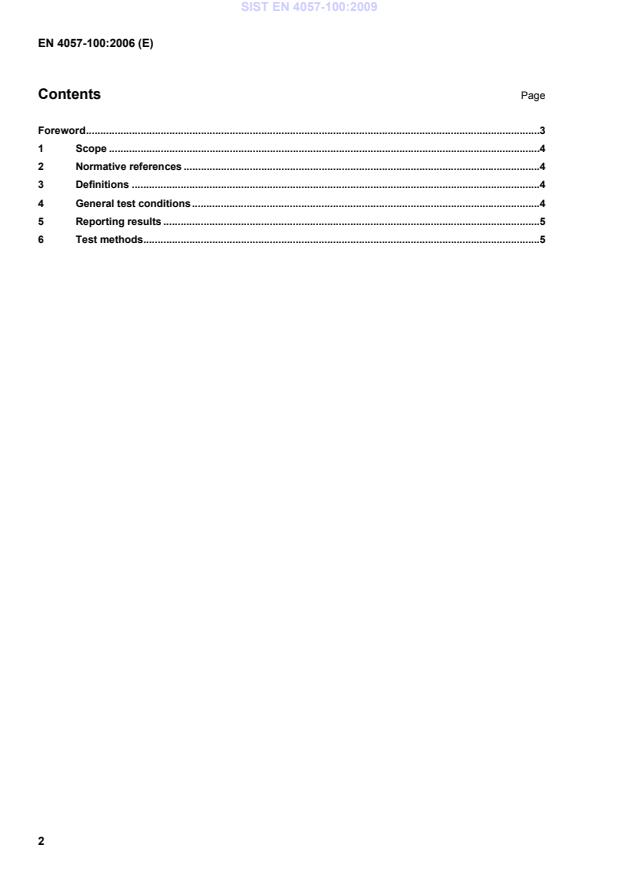
SIST EN 4057-100:2009 is the Slovenian adoption of EN 4057-100:2006 in the aerospace series on cable ties for harnesses. It specifies the general test requirements and test procedures for cable ties used on aircraft harnesses, so manufacturers, test laboratories, and buyers can use the same basis when checking these parts.
What does SIST EN 4057-100:2009 specify?
SIST EN 4057-100:2009 covers the general test framework for aircraft-use cable ties for harnesses. It sets out the scope, the references needed to use the document, the definitions to apply, the general test conditions, the reporting items, and the list of test methods used with this part.
The scope excludes accessories such as mounting brackets, identification lags, and reusable cable ties. That matters because the standard is aimed at the tie itself, not the mounting or identification hardware around it.
The document is organized into six clauses and three method tables:
| Part of the document | What it covers |
|---|---|
| Clause 1 | Scope |
| Clause 2 | Normative references |
| Clause 3 | Definitions |
| Clause 4 | General test conditions |
| Clause 5 | Reporting results |
| Clause 6 and Tables 1-3 | Test methods |
Table 1 lists general tests, Table 2 lists environmental tests, and Table 3 lists mechanical tests. Several methods have applicability notes, for example for ties with metallic parts or coloured ties, which helps users choose the right checks for the product type.
What are the key requirements of SIST EN 4057-100:2009?
SIST EN 4057-100:2009 is mainly a procedure standard, so its key requirements are about how to prepare, test, and report specimens. The practical value is that it makes results comparable between laboratories and between product batches.
Specimen preparation and handling
Clause 4.1 requires specimens to be conditioned before testing under controlled temperature and humidity, then kept in an airtight container before installation. In practice, this reduces the risk that the test result is distorted by recent handling or storage conditions.
Clause 4.2 requires cable ties to be installed on the test fixture with a qualified application tool, set to the tension required by the applicable product standard. For the user, this means the application method is part of the test setup, not an afterthought.
Test atmosphere
Clause 4.3 states that testing is carried out under a normal atmospheric environment, with a specified temperature range and relative humidity (r.h.) not greater than 80 %. In dispute cases, the test atmosphere is switched to a specified alternate condition. That matters when two parties need a single reference environment for comparison.
Reporting
Clause 5 requires the report to include the approved drawing, materials and colours, type and size code, application tool type and application torsion values, and the test results. This gives traceability back to the exact product and application method that was tested.
Test method families
Clause 6 points to three groups of methods:
- General tests in Table 1
- Environmental tests in Table 2
- Mechanical tests in Table 3
That structure tells the reader whether a check is about appearance and dimensions, resistance to environment, or mechanical performance.
Applicability notes
Some methods apply only in specific cases, such as ties containing metallic parts or coloured ties. In practice, the buyer or lab must check those remarks before selecting a test plan, because not every method applies to every tie.
What terms does SIST EN 4057-100:2009 define?
SIST EN 4057-100:2009 uses the definitions in EN 4056-001 and applies several operational terms in its test clauses.
- Cable ties for harnesses - ties used to secure harnesses for aircraft use.
- Specimen - the sample prepared and installed for testing.
- Qualified application tool - the approved tool used to install the tie on the fixture.
- Application torsion values - the tool-setting values recorded for how the tie was applied.
- Relative humidity (r.h.) - the moisture level of the test atmosphere expressed as humidity relative to saturation.
- Loop tensile strength - the mechanical performance check that measures how the tied loop withstands tension.
- Compass safe distance - a distance-based check used for ties containing metallic parts.
Who uses SIST EN 4057-100:2009?
SIST EN 4057-100:2009 is used by aerospace cable tie manufacturers, harness assemblers, and test laboratories. Quality managers use it to define test conditions and reporting, while buyers and inspectors use it to compare product claims against a shared aerospace test method. It is also relevant wherever aircraft harness hardware with metallic parts, coloured ties, or low-temperature installation needs to be assessed.
What changed in SIST EN 4057-100:2009 from the previous edition?
SIST EN 4057-100:2009 is the Slovenian standard identical to EN 4057-100:2006.
Which standards are used with SIST EN 4057-100:2009?
- EN 4056-001 - its definitions apply to this document.
- EN 4057 - the aerospace series of cable-tie test methods that this part belongs to and references through Tables 1-3.
What does the SIST EN 4057-100:2009 document contain?
SIST EN 4057-100:2009 contains the general conditioning rules, the installation rule for test specimens, the atmospheric conditions for testing, and the reporting items needed for traceability. It also contains a structured index of test methods across general, environmental, and mechanical categories.
The method tables cover visual examination, mass and dimensions, salt mist, flammability, resistance to fluids, loop tensile strength at maximum working temperature, colour fastness, heat ageing, ultraviolet radiation, life cycle, low temperature installation, compass safe distance, locking device retention, and verification of application tool settings. In practice, this gives laboratories a map of which checks are available for each cable tie type and what special applicability limits to watch for.
Relations
- Effective Date
- 28-Jan-2026
- Effective Date
- 28-Jan-2026
- Effective Date
- 28-Jan-2026
- Effective Date
- 28-Jan-2026
- Effective Date
- 28-Jan-2026
- Effective Date
- 28-Jan-2026
- Effective Date
- 28-Jan-2026
- Effective Date
- 28-Jan-2026
- Effective Date
- 28-Jan-2026
- Effective Date
- 28-Jan-2026
- Effective Date
- 28-Jan-2026
- Effective Date
- 28-Jan-2026
- Effective Date
- 28-Jan-2026
- Effective Date
- 28-Jan-2026
- Effective Date
- 28-Jan-2026
Get Certified
Connect with accredited certification bodies for this standard

BUREAU VERITAS Certification Germany
Bureau Veritas certification in Germany.

Element Materials Technology
Materials testing and product certification.

AQMS Ltd.
AQMS provides ISO certification to SMEs across the UK.
Sponsored listings
Frequently Asked Questions
SIST EN 4057-100:2009 is a standard published by the Slovenian Institute for Standardization (SIST). Its full title is "Aerospace series - Cable ties for harnesses - Test methods - Part 100: General". This standard covers: This standard specifies the general requirements and test procedures for cable ties for harnesses for aircraft use. This standard does not include accessories such as mounting brackets, identification lags or reusable cable ties.
This standard specifies the general requirements and test procedures for cable ties for harnesses for aircraft use. This standard does not include accessories such as mounting brackets, identification lags or reusable cable ties.
SIST EN 4057-100:2009 is classified under the following ICS (International Classification for Standards) categories: 49.060 - Aerospace electric equipment and systems. The ICS classification helps identify the subject area and facilitates finding related standards.
SIST EN 4057-100:2009 has the following relationships with other standards: It is inter standard links to SIST EN 4057-402:2014, SIST EN 4056-001:2015, SIST EN 4057-307:2009, SIST EN 4057-304:2009, SIST EN 4056-006:2014, SIST EN 4057-406:2009, SIST EN 4057-202:2006, SIST EN 4057-301:2006, SIST EN 4057-303:2006, SIST EN 4056-001:2009, SIST EN 4057-306:2009, SIST EN 4057-405:2006, SIST EN 4057-401:2009, SIST EN 4056-003:2016, SIST EN 4057-402:2009. Understanding these relationships helps ensure you are using the most current and applicable version of the standard.
SIST EN 4057-100:2009 is available in PDF format for immediate download after purchase. The document can be added to your cart and obtained through the secure checkout process. Digital delivery ensures instant access to the complete standard document.
Standards Content (Sample)
2003-01.Slovenski inštitut za standardizacijo. Razmnoževanje celote ali delov tega standarda ni dovoljeno.Aeronavtika - Kabelske spojke za vezalno pasovje - Preskusne metode - 100. del: SplošnoLuft- und Raumfahrt - Befestigungsbänder für Leitungsbündel - Prüfverfahren - Teil 100: AllgemeinesSérie aérospatiale - Frettes de câblage pour harnais - Méthodes d'essais - Partie 100 : GénéralitésAerospace series - Cable ties for harnesses - Test methods - Part 100: General49.060Aerospace electric equipment and systemsICS:Ta slovenski standard je istoveten z:EN 4057-100:2006SIST EN 4057-100:2009en,de01-maj-2009SIST EN 4057-100:2009SLOVENSKI
STANDARD
EUROPEAN STANDARDNORME EUROPÉENNEEUROPÄISCHE NORMEN 4057-100December 2006ICS 49.060 English VersionAerospace series - Cable ties for harnesses - Test methods -Part 100: GeneralSérie aérospatiale - Frettes de câblage pour harnais -Méthodes d'essais - Partie 100 : GénéralitésLuft- und Raumfahrt - Befestigungsbänder fürLeitungsbündel - Prüfverfahren - Teil 100: AllgemeinThis European Standard was approved by CEN on 28 October 2005.CEN members are bound to comply with the CEN/CENELEC Internal Regulations which stipulate the conditions for giving this EuropeanStandard the status of a national standard without any alteration. Up-to-date lists and bibliographical references concerning such nationalstandards may be obtained on application to the Central Secretariat or to any CEN member.This European Standard exists in three official versions (English, French, German). A version in any other language made by translationunder the responsibility of a CEN member into its own language and notified to the Central Secretariat has the same status as the officialversions.CEN members are the national standards bodies of Austria, Belgium, Cyprus, Czech Republic, Denmark, Estonia, Finland, France,Germany, Greece, Hungary, Iceland, Ireland, Italy, Latvia, Lithuania, Luxembourg, Malta, Netherlands, Norway, Poland, Portugal, Romania,Slovakia, Slovenia, Spain, Sweden, Switzerland and United Kingdom.EUROPEAN COMMITTEE FOR STANDARDIZATIONCOMITÉ EUROPÉEN DE NORMALISATIONEUROPÄISCHES KOMITEE FÜR NORMUNGManagement Centre: rue de Stassart, 36
B-1050 Brussels© 2006 CENAll rights of exploitation in any form and by any means reservedworldwide for CEN national Members.Ref. No. EN 4057-100:2006: ESIST EN 4057-100:2009
...